
Managing Your Student Loans 101 Basic Understanding of
Managing Your Student Loans 101 Basic Understanding of the Repayment Process College Prep | Fall 2017
Agenda • • Financial Aid Landscape Loan Servicers Loan Basics Repayment Plans Postponing Repayment: Deferment & Forbearance Delinquency, Default, & Collections Discharge, Forgiveness, & Cancellation
The Financial Aid Landscape What are the sources of financial aid? Federal government • State government • Colleges and universities • Private foundations • Employers and private companies • Professional and service organizations •
Your Financial Aid History What types of financial aid have you received? Grants • Work-study • Scholarships • Merit Awards • Student Loans • Parent Loans •
Your Financial Aid History Gift Aid vs. Self-help Aid • Federal Student Loans vs. Private Student Loans • Knowing your balance(s)! • How many of you know the total balance of your student loans?
Your Financial Aid History Private Student Loans May: §Require payments while your are still in school §Have variable interest rates, some greater than 18% §Not be subsidized. §Require an established credit record. The cost of a private student loan will depend upon your credit score and other factors §Need a co-signer §Not be consolidated into a Direct Consolidation Loan §Not offer forbearance or deferment options §Not offer a loan forgiveness program 6
Your Loan History The National Student Loan Data System (NSLDS): • Is a centralized national database • Stores information on federal grants and loans (no private student loans) • Shows how much aid you've received • Displays your current enrollment status Access NSLDS using your Federal Student Aid PIN at www. nslds. ed. gov
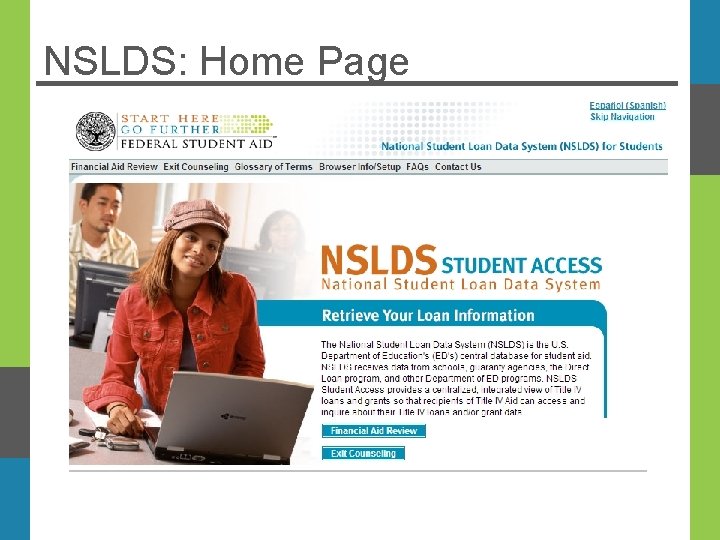
NSLDS: Home Page
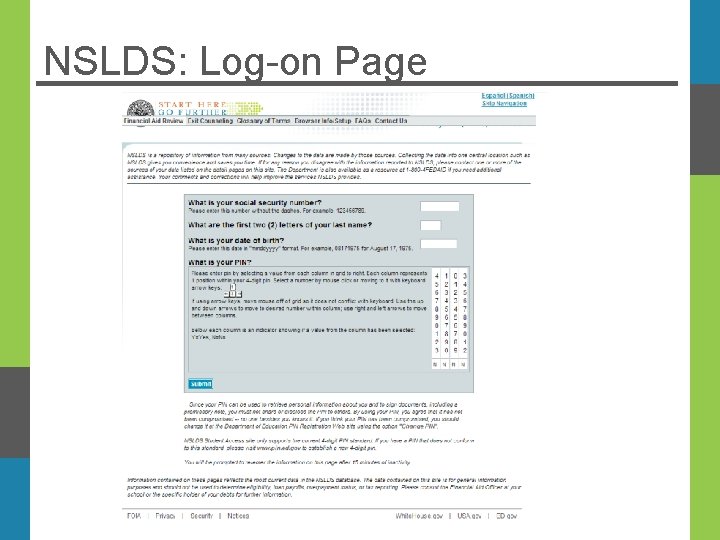
NSLDS: Log-on Page
Your Loan Servicer Collects payments on a loan • Responds to customer service inquiries • Performs other administrative tasks associated with maintaining a loan on behalf of a lender • If you're unsure of who your federal student loan servicer is, you can look it up on www. nslds. ed. gov
Loan Basics
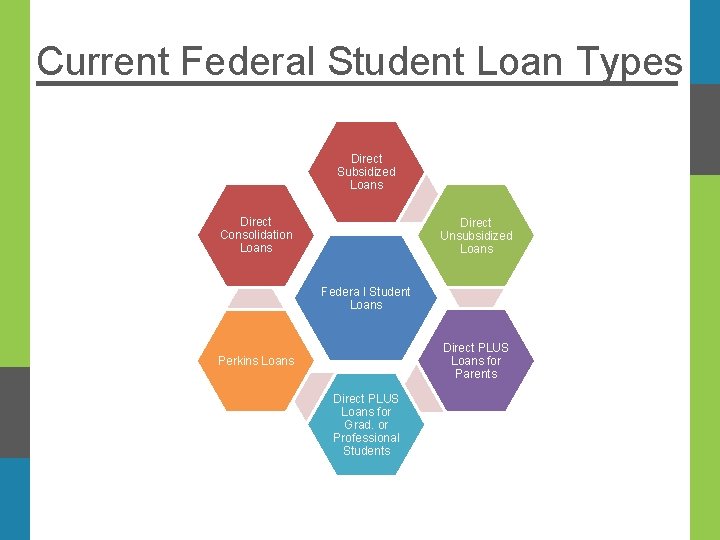
Current Federal Student Loan Types Direct Subsidized Loans Direct Consolidation Loans Direct Unsubsidized Loans Federa l Student Loans Direct PLUS Loans for Parents Perkins Loans Direct PLUS Loans for Grad. or Professional Students
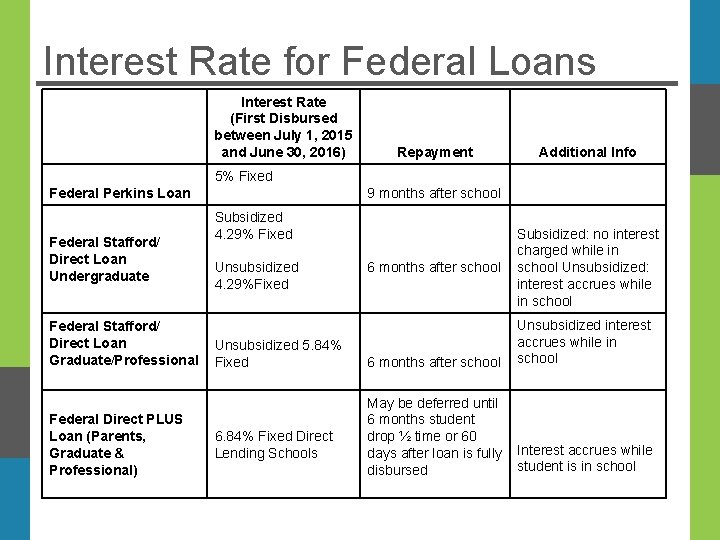
Interest Rate for Federal Loans Interest Rate (First Disbursed between July 1, 2015 and June 30, 2016) Repayment Additional Info 5% Fixed Federal Perkins Loan Federal Stafford/ Direct Loan Undergraduate Federal Stafford/ Direct Loan Graduate/Professional Federal Direct PLUS Loan (Parents, Graduate & Professional) 9 months after school Subsidized 4. 29% Fixed Unsubsidized 4. 29%Fixed Unsubsidized 5. 84% Fixed 6. 84% Fixed Direct Lending Schools 6 months after school Subsidized: no interest charged while in school Unsubsidized: interest accrues while in school Unsubsidized interest accrues while in school May be deferred until 6 months student drop ½ time or 60 days after loan is fully Interest accrues while student is in school disbursed
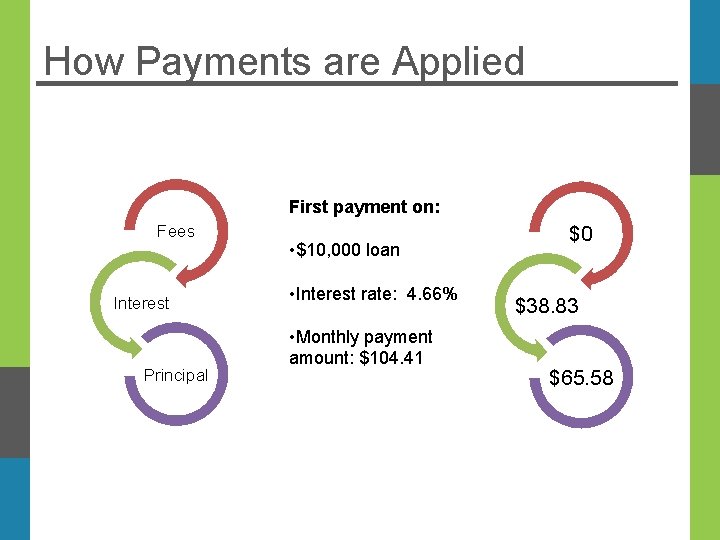
How Payments are Applied First payment on: Fees Interest Principal • $10, 000 loan • Interest rate: 4. 66% • Monthly payment amount: $104. 41 $0 $38. 83 $65. 58
Repayment Plans
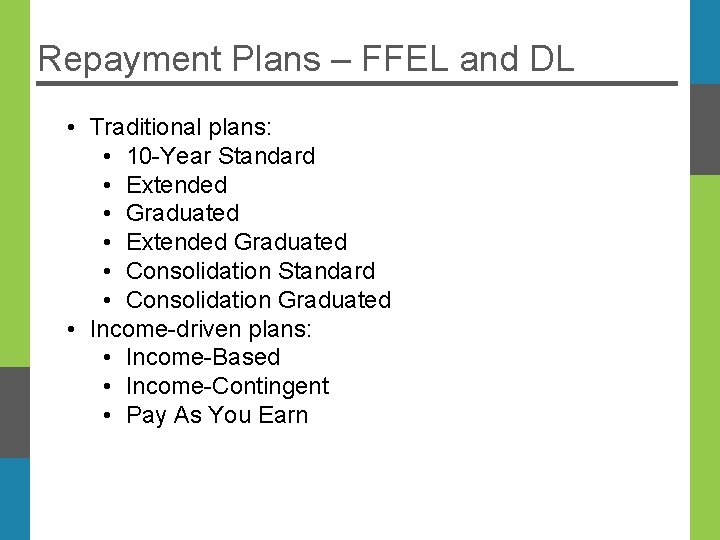
Repayment Plans – FFEL and DL • Traditional plans: • 10 -Year Standard • Extended • Graduated • Extended Graduated • Consolidation Standard • Consolidation Graduated • Income-driven plans: • Income-Based • Income-Contingent • Pay As You Earn
Standard Repayment Plan Under this plan, the borrower will pay a fixed amount that ensures they pay their loan(s) in full within the repayment period. Payments will be at least $50 per month. For subsidized, unsubsidized, and PLUS loans, the repayment period is 10 years. For consolidation loans, the repayment period is 10 -30 years, depending on the borrower’s total educational indebtedness. For borrowers who do not have consolidation loans, this plan results in the lowest total interest paid because the repayment period is shorter than it would be under any of the other repayment plans.
Extended Repayment Plan Under this plan, the borrower will pay a fixed or graduated amount in an amount that will ensure that they pay their loans(s) in full within 25 years. Fixed payments will be at least $50 per month. Graduated payments will be at least the amount of interest that accrues in a month. A borrower may choose this plan if: He or she did not have an outstanding balance on a FFEL Program or Direct Loan as of October 7, 1998 or on the date they obtained a student loan after that date and • He or she has more than $30, 000 in outstanding FFEL Program loans or more than $30, 000 in outstanding Direct Loans. •
Graduated Repayment Plan Under this plan, the borrower will pay an amount that increases every two years and ensures that they pay their loan(s) in full within the repayment period. For subsidized, unsubsidized, and PLUS loans, the repayment period is 10 years. For consolidation loans, the repayment period is 10 -30 years, depending on the borrower’s total educational indebtedness. The minimum payment equals the amount of interest that accrues monthly. No one payment will be more than three times greater than any other payment.
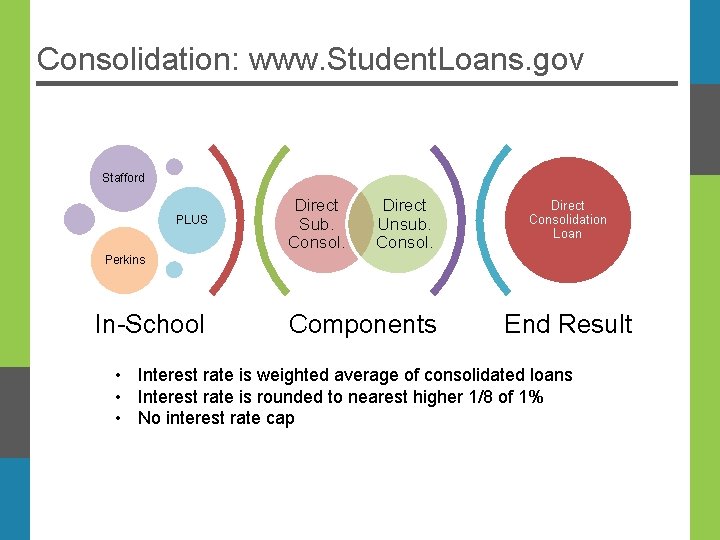
Consolidation: www. Student. Loans. gov Stafford PLUS Direct Sub. Consol. Direct Unsub. Consol. Direct Consolidation Loan Perkins In-School Components End Result • Interest rate is weighted average of consolidated loans • Interest rate is rounded to nearest higher 1/8 of 1% • No interest rate cap
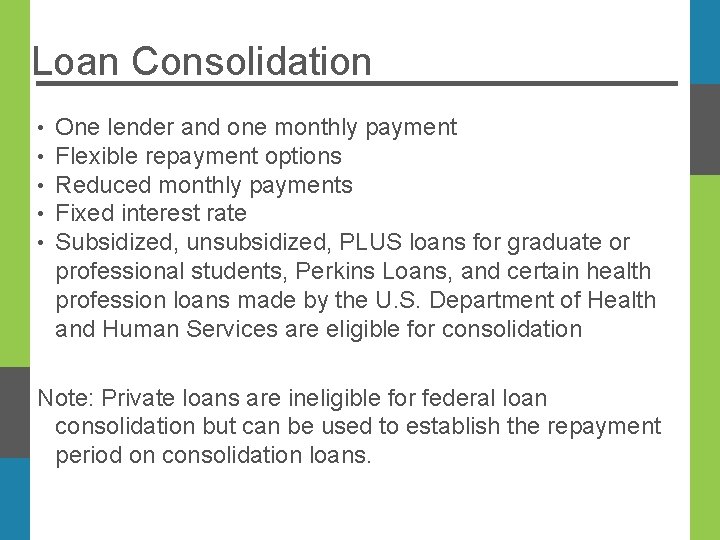
Loan Consolidation • • • One lender and one monthly payment Flexible repayment options Reduced monthly payments Fixed interest rate Subsidized, unsubsidized, PLUS loans for graduate or professional students, Perkins Loans, and certain health profession loans made by the U. S. Department of Health and Human Services are eligible for consolidation Note: Private loans are ineligible for federal loan consolidation but can be used to establish the repayment period on consolidation loans.
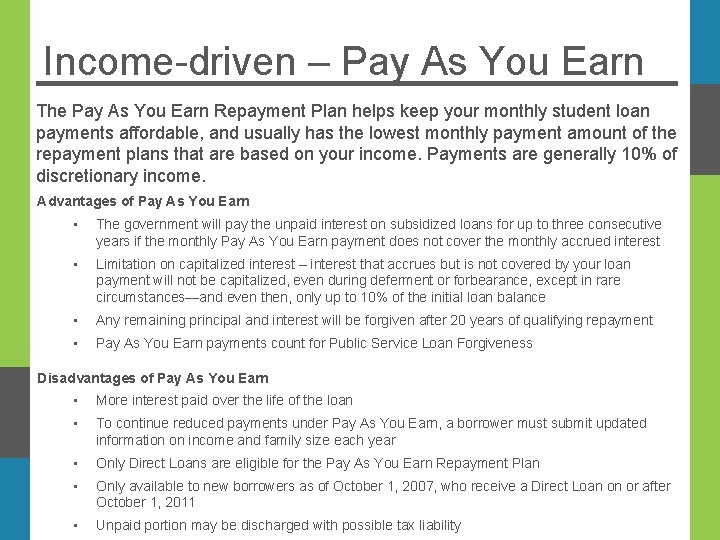
Income-driven – Pay As You Earn The Pay As You Earn Repayment Plan helps keep your monthly student loan payments affordable, and usually has the lowest monthly payment amount of the repayment plans that are based on your income. Payments are generally 10% of discretionary income. Advantages of Pay As You Earn • The government will pay the unpaid interest on subsidized loans for up to three consecutive years if the monthly Pay As You Earn payment does not cover the monthly accrued interest • Limitation on capitalized interest – interest that accrues but is not covered by your loan payment will not be capitalized, even during deferment or forbearance, except in rare circumstances—and even then, only up to 10% of the initial loan balance • Any remaining principal and interest will be forgiven after 20 years of qualifying repayment • Pay As You Earn payments count for Public Service Loan Forgiveness Disadvantages of Pay As You Earn • More interest paid over the life of the loan • To continue reduced payments under Pay As You Earn, a borrower must submit updated information on income and family size each year • Only Direct Loans are eligible for the Pay As You Earn Repayment Plan • Only available to new borrowers as of October 1, 2007, who receive a Direct Loan on or after October 1, 2011 • Unpaid portion may be discharged with possible tax liability
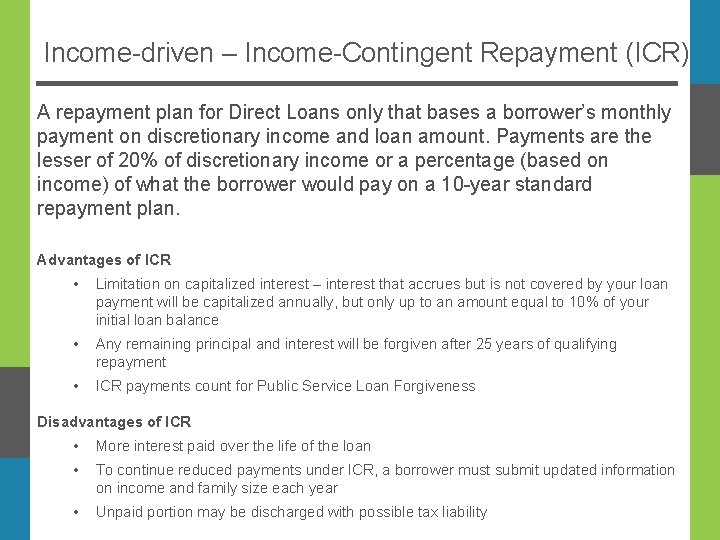
Income-driven – Income-Contingent Repayment (ICR) A repayment plan for Direct Loans only that bases a borrower’s monthly payment on discretionary income and loan amount. Payments are the lesser of 20% of discretionary income or a percentage (based on income) of what the borrower would pay on a 10 -year standard repayment plan. Advantages of ICR • Limitation on capitalized interest – interest that accrues but is not covered by your loan payment will be capitalized annually, but only up to an amount equal to 10% of your initial loan balance • Any remaining principal and interest will be forgiven after 25 years of qualifying repayment • ICR payments count for Public Service Loan Forgiveness Disadvantages of ICR • More interest paid over the life of the loan • To continue reduced payments under ICR, a borrower must submit updated information on income and family size each year • Unpaid portion may be discharged with possible tax liability
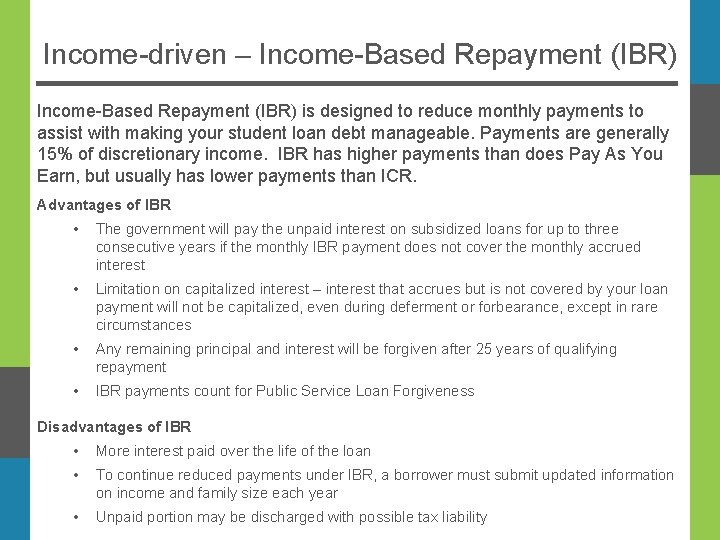
Income-driven – Income-Based Repayment (IBR) is designed to reduce monthly payments to assist with making your student loan debt manageable. Payments are generally 15% of discretionary income. IBR has higher payments than does Pay As You Earn, but usually has lower payments than ICR. Advantages of IBR • The government will pay the unpaid interest on subsidized loans for up to three consecutive years if the monthly IBR payment does not cover the monthly accrued interest • Limitation on capitalized interest – interest that accrues but is not covered by your loan payment will not be capitalized, even during deferment or forbearance, except in rare circumstances • Any remaining principal and interest will be forgiven after 25 years of qualifying repayment • IBR payments count for Public Service Loan Forgiveness Disadvantages of IBR • More interest paid over the life of the loan • To continue reduced payments under IBR, a borrower must submit updated information on income and family size each year • Unpaid portion may be discharged with possible tax liability
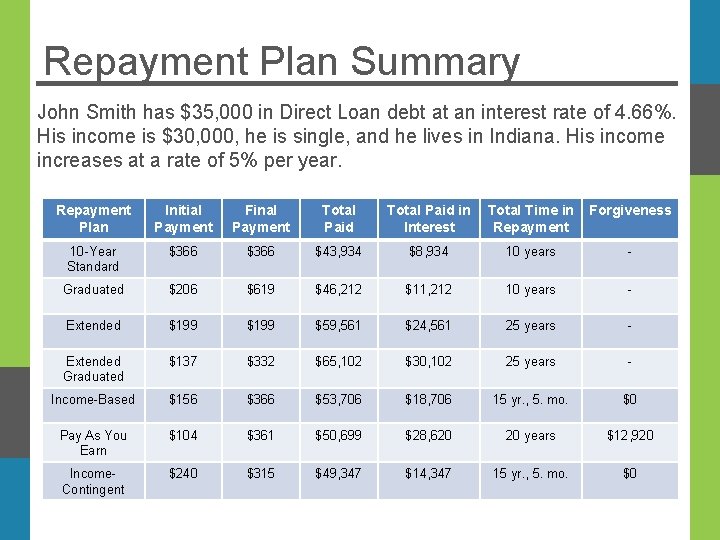
Repayment Plan Summary John Smith has $35, 000 in Direct Loan debt at an interest rate of 4. 66%. His income is $30, 000, he is single, and he lives in Indiana. His income increases at a rate of 5% per year. Repayment Plan Initial Payment Final Payment Total Paid in Interest Total Time in Repayment Forgiveness 10 -Year Standard $366 $43, 934 $8, 934 10 years - Graduated $206 $619 $46, 212 $11, 212 10 years - Extended $199 $59, 561 $24, 561 25 years - Extended Graduated $137 $332 $65, 102 $30, 102 25 years - Income-Based $156 $366 $53, 706 $18, 706 15 yr. , 5. mo. $0 Pay As You Earn $104 $361 $50, 699 $28, 620 20 years $12, 920 Income. Contingent $240 $315 $49, 347 $14, 347 15 yr. , 5. mo. $0
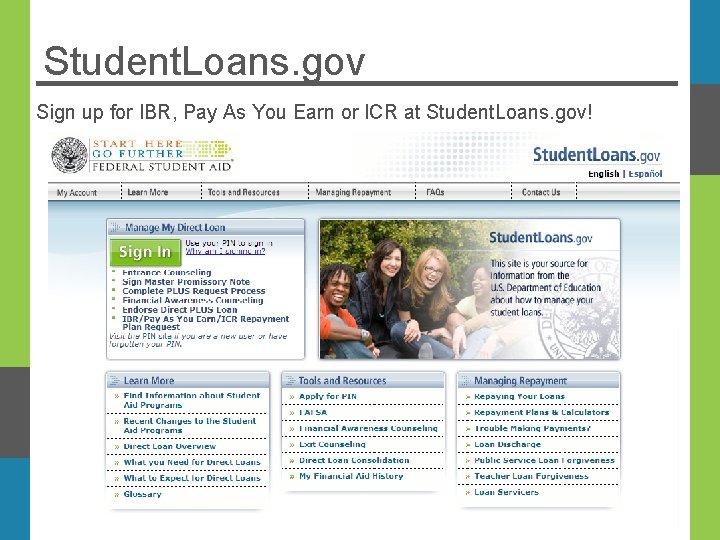
Student. Loans. gov Sign up for IBR, Pay As You Earn or ICR at Student. Loans. gov!
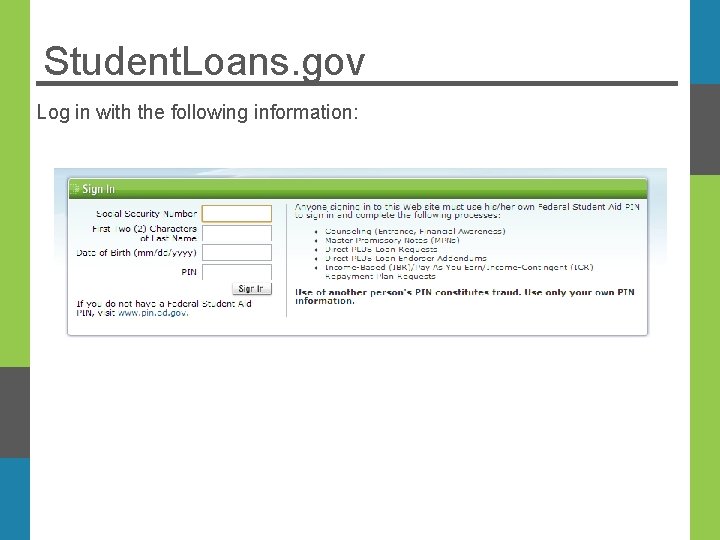
Student. Loans. gov Log in with the following information:
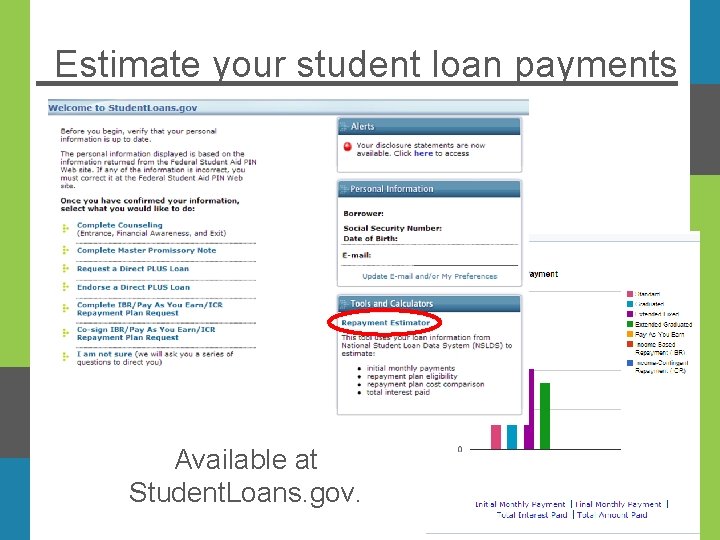
Estimate your student loan payments Available at Student. Loans. gov.
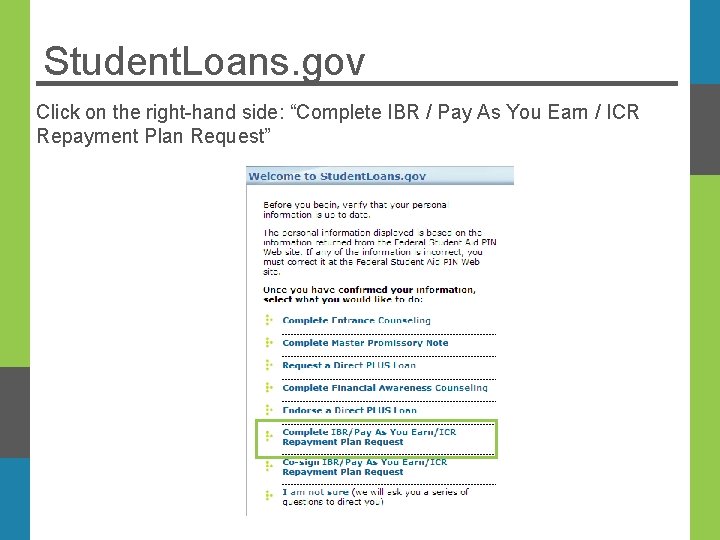
Student. Loans. gov Click on the right-hand side: “Complete IBR / Pay As You Earn / ICR Repayment Plan Request”
Postponing Repayment - Deferment and Forbearance
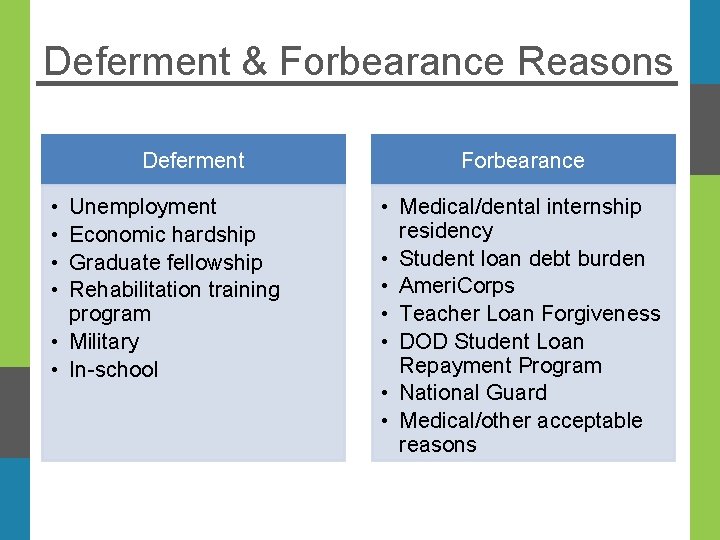
Deferment & Forbearance Reasons Deferment • • Unemployment Economic hardship Graduate fellowship Rehabilitation training program • Military • In-school Forbearance • Medical/dental internship residency • Student loan debt burden • Ameri. Corps • Teacher Loan Forgiveness • DOD Student Loan Repayment Program • National Guard • Medical/other acceptable reasons
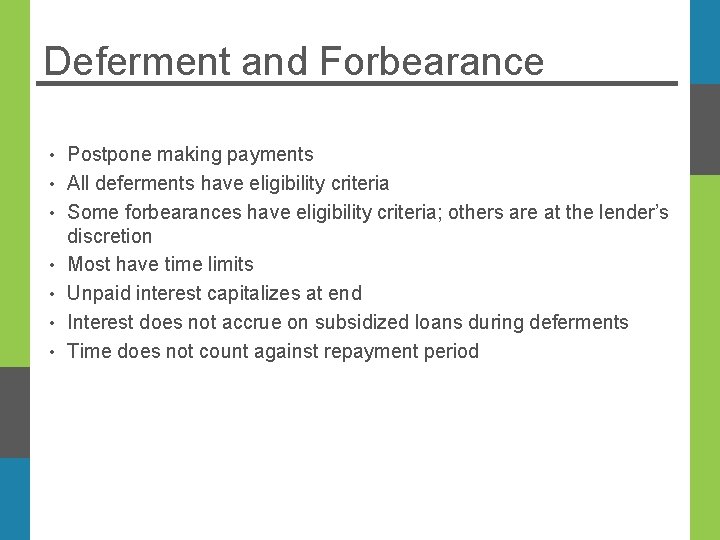
Deferment and Forbearance • • Postpone making payments All deferments have eligibility criteria Some forbearances have eligibility criteria; others are at the lender’s discretion Most have time limits Unpaid interest capitalizes at end Interest does not accrue on subsidized loans during deferments Time does not count against repayment period
Delinquency, Default, and Collections
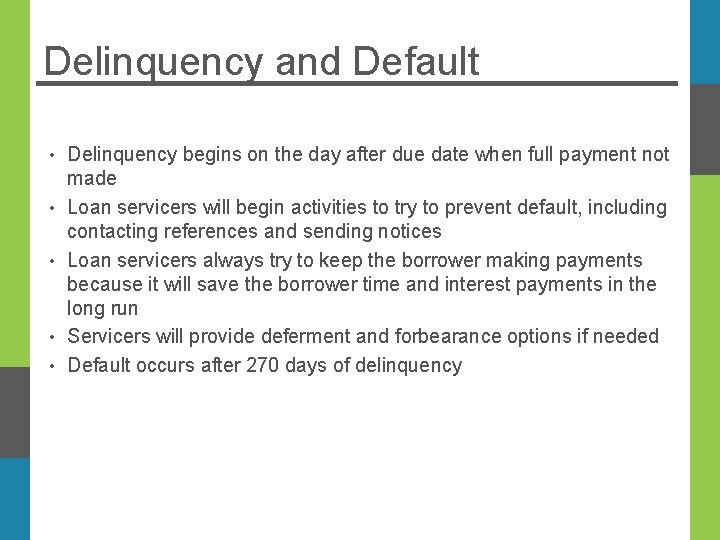
Delinquency and Default • • • Delinquency begins on the day after due date when full payment not made Loan servicers will begin activities to try to prevent default, including contacting references and sending notices Loan servicers always try to keep the borrower making payments because it will save the borrower time and interest payments in the long run Servicers will provide deferment and forbearance options if needed Default occurs after 270 days of delinquency
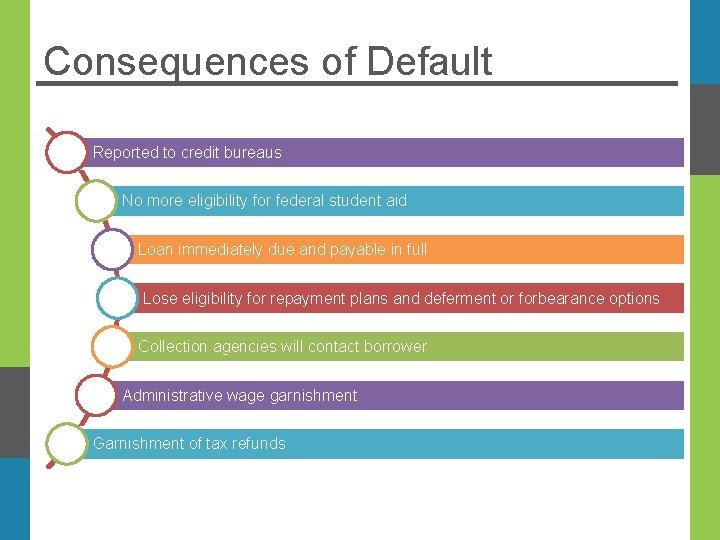
Consequences of Default Reported to credit bureaus No more eligibility for federal student aid Loan immediately due and payable in full Lose eligibility for repayment plans and deferment or forbearance options Collection agencies will contact borrower Administrative wage garnishment Garnishment of tax refunds
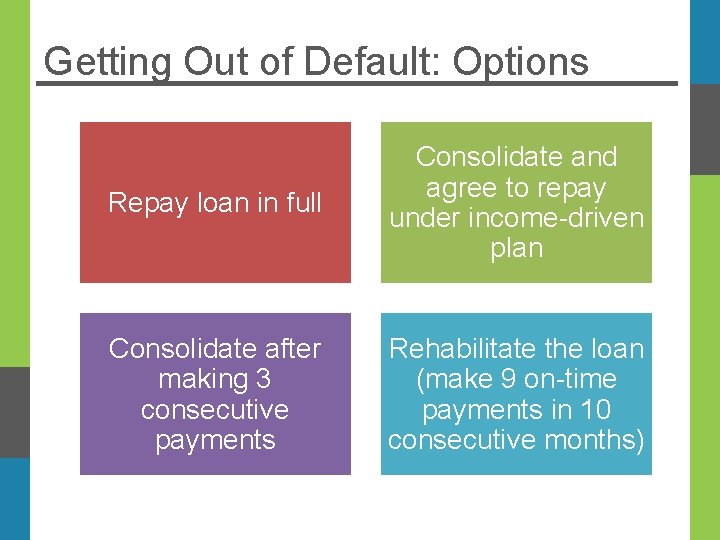
Getting Out of Default: Options Repay loan in full Consolidate and agree to repay under income-driven plan Consolidate after making 3 consecutive payments Rehabilitate the loan (make 9 on-time payments in 10 consecutive months)
Discharge, Forgiveness, and Cancellation
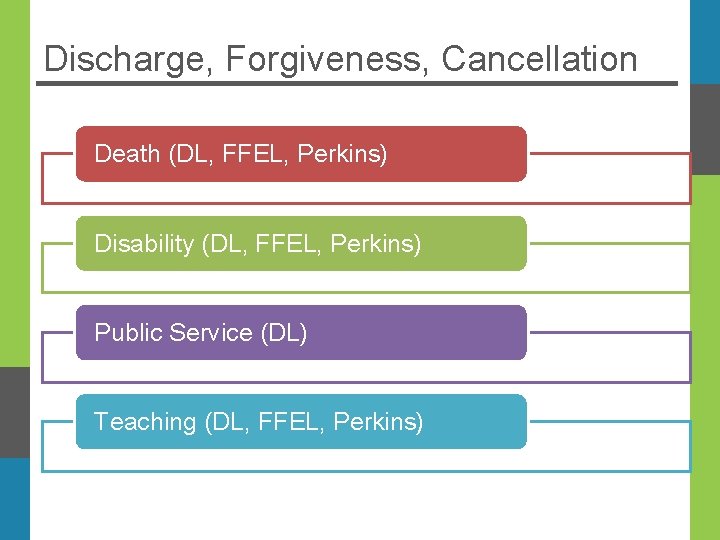
Discharge, Forgiveness, Cancellation Death (DL, FFEL, Perkins) Disability (DL, FFEL, Perkins) Public Service (DL) Teaching (DL, FFEL, Perkins)
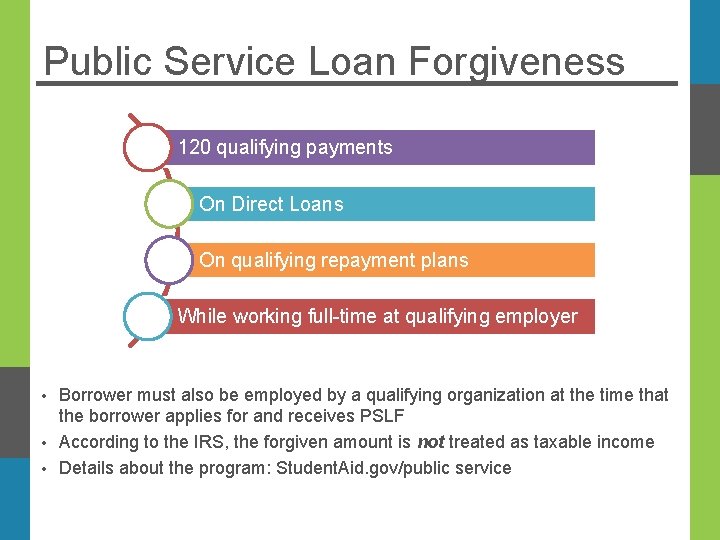
Public Service Loan Forgiveness 120 qualifying payments On Direct Loans On qualifying repayment plans While working full-time at qualifying employer • Borrower must also be employed by a qualifying organization at the time that the borrower applies for and receives PSLF • According to the IRS, the forgiven amount is not treated as taxable income • Details about the program: Student. Aid. gov/public service
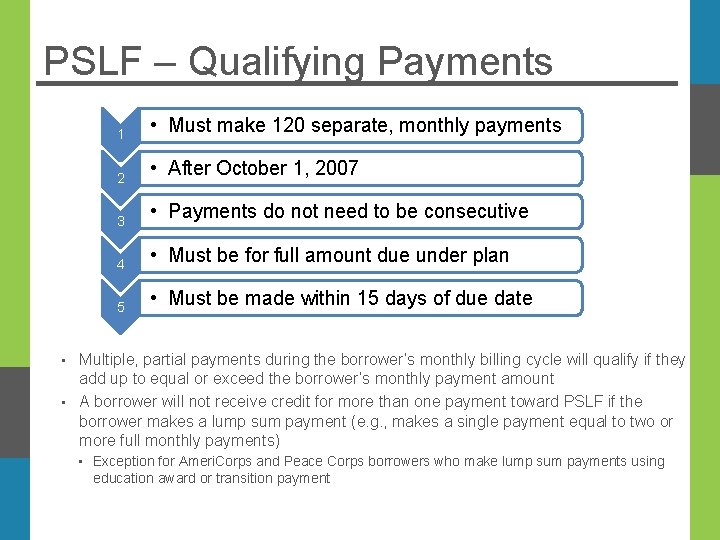
PSLF – Qualifying Payments 1 • Must make 120 separate, monthly payments 2 • After October 1, 2007 3 • Payments do not need to be consecutive 4 • Must be for full amount due under plan 5 • Must be made within 15 days of due date Multiple, partial payments during the borrower’s monthly billing cycle will qualify if they add up to equal or exceed the borrower’s monthly payment amount • A borrower will not receive credit for more than one payment toward PSLF if the borrower makes a lump sum payment (e. g. , makes a single payment equal to two or more full monthly payments) • • Exception for Ameri. Corps and Peace Corps borrowers who make lump sum payments using education award or transition payment
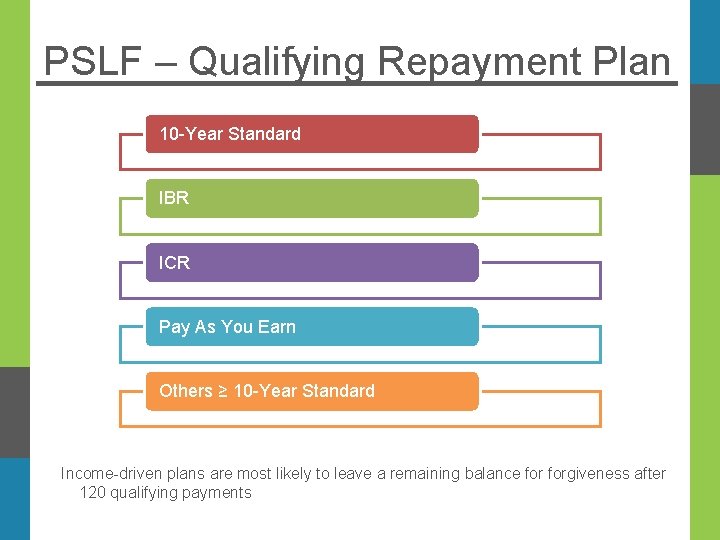
PSLF – Qualifying Repayment Plan 10 -Year Standard IBR ICR Pay As You Earn Others ≥ 10 -Year Standard Income-driven plans are most likely to leave a remaining balance forgiveness after 120 qualifying payments
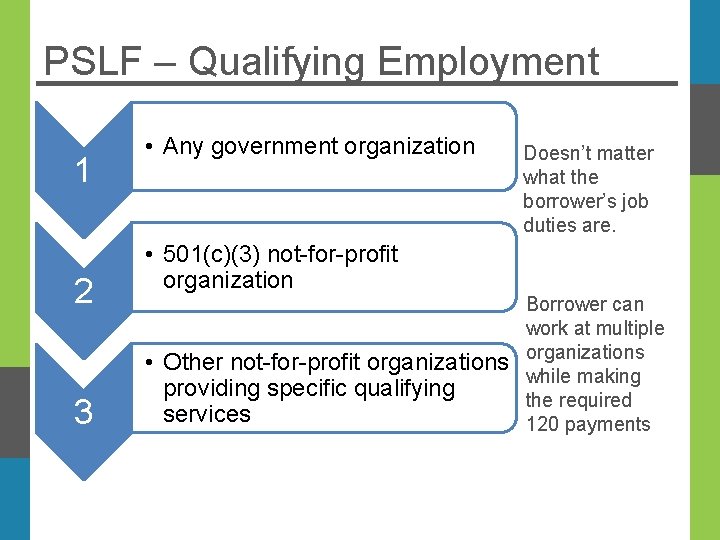
PSLF – Qualifying Employment 1 2 3 • Any government organization • 501(c)(3) not-for-profit organization • Other not-for-profit organizations providing specific qualifying services Doesn’t matter what the borrower’s job duties are. Borrower can work at multiple organizations while making the required 120 payments
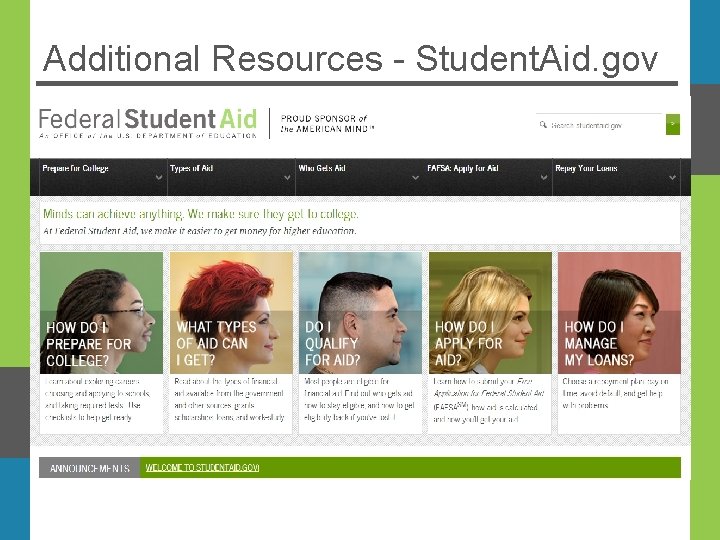
Additional Resources - Student. Aid. gov
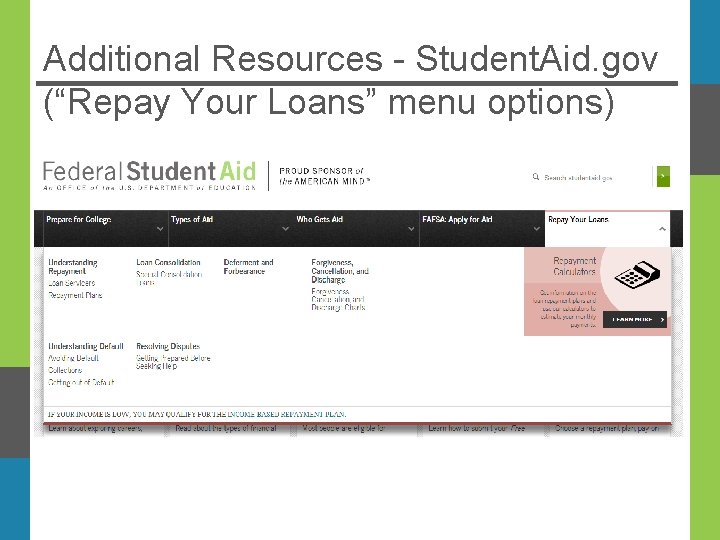
Additional Resources - Student. Aid. gov (“Repay Your Loans” menu options)
Federal Student Aid Information Center The Federal Student Aid Information Center (FSAIC) operates a toll-free hotline to provide comprehensive assistance in English, as well as Spanish on: o General information about federal student aid (Title IV programs); o The FAFSA application (paper and online); o FAFSA corrections; o Student loan history Ø 1 -800 -4 -FED-AID (1 -800 -433 -3243) Øwww. studentaid. gov Øwww. fafsa. ed. gov Hours: Monday through Friday 8: 00 a. m. – 11: 00 p. m. ET *Extended hours may be available*
Questions?
- Slides: 46