
Managing your Personal Information Serge Abiteboul INRIA ENS
Managing your Personal Information Serge Abiteboul INRIA & ENS Cachan serge. abiteboul@inria. fr Amélie Marian Rutgers University amelie@cs. rutgers. edu
Organization • What is a PIMS • Why it is coming now • Personal information: the killer apps – Data integration – Searching personal information – Personal knowledge bases Amélie & Serge, Dagstuhl 2016 2
Personal Information Management System WHAT IS A PIMS Amélie & Serge, Dagstuhl 2016 3
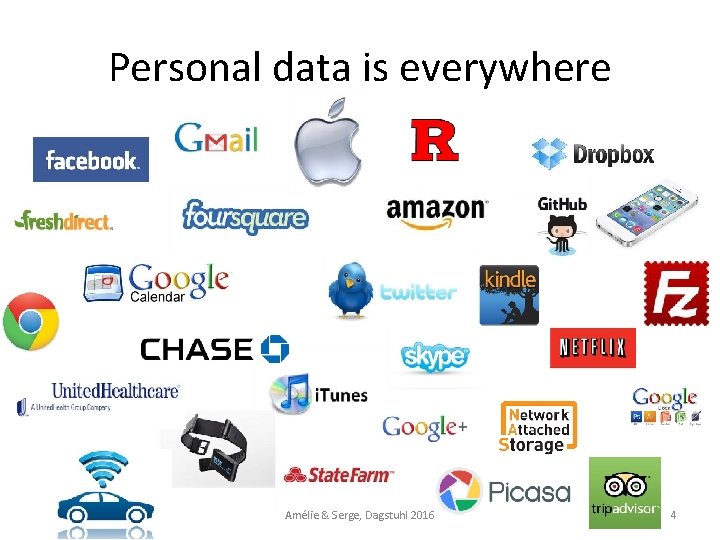
Personal data is everywhere Amélie & Serge, Dagstuhl 2016 4
Bad news • Loss of functionalities because of fragmentation – You don’t know where your data is, how to maintain it up to date, how to get it sometimes – Difficult to do global search, maintenance, synchronization, archiving. . . • Loss of control over the data – Difficult to control privacy – Difficult to control sharing – Leaks of private information • Loss of freedom – Vendor lock-in Amélie & Serge, Dagstuhl 2016 5
Whe r keep e do yo u your data ? Alternatives 1. Continue with this increasing mess – Use a shrink to overcome the frustration 2. Regroup all your data on the same platform – Google, Apple, Facebook, …, a new comer – Use a shrink to overcome resentment 3. Study 2 years to become a geek – – Geeks know how to manage their information Use a shrink to survive the experience Amélie & Serge, Dagstuhl 2016 6
The time for PIMS is now! A memex is a device in which an individual stores all his books, records, and communications, and which is mechanized so that it may be consulted with exceeding speed and flexibility. It is an enlarged intimate supplement to his memory. Vannevar Bush, The Atlantic Monthly, 1945 Definition for this talk: a Personal Information Management System is a (cloud) system that manages all the information of a person Amélie & Serge, Dagstuhl 2016 7
The PIMS: A change in paradigm Many Web services Each one running Your PIMS • On some unknown machines • With your data (you may not even know what data) • With unknown software • Your machine • With your data – Possibly replica of data from external services you choose • With your software or – Possibly wrappers to external services Amélie & Serge, Dagstuhl 2016 8
Rebalance the Web • User control over their data – Who has access to what, under what rules, to do what • User empowerment – They choose freely services & they can leave a service • Participation to a more “neutral” Web – With the "network effects", the main platforms are accumulating data/customers and distorting competition – The PIMS bring back fairness on the Web – Good practices are encouraged, e. g. , interoperability, portability Amélie & Serge, Dagstuhl 2016 9
Key issue : the security of data • An intrusion on my PIMS puts all my information at risk • Hard to be riskier than today’s model – Hardly comforting • The PIMS is ran by a professional operator – Security/privacy is guaranteed by contract – Applications codes are verified by the operator – The PIMS monitors the user’s actions to prevent security violations • Data of different users are isolated – Less tempting for pirates • The PIMS does not solve the security issues • It provides a better environment to address them Amélie & Serge, Dagstuhl 2016 10
For societal, technical, industrial reasons WHY IT IS COMING NOW Amélie & Serge, Dagstuhl 2016 11
Society is ready to move • Growing resentment – Against companies: intrusive marketing… – Against governments: NSA, Loi de renseignement… – Increasing awareness of the dissymmetry • Emerging understanding of the value of personal data for individuals • Data privacy regulations in Europe • Many reports/proposals on the topic – E. g. , CNNum • Personal data disclosure initiatives – E. g. , in France Mes. Infos (France) of Fing Amélie & Serge, Dagstuhl 2016 12
Technology is gearing up • • System administration is easier Open source technology available for services Price of machines is going down Many systems & projects – E. g. , in France Cozy Cloud • Some on particular aspects – Mailpile for mail – Lima for a Dropbox-like service – Personal data store of Samsung. . . Amélie & Serge, Dagstuhl 2016 13
Industry is interested Pre-digital companies • E. g. , hotels or banks • Disintermediated from their customers by pure Internet players • In Pims, they can rebuild direct interaction in a neutral field Amélie & Serge, Dagstuhl 2016 14
Industry is interested (2) Home appliances companies • Many boxes deployed at home or in datacenters • Personal data spaces dedicated to specific usage • Could evolve to become more generic • Control of private Internet of objects Amélie & Serge, Dagstuhl 2016 15
Industry is interested (3) Pure Internet players • Pros – Amazon: great know-how in providing services – Facebook, Google: cannot afford to be out of a movement in personal data management • Cons for some of them – Very far from their business model based on personal advertisement – Moving to this new market would require major changes & the clarification of the relationship with users w. r. t. data monetization Amélie & Serge, Dagstuhl 2016 16
Pure internet players: Monetization • What if the big platforms start proposing PIMS? • Their DNA is personal data monetization • They may provide PIMS for free – pay you for having access to your data • This defeats the spirit of PIMS… • The PIMS does not prevent from monetization • It encourages good practices – Monetization without giving away your data Amélie & Serge, Dagstuhl 2016 17
PERSONAL INFORMATION: THE KILLER APPS Amélie & Serge, Dagstuhl 2016 18
Some Apps are starting to take root • Personal assistant – Google now enhanced – Appointments, trips, shopping – Tax, financial, insurance, pension… • Health monitoring – Quantified self – Digital medical records But limited by proprietary systems and lack of interconnection • Smart home • Elder care monitoring and advising Amélie & Serge, Dagstuhl 2016 19
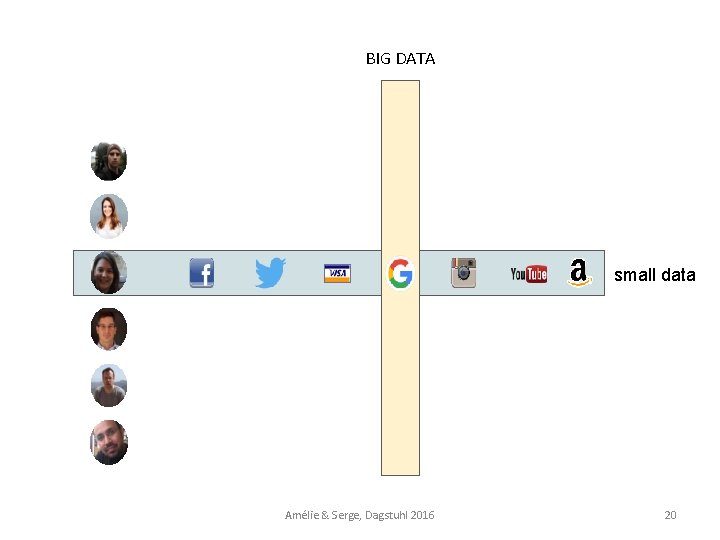
BIG DATA small data Amélie & Serge, Dagstuhl 2016 20
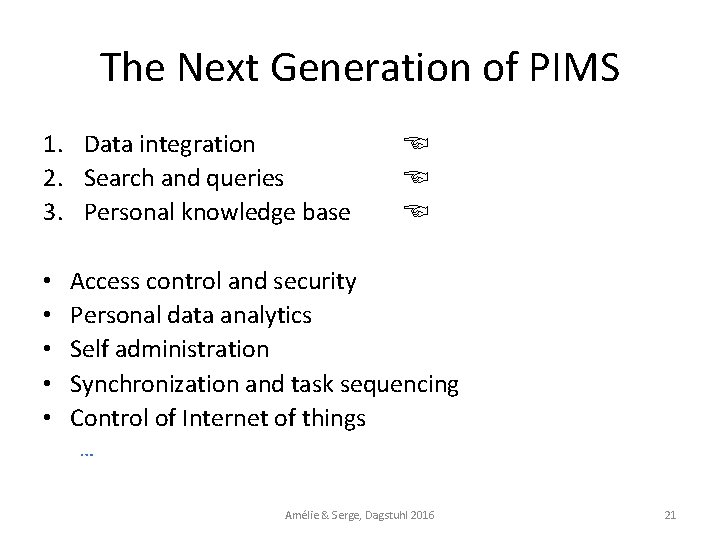
The Next Generation of PIMS 1. Data integration 2. Search and queries 3. Personal knowledge base • • • ☜ ☜ ☜ Access control and security Personal data analytics Self administration Synchronization and task sequencing Control of Internet of things … Amélie & Serge, Dagstuhl 2016 21
INTEGRATING PERSONAL DATA Amélie & Serge, Dagstuhl 2016 22
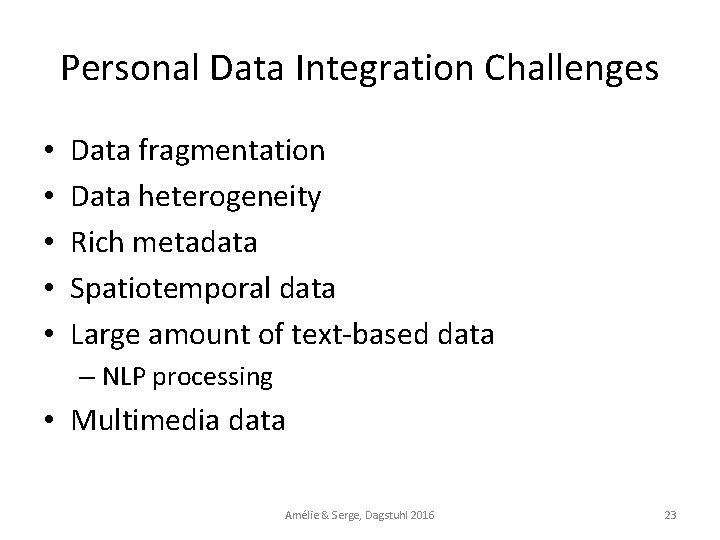
Personal Data Integration Challenges • • • Data fragmentation Data heterogeneity Rich metadata Spatiotemporal data Large amount of text-based data – NLP processing • Multimedia data Amélie & Serge, Dagstuhl 2016 23
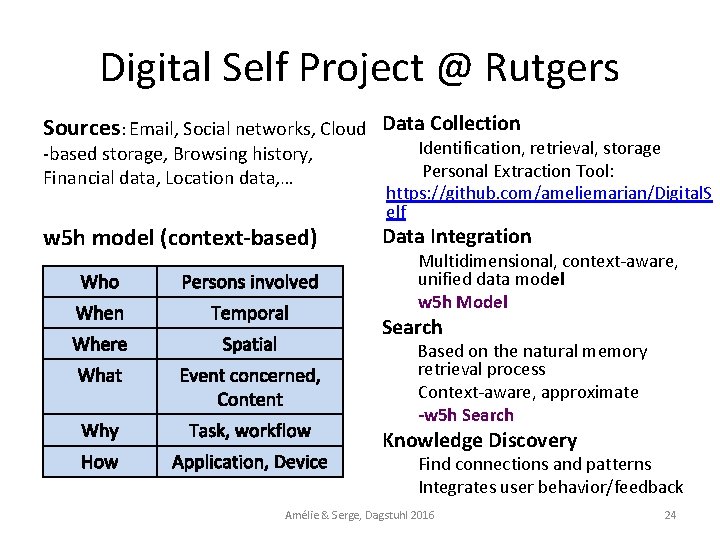
Digital Self Project @ Rutgers Sources: Email, Social networks, Cloud Data Collection -based storage, Browsing history, Financial data, Location data, … w 5 h model (context-based) Who Persons involved When Temporal Where Spatial What Event concerned, Content Why Task, workflow How Application, Device Identification, retrieval, storage Personal Extraction Tool: https: //github. com/ameliemarian/Digital. S elf Data Integration Multidimensional, context-aware, unified data model w 5 h Model Search Based on the natural memory retrieval process Context-aware, approximate -w 5 h Search Knowledge Discovery Find connections and patterns Integrates user behavior/feedback Amélie & Serge, Dagstuhl 2016 24
SEARCHING PERSONAL DATA Amélie & Serge, Dagstuhl 2016 25
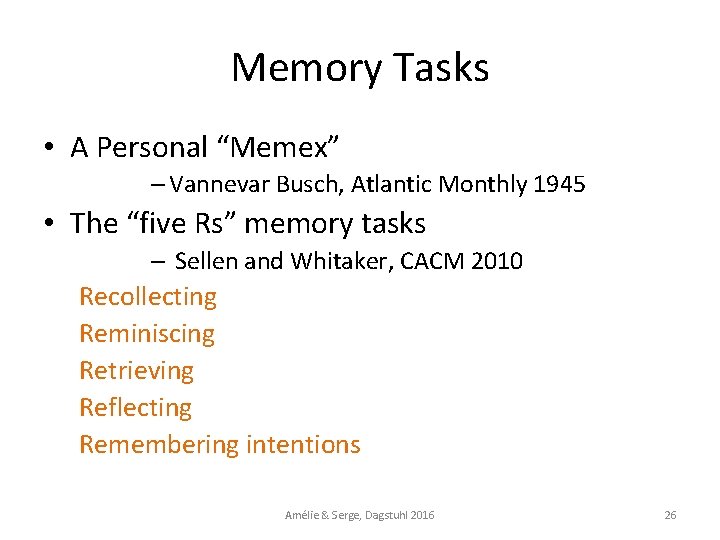
Memory Tasks • A Personal “Memex” – Vannevar Busch, Atlantic Monthly 1945 • The “five Rs” memory tasks – Sellen and Whitaker, CACM 2010 Recollecting Reminiscing Retrieving Reflecting Remembering intentions Amélie & Serge, Dagstuhl 2016 26
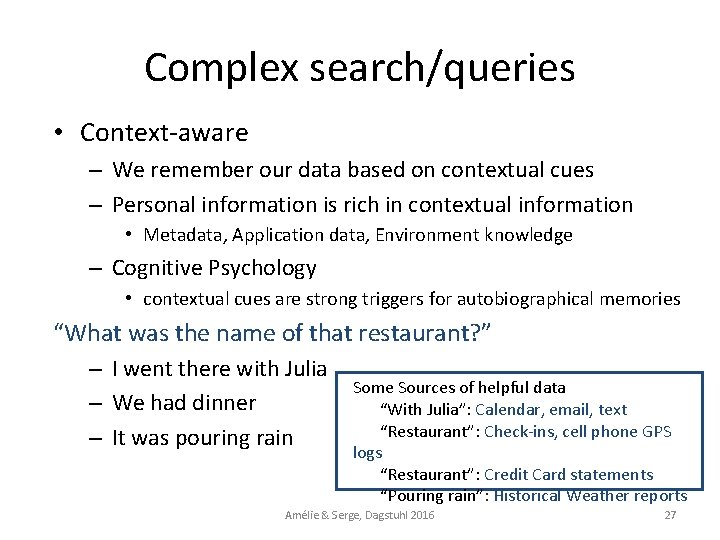
Complex search/queries • Context-aware – We remember our data based on contextual cues – Personal information is rich in contextual information • Metadata, Application data, Environment knowledge – Cognitive Psychology • contextual cues are strong triggers for autobiographical memories “What was the name of that restaurant? ” – I went there with Julia – We had dinner – It was pouring rain Some Sources of helpful data “With Julia”: Calendar, email, text “Restaurant”: Check-ins, cell phone GPS logs “Restaurant”: Credit Card statements “Pouring rain”: Historical Weather reports Amélie & Serge, Dagstuhl 2016 27
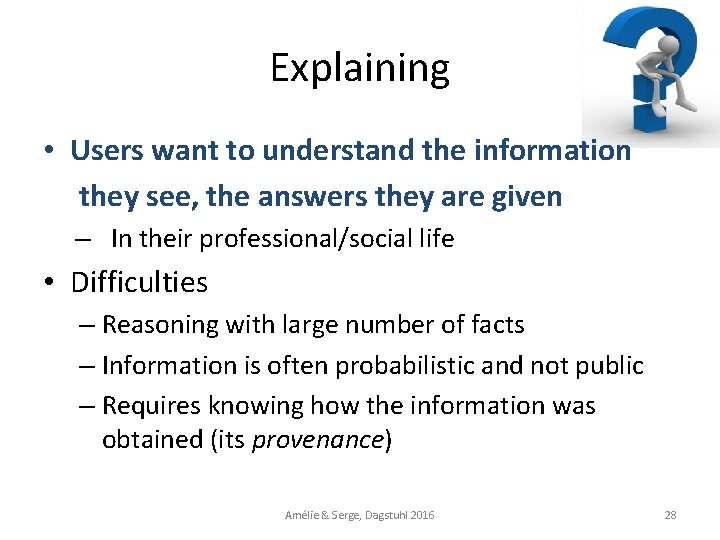
Explaining • Users want to understand the information they see, the answers they are given – In their professional/social life • Difficulties – Reasoning with large number of facts – Information is often probabilistic and not public – Requires knowing how the information was obtained (its provenance) Amélie & Serge, Dagstuhl 2016 28
PERSONAL KNOWLEDGE BASE Amélie & Serge, Dagstuhl 2016 29
Towards a Personal Knowledge Base • Combine information from different sources to infer facts • Example Query – “What are the dates of my trips out of the U. S. ? ” – “When was the last time I had dinner with Gerhard? ” – “How much did my vacation cost me? ” – “Remind me to return Julia’s book next time I see her” Amélie & Serge, Dagstuhl 2016 30
The Thymeflow system @ Inria • Integration of data from – Calendar, contact, mail, social networks, GPS localization, web search… – E. g. align a spatiotemporal location with a calendar entry and some event mentioned in a mail • In an RDF knowledge base – SPARQL interface, schema. org ontology – Based on standards such as caldav • Propagation – Of data-source updates to the KB – Of KB updates or KB inference to data-sources Amélie & Serge, Dagstuhl 2016 31
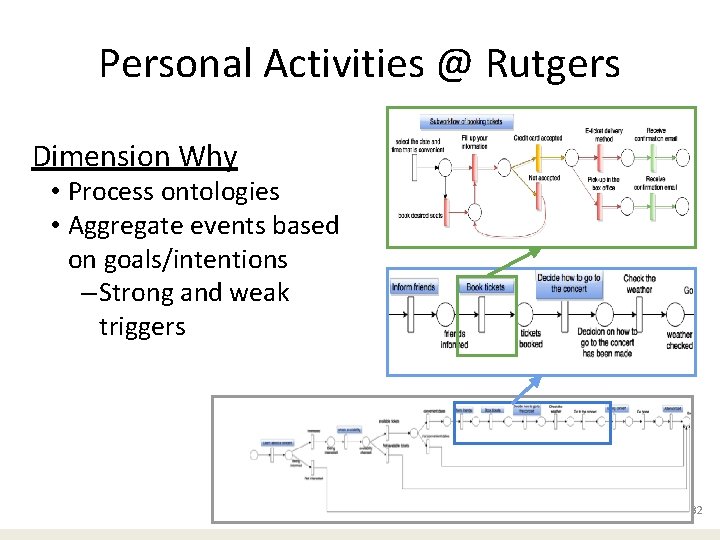
Personal Activities @ Rutgers Dimension Why • Process ontologies • Aggregate events based on goals/intentions – Strong and weak triggers 32
IT IS NOW TIME FOR USERS TO TAKE CONTROL OF THEIR PERSONAL INFORMATION Amélie & Serge, Dagstuhl 2016 33

Merci, Danke
- Slides: 34