
MANAGING WORKPLACE CHANGE AND TRANSITION LEARNING OBJECTIVES To

MANAGING WORKPLACE CHANGE AND TRANSITION
LEARNING OBJECTIVES • To gain an increased insight into the life and work processes of change and transition • To identify effective personal suggestions for managing change and transition • To highlight key organizational practices for facilitating positive change and transition
UNDERSTANDING CHANGE AND TRANSITION Definitions Change refers to the continuous adjustments and shifts that organizations make to address matters like increasing customer demands, technological changes and fiscal realities. Transition is the process of change, which includes the impact that change has on our feelings, relationships and routines.
UNDERSTANDING CHANGE AND TRANSITION Inward psychological transition occurs much more slowly than situational or organizational change. Understanding what happens during this transition time, and allowing oneself to work through it, is key to coming to terms with change.
RESPONSES TO CHANGE AND TRANSITION We don't move through the stages of change one at a time, in a neat, linear step-by-step manner. • It is possible to get stuck in one of the stages, and to find it difficult or impossible to move on. •
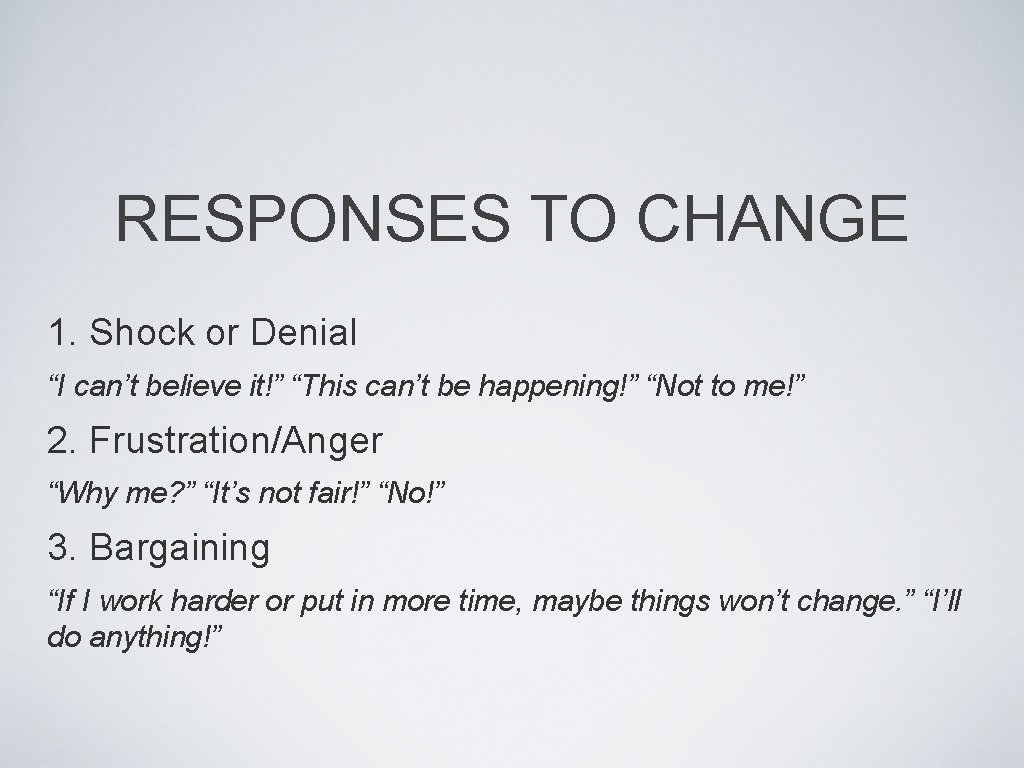
RESPONSES TO CHANGE 1. Shock or Denial “I can’t believe it!” “This can’t be happening!” “Not to me!” 2. Frustration/Anger “Why me? ” “It’s not fair!” “No!” 3. Bargaining “If I work harder or put in more time, maybe things won’t change. ” “I’ll do anything!”
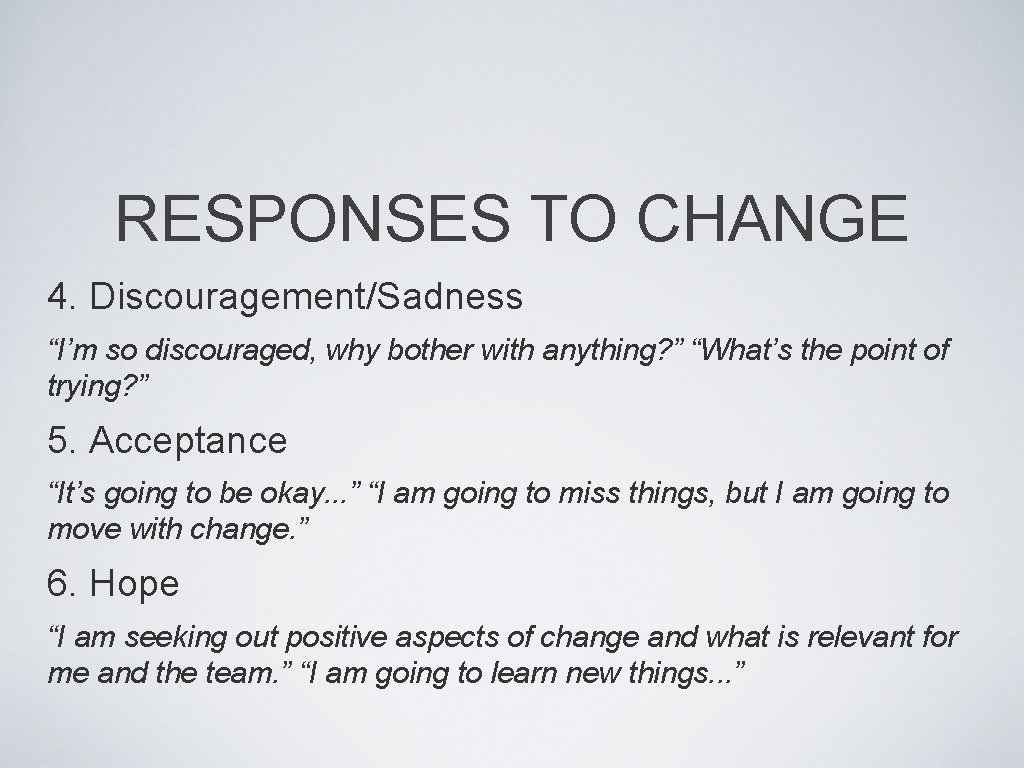
RESPONSES TO CHANGE 4. Discouragement/Sadness “I’m so discouraged, why bother with anything? ” “What’s the point of trying? ” 5. Acceptance “It’s going to be okay. . . ” “I am going to miss things, but I am going to move with change. ” 6. Hope “I am seeking out positive aspects of change and what is relevant for me and the team. ” “I am going to learn new things. . . ”

PRACTICAL WISDOM Transition and Change in the Workplace What lessons have you learned through experiencing change? What insights would you provide to a close friend or family member about moving through change? Reflect on the provided quotes about living through times of change.

PERSPECTIVES ON CHANGE 1. Change is inevitable. We can’t control everything - change does happen! 2. Change can be unsettling, and can make things feel different. The unknown can seem daunting. New routines and relationships may feel initially unfamiliar. 3. Change is part of growth and development. Change involves leaving and receiving. Change gives us opportunities to experience new things and different sides of ourselves.
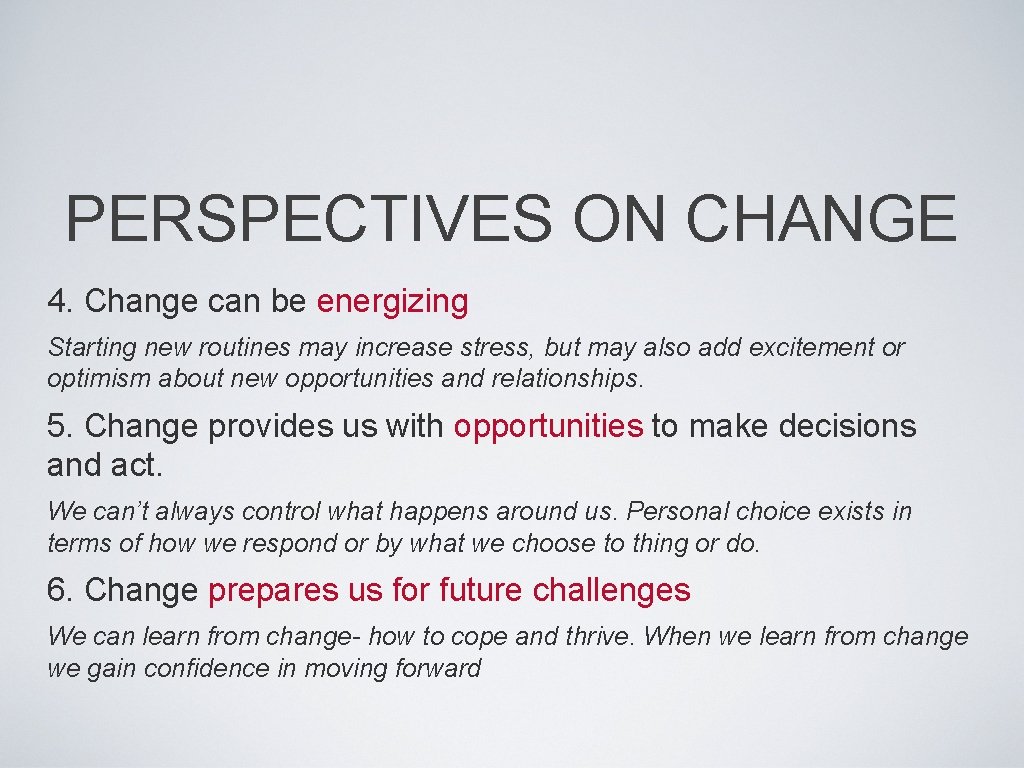
PERSPECTIVES ON CHANGE 4. Change can be energizing Starting new routines may increase stress, but may also add excitement or optimism about new opportunities and relationships. 5. Change provides us with opportunities to make decisions and act. We can’t always control what happens around us. Personal choice exists in terms of how we respond or by what we choose to thing or do. 6. Change prepares us for future challenges We can learn from change- how to cope and thrive. When we learn from change we gain confidence in moving forward

LEARNED OPTIMISM Ways of looking at life. Seligman (1990) discussed the idea of learned optimism — the idea that we could change our outlook so that we could begin to believe that we do have a role in altering our lives. While we can’t change other people and some circumstances, we can take control of our lives and take small steps toward transforming our outlook, and in turn, our health and wellness –
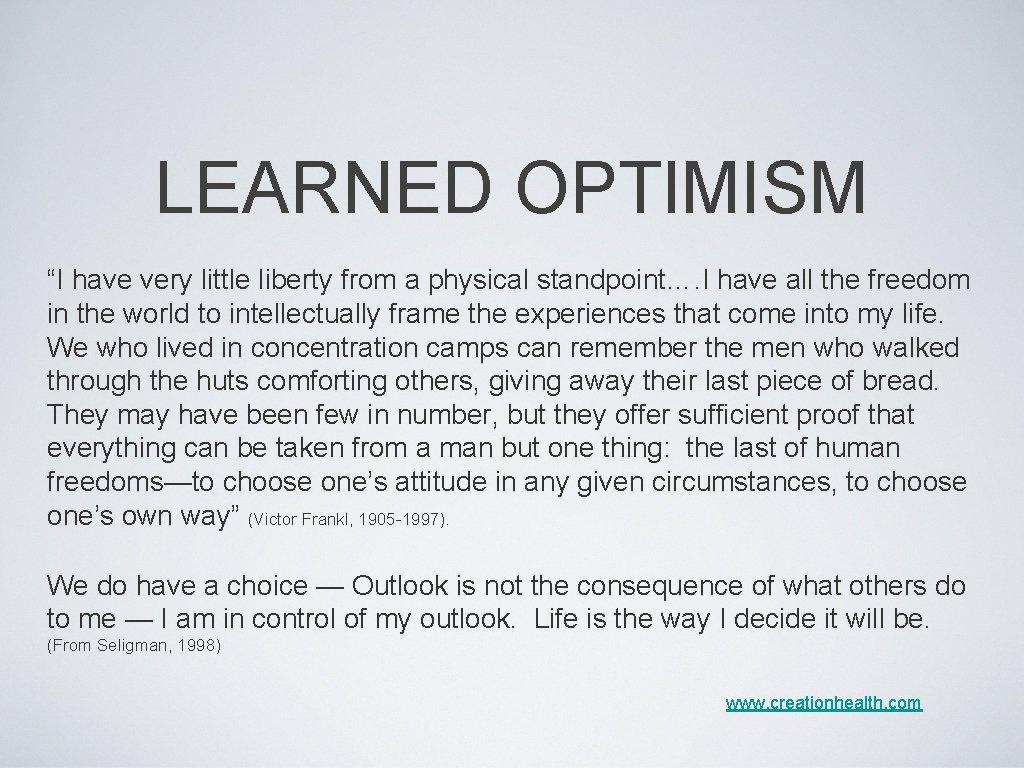
LEARNED OPTIMISM “I have very little liberty from a physical standpoint…. I have all the freedom in the world to intellectually frame the experiences that come into my life. We who lived in concentration camps can remember the men who walked through the huts comforting others, giving away their last piece of bread. They may have been few in number, but they offer sufficient proof that everything can be taken from a man but one thing: the last of human freedoms—to choose one’s attitude in any given circumstances, to choose one’s own way” (Victor Frankl, 1905 -1997). We do have a choice — Outlook is not the consequence of what others do to me — I am in control of my outlook. Life is the way I decide it will be. (From Seligman, 1998) www. creationhealth. com

MANAGING CHANGE AND TRANSITION Often involves many simultaneous and interactive changes, and the need for new ways of thinking, organizing and doing business • Sometimes feels like a path to an unknown state • Can pose a break from the past • Involves shifting existing practices and routines, leaving some familiar ones and accepting some new ones •
POSITIVE TIPS FOR MANAGING PERSONAL CHANGE AND • Set realistic goals. Keep moving toward goals that are TRANSITION achievable, and that provide opportunities for celebrating small successes. • Look for opportunities for self-discovery. Question the assumptions that you have made about yourself and others. Believe that you have the capacity to grow and to change. • Keep things in perspective. Don’t allow challenges to overwhelm you – take a moment to place changes in their proper perspective. • Maintain an optimistic outlook. Choose to believe that things will work out, and that you have the strength to (Adapted from Martin Smith, 2011) adapt.
POSITIVE TIPS FOR MANAGING PERSONAL CHANGE AND • Choose a mantra to TRANSITION think by. “Live in the moment. ” “One day at a time. ” “Focus on the positive. ” “Be the difference. ” “Go with the flow. ” • Remember your family and friends. Take time for what is truly important. Be sure to make time – especially when things get hectic – to foster and maintain your most important relationships. • Develop and use your support systems. Turn to people you trust for help when needed. Be familiar with available supports – employee assistance programs, mentors and advisors, and community service providers. • Surround yourself with resilient people and energy givers. Make connections with others who live their lives with positivity. Reevaluate relationships that seem to draw on your energy or (Adapted from Martin Smith, 2011) strength.
POSITIVE TIPS FOR MANAGING PERSONAL CHANGE AND TRANSITION • Pursue wellness: Commit to taking the time to develop a personal program of wellness, keeping in mind body, spirit and mind as areas for continual development and growth. • Seek clarification: Ensure that you understand the implications of upcoming changes. Ask questions, and be sure that you understand the answers. • Begin learning: Perceive change as an opportunity to learn new skills, enhance knowledge, and build expertise. Start learning about your new responsibilities right away, and allow yourself to be excited about this opportunity. • Practice generosity: Take a moment to move beyond your own concerns about change. Listen to others, express gratitude and carry out acts of kindness. (Adapted from Martin Smith, 2011)
THINK ABOUT Proactive Organizational Practices What organizational conditions contribute to resiliency among employees? How can organizations proactively manage times of organizational change and transition for employees?
ORGANIZATIONAL PRACTICES THAT SUPPORT POSITIVE CHANGE AND TRANSITION 1. Reduce uncertainty through regular and clear communication. 2. Communicate the benefits of emerging changes. 3. Invite participation in problem solving and adapting team processes and practices. 4. Identify and build champions to support team development. 5. Provide opportunities for team building, given shifts in relationships and routines. 6. Plan for and report on early successes. 7. Come alongside of others to provide support and encouragement. 8. Meet individually with employees who are directly impacted by transition.
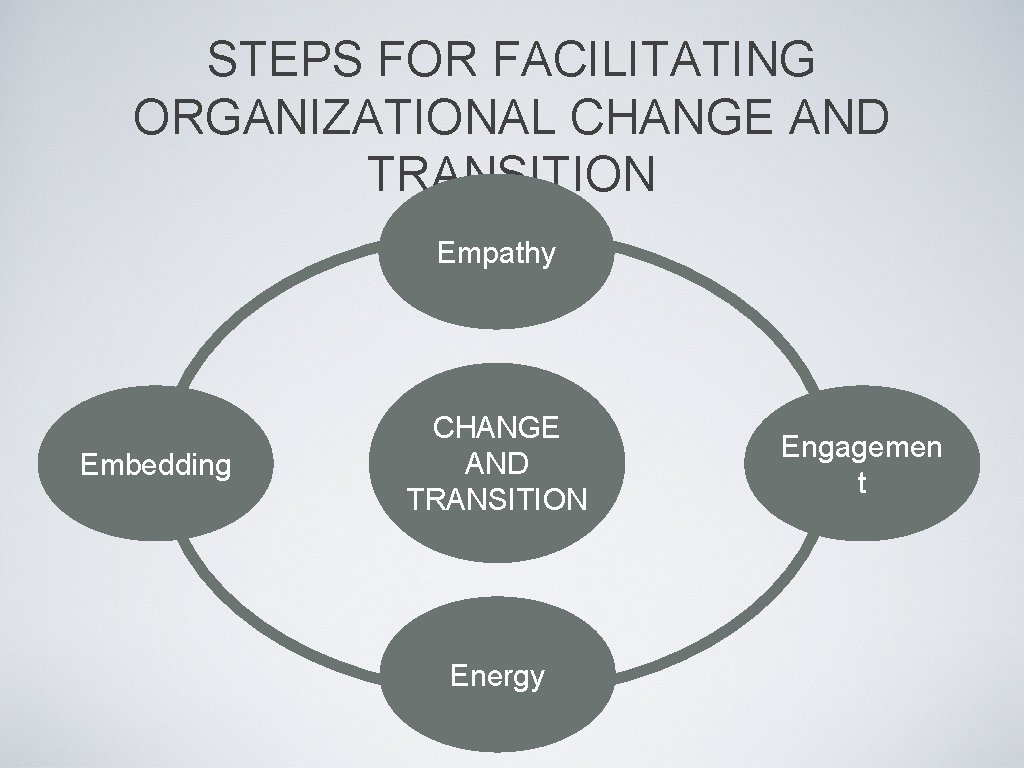
STEPS FOR FACILITATING ORGANIZATIONAL CHANGE AND TRANSITION Empathy Embedding CHANGE AND TRANSITION Energy Engagemen t
EMPATHY Objective: To acknowledge the realities of change and transition Actions: Communicate recognition of the challenges and benefits of transition and adaptation. • Offer workshops to raise awareness of transition dynamics and the adaptation process. •
ENGAGEMENT Objective: To engage team members in understanding and planning for change and transition Actions: Express openness and provide opportunities for dialogue and solution building. • Identify and reduce barriers to adaptation. •
ENERGY Objective: To increase optimism and hope related to areas of change Actions: Clarify and develop a shared team or organizational vision. • Provide opportunities for learning and recognition of short-term successes as change is embraced. • Connect with individuals in transition and provide encouragement as needed. •
EMBEDDING Objective: To embed perspectives and practices that support a shared team and organizational vision, reflecting high employee engagement and performance Actions: Embed and refine processes that contribute to team approaches and integration of the collective use of employee strengths. • Align system-wide policies and practices. • Track and adjust organizational processes and practices to support the new vision. •
APPLICATION ACTIVITY Eleven Positive Tips for Managing Change and Transition have been provided. 1. Review this list with another individual from your workplace. Discuss which strategies that you often or usually apply to manage change or transition. 2. Take a moment to consider one or two of the listed suggestions that you have not used often, but that you identify as potentially useful in building personal resiliency. 3. Make a plan this week to put this strategy into practice. Follow up with your co-worker and discuss how your plan worked.
- Slides: 24