
Managing Tier 2 and Tier 3 Interventions Developing



- Slides: 73
Managing Tier 2 and Tier 3 Interventions Developing the Intervention System Secondary Level miblsi. org
1. 0 Defining a School-wide Content Area Reading Model Within an MTSS Framework 2
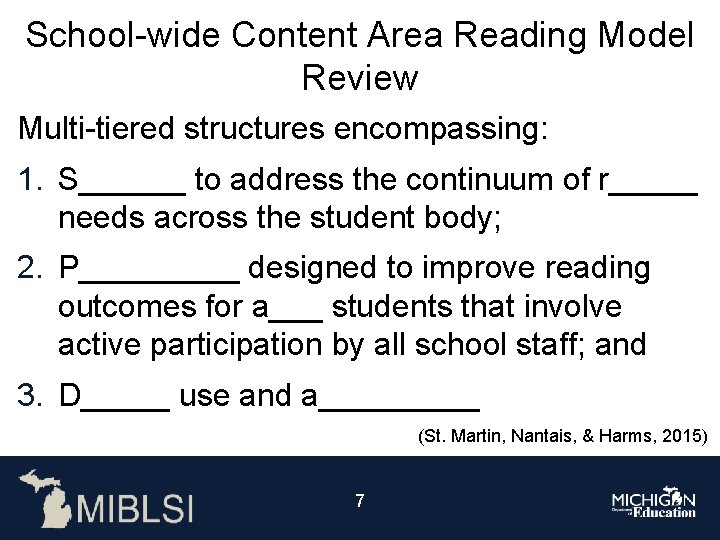
School-wide Content Area Reading Model Definition: Multi-tiered structures encompassing: 1. Systems to address the continuum of reading needs across the student body; 2. Practices designed to improve reading outcomes for all students that involve active participation by all school staff; and 3. Data use and analysis (St. Martin, Nantais, & Harms, 2015) 3
Systems to Address Needs • Team structures • School-wide Content Area Reading Plan • Professional Learning Plan • Intervention Grid with entry criteria, progress monitoring, and exit criteria • Intervention System • Define process for selection of content area reading strategies, programs and intervention program and materials (at the district level) 4
Evidence-Based Practices • Common content area reading strategies using instructional routines • Focus core instruction and intervention on the big ideas of adolescent reading (advanced decoding, fluency, comprehension, vocabulary & motivation) for all students 5
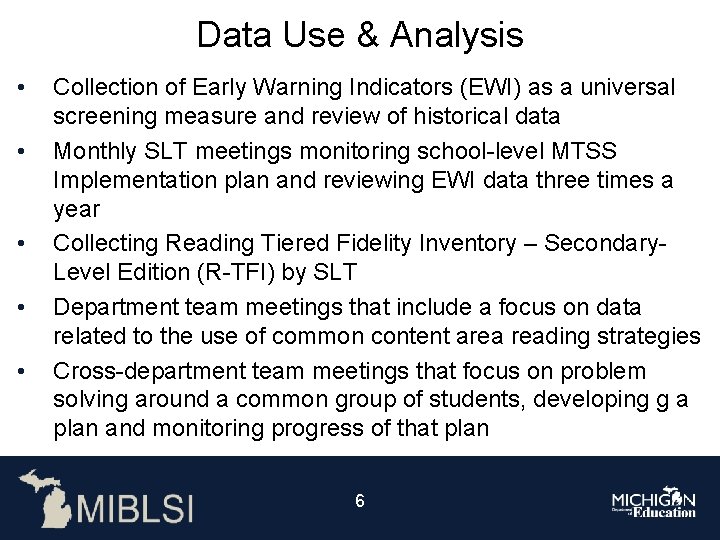
Data Use & Analysis • • • Collection of Early Warning Indicators (EWI) as a universal screening measure and review of historical data Monthly SLT meetings monitoring school-level MTSS Implementation plan and reviewing EWI data three times a year Collecting Reading Tiered Fidelity Inventory – Secondary. Level Edition (R-TFI) by SLT Department team meetings that include a focus on data related to the use of common content area reading strategies Cross-department team meetings that focus on problem solving around a common group of students, developing g a plan and monitoring progress of that plan 6
School-wide Content Area Reading Model Review Multi-tiered structures encompassing: 1. S______ to address the continuum of r_____ needs across the student body; 2. P_____ designed to improve reading outcomes for a___ students that involve active participation by all school staff; and 3. D_____ use and a_____ (St. Martin, Nantais, & Harms, 2015) 7
2. 0 Why Students Struggle to Understand Text 8
In Module 2. 0, we will… • Review the Simple View of Reading • Discuss the changing emphasis of reading instruction • Provide reasons students struggle to read and understand what they read 9
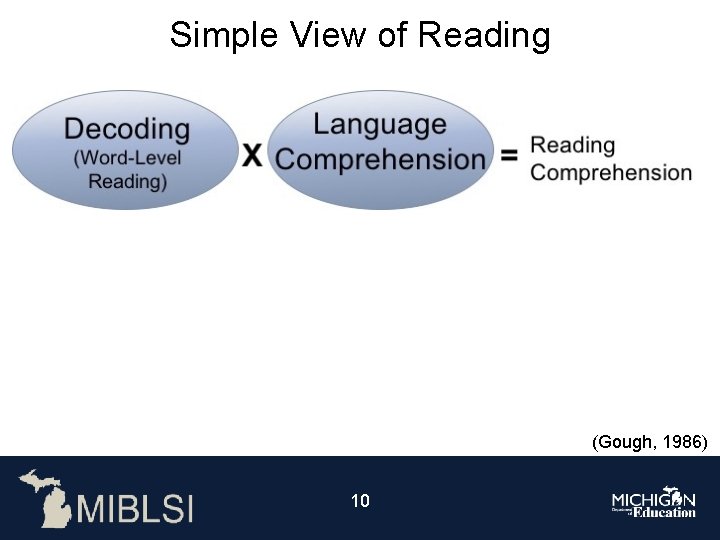
Simple View of Reading (Gough, 1986) 10
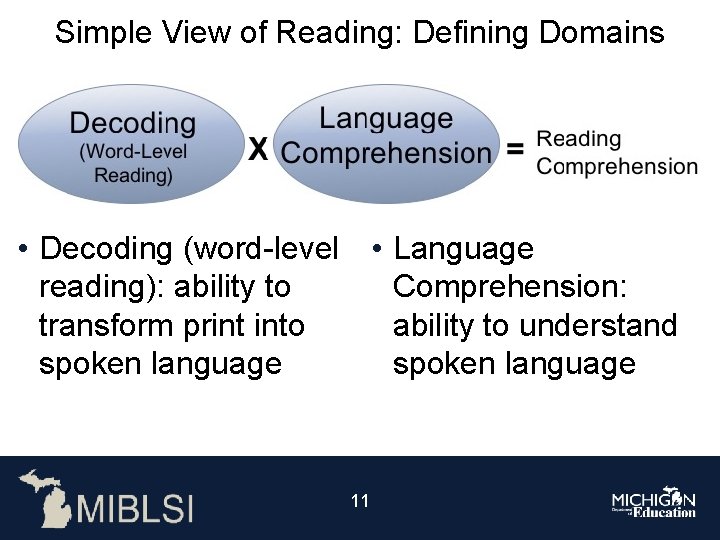
Simple View of Reading: Defining Domains • Decoding (word-level • Language reading): ability to Comprehension: transform print into ability to understand spoken language 11
Simple View of Reading: Language Skills Focus on the Language Comprehension Domain that is made up of Academic Language Skills: Background Knowledge: possesses general and topicspecific background knowledge, Inferential Language Skills: ability to discuss topics beyond immediate context, Narrative Language Skills: ability to clearly relate a series of events, and Academic Vocabulary: ability to comprehend and use words in formal writing. 12
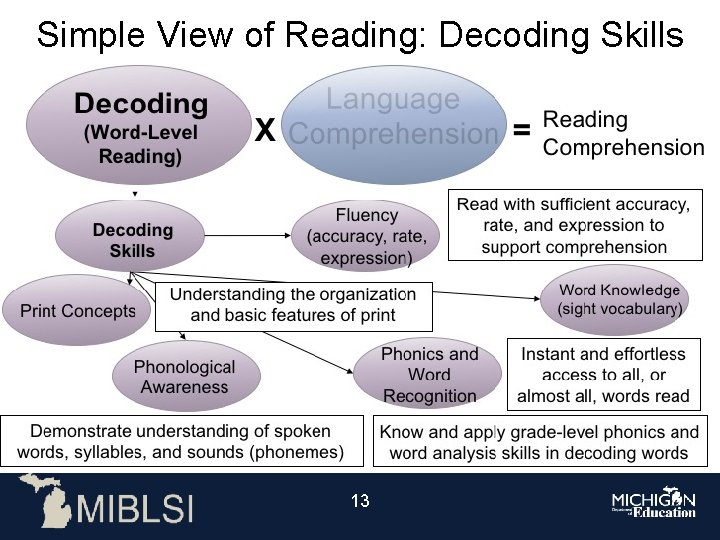
Simple View of Reading: Decoding Skills 13
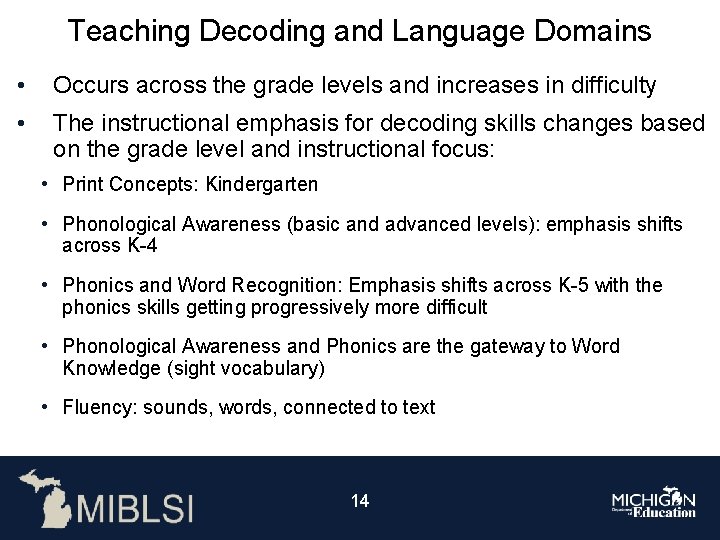
Teaching Decoding and Language Domains • Occurs across the grade levels and increases in difficulty • The instructional emphasis for decoding skills changes based on the grade level and instructional focus: • Print Concepts: Kindergarten • Phonological Awareness (basic and advanced levels): emphasis shifts across K-4 • Phonics and Word Recognition: Emphasis shifts across K-5 with the phonics skills getting progressively more difficult • Phonological Awareness and Phonics are the gateway to Word Knowledge (sight vocabulary) • Fluency: sounds, words, connected to text 14
Why Students Struggle? • Traditional reading approaches did not use instructional methods to allow all students to become proficient in the “code of printed English and to build a large sight vocabulary” • Whole-word approach: uses multiple exposures to words so the words are memorized • Three cueing system model: proposes unknown words are read by using context clues, understanding the structure of language (syntax), and by visually recognizing words (recall words based on their appearance) (Kilpatrick, 2014) 15
Addressing the Needs of Struggling Students 1. Administer intervention-oriented assessments 2. Analyze assessment data and apply empiricallyproven methods of reading acquisition to address reading deficits 3. Intervene to remediate the skill deficits (e. g. , decoding of multi-syllabic words) 16
Addressing the Needs of Struggling Students (cont. ) 4. Teach compensatory strategies to successfully engage with text in content area classes (e. g. , strategies for reading unfamiliar words, understanding text features and types, extracting the most important pieces of information) 17
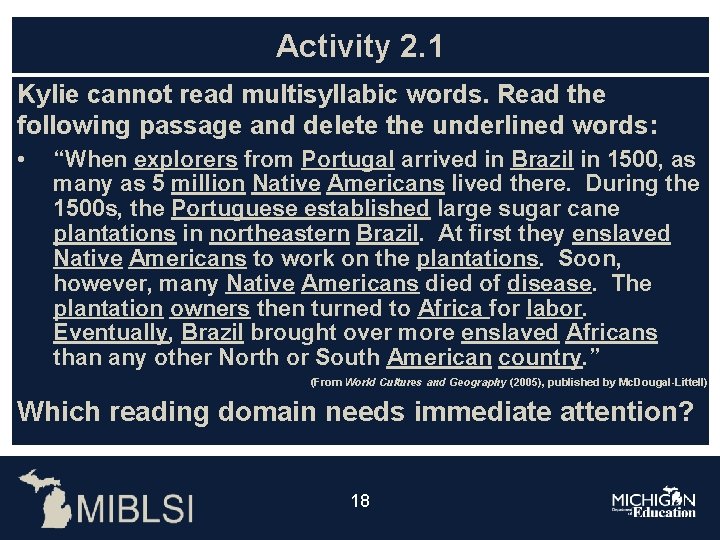
Activity 2. 1 Kylie cannot read multisyllabic words. Read the following passage and delete the underlined words: • “When explorers from Portugal arrived in Brazil in 1500, as many as 5 million Native Americans lived there. During the 1500 s, the Portuguese established large sugar cane plantations in northeastern Brazil. At first they enslaved Native Americans to work on the plantations. Soon, however, many Native Americans died of disease. The plantation owners then turned to Africa for labor. Eventually, Brazil brought over more enslaved Africans than any other North or South American country. ” (From World Cultures and Geography (2005), published by Mc. Dougal-Littell) Which reading domain needs immediate attention? 18
Activity 2. 2 • Shaun can accurately read the passage on the previous slide • When asked to discuss the events leading up to why the Portuguese needed to enslave Africans, his answer was, “because they needed people to work on the plantations. ” • Which reading domain and skill(s) likely need attention? 19
3. 0 Compensatory Strategies: Strategies to Use Before, During, and After Students Read 20
In Module 3. 0 we will… • Briefly review comprehension strategies that should be done before, during, and after students read text • Discuss the challenges with understanding informational text • Review compensatory strategies that can be used across core subject area classes to improve students’ understanding of what they read in their classes 21
Framing Comprehension • To ensure students understand what they are expected to read in their core subject area classes there are things that need to be done: 1. Before reading 2. During reading 3. After reading • Some strategies differ depending on text genre (informational vs. narrative) 22
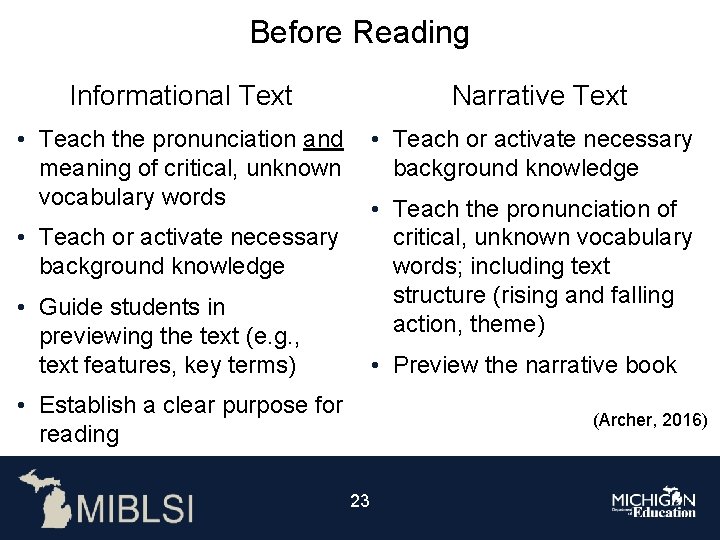
Before Reading Informational Text Narrative Text • Teach the pronunciation and meaning of critical, unknown vocabulary words • Teach or activate necessary background knowledge • Teach the pronunciation of critical, unknown vocabulary words; including text structure (rising and falling action, theme) • Teach or activate necessary background knowledge • Guide students in previewing the text (e. g. , text features, key terms) • Preview the narrative book • Establish a clear purpose for reading (Archer, 2016) 23
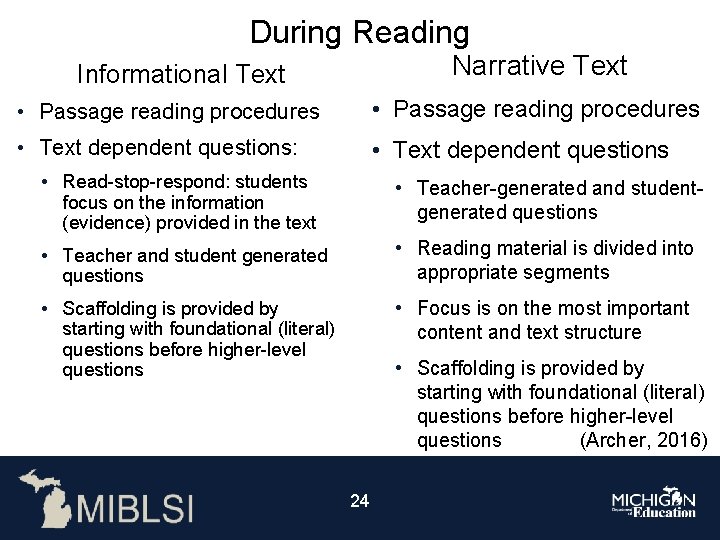
During Reading Narrative Text Informational Text • Passage reading procedures • Text dependent questions: • Text dependent questions • Read-stop-respond: students focus on the information (evidence) provided in the text • Teacher-generated and studentgenerated questions • Teacher and student generated questions • Reading material is divided into appropriate segments • Scaffolding is provided by starting with foundational (literal) questions before higher-level questions • Focus is on the most important content and text structure • Scaffolding is provided by starting with foundational (literal) questions before higher-level questions (Archer, 2016) 24
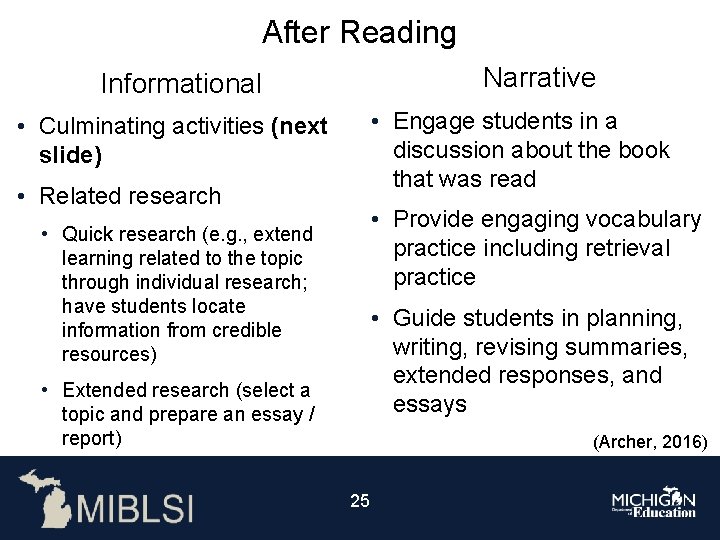
After Reading Narrative Informational • Engage students in a discussion about the book that was read • Culminating activities (next slide) • Related research • Provide engaging vocabulary practice including retrieval practice • Quick research (e. g. , extend learning related to the topic through individual research; have students locate information from credible resources) • Guide students in planning, writing, revising summaries, extended responses, and essays • Extended research (select a topic and prepare an essay / report) (Archer, 2016) 25
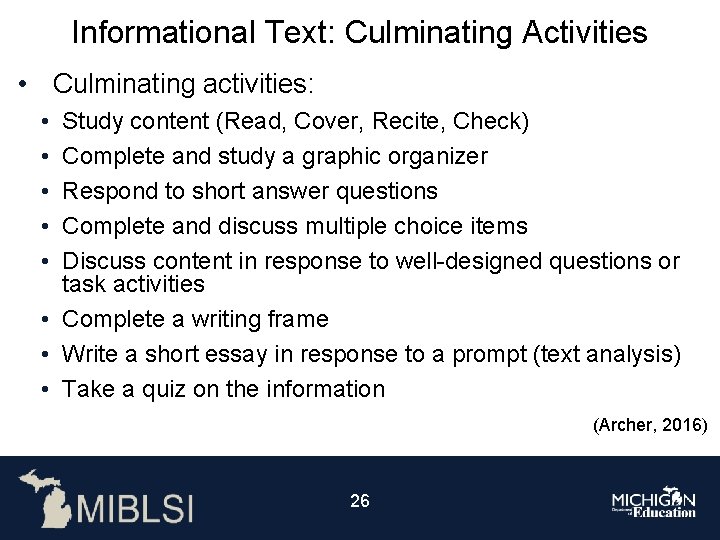
Informational Text: Culminating Activities • Culminating activities: • • • Study content (Read, Cover, Recite, Check) Complete and study a graphic organizer Respond to short answer questions Complete and discuss multiple choice items Discuss content in response to well-designed questions or task activities • Complete a writing frame • Write a short essay in response to a prompt (text analysis) • Take a quiz on the information (Archer, 2016) 26
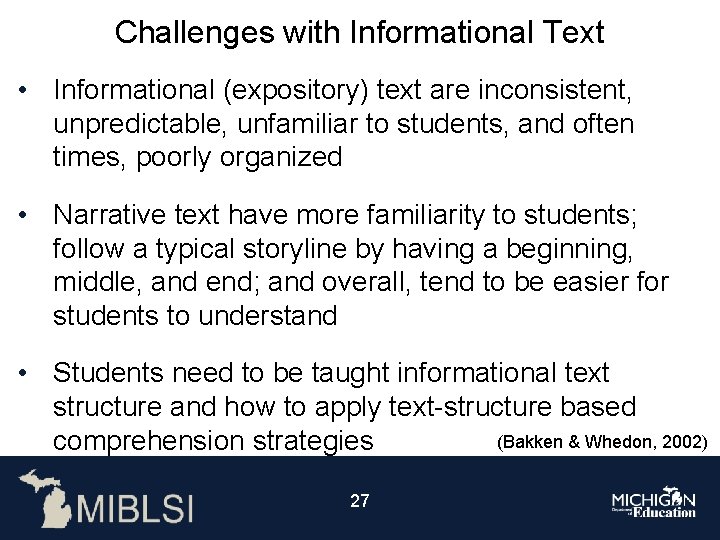
Challenges with Informational Text • Informational (expository) text are inconsistent, unpredictable, unfamiliar to students, and often times, poorly organized • Narrative text have more familiarity to students; follow a typical storyline by having a beginning, middle, and end; and overall, tend to be easier for students to understand • Students need to be taught informational text structure and how to apply text-structure based (Bakken & Whedon, 2002) comprehension strategies 27
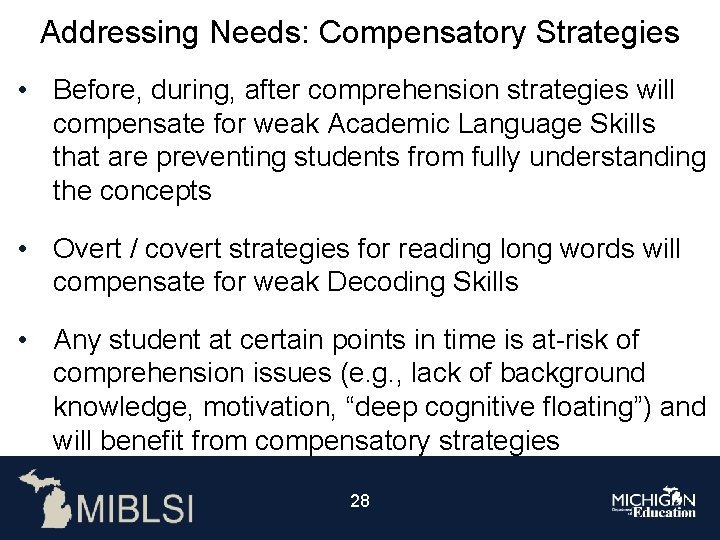
Addressing Needs: Compensatory Strategies • Before, during, after comprehension strategies will compensate for weak Academic Language Skills that are preventing students from fully understanding the concepts • Overt / covert strategies for reading long words will compensate for weak Decoding Skills • Any student at certain points in time is at-risk of comprehension issues (e. g. , lack of background knowledge, motivation, “deep cognitive floating”) and will benefit from compensatory strategies 28
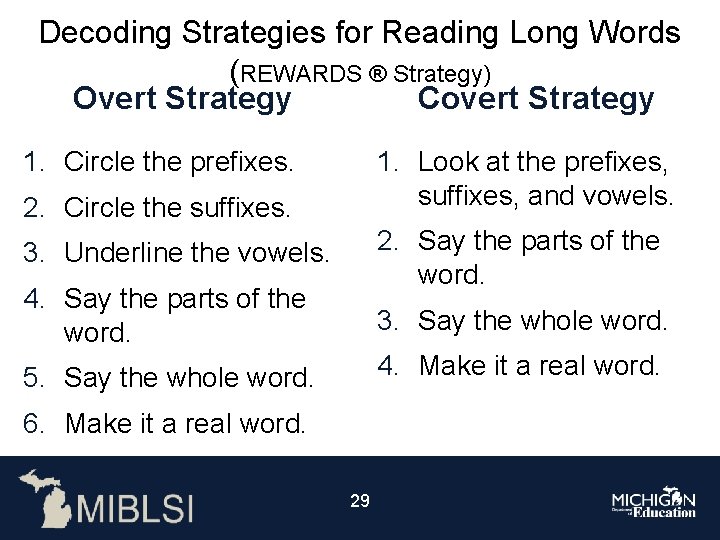
Decoding Strategies for Reading Long Words (REWARDS ® Strategy) Overt Strategy Covert Strategy 1. Circle the prefixes. 1. Look at the prefixes, suffixes, and vowels. 2. Circle the suffixes. 2. Say the parts of the word. 3. Underline the vowels. 4. Say the parts of the word. 3. Say the whole word. 4. Make it a real word. 5. Say the whole word. 6. Make it a real word. 29
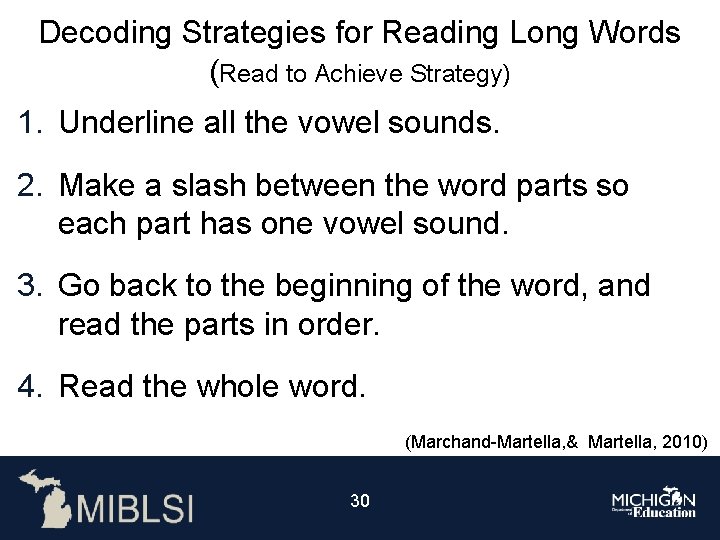
Decoding Strategies for Reading Long Words (Read to Achieve Strategy) 1. Underline all the vowel sounds. 2. Make a slash between the word parts so each part has one vowel sound. 3. Go back to the beginning of the word, and read the parts in order. 4. Read the whole word. (Marchand-Martella, & Martella, 2010) 30
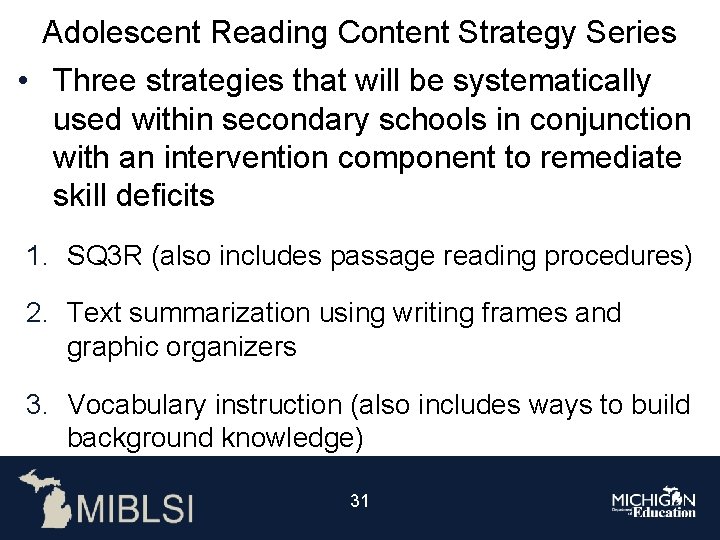
Adolescent Reading Content Strategy Series • Three strategies that will be systematically used within secondary schools in conjunction with an intervention component to remediate skill deficits 1. SQ 3 R (also includes passage reading procedures) 2. Text summarization using writing frames and graphic organizers 3. Vocabulary instruction (also includes ways to build background knowledge) 31
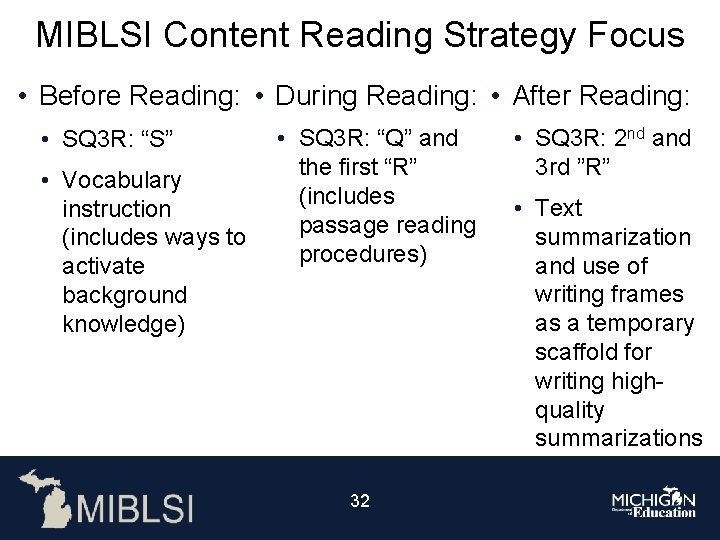
MIBLSI Content Reading Strategy Focus • Before Reading: • During Reading: • After Reading: • SQ 3 R: “S” • Vocabulary instruction (includes ways to activate background knowledge) • SQ 3 R: “Q” and the first “R” (includes passage reading procedures) 32 • SQ 3 R: 2 nd and 3 rd ”R” • Text summarization and use of writing frames as a temporary scaffold for writing highquality summarizations
Use of the Content Reading Strategies • You will seek input from the rest of the school staff in order to draft an implementation plan for the installation and use of the three content area reading strategies • The implementation plan components are going to be shared with your District Implementation Team • They are focused on making your use of district-supported strategies or programs as easy as possible (barrier-free) 33
Activity 3. 1 • Partner 1: Study slides 22 -26 (framing comprehension; before, during, and after reading comprehension strategies) • Partner 2: Study slides 27 -33 (challenges with informational text, compensatory strategies, MIBLSI content reading strategy focus) • Pretend your partner just arrived to the session and it is your responsibility to teach them the information on the slides you studied 34
4. 0 Intervention System 35
Defining Intervention System • Efficient and effective process for ensuring students have access to academic and behavioral intervention supports and are making adequate progress within those supports 36
Why an Intervention System • Sense of urgency is needed to accelerate the performance of low-performing students so they can be successful students • Closing the performance gap becomes increasingly difficult as students progress through school 37
Intervention System Components 1. Process for identifying students needing interventions 2. Intervention essentials: (you started to develop an Intervention Grid that included this information during your Tier 2 Behavior Systems session) • Description • Skills designed to address • Entrance criteria • Progress monitoring guidelines • Exit criteria 38
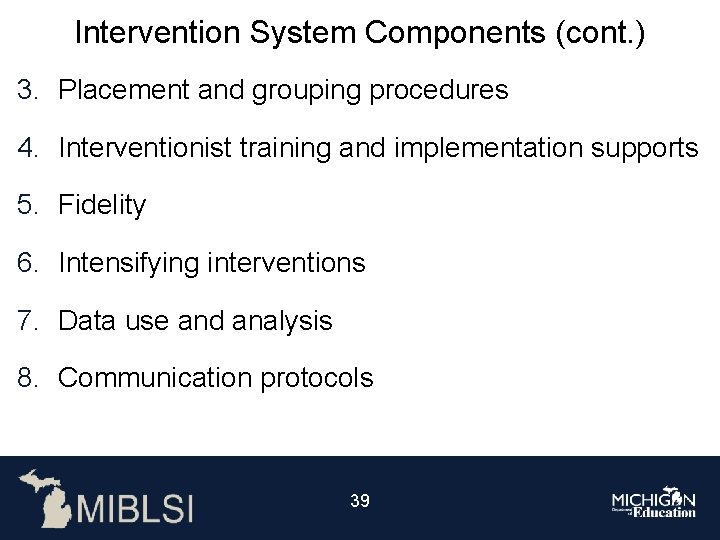
Intervention System Components (cont. ) 3. Placement and grouping procedures 4. Interventionist training and implementation supports 5. Fidelity 6. Intensifying interventions 7. Data use and analysis 8. Communication protocols 39
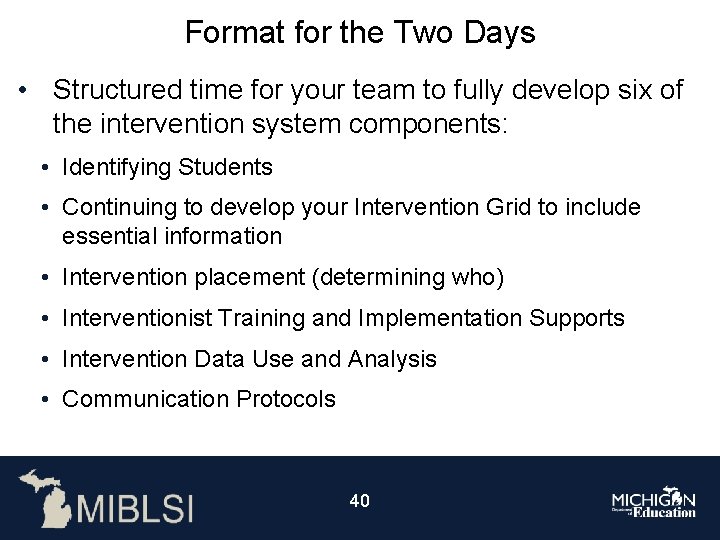
Format for the Two Days • Structured time for your team to fully develop six of the intervention system components: • Identifying Students • Continuing to develop your Intervention Grid to include essential information • Intervention placement (determining who) • Interventionist Training and Implementation Supports • Intervention Data Use and Analysis • Communication Protocols 40
Format for the Two Days (cont. ) • We will discuss why each component is critical for a well-developed intervention system • The documents for each of the components are accessible electronically for your team to contextualize today • Time will be allocated for your teams to work on one component at a time 41
5. 0 Process for Identifying Students Intervention System: Component 1 42
Identifying Students • Emphasis is on data to identify students in need of intervention and data to appropriately place them into intervention • Example: multi-gated approach • EWI data and incoming risk indicator data indicates students that are in need of intervention • Additional data are gathered if it is unknown what grade level the student is reading • Intervention placement assessments are administered to appropriately place students into programs 43
Identifying Students (cont. ) • The process for identifying students is for current and new students (new to the district and new from feeder schools) • Gathering data from feeder schools can (and should) begin in the winter / early spring so you can begin to determine intervention needs / classes 44
Activity 5. 1 • You have been shared an Intervention System Google Folder • Access Part 1: Identifying Students • The Google document titled, “Part 1: Identifying Students outlines what you are expected to do • The “Reading Assessment System” document is where you will: • Outline the data the various data sources that will be used to flag students in need of intervention • Document logistics for things like administration, scoring, data entry 45
6. 0 Intervention Essentials Intervention System: Component 2 46
Intervention Essentials • Documented in an Intervention Grid • Provides an “at-a-glance” view of the interventions accessible to students within the school • Outlines critical decision rules for each intervention: • Entrance criteria • Progress monitoring guidelines • Exit criteria • You started your Intervention Grid during Tier 2 Behavior Systems and framed it around CICO 47
Activity 6. 1 • There are pre-populated categories of skill deficits any intervention system should address • Access the Intervention Grid in your Google Folder (Part 2: Intervention Essentials) • You have an example of the reading portions of an Intervention Grid • Consider what interventions you currently have for students to access • Start to develop the reading components of your Intervention Grid 48
7. 0 Intervention Placement Intervention System: Component 3 49
Intervention Placement Testing • Intervention programs should have a mechanisms to appropriately place students • Some may only include a pre / post test; however, it is critical to ensure they meet the minimum pre-requisite skills for the program • People will need to be designated to administer the placement tests and then use the data to group students accordingly 50
Intervention Grouping • Predicated on student’s performance in the placement tests • Contingent on how many intervention grouping options available 51
Activity 7. 1 Access Part 3: Intervention Placement in your Google Folder • Identify people that will be responsible for administering intervention placement tests and document in your action plan training of those individuals • Access the example flow chart for developing intervention groups • Outline your process for determining intervention groupings 52
8. 0 Interventionists Training and Implementation Supports Intervention System: Component 4 53
Successful Use of Interventions • Interventionists need to access high-quality professional learning that includes: • Overview of the program components • Modeling of components • Practice opportunities • Error correction procedures and strategies to “firm-up” student’s automaticity of the skills • Interventionists need support in their initial use of the interventions 54
Implementation Supports • Materials needed to use the program (teacher displays, mastery assessment copies, etc. ) • Fluency building opportunities: • Modeling lesson components in front of students (as needed) • Co-teaching lesson segments • Feedback • Goal is to support interventionists until they can successfully deliver the program independentl 55
Activity 8. 1 • Access Part 4 of your Google Folder • Identify your interventionists • Note if they need to access training in intervention programs • Identify who from your staff will be responsible for providing on-going supports (e. g. , organizing materials for interventionists, fluency building opportunities) 56
9. 0 Intervention Fidelity Intervention System: Component 5 57
Importance of “Fidelity” • “Many educators spend a great deal of time focusing on selecting the right intervention. Intervention selection is important, no doubt. However, most interventions fail because they are not implemented well. ” (Van. Der. Heyden & Tilly, 2010, p. 20. ) • Reasons for why interventions are not implemented well are typically related to the quality of the initial training and a lack of implementation supports 58
Fidelity: Easiest Variable to Eliminate • If students are not making adequate progress, the easiest, least intrusive variable to rule-out is fidelity to the use of the intervention • Other variables to consider after fidelity include: • Appropriate placement • Use of error correction procedures • Strategies to intensify the instruction within the program • Analysis and use of intervention program assessment data • Group size (Is the size of the group preventing the teacher from being able to monitor, provided the needed feedback, and adjust instruction in the intervention program accordingly? ) 59
Activity 9. 1 • Access Part 5 of your Google Folder • You have a generic fidelity tool that can be used with a variety of intervention programs • If your current intervention programs provide a fidelity tool then use it • Identify who from your staff will be responsible for conducting fidelity checks for interventions and note their training needs on your action plan 60
10. 0 Intensifying Interventions Intervention System: Component 6 61
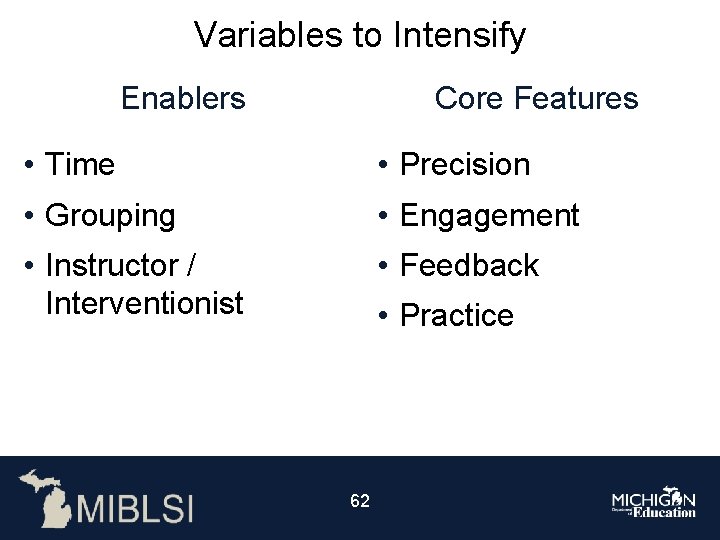
Variables to Intensify Enablers Core Features • Time • Precision • Grouping • Engagement • Instructor / Interventionist • Feedback • Practice 62
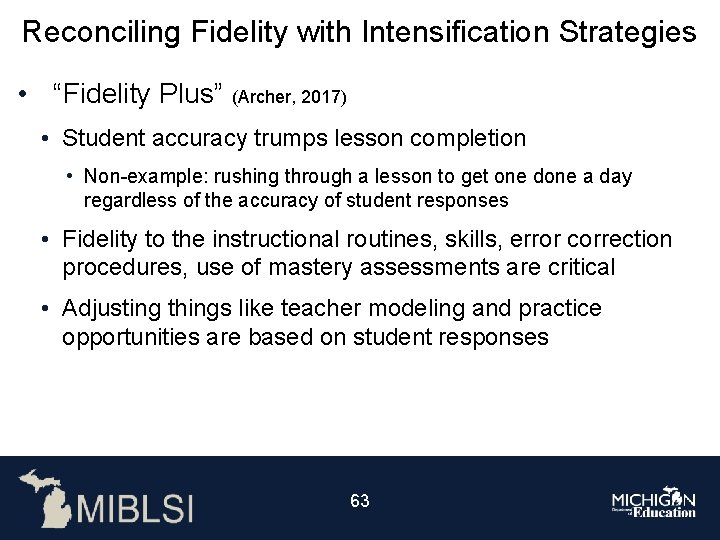
Reconciling Fidelity with Intensification Strategies • “Fidelity Plus” (Archer, 2017) • Student accuracy trumps lesson completion • Non-example: rushing through a lesson to get one done a day regardless of the accuracy of student responses • Fidelity to the instructional routines, skills, error correction procedures, use of mastery assessments are critical • Adjusting things like teacher modeling and practice opportunities are based on student responses 63
Activity 10. 1 • • Access Part 6 of your Google Folder Locate the Intensifying Supports document Review the Core Features rows Discuss as a team the following: • “What do you notice about the movement of increased intensity? ” • “What about this information should be communicated with individuals providing interventions within your school? ” 64
11. 0 Intervention Data Analysis and Use Intervention System: Component 7 65
Necessity of Data Analysis and Use • The key is to accelerate student progress • Analyzing data at multiple levels will make acceleration more of a possibility 66
Levels of Data Analysis 1. School-wide intervention access: percentages of students who need intervention are able to access interventions 2. Intervention in-program assessment data analysis: student mastery assessment data are entered for interventionists to analyze 3. Intervention effectiveness across groupings 67
Data Tool • “Intervention Access and Effectiveness Monitoring Tool” • Access: reviewed quarterly • Effectiveness reviewed every 2 -4 weeks • We have provided you with data analysis questions for each of these levels 68
Activity 11. 1 • Access Part 7 of your Google Folder • You will need to do three things: 1. Note the quarterly meetings your School Leadership Team will be reviewing school-wide intervention access data 2. List dates for when interventionists can come together to learn how to review their intervention mastery assessment data to develop strategies to intensify the intervention 3. Review the Intervention Access and Effectiveness Tool 69
12. 0 Communication Protocols Intervention System: Component 8 70
Intervention System Communication Protocols • Groups / Teams, Staff to communicate: • School leadership team (if you have a separate Intervention System Team) • Grade / cross-department teams • All staff • Central office • Parents • Other? 71
Communication Protocols • Include the following: 1. Protocol (process) for what information needs to be gathered and disseminated to each group / team, in what format, and in a pre-determined timeframe 2. Designees from each group / team that are assigned the task of gathering and disseminating information 72
Activity 12. 1 • Access Part 8 of your Google Folder • Identify / confirm the groups / teams, staff that need intentional communication in the intervention system • Based on everything you have outlined over the two sessions, start to developing your communication • Anything that is not finished should be added to your action plan 73