
Managing the Violent Patient in the Transition from

- Slides: 23
Managing the Violent Patient in the Transition from Prehospital Care to the Emergency Department Jim Holliman, M. D. , F. A. C. E. P. Professor of Military and Emergency Medicine Uniformed Services University of the Health Sciences Clinical Professor of Emergency Medicine George Washington University Bethesda, Maryland, U. S. A.
Managing the Violent Patient in Transition from Prehospital Care to the E. D. ŸLecture Goals : ƒ Present considerations in prehospital management of violent & potentially violent patients –To ensure patient safety –To ensure safety of prehospital personnel –To ensure safety of E. D. staff –To maximize quality and efficiency of patient care
Prehospital Dispatch Considerations ŸPrehospital responders need to be notified right away about any potential violence situations ŸConcurrent or primary dispatch of police units ŸMay need dispatch of more than one EMS unit ŸPresence of weapons at the scene
Potentially Violent Situations for Which Dispatchers Need to Obtain More Information Over the Phone Ÿ"Person down" ƒ Might be victim of violence / assault ŸPatients with suicidal ideation ŸInjuries in a residence ŸAddress where prior violent events reported ŸPatients with prior psychiatric problems
Initial On-Scene Management of Potentially Violent Situations ŸEMS should not enter scene until secure by police ŸRescue in weapons situation should only be by police ŸDo not allow patient to get between EMS personnnel & scene exit ŸAlways keep violent patient in sight ŸRemove potential weapons from scene ƒ Caution if handling will alter evidence needed by police
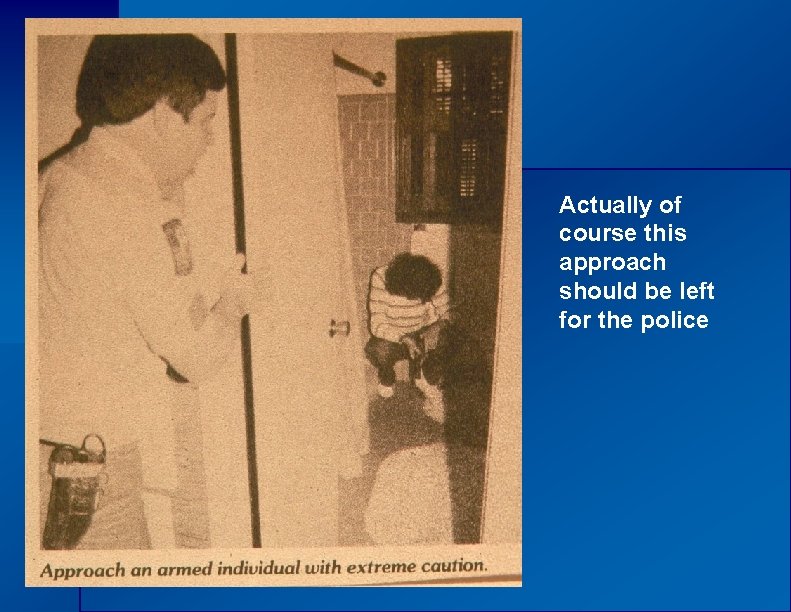
Actually of course this approach should be left for the police
Options to Consider in Disposition of Violent Patients ŸArrest & restraint by police, then transport by police To jail ƒ To medical facility ƒ ŸPolice assist in restraint, then transport in EMS vehicle to medical facility ƒ With or without police in EMS vehicle ŸIf police unwilling to assist in restraint, should call physician medical command to talk to police directly
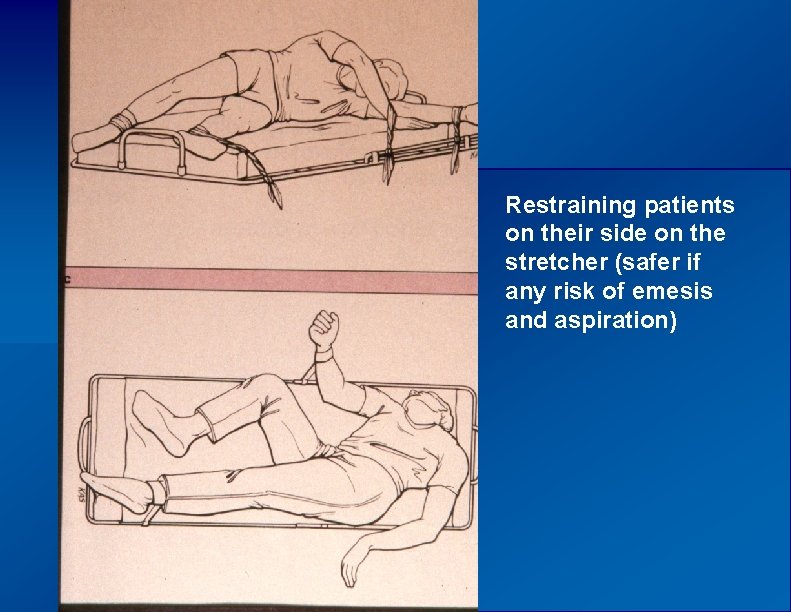
Sequence of Events Needed to Physically Restrain a Violent Patient ŸCollect at least 5 strong personnel ŸDesignate one person in charge ŸPreposition belts & wraps & backboard or scoop stretcher on litter ŸBody fluid precautions ŸOne person preassigned to take each limb & one person immobilizes head ŸMay be safer for some patients to restrain on their side on the stretcher ŸCan pin patient to ground with mattress
Initial Considerations Once the Patient is Physically Restrained ŸSearch clothes for weapons or meds & remove ŸQuickly check for hypoxia, hypoglycemia, hyperthermia, and treat if identified ŸPrecautions against aspiration ƒ Suction should be ready ŸKeep stretcher close to ground level ŸDecide if > 1 person needed in back of ambulance for safety
Personal Protective Measures for Prehospital Personnel ŸBody armor / bullet-proof vests ƒ Protect also well against stabs and blunt chest trauma from MVC's ŸWeapons Should be carried by EMS personnel only if trained equivalent to police ƒ Taser, Mace, or pepper spray may be allowed as last resort in some areas ƒ
Restraint Considerations on the Ambulance Stretcher ŸCervical collar if any possible neck trauma ŸLegs or ankles should not be crossed ŸAdditional belts or straps needed across knees, pelvis or lower back, & upper trunk (extending underneath either arm at the axilla) ŸOxygen mask with high flow O 2 if patient is spitting at EMS personnel ŸProvide padding for stretcher contact points if transport prolonged ŸCheck restrints every 10 minutes for tightness
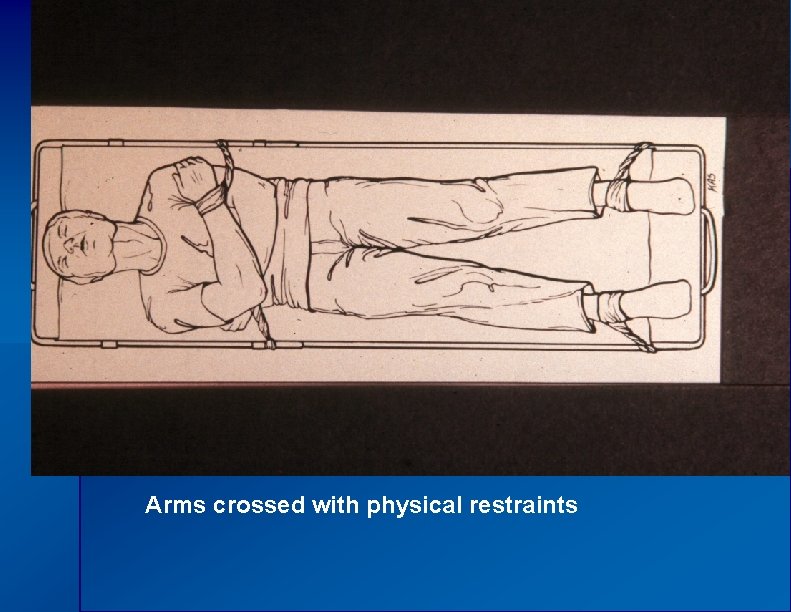
Arms crossed with physical restraints
Restraining patients on their side on the stretcher (safer if any risk of emesis and aspiration)
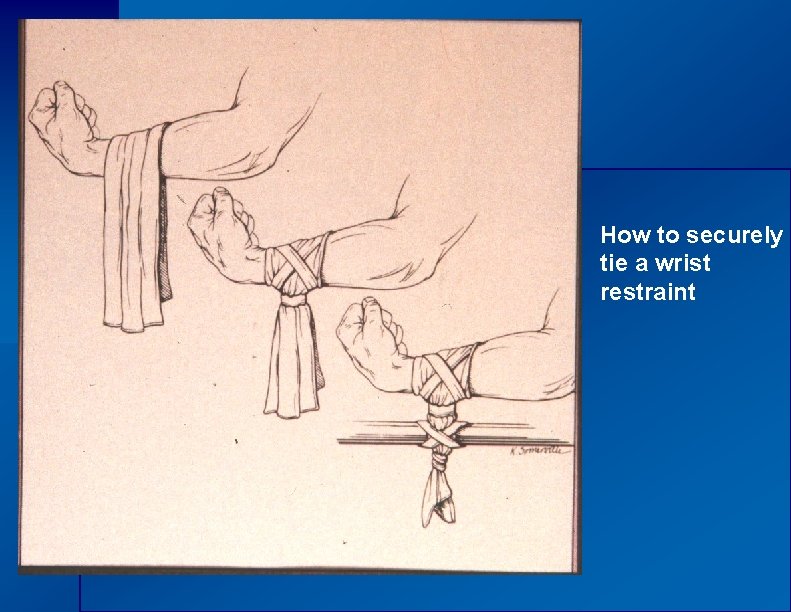
How to securely tie a wrist restraint
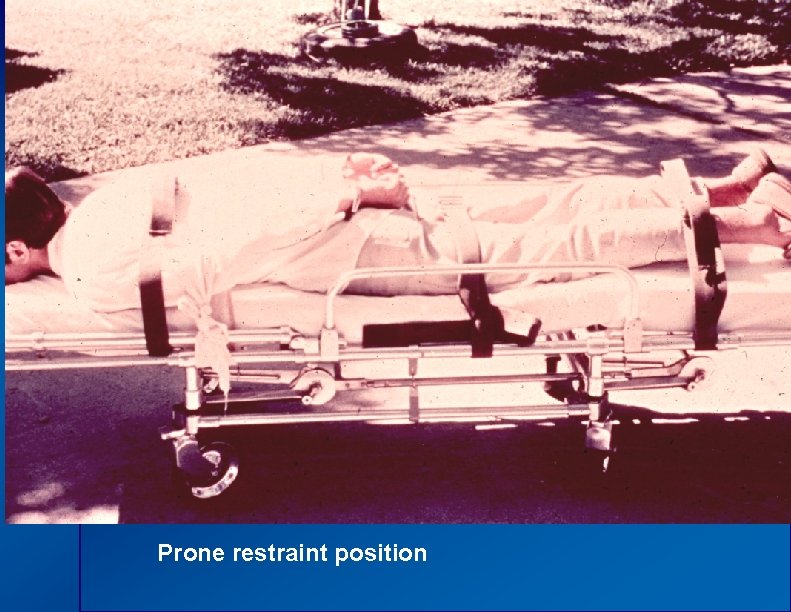
Prone restraint position
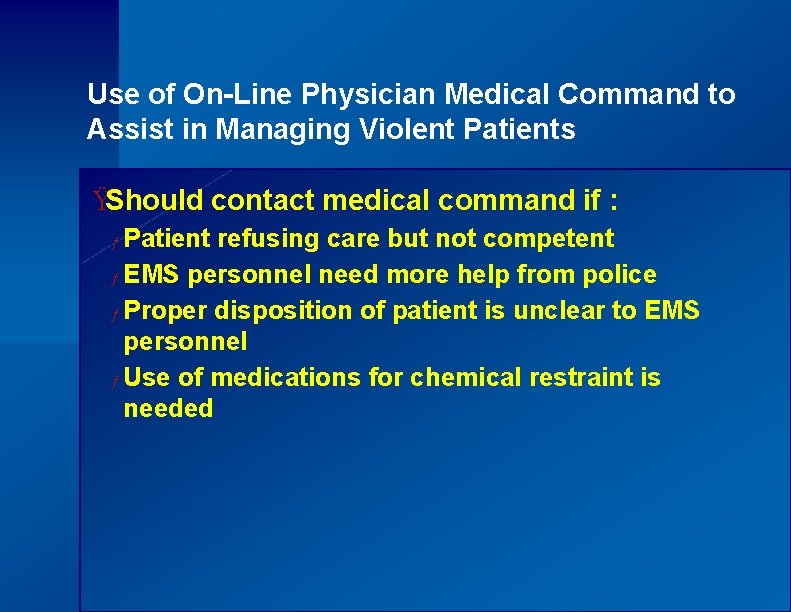
Use of On-Line Physician Medical Command to Assist in Managing Violent Patients ŸShould contact medical command if : Patient refusing care but not competent ƒ EMS personnel need more help from police ƒ Proper disposition of patient is unclear to EMS personnel ƒ Use of medications for chemical restraint is needed ƒ
Use of Chemical Restraints ŸChoices include : Narcotics (morphine) ƒ Benzodiazepines (midazolam, diazepam) –Advantage of these is that they can be reversed by naloxone or flumazenil ƒ Haloperidol ƒ Neuromuscular blockers –Require endotacheal intubation & adavanced training ƒ ŸUse of any agent requires close monitoring
Considerations in Use of Haloperidol for Chemical Restraint ŸOften is agent of choice because does not cause respiratory depression or hypotension ŸCan be given IM or IV (same dose) ŸDose 1 to 10 mg IM or IV ƒ Generally should use 10 mg at a time & may repeat q 10 to 20 minutes if insufficient tranquilization achieved ŸCan cause dystonic reactions ƒ Treat with 25 mg diphenhydramine IV
Considerations in Use of Benzodiazepines for Chemical Restraint ŸCan cause respiratory depression and sometimes hypotension ŸHave adjuctive additional effect to use of haloperidol ŸRarely can cause paradoxical agitation ŸAdvantage of midazolam is that it can be given IM (dose 0. 5 to 2 mg IM or IV, repeat as needed) ŸDiazepam dose 2 to 5 mg IV & repeat as needed
Considerations in Use of Narcotics as Chemical Restraints ŸCommonly cause respiratory depression & / or hypotension ŸAlso may cause nausea / emesis ŸUseful if concurrent pain from injury contributing to patient's combativeness ŸMorphine dose is 1 to 5 mg IM or IV, & repeat as needed
Considerations in Transferring Care of the Violent Patient at the E. D. ŸImportant to bring combatants from different "sides" in the same altercation to different hospitals so they do not resume combat in the E. D. ŸPatient should be directly delivered to E. D. personnel & not left alone ŸNeed to mobilize at least 5 personnel prior to releasing or reapplying any restraints ŸObtain pulse oximetry, temp. , and fingerstick glucose if not done yet
Considerations in Further Care of the Violent Patient in the E. D. ŸPatient at risk for pressure ulcers and rhabdomyolysis with prolonged physical restraint, so early establishment of chemical restraint often preferable ŸAdvise all personnel (radiology, etc. ) about need for continued physical restraints ŸShould have formal restraint protocol to follow ŸRecheck patient frequently ŸDon't leave patient unobserved
Managing Violent Patients from Prehospital to E. D. Care : Summary ŸPrehospital communication by dispatchers is important ŸEMS personnel should first assure their own safety ŸAdequate personnel should be mobilized prior to any physical restraint attempt ŸOnce restraint is achieved, rapid evaluation for medical problems should ensue ŸContinued monitoring is important if chemical restraint is used