
Managing the Statutory Requirements for Assessment April 2011

- Slides: 32
Managing the Statutory Requirements for Assessment April 2011
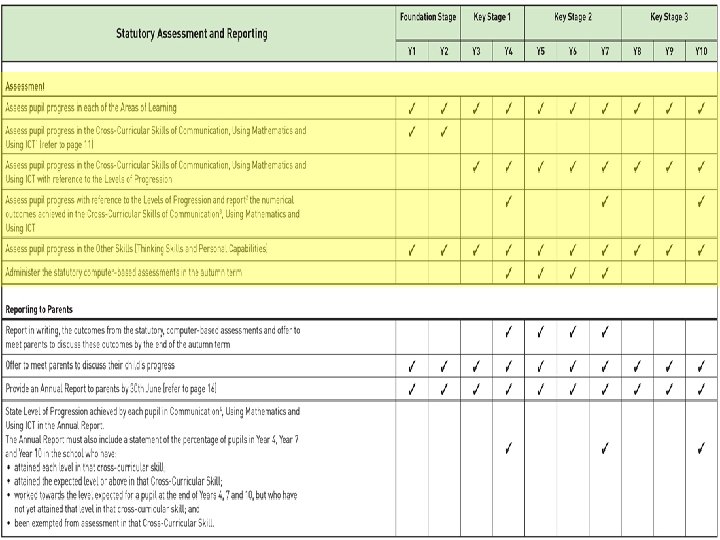
Purpose of the Day 1. To ensure a greater understanding of the statutory assessment arrangements for introduction in 2012/13 2. To consider the management and coordination issues associated with the development of Literacy and meeting the statutory requirements for the assessment of Communication 3. To start to consider and plan the next steps within your own school
Overview of the Day 1. The Statutory Requirements …. What is required? By when? 2. Assessing Communication – Key Messages 3. Managing and Coordinating the Assessment Requirements i. Planning for Assessment ii. Assessment Task for Communication iii. Quality Assurance of Assessment Outcomes 4. Planning the Next Steps
The Statutory Requirements What is required? By when?
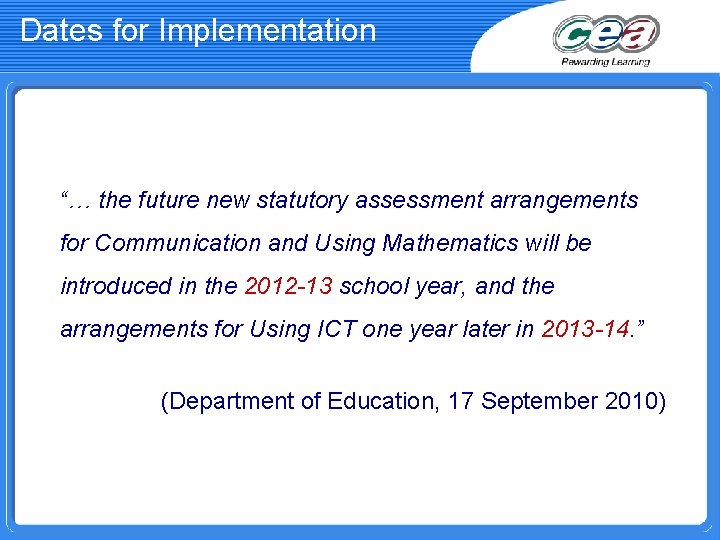
Dates for Implementation “… the future new statutory assessment arrangements for Communication and Using Mathematics will be introduced in the 2012 -13 school year, and the arrangements for Using ICT one year later in 2013 -14. ” (Department of Education, 17 September 2010)
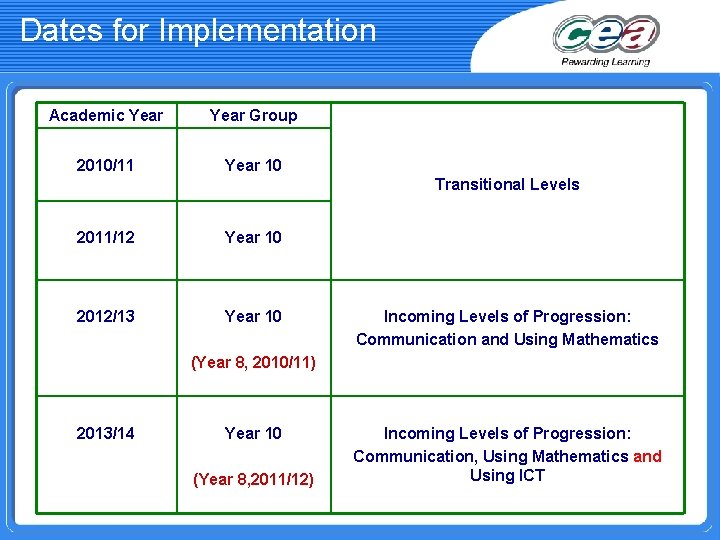
Dates for Implementation Academic Year Group 2010/11 Year 10 Transitional Levels 2011/12 Year 10 2012/13 Year 10 Incoming Levels of Progression: Communication and Using Mathematics (Year 8, 2010/11) 2013/14 Year 10 (Year 8, 2011/12) Incoming Levels of Progression: Communication, Using Mathematics and Using ICT
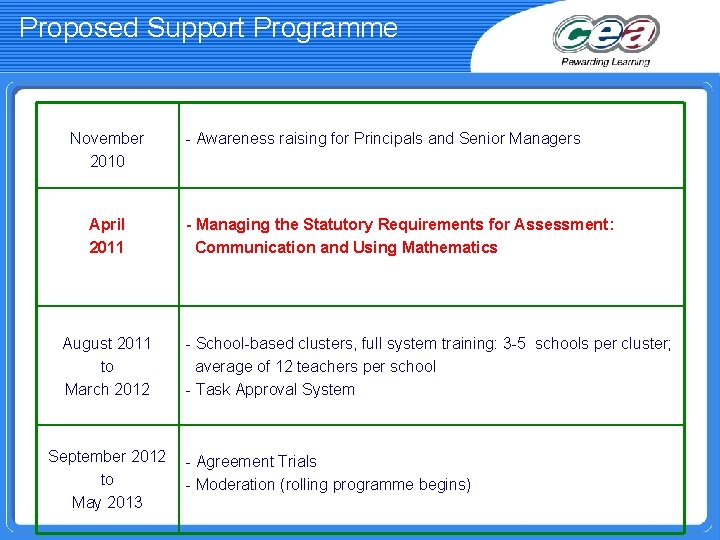
Proposed Support Programme November 2010 April 2011 August 2011 to March 2012 September 2012 to May 2013 - Awareness raising for Principals and Senior Managers - Managing the Statutory Requirements for Assessment: Communication and Using Mathematics - School-based clusters, full system training: 3 -5 schools per cluster; average of 12 teachers per school - Task Approval System - Agreement Trials - Moderation (rolling programme begins)
Assessing Communication Key Messages
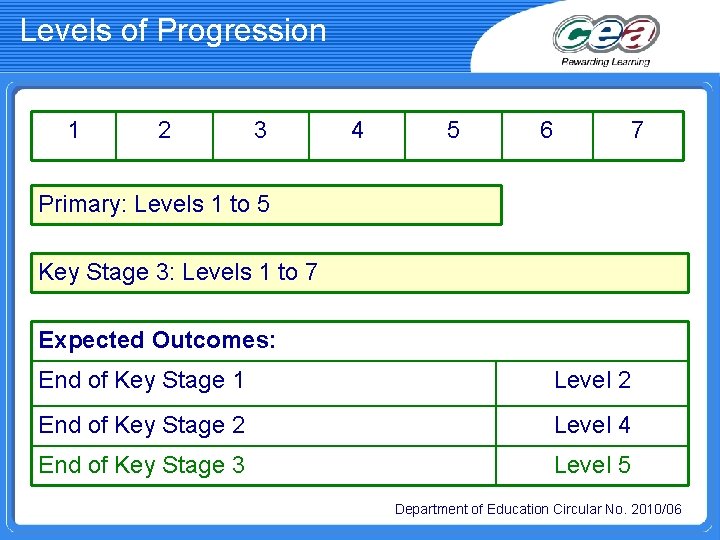
Levels of Progression 1 2 3 4 5 6 7 Primary: Levels 1 to 5 Key Stage 3: Levels 1 to 7 Expected Outcomes: End of Key Stage 1 Level 2 End of Key Stage 2 Level 4 End of Key Stage 3 Level 5 Department of Education Circular No. 2010/06
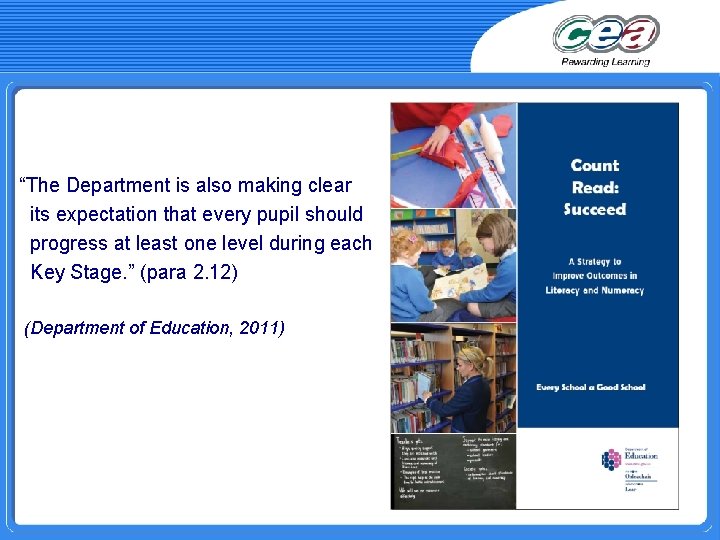
“The Department is also making clear its expectation that every pupil should progress at least one level during each Key Stage. ” (para 2. 12) (Department of Education, 2011)
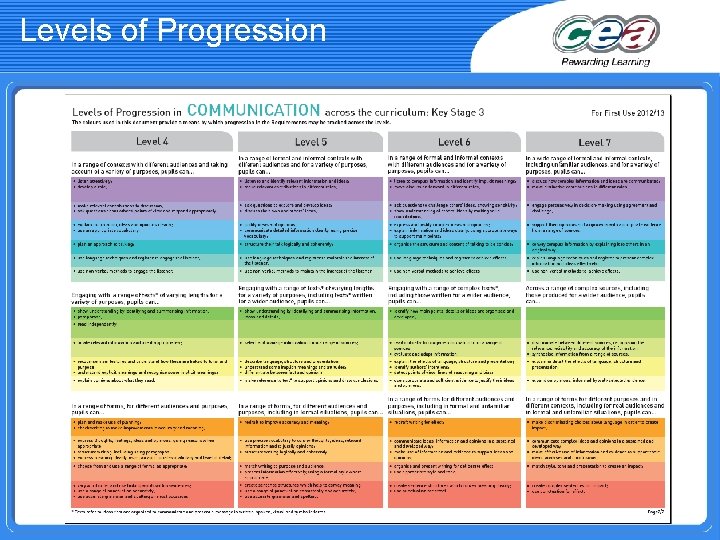
Levels of Progression
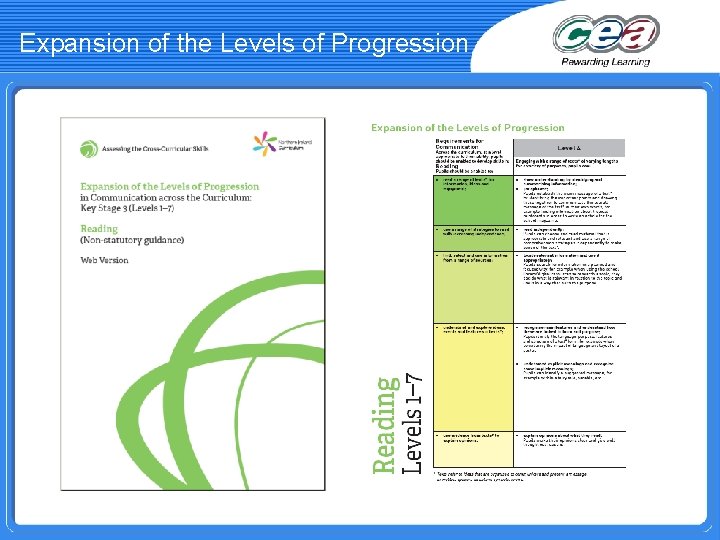
Expansion of the Levels of Progression
“ An emphasis on literacy and numeracy exists across the curriculum. ” (Department of Education, 2009)
Assessing Communication “It is important that post-primary schools ensure that teachers of all subjects help to develop and promote pupils’ literacy and numeracy skills through a whole school approach. ” (para 4. 25) (Department of Education, 2011)
“While recognising that Communication and Using Mathematics are cross-curricular, the mathematics and English (and, in Irishmedium schools, Irish) departments should lead the assessment of numeracy and literacy and be provided with sufficient time and support from school leaders to undertake this role. The cross-curricular nature of Communication and Using Mathematics should be reflected through the whole-school approach to planning for literacy and numeracy, with assessment supported by feedback to the English and mathematics (and, in Irish medium schools, Irish) departments as appropriate. ” (para 4. 27) (Department of Education, 2011)
Reflection Consider the messages presented so far today. Where are you now? What is already happening?
Managing and Coordinating the Assessment Requirements
Planning for Assessment
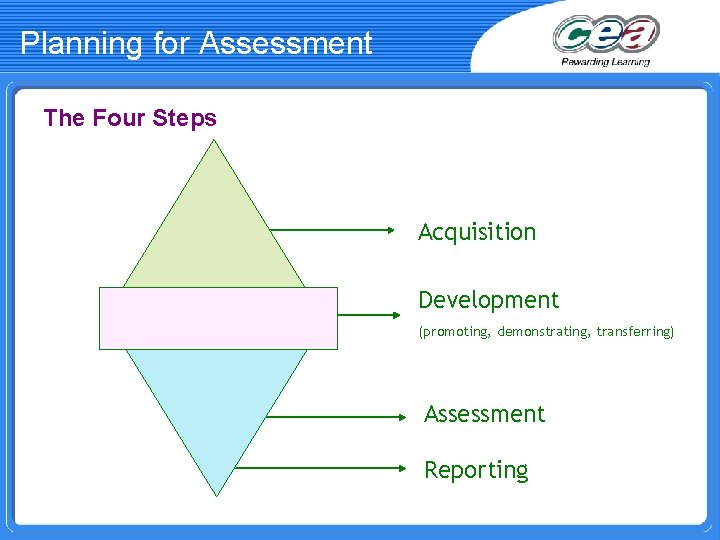
Planning for Assessment The Four Steps Acquisition Development (promoting, demonstrating, transferring) Assessment Reporting
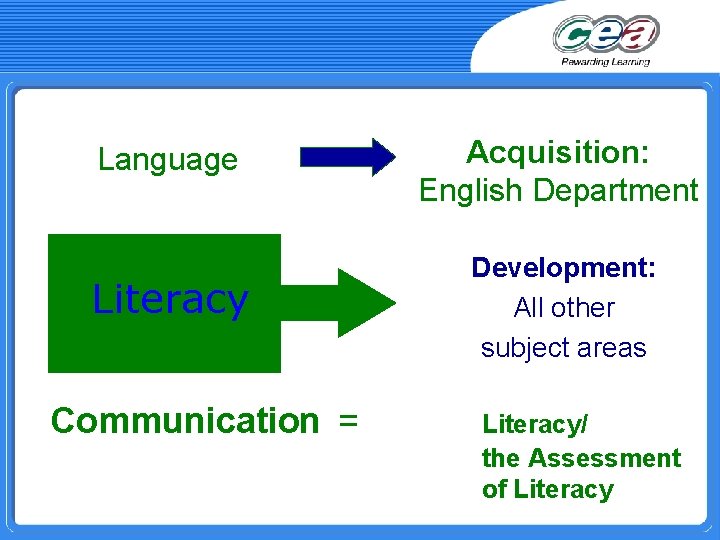
Language Acquisition: English Department Literacy Development: All other subject areas Communication = Literacy/ the Assessment of Literacy
How to make this happen? Consider: - the experience of the pupil in Years 8, 9 and 10? - evidence of progression? - schemes of work? - coordination over the three years?
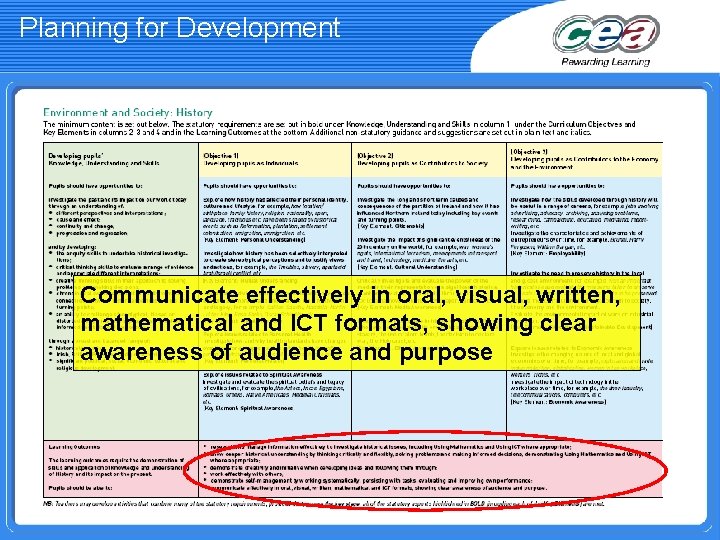
Planning for Development Communicate effectively in oral, visual, written, mathematical and ICT formats, showing clear awareness of audience and purpose
Assessment Tasks for Communication
Let us look at… § A Communication Task
Assessment Tasks for Communication § Purpose of an assessment task § Assessment task design § Assessment task approval process § Support Materials
Quality Assurance of Assessment Outcomes
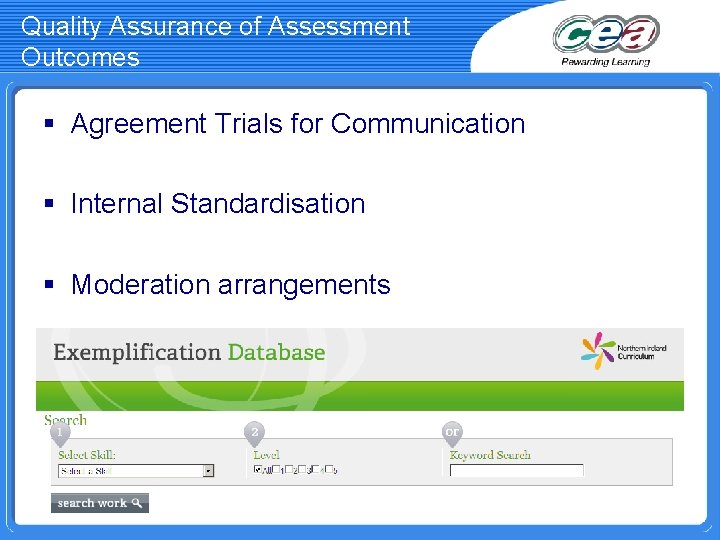
Quality Assurance of Assessment Outcomes § Agreement Trials for Communication § Internal Standardisation § Moderation arrangements
Communication Planning the Next Steps
§ Plenary § Evaluation