
Managing Student Debt An Overview of Consolidation and
Managing Student Debt: An Overview of Consolidation and Refinancing Options Michelle Enriquez, Vice President-Relationship Manager Citizens Bank Student Lending
Overview • Student Loan Debt…The Impact • Federal Student Loan Repayment Plans & Benefits • Differences Between Federal Consolidation & Private Refinance • Private Student Loan Refinance Details • Preparing For Refinance • Maximizing the Power of Your Credit Score • Factors to Consider When Refinancing • Helpful Resources • Questions & Discussion
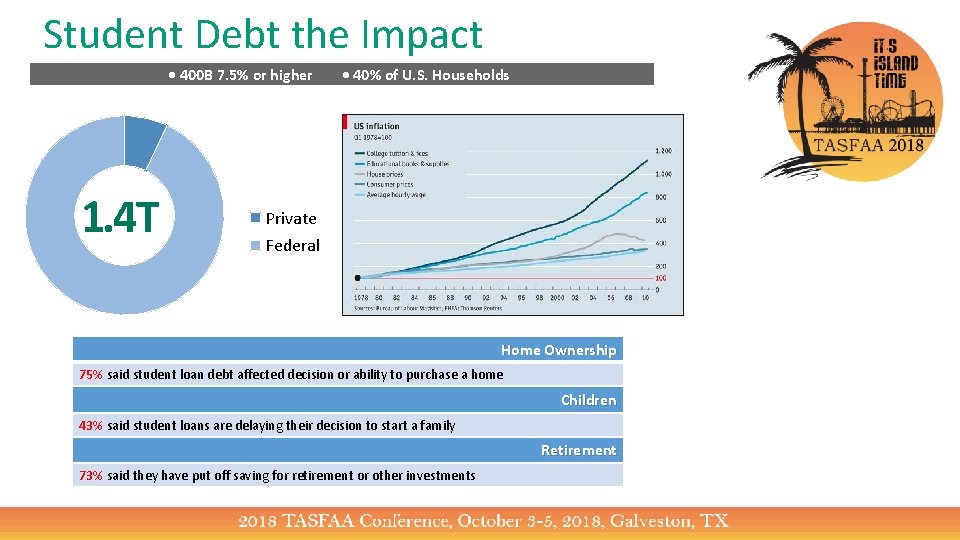
Student Debt the Impact • 400 B 7. 5% or higher 1. 4 T • 40% of U. S. Households Private Federal Home Ownership 75% said student loan debt affected decision or ability to purchase a home Children 43% said student loans are delaying their decision to start a family Retirement 73% said they have put off saving for retirement or other investments
Student Debt - Sources Federal Loans represent 93% of outstanding student debt. Subsidized Stafford Unsubsidized Stafford Federal Perkins Loan Grad PLUS/Parent PLUS Direct Consolidation Loan Private Loans are typically used once the above listed options have been exhausted. They are based on income and credit, and may require a co-signer.
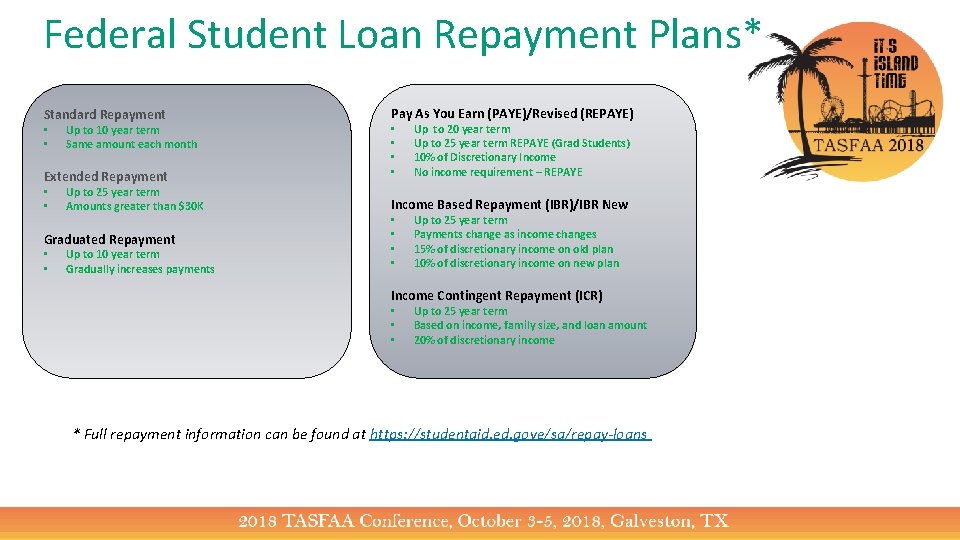
Federal Student Loan Repayment Plans* Standard Repayment • • Up to 10 year term Same amount each month Extended Repayment • • Up to 25 year term Amounts greater than $30 K Graduated Repayment • • Up to 10 year term Gradually increases payments Pay As You Earn (PAYE)/Revised (REPAYE) • • Up to 20 year term Up to 25 year term REPAYE (Grad Students) 10% of Discretionary Income No income requirement – REPAYE Income Based Repayment (IBR)/IBR New • • Up to 25 year term Payments change as income changes 15% of discretionary income on old plan 10% of discretionary income on new plan Income Contingent Repayment (ICR) • • • Up to 25 year term Based on income, family size, and loan amount 20% of discretionary income * Full repayment information can be found at https: //studentaid. ed. gove/sa/repay-loans
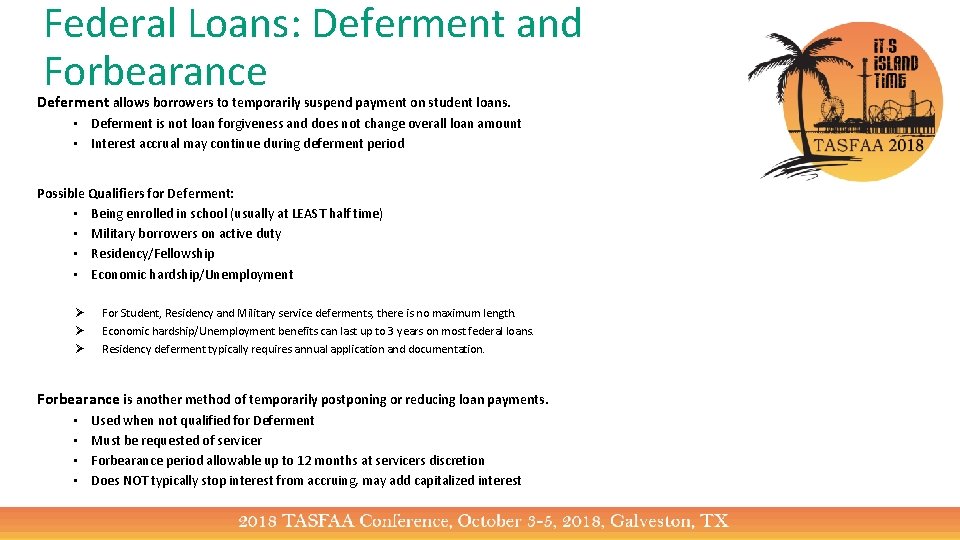
Federal Loans: Deferment and Forbearance Deferment allows borrowers to temporarily suspend payment on student loans. • Deferment is not loan forgiveness and does not change overall loan amount • Interest accrual may continue during deferment period Possible Qualifiers for Deferment: • Being enrolled in school (usually at LEAST half time) • Military borrowers on active duty • Residency/Fellowship • Economic hardship/Unemployment Ø Ø Ø For Student, Residency and Military service deferments, there is no maximum length. Economic hardship/Unemployment benefits can last up to 3 years on most federal loans. Residency deferment typically requires annual application and documentation. Forbearance is another method of temporarily postponing or reducing loan payments. • • Used when not qualified for Deferment Must be requested of servicer Forbearance period allowable up to 12 months at servicers discretion Does NOT typically stop interest from accruing, may add capitalized interest

Federal Loans: Loan Forgiveness and Discharge Loan Forgiveness & Discharge options may exist under certain conditions: • Teacher Loan Forgiveness programs • School Related Discharge (School closing, Fraud, ID Theft, False Certification, Unpaid Refund) • Public Service Loan Forgiveness Currently there also loan forgiveness programs for underserved populations. • Most are restricted by specialty • Service requirements and amount of debt forgiven vary by program • Obligated physicians were found to be more satisfied with their work and more likely to remain at their place of work than non-obligated physicians Loans may be discharged/forgiven in cases of total and permanent disability, death, and in rare cases during bankruptcy proceedings. *Federal Forgiveness & Discharge information can be found at https: //studentaid. ed. gov/sa/repay-loans/forgiveness-cancellation
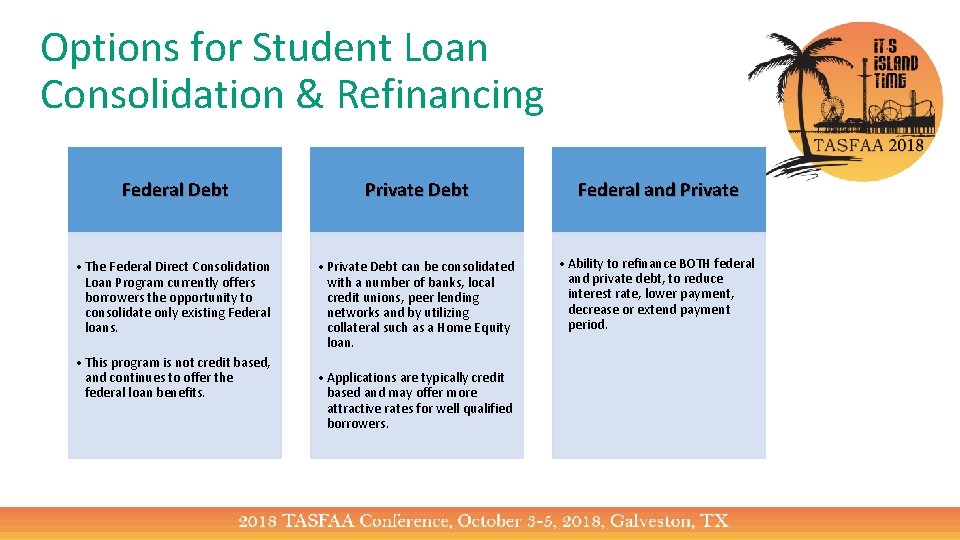
Options for Student Loan Consolidation & Refinancing Federal Debt Private Debt Federal and Private • The Federal Direct Consolidation Loan Program currently offers borrowers the opportunity to consolidate only existing Federal loans. • Private Debt can be consolidated with a number of banks, local credit unions, peer lending networks and by utilizing collateral such as a Home Equity loan. • Ability to refinance BOTH federal and private debt, to reduce interest rate, lower payment, decrease or extend payment period. • This program is not credit based, and continues to offer the federal loan benefits. • Applications are typically credit based and may offer more attractive rates for well qualified borrowers.
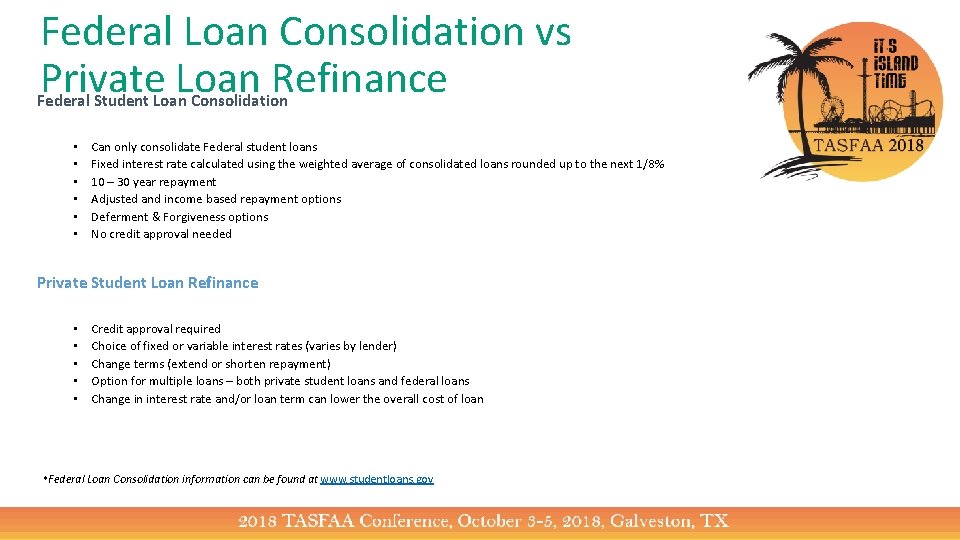
Federal Loan Consolidation vs Private Loan Refinance Federal Student Loan Consolidation • • • Can only consolidate Federal student loans Fixed interest rate calculated using the weighted average of consolidated loans rounded up to the next 1/8% 10 – 30 year repayment Adjusted and income based repayment options Deferment & Forgiveness options No credit approval needed Private Student Loan Refinance • • • Credit approval required Choice of fixed or variable interest rates (varies by lender) Change terms (extend or shorten repayment) Option for multiple loans – both private student loans and federal loans Change in interest rate and/or loan term can lower the overall cost of loan *Federal Loan Consolidation information can be found at www. studentloans. gov

Private Bank Education Refinance Loan Existing Private and Federal Student Loans Bar Study or Residency Loan Prior Education Loan Consolidation One Education Refinance Loan • Borrowers can combine multiple existing private and federal student loans into a single new private student loan • Usually as many as fifteen loans or as few as one loan • Can include bar study and residency loans • Cannot include • Any other non-student loan debt (even if it was used to pay for school, such as credit card or home equity • Typically, borrowers may choose to apply alone or with a cosigner
Possible Education Refinance Loan Eligibility Requirements • Cannot be currently enrolled in school • Eligible applicants with Graduate Degree or above can refinance at any time after graduation • Eligible applicants with a Bachelor’s Degree or less must be in repayment on their student loan(s) • Applicants with a bachelor’s degree may be eligible to refinance their student loan(s) upon making 3 consecutive, on-time monthly payments • Applicants without a bachelor’s degree may be eligible to refinance their student loan(s) upon making 12 consecutive, on-time monthly payments
Possible Education Refinance Loan Eligibility Requirements • Borrower or cosigner, if applicable, with a graduate degree or above, must demonstrate current minimum income • Borrower or cosigner, if applicable, with a bachelor’s degree or less, must demonstrate 12 consecutive months of recent earnings history • Borrower and Co-signer (if applicable) must be U. S. citizen, permanent resident or resident alien with a valid U. S. Social Security Number residing in the United States • Borrower must meet the age of majority • Meet all credit requirements
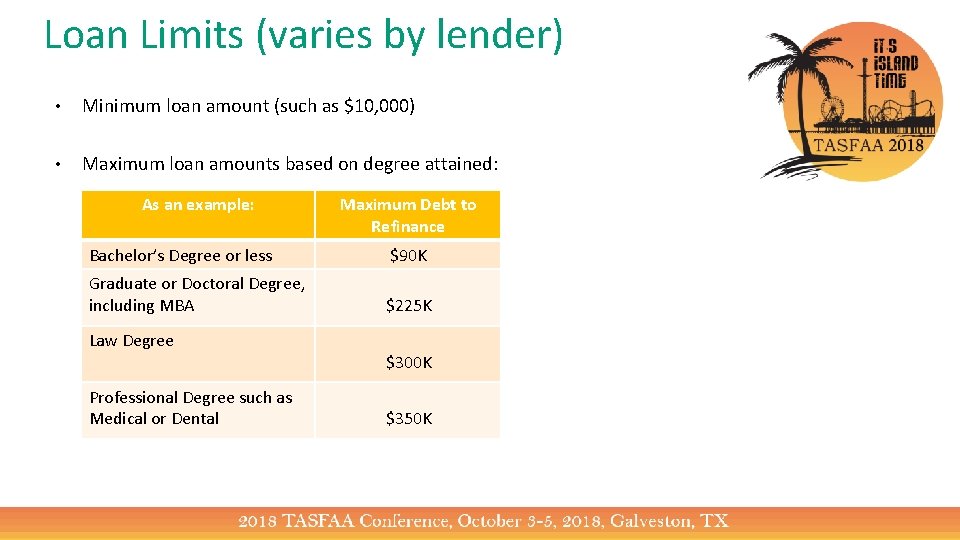
Loan Limits (varies by lender) • Minimum loan amount (such as $10, 000) • Maximum loan amounts based on degree attained: As an example: Maximum Debt to Refinance Bachelor’s Degree or less $90 K Graduate or Doctoral Degree, including MBA $225 K Law Degree Professional Degree such as Medical or Dental $300 K $350 K
Private Education Refinance Loan Borrower Benefits • Interest Rate Reductions (varies by lender) • Existing bank customers (borrower or co-signer) receive an immediate percentage point interest rate reduction • Automatic Payment Discount: Borrowers receive a 0. 25 percentage point interest rate reduction for auto payments from any bank • Cosigner Release (varies by lender) • Lenders may provide an option for the cosigner to be released after the borrower makes 36 months of consecutive on-time payments provided that the borrower meets credit criteria • Loan Forgiveness (varies by lender) • In the unfortunate event of the borrower’s death or permanent and total disability – regardless of the presence of a cosigner Please contact your lender for full eligibility requirements for any borrower benefits.
How to Prepare for Private Loan Refinance • Compare your current student loan terms with available options • Determine which loans you would like to consolidate • Research and select the lender that best meets your needs • Gather necessary documentation: Social Security Number Gross monthly income (2 pay stubs or other documentation) Employer name, phone number and length of employment Monthly rent or mortgage payment Current statements & information from your existing loans, including lender, account number, payment, existing balance, term and rate ü Keep in mind that self employment is typically more involved & requires detailed tax returns. Income is determined not only by your take home but the impact of any business losses as well. ü ü ü • Continue making payments until the loans are consolidated as it can take up to 2 billing cycles before the process is complete
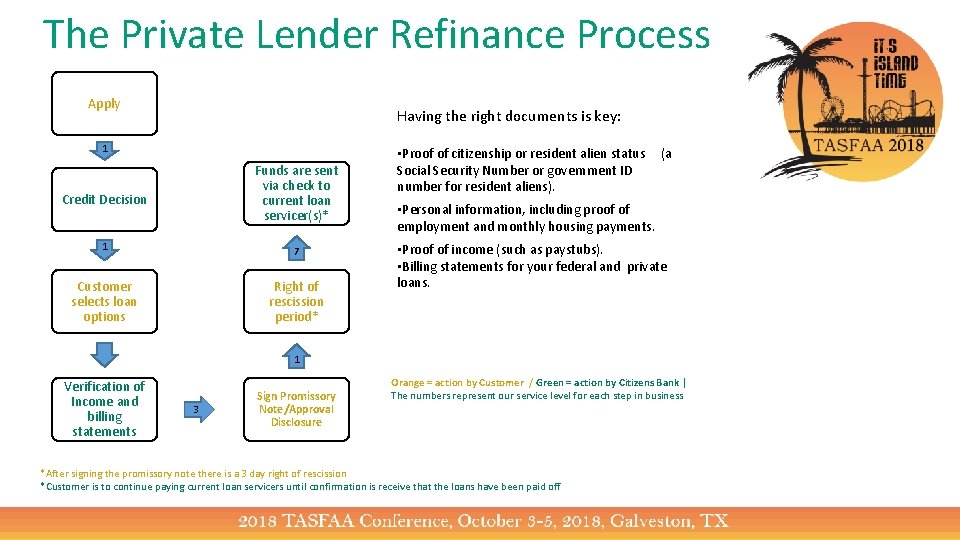
The Private Lender Refinance Process Apply Having the right documents is key: 1 Funds are sent via check to current loan servicer(s)* Credit Decision 1 7 Customer selects loan options Right of rescission period* • Proof of citizenship or resident alien status Social Security Number or government ID number for resident aliens). (a • Personal information, including proof of employment and monthly housing payments. • Proof of income (such as paystubs). • Billing statements for your federal and private loans. 1 Verification of Income and billing statements 3 Sign Promissory Note/Approval Disclosure Orange = action by Customer / Green = action by Citizens Bank | The numbers represent our service level for each step in business *After signing the promissory note there is a 3 day right of rescission *Customer is to continue paying current loan servicers until confirmation is receive that the loans have been paid off
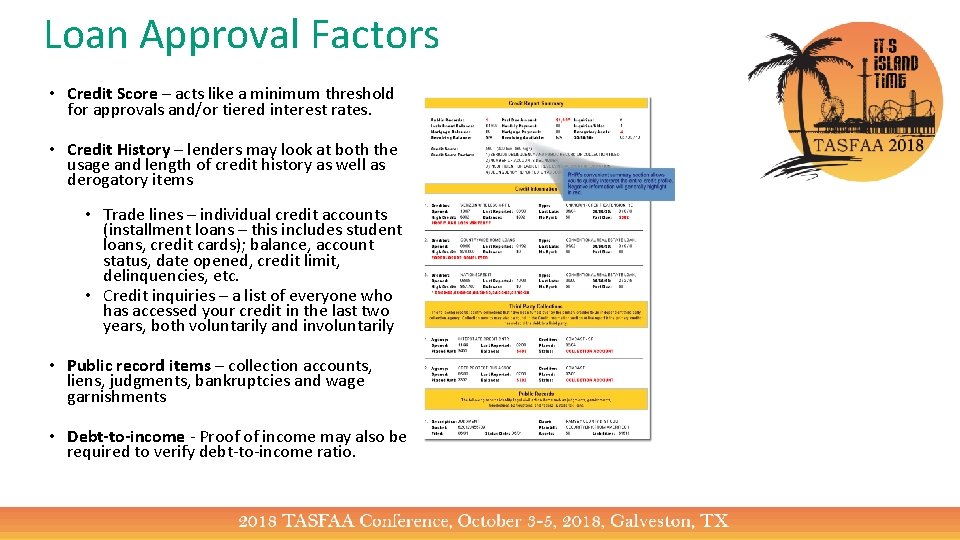
Loan Approval Factors • Credit Score – acts like a minimum threshold for approvals and/or tiered interest rates. • Credit History – lenders may look at both the usage and length of credit history as well as derogatory items • Trade lines – individual credit accounts (installment loans – this includes student loans, credit cards); balance, account status, date opened, credit limit, delinquencies, etc. • Credit inquiries – a list of everyone who has accessed your credit in the last two years, both voluntarily and involuntarily • Public record items – collection accounts, liens, judgments, bankruptcies and wage garnishments • Debt-to-income - Proof of income may also be required to verify debt-to-income ratio.
Your Credit Score – The Impact on Your Rate • Websites such as www. myfico. com provide a FICO score for a charge. • www. annualcreditreport. com free copy of your credit report from each of the 3 bureaus. • Denied credit? You may request a copy of your credit report. • Read the fine print when pulling a credit score – many consumer sites (such as credit monitoring companies) offer a credit score. This is not necessarily a FICO score. • Some companies create scoring models with different factors/percentages. The score you are given may not be the FICO score the lenders are seeing.
Maximizing the Power of Your Credit Score
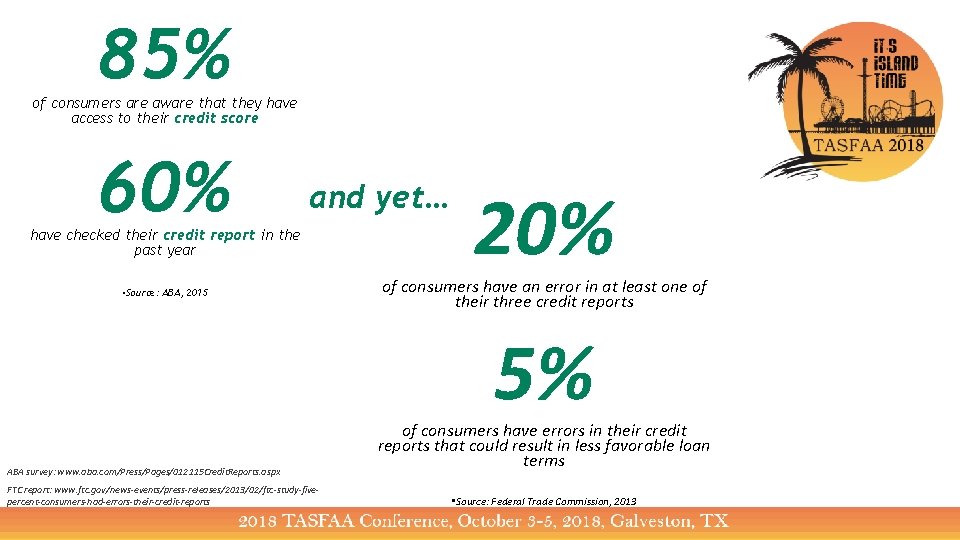
85% of consumers are aware that they have access to their credit score 60% and yet… have checked their credit report in the past year • Source: ABA, 2015 20% of consumers have an error in at least one of their three credit reports 5% ABA survey: www. aba. com/Press/Pages/012115 Credit. Reports. aspx FTC report: www. ftc. gov/news-events/press-releases/2013/02/ftc-study-fivepercent-consumers-had-errors-their-credit-reports of consumers have errors in their credit reports that could result in less favorable loan terms • Source: Federal Trade Commission, 2013
What Should You Do With Your Credit Report? Review your credit report regularly. If you see any errors you can dispute them by contacting the company or lender in question or by contacting any of the three reporting agencies (each has a dispute form on its website). • If you see any errors, fill out the dispute forms at the credit reporting agencies websites and contact the company or lender involved. • You cannot "fix" your credit score, but over time, you can improve it.
Why Does Your Credit Score Matter? • It helps lenders evaluate your credit risk • It is viewed any time you apply for a credit card or any type of loan linked to your social security number • It impacts the following life events: • • • Getting a mortgage Renting a home Buying or leasing a car Securing a credit card Applying for a job Refinancing debt
What is a Good Score? • The national average score is 695. Scores range from 300 -850. • A higher score demonstrates lower credit risk, while a lower score demonstrates higher credit risk. • What’s considered a “good” score varies by lender. For example, one lender may offer its lowest interest rates to people with scores above 730, while another lender only offers its lowest interest rates to people with scores above 760. Source: www. valuepenguin. com/average-credit-score
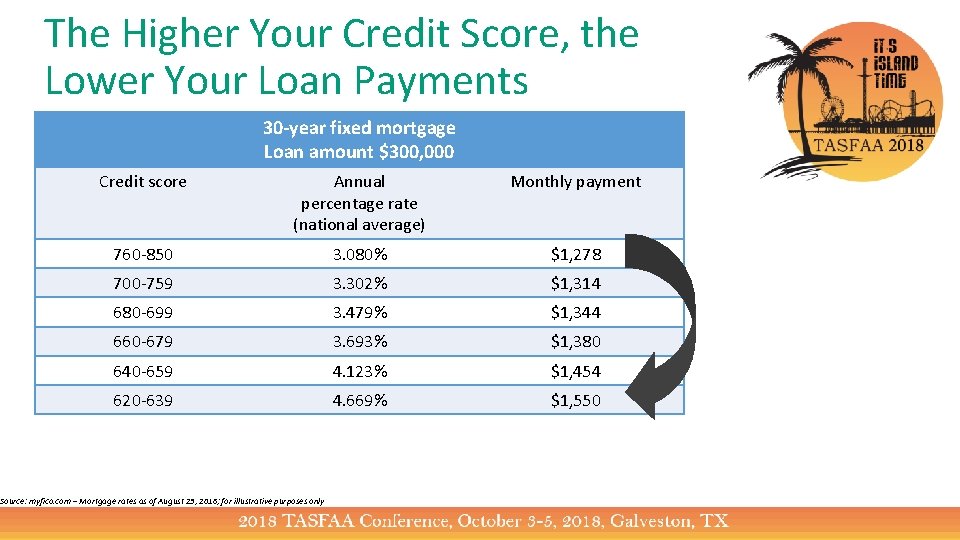
The Higher Your Credit Score, the Lower Your Loan Payments 30 -year fixed mortgage Loan amount $300, 000 Credit score Annual percentage rate (national average) Monthly payment 760 -850 3. 080% $1, 278 700 -759 3. 302% $1, 314 680 -699 3. 479% $1, 344 660 -679 3. 693% $1, 380 640 -659 4. 123% $1, 454 620 -639 4. 669% $1, 550 Source: myfico. com – Mortgage rates as of August 23, 2016; for illustrative purposes only
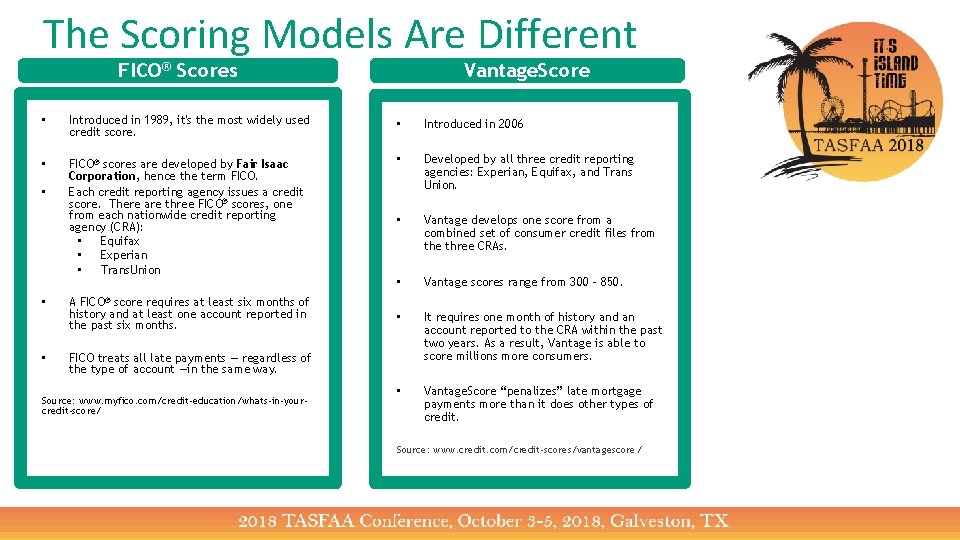
The Scoring Models Are Different FICO® Scores Vantage. Score • Introduced in 1989, it's the most widely used credit score. • Introduced in 2006 • FICO® scores are developed by Fair Isaac Corporation, hence the term FICO. Each credit reporting agency issues a credit score. There are three FICO® scores, one from each nationwide credit reporting agency (CRA): • Equifax • Experian • Trans. Union • Developed by all three credit reporting agencies: Experian, Equifax, and Trans Union. • Vantage develops one score from a combined set of consumer credit files from the three CRAs. • Vantage scores range from 300 – 850. • It requires one month of history and an account reported to the CRA within the past two years. As a result, Vantage is able to score millions more consumers. • Vantage. Score “penalizes” late mortgage payments more than it does other types of credit. • • • A FICO® score requires at least six months of history and at least one account reported in the past six months. FICO treats all late payments — regardless of the type of account —in the same way. Source: www. myfico. com/credit-education/whats-in-yourcredit-score/ Source: www. credit. com/credit-scores/vantagescore/
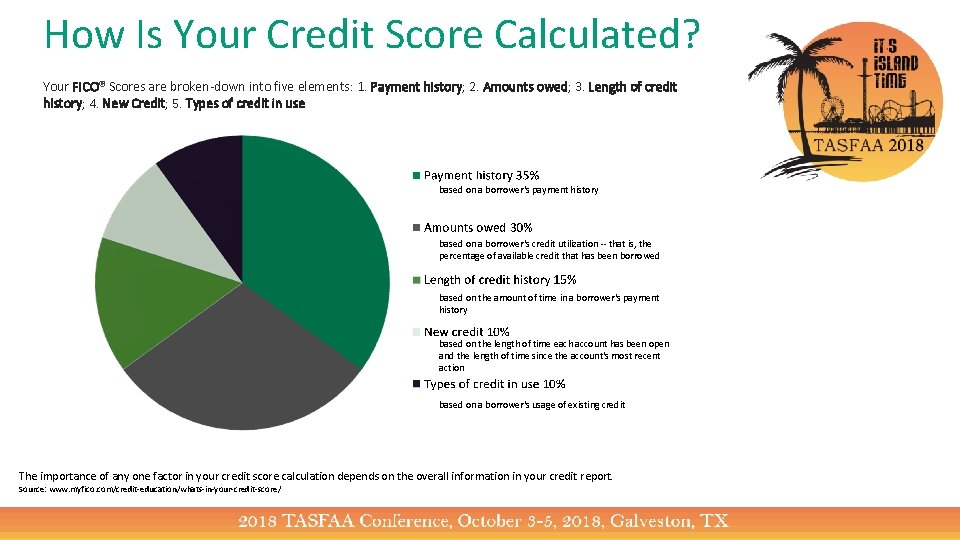
How Is Your Credit Score Calculated? Your FICO® Scores are broken-down into five elements: 1. Payment history; 2. Amounts owed; 3. Length of credit history; 4. New Credit; 5. Types of credit in use based on a borrower's payment history based on a borrower's credit utilization -- that is, the percentage of available credit that has been borrowed based on the amount of time in a borrower's payment history based on the length of time each account has been open and the length of time since the account's most recent action based on a borrower's usage of existing credit The importance of any one factor in your credit score calculation depends on the overall information in your credit report. Source: www. myfico. com/credit-education/whats-in-your-credit-score/
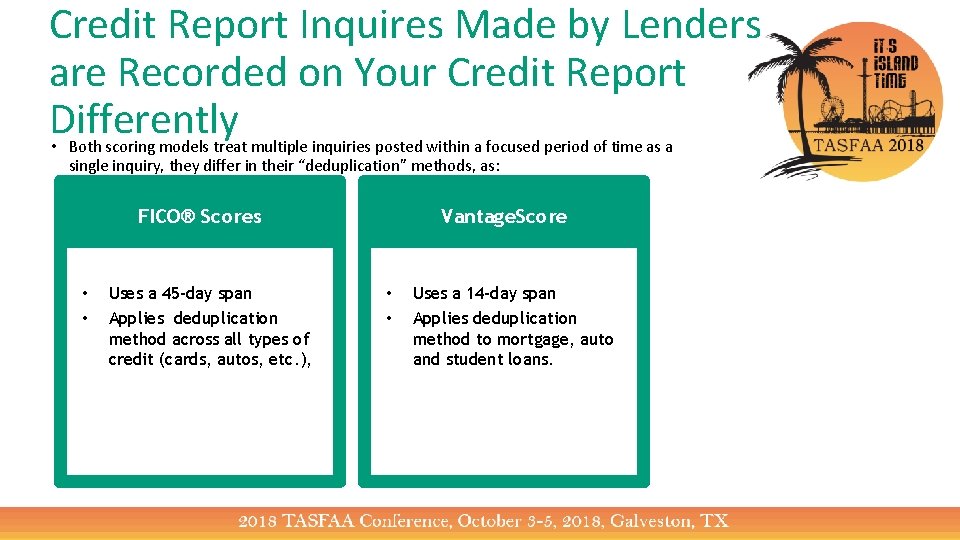
Credit Report Inquires Made by Lenders are Recorded on Your Credit Report Differently • Both scoring models treat multiple inquiries posted within a focused period of time as a single inquiry, they differ in their “deduplication” methods, as: FICO® Scores • • Uses a 45 -day span Applies deduplication method across all types of credit (cards, autos, etc. ), Vantage. Score • • Uses a 14 -day span Applies deduplication method to mortgage, auto and student loans.
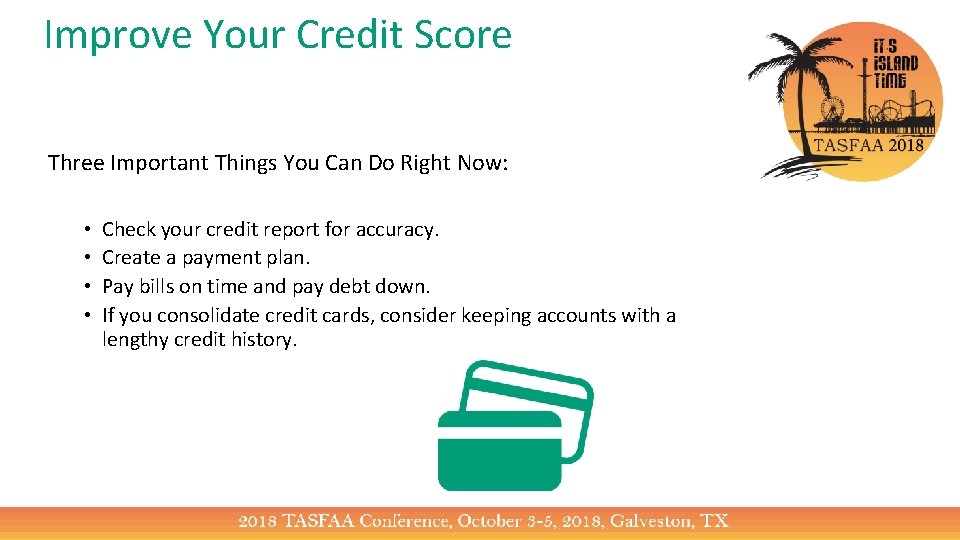
Improve Your Credit Score Three Important Things You Can Do Right Now: • • Check your credit report for accuracy. Create a payment plan. Pay bills on time and pay debt down. If you consolidate credit cards, consider keeping accounts with a lengthy credit history.
Credit Reporting Agency Contact Information • Annual. Credit. Report. com or 1 -877 -322 -8228 • Equifax. com or 1 -800 -846 -5279 • Experian. com or 1 -888 -EXPERIAN (397 -3742) • Trans. Union. com or 1 -800 -888 -4213 • My. FICO. com
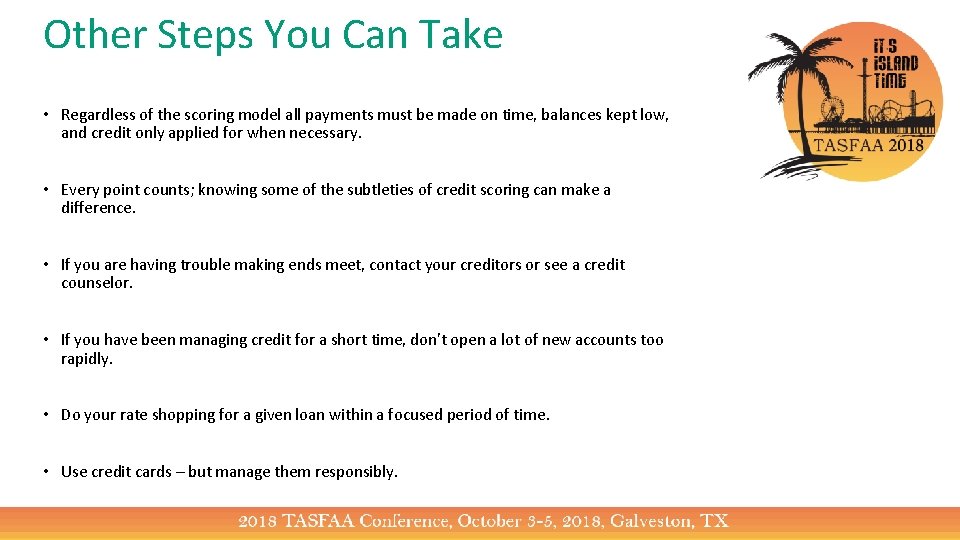
Other Steps You Can Take • Regardless of the scoring model all payments must be made on time, balances kept low, and credit only applied for when necessary. • Every point counts; knowing some of the subtleties of credit scoring can make a difference. • If you are having trouble making ends meet, contact your creditors or see a credit counselor. • If you have been managing credit for a short time, don't open a lot of new accounts too rapidly. • Do your rate shopping for a given loan within a focused period of time. • Use credit cards – but manage them responsibly.
Refinancing Student Loans – Quick Review Advantages • Convenience & Simplification – one monthly payment • Lower interest rate and overall lower cost of borrowing • Lower monthly payment as a result of a longer repayment term • Move from variable rate to fixed rate • No application, origination, or disbursement fees (based on lender) • No prepayment penalties (based on lender) • Select your own repayment terms (based on lender) • Borrower Benefits (rate reductions, based on lender) • Deferment & Forbearance Options (based on lender) In-School, Residency/Internship, Military, Hardship • Cosigner Release (based on lender) • Loan Forgiveness (based on lender) Disadvantages • Longer repayment term could mean higher total cost • Loss of borrower benefits from original loan (if applicable) • Possible loss of subsidy or forgiveness
FAQ’s – Is Education Loan Refinancing Right for Me Frequently Asked Questions § How do I decide if refinancing is the right thing for me? There are many potential benefits, but keep in mind that when you refinance your student loans, you replace all of your current and future benefits with the benefits of the new refinance loan. § How good must my credit be to be Eligible? Most lenders require a reasonably strong credit history, which is derived from your credit score, along with a minimum household income (for either the borrower or co‑signer). § Is it necessary to have a cosigner? Although a co‑signer is not required, if you have little or no credit history, it’s best to apply with a qualified co‑signer to increase your chances of being approved. A qualified co‑signer can sometimes help you secure a lower interest rate. § How will applying impact my credit score? Since most bank loans are credit-based, any applications submitted will result in an inquiry on the applicants' credit report. § What is the difference between a fixed and a variable rate loan? Initially, a variable rate loan may be lower than a fixed rate option. However, over time the variable rate may change based on the one‑month LIBOR or the Prime Rate, and the monthly payment amount may change as well. A fixed rate will remain the same over the life of the loan, and you’ll owe the same monthly payment each month.
Managing Student Loan Debt – Helpful Resources Federal Student Aid Information: www. studentaid. ed. gov Federal Student Aid, Account Management: https: //studentloans. gov/my. Direct. Loan/index. action National Student Loan Data System (NSLDS): https: //www. nslds. ed. gov/nslds_SA/ Federal Loan Consolidation Information: www. studentloans. gov Loan Consolidation/Repay Information: https: //studentaid. ed. gov/sa/repay-loans Federal Public Service Loan Forgiveness: www. studentaid. gov/publicservice Citizens Bank Resources Student Services &Tools: http: //www. citizensbank. com/student-services Helpful Credit Advice: https: //www. citizensbank. com/student-loans/tools. aspx Credit Score Resources Annual. Credit. Report. com or 1 -877 -322 -8228 Equifax. com or 1 -800 -846 -5279 Experian. com or 1 -888 -EXPERIAN (397 -3742) Trans. Union. com or 1 -800 -888 -4213 my. FICO. com
Citizens Bank Legal Disclaimer The information presented in these materials are intended and written to be educational only. This presentation is not intended or written to be relied on for tax or legal advice. We are not in the business of providing tax or legal advice. Please seek advice based on your particular situation from an independent tax or legal advisor. Member FDIC. Equal Housing Lender. Citizens Bank® is a brand name of Citizens Bank, N. A. (NMLS ID #433960) and Citizens Bank of Pennsylvania (NMLS #522615).
- Slides: 34