
MANAGING STRATEGY 9 Copyright 2014 2016 Pearson Education
- Slides: 36
MANAGING STRATEGY 9 Copyright © © 2014 2016 Pearson Education, Ltd. 9 -1
LEARNING OBJECTIVES 1. Define strategic management and explain why it’s 2. 3. 4. 5. important. Explain what managers do during the six steps of the strategic management process. • Know how to identify your own personal strengths and weaknesses and deal with them. • Develop your skill at strategic planning. Describe three types of corporate strategies. Describe competitive advantage and the competitive strategies organizations use to get it. Discuss current strategic management issues. Copyright © © 2014 2016 Pearson Education, Ltd. 9 -2
WHAT IS STRATEGIC MANAGEMENT? Strategic management – what managers do to develop the organization’s strategies. • Strategies – the plans for how the organization will do what it’s in business to do, how it will compete successfully, and how it will attract and satisfy its customers in order to achieve its goals. • Business model – how a company is going to make money. Copyright © © 2014 2016 Pearson Education, Ltd. 9 -3
WHY IS STRATEGIC MANAGEMENT IMPORTANT? 1. It results in higher organizational performance. 2. It requires that managers examine and adapt to business environment changes. 3. It coordinates diverse organizational units, helping them focus on organizational goals. Copyright © © 2014 2016 Pearson Education, Ltd. 9 -4
THE STRATEGIC MANAGEMENT PROCESS Strategic management process – a six- step process that encompasses strategic planning, implementation, and evaluation. Copyright © © 2014 2016 Pearson Education, Ltd. 9 -5
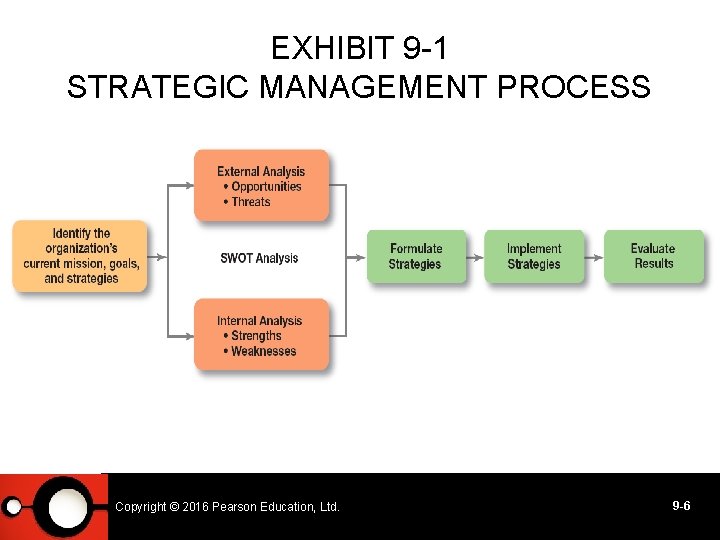
EXHIBIT 9 -1 STRATEGIC MANAGEMENT PROCESS Copyright © © 2014 2016 Pearson Education, Ltd. 9 -6
THE STRATEGIC MANAGEMENT PROCESS (CONT. ) Step 1: Identifying the organization’s current mission, goals, and strategies: – Mission: a statement of the purpose of an organization. • The scope of its products and services – Goals: the foundation for further planning. • Measurable performance targets Copyright © © 2014 2016 Pearson Education, Ltd. 9 -7
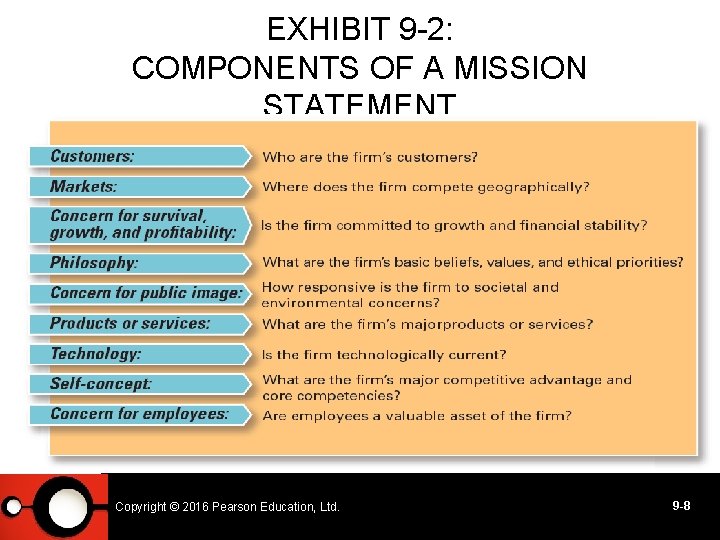
EXHIBIT 9 -2: COMPONENTS OF A MISSION STATEMENT Copyright © © 2014 2016 Pearson Education, Ltd. 9 -8
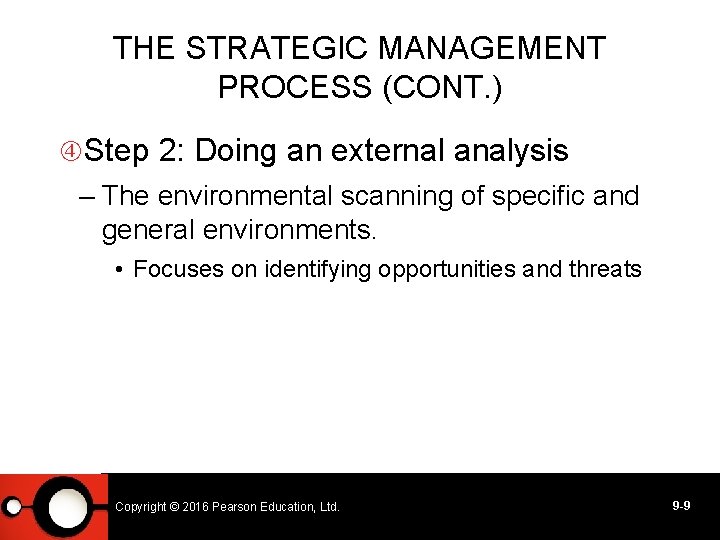
THE STRATEGIC MANAGEMENT PROCESS (CONT. ) Step 2: Doing an external analysis – The environmental scanning of specific and general environments. • Focuses on identifying opportunities and threats Copyright © © 2014 2016 Pearson Education, Ltd. 9 -9
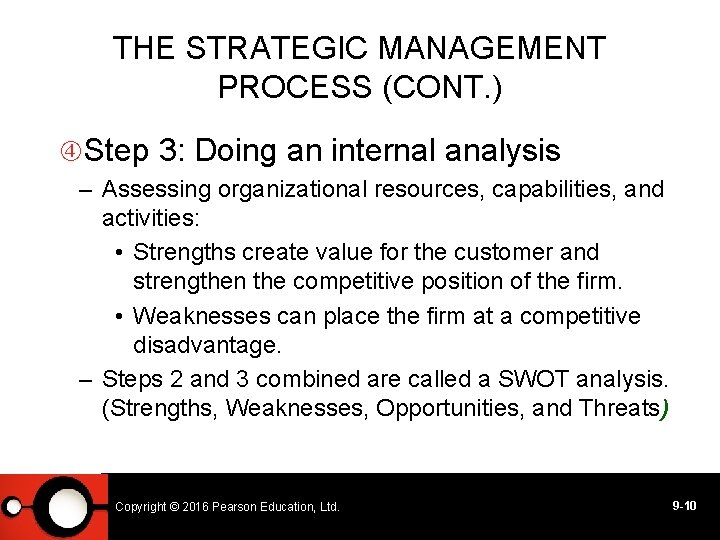
THE STRATEGIC MANAGEMENT PROCESS (CONT. ) Step 3: Doing an internal analysis – Assessing organizational resources, capabilities, and activities: • Strengths create value for the customer and strengthen the competitive position of the firm. • Weaknesses can place the firm at a competitive disadvantage. – Steps 2 and 3 combined are called a SWOT analysis. (Strengths, Weaknesses, Opportunities, and Threats) Copyright © © 2014 2016 Pearson Education, Ltd. 9 -10
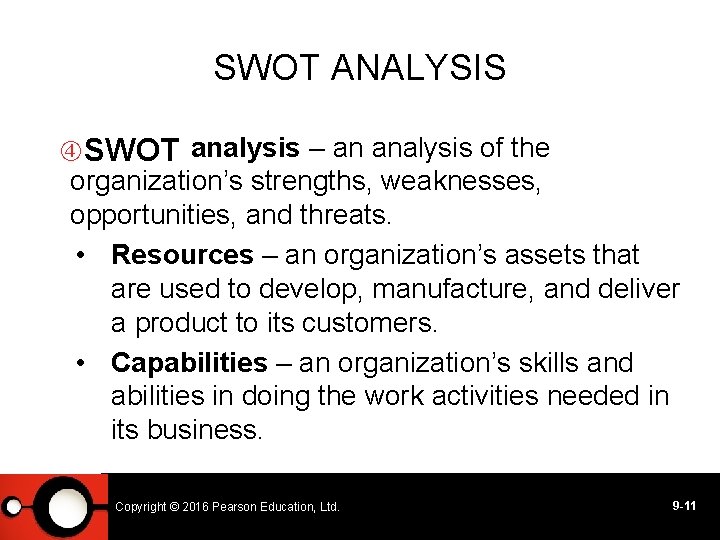
SWOT ANALYSIS SWOT analysis – an analysis of the organization’s strengths, weaknesses, opportunities, and threats. • Resources – an organization’s assets that are used to develop, manufacture, and deliver a product to its customers. • Capabilities – an organization’s skills and abilities in doing the work activities needed in its business. Copyright © © 2014 2016 Pearson Education, Ltd. 9 -11
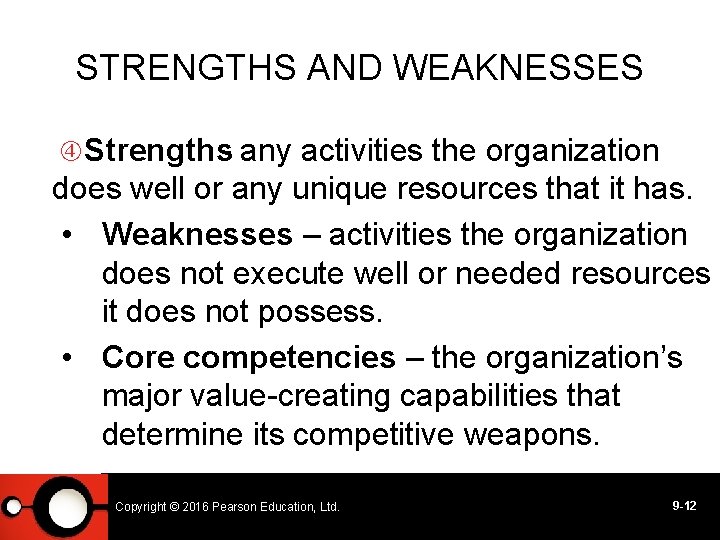
STRENGTHS AND WEAKNESSES Strengths- any activities the organization does well or any unique resources that it has. • Weaknesses – activities the organization does not execute well or needed resources it does not possess. • Core competencies – the organization’s major value-creating capabilities that determine its competitive weapons. Copyright © © 2014 2016 Pearson Education, Ltd. 9 -12
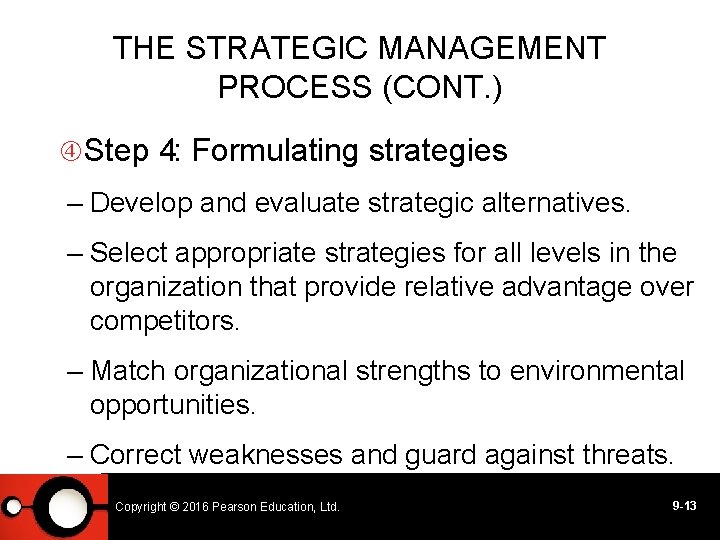
THE STRATEGIC MANAGEMENT PROCESS (CONT. ) Step 4: Formulating strategies – Develop and evaluate strategic alternatives. – Select appropriate strategies for all levels in the organization that provide relative advantage over competitors. – Match organizational strengths to environmental opportunities. – Correct weaknesses and guard against threats. Copyright © © 2014 2016 Pearson Education, Ltd. 9 -13
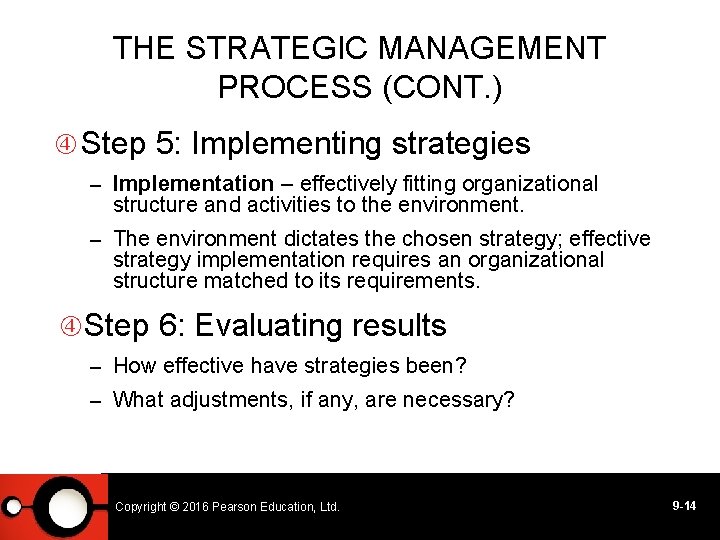
THE STRATEGIC MANAGEMENT PROCESS (CONT. ) Step 5: Implementing strategies – Implementation – effectively fitting organizational structure and activities to the environment. – The environment dictates the chosen strategy; effective strategy implementation requires an organizational structure matched to its requirements. Step 6: Evaluating results – How effective have strategies been? – What adjustments, if any, are necessary? Copyright © © 2014 2016 Pearson Education, Ltd. 9 -14
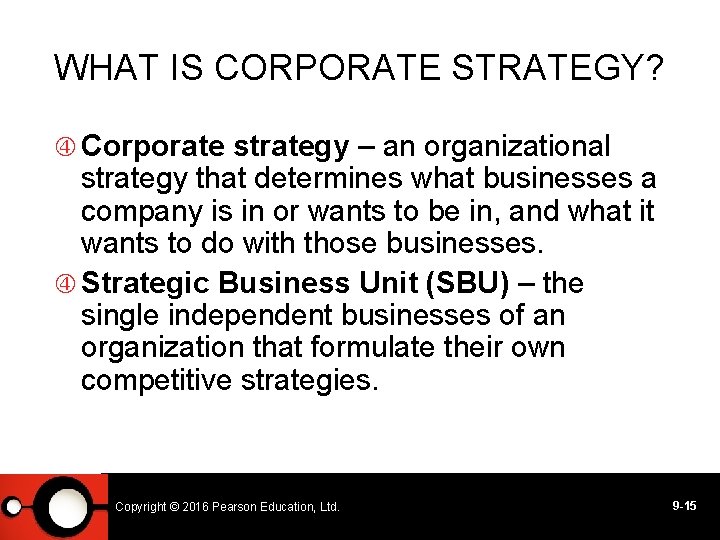
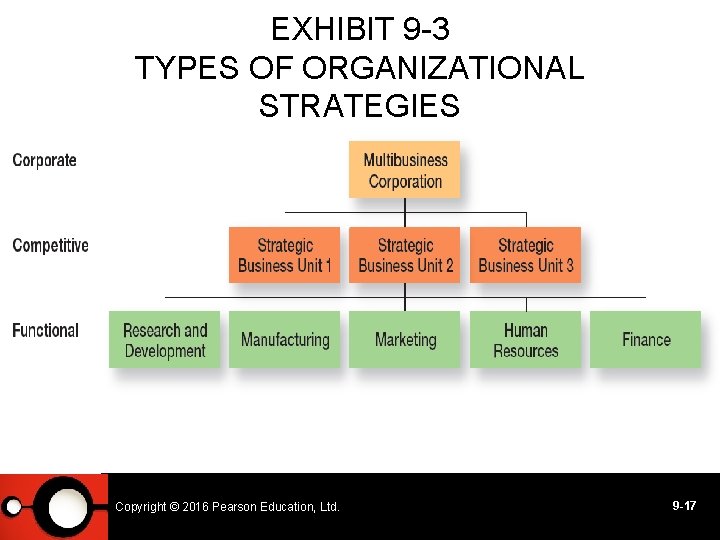
WHAT IS CORPORATE STRATEGY? Corporate strategy – an organizational strategy that determines what businesses a company is in or wants to be in, and what it wants to do with those businesses. Strategic Business Unit (SBU) – the single independent businesses of an organization that formulate their own competitive strategies. Copyright © © 2014 2016 Pearson Education, Ltd. 9 -15
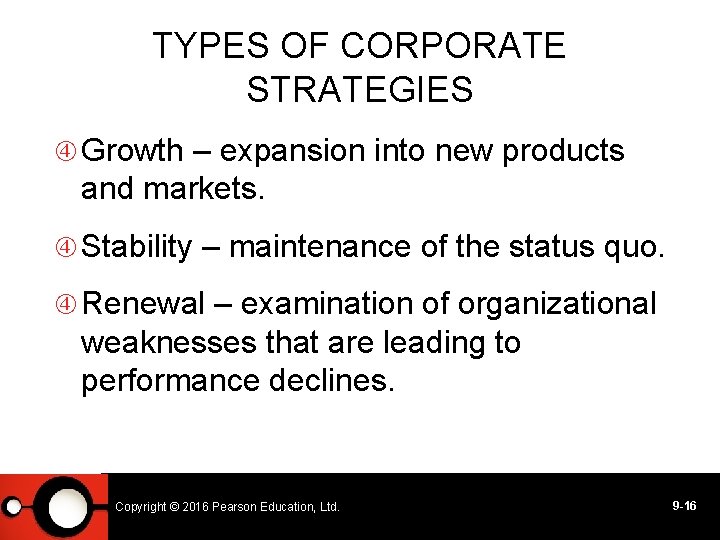
TYPES OF CORPORATE STRATEGIES Growth – expansion into new products and markets. Stability – maintenance of the status quo. Renewal – examination of organizational weaknesses that are leading to performance declines. Copyright © © 2014 2016 Pearson Education, Ltd. 9 -16
EXHIBIT 9 -3 TYPES OF ORGANIZATIONAL STRATEGIES Copyright © © 2014 2016 Pearson Education, Ltd. 9 -17
GROWTH STRATEGIES Growth Strategy – a corporate strategy that’s used when an organization wants to expand the number of markets served or products offered, through either its current business(es) or new business(es). Copyright © © 2014 2016 Pearson Education, Ltd. 9 -18
TYPES OF GROWTH STRATEGIES Concentration – focuses on its primary line of business and increases the number of products offered or markets served in this primary business. Vertical integration – Backward vertical integration – the organization becomes its own supplier. – Forward vertical integration – the organization becomes its own distributor. Copyright © © 2014 2016 Pearson Education, Ltd. 9 -19
TYPES OF GROWTH STRATEGIES (CONT. ) Horizontal integration – a company grows by combining with competitors. Diversification – Related diversification – when a company combines with other companies in different, but related industries. – Unrelated diversification – when a company combines with firms in different and unrelated industries. Copyright © © 2014 2016 Pearson Education, Ltd. 9 -20
CORPORATE STRATEGIES (CONT. ) Stability Strategy – a corporate strategy in which an organization continues to do what it is currently doing. Copyright © © 2014 2016 Pearson Education, Ltd. 9 -21
CORPORATE STRATEGIES (CONT. ) Renewal Strategy – a corporate strategy designed to address declining performance. – – Retrenchment strategy – a short-run renewal strategy used for minor performance problems. Turnaround strategy – when an organization’s problems are more serious, more drastic action is needed. Copyright © © 2014 2016 Pearson Education, Ltd. 9 -22
HOW ARE CORPORATE STRATEGIES MANAGED? BCG matrix – a strategy tool that guides resource allocation decisions on the basis of market share and growth rate of SBUs. Four Categories – Stars – Cash Cows – Question Marks – Dogs Copyright © © 2014 2016 Pearson Education, Ltd. 9 -23
COMPETITIVE STRATEGIES Competitive strategy – an organizational strategy for how an organization will compete in its business(es). Competitive advantage – what sets an organization apart; its distinctive edge. – Quality as a Competitive Advantage – Design Thinking as a Competitive Advantage – Sustaining Competitive Advantage Copyright © © 2014 2016 Pearson Education, Ltd. 9 -24
FIVE FORCES MODEL Five forces determine industry attractiveness and profitability: 1. Threat of new entrants. How likely is it that new competitors will come into the industry? 2. Threat of substitutes. How likely is it that other industries’ products can be substituted for our industry’s products? Copyright © © 2014 2016 Pearson Education, Ltd. 9 -25
FIVE FORCES MODEL (CONT. ) 3. Bargaining power of buyers. How much bargaining power do buyers (customers) have? 4. Bargaining power of suppliers. How much bargaining power do suppliers have? 5. Current rivalry. How intense is the rivalry among current industry competitors? Copyright © © 2014 2016 Pearson Education, Ltd. 9 -26
CHOOSING A COMPETITIVE STRATEGY Cost leadership strategy – when an organization competes on the basis of having the lowest costs (costs or expenses, not prices) in its industry. Differentiation strategy – a company that competes by offering unique products that are widely valued by customers. Copyright © © 2014 2016 Pearson Education, Ltd. 9 -27
CHOOSING A COMPETITIVE STRATEGY (CONT. ) Focus strategy – involves a cost advantage (cost focus) or a differentiation advantage (differentiation focus) in a narrow segment or niche. Stuck in the middle – when costs are too high to compete with the low-cost leader or when its products and services aren’t differentiated enough to compete with the differentiator. Copyright © © 2014 2016 Pearson Education, Ltd. 9 -28
FUNCTIONAL STRATEGY Functional strategy – the strategies used by an organization’s various functional departments to support the competitive strategy. Copyright © © 2014 2016 Pearson Education, Ltd. 9 -29
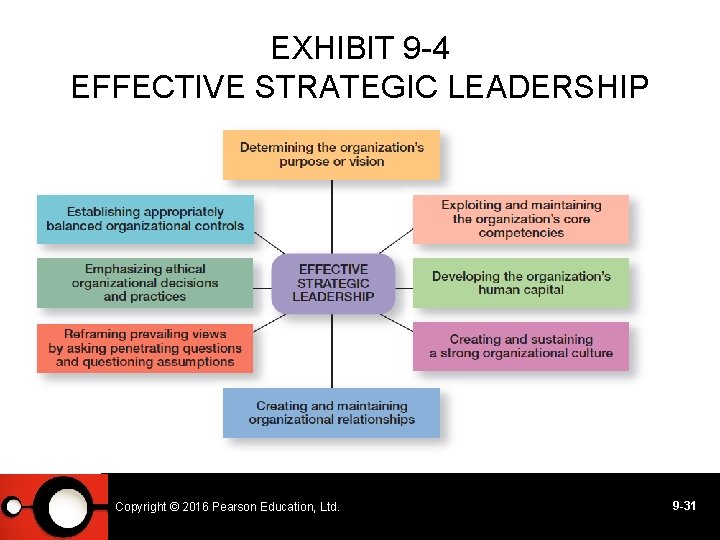
CURRENT STRATEGIC MANAGEMENT ISSUES Strategic leadership – the ability to anticipate, envision, maintain flexibility, think strategically, and work with others in the organization to initiate changes that will create a viable and valuable future for the organization. Copyright © © 2014 2016 Pearson Education, Ltd. 9 -30
EXHIBIT 9 -4 EFFECTIVE STRATEGIC LEADERSHIP Copyright © © 2014 2016 Pearson Education, Ltd. 9 -31
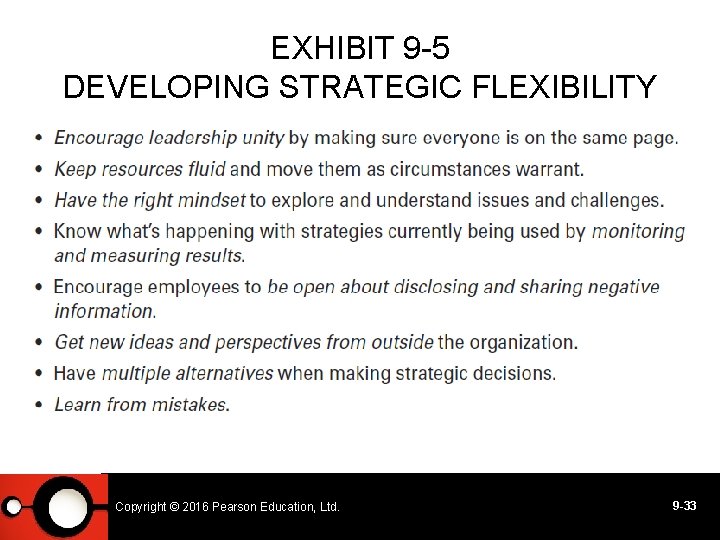
CURRENT STRATEGIC MANAGEMENT ISSUES (CONT. ) Strategic flexibility – the ability to recognize major external changes, to quickly commit resources, and to recognize when a strategic decision was a mistake. Copyright © © 2014 2016 Pearson Education, Ltd. 9 -32
EXHIBIT 9 -5 DEVELOPING STRATEGIC FLEXIBILITY Copyright © © 2014 2016 Pearson Education, Ltd. 9 -33
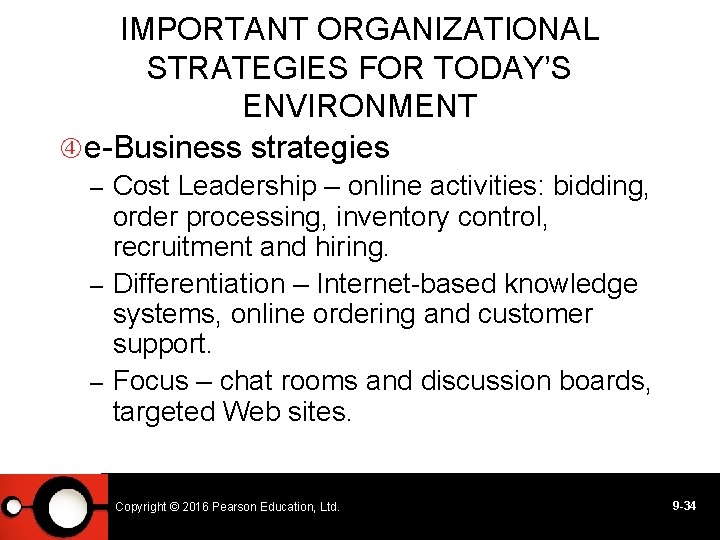
IMPORTANT ORGANIZATIONAL STRATEGIES FOR TODAY’S ENVIRONMENT e-Business strategies – Cost Leadership – online activities: bidding, order processing, inventory control, recruitment and hiring. – Differentiation – Internet-based knowledge systems, online ordering and customer support. – Focus – chat rooms and discussion boards, targeted Web sites. Copyright © © 2014 2016 Pearson Education, Ltd. 9 -34
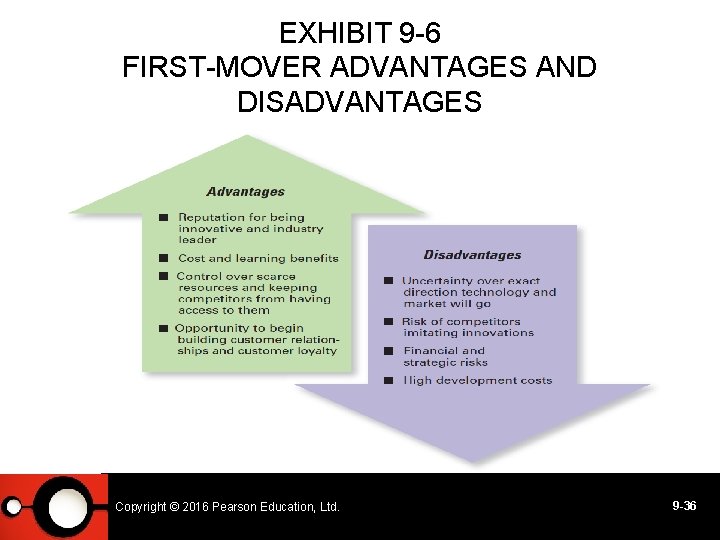
IMPORTANT ORGANIZATIONAL STRATEGIES FOR TODAY’S ENVIRONMENT (CONT. ) Customer Service Strategies – companies emphasizing excellent customer service need strategies that cultivate that atmosphere from top to bottom. Innovation Strategies First Mover – an organization that brings a product innovation to the market or uses new process innovations. Copyright © © 2014 2016 Pearson Education, Ltd. 9 -35
EXHIBIT 9 -6 FIRST-MOVER ADVANTAGES AND DISADVANTAGES Copyright © © 2014 2016 Pearson Education, Ltd. 9 -36