
Managing Stock Warehouses Distribution Managing Stock 1 Company
Managing Stock Warehouses Distribution
Managing Stock 1. Company needs to have stock of raw material 2. During manufacturing some unfinished products may wait for the next stage of the production and will need to be stocked 3. Once the production is completed the company will have stock of finished products waiting to be sent to the customers.
Factors affecting stock management 1. Demand for finished products => number of orders, quantities etc… 2. Quantities which can be manufactured at any one time 3. Working practices, procedures and H&S 4. Storage facilities 5. Procedures for maintaining and managing quality 6. Costs of storing products
Activity 1: List the consequences of: Having too little stock Having too much stock 1. 2. 3. 4. 5.

Stock management issues Too little stock Too much stock • Production could stop • Customers might not have their orders on time • Poor reputation and image which could result in losing customers • Financial costs (storage, security, insurance) • Stock that could go to waste or deteriorate • Risk of stock being stolen
Stock Management systems: 1. To set Maximum Stock level = max amount of stock at any one time 2. To set Minimum stock level = min quantity of stock at any one time 3. To set a Re-order level = quantity of stock at which point a new order is triggered 4. To set a Re-order quantity = quantity of stock which needs to be ordered to bring the levels back to maximum stock level
Factors to take into account: • Delivery time or Lead time • Terms and conditions • Distances
Management systems • Manual system using stock cards • Computerised systems • Just in Time (JIT) => stocks are kept to a minimum and are directly used to produce goods which have been ordered. – Good relationship with suppliers – Rely on suppliers who can deliver on time and to the right standards => otherwise production stops – Save money – Less risk for stock to deteriorate

Methods of storing stock • Centralised storage • Decentralised storage The use of warehouse for stocking finished products: – Importance of design to ensure easy movements – Size – Location – Type of products – Order and delivery procedures
Activity 2: Centralised V decentralised List the advantages and disadvantages for both options
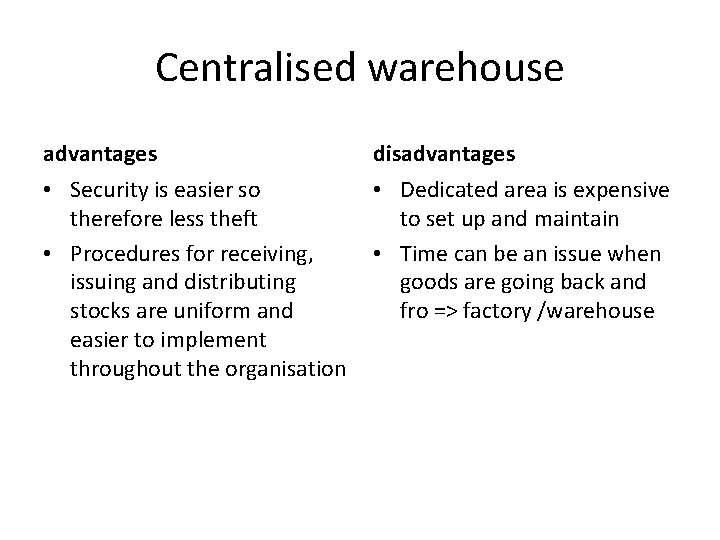
Centralised warehouse advantages disadvantages • Security is easier so therefore less theft • Procedures for receiving, issuing and distributing stocks are uniform and easier to implement throughout the organisation • Dedicated area is expensive to set up and maintain • Time can be an issue when goods are going back and fro => factory /warehouse
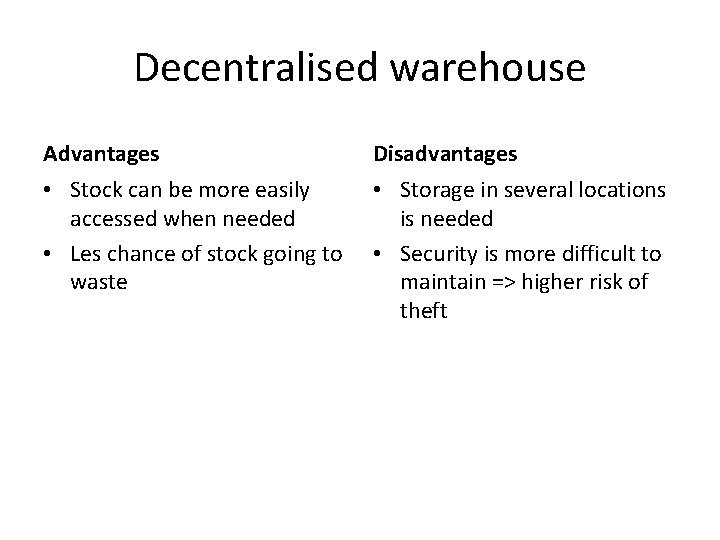
Decentralised warehouse Advantages Disadvantages • Stock can be more easily accessed when needed • Les chance of stock going to waste • Storage in several locations is needed • Security is more difficult to maintain => higher risk of theft
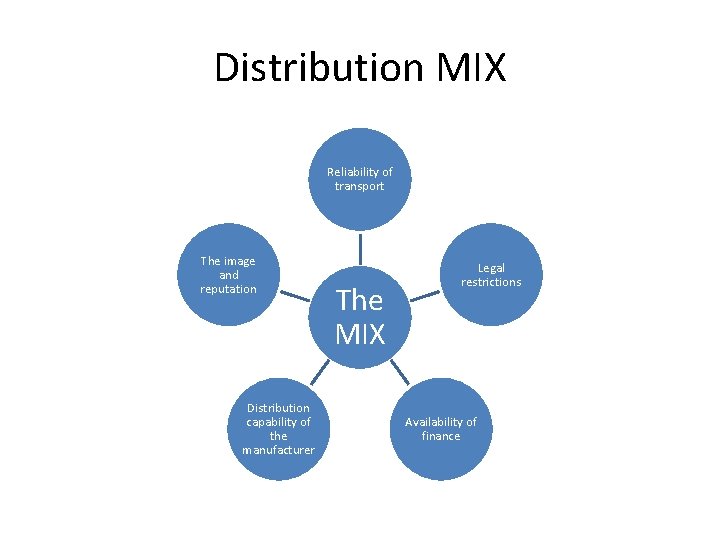
Distribution MIX Reliability of transport The image and reputation Distribution capability of the manufacturer The MIX Legal restrictions Availability of finance
- Slides: 13