
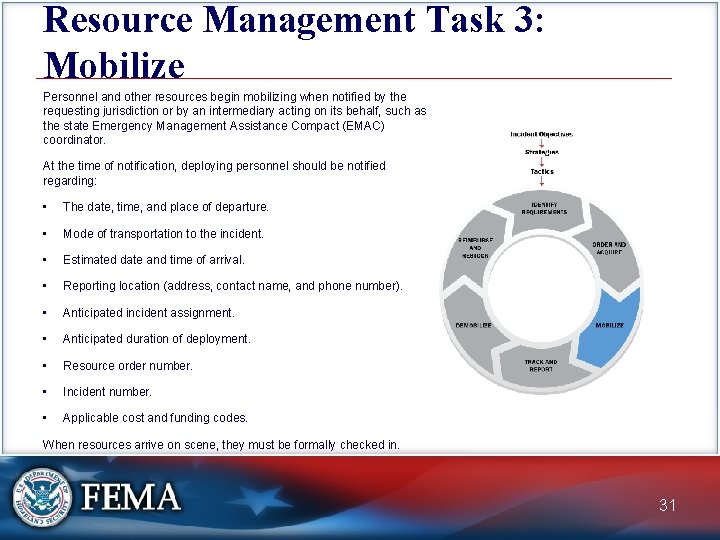
Managing Resources Overview This graphic depicts the six
- Slides: 55
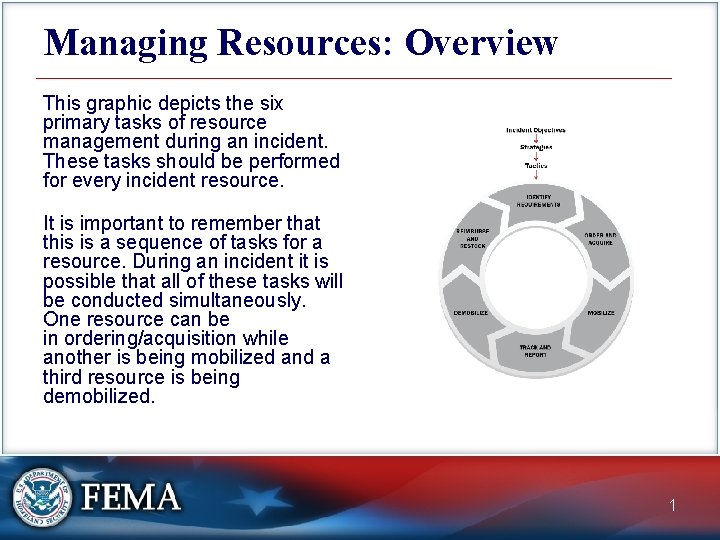
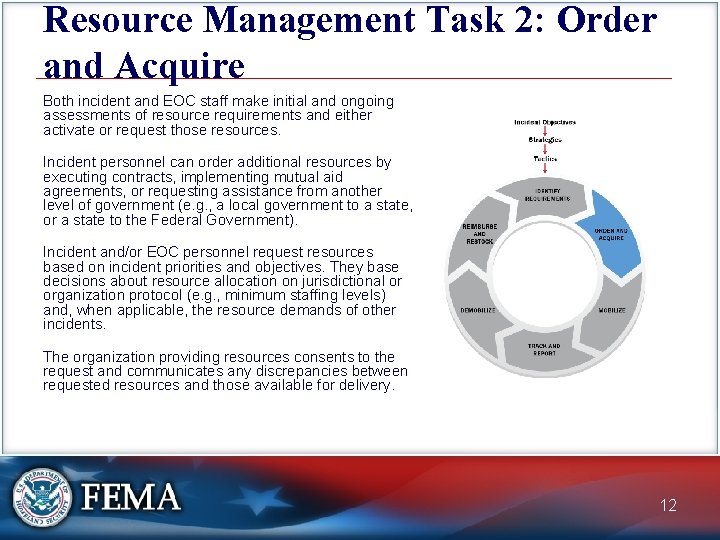
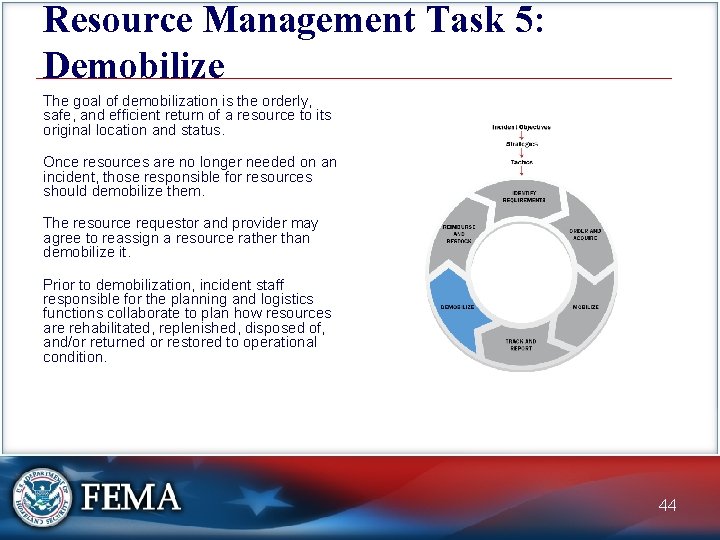
Managing Resources: Overview This graphic depicts the six primary tasks of resource management during an incident. These tasks should be performed for every incident resource. It is important to remember that this is a sequence of tasks for a resource. During an incident it is possible that all of these tasks will be conducted simultaneously. One resource can be in ordering/acquisition while another is being mobilized and a third resource is being demobilized. 1
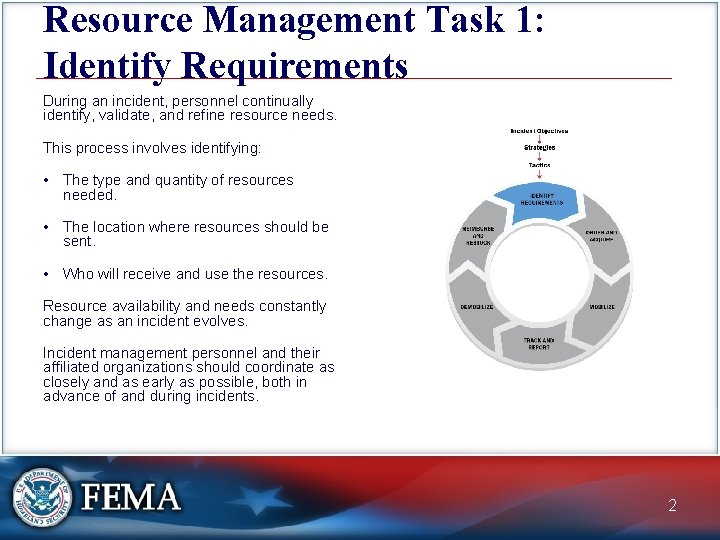
Resource Management Task 1: Identify Requirements During an incident, personnel continually identify, validate, and refine resource needs. This process involves identifying: • The type and quantity of resources needed. • The location where resources should be sent. • Who will receive and use the resources. Resource availability and needs constantly change as an incident evolves. Incident management personnel and their affiliated organizations should coordinate as closely and as early as possible, both in advance of and during incidents. 2
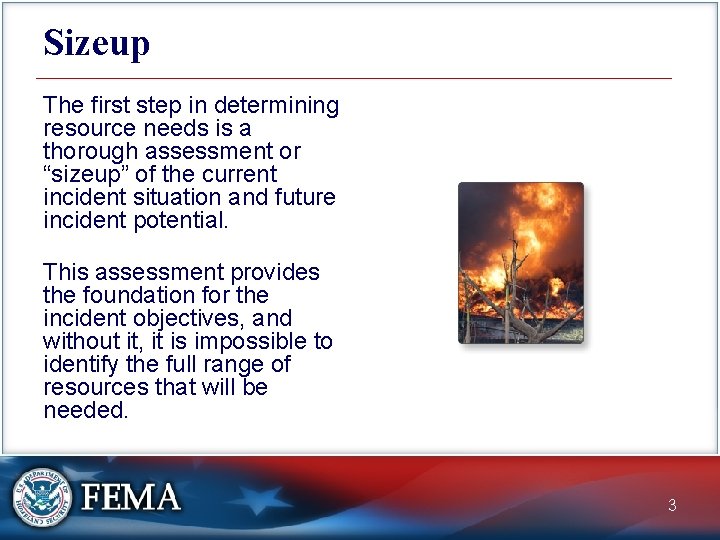
Sizeup The first step in determining resource needs is a thorough assessment or “sizeup” of the current incident situation and future incident potential. This assessment provides the foundation for the incident objectives, and without it, it is impossible to identify the full range of resources that will be needed. 3
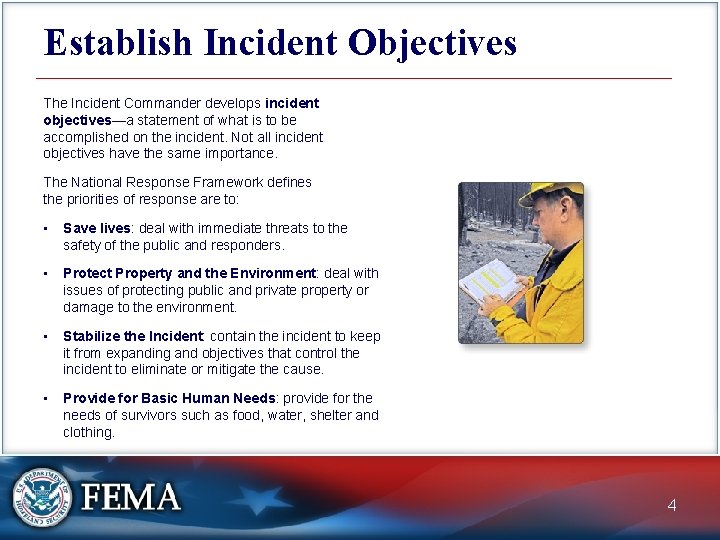
Establish Incident Objectives The Incident Commander develops incident objectives—a statement of what is to be accomplished on the incident. Not all incident objectives have the same importance. The National Response Framework defines the priorities of response are to: • Save lives: deal with immediate threats to the safety of the public and responders. • Protect Property and the Environment: deal with issues of protecting public and private property or damage to the environment. • Stabilize the Incident: contain the incident to keep it from expanding and objectives that control the incident to eliminate or mitigate the cause. • Provide for Basic Human Needs: provide for the needs of survivors such as food, water, shelter and clothing. 4
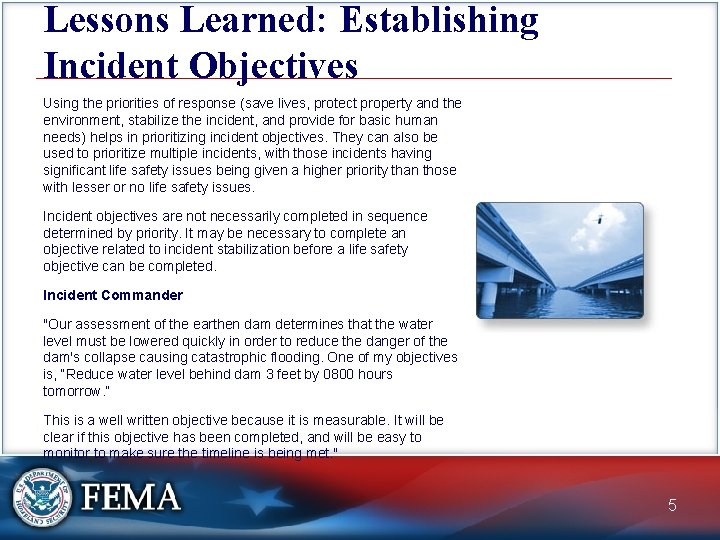
Lessons Learned: Establishing Incident Objectives Using the priorities of response (save lives, protect property and the environment, stabilize the incident, and provide for basic human needs) helps in prioritizing incident objectives. They can also be used to prioritize multiple incidents, with those incidents having significant life safety issues being given a higher priority than those with lesser or no life safety issues. Incident objectives are not necessarily completed in sequence determined by priority. It may be necessary to complete an objective related to incident stabilization before a life safety objective can be completed. Incident Commander "Our assessment of the earthen dam determines that the water level must be lowered quickly in order to reduce the danger of the dam's collapse causing catastrophic flooding. One of my objectives is, “Reduce water level behind dam 3 feet by 0800 hours tomorrow. ” This is a well written objective because it is measurable. It will be clear if this objective has been completed, and will be easy to monitor to make sure the timeline is being met. " 5
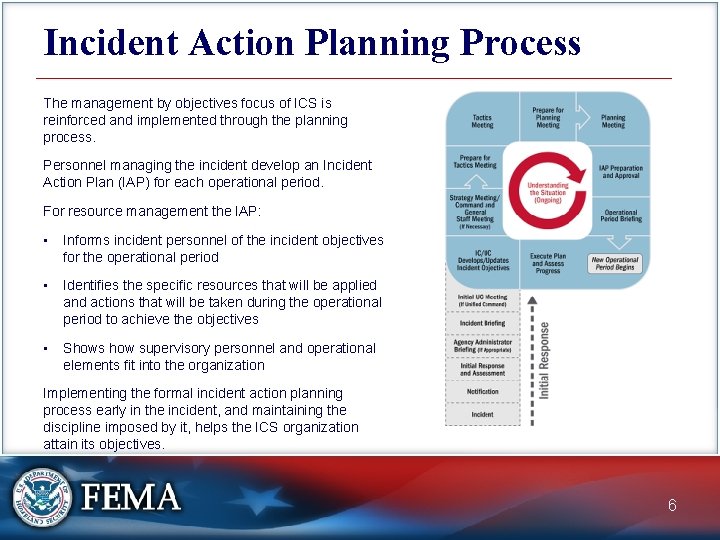
Incident Action Planning Process The management by objectives focus of ICS is reinforced and implemented through the planning process. Personnel managing the incident develop an Incident Action Plan (IAP) for each operational period. For resource management the IAP: • Informs incident personnel of the incident objectives for the operational period • Identifies the specific resources that will be applied and actions that will be taken during the operational period to achieve the objectives • Shows how supervisory personnel and operational elements fit into the organization Implementing the formal incident action planning process early in the incident, and maintaining the discipline imposed by it, helps the ICS organization attain its objectives. 6
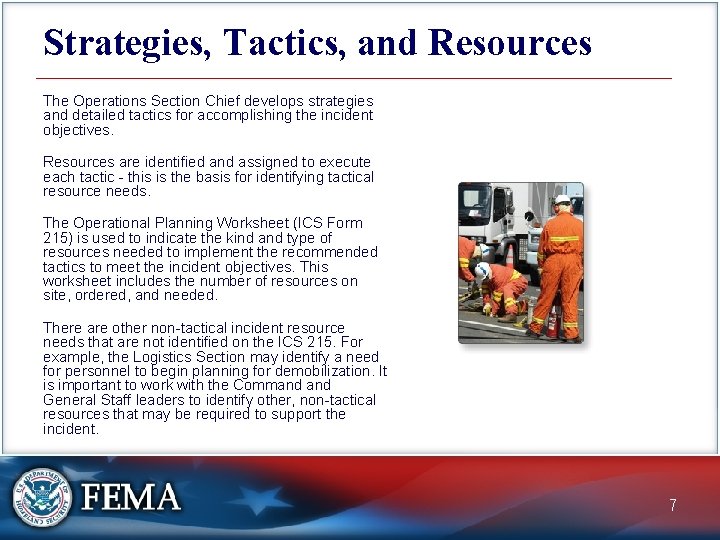
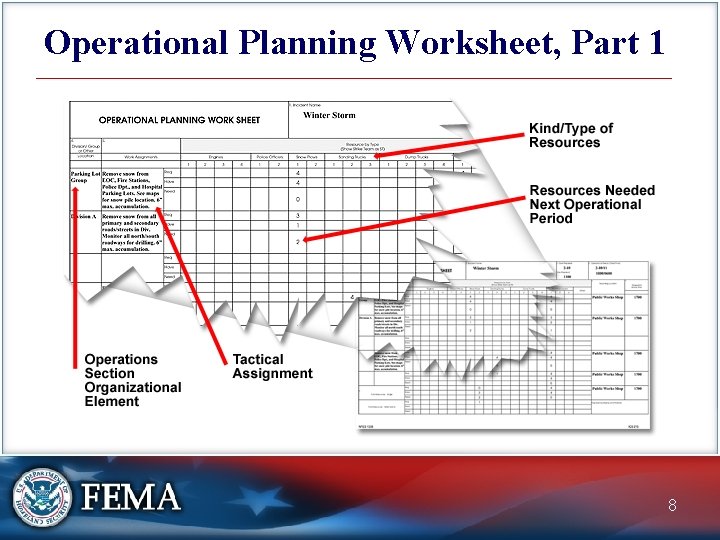
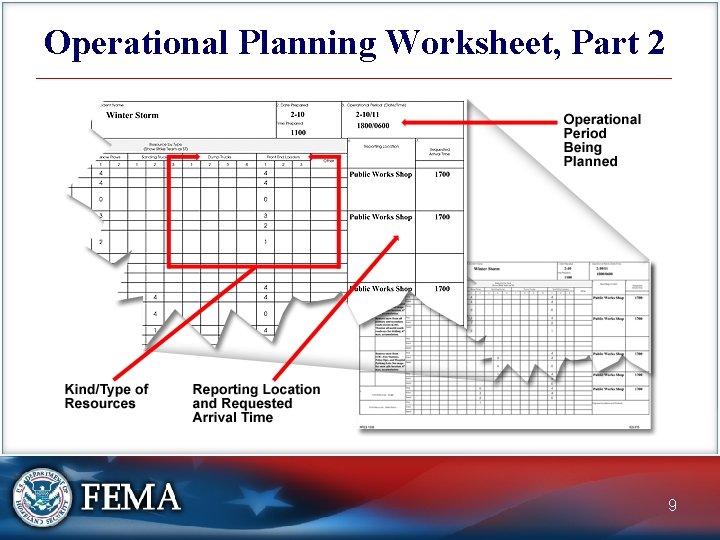
Strategies, Tactics, and Resources The Operations Section Chief develops strategies and detailed tactics for accomplishing the incident objectives. Resources are identified and assigned to execute each tactic - this is the basis for identifying tactical resource needs. The Operational Planning Worksheet (ICS Form 215) is used to indicate the kind and type of resources needed to implement the recommended tactics to meet the incident objectives. This worksheet includes the number of resources on site, ordered, and needed. There are other non-tactical incident resource needs that are not identified on the ICS 215. For example, the Logistics Section may identify a need for personnel to begin planning for demobilization. It is important to work with the Command General Staff leaders to identify other, non-tactical resources that may be required to support the incident. 7
Operational Planning Worksheet, Part 1 8
Operational Planning Worksheet, Part 2 9
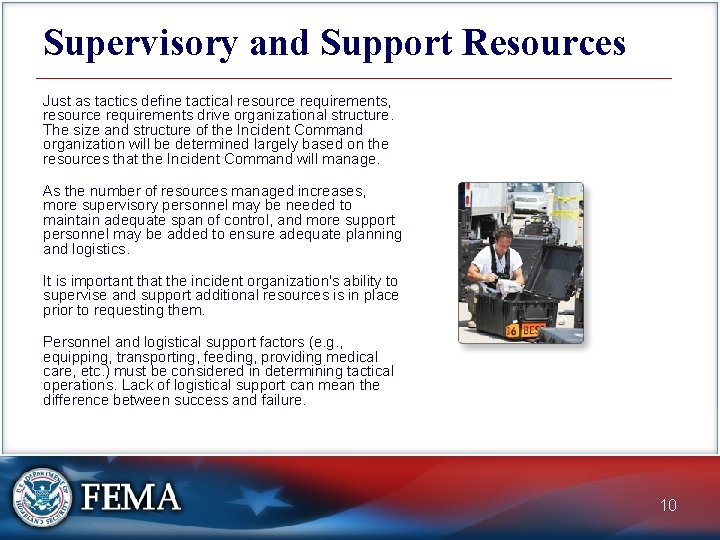
Supervisory and Support Resources Just as tactics define tactical resource requirements, resource requirements drive organizational structure. The size and structure of the Incident Command organization will be determined largely based on the resources that the Incident Command will manage. As the number of resources managed increases, more supervisory personnel may be needed to maintain adequate span of control, and more support personnel may be added to ensure adequate planning and logistics. It is important that the incident organization's ability to supervise and support additional resources is in place prior to requesting them. Personnel and logistical support factors (e. g. , equipping, transporting, feeding, providing medical care, etc. ) must be considered in determining tactical operations. Lack of logistical support can mean the difference between success and failure. 10
Discussion Point - Identify Needed Resources In what order should the five steps to identify needed resources be accomplished? Identify strategies to meet objectives. Assign resources to each tactic. Develop incident objectives. Develop detailed tactics to implement selected strategies. Conduct a sizeup of the incident. 11
Resource Management Task 2: Order and Acquire Both incident and EOC staff make initial and ongoing assessments of resource requirements and either activate or request those resources. Incident personnel can order additional resources by executing contracts, implementing mutual aid agreements, or requesting assistance from another level of government (e. g. , a local government to a state, or a state to the Federal Government). Incident and/or EOC personnel request resources based on incident priorities and objectives. They base decisions about resource allocation on jurisdictional or organization protocol (e. g. , minimum staffing levels) and, when applicable, the resource demands of other incidents. The organization providing resources consents to the request and communicates any discrepancies between requested resources and those available for delivery. 12
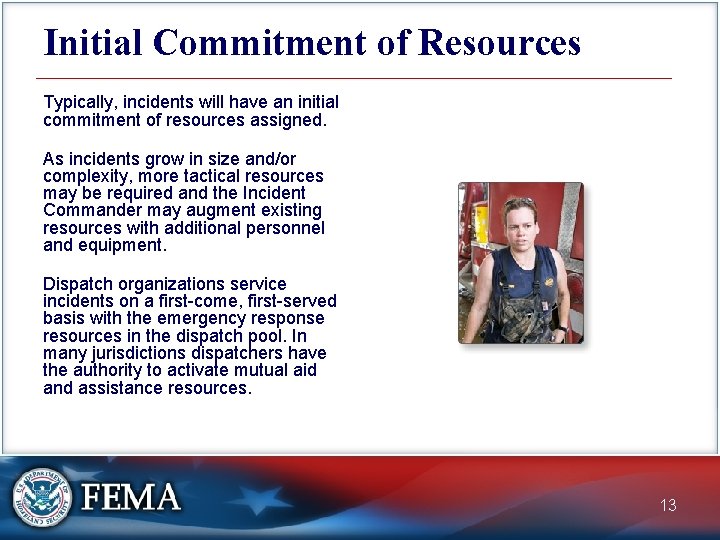
Initial Commitment of Resources Typically, incidents will have an initial commitment of resources assigned. As incidents grow in size and/or complexity, more tactical resources may be required and the Incident Commander may augment existing resources with additional personnel and equipment. Dispatch organizations service incidents on a first-come, first-served basis with the emergency response resources in the dispatch pool. In many jurisdictions dispatchers have the authority to activate mutual aid and assistance resources. 13
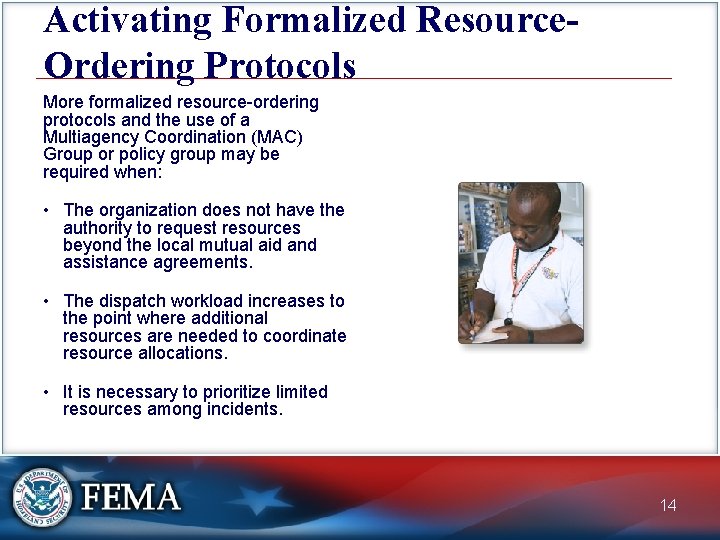
Activating Formalized Resource. Ordering Protocols More formalized resource-ordering protocols and the use of a Multiagency Coordination (MAC) Group or policy group may be required when: • The organization does not have the authority to request resources beyond the local mutual aid and assistance agreements. • The dispatch workload increases to the point where additional resources are needed to coordinate resource allocations. • It is necessary to prioritize limited resources among incidents. 14
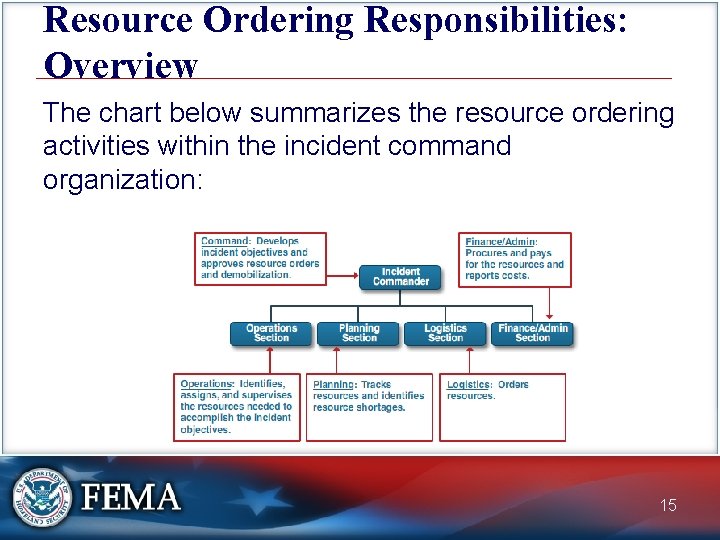
Resource Ordering Responsibilities: Overview The chart below summarizes the resource ordering activities within the incident command organization: 15
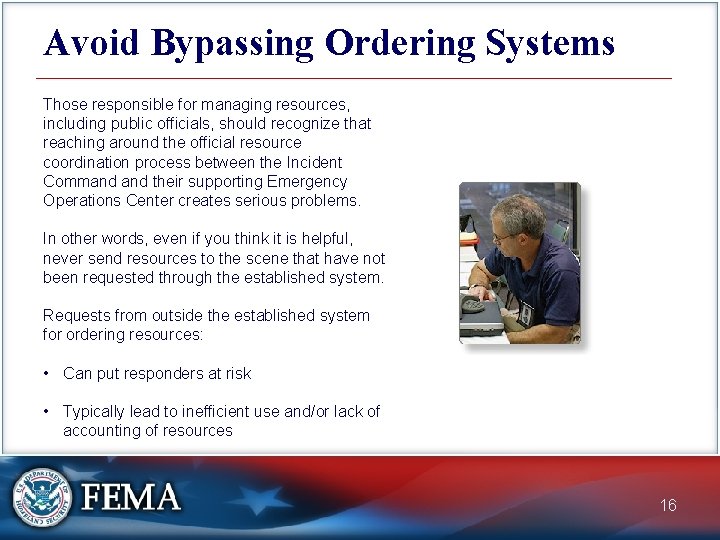
Avoid Bypassing Ordering Systems Those responsible for managing resources, including public officials, should recognize that reaching around the official resource coordination process between the Incident Command their supporting Emergency Operations Center creates serious problems. In other words, even if you think it is helpful, never send resources to the scene that have not been requested through the established system. Requests from outside the established system for ordering resources: • Can put responders at risk • Typically lead to inefficient use and/or lack of accounting of resources 16
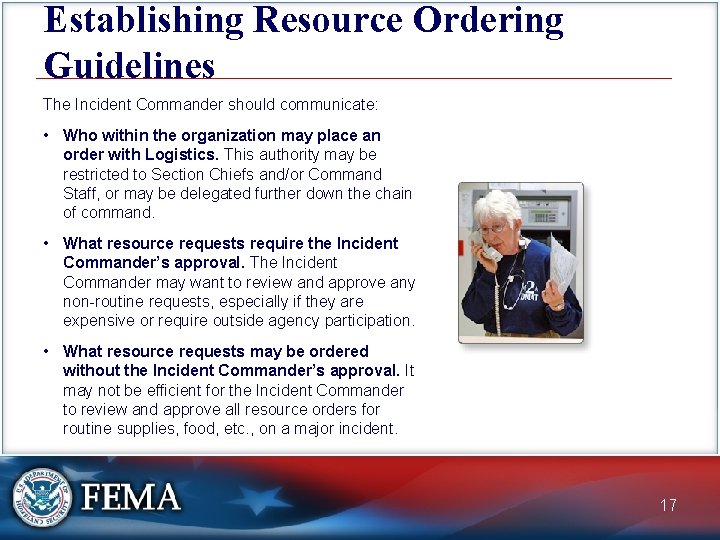
Establishing Resource Ordering Guidelines The Incident Commander should communicate: • Who within the organization may place an order with Logistics. This authority may be restricted to Section Chiefs and/or Command Staff, or may be delegated further down the chain of command. • What resource requests require the Incident Commander’s approval. The Incident Commander may want to review and approve any non-routine requests, especially if they are expensive or require outside agency participation. • What resource requests may be ordered without the Incident Commander’s approval. It may not be efficient for the Incident Commander to review and approve all resource orders for routine supplies, food, etc. , on a major incident. 17
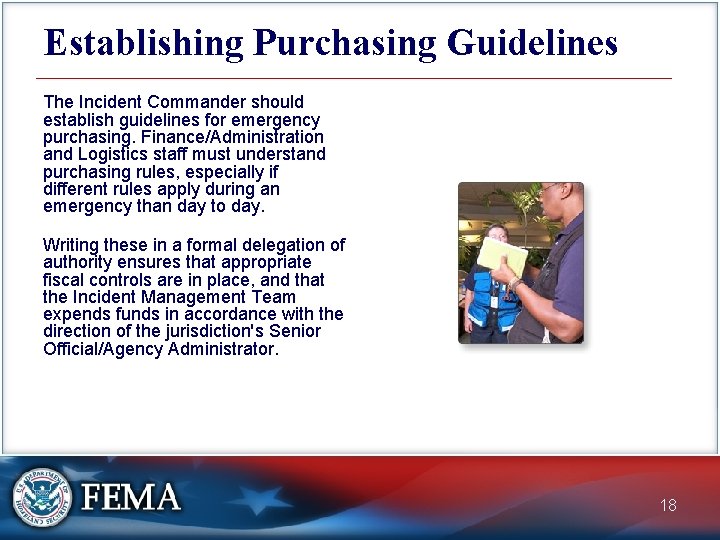
Establishing Purchasing Guidelines The Incident Commander should establish guidelines for emergency purchasing. Finance/Administration and Logistics staff must understand purchasing rules, especially if different rules apply during an emergency than day to day. Writing these in a formal delegation of authority ensures that appropriate fiscal controls are in place, and that the Incident Management Team expends funds in accordance with the direction of the jurisdiction's Senior Official/Agency Administrator. 18
Activity 4. 1: Resource Management Instructions: Working with your table group. . . 1. Read the scenarios in your Student Manual. 2. Determine the optimal action for each resource management issue. 3. Write your answers on chart paper. 4. Select a spokesperson and be prepared to present your answers in 10 minutes. 19
The Resource Order: Elements Organizations that request resources should provide enough detail to ensure that those receiving the request understand what is needed. Using NIMS resource names and types helps ensure that requests are clearly communicated and understood. Requesting organizations should include the following information in the request: • Detailed item description including quantity, kind, and type (if known), or a description of required capability and/or intended use • Required arrival date and time • Required delivery or reporting location • The position title of the individual to whom the resource should report • Any incident-specific health or safety concerns (e. g. , vaccinations, adverse living/working conditions, or identified environmental hazards) 20
The Resource Order: Documentation Resource orders should also document action taken on a request, including but not limited to: • Contacts with sources or potential sources for the resource request. • Source for the responding resource. • Identification of the responding resource (name, ID number, transporting company, etc. ). • Estimated time of arrival. • Estimated cost. • Changes to the order made by Command, or the position placing the order. Such detailed information is often critical in tracking resource status through multiple staff changes and operational periods. 21
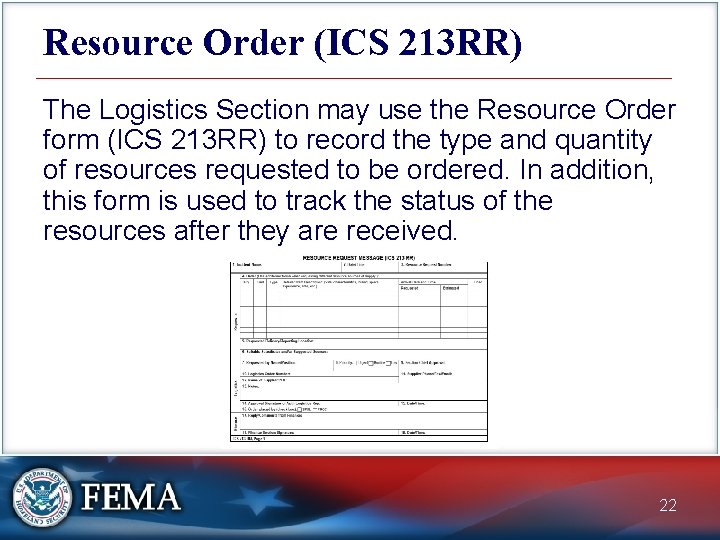
Resource Order (ICS 213 RR) The Logistics Section may use the Resource Order form (ICS 213 RR) to record the type and quantity of resources requested to be ordered. In addition, this form is used to track the status of the resources after they are received. 22
Activity 4. 2: Resource Ordering Instructions: Working with your table group. . . 1. Read the scenario below in your Student Manual. 2. Review the resource orders and identify missing information that would be needed for each order to be successfully processed. 3. Write your answers on chart paper. 4. Select a spokesperson and be prepared to present your answers in 5 minutes. 23
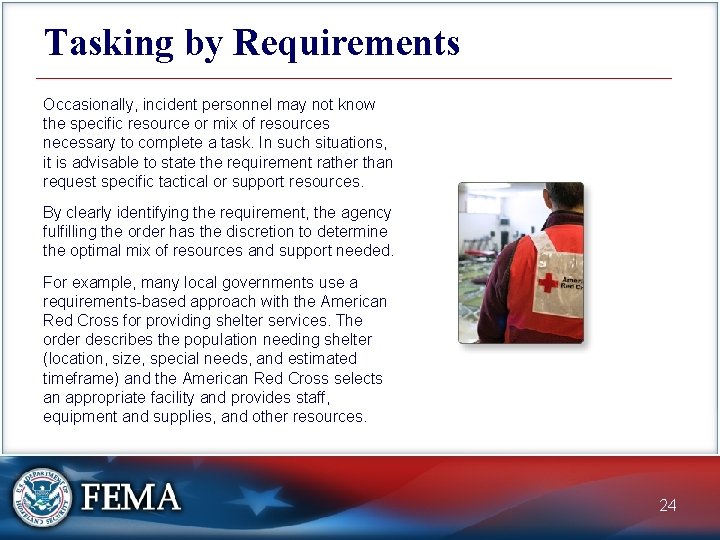
Tasking by Requirements Occasionally, incident personnel may not know the specific resource or mix of resources necessary to complete a task. In such situations, it is advisable to state the requirement rather than request specific tactical or support resources. By clearly identifying the requirement, the agency fulfilling the order has the discretion to determine the optimal mix of resources and support needed. For example, many local governments use a requirements-based approach with the American Red Cross for providing shelter services. The order describes the population needing shelter (location, size, special needs, and estimated timeframe) and the American Red Cross selects an appropriate facility and provides staff, equipment and supplies, and other resources. 24
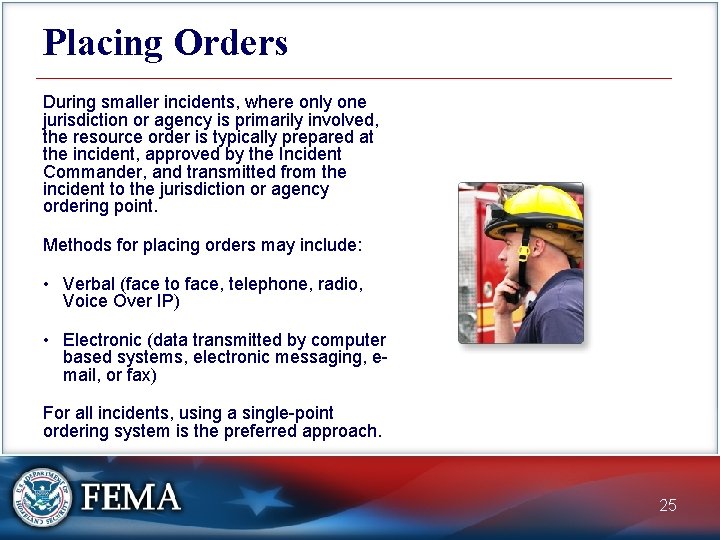
Placing Orders During smaller incidents, where only one jurisdiction or agency is primarily involved, the resource order is typically prepared at the incident, approved by the Incident Commander, and transmitted from the incident to the jurisdiction or agency ordering point. Methods for placing orders may include: • Verbal (face to face, telephone, radio, Voice Over IP) • Electronic (data transmitted by computer based systems, electronic messaging, email, or fax) For all incidents, using a single-point ordering system is the preferred approach. 25
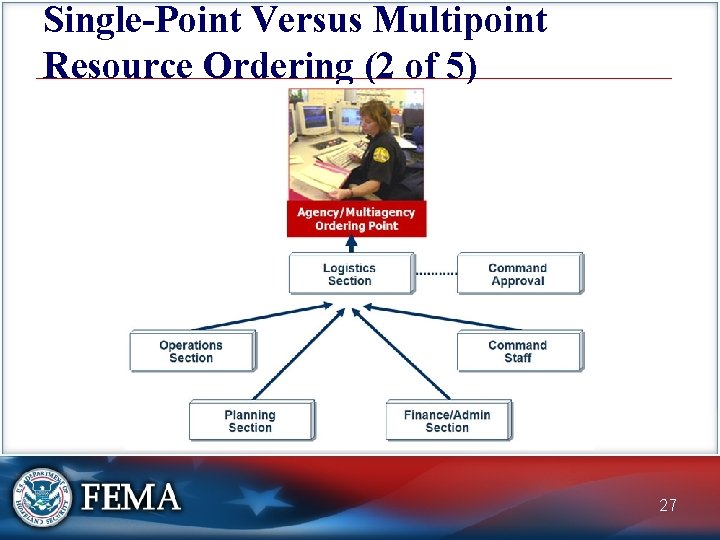
Single-Point Versus Multipoint Resource Ordering (1 of 5) Single-Point Resource Ordering: The concept of single-point resource ordering is that the burden of finding the requested resources is placed on the responsible jurisdiction/agency dispatch/ordering center and not on the incident organization. Single-point resource ordering (i. e. , ordering all resources through one dispatch/ordering center) is usually the preferred method. 26
Single-Point Versus Multipoint Resource Ordering (2 of 5) 27
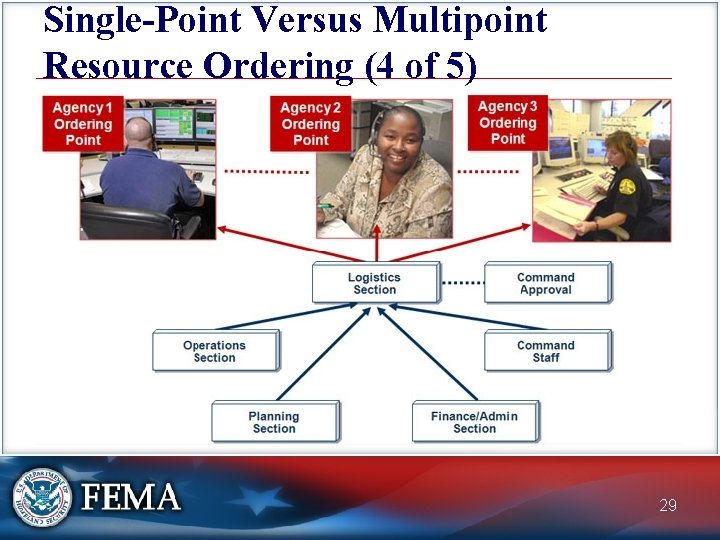
Single-Point Versus Multipoint Resource Ordering (3 of 5) However, single-point resource ordering may not be feasible when: • The dispatch/ordering center becomes overloaded with other activity and is unable to handle new requests in a timely manner. • Assisting agencies at the incident have policies that require all resource orders be made through their respective dispatch/ordering centers. • Special situations relating to the order necessitate that personnel at the incident discuss the details of the request directly with an off-site agency or private-sector provider. Multipoint Resource Ordering: Multipoint ordering is when the incident orders resources from several different ordering points and/or the private sector. Multipoint off-incident resource ordering should be done only when necessary. 28
Single-Point Versus Multipoint Resource Ordering (4 of 5) 29
Single-Point Versus Multipoint Resource Ordering (5 of 5) Multipoint ordering places a heavier load on incident personnel by requiring them to place orders through two or more ordering points. This method of ordering also requires tremendous coordination between and among ordering points, and increases the chances of lost or duplicated orders. 30
Resource Management Task 3: Mobilize Personnel and other resources begin mobilizing when notified by the requesting jurisdiction or by an intermediary acting on its behalf, such as the state Emergency Management Assistance Compact (EMAC) coordinator. At the time of notification, deploying personnel should be notified regarding: • The date, time, and place of departure. • Mode of transportation to the incident. • Estimated date and time of arrival. • Reporting location (address, contact name, and phone number). • Anticipated incident assignment. • Anticipated duration of deployment. • Resource order number. • Incident number. • Applicable cost and funding codes. When resources arrive on scene, they must be formally checked in. 31
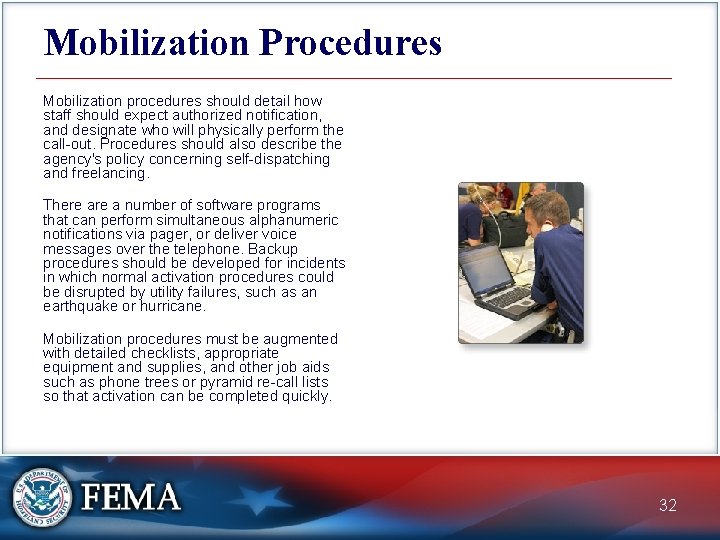
Mobilization Procedures Mobilization procedures should detail how staff should expect authorized notification, and designate who will physically perform the call-out. Procedures should also describe the agency's policy concerning self-dispatching and freelancing. There a number of software programs that can perform simultaneous alphanumeric notifications via pager, or deliver voice messages over the telephone. Backup procedures should be developed for incidents in which normal activation procedures could be disrupted by utility failures, such as an earthquake or hurricane. Mobilization procedures must be augmented with detailed checklists, appropriate equipment and supplies, and other job aids such as phone trees or pyramid re-call lists so that activation can be completed quickly. 32
Activity: Mobilization and Notification Instructions: Working with your table group. . . 1. Review the likely emergencies listed in your jurisdiction’s hazard analysis. 2. For each incident type, describe the mobilization and notification method. 3. Identify alternate mobilization and notification methods for incidents likely to affect telephones, pagers, and other electronic systems. 4. Write your answers on chart paper, select a spokesperson, and be prepared to present your answers to the class in 15 minutes. Review the likely emergencies listed in your jurisdiction’s hazard analysis, and answer the questions below. For each emergency, what is the mobilization and notification method? For those emergencies that are likely to affect telephones, pagers, and other electronic notification systems, does the plan outline alternate methods of mobilization and notification? Does your plan have alternate methods of activation for emergencies that are likely to affect telephones, pagers, and other electronic notification systems? Could you describe the mobilization and notification methods for each potential emergency? 33
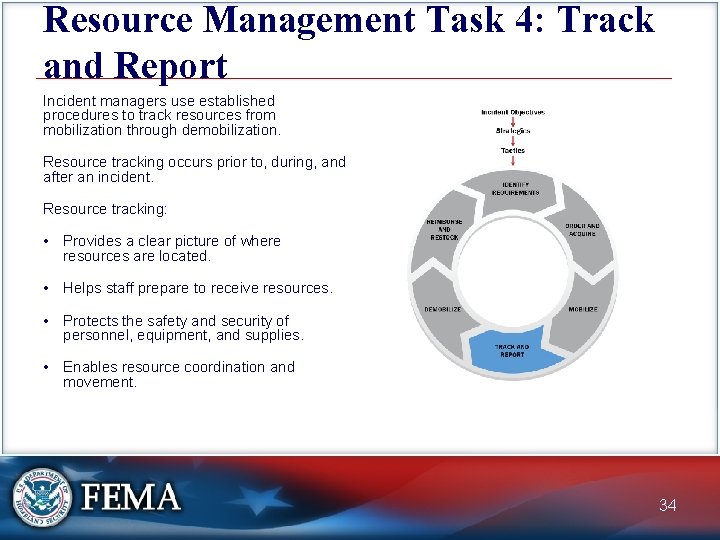
Resource Management Task 4: Track and Report Incident managers use established procedures to track resources from mobilization through demobilization. Resource tracking occurs prior to, during, and after an incident. Resource tracking: • Provides a clear picture of where resources are located. • Helps staff prepare to receive resources. • Protects the safety and security of personnel, equipment, and supplies. • Enables resource coordination and movement. 34
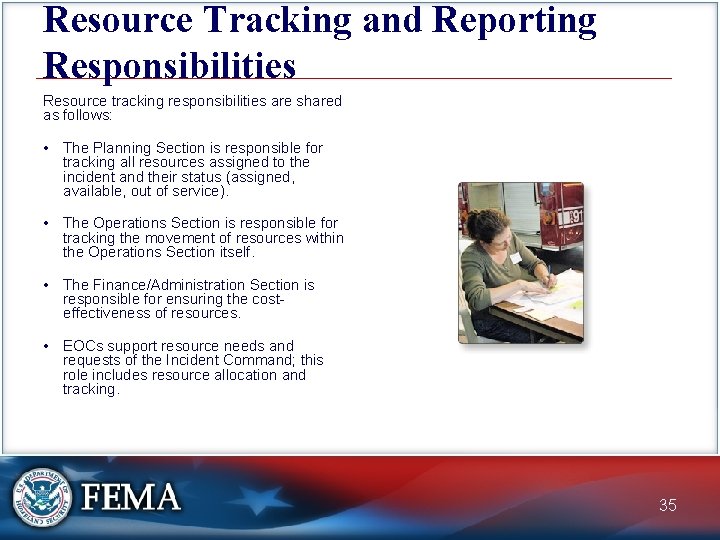
Resource Tracking and Reporting Responsibilities Resource tracking responsibilities are shared as follows: • The Planning Section is responsible for tracking all resources assigned to the incident and their status (assigned, available, out of service). • The Operations Section is responsible for tracking the movement of resources within the Operations Section itself. • The Finance/Administration Section is responsible for ensuring the costeffectiveness of resources. • EOCs support resource needs and requests of the Incident Command; this role includes resource allocation and tracking. 35
Accounting for Responders As soon as the incident is discovered and reported, and often even before responders are dispatched, volunteers, survivors, and spectators will converge at the scene. When responders arrive, they must separate first spectators and then volunteers from disaster survivors, and secure a perimeter around the incident. Securing a perimeter allows the incident response organization to: • Establish resource accountability. • Provide security and force protection. • Ensure safety of responders and the public. 36
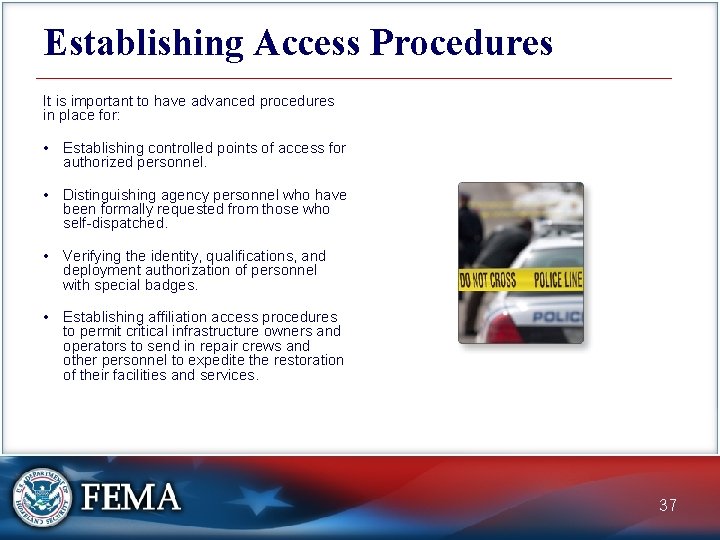
Establishing Access Procedures It is important to have advanced procedures in place for: • Establishing controlled points of access for authorized personnel. • Distinguishing agency personnel who have been formally requested from those who self-dispatched. • Verifying the identity, qualifications, and deployment authorization of personnel with special badges. • Establishing affiliation access procedures to permit critical infrastructure owners and operators to send in repair crews and other personnel to expedite the restoration of their facilities and services. 37
Why is it important to secure the incident scene? 38
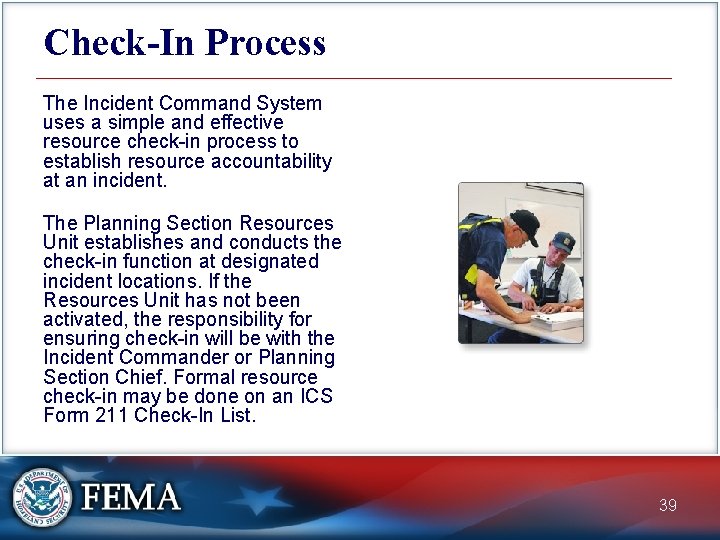
Check-In Process The Incident Command System uses a simple and effective resource check-in process to establish resource accountability at an incident. The Planning Section Resources Unit establishes and conducts the check-in function at designated incident locations. If the Resources Unit has not been activated, the responsibility for ensuring check-in will be with the Incident Commander or Planning Section Chief. Formal resource check-in may be done on an ICS Form 211 Check-In List. 39
Check-In Process: Information Collected Information collected at check-in is used for tracking, resource assignment, and financial purposes, and includes: • Date and time of check-in • Name of resource • Home base • Departure point • Order number and resource filled • Resource Leader name and personnel manifest (if applicable) • Other qualifications • Travel method Depending on agency policy, the Planning Section Resources Unit may contact the dispatch organization to confirm the arrival of resources, personnel may contact their agency ordering point to confirm their arrival, or the system may assume on-time arrival unless specifically notified otherwise. 40
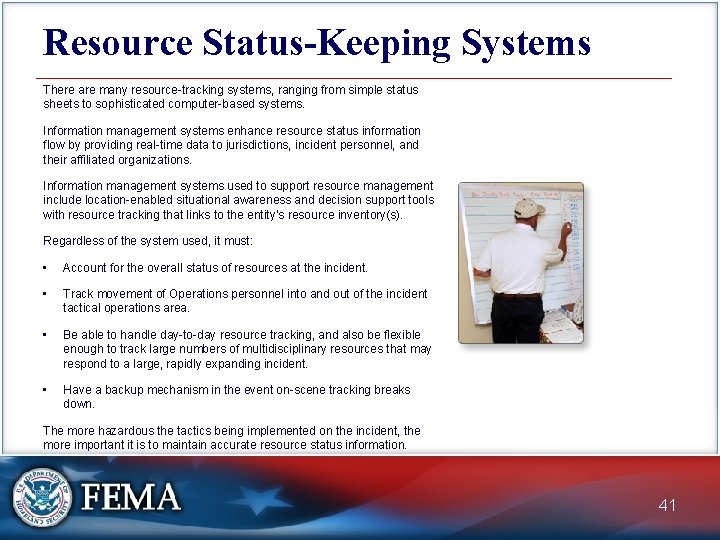
Resource Status-Keeping Systems There are many resource-tracking systems, ranging from simple status sheets to sophisticated computer-based systems. Information management systems enhance resource status information flow by providing real-time data to jurisdictions, incident personnel, and their affiliated organizations. Information management systems used to support resource management include location-enabled situational awareness and decision support tools with resource tracking that links to the entity’s resource inventory(s). Regardless of the system used, it must: • Account for the overall status of resources at the incident. • Track movement of Operations personnel into and out of the incident tactical operations area. • Be able to handle day-to-day resource tracking, and also be flexible enough to track large numbers of multidisciplinary resources that may respond to a large, rapidly expanding incident. • Have a backup mechanism in the event on-scene tracking breaks down. The more hazardous the tactics being implemented on the incident, the more important it is to maintain accurate resource status information. 41
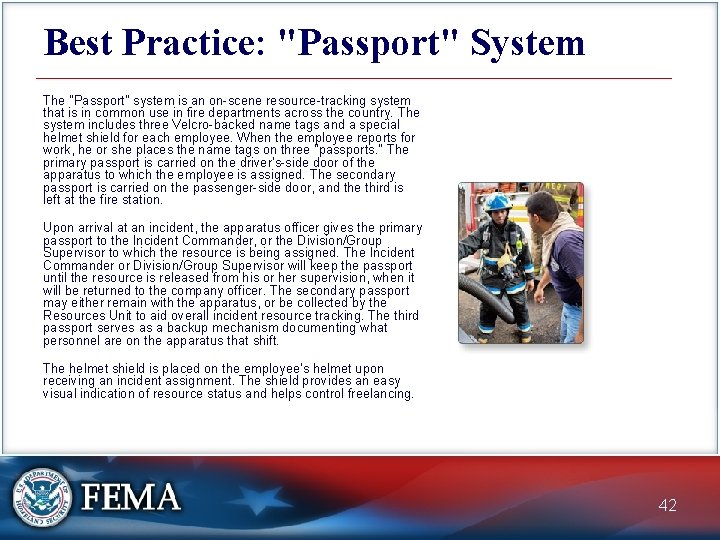
Best Practice: "Passport" System The "Passport" system is an on-scene resource-tracking system that is in common use in fire departments across the country. The system includes three Velcro-backed name tags and a special helmet shield for each employee. When the employee reports for work, he or she places the name tags on three "passports. " The primary passport is carried on the driver's-side door of the apparatus to which the employee is assigned. The secondary passport is carried on the passenger-side door, and the third is left at the fire station. Upon arrival at an incident, the apparatus officer gives the primary passport to the Incident Commander, or the Division/Group Supervisor to which the resource is being assigned. The Incident Commander or Division/Group Supervisor will keep the passport until the resource is released from his or her supervision, when it will be returned to the company officer. The secondary passport may either remain with the apparatus, or be collected by the Resources Unit to aid overall incident resource tracking. The third passport serves as a backup mechanism documenting what personnel are on the apparatus that shift. The helmet shield is placed on the employee's helmet upon receiving an incident assignment. The shield provides an easy visual indication of resource status and helps control freelancing. 42
Discussion Question - Checking in Resources Who is responsible for checking in resources acquired through a mutual aid agreement when they arrive at the incident scene? 43
Resource Management Task 5: Demobilize The goal of demobilization is the orderly, safe, and efficient return of a resource to its original location and status. Once resources are no longer needed on an incident, those responsible for resources should demobilize them. The resource requestor and provider may agree to reassign a resource rather than demobilize it. Prior to demobilization, incident staff responsible for the planning and logistics functions collaborate to plan how resources are rehabilitated, replenished, disposed of, and/or returned or restored to operational condition. 44
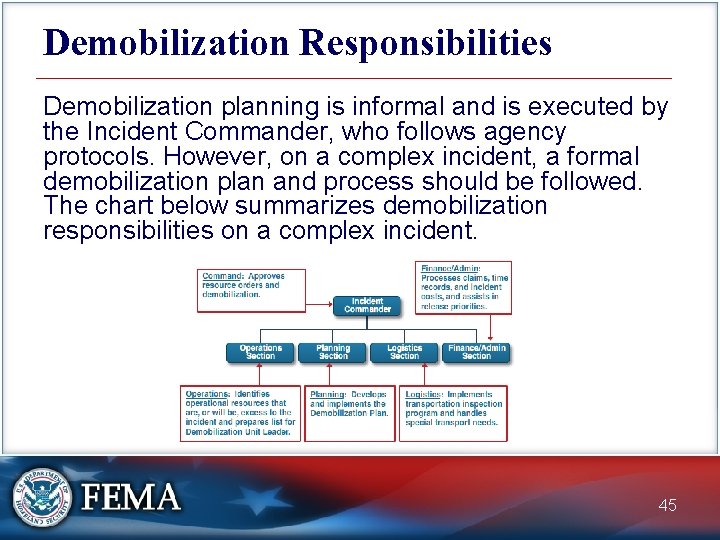
Demobilization Responsibilities Demobilization planning is informal and is executed by the Incident Commander, who follows agency protocols. However, on a complex incident, a formal demobilization plan and process should be followed. The chart below summarizes demobilization responsibilities on a complex incident. 45
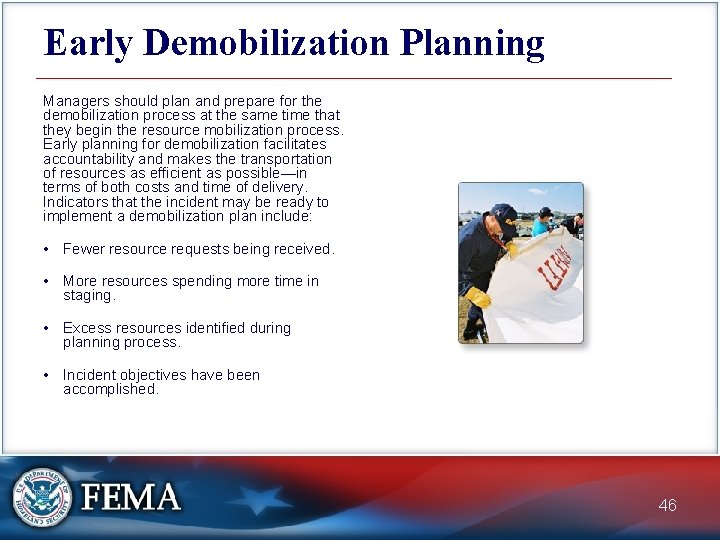
Early Demobilization Planning Managers should plan and prepare for the demobilization process at the same time that they begin the resource mobilization process. Early planning for demobilization facilitates accountability and makes the transportation of resources as efficient as possible—in terms of both costs and time of delivery. Indicators that the incident may be ready to implement a demobilization plan include: • Fewer resource requests being received. • More resources spending more time in staging. • Excess resources identified during planning process. • Incident objectives have been accomplished. 46
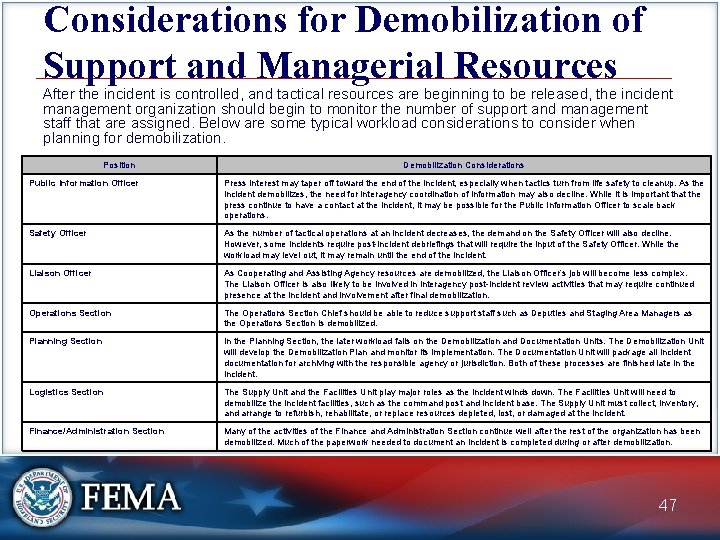
Considerations for Demobilization of Support and Managerial Resources After the incident is controlled, and tactical resources are beginning to be released, the incident management organization should begin to monitor the number of support and management staff that are assigned. Below are some typical workload considerations to consider when planning for demobilization. Position Demobilization Considerations Public Information Officer Press interest may taper off toward the end of the incident, especially when tactics turn from life safety to cleanup. As the incident demobilizes, the need for interagency coordination of information may also decline. While it is important that the press continue to have a contact at the incident, it may be possible for the Public Information Officer to scale back operations. Safety Officer As the number of tactical operations at an incident decreases, the demand on the Safety Officer will also decline. However, some incidents require post-incident debriefings that will require the input of the Safety Officer. While the workload may level out, it may remain until the end of the incident. Liaison Officer As Cooperating and Assisting Agency resources are demobilized, the Liaison Officer’s job will become less complex. The Liaison Officer is also likely to be involved in interagency post-incident review activities that may require continued presence at the incident and involvement after final demobilization. Operations Section The Operations Section Chief should be able to reduce support staff such as Deputies and Staging Area Managers as the Operations Section is demobilized. Planning Section In the Planning Section, the later workload falls on the Demobilization and Documentation Units. The Demobilization Unit will develop the Demobilization Plan and monitor its implementation. The Documentation Unit will package all incident documentation for archiving with the responsible agency or jurisdiction. Both of these processes are finished late in the incident. Logistics Section The Supply Unit and the Facilities Unit play major roles as the incident winds down. The Facilities Unit will need to demobilize the incident facilities, such as the command post and incident base. The Supply Unit must collect, inventory, and arrange to refurbish, rehabilitate, or replace resources depleted, lost, or damaged at the incident. Finance/Administration Section Many of the activities of the Finance and Administration Section continue well after the rest of the organization has been demobilized. Much of the paperwork needed to document an incident is completed during or after demobilization. 47
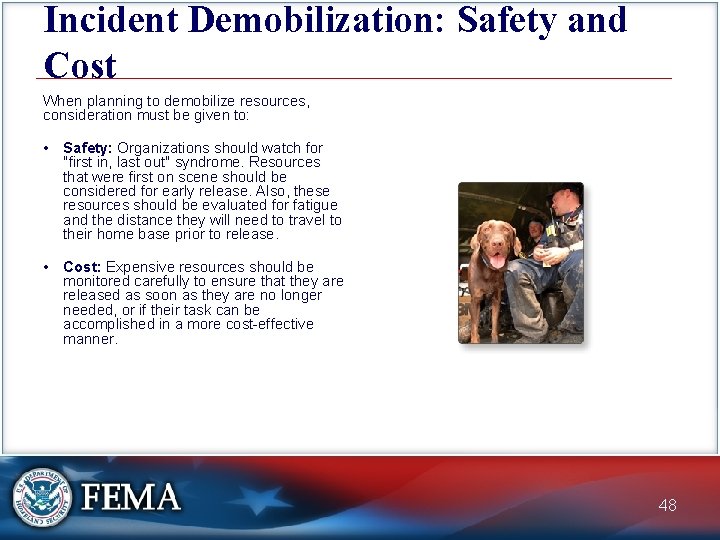
Incident Demobilization: Safety and Cost When planning to demobilize resources, consideration must be given to: • Safety: Organizations should watch for "first in, last out" syndrome. Resources that were first on scene should be considered for early release. Also, these resources should be evaluated for fatigue and the distance they will need to travel to their home base prior to release. • Cost: Expensive resources should be monitored carefully to ensure that they are released as soon as they are no longer needed, or if their task can be accomplished in a more cost-effective manner. 48
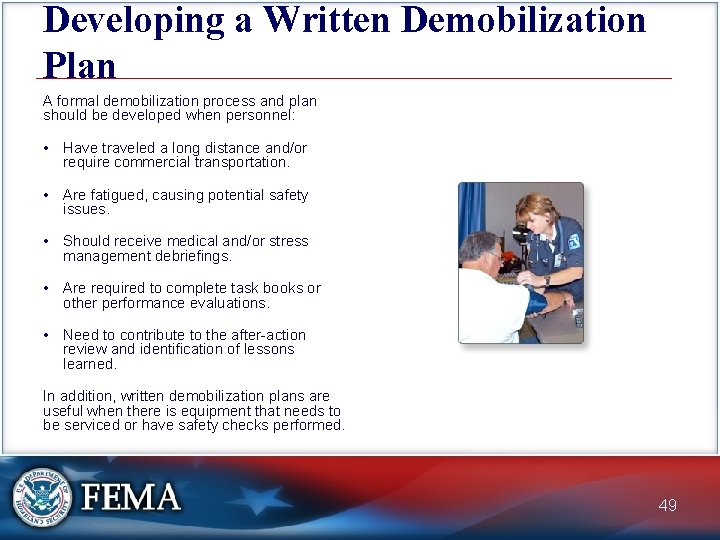
Developing a Written Demobilization Plan A formal demobilization process and plan should be developed when personnel: • Have traveled a long distance and/or require commercial transportation. • Are fatigued, causing potential safety issues. • Should receive medical and/or stress management debriefings. • Are required to complete task books or other performance evaluations. • Need to contribute to the after-action review and identification of lessons learned. In addition, written demobilization plans are useful when there is equipment that needs to be serviced or have safety checks performed. 49
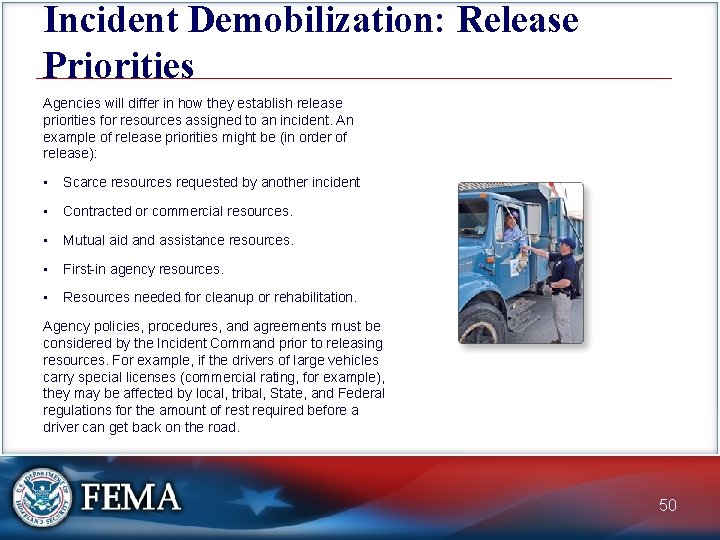
Incident Demobilization: Release Priorities Agencies will differ in how they establish release priorities for resources assigned to an incident. An example of release priorities might be (in order of release): • Scarce resources requested by another incident • Contracted or commercial resources. • Mutual aid and assistance resources. • First-in agency resources. • Resources needed for cleanup or rehabilitation. Agency policies, procedures, and agreements must be considered by the Incident Command prior to releasing resources. For example, if the drivers of large vehicles carry special licenses (commercial rating, for example), they may be affected by local, tribal, State, and Federal regulations for the amount of rest required before a driver can get back on the road. 50
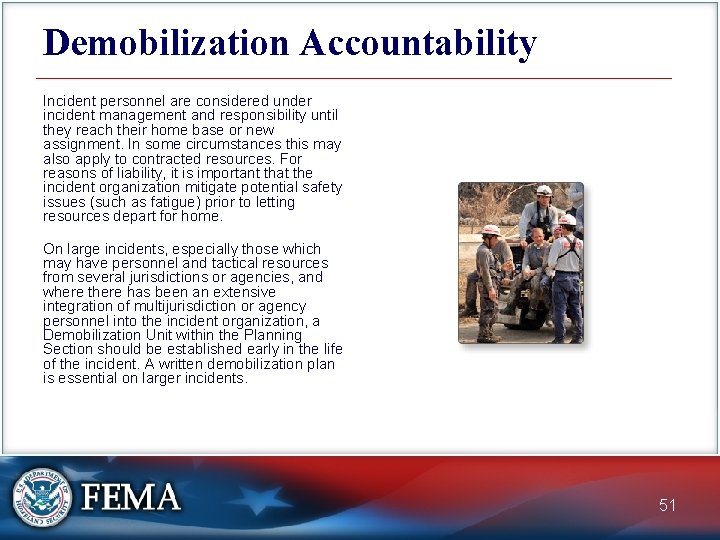
Demobilization Accountability Incident personnel are considered under incident management and responsibility until they reach their home base or new assignment. In some circumstances this may also apply to contracted resources. For reasons of liability, it is important that the incident organization mitigate potential safety issues (such as fatigue) prior to letting resources depart for home. On large incidents, especially those which may have personnel and tactical resources from several jurisdictions or agencies, and where there has been an extensive integration of multijurisdiction or agency personnel into the incident organization, a Demobilization Unit within the Planning Section should be established early in the life of the incident. A written demobilization plan is essential on larger incidents. 51
Discussion Question - Release Priorities Agencies will differ in how they establish release priorities for resources assigned to an incident. How does your organizations establish release priorities for resources assigned to an incident? 52
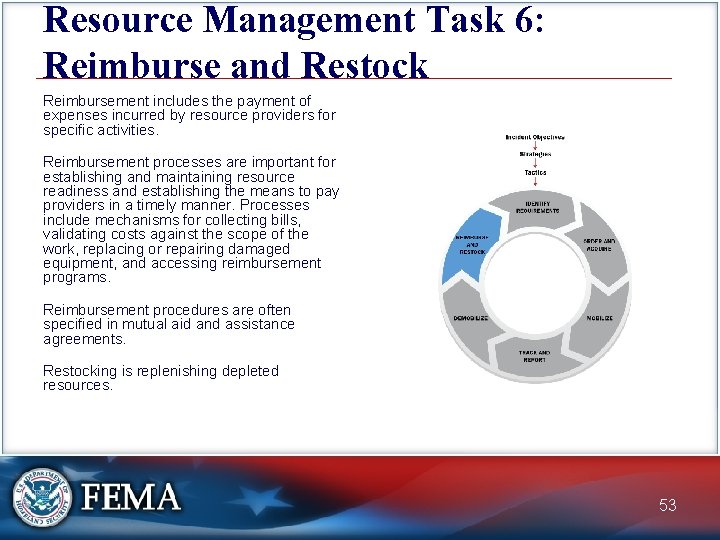
Resource Management Task 6: Reimburse and Restock Reimbursement includes the payment of expenses incurred by resource providers for specific activities. Reimbursement processes are important for establishing and maintaining resource readiness and establishing the means to pay providers in a timely manner. Processes include mechanisms for collecting bills, validating costs against the scope of the work, replacing or repairing damaged equipment, and accessing reimbursement programs. Reimbursement procedures are often specified in mutual aid and assistance agreements. Restocking is replenishing depleted resources. 53
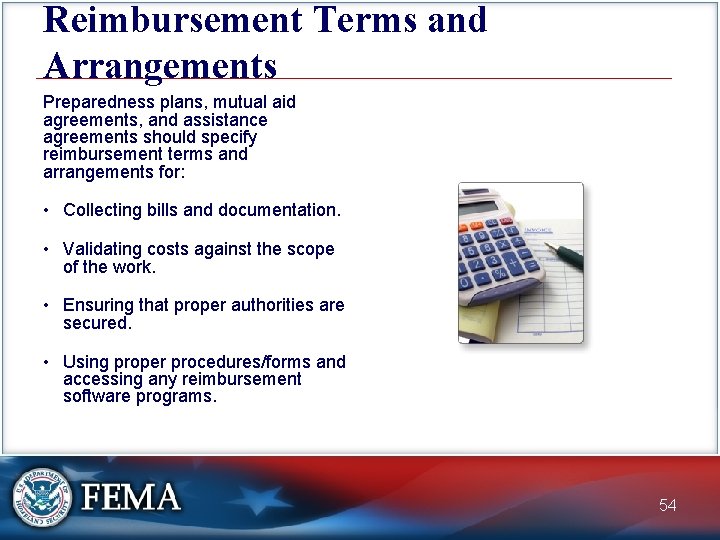
Reimbursement Terms and Arrangements Preparedness plans, mutual aid agreements, and assistance agreements should specify reimbursement terms and arrangements for: • Collecting bills and documentation. • Validating costs against the scope of the work. • Ensuring that proper authorities are secured. • Using proper procedures/forms and accessing any reimbursement software programs. 54
Unit Summary This unit focused on the six primary tasks of resource management during an incident. 1. Identify Requirements 2. Order and Acquire 3. Mobilize 4. Track and Report 5. Demobilize 6. Reimburse and Restock The next unit covers specialized considerations for managing resources during complex incidents. 55