
Managing Railway Bridges Bryant Le Professor John Andrews
Managing Railway Bridges Bryant Le Professor John Andrews
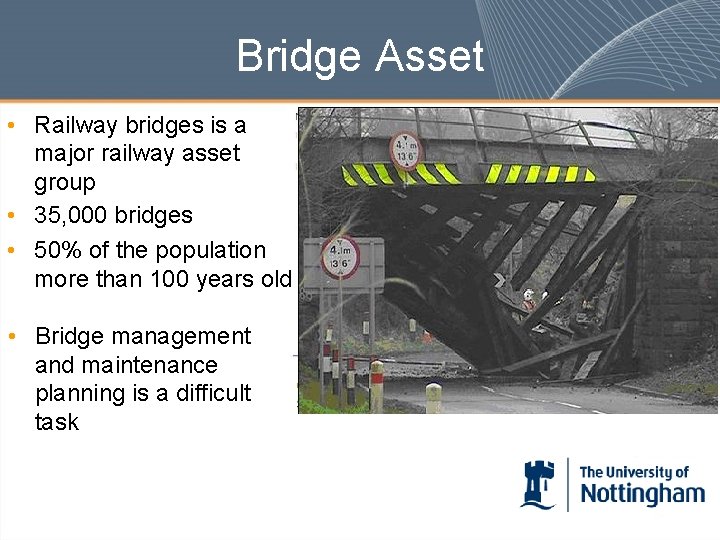
Bridge Asset • Railway bridges is a major railway asset group • 35, 000 bridges • 50% of the population more than 100 years old • Bridge management and maintenance planning is a difficult task >100 years old
Aims and Objectives • Develop a management tool • Maintenance strategy (repair and renew) can be investigated and optimised • Longer term objective to minimise the whole life costs.

Current bridge system • Structure condition marking index (SCMI) • Bridge condition is often rated in term of condition score from 0 -100 Problems • Data not available with the rating system started in 2000, only 60% of bridges were inspected by 2006 • Large inspection interval (6 years) • Asset contains only one set of score • Concern from the ORR (Office of Rail Regulation) about the accuracy of the scores
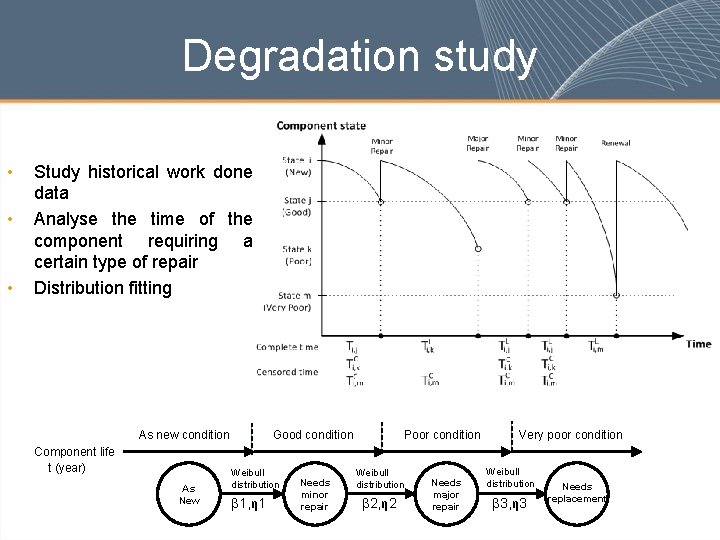
Degradation study • • • Study historical work done data Analyse the time of the component requiring a certain type of repair Distribution fitting Good condition As new condition Component life t (year) As New Weibull distribution β 1, η 1 Needs minor repair Poor condition Weibull distribution β 2, η 2 Needs major repair Very poor condition Weibull distribution β 3, η 3 Needs replacement
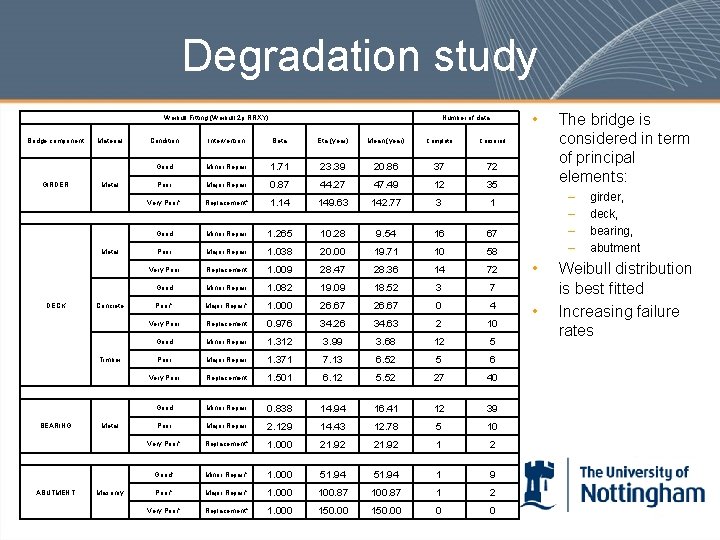
Degradation study Weibull Fitting (Weibull 2 p RRXY) Bridge component GIRDER Material Metal Number of data Condition Intervention Beta Eta (year) Mean (year) Complete Censored Good Minor Repair 1. 71 23. 39 20. 86 37 72 Poor Major Repair 0. 87 44. 27 47. 49 12 35 Very Poor* Replacement* 1. 14 149. 63 142. 77 3 1 Good Minor Repair 1. 265 10. 28 9. 54 16 67 Poor Major Repair 1. 038 20. 00 19. 71 10 58 Very Poor Replacement 1. 009 28. 47 28. 36 14 72 Good Minor Repair 1. 082 19. 09 18. 52 3 7 Poor* Major Repair* 1. 000 26. 67 0 4 Very Poor Replacement 0. 976 34. 26 34. 63 2 10 Good Minor Repair 1. 312 3. 99 3. 68 12 5 Poor Major Repair 1. 371 7. 13 6. 52 5 6 Very Poor Replacement 1. 501 6. 12 5. 52 27 40 Good Minor Repair 0. 838 14. 94 16. 41 12 39 Poor Major Repair 2. 129 14. 43 12. 78 5 10 Very Poor* Replacement* 1. 000 21. 92 1 2 • – – Metal DECK Concrete Timber BEARING Metal ABUTMENT Masonry Good* Minor Repair* 1. 000 51. 94 1 9 Poor* Major Repair* 1. 000 100. 87 1 2 Very Poor* Replacement* 1. 000 150. 00 0 0 The bridge is considered in term of principal elements: • • girder, deck, bearing, abutment Weibull distribution is best fitted Increasing failure rates
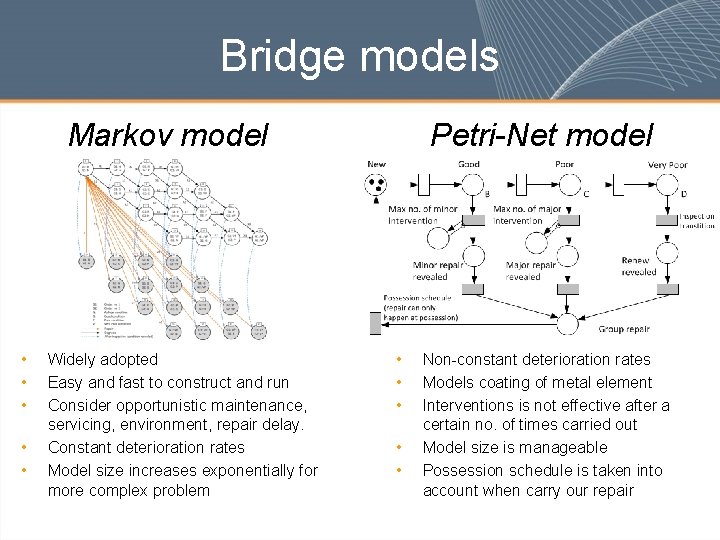
Bridge models Markov model • • • Widely adopted Easy and fast to construct and run Consider opportunistic maintenance, servicing, environment, repair delay. Constant deterioration rates Model size increases exponentially for more complex problem Petri-Net model • • • Non-constant deterioration rates Models coating of metal element Interventions is not effective after a certain no. of times carried out Model size is manageable Possession schedule is taken into account when carry our repair
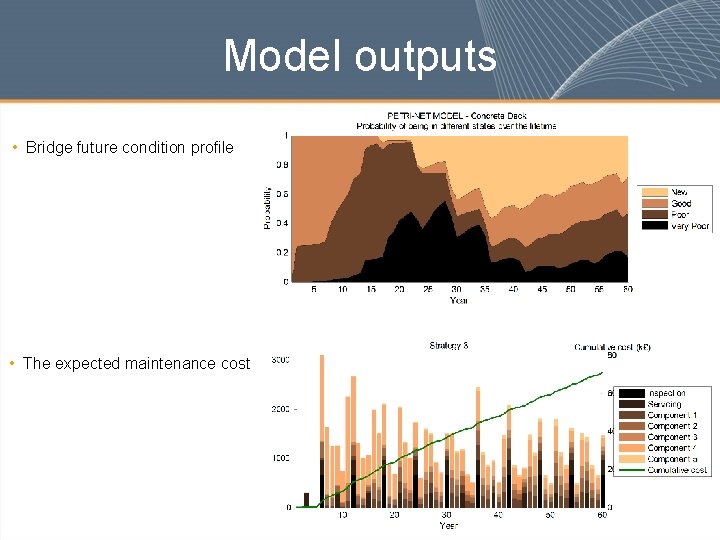
Model outputs • Bridge future condition profile • The expected maintenance cost
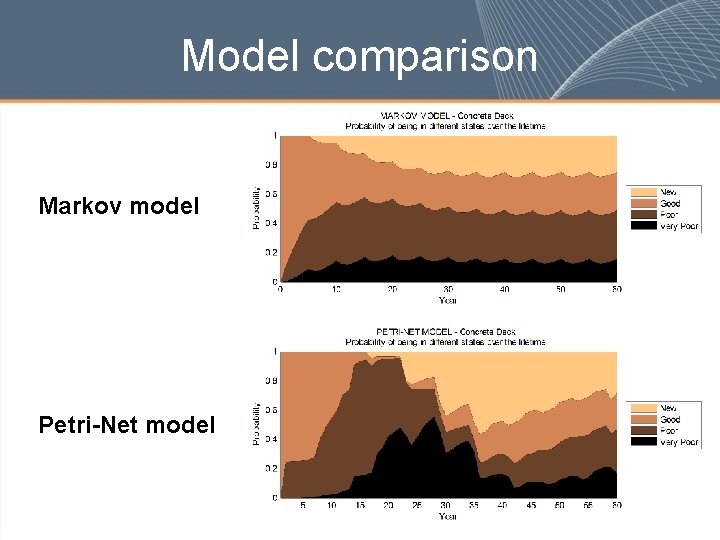
Model comparison Markov model Petri-Net model
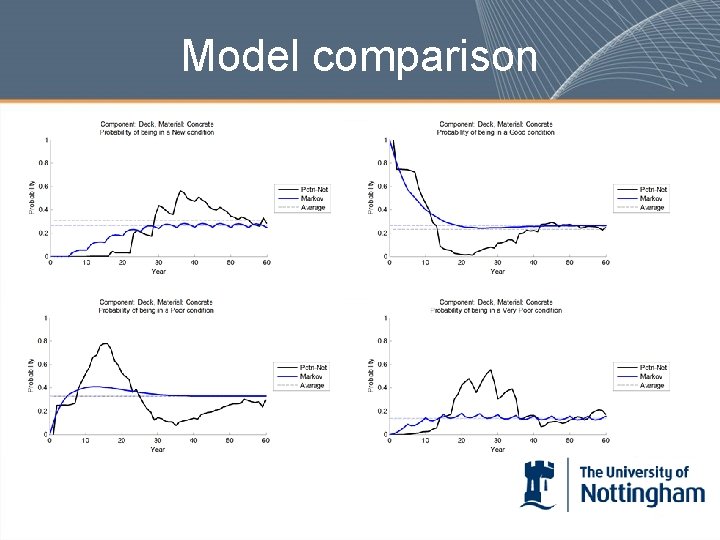
Model comparison
Maintenance Strategy Optimisation • Multi-objective Genetic Algorithm Optimisation • Find optimum maintenance strategy gives: – Best condition profile – Lowest WLCC cost • Model inputs (variables) – – Repair strategy Scheduling of maintenance (delay repair) Inspection, servicing interval Possession schedule
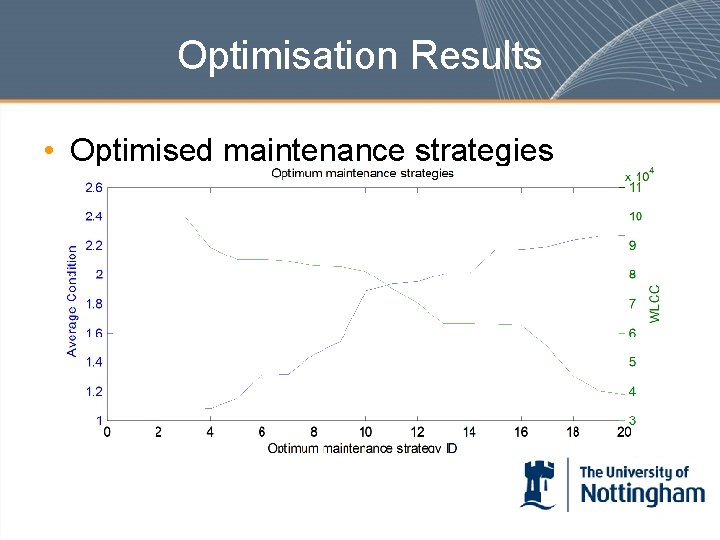
Optimisation Results • Optimised maintenance strategies
Thank you for your time
- Slides: 13