
Managing Organizational Conflicts at the OHLGS Introduction Overview
- Slides: 55
Managing Organizational Conflicts at the OHLGS
Introduction
Overview of Organizational Conflicts • The discord that arises when goals, interests or values of different individuals or groups are incompatible and those people block or thwart each other’s efforts to achieve their objectives. • Conflict is inevitable given the wide range of goals for the different stakeholder in the organization.
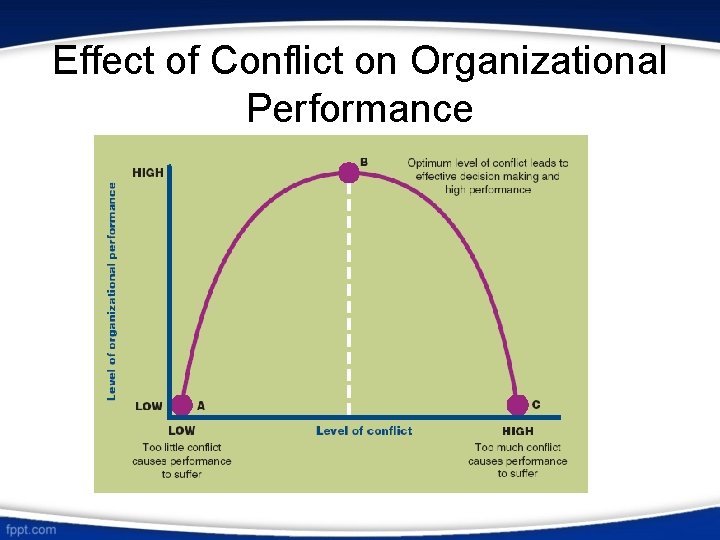
Effect of Conflict on Organizational Performance
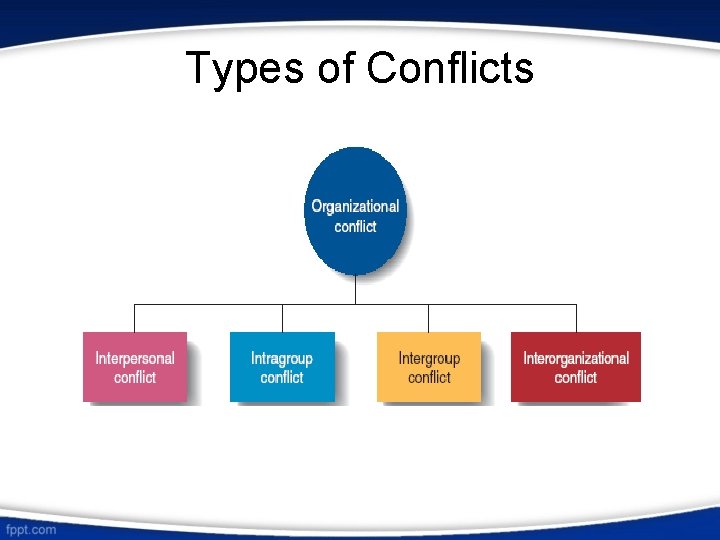
Types of Conflicts
Types of Conflicts • Inter-personal Conflict – Conflict between individuals due to differences in their goals or values • Intra-group Conflict – Conflict within a group or team. • Inter-group Conflict – Conflict between two or more teams, groups or departments. Managers play a key role in resolution of this conflict • Inter-organizational Conflict – Conflict that arises across organizations.
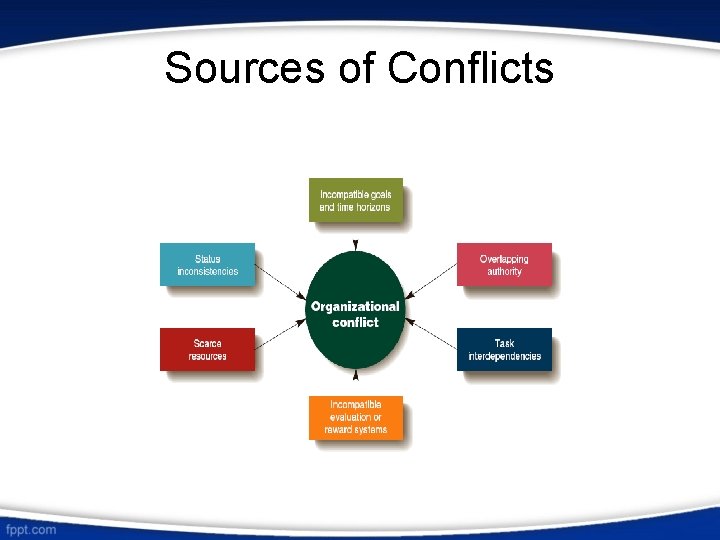
Sources of Conflicts
Sources of Conflicts • Different Goals and Time Horizons – Different groups have differing goals and focus. • Overlapping Authority – Two or more managers claim authority for the same activities which leads to conflict between the managers and workers. • Task Interdependencies – One member of a group or a group fails to finish a task that another member or group depends on, causing the waiting worker or group to fall behind. • Different Evaluation or Reward Systems – A group is rewarded for achieving a goal, but another interdependent group is rewarded for achieving a goal that conflicts with the first group. • Scarce Resources – Managers can come into conflict over the allocation of scare resources. • Status Inconsistencies – Some individuals and groups have a higher organizational status than others, leading to conflict with lower status groups.
Conflict Management Strategies
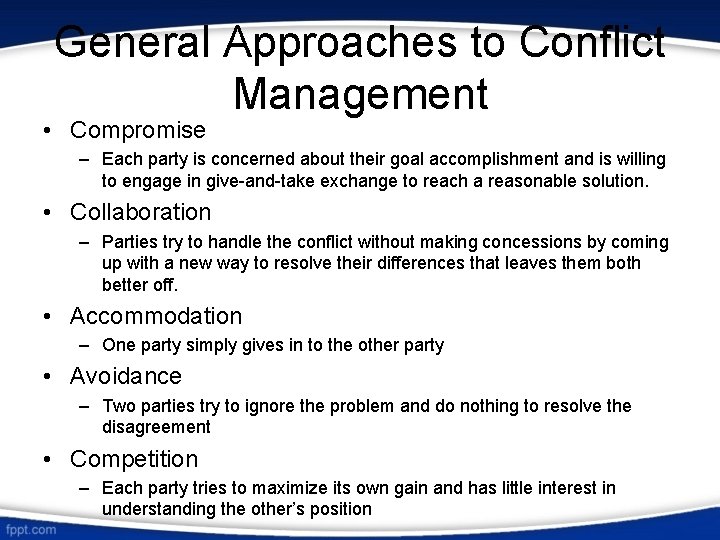
General Approaches to Conflict Management • Compromise – Each party is concerned about their goal accomplishment and is willing to engage in give-and-take exchange to reach a reasonable solution. • Collaboration – Parties try to handle the conflict without making concessions by coming up with a new way to resolve their differences that leaves them both better off. • Accommodation – One party simply gives in to the other party • Avoidance – Two parties try to ignore the problem and do nothing to resolve the disagreement • Competition – Each party tries to maximize its own gain and has little interest in understanding the other’s position
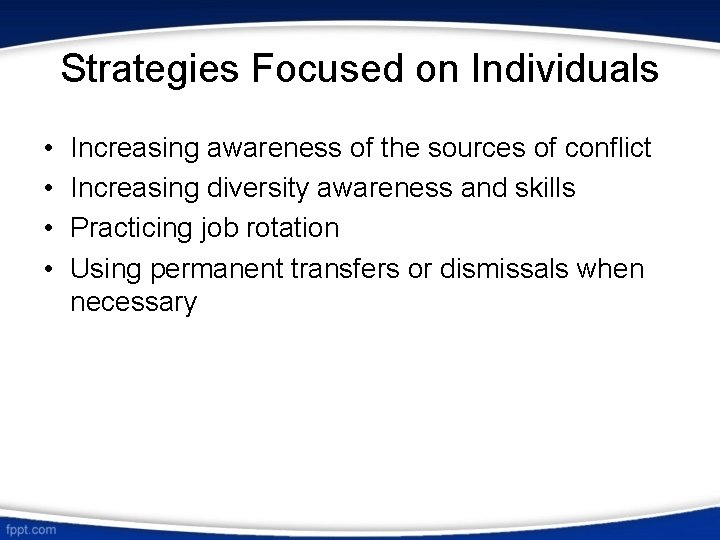
Strategies Focused on Individuals • • Increasing awareness of the sources of conflict Increasing diversity awareness and skills Practicing job rotation Using permanent transfers or dismissals when necessary
Strategies Focused on the Whole Organization • Changing an organization’s structure or culture • Altering the source of conflict
What constitutes Misconduct? • Any act done by an employee without reasonable cause constitutes misconduct if it: – amounts to failure to perform in a proper manner any duty imposed on him/her; or – contravenes any enactment relating to the Local Government Service; or – is otherwise prejudicial to the efficient conduct of the functions of the Local Government Service; or – tends to bring the Local Government Service into disrepute
Offences
Major Offences At the LGS the following constitutes major offences: • Coercion, intimidation, threatening of fellow employees; • Use of insulting language towards another employee; • Deceit of public officer in the performance of his/her duties; • Sexual harassment, physical assault, or fighting on premises; • Gross dereliction of duties, gross insubordination, • Stealing, misappropriation of funds, fraud, or falsification of records, extortion,
Major Offences Cont’d • • • Wilful damage to state property; Incitement of employees to engage in illegal strikes; Habitual lateness to work; Sleeping on duty by security staff; Absence from work for ten (10) consecutive working days Improper influence; False and misleading information; Unauthorized disclosure of official information Persistent alcoholism, drug abuse, etc.
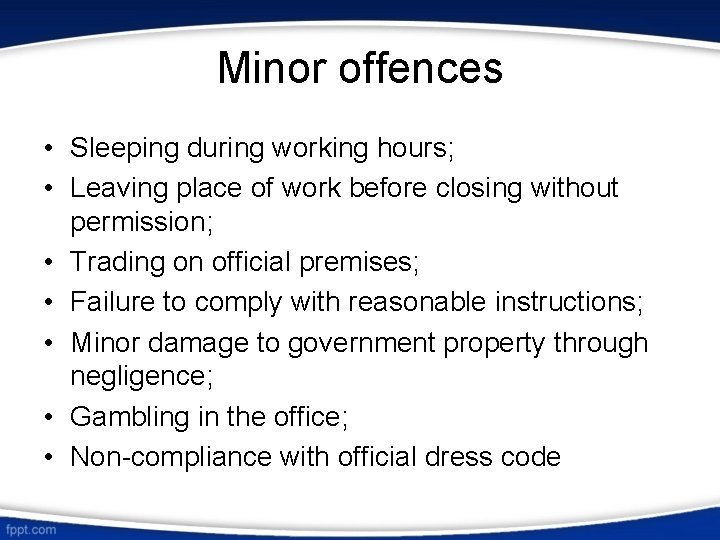
Minor offences • Sleeping during working hours; • Leaving place of work before closing without permission; • Trading on official premises; • Failure to comply with reasonable instructions; • Minor damage to government property through negligence; • Gambling in the office; • Non-compliance with official dress code
Penalties
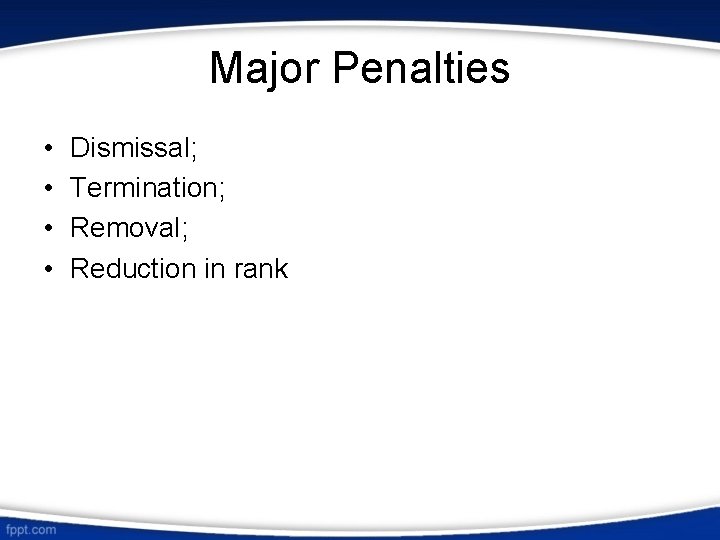
Major Penalties • • Dismissal; Termination; Removal; Reduction in rank
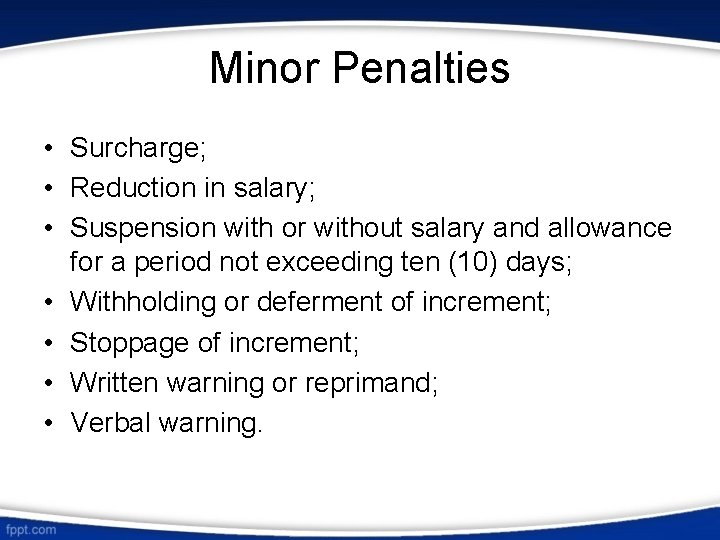
Minor Penalties • Surcharge; • Reduction in salary; • Suspension with or without salary and allowance for a period not exceeding ten (10) days; • Withholding or deferment of increment; • Stoppage of increment; • Written warning or reprimand; • Verbal warning.
Disciplinary Procedure
Interdiction • Interdiction may be ordered: – where further disciplinary proceedings are to be taken against an officer; – where the officer is the subject of criminal investigation or offence, whether or not connected with the officer’s work; – where the continued presence of an officer at his/her workplace may influence investigations into an offence allegedly committed by the officer. – During the period of interdiction which should not exceed six (6) calendar months, the interdicted officer shall be paid one-half of his/her salary provided he/she is not indebted to the government.
Interdiction arising from Criminal Investigation • Where interdiction is the result of criminal investigation leading to prosecution, and the interdicted officer is subsequently convicted in a court of law of the criminal offence involving fraud or theft or is sentenced to a term of imprisonment, the officer shall be summarily dismissed from the Service and shall forfeit the salary withheld upon interdiction.
Dismissal Upon and After Trial • Where an officer of the Local Government Service is convicted of an offence involving fraud or theft for which he/she is sentenced to imprisonment, the appointing authority shall dismiss him/her forthwith and this will take effect from the date of judgment by the court and a copy of the judgment should be placed on the officers file.
Discipline and grievance procedures
Key Principles • During disciplinary procedures staff/offender has the right to be accompanied by a colleague or union representative • The staff will be assured that they will be given the opportunity to state their case fully and that they have a right of appeal
Key Principles Cont’d • Management level Staff and staff involved in disciplinary meetings should make it a point to be present in order to complete the assignment with dispatch • Unless the case of summary dismissal, no offender will be dismissed for a first instance of misconduct • Procedures may commence from verbal warning, to first written warning up to final written warning and finally to dismissal
Responsibility / Authority • It is the mandate of the LGSC and the Head of Service to see to the implementation of the policy. • District Coordinating Directors, Regional Coordinating Directors and Regional and District Heads of DDUs will implement the policy as a delegated function of the LGS.
Procedures
Informal Procedure • This procedure should be applicable to conduct that is considered as minor. • An informal advisory meeting is usually called and discussions are brisk because the object is for the offender to recognize and accept shortcomings and agree to change. • A note of this discussion should be kept for record purposes. • As a matter of fact, informal procedures are a part of everyday administrative work that seek to bring about corrective measures.
Formal Procedures • This Process is applicable where an offender does not respond to informal action. • Conduct at this stage is considered unsatisfactory and therefore to be dealt with as a misconduct
Procedure for Deferment of Increment • Any employee’s salary increment may be withheld on grounds of inefficient work or conduct. • The Head of Service shall notify the employee of the Service intention to defer his/her increment and shall assign reasons for such action and shall indicate the duration of the deferment of the increment. • Where an employee has not earned his annual increment and his Head of Division/Unit is satisfied that the employee’s increment may be deferred, the Head of Division/Unit shall inform the Head of Service with a full statement of reasons for recommending the deferment of the employee’s increment.
Deferment of Increment Cont’d • Upon conviction of a criminal offence, an employee shall be dismissed with effect from the date on which she/he was convicted • Any employee who has had his increment deferred may have the increment restored to him/her, where the Head of Division/Unit is satisfied that the employee has earned its restoration by an improvement in the standard of his work and conduct. • Any employee whose increment is deferred shall lose the amount of increment which otherwise would have drawn interest for the period during which the increment was withheld.
Procedure for Suspension • Where the disciplinary authority is satisfied that an employee has committed an offence, the disciplinary authority may suspend the employee from duty without pay for a period not exceeding fourteen (14) days. • It shall be unlawful for any employee so suspended to carry out his duties or visit his place of work without the express permission of the Head of Service. • Where an employee has been suspended, she/he shall be called upon to hand over any uniform, accounts books, records, and any property of the Service in his charge to such other employee as may be designated.
Procedure for Suspension Cont’d • The Head of Service or his nominee shall convey notice of suspension in writing to the employee concerned. • The power to suspend an employee shall rest in the authority of the Head of Service, provided that in exceptional circumstances where any delay might be detrimental to the interest of the Service, an employee nominated by the Head of Service to act on his behalf may exercise such power. • Where an employee is suspended, a full report of the circumstances leading to the suspension shall be submitted to the Head of Service who shall give consideration to the matter and make such order as she/he considers appropriate in the circumstances
Procedure for Reprimand • • • The Head of Service or Head of Department, Division or Unit shall query in writing after two verbal warnings, an employee whose work or conduct is unsatisfactory. Where an employee has been queried and the explanation is considered unsatisfactory, a decision shall be recorded in writing against him/her. Where an employee is queried by the Head of Division/Unit and a decision is recorded in writing against him/her, a copy each of the query, the reply to the query and written decision shall be forwarded to the Head of Service. No employee shall be allowed to accumulate a long record of warnings, censures, misconduct and faults before disciplinary action is taken against him/her. Notwithstanding the triviality of the offences, where it is clear that the employee is not likely to respond to Department/Divisional/Unit correction and there is sufficient reason to warrant it, disciplinary proceedings shall be taken against the employee.
Procedure for Termination of Appointment • Notwithstanding the provisions of section 9. 5, the Head of Service may terminate the appointment of any employee, where she/he is satisfied that on the basis of results of investigation or inquiry, it is in the interest of the Service to do so. • Notwithstanding the termination of his/her appointment, an employee shall be allowed to continue to stay in the Service premises for a period not exceeding one (1) month, and shall be provided with transport to his home town. • The Head of Service may at any time and for sufficient reason terminate the appointment of any employee on trial or probation.
Procedure for Reduction In Rank • Where on disciplinary grounds, a major penalty other than dismissal is the appropriate penalty to be imposed on any employee; such employee may be reduced in rank. • Any employee reduced in rank shall be removed to a lower grade with subsequent reduction in salary.
Disciplinary Procedure • Interdiction may be ordered: – where further disciplinary proceedings are to be taken against an officer; – where the officer is the subject of criminal investigation or offence, whether or not connected with the officer’s work; – where the continued presence of an officer at his/her work-place may influence investigations into an offence allegedly committed by the officer. – During the period of interdiction which should not exceed six (6) calendar months, the interdicted officer shall be paid one-half of his/her salary provided he/she is not indebted to the government.
Formal Proceedings • • • Where it is considered necessary to institute formal proceedings against an officer, the appropriate authority shall frame a charge or charges against the offending employee in writing. The authority may consult the Attorney. General with respect to the terms of the charge or charges. When a copy of the charge or charges together with a brief statement of the allegation on which the charge is based has been forwarded to the offending employee, he/she shall be required to state in writing, within seven (7) days, any grounds upon which he/she wishes to exonerate himself/herself. Failure on the part of the officer to react within the period of seven (7) days may be deemed to mean that he/she has no defence to the charge or charges. The appropriate disciplinary authority may proceed to take relevant decision. When a statement submitted by the offending employee is not considered satisfactory, the disciplinary authority shall proceed to refer the matter to a committee for further inquiry. The committee may, when the need arises, request for the assistance of professional or technical persons.
Disciplinary Committee • The composition of the Disciplinary Committee shall be as follows: – – Human Resource Director or his/her representative; Representative of local union or staff association; Any other senior staff appointed by management; Any other relevant technical or professional persons(s).
The Right of Appeal: • Any worker who is given disciplinary warning or any sanction or notice of dismissal, has a right to appeal and this appeal must be written and submitted to the Human Resource Unit, 10 working days after receiving sanction. • The notice must state grounds of the appeal.
Appeals Procedure: • A Senior Staff will usually hear appeals. Which should include representatives of HR Unit to advise. Reasons for appeal may include: – If the offender thinks that penalty is not fair; – If new evidence to assist offender is discovered; – If offender feels that the procedure was not applied correctly
The Appeal Process: • • Management shall present case first, and explain why action is being taken. Witnesses may be called; Offender/worker will then ask questions and appeal side would also ask any questions they may have; The third group which is the appeal panel will also ask questions; After these questions the worker side will be asked to make its presentation to the panel, including calling witnesses if necessary; The management side follows with their presentation including witnesses; Both parties- (worker and management) will then sum up their cases; There is then an adjournment to enable the panel consider the information presented to reach a decision; and, On return of the two parties, the panel will communicate their decision to them verbally. This will later be confirmed in writing to both parties, at least 5 working days after the Appeal Hearing.
Grievance Procedures
Timeline and Confidentiality • In order to deal with worker’s concerns quickly, it is important that all parties-management and workers meet the prescribed timelines. • Grievance is usually considered where it relates to an event or decision which occurred within three months before the hearing of the grievance. • It is the responsibility of all workers and management to maintain strict confidentiality of personal information during grievance procedure and after.
Equality and Diversity Considerations • Management should remember that when applying the procedure, they have a duty to ensure that no unlawful discriminatory practices occur • People with Disability should be supported if they are involved in a grievance process.
Initial Action • Workers are advised to always contact their supervisors informally when they have any concern. • In this context, management will consider this under the usual day-to- day management process and resolve such disputes informally
Steps
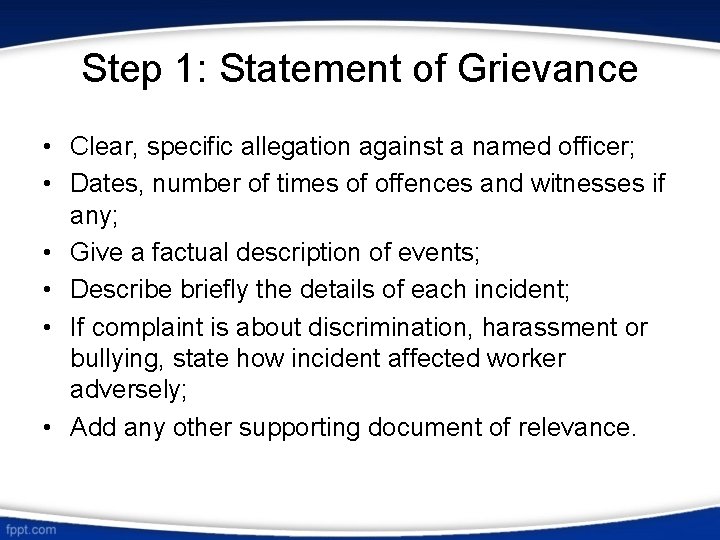
Step 1: Statement of Grievance • Clear, specific allegation against a named officer; • Dates, number of times of offences and witnesses if any; • Give a factual description of events; • Describe briefly the details of each incident; • If complaint is about discrimination, harassment or bullying, state how incident affected worker adversely; • Add any other supporting document of relevance.
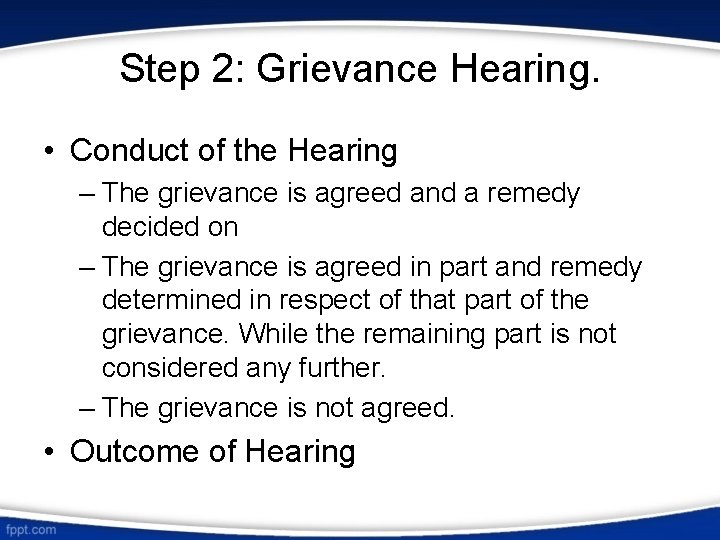
Step 2: Grievance Hearing. • Conduct of the Hearing – The grievance is agreed and a remedy decided on – The grievance is agreed in part and remedy determined in respect of that part of the grievance. While the remaining part is not considered any further. – The grievance is not agreed. • Outcome of Hearing
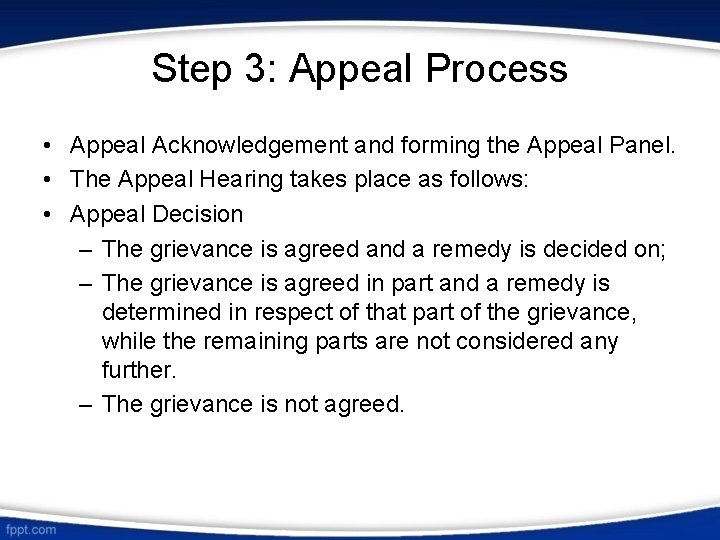
Step 3: Appeal Process • Appeal Acknowledgement and forming the Appeal Panel. • The Appeal Hearing takes place as follows: • Appeal Decision – The grievance is agreed and a remedy is decided on; – The grievance is agreed in part and a remedy is determined in respect of that part of the grievance, while the remaining parts are not considered any further. – The grievance is not agreed.
Grievance Resolution • Grievance Reporting and Resolution Procedure • Grievance Presentation – – – • be in writing and signed or marked by the originator; state the nature of the grievance; specify the authority against which the grievance is being made; state the remedy being sought; be copied to the authority against which the grievance is being made. Right of Representation
The HR Manager’s Role • • • Prevention through good company culture, training and education Proactive and responsive to complaints All reasonable steps necessary to prevent Prompt, thorough and effective investigations Appropriate follow-through Treat employees with dignity and respect – – – Find an office or conference room for privacy Start with general, open-ended questions Avoid questions that suggest a bias Avoid editorial comments or legal conclusions Any matter that is potentially significant (such as harassment, discrimination, family leave, retaliation, wage and hour or workplace safety) must be reported to HR
HR’s Role Cont’d • What to Document • Performance Assessments • Both formal and informal performance evaluations should be documented • Tie the evaluation to job-related standards • Performance Management/Discipline • Give the employee specific information about performance problems and the steps to correct the problems