
Managing Organizational Change A Multiple Perspective Approach Third
- Slides: 11
Managing Organizational Change A Multiple Perspective Approach Third Edition Chapter 2 Images of Change Management Copyright © 2017 Mc. Graw-Hill Education. All rights reserved. No reproduction or distribution without the prior written consent of Mc. Graw-Hill Education. 2 -1
Learning Objectives • • • Images of Managing Change Images of Change Outcomes Images of Change Managers: - • Director Coach Navigator Interpreter Caretaker Nurturer Three Core Uses of the Images Copyright © 2017 Mc. Graw-Hill Education. All rights reserved. No reproduction or distribution without the prior written consent of Mc. Graw-Hill Education. 2 -
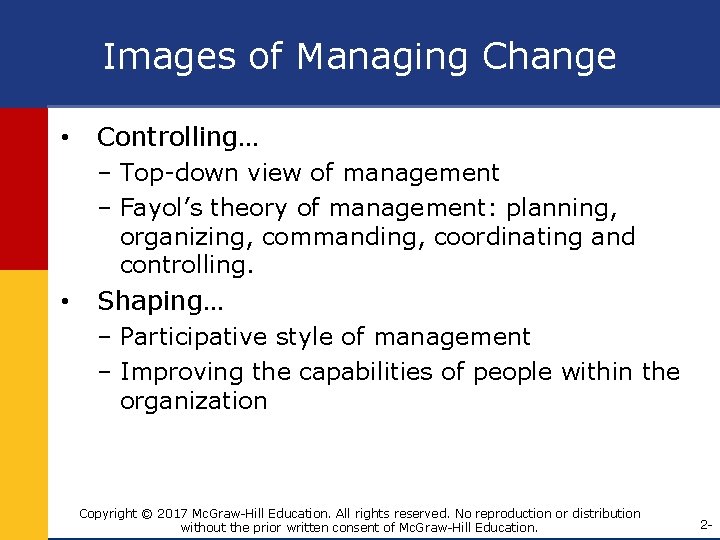
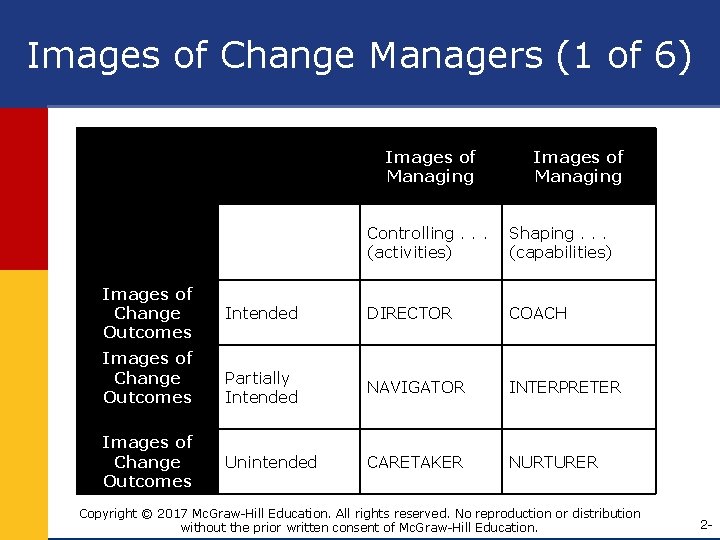
Images of Managing Change • Controlling… – Top-down view of management – Fayol’s theory of management: planning, organizing, commanding, coordinating and controlling. • Shaping… – Participative style of management – Improving the capabilities of people within the organization Copyright © 2017 Mc. Graw-Hill Education. All rights reserved. No reproduction or distribution without the prior written consent of Mc. Graw-Hill Education. 2 -
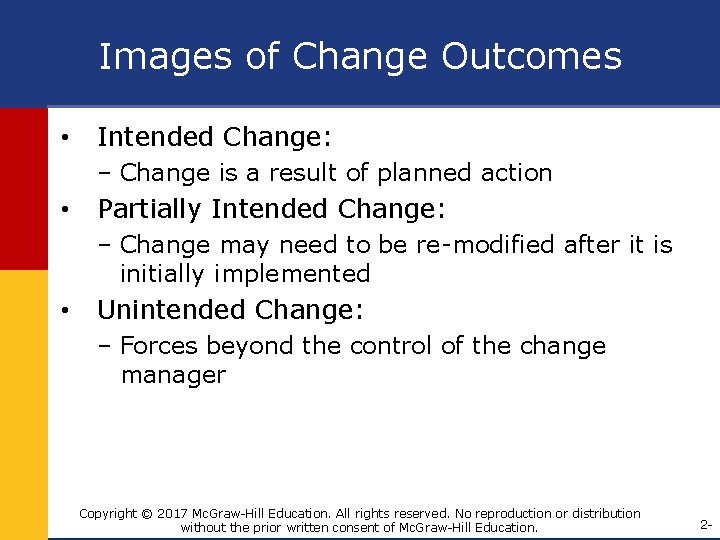
Images of Change Outcomes • Intended Change: – Change is a result of planned action • Partially Intended Change: – Change may need to be re-modified after it is initially implemented • Unintended Change: – Forces beyond the control of the change manager Copyright © 2017 Mc. Graw-Hill Education. All rights reserved. No reproduction or distribution without the prior written consent of Mc. Graw-Hill Education. 2 -
Images of Change Managers (1 of 6) Images of Managing Images of Change Outcomes Images of Managing Controlling. . . (activities) Shaping. . . (capabilities) Intended DIRECTOR COACH Partially Intended NAVIGATOR INTERPRETER Unintended CARETAKER NURTURER Copyright © 2017 Mc. Graw-Hill Education. All rights reserved. No reproduction or distribution without the prior written consent of Mc. Graw-Hill Education. 2 -
Images of Change Managers (2 of 6) • Director – Based on an image of management as control and of change outcomes as being achievable. – Supported by the n-step models and contingency theory. • Coach – Relies upon building in the right set of values, skills and “drills” that are deemed to be the best ones to be drawn upon in order to achieve desired organizational outcomes. – Related to OD approaches. Copyright © 2017 Mc. Graw-Hill Education. All rights reserved. No reproduction or distribution without the prior written consent of Mc. Graw-Hill Education. 2 -
Images of Change Managers (3 of 6) • Navigator – Control is the heart of management action, although a variety of external factors mean that managers may achieve some intended change outcomes and others will occur over which they have little control. – Supported by the contextualist and processual theories of change. Copyright © 2017 Mc. Graw-Hill Education. All rights reserved. No reproduction or distribution without the prior written consent of Mc. Graw-Hill Education. 2 -
Images of Change Managers (4 of 6) • Interpreter – The manager creates meaning for other organizational members, helping them to make sense of various organizational events and actions. – Supported by the sense-making theory of organizational change Copyright © 2017 Mc. Graw-Hill Education. All rights reserved. No reproduction or distribution without the prior written consent of Mc. Graw-Hill Education. 2 -
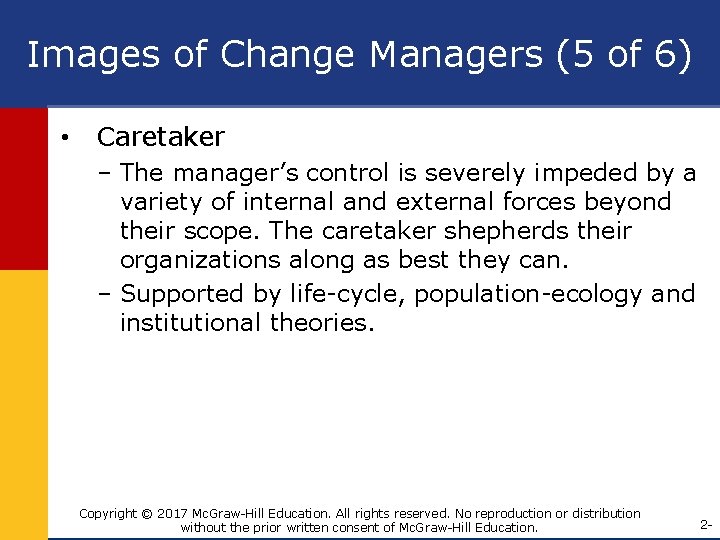
Images of Change Managers (5 of 6) • Caretaker – The manager’s control is severely impeded by a variety of internal and external forces beyond their scope. The caretaker shepherds their organizations along as best they can. – Supported by life-cycle, population-ecology and institutional theories. Copyright © 2017 Mc. Graw-Hill Education. All rights reserved. No reproduction or distribution without the prior written consent of Mc. Graw-Hill Education. 2 -
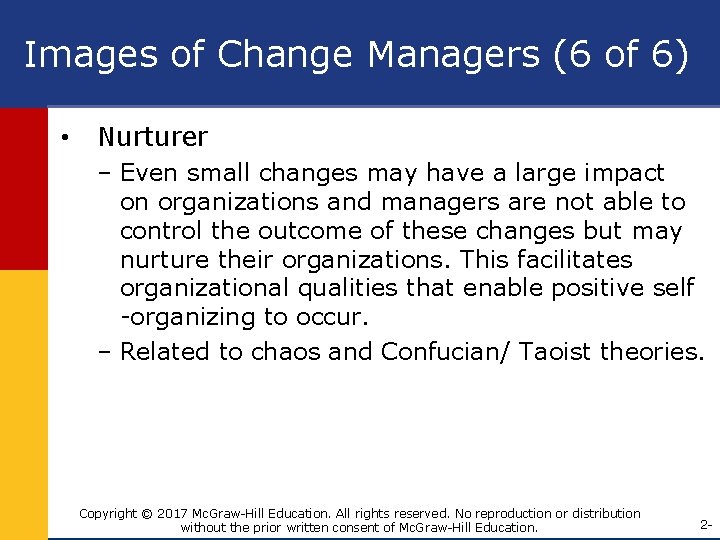
Images of Change Managers (6 of 6) • Nurturer – Even small changes may have a large impact on organizations and managers are not able to control the outcome of these changes but may nurture their organizations. This facilitates organizational qualities that enable positive self -organizing to occur. – Related to chaos and Confucian/ Taoist theories. Copyright © 2017 Mc. Graw-Hill Education. All rights reserved. No reproduction or distribution without the prior written consent of Mc. Graw-Hill Education. 2 -
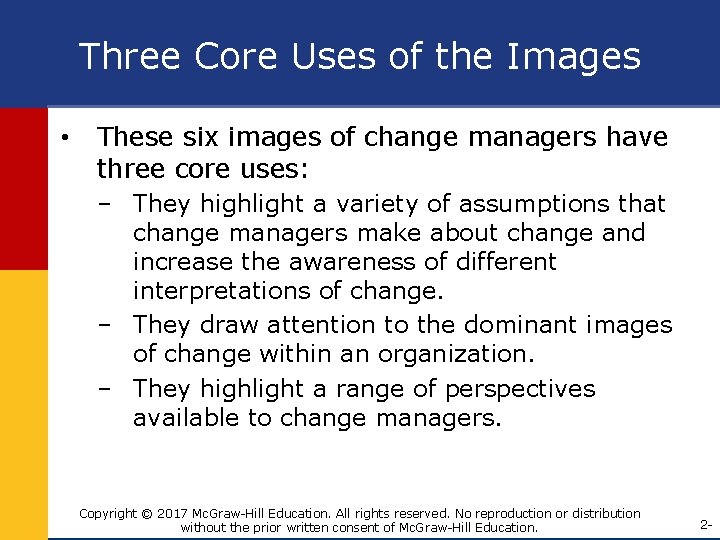
Three Core Uses of the Images • These six images of change managers have three core uses: – They highlight a variety of assumptions that change managers make about change and increase the awareness of different interpretations of change. – They draw attention to the dominant images of change within an organization. – They highlight a range of perspectives available to change managers. Copyright © 2017 Mc. Graw-Hill Education. All rights reserved. No reproduction or distribution without the prior written consent of Mc. Graw-Hill Education. 2 -