
Managing Motor Driven Systems Tony Simon Energy Systems








- Slides: 67
Managing Motor Driven Systems Tony Simon, Energy Systems Engineer Wastewater / Water Sustainable Energy Cohort Session #2 Webinar September 6, 2012
WSU Energy Program Our staff has decades of experience in industrial efficiency: • DOE Certified Specialists, Energy Experts, and Instructors • Authors of many DOE publications and software tools • Experience in scores of plant assessments – Municipal – Industrial – Agricultural Intro
Tony’s Energy Background Maintenance/Technical Background: • FAA certified aircraft mechanic • Electrical Engineer At WSU Extension Energy Program: • Energy Training Instructor/Auditor • Energy assessments Ø Industrial Ø Municipal Ø Agricultural
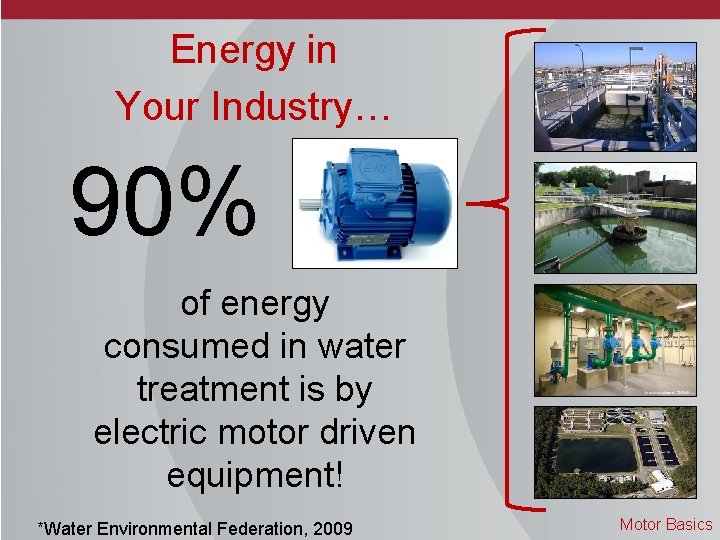
Energy in Your Industry… 90% of energy consumed in water treatment is by electric motor driven equipment! *Water Environmental Federation, 2009 Motor Basics
Managing Motor Driven Systems • Survey In-service and spare motors – Nameplate data – Load and Operating hours – Electrical utility rates and incentives • Build an electronic inventory of motors • Repair and replace policy – New motor purchase policy – Use model repair specifications • Motor Inventory Management – Maintenance logging to identify “bad actors” • Motor. Master+ software walkthrough 5
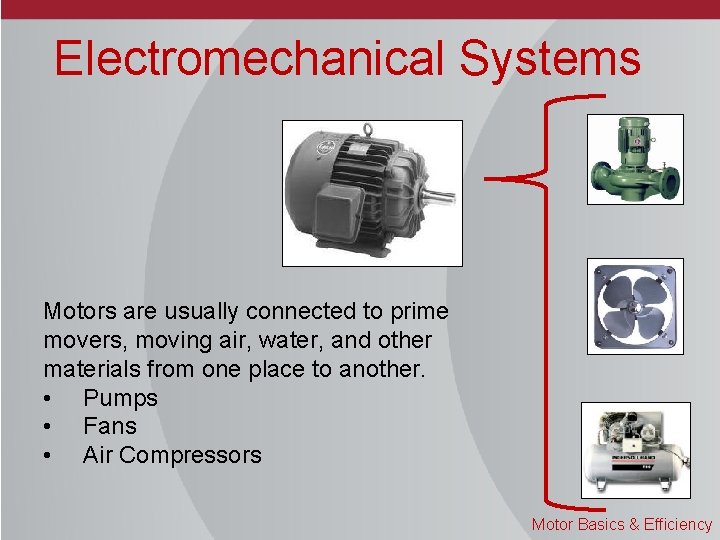
Electromechanical Systems Motors are usually connected to prime movers, moving air, water, and other materials from one place to another. • Pumps • Fans • Air Compressors Motor Basics & Efficiency
MOTOR BASICS & EFFICIENCY 7
8
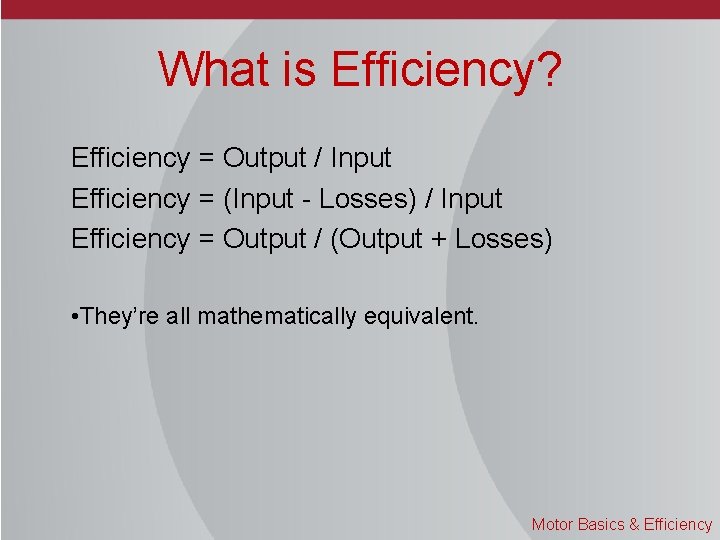
What is Efficiency? Efficiency = Output / Input Efficiency = (Input - Losses) / Input Efficiency = Output / (Output + Losses) • They’re all mathematically equivalent. Motor Basics & Efficiency
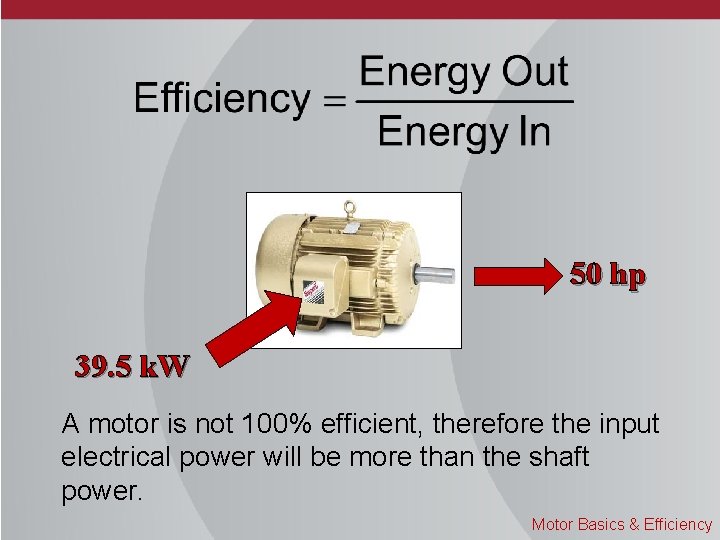
50 hp 39. 5 k. W A motor is not 100% efficient, therefore the input electrical power will be more than the shaft power. Motor Basics & Efficiency
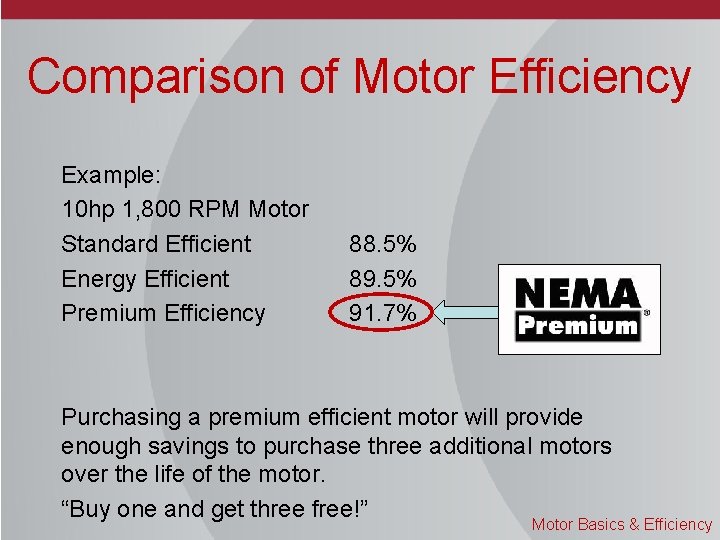
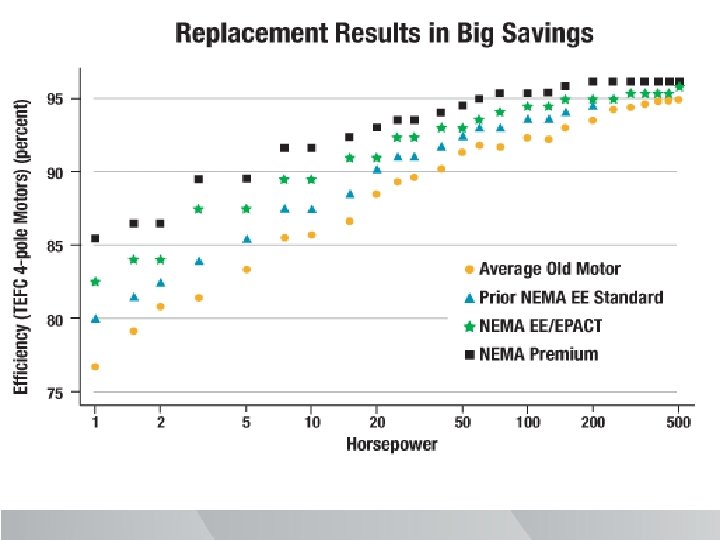
Comparison of Motor Efficiency Example: 10 hp 1, 800 RPM Motor Standard Efficient Energy Efficient Premium Efficiency 88. 5% 89. 5% 91. 7% Purchasing a premium efficient motor will provide enough savings to purchase three additional motors over the life of the motor. “Buy one and get three free!” Motor Basics & Efficiency
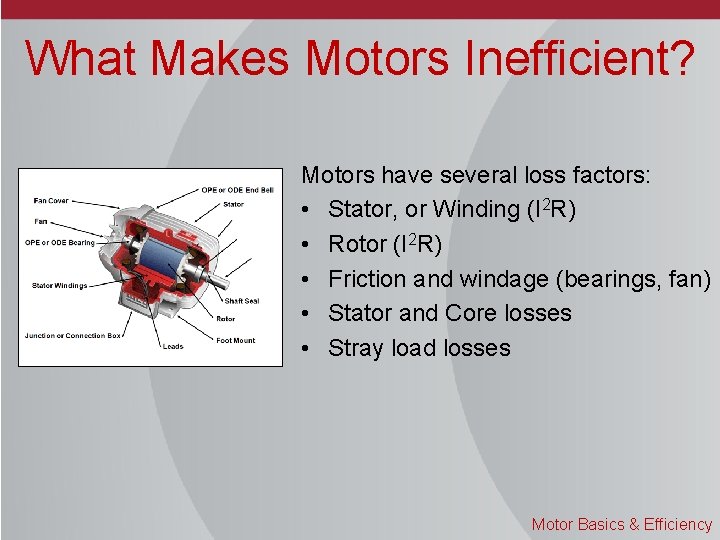
What Makes Motors Inefficient? Motors have several loss factors: • Stator, or Winding (I 2 R) • Rotor (I 2 R) • Friction and windage (bearings, fan) • Stator and Core losses • Stray load losses Motor Basics & Efficiency
What’s in a NEMA Premium™ motor? All the same things; just more and better materials and closer tolerances to help the motor meet NEMA’s Premium standard, including: èLarger wire gage – Lower stator winding loss èLonger rotor and stator – Lower core loss èLower rotor bar resistance – Lower rotor loss èSmaller fan – Lower windage loss èOptimized air gap size – Lower stray load loss èBetter steel with thinner laminations -- Lower core loss èOptimum bearing seal/shield – Lower friction loss. Motor Basics & Efficiency
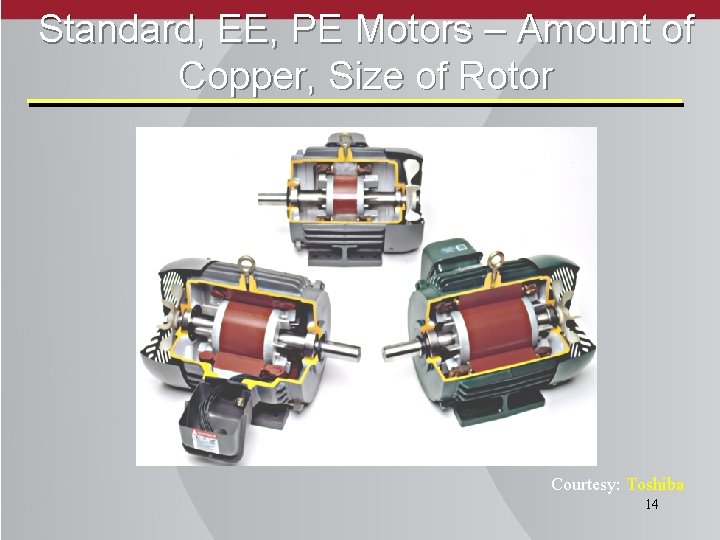
Standard, EE, PE Motors – Amount of Copper, Size of Rotor Courtesy: Toshiba 14
15
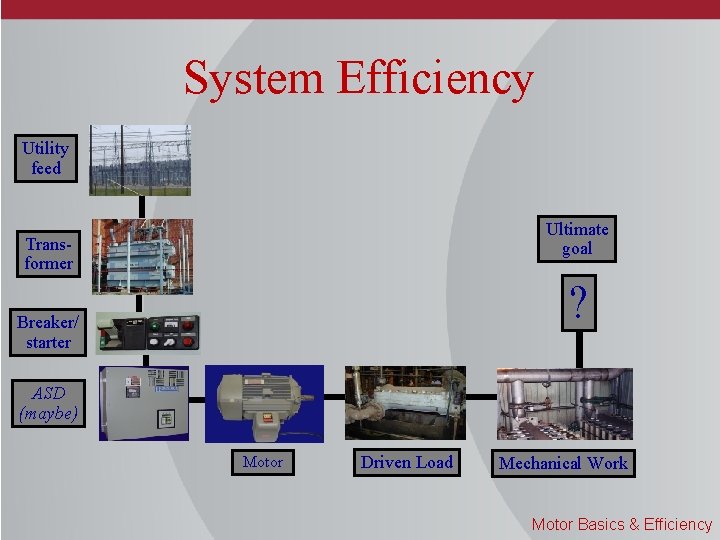
System Efficiency Utility feed Ultimate goal Transformer ? Breaker/ starter ASD (maybe) Motor Driven Load Mechanical Work Motor Basics & Efficiency
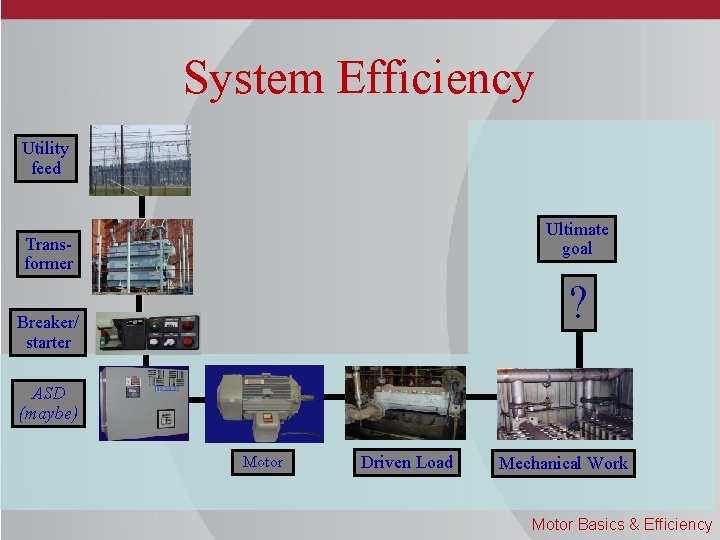
System Efficiency Utility feed Ultimate goal Transformer ? Breaker/ starter ASD (maybe) Motor Driven Load Mechanical Work Motor Basics & Efficiency
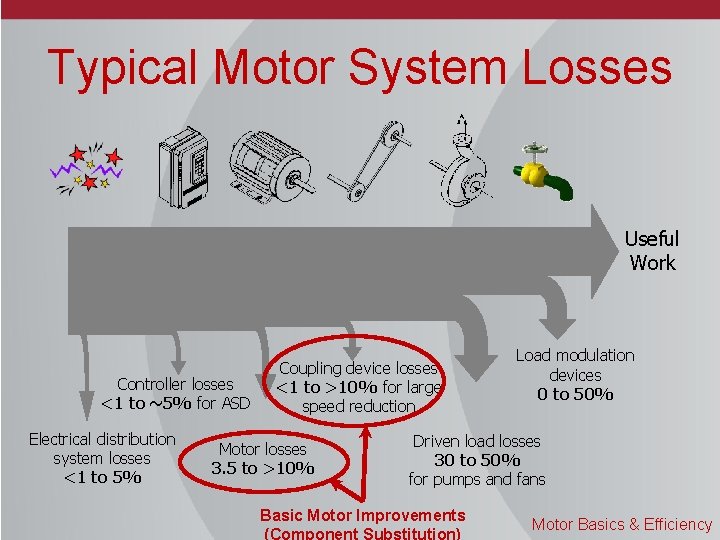
Typical Motor System Losses Useful Work Controller losses <1 to ~5% for ASD Electrical distribution system losses <1 to 5% Coupling device losses <1 to >10% for large speed reduction Motor losses 3. 5 to >10% Load modulation devices 0 to 50% Driven load losses 30 to 50% for pumps and fans Basic Motor Improvements (Component Substitution) Motor Basics & Efficiency
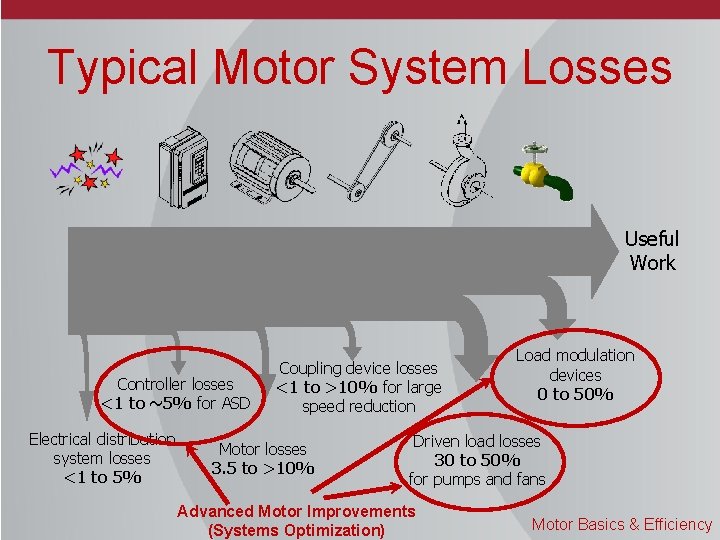
Typical Motor System Losses Useful Work Controller losses <1 to ~5% for ASD Electrical distribution system losses <1 to 5% Coupling device losses <1 to >10% for large speed reduction Motor losses 3. 5 to >10% Load modulation devices 0 to 50% Driven load losses 30 to 50% for pumps and fans Advanced Motor Improvements (Systems Optimization) Motor Basics & Efficiency
MOTOR INVENTORY MANAGEMENT 20
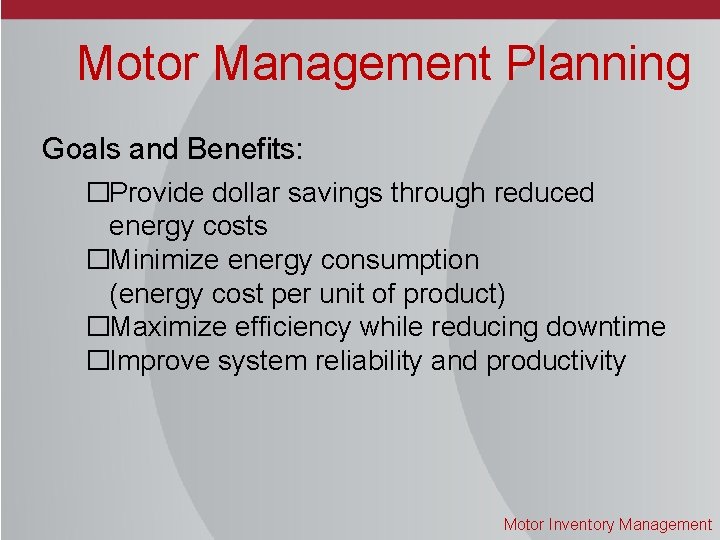
Motor Management Planning Goals and Benefits: �Provide dollar savings through reduced energy costs �Minimize energy consumption (energy cost per unit of product) �Maximize efficiency while reducing downtime �Improve system reliability and productivity Motor Inventory Management
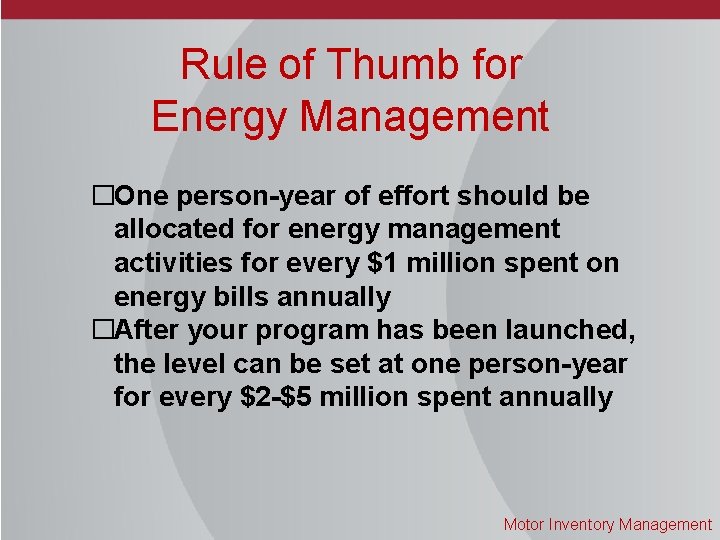
Rule of Thumb for Energy Management �One person-year of effort should be allocated for energy management activities for every $1 million spent on energy bills annually �After your program has been launched, the level can be set at one person-year for every $2 -$5 million spent annually Motor Inventory Management
Who should be included in motor management? �Upper Management (must have commitment) �Resource Conservation Managers �Engineers �Electricians and Maintenance Staff �Procurement/Purchasing Motor Inventory Management
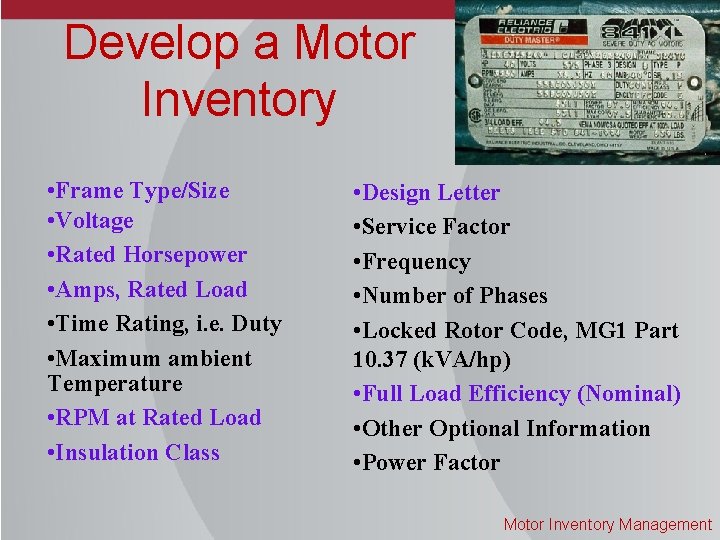
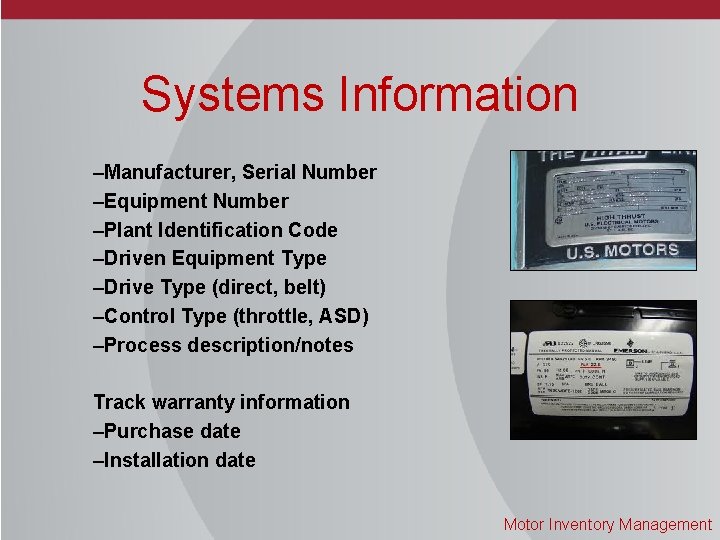
Develop a Motor Inventory • Frame Type/Size • Voltage • Rated Horsepower • Amps, Rated Load • Time Rating, i. e. Duty • Maximum ambient Temperature • RPM at Rated Load • Insulation Class • Design Letter • Service Factor • Frequency • Number of Phases • Locked Rotor Code, MG 1 Part 10. 37 (k. VA/hp) • Full Load Efficiency (Nominal) • Other Optional Information • Power Factor Motor Inventory Management
Systems Information –Manufacturer, Serial Number –Equipment Number –Plant Identification Code –Driven Equipment Type –Drive Type (direct, belt) –Control Type (throttle, ASD) –Process description/notes Track warranty information –Purchase date –Installation date Motor Inventory Management
Motor Management Building Blocks • Develop a motor inventory and tracking system • Replace critical motors with histories of frequent failures immediately • Develop a new motor purchase policy • Identify which motors should be replaced with Premium Efficiency units when they fail • Establish a PEM-Ready spares inventory • Adopt model motor repair standards • Prepare an Action Plan with assigned responsibilities Motor Inventory Management
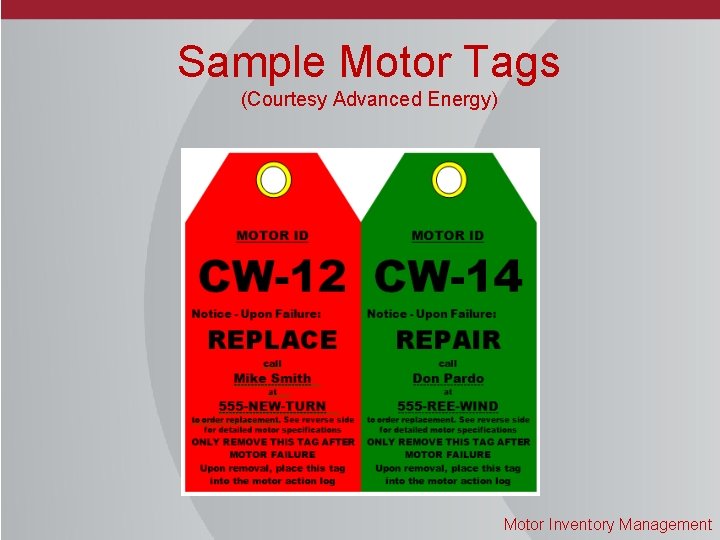
Sample Motor Tags (Courtesy Advanced Energy) Motor Inventory Management
Information Requirements for Motor Management Planning – – – Motor. Master+ Inputs Understand Utility Rates Gather Motor Nameplate Data Establish Motor Operating Profiles Tune Your Electrical Distribution System Obtain Measurements at Connected Loads Know Your Load Requirements Motor Inventory Management
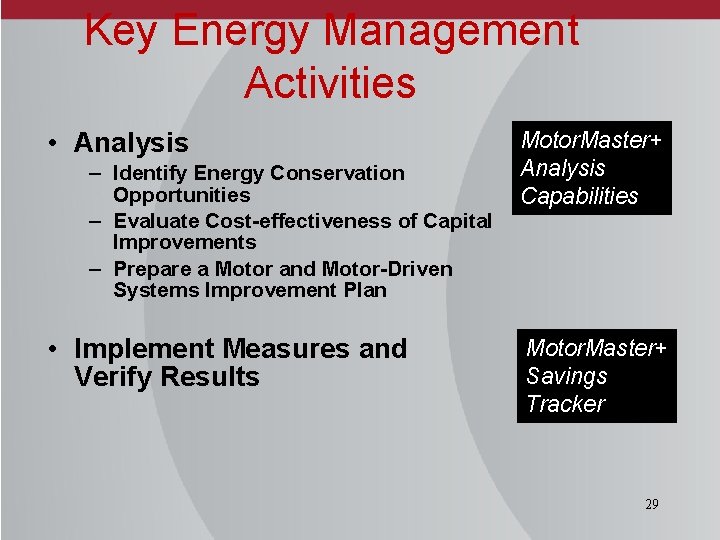
Key Energy Management Activities • Analysis – Identify Energy Conservation Opportunities – Evaluate Cost-effectiveness of Capital Improvements – Prepare a Motor and Motor-Driven Systems Improvement Plan • Implement Measures and Verify Results Motor. Master+ Analysis Capabilities Motor. Master+ Savings Tracker 29
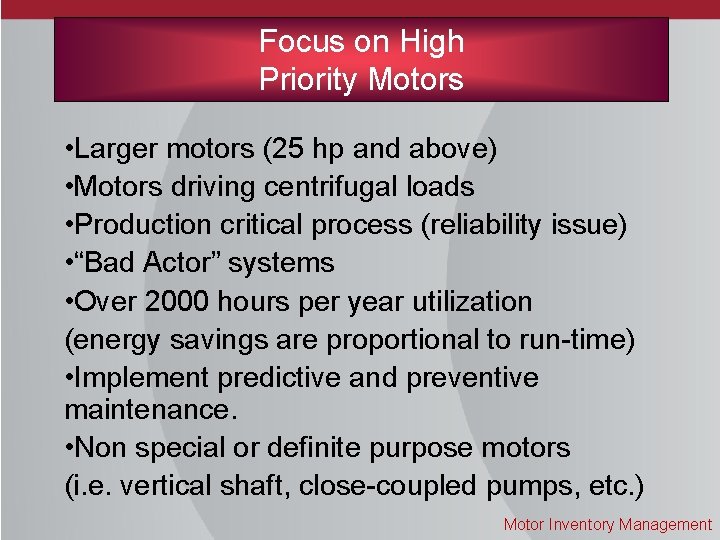
Focus on High Priority Motors • Larger motors (25 hp and above) • Motors driving centrifugal loads • Production critical process (reliability issue) • “Bad Actor” systems • Over 2000 hours per year utilization (energy savings are proportional to run-time) • Implement predictive and preventive maintenance. • Non special or definite purpose motors (i. e. vertical shaft, close-coupled pumps, etc. ) Motor Inventory Management
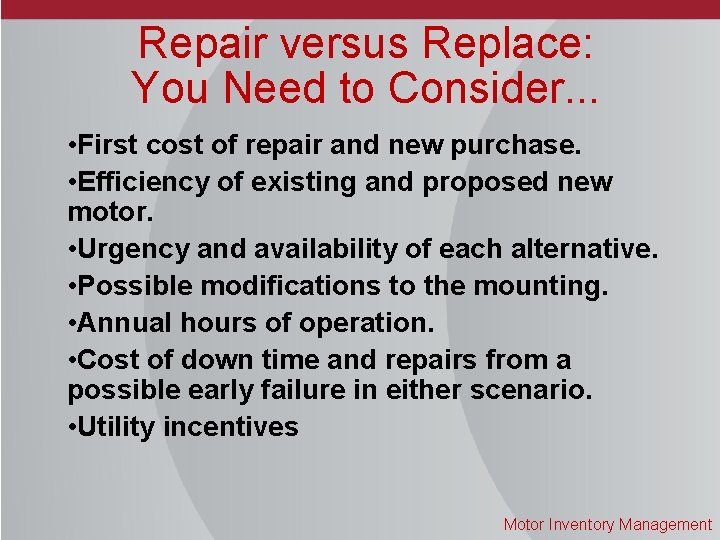
Repair versus Replace: You Need to Consider. . . • First cost of repair and new purchase. • Efficiency of existing and proposed new motor. • Urgency and availability of each alternative. • Possible modifications to the mounting. • Annual hours of operation. • Cost of down time and repairs from a possible early failure in either scenario. • Utility incentives Motor Inventory Management
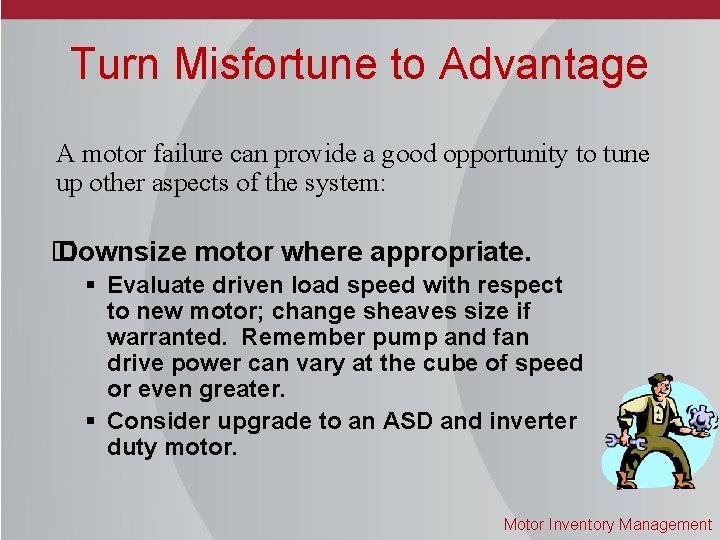
Turn Misfortune to Advantage A motor failure can provide a good opportunity to tune up other aspects of the system: � Downsize motor where appropriate. Evaluate driven load speed with respect to new motor; change sheaves size if warranted. Remember pump and fan drive power can vary at the cube of speed or even greater. Consider upgrade to an ASD and inverter duty motor. Motor Inventory Management
Mean Time Between Motor Failures • ---Work Orders for Motor Repairs examined. • ---New Motor Purchases also considered • Mean time between failures for standard efficiency motors is 10 years • An older, less-efficient motor could be running for this amount of time, wasting energy. Motor Inventory Management
Advanced Motor Management: Matching Output to Load Requirements 34
Power Transmission Systems �V-belts have a peak efficiency of 95 to 98% at the time of installation. Efficiency deteriorates by as much as 5% over time if slippage occurs and the belt is not properly tensioned. 35
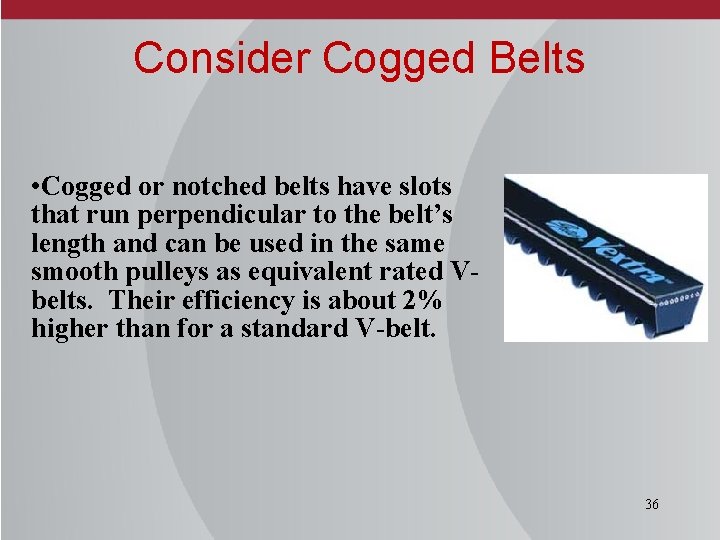
Consider Cogged Belts • Cogged or notched belts have slots that run perpendicular to the belt’s length and can be used in the same smooth pulleys as equivalent rated Vbelts. Their efficiency is about 2% higher than for a standard V-belt. 36
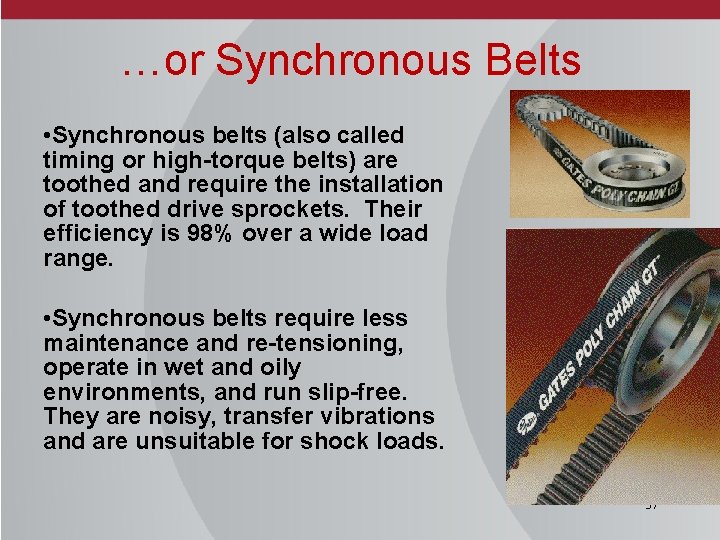
…or Synchronous Belts • Synchronous belts (also called timing or high-torque belts) are toothed and require the installation of toothed drive sprockets. Their efficiency is 98% over a wide load range. • Synchronous belts require less maintenance and re-tensioning, operate in wet and oily environments, and run slip-free. They are noisy, transfer vibrations and are unsuitable for shock loads. 37
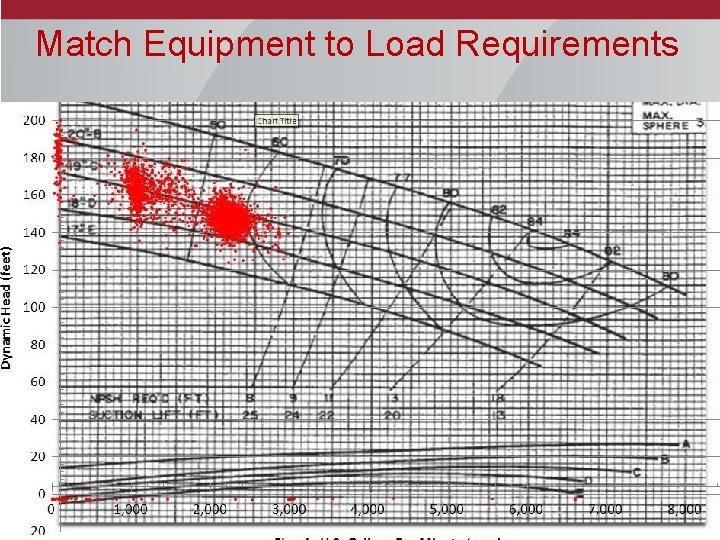
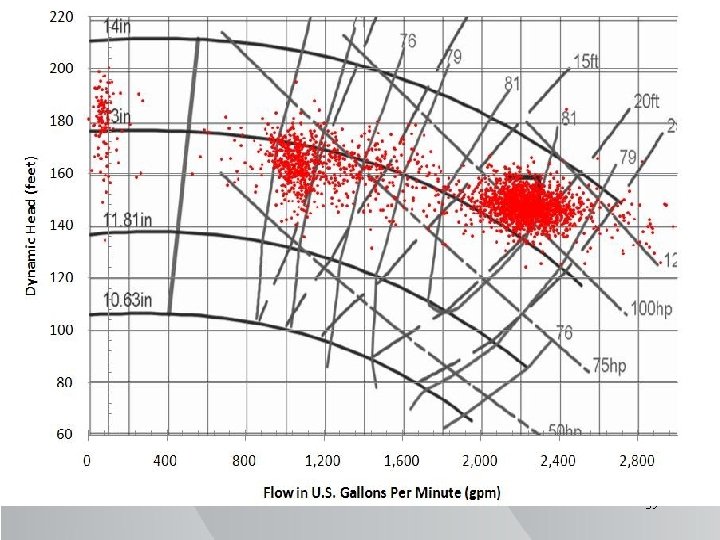
Match Equipment to Load Requirements 38
39
Pump Replacement Results �---250 hp MV motor and pump replaced by 125 hp LV motor and new pump �---Motor efficiency improves from 91. 9% to 95% �---Pump efficiency improves from 48. 2% to 73. 9% �---Annual energy savings of 509, 000 k. Wh, equivalent to 53. 5% of baseline energy use
Thank You Questions? Tony Simon Energy Systems Engineer WSU Extension Energy Program 360 -956 -2141 Simon. T@energy. wsu. edu EERE Information Center eere. energy. gov/informationcenter
ADVANCED OPTIMIZATION (ASDs) 42
Wastewater/Water Sustainable Energy Cohort
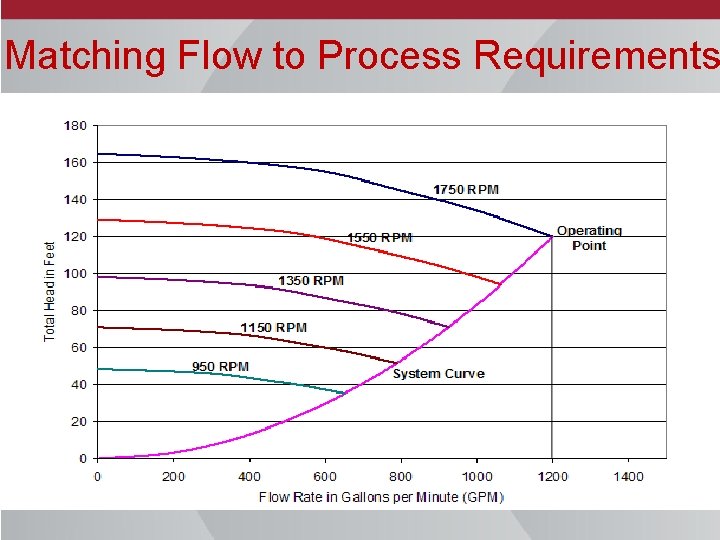
Matching Flow to Process Requirements 44
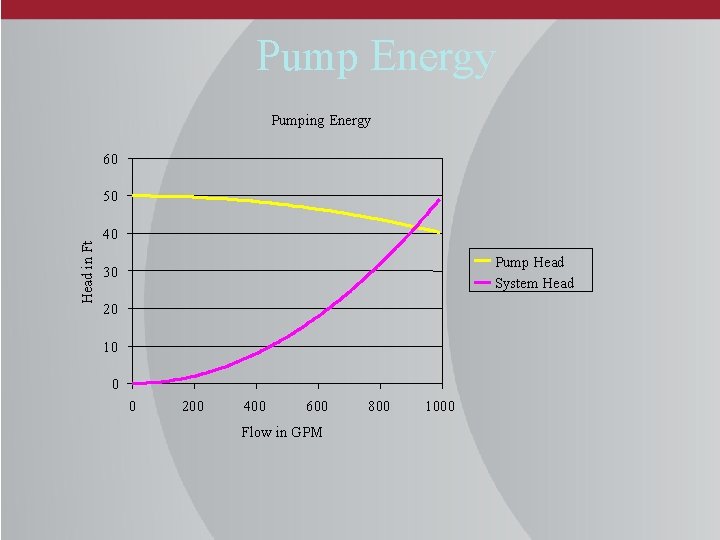
Pump Energy Pumping Energy 60 Head in Ft 50 40 Pump Head System Head 30 20 10 0 0 200 400 600 Flow in GPM 800 1000
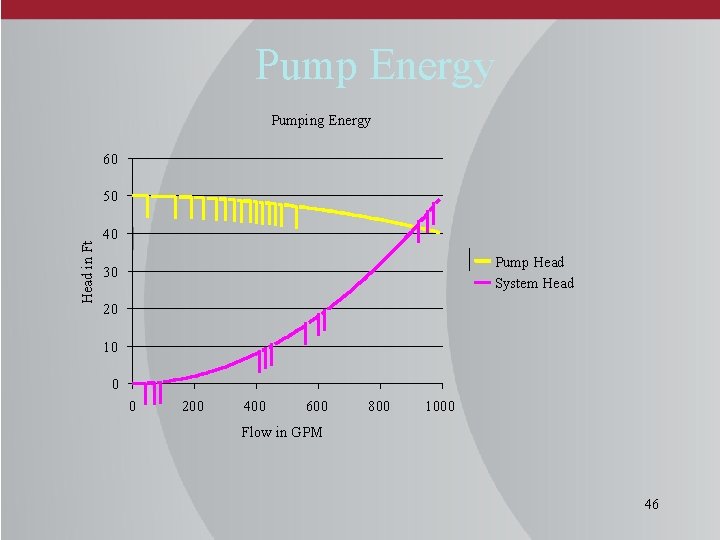
Pump Energy Pumping Energy 60 Head in Ft 50 40 Pump Head System Head 30 20 10 0 0 200 400 600 800 1000 Flow in GPM 46
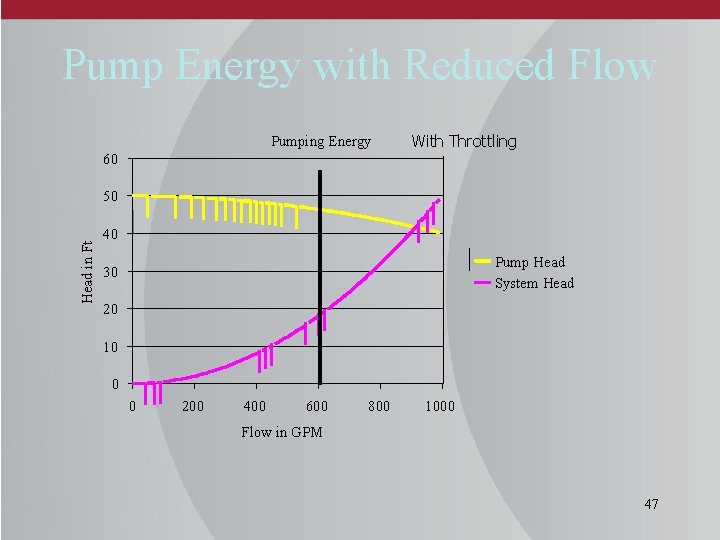
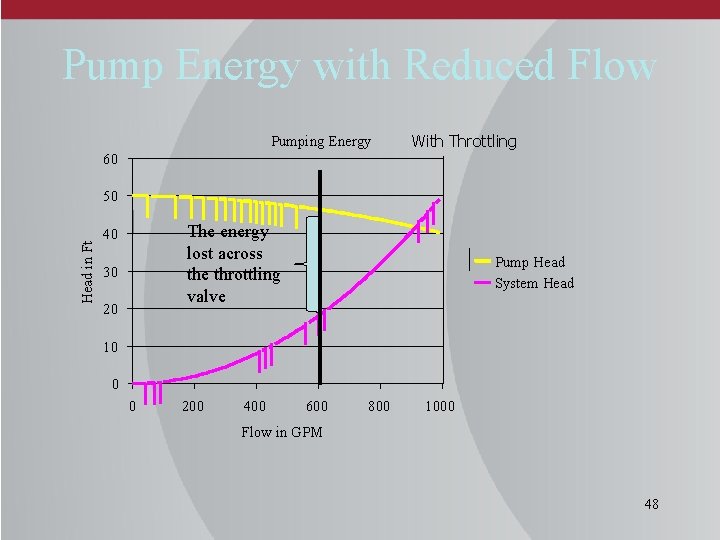
Pump Energy with Reduced Flow Pumping Energy With Throttling 60 Head in Ft 50 40 Pump Head System Head 30 20 10 0 0 200 400 600 800 1000 Flow in GPM 47
Pump Energy with Reduced Flow Pumping Energy With Throttling 60 Head in Ft 50 The energy lost across the throttling valve 40 30 20 Pump Head System Head 10 0 0 200 400 600 800 1000 Flow in GPM 48
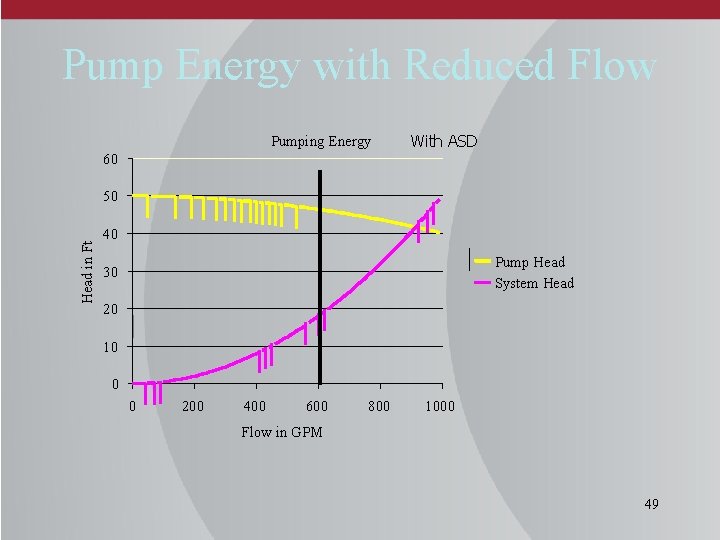
Pump Energy with Reduced Flow Pumping Energy With ASD 60 Head in Ft 50 40 Pump Head System Head 30 20 10 0 0 200 400 600 800 1000 Flow in GPM 49
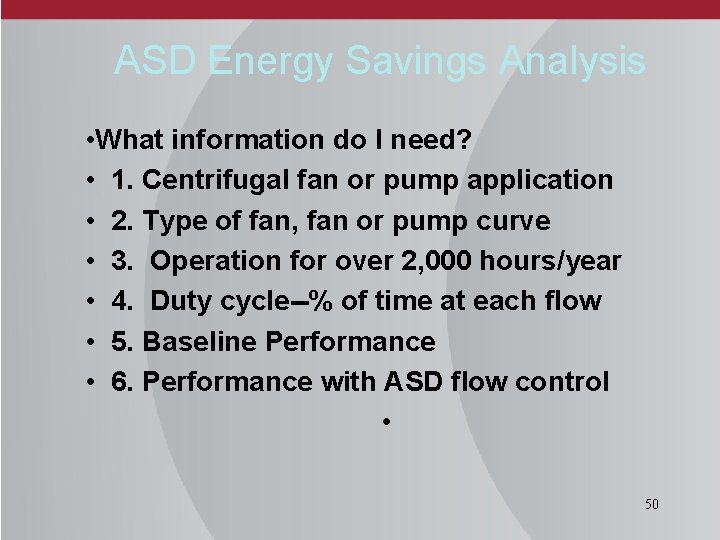
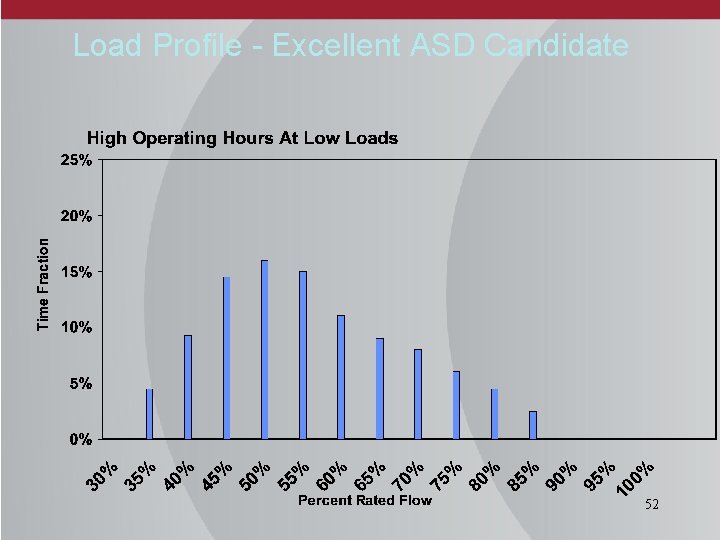
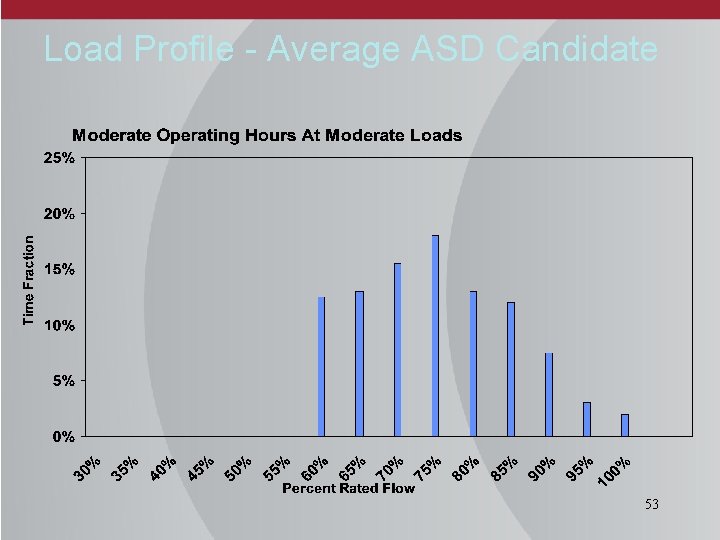
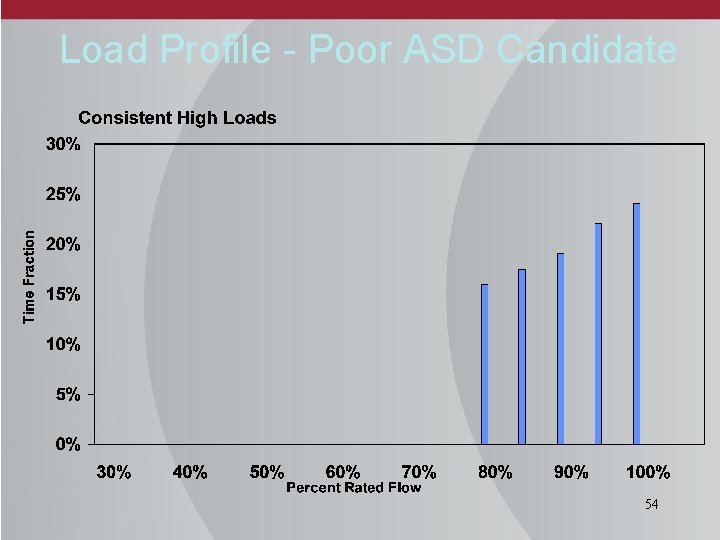
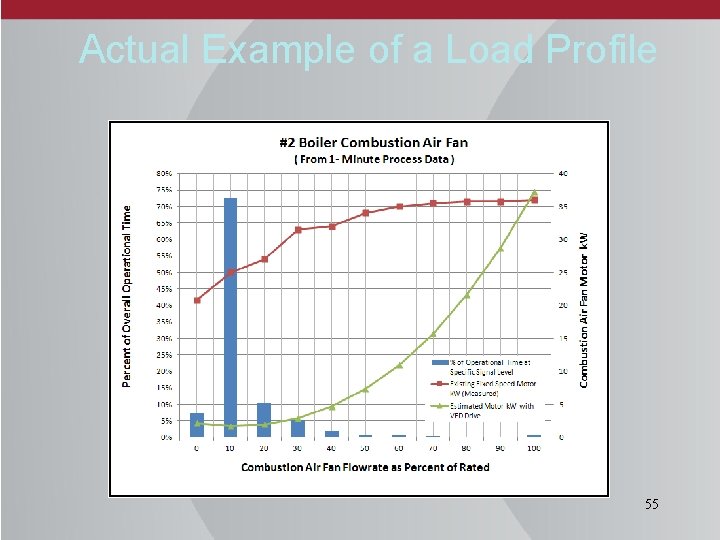
ASD Energy Savings Analysis • What information do I need? • 1. Centrifugal fan or pump application • 2. Type of fan, fan or pump curve • 3. Operation for over 2, 000 hours/year • 4. Duty cycle--% of time at each flow • 5. Baseline Performance • 6. Performance with ASD flow control • 50
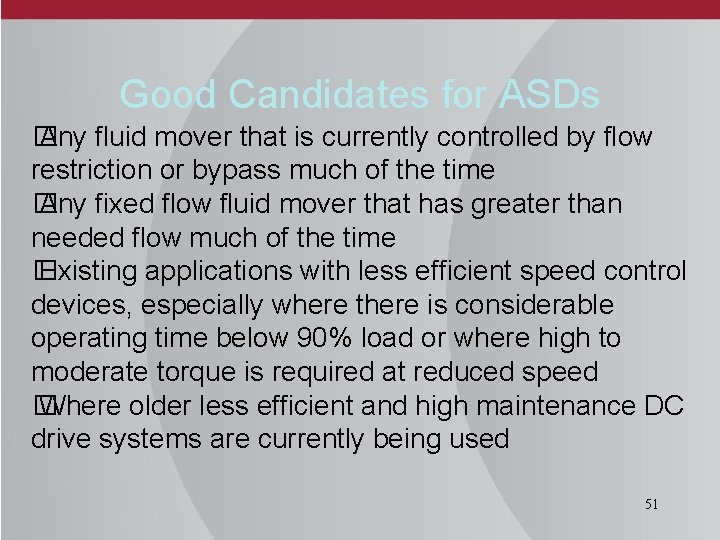
Good Candidates for ASDs � Any fluid mover that is currently controlled by flow restriction or bypass much of the time � Any fixed flow fluid mover that has greater than needed flow much of the time � Existing applications with less efficient speed control devices, especially where there is considerable operating time below 90% load or where high to moderate torque is required at reduced speed � Where older less efficient and high maintenance DC drive systems are currently being used 51
Load Profile - Excellent ASD Candidate 52
Load Profile - Average ASD Candidate 53
Load Profile - Poor ASD Candidate 54
Actual Example of a Load Profile 55
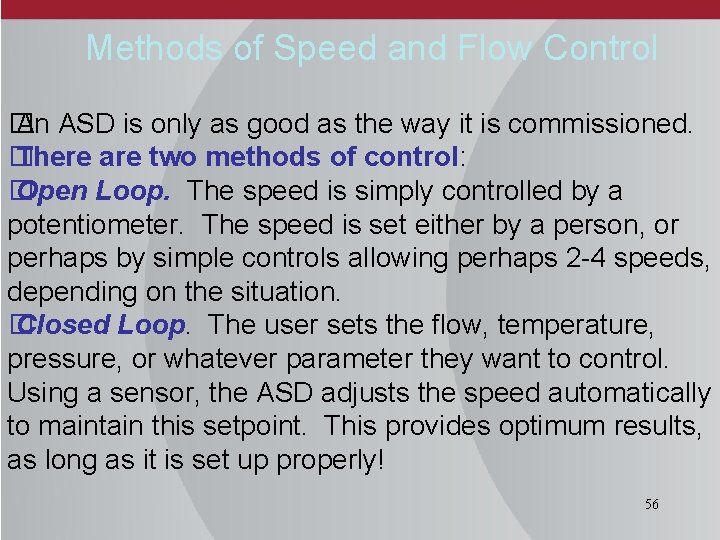
Methods of Speed and Flow Control � An ASD is only as good as the way it is commissioned. � There are two methods of control: � Open Loop. The speed is simply controlled by a potentiometer. The speed is set either by a person, or perhaps by simple controls allowing perhaps 2 -4 speeds, depending on the situation. � Closed Loop. The user sets the flow, temperature, pressure, or whatever parameter they want to control. Using a sensor, the ASD adjusts the speed automatically to maintain this setpoint. This provides optimum results, as long as it is set up properly! 56
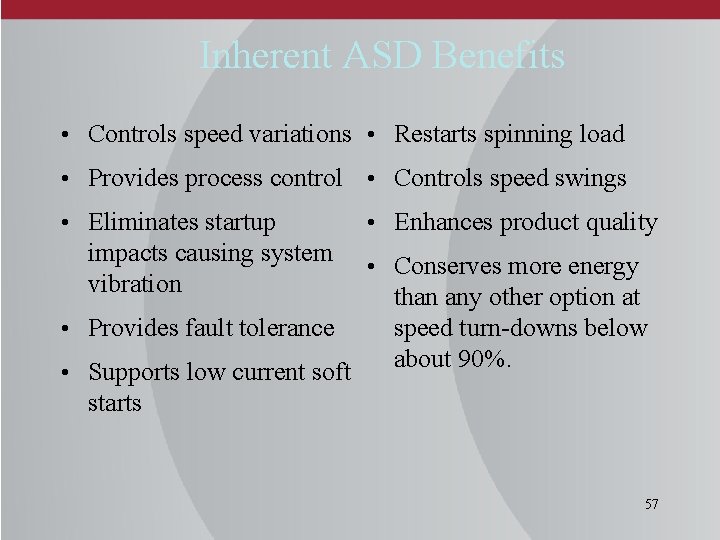
Inherent ASD Benefits • Controls speed variations • Restarts spinning load • Provides process control • Controls speed swings • Eliminates startup impacts causing system vibration • Provides fault tolerance • Supports low current soft • Enhances product quality • Conserves more energy than any other option at speed turn-downs below about 90%. starts 57
An ASD Analysis Tool • Try Energy savings software such as the Bonneville Power Administrations ASDCalculators • Available at: • http: //www. bpa. gov/Energy/N/projects/indus trial/xls/asdcalculators. xls 58
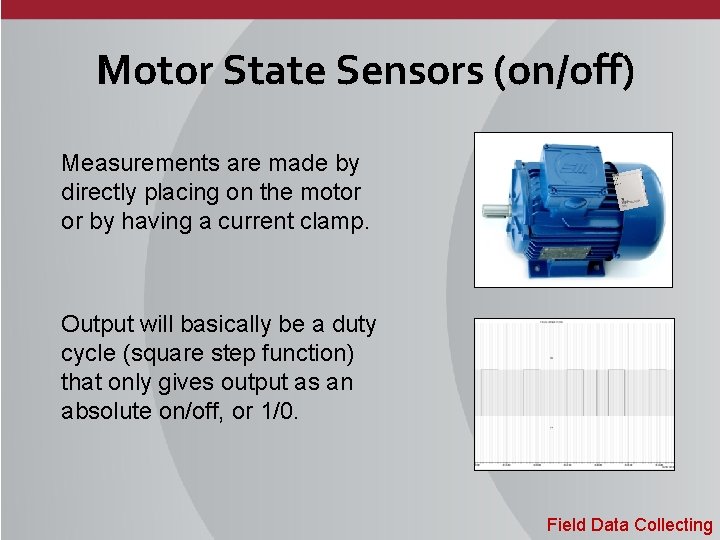
Motor State Sensors (on/off) Measurements are made by directly placing on the motor or by having a current clamp. Output will basically be a duty cycle (square step function) that only gives output as an absolute on/off, or 1/0. Field Data Collecting
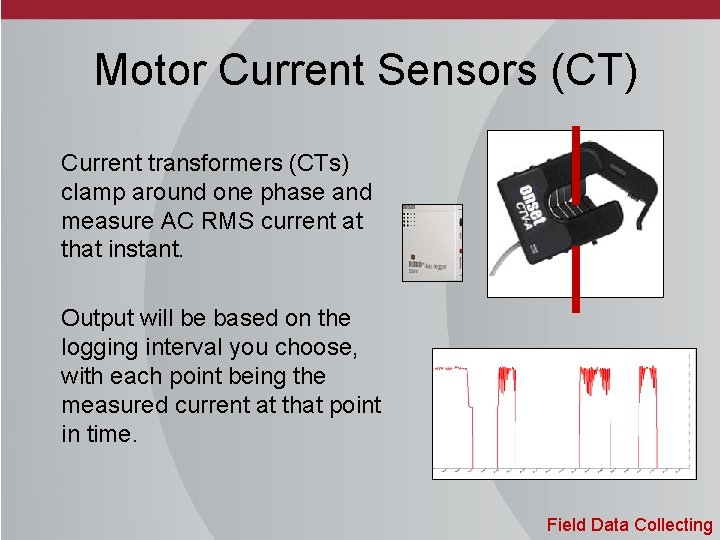
Motor Current Sensors (CT) Current transformers (CTs) clamp around one phase and measure AC RMS current at that instant. Output will be based on the logging interval you choose, with each point being the measured current at that point in time. Field Data Collecting
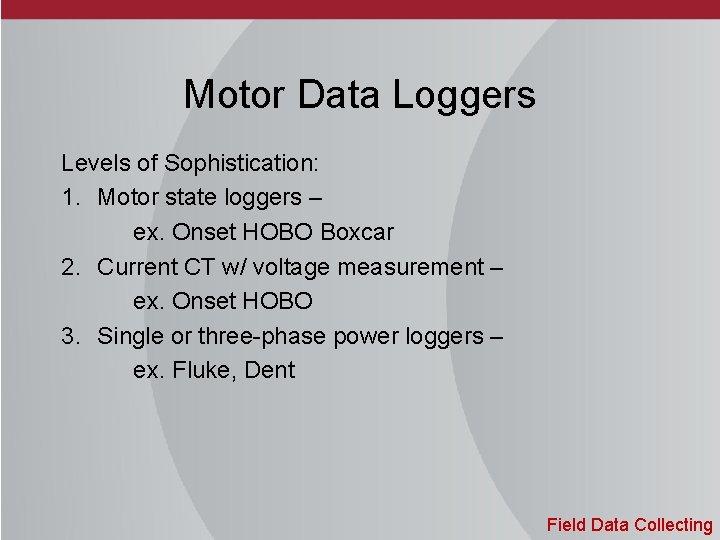
Motor Data Loggers Levels of Sophistication: 1. Motor state loggers – ex. Onset HOBO Boxcar 2. Current CT w/ voltage measurement – ex. Onset HOBO 3. Single or three-phase power loggers – ex. Fluke, Dent Field Data Collecting
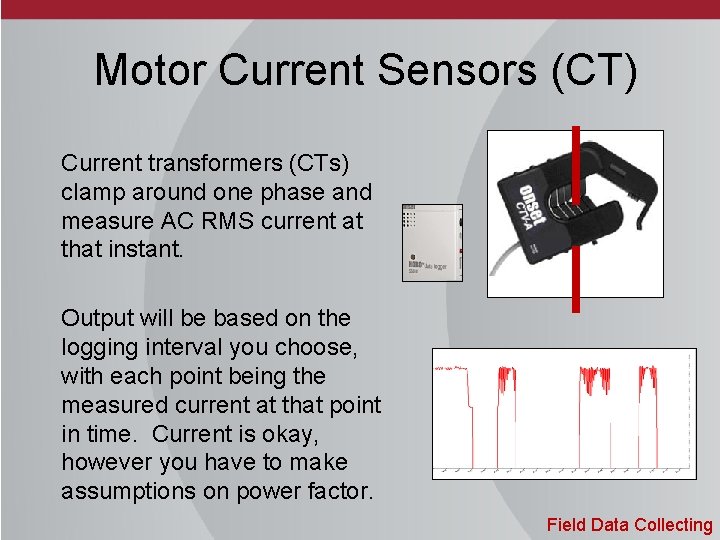
Motor Current Sensors (CT) Current transformers (CTs) clamp around one phase and measure AC RMS current at that instant. Output will be based on the logging interval you choose, with each point being the measured current at that point in time. Current is okay, however you have to make assumptions on power factor. Field Data Collecting
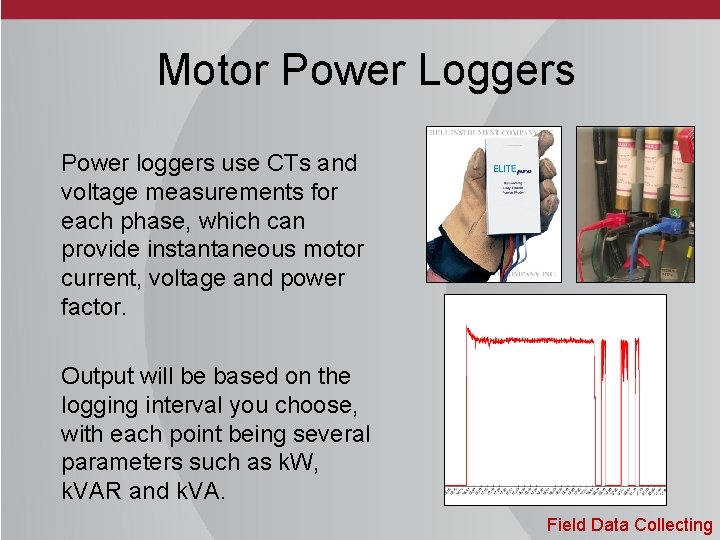
Motor Power Loggers Power loggers use CTs and voltage measurements for each phase, which can provide instantaneous motor current, voltage and power factor. Output will be based on the logging interval you choose, with each point being several parameters such as k. W, k. VAR and k. VA. Field Data Collecting
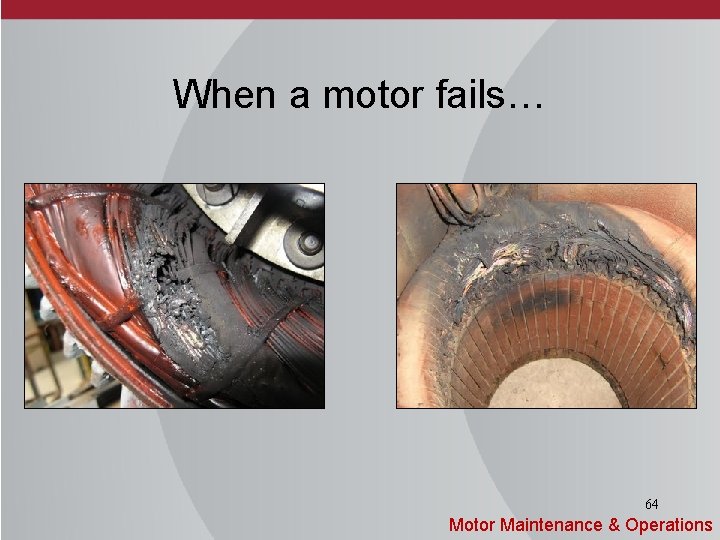
When a motor fails… 64 Motor Maintenance & Operations
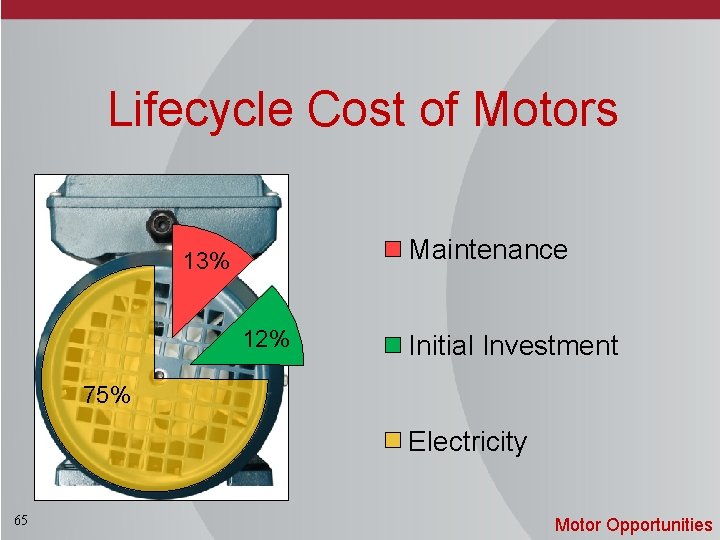
Lifecycle Cost of Motors Maintenance 13% 12% Initial Investment 75% Electricity 65 Motor Opportunities
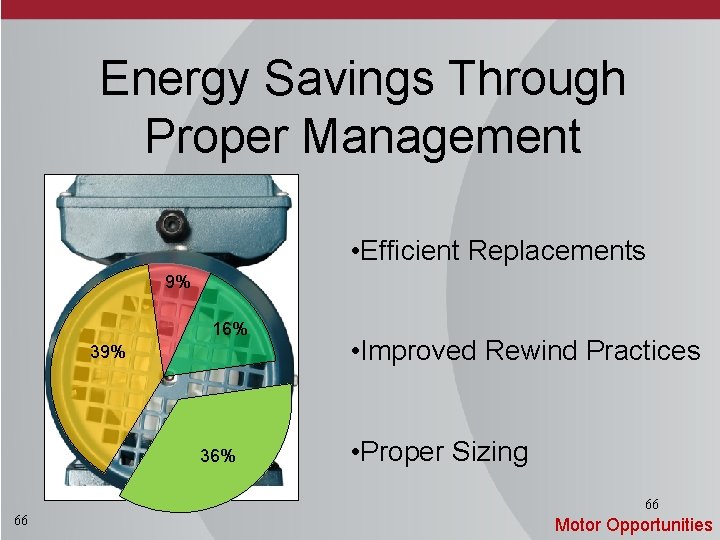
Energy Savings Through Proper Management • Efficient Replacements 9% 16% 39% 36% • Improved Rewind Practices • Proper Sizing 66 66 Motor Opportunities
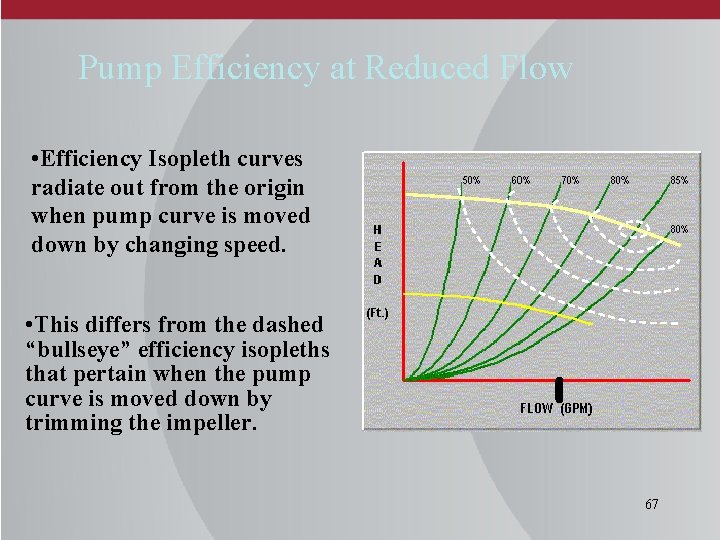
Pump Efficiency at Reduced Flow • Efficiency Isopleth curves radiate out from the origin when pump curve is moved down by changing speed. • This differs from the dashed “bullseye” efficiency isopleths that pertain when the pump curve is moved down by trimming the impeller. 67