
Managing Interdependence The New Scenarios for Financial Risks


- Slides: 24
Managing Interdependence The New Scenarios for Financial Risks and Uncertainty Paolo Garonna 22 May 2019
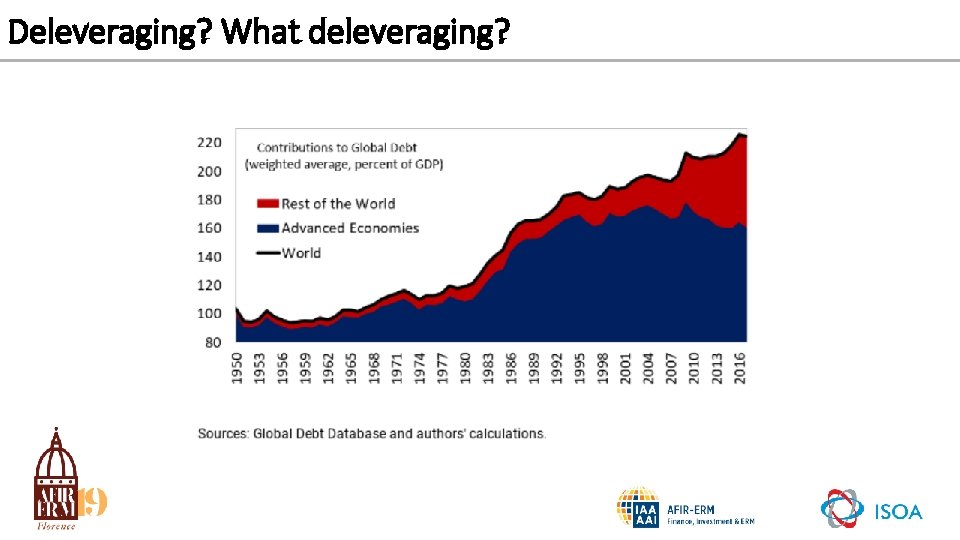
The Context: From the Financial Crisis to the Great Uncertainty • Growing uncertainty: Knightian, structural (more than methodological or parametric), black swans and Plinian eruptions • Multiple conundrums generated by uncertainty have put risk scenarios at the heart of decision-making. Risks perceived to be on the rise. • Example 1 (policy): Should we maintain and extend overexpansionary monetary and fiscal policies, or accelerate the «normalisation» ? Deleveraging? What deleveraging? Global private and public debt are alltime high ($184 trillion, 225% of GDP, 22, 5 times the average income per capita, 2017). This constitutes «a potential fault line» (IMF). See graph • Example 2 (business): Markets affected by increased volatility, reflecting the building up of unresolved vulnerabilities (trade wars, political instability, downside risks to the housing market, etc. ). Investors caught between two fears: fomo (fear of missing out) and folm (fear of losing money). Cyclothymic investors: bouts of risk aversion and investment euphoria. Deployment of macro-prudential tools and repair of public and private balance sheets are still lagging behind. 2
Deleveraging? What deleveraging?
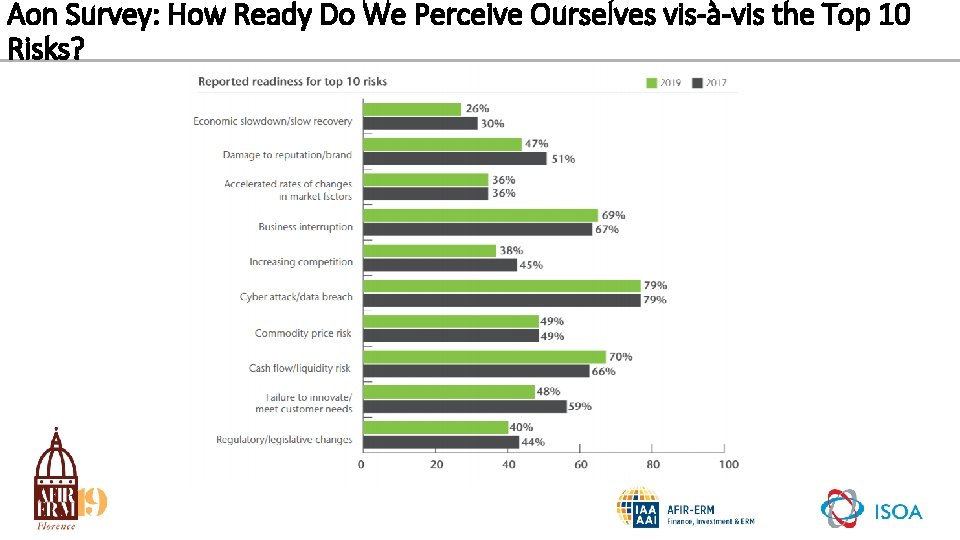
Shifting Risk Scenarios: a Challenge to Conventional Risk Management (RM) • Financial institutions and regulators have improved considerably their capacity to manage traditional risk types, such as market, credit and liquidity risk (modelling, analytics, data, IT, etc. ). • But, the importance of other (non-financial) risks has grown, challenging RM effectiveness: operational, misconduct (reputation), third-party, business interruption (due to conflicts or disasters), etc. Such risks are often hard to quantify, non-insurable or only partially insurable (uncertainty), and increasingly unpredictable to prepare for and mitigate (see next Table). • Moreover, risk rankings and perceptions vary across markets and regions and change rapidly. 1/3 of the top 15 risks were found to be new entries, several risks gained or lost relevance, often in connection with events or viral news headlines. • New risks have emerged, such as macroeconomic conditions, cybersecurity, social and political stability, climate change and disasters, geopolitical conflicts, regulatory and legislative changes, disruptive technologies and skill shortages. Managing such risks require a holistic approach and a very broad set of expertise, analysis, data, which are not generally leveraged by conventional RM environment. • The consequence is a growing gap in RM effectiveness and a widespread perception of insufficient risk readiness. The paradox is that the more one invests in enhancing RM capacity, the more one becomes aware of unmanageable risks. Risk readiness is estimated to be now at its lowest level over the last 12 years ( ).
Insurable and Non-Insurable Risks Source: Aon, Global Risk Management Survey 2019
Aon Survey: How Ready Do We Perceive Ourselves vis-à-vis the Top 10 Risks?
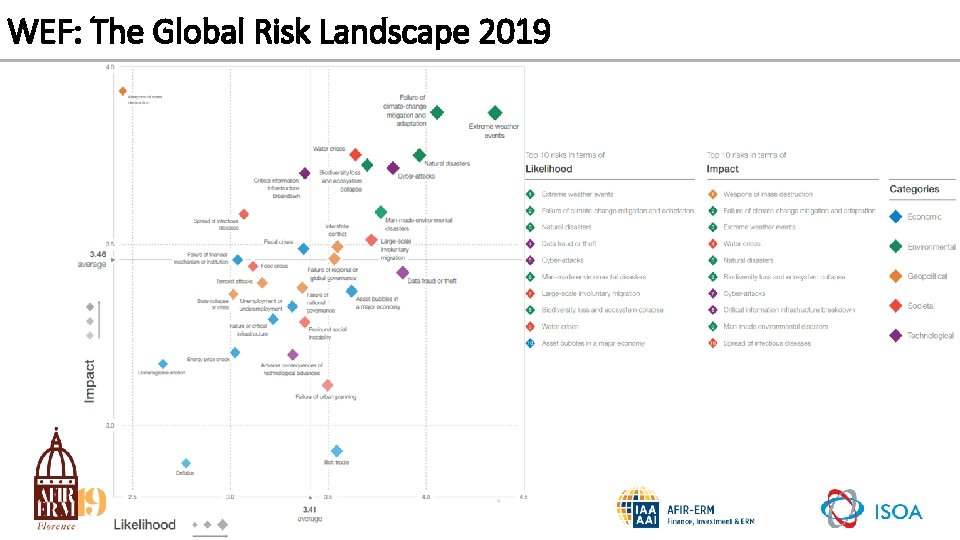
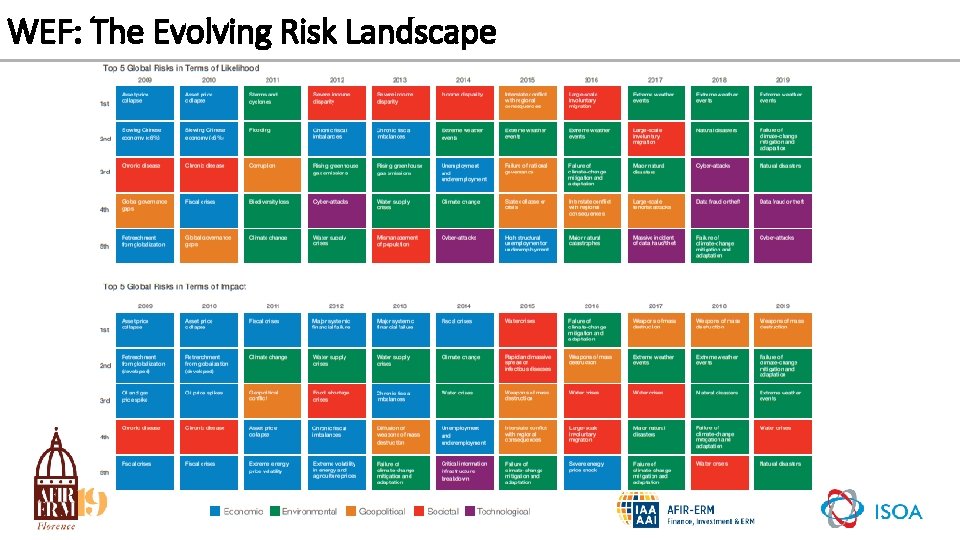
The Most Threatening Risks: Assessments and Rankings • Risk scenarios are now regularly released from national and international agencies. Methods, modalities, degree of accuracy, and outcomes vary. There is no consensus scenario, as with economic forecasts or rating agencies. A few trends however emerge. • The main sources of anxiety lie in environmental, economic and geopolitical factors (see WEF Table 1) • The shifts over the last 10 years have been significant. While before the dominant factors were economic and societal, now the top positions in terms of likelihood are held by natural catastrophes and other events linked to climate change and environmental degradation, and technological disruptions such as cyberattacks and data fraud or theft. In terms of impact, the top ranking is taken by geo-political tensions linked to trade disputes or conflicts (e. g. Libia, Venezuela, US-China or US-Russia power relations), environmental and social (polarization) factors. (WEF, Table 2) • The most serious threats come from tail risks, unknowns or black swans that are impossible to predict, mitigate or prepare for. Black swans do exist!, and when they appear have catastrophic consequences. Ex-ante risk analysis in that case is relatively powerless. The lesson we have learned from the last crisis is that an inherent characteristic of such risks is that they tend to be sistemic, i. e. associated with risk interdependence.
WEF: The Global Risk Landscape 2019
WEF: The Evolving Risk Landscape
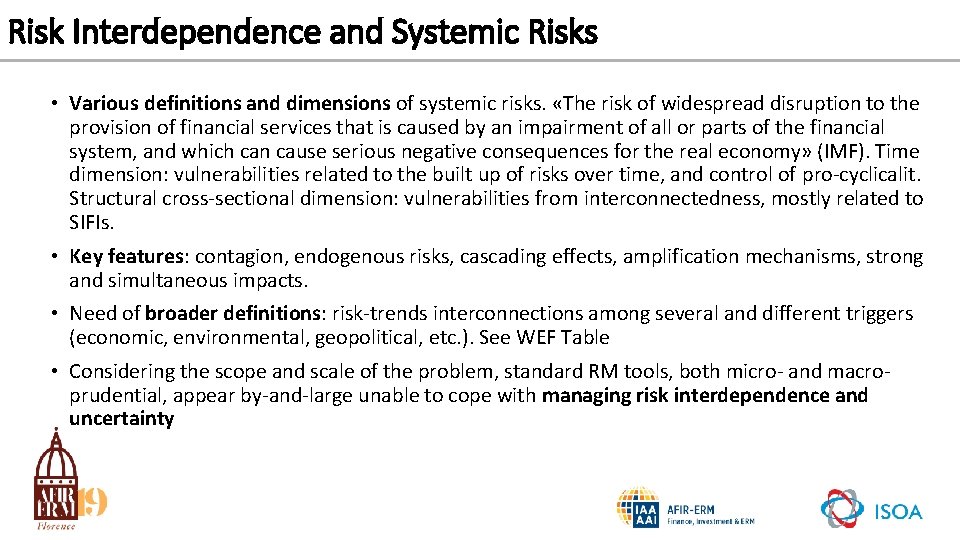
Risk Interdependence and Systemic Risks • Various definitions and dimensions of systemic risks. «The risk of widespread disruption to the provision of financial services that is caused by an impairment of all or parts of the financial system, and which can cause serious negative consequences for the real economy» (IMF). Time dimension: vulnerabilities related to the built up of risks over time, and control of pro-cyclicalit. Structural cross-sectional dimension: vulnerabilities from interconnectedness, mostly related to SIFIs. • Key features: contagion, endogenous risks, cascading effects, amplification mechanisms, strong and simultaneous impacts. • Need of broader definitions: risk-trends interconnections among several and different triggers (economic, environmental, geopolitical, etc. ). See WEF Table • Considering the scope and scale of the problem, standard RM tools, both micro- and macroprudential, appear by-and-large unable to cope with managing risk interdependence and uncertainty
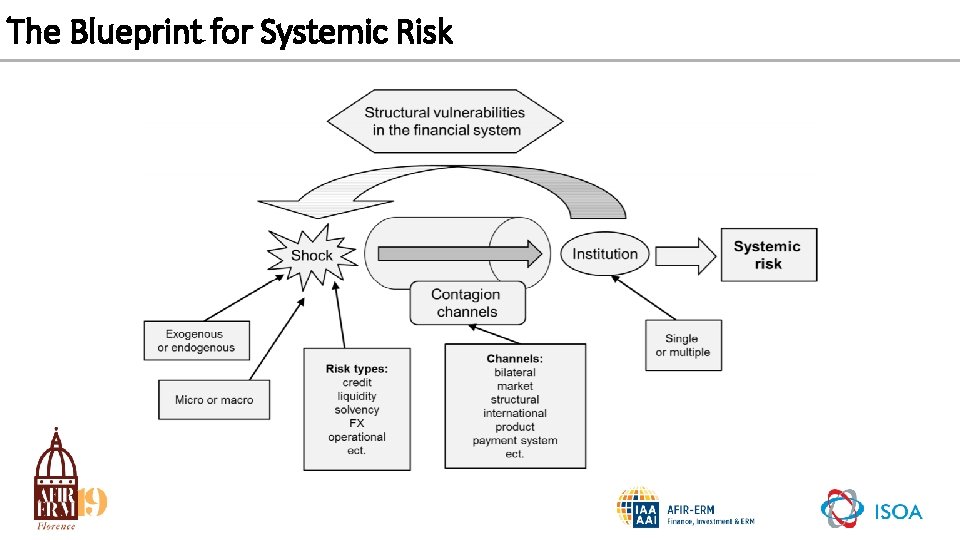
The Blueprint for Systemic Risk
The Risk-Trends Interconnections Map 2019
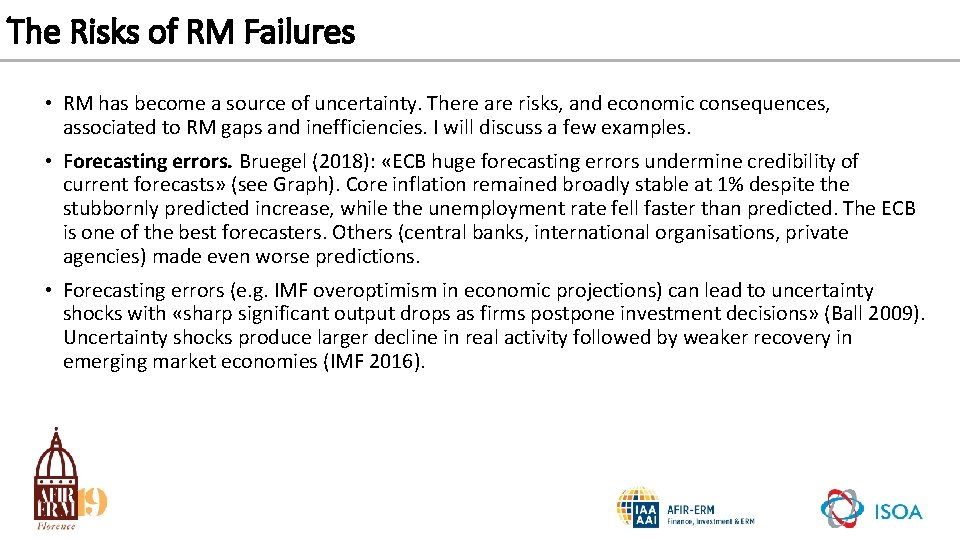
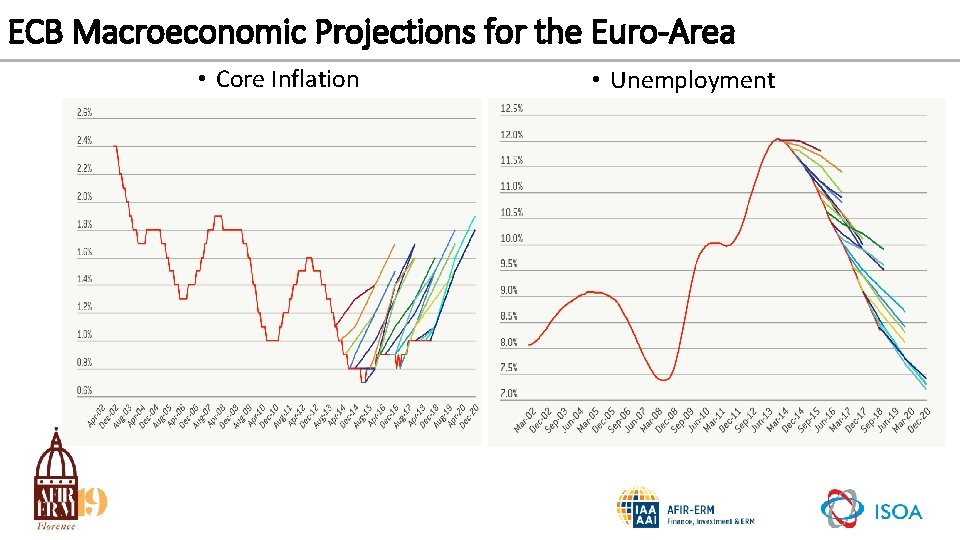
The Risks of RM Failures • RM has become a source of uncertainty. There are risks, and economic consequences, associated to RM gaps and inefficiencies. I will discuss a few examples. • Forecasting errors. Bruegel (2018): «ECB huge forecasting errors undermine credibility of current forecasts» (see Graph). Core inflation remained broadly stable at 1% despite the stubbornly predicted increase, while the unemployment rate fell faster than predicted. The ECB is one of the best forecasters. Others (central banks, international organisations, private agencies) made even worse predictions. • Forecasting errors (e. g. IMF overoptimism in economic projections) can lead to uncertainty shocks with «sharp significant output drops as firms postpone investment decisions» (Ball 2009). Uncertainty shocks produce larger decline in real activity followed by weaker recovery in emerging market economies (IMF 2016).
ECB Macroeconomic Projections for the Euro-Area • Core Inflation • Unemployment
Navigating with a Macroeconomic Compass Pointing to Shifting Directions! • This is how J. Powell, the Governor of the Fed, decribed «navigation» in monetary policy, as a very challenging endeavour. He spoke of «shifting stars during normalisation» : «According to the conventional thinking, policy-makers should navigate by the stars» . This refers to the importance of «starred» variables (the natural rate of unemployment, the neutral interest rate and the target rate of inflation) in guiding macroeconomic policy manoeuvring. • But assessments of the value of the «stars» are often imprecise volatile and subject to significant revisions. Therefore monetary authorities end up navigating perilously: between «the shoals of overheating and the premature tightening» . • In practise, policy decision makers must have recourse to euristics or use opportunistically a broad range of indicators and plausible scenarios. They are increasingly exposed to the risk of mis-perception and mood swings. They tend to be overcautious and slow-reacting.
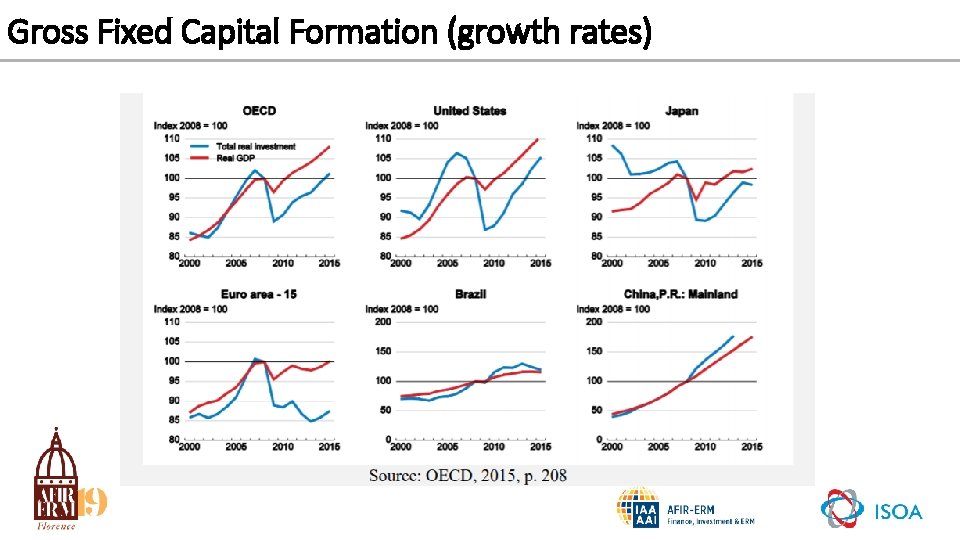
Lont-Term Investment: the Vicious Circle of RM- and Policy-Failures • Growing uncertainty has favored a shift towards short term low risk low yield investment. This had serious consequences, as underinvestment, particularly on SME and infrastructure, is at the root of stagnating productivity and sluggish growth (see Table) • Long Term Investment (LTI) is particularly weak in Europe, here it is still below pre-crisis levels, even tough requirements are rising facing the greater challenges in risk scenarios (aging, climate change, migration and geopolitical threats, growth potential, etc. ). • Have policy responses been forthcoming, and adequate? A recent report (De la Martinière 2018) has sharply criticised it, saying that they were even counter-productive. Austerity induced public investment cuts, deleveraging affecting corporate investment, accomodative monetary policies flattening the interest rates curve and slashing illiquidity premiums, macroeconomic uncertainties linked to geo-political slippages, etc. : the environment for LTI deteriorated significantly, causing increased risk aversion, low R&D expenditures, feeble equity markets and slim venture capital.
Gross Fixed Capital Formation (growth rates)
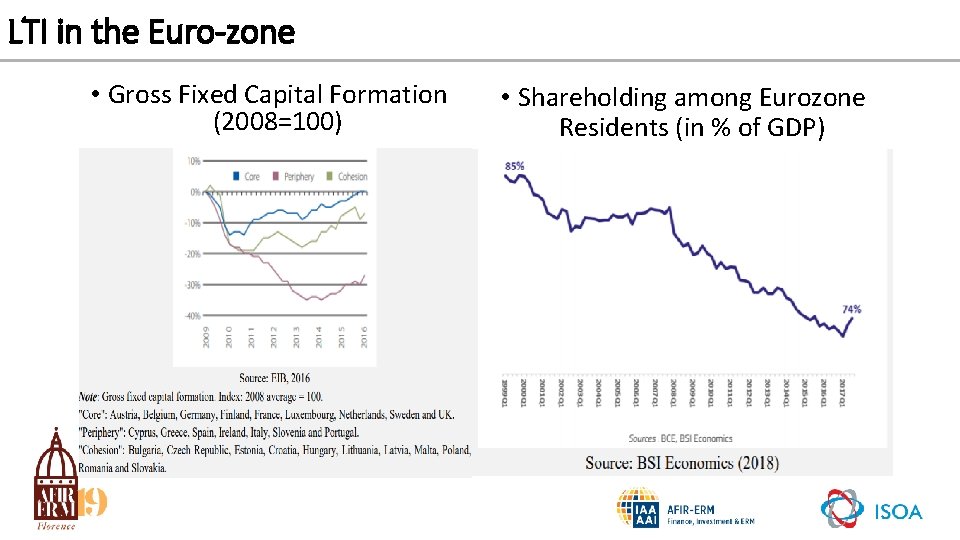
Financial Stability Regulation Feeding Uncertainty • More specifically, measures in support of financial stability have ultimately undermined LTI: e. g. accounting standards (mark-to-market), solvency capital requirements that consider liquidity the main protection against risk, penalization of equity, securitization and infrastructure investment, penalisation of research (under Mifid 2 the cost of financial analysis is subject to the provisions applicable to management fees), etc. • The outcome of this unfavourable LTI environment is consequencial: LT investors (insurers and pension funds) have withdrawn from the securitization market and from equity investment (the equity portfolio of insurers dropped from over 20% of assets to 10% in 10 years), R&D and social infrastructures went down, shareholding among Eurozone residents fell between 2000 and 2017 by more than 10 pp of GDP, cross-border financing has gone down (fragmentation). • J. De Larosière concludes: «This is why, in spite of unprecedented strengthening of financial institutions’ prudential constraints, confidence continues to be lacking among investors and supervisory authorities – whose constant addition of supplementary regulatory mechanisms (loss-absorbing capacity, stress testing, continuity plans, …) demonstrate that the economy is still at risk» . • The paradox is that the response to uncertainty by policy and regulation contributed to increase uncertainty (vitious circle). RM failure compounded with regulatory and policy failures became a source of uncertainty.
LTI in the Euro-zone • Gross Fixed Capital Formation (2008=100) • Shareholding among Eurozone Residents (in % of GDP)
Inadequate Policy Responses and Unmanaged Uncertainty, Fear and Anger • Policy responses to the new risks scenarios (interdependence) have been by-and-large inadequate – not only in Europe. They can be grouped and summed up as follows: - micro-prudential; - macro-prudential; crisis management (resolution, deposit insurance, etc. ); - structural constraints (separation of proprietary trading, commercial versus investment banking); SIFIs (too big to fail); - organisational (monitoring, analysis, early warning, etc. ); - capital flows management measures; - cross-border (G-20, IMF annual report, coordination –see BIS) • Most commentators support a holistic approach (banks, capital markets, real estates, etc. ). But in general it is not holistic enough. • Main missing links are: 1. those between the financial sector, the real economy and societal stress/vulnerabilities (economic and social policies); 2. those between individual institutions, localnational - and international/global dimensions. • Several measures address interdependence with a backward-looking, avoidant, almost denying perspective; ie. by reducing interdependence. The intention is to regain control, pursue independence, go alone, etc. For instance: retrenching within national jurisdictions, limits to capital flows, building operational firewalls, sand-boxing innovation, breaking global value chains, even protectionism. But the potential collateral damage is great, and often tools miss the point. • Ultimately the outcome is greater uncertainty. • Unmanaged uncertainties is –in my view- one of the root causes of emotional/irrational economic decisions, populism and the failures of liberal democracies.
A Comprehensive Response to Uncertainty Requires Focusing on Economic and Social Policies • J. De Larosière clearly points out the direction to follow: «In order to exit the vicious circle…, the overriding priority should be to structurally reform our economies. This notably means reducing budget deficits, excessive levels of indebtness and balance of payments imbalances, the primary threats facing LTI. …public policy must enhance the growth potential of European economies … stimulate innovation … develop proactive education and training programmes …reduce inequalities…» (op. cit. ). This broad conclusion in a technical report devoted to obstacles to LTI created by accounting and prudential frameworks should not be considered surprising. • Managing uncertainty in fact means governing interdependence. It is therefore different, much broader and more complex than managing risk (remember F. Knight). The role of public policy and the governance aspects are key to this task that calls into question the responsibility of both private and public players, and their partnership.
The Public Policy Task of Dealing with Uncertainty • A credible response to uncertainty requires a robust infrastructure of public policy for several reasons (see also Keynes -Treatise on Probability-): - There are significant spillover and externalities, both positive and negative. Costs of uncertainty are often born by people not directly involved or by society as a whole. Idem for benefits. – changes need long gestation to mature; - trasformations are so deep and wide that only pubblic efforts can sustain it (energy or demographic transitions, low carbon and circular economy, peace building or constitutional reforms, etc. ); - strong ethical foundations are required; - consistency with structural reforms and socio-economic policy adjustments. • The market alone is unable to face up to those challenges. We need incentives, tax/subsidy tools, safety nets, education and public information, a change of culture (resilience), social capital (trust). Eg. compulsory insurance • But also the market has an important role. We need a new public-private partnership approach, to build a multipillar system of interdependent protection or risk sharing mechanisms: public welfare, private insurance –financing, self-protection (market discipline). The case of pensions, health, disasters, long-term care, securitisation, impact investment, green bonds, etc.
Best Practise: the European Economic and Monetary Union & the Capital Markets Union • The EU has put LTI financing (Invest. EU) and the development of integrated capital markets (CMU) at the center of its strategy for economic growth and stability (EMU). • CMU has the objective of providing additional sources of funding to the real economy, particularly SME and infrastructure. The related action plan foresaw 33 action points, with a focus on fintech, sustainable finance, personal pension products, securitisation, a review of the institutional architecture of regulation and supervision, and an ambitious standardisation programme, includign controversial areas such as corporate taxation and insolvency). • To succeed, this project needs leap forward in fiscal union (ESM, SRF, EDIS, stabilisation function, etc. ), transfer of prerogatives to the European level, European «safe assets» , etc. , i. e. economic and institutional reforms that can promote growth and stability. • This development is encountering –as expected- considerable resistance and delays. But it is the right approach to deal with interdependence and the root causes of uncertainty.
Actuaries as Risk Interdependence Managers and Stakeholders of Socio. Economic Policies • The new context creates great challenges (e. g. growing frustration and customers’ dissatisfaction), but also great opportunities: new centrality of risk professions and tools, greater policy relevance and visibility, more strategic managerial and innovative tasks, greater recognition and credibility. • Actuaries are engaging in a much wider and complex agenda of resilience and risk frameworks affecting norms, tools and skills, well beyond the traditional boundaries of risk management, and reaching out to social and economic policies. • This opens up new horizons for actuaries, in relation to skills, partnerships with other scientists and professionals, interplay with private and public decision makers, engagement in public policy (e. g. financial inclusion, sustainability and education). • It requires strong foundations and insights not only in hard science but also in social science, openness to innovation, technology and research, a sense of public purpose, leadership and commitment to democracy and the public good. • It requires bridging the gap between science and society, management and politics, promises and achievements, demands and responsibilities, the world of risk management and the widespread aspiration to security and protection.