
Managing Human Resources Bohlander Snell Sherman Chapter 10
Managing Human Resources Bohlander Snell Sherman Chapter 10 Incentive Rewards Managing Human Resources, 12 e, by Bohlander/Snell/Sherman © 2001 South-Western/Thomson Learning 1
Learning Objectives Discuss the basic requirements for successful implementation of incentive programs. List the types of, and reasons for implementing, individual incentive plans. Explain why merit raises may fail to motivate employees adequately and discuss ways to increase their motivational value. State and identify the advantage of each of the principal methods used to compensate salespersons. Managing Human Resources, 12 e, by Bohlander/Snell/Sherman © 2001 South-Western/Thomson Learning 2
Learning Objectives, cont. Differentiate how gains may be shared with employees under the Scanlon, Rucker, Improshare, and earnings-at-risk gainsharing systems. Explain what profit-sharing plans are and the advantages and disadvantages of these programs. Describe the main types of ESOP plans and discuss the advantages of ESOPs to employers and employees. Managing Human Resources, 12 e, by Bohlander/Snell/Sherman © 2001 South-Western/Thomson Learning 3
Presentation Slide 10 -1 Advantages of Incentive Pay Programs Employee effort is focused on important targets n Rewards are variable costs linked to results n Incentives are directly related to improved performance n Incentives reward those responsible for higher performance n Managing Human Resources, 12 e, by Bohlander/Snell/Sherman © 2001 South-Western/Thomson Learning 4
Variable Pay Tying pay to some measure of individual, group, or organizational performance Managing Human Resources, 12 e, by Bohlander/Snell/Sherman © 2001 South-Western/Thomson Learning 5
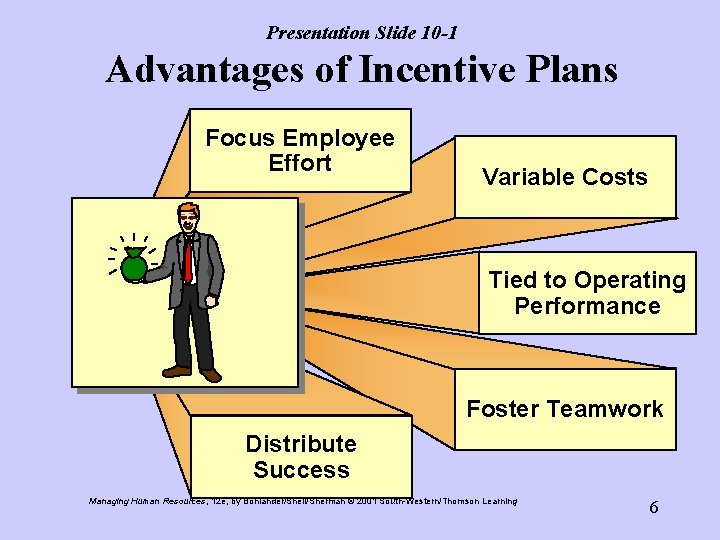
Presentation Slide 10 -1 Advantages of Incentive Plans Focus Employee Effort Variable Costs Tied to Operating Performance Foster Teamwork Distribute Success Managing Human Resources, 12 e, by Bohlander/Snell/Sherman © 2001 South-Western/Thomson Learning 6
Six Components of Effective Incentive Plan Administration u Grant incentives based on performance u Adequate financial resources to reward performance u Clearly defined and accepted performance standards u Easily understood payout formula u Reasonable administrative costs u Wide coverage of employees Managing Human Resources, 12 e, by Bohlander/Snell/Sherman © 2001 South-Western/Thomson Learning 7
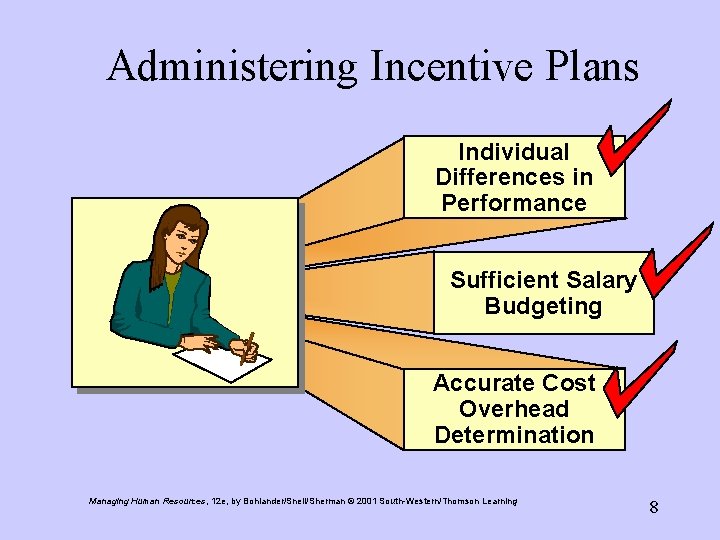
Administering Incentive Plans Individual Differences in Performance Sufficient Salary Budgeting Accurate Cost Overhead Determination Managing Human Resources, 12 e, by Bohlander/Snell/Sherman © 2001 South-Western/Thomson Learning 8
Presentation Slide 10 -2 Employee Opposition to Incentive Plans s s s Production standards are set unfairly. Incentive plans are really “work speedup. ” Incentive plans create competition among workers. Increased earnings result in tougher standards. Payout formulas are complex and difficult to understand. Incentive plans cause friction between employees and management. Managing Human Resources, 12 e, by Bohlander/Snell/Sherman © 2001 South-Western/Thomson Learning 9
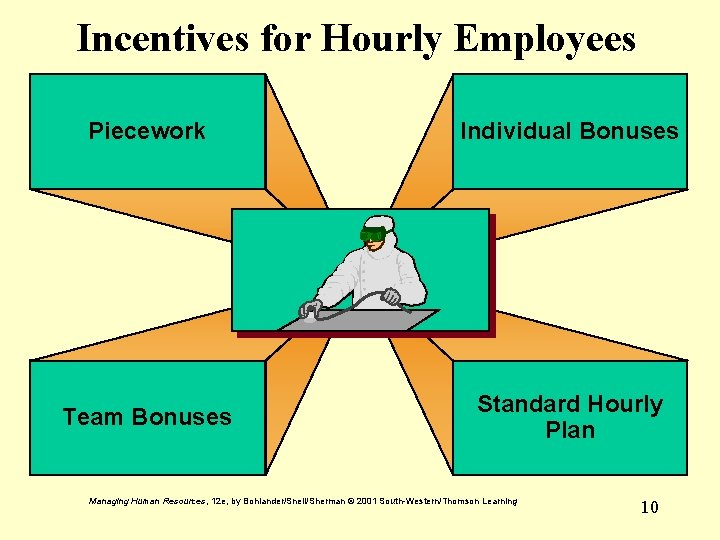
Incentives for Hourly Employees Piecework Individual Bonuses Team Bonuses Standard Hourly Plan Managing Human Resources, 12 e, by Bohlander/Snell/Sherman © 2001 South-Western/Thomson Learning 10
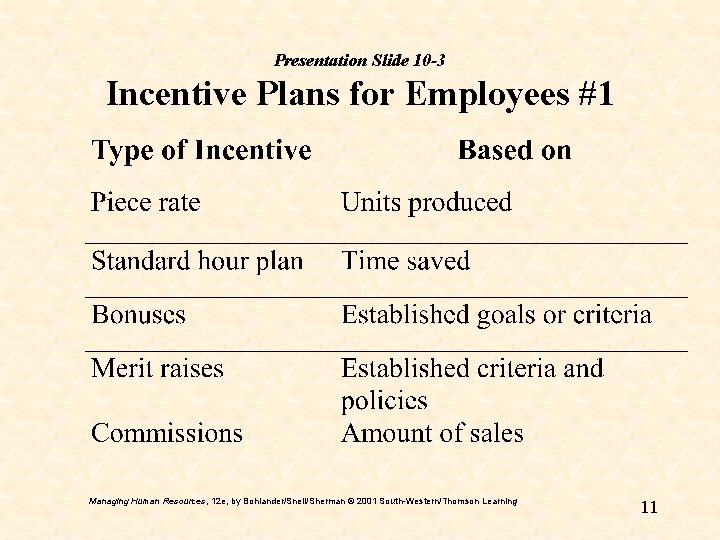
Presentation Slide 10 -3 Incentive Plans for Employees #1 Managing Human Resources, 12 e, by Bohlander/Snell/Sherman © 2001 South-Western/Thomson Learning 11
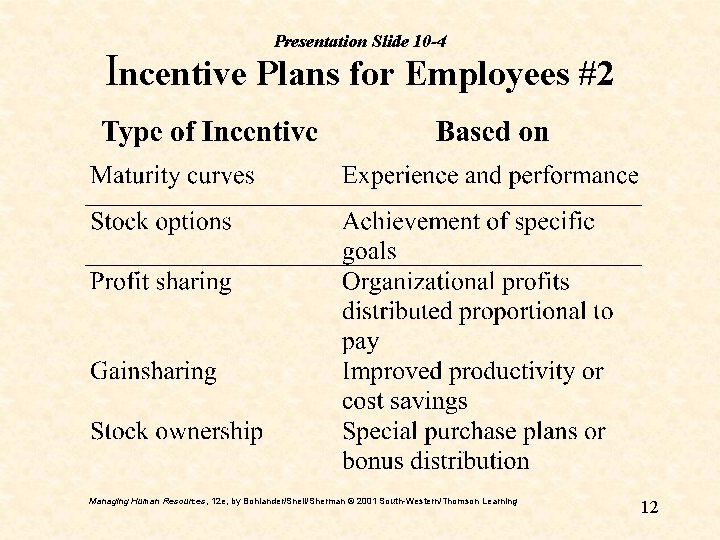
Presentation Slide 10 -4 Incentive Plans for Employees #2 Managing Human Resources, 12 e, by Bohlander/Snell/Sherman © 2001 South-Western/Thomson Learning 12

Presentation Slide 10 -5 Motivation Through Merit Raises w w w Develop employee confidence and trust in performance appraisal Establish job-related performance criteria Separate merit pay from regular pay Withhold merit payments when performance declines Distinguish merit raises from cost-of-living raises Managing Human Resources, 12 e, by Bohlander/Snell/Sherman © 2001 South-Western/Thomson Learning 13
Straight Piecework Incentive plan under which employees receive a certain rate for each unit produced Managing Human Resources, 12 e, by Bohlander/Snell/Sherman © 2001 South-Western/Thomson Learning 14
Differential Piece Rate Compensation rate under which employees whose production exceeds the standard amount of output receive a higher rate for all of their work than the rate paid to those who do not exceed the standard amount Managing Human Resources, 12 e, by Bohlander/Snell/Sherman © 2001 South-Western/Thomson Learning 15
Standard Hour Plan Incentive plan that sets rates based upon the completion of a job in a predetermined standard time Managing Human Resources, 12 e, by Bohlander/Snell/Sherman © 2001 South-Western/Thomson Learning 16
Bonus Incentive payment that is supplemental to the base wage Managing Human Resources, 12 e, by Bohlander/Snell/Sherman © 2001 South-Western/Thomson Learning 17
Spot Bonus Unplanned bonus given for employee effort unrelated to an established performance measure Managing Human Resources, 12 e, by Bohlander/Snell/Sherman © 2001 South-Western/Thomson Learning 18
Merit Guidelines for awarding merit raises that are tied to performance objectives Managing Human Resources, 12 e, by Bohlander/Snell/Sherman © 2001 South-Western/Thomson Learning 19
Lump-Sum Merit Program under which employees receive a year-end merit payment, which is not added to their base pay Managing Human Resources, 12 e, by Bohlander/Snell/Sherman © 2001 South-Western/Thomson Learning 20
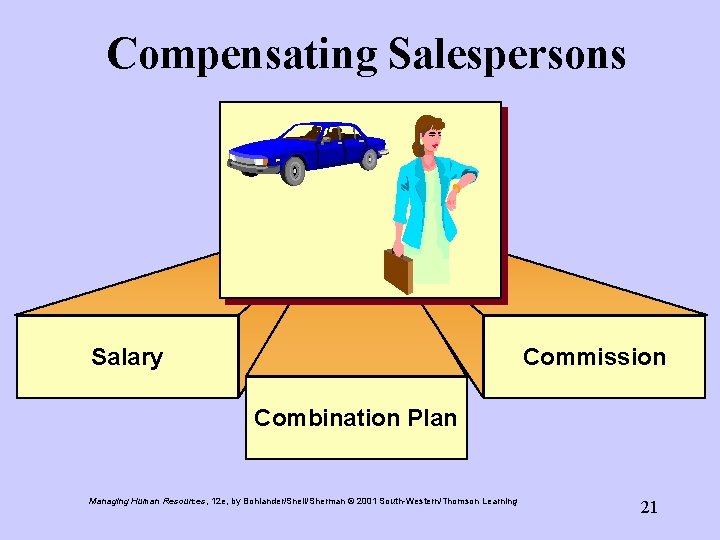
Compensating Salespersons Salary Commission Combination Plan Managing Human Resources, 12 e, by Bohlander/Snell/Sherman © 2001 South-Western/Thomson Learning 21
Straight Salary Plan Compensation plan that permits salespeople to be paid for performing various duties that are not reflected immediately in their sales volume Managing Human Resources, 12 e, by Bohlander/Snell/Sherman © 2001 South-Western/Thomson Learning 22
Straight Commission Plan Compensation plan based upon a percentage of sales Managing Human Resources, 12 e, by Bohlander/Snell/Sherman © 2001 South-Western/Thomson Learning 23
Combined Salary and Commission Plan Compensation plan that includes a straight salary and a commission Managing Human Resources, 12 e, by Bohlander/Snell/Sherman © 2001 South-Western/Thomson Learning 24

Maturity Curves Experience or performance bases for providing salary increases for professional employees Managing Human Resources, 12 e, by Bohlander/Snell/Sherman © 2001 South-Western/Thomson Learning 25

Perquisites Special benefits given to executives; often referred to as perks Managing Human Resources, 12 e, by Bohlander/Snell/Sherman © 2001 South-Western/Thomson Learning 26

Executive Perquisites n n n n company-provided car free financial consulting club memberships use of company plane and yacht use of company loges at sporting events low-cost or no-cost loans special travel allowances limousine service n n n n kidnap and ransom protection free legal counseling family member travel allowances home entertainment allowance payment of children’s educational expenses executive dining room estate planning Managing Human Resources, 12 e, by Bohlander/Snell/Sherman © 2001 South-Western/Thomson Learning 27
Presentation Slide 10 -6 Criticisms of Executive Incentive Plans u Incentive payments are excessive compared with return to stockholders. u Time periods for judging and rewarding performance are too short. u Quarterly earnings growth is emphasized at the expense of research and development. u Emphasis is placed upon equaling or exceeding executive salary survey averages. u Benefits do not relate closely to individual performance. Managing Human Resources, 12 e, by Bohlander/Snell/Sherman © 2001 South-Western/Thomson Learning 28
Presentation Slide 10 -7 Types of Group Incentive Plans • Teams • Gainsharing Incentive Plans – Scanlon Plan – Rucker Plan – Improshare – Earnings-at-Risk Managing Human Resources, 12 e, by Bohlander/Snell/Sherman © 2001 South-Western/Thomson Learning 29
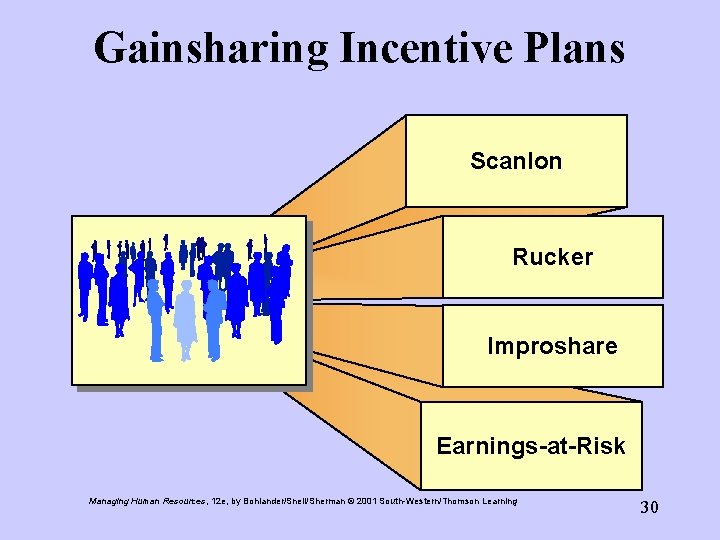
Gainsharing Incentive Plans Scanlon Rucker Improshare Earnings-at-Risk Managing Human Resources, 12 e, by Bohlander/Snell/Sherman © 2001 South-Western/Thomson Learning 30
Team Incentive Plan Compensation plan where all team members receive an incentive bonus payment when production or service standards are met or exceeded Managing Human Resources, 12 e, by Bohlander/Snell/Sherman © 2001 South-Western/Thomson Learning 31
Gainsharing Plans Programs under which both employees and the organization share the financial gains according to a predetermined formula that reflects improved productivity and profitability Managing Human Resources, 12 e, by Bohlander/Snell/Sherman © 2001 South-Western/Thomson Learning 32
Scanlon Plan Bonus incentive plan using employee and management committees to gain cost-reduction improvements Managing Human Resources, 12 e, by Bohlander/Snell/Sherman © 2001 South-Western/Thomson Learning 33
Rucker Plan Bonus incentive plan based on the historic relationship between the total earnings of hourly employees and the production value created by the employees Managing Human Resources, 12 e, by Bohlander/Snell/Sherman © 2001 South-Western/Thomson Learning 34
Improshare Gainsharing program under which bonuses are based upon the overall productivity of the work team Managing Human Resources, 12 e, by Bohlander/Snell/Sherman © 2001 South-Western/Thomson Learning 35
Earnings-at-Risk Incentive Plans Incentive pay plans placing a portion of the employee’s base pay at risk, but giving the opportunity to earn income above base pay when goals are met or exceeded Managing Human Resources, 12 e, by Bohlander/Snell/Sherman © 2001 South-Western/Thomson Learning 36
Profit Sharing Any procedure by which an employer pays, or makes available to all regular employees, in addition to base pay, special current or deferred sums based upon the profits of the enterprise Managing Human Resources, 12 e, by Bohlander/Snell/Sherman © 2001 South-Western/Thomson Learning 37
Employee Stock Ownership Plans (ESOPs) Stock plans in which an organization contributes shares of its stock to an established trust for the purpose of stock purchases by its employees Managing Human Resources, 12 e, by Bohlander/Snell/Sherman © 2001 South-Western/Thomson Learning 38
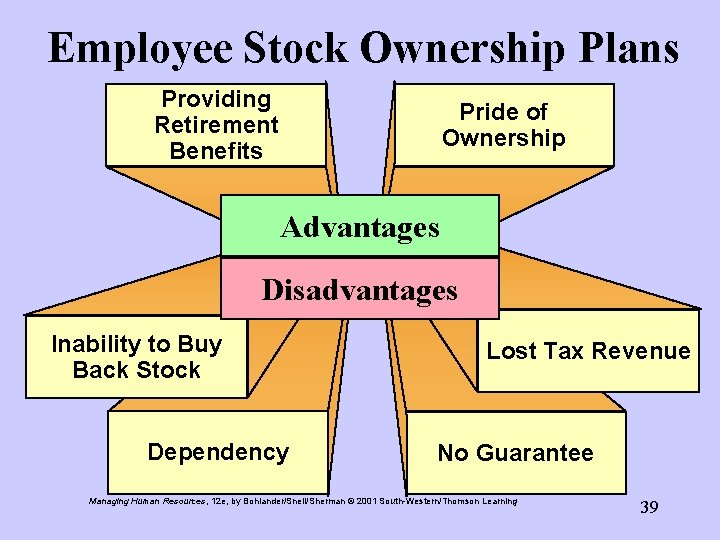
Employee Stock Ownership Plans Providing Retirement Benefits Pride of Ownership Advantages Disadvantages Inability to Buy Back Stock Dependency Lost Tax Revenue No Guarantee Managing Human Resources, 12 e, by Bohlander/Snell/Sherman © 2001 South-Western/Thomson Learning 39
- Slides: 39