
MANAGING HERPES SIMPLEX KERATITIS Marilynn Sultana M D


















- Slides: 41
MANAGING HERPES SIMPLEX KERATITIS Marilynn Sultana, M. D. , F. A. C. S. Cataract & Eye Consultants of Michigan 29753 Hoover Rd. Warren, MI 48093
Learning Objectives § Describe clinical presentations of herpes simplex keratitis § Explain available therapies
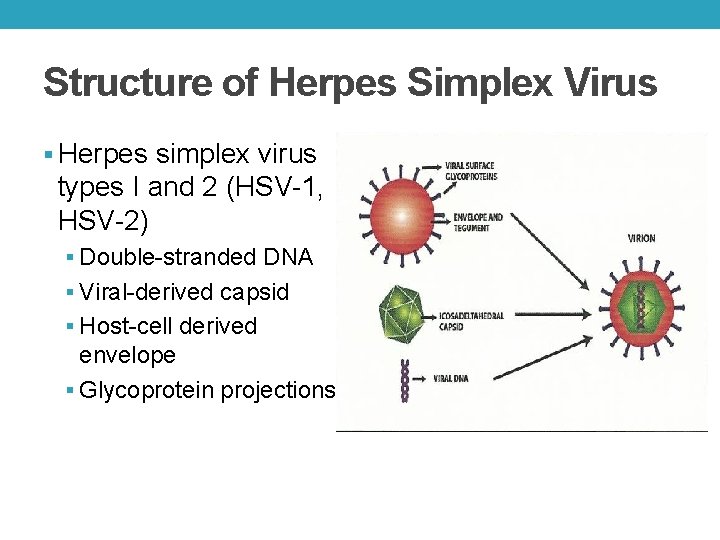
Structure of Herpes Simplex Virus § Herpes simplex virus types I and 2 (HSV-1, HSV-2) § Double-stranded DNA § Viral-derived capsid § Host-cell derived envelope § Glycoprotein projections
Epidemiology of Ocular HSV § Initial exposure: childhood “viral” illness § Ocular manifestation: reactivation of latent virus § Blepharitis, follicular conjunctivitis, keratouveitis, acute retinal necrosis § 50, 000 new and recurring cases annually § Recurrence rate: 27% at one year
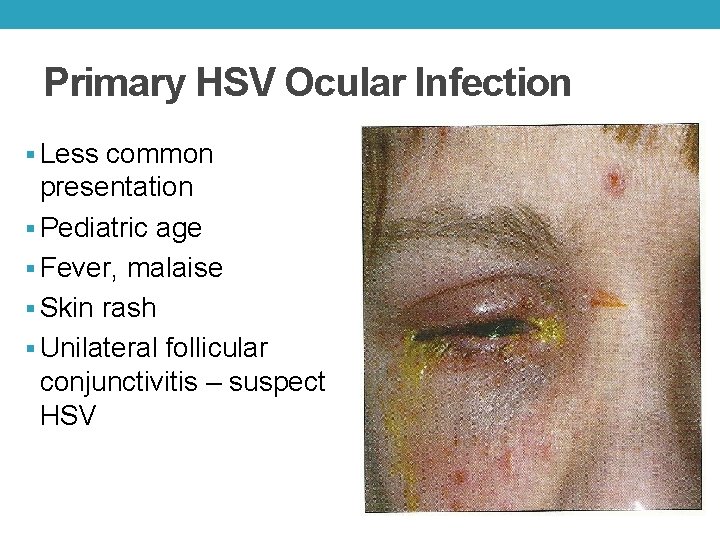
Primary HSV Ocular Infection § Less common presentation § Pediatric age § Fever, malaise § Skin rash § Unilateral follicular conjunctivitis – suspect HSV
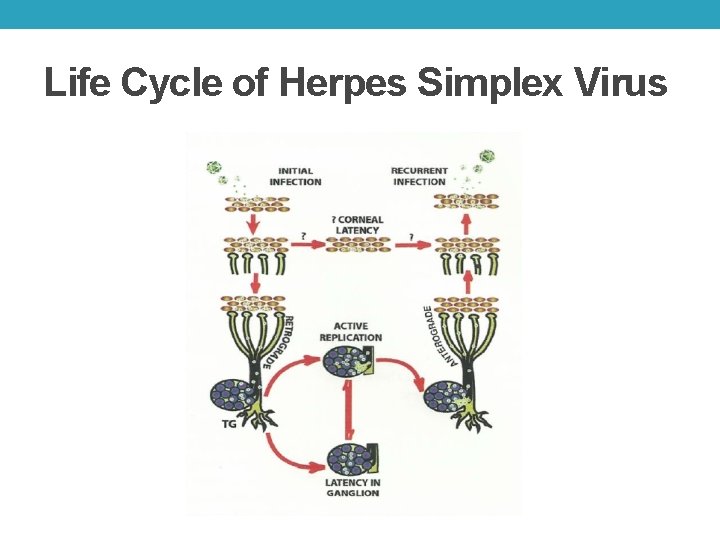
Life Cycle of Herpes Simplex Virus
Recurrent HSV Infection § Orofacial: Cold sores on lip, cheek or tongue § Ocular: Most frequently involves cornea § Epithelial keratitis – active virus § Stromal keratitis – immunologic
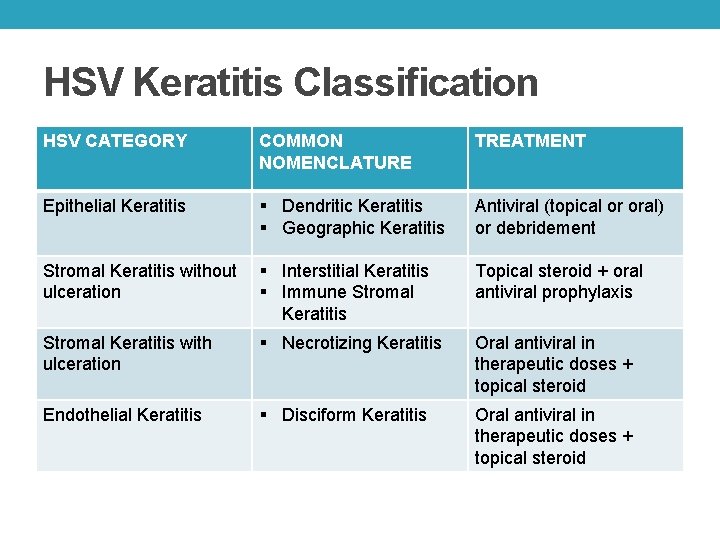
HSV Keratitis Classification HSV CATEGORY COMMON NOMENCLATURE TREATMENT Epithelial Keratitis § Dendritic Keratitis § Geographic Keratitis Antiviral (topical or oral) or debridement Stromal Keratitis without ulceration § Interstitial Keratitis § Immune Stromal Keratitis Topical steroid + oral antiviral prophylaxis Stromal Keratitis with ulceration § Necrotizing Keratitis Oral antiviral in therapeutic doses + topical steroid Endothelial Keratitis § Disciform Keratitis Oral antiviral in therapeutic doses + topical steroid
Epithelial Keratitis § Dendritic ulcer § Geographic ulcer § Others: § Marginal ulcer § Metaherpetic (trophic) ulcer
Epithelial Keratitis: Dendritic Ulcer § Classic corneal lesion § Branching with terminal bulbs § Raised borders § Consist of HSVinfected cells § Dendritic scar (ghost dendrite) may remain
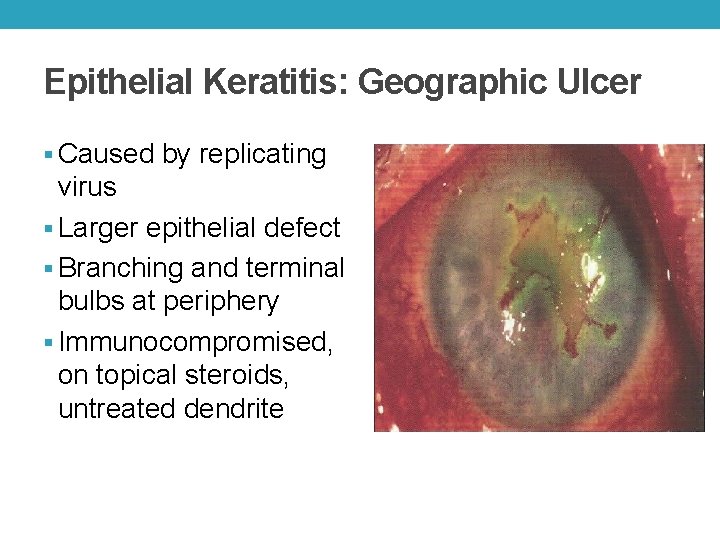
Epithelial Keratitis: Geographic Ulcer § Caused by replicating virus § Larger epithelial defect § Branching and terminal bulbs at periphery § Immunocompromised, on topical steroids, untreated dendrite
Epithelial Keratitis: Marginal Ulcer • Lesion near limbus • Resembles Staph ulcer • More stromal inflammation • More resistant to treatment
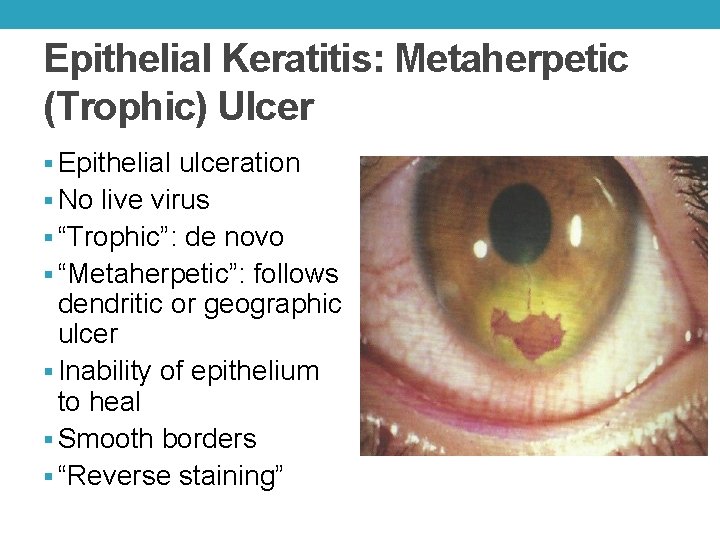
Epithelial Keratitis: Metaherpetic (Trophic) Ulcer § Epithelial ulceration § No live virus § “Trophic”: de novo § “Metaherpetic”: follows dendritic or geographic ulcer § Inability of epithelium to heal § Smooth borders § “Reverse staining”
Treatment: Metaherpetic Ulcer § Form of epithelial ulceration that does not have live virus § Goal: rapidly heal epithelial defect § Stop use of toxic meds § Punctal occlusion § Tear film supplements § Bandage contact lens § Tarsorrhaphy § Cautious use of topical steroids
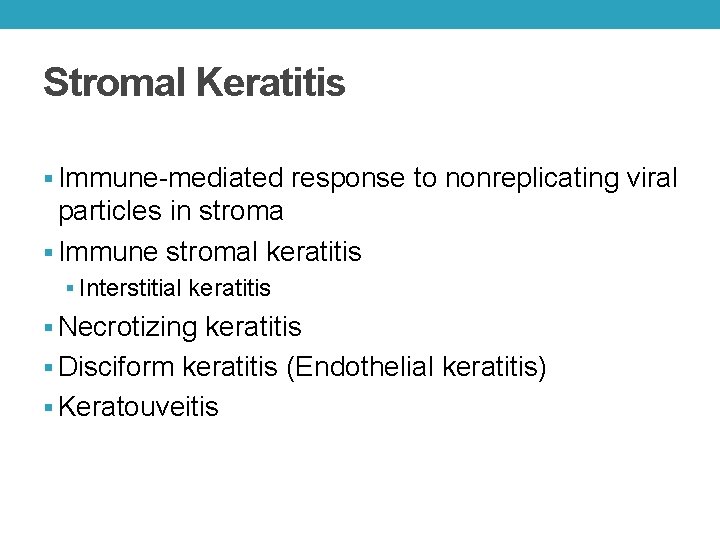
Stromal Keratitis § Immune-mediated response to nonreplicating viral particles in stroma § Immune stromal keratitis § Interstitial keratitis § Necrotizing keratitis § Disciform keratitis (Endothelial keratitis) § Keratouveitis
Stromal: Immune Stromal Keratitis • Inflammatory response to viral antigen in stroma • Focal, multifocal, diffuse stromal opacities • Interstitial keratitis – vascularization • Ghost-like • HSV most common cause
Stromal: Necrotizing Keratitis § Reaction to live viral particles in stroma § History multiple recurrences § Corneal melting, perforation § Significant associated uveitis
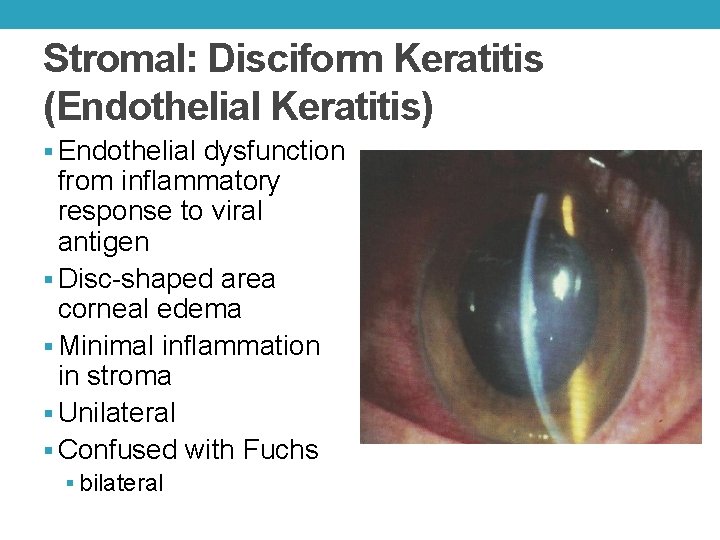
Stromal: Disciform Keratitis (Endothelial Keratitis) § Endothelial dysfunction from inflammatory response to viral antigen § Disc-shaped area corneal edema § Minimal inflammation in stroma § Unilateral § Confused with Fuchs § bilateral
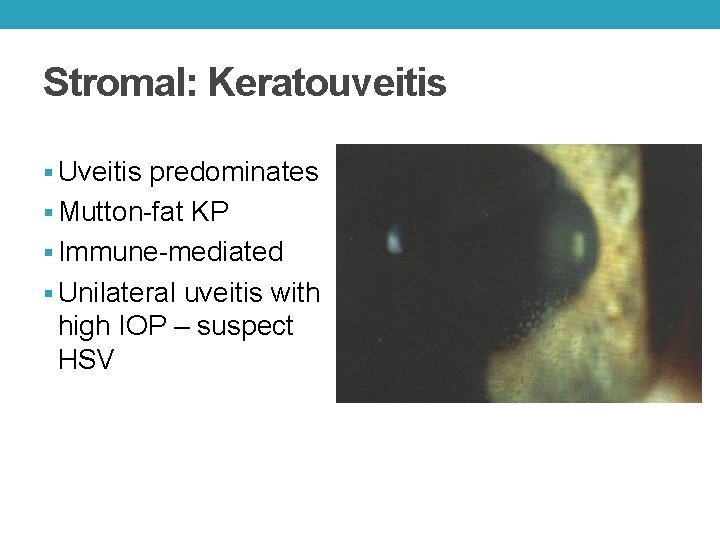
Stromal: Keratouveitis § Uveitis predominates § Mutton-fat KP § Immune-mediated § Unilateral uveitis with high IOP – suspect HSV
Diagnosis: HSV Keratitis § Clinical findings § Lab tests seldom needed § Of no use in stromal keratitis § Herpes Culture § HSV-1 or HSV-2 typing § Serum Antibody Testing § Positive titers in adults indicates past infection § Nearly universal
Diagnosis: Clinical Findings § Patient is in far less pain than findings would suggest § Photophobic or uveitis and high IOP § Patient has history of ocular HSV
Diagnosis: Reduced Corneal Sensation § Hallmark of HSK § Viral replication kills host neuron § Leads to hyposensitivity, poor tear production, persistent epithelial defects § Test prior to topical anesthetic § Use dental floss or cotton wisp
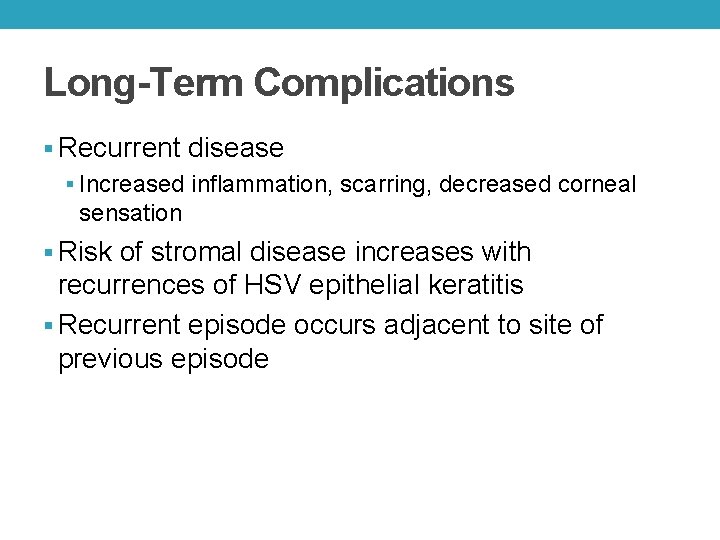
Long-Term Complications § Recurrent disease § Increased inflammation, scarring, decreased corneal sensation § Risk of stromal disease increases with recurrences of HSV epithelial keratitis § Recurrent episode occurs adjacent to site of previous episode
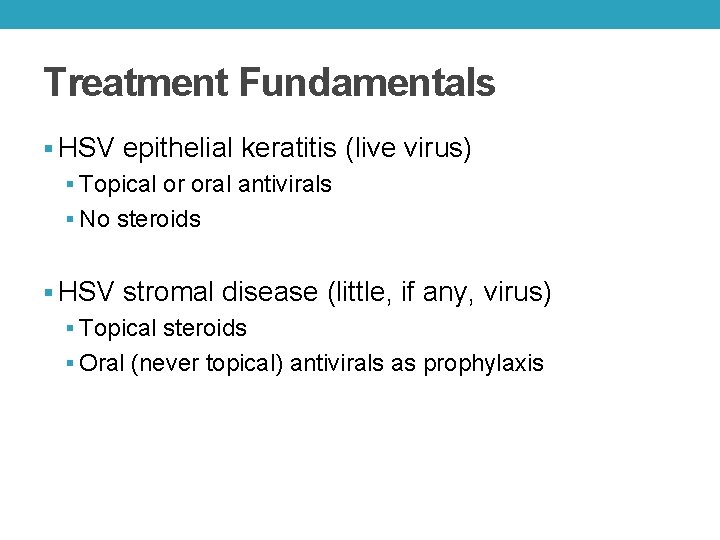
Treatment Fundamentals § HSV epithelial keratitis (live virus) § Topical or oral antivirals § No steroids § HSV stromal disease (little, if any, virus) § Topical steroids § Oral (never topical) antivirals as prophylaxis
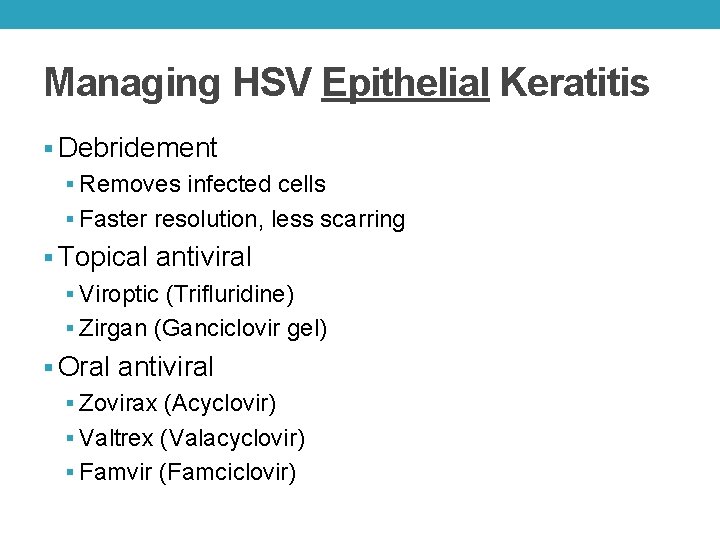
Managing HSV Epithelial Keratitis § Debridement § Removes infected cells § Faster resolution, less scarring § Topical antiviral § Viroptic (Trifluridine) § Zirgan (Ganciclovir gel) § Oral antiviral § Zovirax (Acyclovir) § Valtrex (Valacyclovir) § Famvir (Famciclovir)
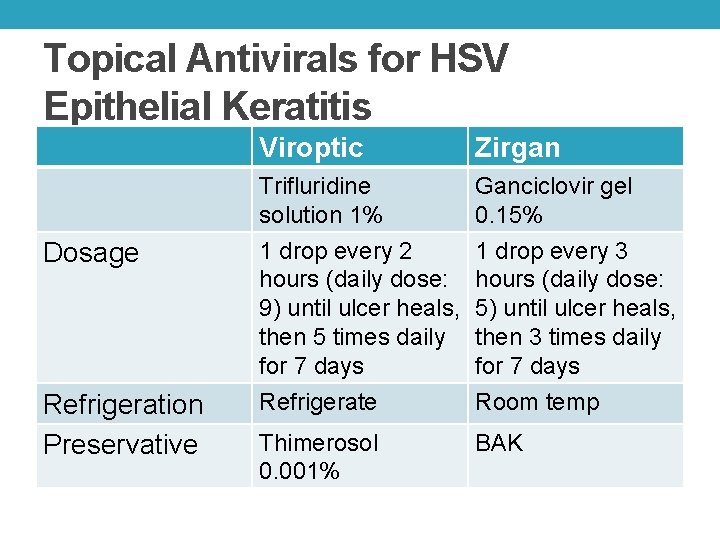
Topical Antivirals for HSV Epithelial Keratitis Dosage Refrigeration Preservative Viroptic Zirgan Trifluridine solution 1% Ganciclovir gel 0. 15% 1 drop every 2 hours (daily dose: 9) until ulcer heals, then 5 times daily for 7 days Refrigerate 1 drop every 3 hours (daily dose: 5) until ulcer heals, then 3 times daily for 7 days Room temp Thimerosol 0. 001% BAK
Managing HSV Stromal Keratitis § Topical steroids § Simultaneous oral antiviral prophylaxis § Reduces risk of HSV reactivation at the trigeminal ganglion level § Zovirax § Valtrex § Famvir
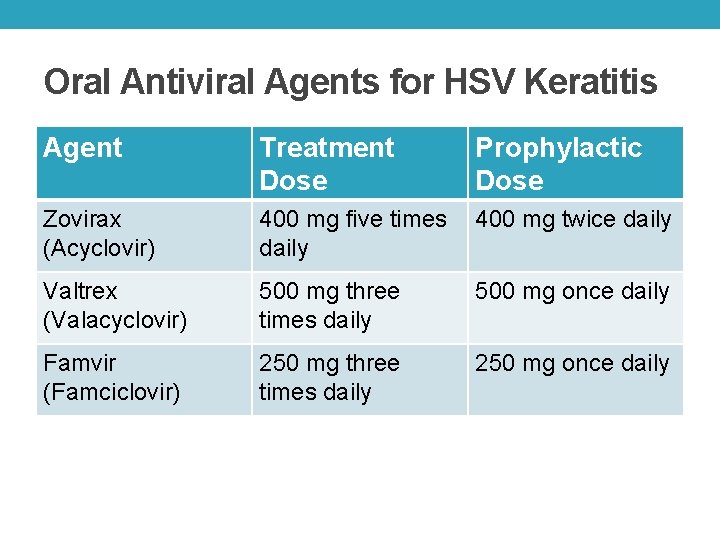
Oral Antiviral Agents for HSV Keratitis Agent Treatment Dose Prophylactic Dose Zovirax (Acyclovir) 400 mg five times daily 400 mg twice daily Valtrex (Valacyclovir) 500 mg three times daily 500 mg once daily Famvir (Famciclovir) 250 mg three times daily 250 mg once daily
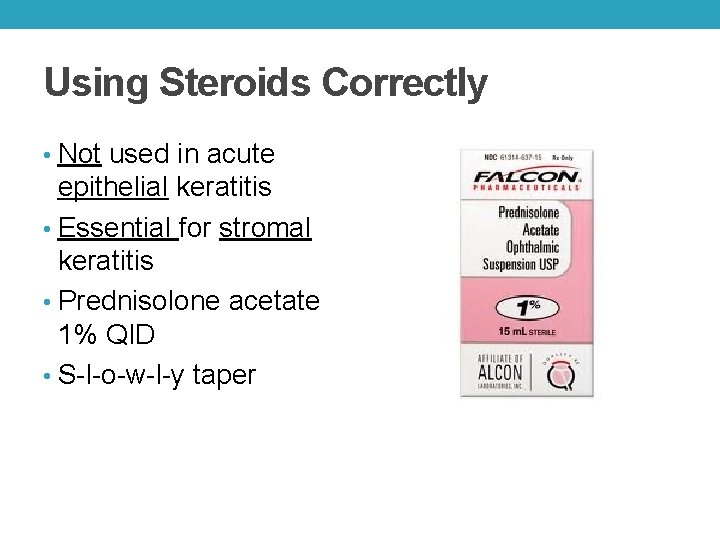
Using Steroids Correctly • Not used in acute epithelial keratitis • Essential for stromal keratitis • Prednisolone acetate 1% QID • S-l-o-w-l-y taper
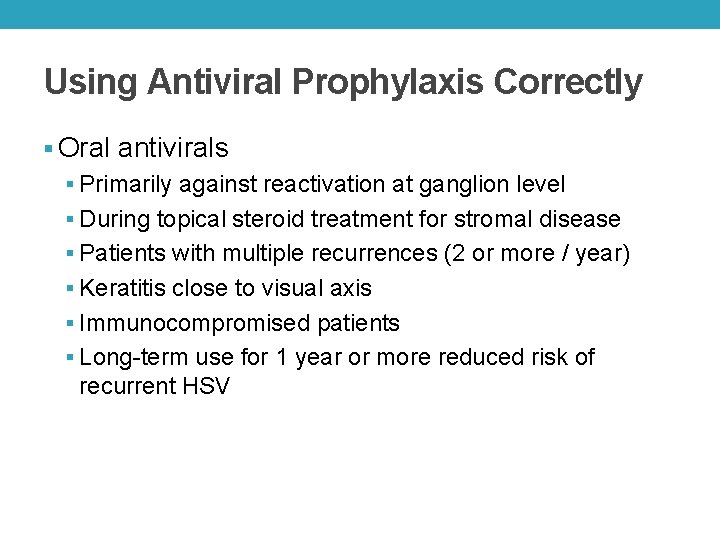
Using Antiviral Prophylaxis Correctly § Oral antivirals § Primarily against reactivation at ganglion level § During topical steroid treatment for stromal disease § Patients with multiple recurrences (2 or more / year) § Keratitis close to visual axis § Immunocompromised patients § Long-term use for 1 year or more reduced risk of recurrent HSV
Quiz Time No Cheating!
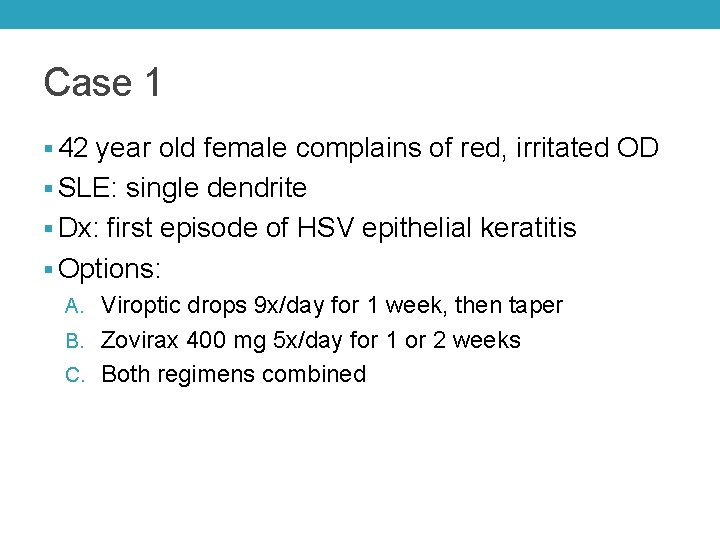
Case 1 § 42 year old female complains of red, irritated OD § SLE: single dendrite § Dx: first episode of HSV epithelial keratitis § Options: A. Viroptic drops 9 x/day for 1 week, then taper B. Zovirax 400 mg 5 x/day for 1 or 2 weeks C. Both regimens combined
Case 1: Recommendation § Each approach reasonable § Consider full dose Viroptic drops § 9 x/day until ulcer heals § then 5 x/day for 1 week § then stop
Case 2 § 51 year old male complains of irritated OS and mild photophobia, vision good § History of three previous episodes HSV epithelial keratitis § SLE: minimal scarring with adjacent new dendrite § Dx: recurrent HSV epithelial keratitis § Options: A. Viroptic drops B. Zovirax oral C. Combination therapy
Case 2: Recommendation § Combination therapy § Viroptic 9 x/day until ulcer heals, then 5 x/day for 1 week § Full therapeutic dose Zovirax 400 mg 5 x/day § Discontinue topical Viroptic within 2 weeks § Taper Zovirax to 400 mg BID for long-term prophylaxis (1 year)
Case 3 § 46 year old female complains of blurry vision OS. § History of treated herpetic dendrite 1½ years ago § Vision: 20/40 § SLE: Mild stromal edema, no scarring § Dx: First episode of HSV stromal keratitis § Options: A. Viroptic drops B. Steroid drops C. Zovirax oral D. Combination therapy
Case 3: Recommendation § Combination therapy of topical steroids with oral antiviral coverage § Pred Forte QID and taper as necessary § Zovirax 400 mg BID until inflammation subsides
Case 4 § 62 year old male complains of blurry vision OD § History of two previous episodes of stromal keratitis § Vision 20/50 § SLE: Mild to moderate edema and patchy scarring § Dx: Recurrent HSV stromal keratitis § Options: A. Viroptic drops B. Steroid drops C. Zovirax oral D. Combination therapy
Case 4: Recommendation § Combination therapy § Pred Forte 1% QID § Zovirax 400 mg BID § Taper steroids s-l-o-w-l-y to avoid recurrence § Continue Zovirax long-term (1 year)
Congratulations!
THANK YOU