
Managing Government Process Reengineering Issues Challenges and Way
- Slides: 48
Managing Government Process Re-engineering: Issues, Challenges and Way forward By Dr. Lawal Zakari, mni Director National Monitoring and Evaluation, Federal Ministry of Finance, Budget & National Planning (November, 2020)
Introduction • Agencies in government are always being challenged to reduce the cost of governance while improving their performance. • As noted globally however, achieving cost savings and performance improvement almost always requires that agencies redesign the business processes they use to accomplish their work. • Despite the dynamic nature of governance, many government agencies are encumbered with structures and processes rooted in the past, aimed at the demands of earlier times, and designed before modern information and communications technology came into vogue, which make the agencies to be poorly positioned to fulfill their missions and strategic goals. 2
Introduction • This therefore calls for the need to consider replacing the outmoded work processes with effective and reengineered government processes, leveraging on information and communication technologies that will make service delivery to the public/customers more effective, efficient and faster. • The replacement of the outmoded work processes with effective and reengineered government processes, leveraging on information and communication technologies is referred to as Business Process Reengineering when conducted by private sector organizations and Government Process Reengineering when embarked by governments and are part of the components of the global New Performance Management and the Nigeria’s e-Government Vision as outlined in the Nigerian e-Government Master Plan. 3
Introduction • The objective of the presentation is therefore to: üDiscuss the Conceptual Clarification Government Process Reengineering (GPR)- What is and What it is not üUnderstand the Guiding Principles Underlying GPR and Why the Need for Reengineering of Government Processes üDiscuss the Design Methodology for Undertaking GPR üExplain the Design Methodology of Process Reengineering Framework üUnderstand the most Common Challenges of Implementing Process Reengineering (PR) Projects in Government üUnderstand the Critical Success Factors of PR in Public and Private Sector Organizations üDiscuss the Nexus Between Government Process Reengineering and E-Governance 4
Introduction • The Status of Implementation of E-Governance in Nigeria • Challenges to Implementation of GPR & E-Governance in Nigeria • Way Forward to Implementation of GPR& E-Governance in Nigeria 10/28/2021 5
Conceptual Clarification Government Process Reengineering • Government Process Re-engineering (GPR) is the application of Business Process Re-engineering (BPR) in government. • BPR is the fundamental reconsideration and radical redesign of organizational processes, in order to achieve dramatic improvements of current performance in cost, speed, and quality of service” – Michael Hammer, Founder of BPR. • GPR is a tool of public sector transformation which unlike business models such as Total Quality Management, Functional Review, or Alternative Service Delivery that are incremental in nature, involves a quantum leap in organizational transformation. • GPR demands government-wide commitment that crosses horizontal and vertical boundaries and is designed to break down ‘silos’ – Ministries or departments that work in isolation. 10/28/2021 6
Conceptual Clarification Government Process Reengineering • Important to understanding business process reengineering does understand what it is not. üGovernment/Business process reengineering is not business transformation. Business transformation refers to any effort to redefine or reformulate the organization’s strategy or philosophy [Davidson, (1993); Boynton, Victor, and Pine, (1993)]. ü Government/Business process reengineering focuses on redesigning processes to support strategy and objective attainment rather than on redesigning the strategy or objectives. examining or üGovernment/ Business process reengineering is not systems reengineering. Systems reengineering is redesigning the computer architecture upon which the organization’s systems are built. Systems reengineering includes downsizing or rightsizing (e. g. , migrating to a client/ server architecture from a mainframe architecture), code restructuring, or migrating systems to more efficient languages. 7 10/28/2021
Conceptual Clarification Government Process Reengineering üMost importantly, government/business process reengineering is not Total Quality Management(TQM). GPR/BPR is similar to TQM because both take a process view of the organization and both focus on the customer as a major source of process measurement. However, TQM focuses on continuous, incremental improvement of those processes through employee and customer feedback. BPR attempts to totally redesign the process from the ground up. It uses a paradigm of a “clean sheet of paper, ” or starting over from scratch, rather than improving the existing situation [Hammer and Champy, (1993)]. ü Further, TQM is a continuous process with strong tools and methods, while GPR/BPR is a one-time project with few proven tools and methodologies. ü Finally, GPR/BPR considers information technology and human resources as prime enablers of major changes, while TQM does not rely heavily on IT for its process improvements. 8 10/28/2021
Conceptual Clarification Government Process Reengineering BPR/GPR is also different from E-Governance üElectronic government or e-government in a simplified definition consists of introducing the Internet and computer networks into the actions of government. üE-government can also be defined as the application of Information Technology to the process of government functioning in order to achieve a Simple, Moral, Accountable, Responsive and Transparent (SMART) Governance. üDevelopment of e-government and government process reengineering complement each other, government process reengineering is required to accelerate the construction of e-government system, and the effective use of information technology and information resources also requires government process reengineering. ü From the perspective of government informatization, the government process reengineering is the organizational guarantee of e-government 9 10/28/2021
Guiding Principles Underlying Government Process Reengineering • The underlying principles of BPR as well as GPR that are universal and could be applied to any organization are: i. Fundamental reconsideration – This involves asking questions about the organization such as – should government be operating in this industry? Could this function be conducted better outside government? Is this a core business for government? ii. Radical redesign – ‘thinking outside the box’ using different techniques must be part of the critical thinking process in the redesign, with special focus on the customer/citizen. • Dramatic improvements – significant improvements in cost, time and speed must be associated with the GPR initiatives. 10
Why the Current Need for Reengineering of Government Processes? • Reduction in revenues with a corresponding growth in expenditures within governments: The global financial crisis – the combination of reduction in revenues with a corresponding growth in expenditures has resulted in unsustainable budget deficits. Radical reviews are needed on the expenditure side of the ledger; • Putting citizens first – transforming government to be more responsive to the needs of citizens, for instance bringing government closer to its citizens via online services, and making government more transparent; • Exploiting technology to enhance investment climate, efficiency and competitiveness – modern infrastructure, the internet, social networks and mobile telephones are being utilised to enhance the investment climate, attracting investors and making government more efficient and competitive. 11
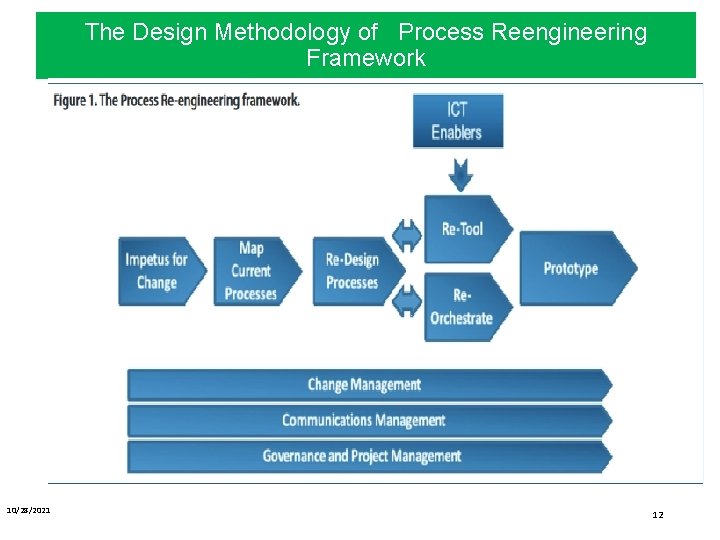
The Design Methodology of Process Reengineering Framework 10/28/2021 12
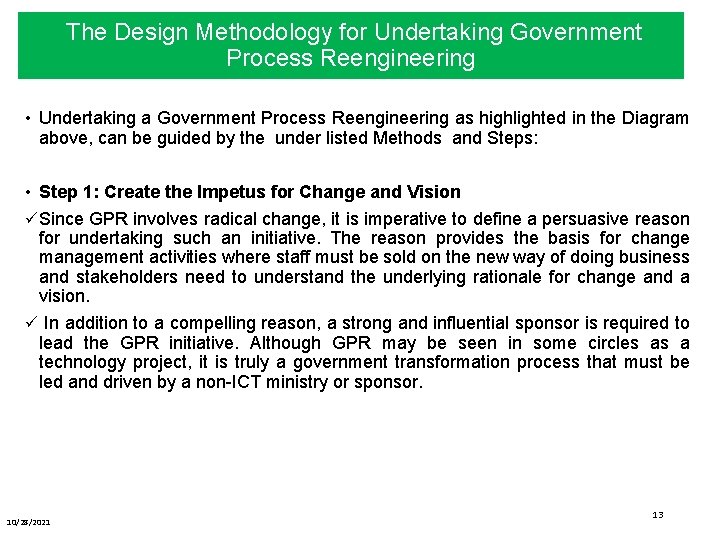
The Design Methodology for Undertaking Government Process Reengineering • Undertaking a Government Process Reengineering as highlighted in the Diagram above, can be guided by the under listed Methods and Steps: • Step 1: Create the Impetus for Change and Vision üSince GPR involves radical change, it is imperative to define a persuasive reason for undertaking such an initiative. The reason provides the basis for change management activities where staff must be sold on the new way of doing business and stakeholders need to understand the underlying rationale for change and a vision. ü In addition to a compelling reason, a strong and influential sponsor is required to lead the GPR initiative. Although GPR may be seen in some circles as a technology project, it is truly a government transformation process that must be led and driven by a non-ICT ministry or sponsor. 10/28/2021 13
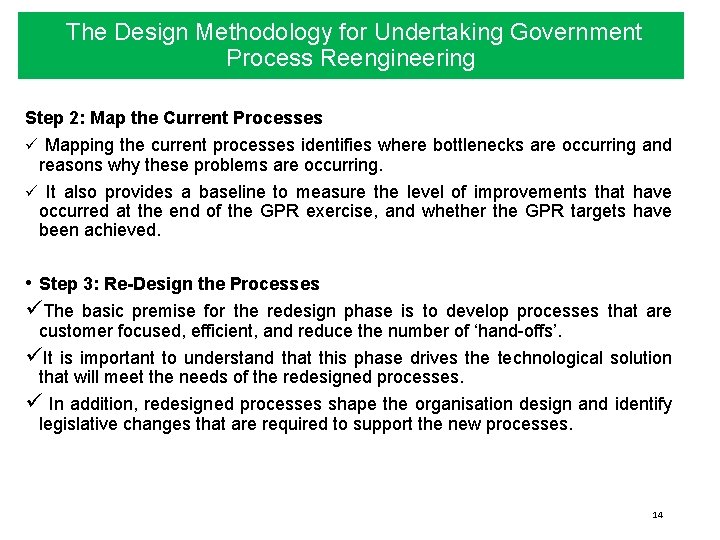
The Design Methodology for Undertaking Government Process Reengineering Step 2: Map the Current Processes ü Mapping the current processes identifies where bottlenecks are occurring and reasons why these problems are occurring. ü It also provides a baseline to measure the level of improvements that have occurred at the end of the GPR exercise, and whether the GPR targets have been achieved. • Step 3: Re-Design the Processes üThe basic premise for the redesign phase is to develop processes that are customer focused, efficient, and reduce the number of ‘hand-offs’. üIt is important to understand that this phase drives the technological solution that will meet the needs of the redesigned processes. ü In addition, redesigned processes shape the organisation design and identify legislative changes that are required to support the new processes. 14
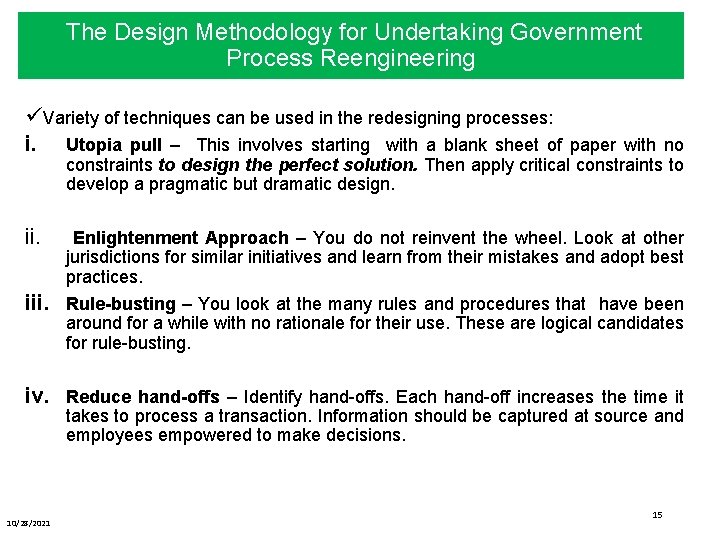
The Design Methodology for Undertaking Government Process Reengineering üVariety of techniques can be used in the redesigning processes: i. Utopia pull – This involves starting with a blank sheet of paper with no constraints to design the perfect solution. Then apply critical constraints to develop a pragmatic but dramatic design. ii. iii. Enlightenment Approach – You do not reinvent the wheel. Look at other jurisdictions for similar initiatives and learn from their mistakes and adopt best practices. Rule-busting – You look at the many rules and procedures that have been around for a while with no rationale for their use. These are logical candidates for rule-busting. iv. Reduce hand-offs – Identify hand-offs. Each hand-off increases the time it takes to process a transaction. Information should be captured at source and employees empowered to make decisions. 10/28/2021 15
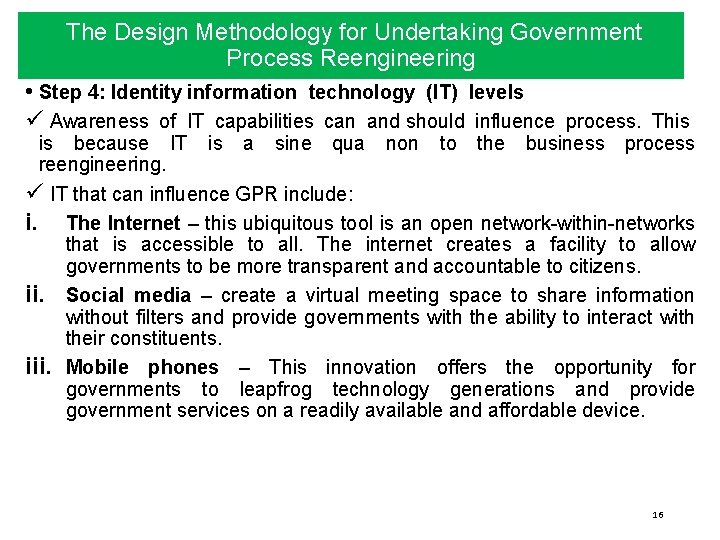
The Design Methodology for Undertaking Government Process Reengineering • Step 4: Identity information technology (IT) levels ü Awareness of IT capabilities can and should influence process. This is because IT is a sine qua non to the business process reengineering. ü IT that can influence GPR include: i. The Internet – this ubiquitous tool is an open network-within-networks that is accessible to all. The internet creates a facility to allow governments to be more transparent and accountable to citizens. ii. Social media – create a virtual meeting space to share information without filters and provide governments with the ability to interact with their constituents. iii. Mobile phones – This innovation offers the opportunity for governments to leapfrog technology generations and provide government services on a readily available and affordable device. 16
The Design Methodology for Undertaking Government Process Reengineering • Step 5: Design and Build a Prototype of New Process üPrototyping is the process of quickly creating a working model (a prototype) to test various aspects of a design, illustrate ideas or features, and gather early user feedback. Prototyping is often treated as an integral part of the system design process, because it is thought to reduce project risk and cost. ü Often, one or more prototypes are made in a process of incremental development where each prototype is influenced by the performance of previous designs. In this way, problems or deficiencies in design can be corrected. üWhen the prototype is sufficiently refined and meets the functionality, robustness, manufacturability and other design goals, the product is ready for production. üIn terms of a process reengineering effort, prototypes are employed to help process designers build an illustrative example of the process in question that is intuitive and easy to manipulate for project participants and the process owner. 17
The Design Methodology for Undertaking Government Process Reengineering • Step 6: Prepare for Change Management üChange management is probably the most difficult aspect of GPR. Getting people to shift from their comfort zone to an unfamiliar place requires discipline, dedication and above all else commitment from all levels of management. ü People need to know why change is necessary, what the benefits are and how they will be affected. üKey elements to any change process: a. Establish a Clear Vision – the destination must be clearly defined with a road map that charts the course to be taken. b. Develop a Compelling Reason – there has to be urgency in GPR initiatives with disastrous consequences for inaction. 18
The Design Methodology for Undertaking Government Process Reengineering • Step 6: Prepare for Change Management (Cont’d) c. Ensure Commitment from the Top – a strong coalition with influential leaders is required to set the right example and drive change within the organisation. d. Identify and aim at Quick wins – identify ‘low hanging fruit’ and deliver these successes quickly to build momentum, credibility and demonstrate tangible progress. e. Maintain Continuous Communication – constant communication with staff and key stakeholders (e. g. unions) is necessary to obtain buy-in and address concerns. f. Institutionalize the Change – to sustain change it must be inculcated into the entire organisation processes. 19
The most Common Challenges of Implementing Process Reengineering Projects in Government • Attitude: Not everyone accepts the changes posed by the BPR. Unnecessary work is eliminated. There is an on-going conflict between the need of modifying labor guidelines upheld for a long time and the lack of contribution from affected people. • Scope: the more relevant the change, the greater the potential of reaching significant benefits. Many of the innovative IT applications take place on superficial aspects of processes. They are easily accepted because the organizational structure remains intact. In general, the first applications of IT were focused on task automation. Deep changes generate more resistance, but also imply larger benefits. 20
The most Common Challenges of Implementing Process Reengineering Projects in Government • Extension: A business process includes many functional areas and the participation of its stakeholders. BPR projects must be coordinated at a level that is high enough to identify problems and opportunities on a large scale instead of suggesting partial improvements that solve part of the problem or some symptoms. This implies working with a large number of agencies, which increases the difficulties. Each agency has its own special features and objectives. Communication problems arise to break boundaries and generate workflows through several agencies, regulations, and legal limitations to which the government is subjected. 21
The most Common Challenges of Implementing Process Reengineering Projects in Government • Knowledge: the Public sector is not used to changing and taking advantage of IT. Then, internal areas that have experience to manage this kind of problems are not usual. Anyway, in the last years, new methodologies and approaches (for example New Public Management) have encouraged the development of specific offices to study these subjects without resorting to external consultants. 22
The most Common Challenges of Implementing Process Reengineering Projects in Government • Leadership: A top-down leadership, which manages motivated people doing non-standard tasks, is required for the BPR. This is difficult when carrying out changes in high administrative positions as a result of elections. BPR efforts can be rejected or abandoned by the new authorities. Even when being continued, BPR is likely to have a different leader, and consequently going forward becomes quite difficult because there may be changes in interests, available resources, etc. BPR implies changes extended in time and risks that must be led by the same person 23
The most Common Challenges of Implementing Process Reengineering Projects in Government • Objectives Definition: Many BPR/GPR projects fail because corporative goals are not taken into account. BPR/GPR involves many agencies with different interests and it is hard to arrive to consistent objectives that match all their needs. In this sense, highly fragmented processes and the change of authorities are very significant constraints. • In contrast to the private sector, it is very difficult to assess benefits such as customer satisfaction, growth, result improvements, etc. This situation makes it hard to show the BPR benefits and to justify the associated risks. 24
Issues to Consider in the Design of Government/Business Process Reengineering • Institutional restrictions: The institutional dimension has a very important role as an inhibitor of innovations. Redesigned processes are affected by restrictions that current legislation imposes. Government bases its behavior on standards that inhibit redesign. • Administrative processes are subject to financial, legal, etc. restrictions, that strengthen the adopted bureaucratic structure. Institutional constraints are usually more strict than those in the private sector, thus drastically limiting the possibility of redesign. 25
The most Common Challenges of Implementing Process Reengineering Projects in Government • Resources: Experience shows that BPR generally takes more time than what has been estimated, involves more people and resources than the available ones and always comes up with unexpected problems. There is a series of problems: annual budgets handling in projects with a larger duration, resources correct estimation, the need of sharing resources among several areas, shared management, etc. • Techno centrism: Likely, IT incorporation increases bureaucracy and generates dependence on a specific technology. Many organizations have spent a lot of money on IT to automate existing processes without determining if they were necessary or not. BPR includes IT with the aim of implementing innovative solutions but demanding, as well, changes in organizational level. The risk of not exploring solutions which implies organizational changes is high. 26
Critical Success Factors of PR in Public and Private Sector Organizations • Egalitarian leadership: this is a form of organizational leadership where top managers and team leaders look to the team for direction when faced with a project, decision, or plan that requires consensus. • Here, when employees are clear about the channel of communication and the shared value of the organization or team (as the case may be), they become more responsive and tends to understand each other better. 27
Critical Success Factors of PR in Public and Private Sector Organizations • Collaborative work environment: teamwork creates room for more effective and quicker service delivery as compared to projects that worked on an individual basis. When employees collaborate, they become more responsible, and their motivational level increases, especially when they work virtually. • However, this can only be achieved in a friendly work environment where there is a free flow of interacting cooperation and mutual trust, with their respective roles being recognized by top management. 28
Critical Success Factors of PR in Public and Private Sector Organizations • Top management commitment: when the board of directors formulates policies, it is expected that top management translates the same into goals and objectives, strategize on how to achieve the policy aim as well as project a shared vision of the future. • Decisions made by top management affect everyone within the organization, hence, it is held responsible when a failure occurs. In the words of Abdolvand et al (2008), "… it is necessary to have a piece of sufficient knowledge about the PR projects and realistic expectation of PR”. 29
Critical Success Factors of PR in Public and Private Sector Organizations • Supportive management: Unlike other forms of management and leadership, supportive management is less interested in just giving orders and/or managing every detail. Rather, it enables the employees to work themselves through the provision of necessary tools. One essential aspect of supportive management is the delegation of function. • Therefore, reengineering the process has to do with redesigning the human resource architecture and other facilities to promote information sharing, decision making, and the achievement of organizational objectives. 30
Critical Success Factors of PR in Public and Private Sector Organizations • Use of information technology: IT remains one of the biggest enablers and soul of PR. Through IT, manual systems are computerized, virtual markers are made possible and there is increased efficiency and effectiveness of the work process. 31
Critical Failure Factors of PR in Public and Private Sector Organizations • Resistance to change: resistance to change is the major failure factor that has been identified. The fear of middle management and employees losing their job, skepticisms about project results, feeling uncomfortable with a new working environment constitute some of the resistance to change that stands as a failure factor in PR, especially in APSOs. 32
The Nexus Between Government Process Reengineering and E-Governance • Government business process reengineering is the basis and prerequisite for the implementation of e-government, business process reengineering will largely influence the potential of egovernment information technology, and the effect of Egovernment in the reform of government management mode. • The e-government and government business process reengineering are interactive, complementary and mutually reinforcing. 33
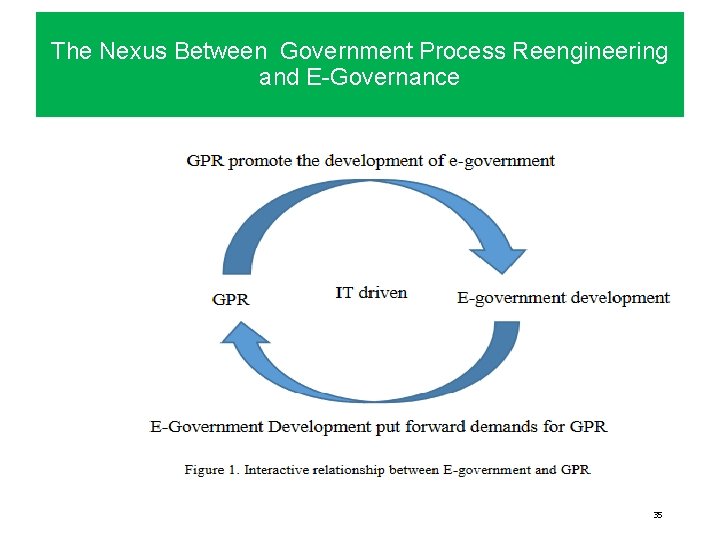
The Nexus Between Government Process Reengineering and E-Governance • Government process reengineering looks at the self-transformation and innovation of the government to adapt to and the use of modern information technology to improve government efficiency, and is the basis for the implementation of e-government. • While, E-government developed continuously with the government management system innovation and technological innovation, the optimization of the government process cannot occur once and for all, but through a deepening, ever-changing, constantly reengineering process. The relationship between e-government development and government process reengineering is shown in Figure 1. 34
The Nexus Between Government Process Reengineering and E-Governance 35
The Nexus Between Government Process Reengineering and E-Governance • In summary, development of e-government and government process reengineering is complement each other, government process reengineering requires to accelerate the construction of egovernment system, and the effective use of information technology and information resources also requires government process reengineering. • From the perspective of government informatization, the government process reengineering is the organizational guarantee of e-government. 36
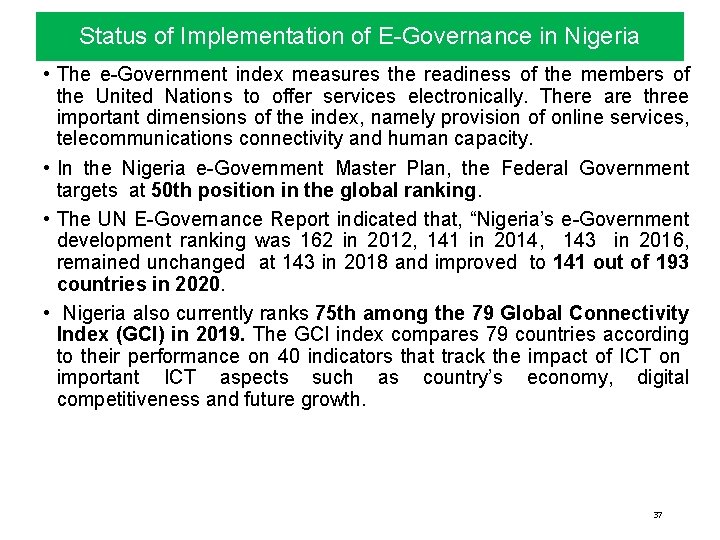
Status of Implementation of E-Governance in Nigeria • The e-Government index measures the readiness of the members of the United Nations to offer services electronically. There are three important dimensions of the index, namely provision of online services, telecommunications connectivity and human capacity. • In the Nigeria e-Government Master Plan, the Federal Government targets at 50 th position in the global ranking. • The UN E-Governance Report indicated that, “Nigeria’s e-Government development ranking was 162 in 2012, 141 in 2014, 143 in 2016, remained unchanged at 143 in 2018 and improved to 141 out of 193 countries in 2020. • Nigeria also currently ranks 75 th among the 79 Global Connectivity Index (GCI) in 2019. The GCI index compares 79 countries according to their performance on 40 indicators that track the impact of ICT on important ICT aspects such as country’s economy, digital competitiveness and future growth. 37
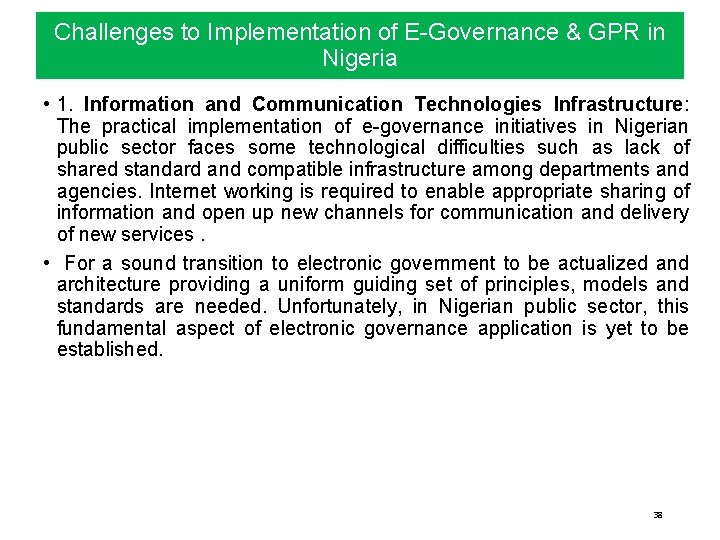
Challenges to Implementation of E-Governance & GPR in Nigeria • 1. Information and Communication Technologies Infrastructure: The practical implementation of e-governance initiatives in Nigerian public sector faces some technological difficulties such as lack of shared standard and compatible infrastructure among departments and agencies. Internet working is required to enable appropriate sharing of information and open up new channels for communication and delivery of new services. • For a sound transition to electronic government to be actualized and architecture providing a uniform guiding set of principles, models and standards are needed. Unfortunately, in Nigerian public sector, this fundamental aspect of electronic governance application is yet to be established. 38
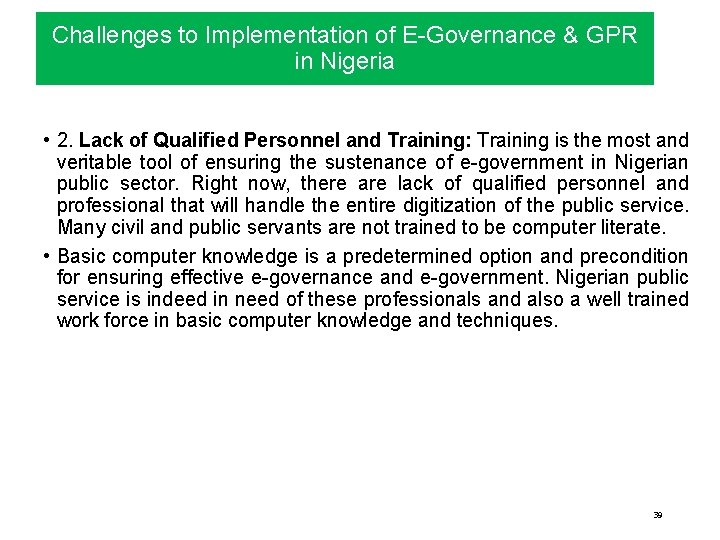
Challenges to Implementation of E-Governance & GPR in Nigeria • 2. Lack of Qualified Personnel and Training: Training is the most and veritable tool of ensuring the sustenance of e-government in Nigerian public sector. Right now, there are lack of qualified personnel and professional that will handle the entire digitization of the public service. Many civil and public servants are not trained to be computer literate. • Basic computer knowledge is a predetermined option and precondition for ensuring effective e-governance and e-government. Nigerian public service is indeed in need of these professionals and also a well trained work force in basic computer knowledge and techniques. 39
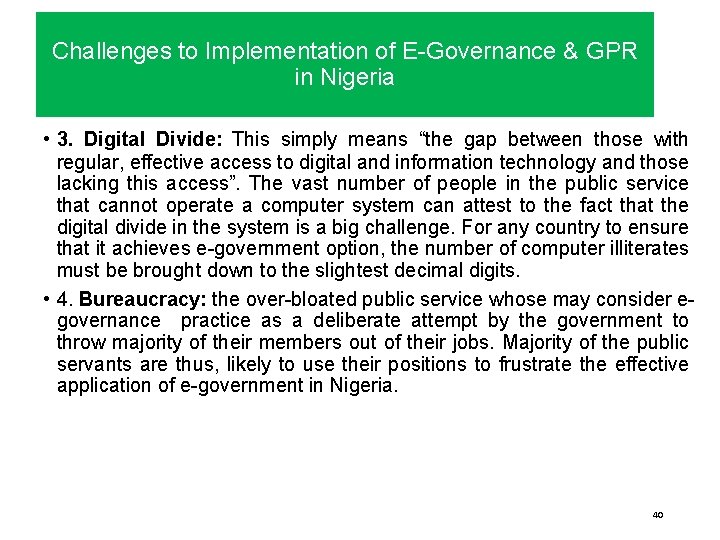
Challenges to Implementation of E-Governance & GPR in Nigeria • 3. Digital Divide: This simply means “the gap between those with regular, effective access to digital and information technology and those lacking this access”. The vast number of people in the public service that cannot operate a computer system can attest to the fact that the digital divide in the system is a big challenge. For any country to ensure that it achieves e-government option, the number of computer illiterates must be brought down to the slightest decimal digits. • 4. Bureaucracy: the over-bloated public service whose may consider egovernance practice as a deliberate attempt by the government to throw majority of their members out of their jobs. Majority of the public servants are thus, likely to use their positions to frustrate the effective application of e-government in Nigeria. 40
Challenges to Implementation of E-Governance & GPR in Nigeria • 5. Attitude or Resistance to Change: This is also a challenge in the public sector. Most of them are still used to the old way of carrying out government activities. That is, they are still known to be working with many papers, carrying of files from one desk to the other or from one office to the other. • Their resistance to e-governance implementation in their services is what has culminated to the poor rating of the implementation of egovernance in the public service. Some of the reasons for this, is that most of the public servants are not computer literate, not qualified, have little or no training in the installation, maintenance, designing and implementation of ICT infrastructure 41
Challenges to Implementation of E-Governance & GPR in Nigeria • 6. Lack of harmonised e-Government Interoperability Framework: The MDAs still face mountainous challenges because they operate in silos rather than having a coordinating body that would ensure that the implementation among them is interconnected, as it is being done in developed climes. The idea of harmonisation, according is to offer a seamless e-Government operation within the entire governance process, knowing that Information Technology, IT projects cannot be executed in silos. 42
Way Forward to Implementation of GPR& Governance in Nigeria E- • 1. The government should have the political will to embrace and implement GPR& e-government in Government Ministries, Departments and Agencies • 2. The government should conduct the training required to ensure that public servants adopt GPR & e-government in their daily activities. • Government Ministries, Departments and Agencies, should constitute Egovernment implementation committees saddled with the responsibility of working out modalities for effective implementation of the concept with feedback mechanism to ascertain implementation effectiveness. 43
Way Forward to Implementation of GPR& -Governance in Nigeria E • 4. The ICT Ministry should collaborate with the implementation committees at different ministries/agencies including state ministries/agencies for performance evaluation as well as feedback generation to ensure effective egovernment implementation. • 5. The government should formulate ICT policies that will make computer literacy a condition for employment and promotion of public or civil servant both at the local, state and federal levels. • 6. The National Orientation Agency should create GPR, E-Governance and ICT awareness among public servants. With the above achieved, the challenges will be reduced to the barest minimum. 44
Way Forward to Implementation of GPR& Governance in Nigeria E- • 7. The government must ensure the availability of the necessary infrastructure that will facilitate the successful implementation of GPR & e-government in Nigeria’s public service. For instance, robust broadband services, required internet network and the availability of power supply. • 8. The government should carefully address the issue of human factor which often manifests in resistance to change, nonchalant attitudes and the likes which are responsible for underutilization of most of the ICT facilities put in place by government especially in offices or departments that tend to embrace e-government in their operations, thereby sabotaging the good effort of the government. 45
Way Forward to Implementation of E-Governance, in Nigeria • 8. The government should come up with a regulatory policy, in particular, on the framework through legislation of e-government and other ICT-related issues as it pertains to the operations strategies among the tiers of government. • 9. The National Information Technology Development Agency, NITDA and other stakeholders should strategies on how to harmonize the e. Government Interoperability Framework. The idea of harmonisation, will offer a seamless e-Government operation within the entire governance process, knowing that Information Technology, IT projects cannot be executed in silos. 46
References • Martin, R. L. , Montagna, J. M. , 2006, in TFTP Tntemational Federation for Information Processing, Voluine 214, Tiie Past and Future of Tnfonnation Systems: 1976 -2006 and Beyond, eds. Avison, D. , Elliot, S. , Krogstie, J. , Pries-Heje, J. , (Bos-ton; Springer), pp. 77 -88 • Wikipedia: Business Process Reengineering. • The United States Government Accountability Office (GAO): Business Process Reengineering Introduction. • Nwodo A. E (2012): Reengineering Nigeria Public Sector Organizations For Efficiency (A Dissertation Submitted In Partial Fulfillment Of The Requirement For The Award Of Master Of Business Administration (MBA) Degree In Management) 47
References • Macrothink Institute (2020)- Process Reengineering in African Public Sector: Lessons From the Private Sector (Journal of Public Administration and Governance 2020, Vol. 10, No. 3) • Adeyemo A. B (2011): E-government implementation in Nigeria: An assessment of Nigeria's global e-gov ranking • Zhigang Li a, Fengyue Yang a (2016): The e-government information model based on Government Process Reengineering. 48