
Managing Fatigue Training Program for Employees Managing Fatigue




- Slides: 20
Managing Fatigue Training Program for Employees
Managing Fatigue For the Employee § What is Fatigue § Signs of fatigue § What causes fatigue § Fatigue mitigation strategies § Utility Policy
What is Fatigue § “A reduction in physical and/or mental capability as the result of physical, mental or emotional exertion which may impair nearly all physical abilities including: strength; speed; reaction time; coordination; decision making; or balance. ” § Source: International Maritime Organization, Maritime Safety Committee Circular
Signs of Fatigue
Signs of Fatigue § Constant yawning § Blurred vision § Heavy or sore eyes § Poor concentration § Slowed reaction time § Poor judgment § Speech slurred § Headaches § Decreased ability to exert force §Leg pain and cramps §Loss of appetite §Giddiness §Decreased ability to pay attention §Irregular heart beats §Heaviness in arms and legs §Decreased eye-hand coordination
What Causes Fatigue § Lack of Sleep § Quality of Sleep § Biological Clock (circadian rhythm) factors § Shift work § Extended Hours § Health (diet and/or illness) § Ingested chemicals (alcohol, drugs, caffeine)
Lack of Sleep (an off duty issue) § Individuals’ needs are unique § Recommended 7 – 8 hours of sleep per 24 hour period § 5 stages of Sleep § Stage 1 – Light Sleep - less than 10% § Stages 2 -4 – Deep Sleep - approximately 65% § Stage 5 - REM Sleep – Rapid Eye Movement Sleep – approximately 25% § Each cycle takes about 90 minutes = 5 -1/2 cycles per 8 hour night § Need all five stages for the body’s recovery from daily fatigue
Quality of Sleep (an off duty issue) § Sleep should be Uninterrupted § Try for long periods of sleep § Short naps will not restore the body to normal operation. § One seven hour period of sleep is much more restorative than seven one hour naps § Try for sufficient sleep before any periods you anticipate a sleep deficiency
Biological Clock § Most animals (including Humans) follow a daily routine (song birds in the morning, nocturnal animals, etc. ) § Called Circadian Rhythm § Time related information controlled within the hypothalamus region of the brain § Melatonin hormone. § Increase in Melatonin – Decrease in alertness
Biological Clock § Human Circadian Rhythm is actually on a 25 hour clock. § Did you ever notice it’s easier to stay up late than it is to get up early? § Jet Lag is a symptom of the body trying to reset the biological clock to a new time zone. § It is easier to “reset” when flying east to west (You get to sleep-in in the morning) than when flying west to east (You have to get up earlier than your internal clock expects). § The internal clock can only adjust by an hour or two each day. § This is helped by environmental cues (such as darkness)
Biological Clock Humans exhibit two “Troughs” or low points in alertness § One between midnight and 6 am § One between 2 and 4 pm § Fatigue related motor vehicle accidents are: § Twice as high at 2 pm as they are at 10 am § Six times as high at 2 am as they are at 10 am
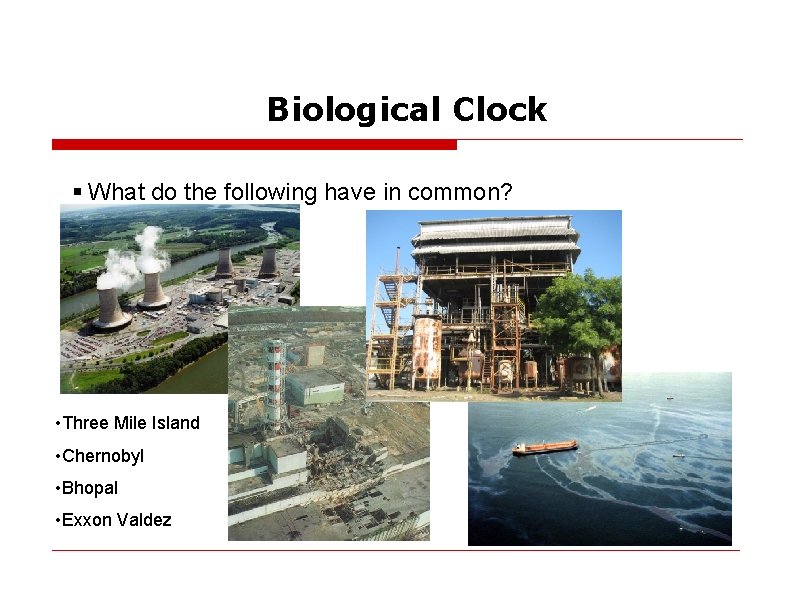
Biological Clock § What do the following have in common? • Three Mile Island • Chernobyl • Bhopal • Exxon Valdez
The Midnight Shift § 1979 - Three Mile Island – 4 am local time - Pressure relief valve opens dumping reactor coolant – control room operators failed to recognize the event. Core meltdown § 1984 – Bhopal, India – shortly after midnight Methyl Isocyantate Gas (MIC) leak kills 3, 800 § 1986 - Chernobyl Reactor disaster – 12: 23 am – 1: 28 am local time - critical control room operator error in failing to reset a controller. Core meltdown and release § 1989 – Exxon Valdez – 12: 04 am ship hits Bligh Reef and spills 10. 8 Million gallons of oil
Extended Hours § Normal work day and week = 8 hours per day and 5 days per week § Anything greater is Extended hours § OSHA recommendations: § Limit use of extended hours § Take additional breaks § Tasks that require heavy physical labor should be performed at the beginning of the shift § Monitor for the signs and symptoms of fatigue
Extended Hours § A study by sleep researchers in Australia found that: § A person kept awake for 17 hours will exhibit behaviors and performance of someone with a Blood Alcohol Concentration (BAC) of 0. 05 § A person kept awake for 24 hours will exhibit behaviors and performance of someone with a BAC of 0. 10
Health Issues (an off-duty issue) § Fatigue can be associated with: § Medical Conditions (such as heart problems) and § Illness (common cold or fever) § Diet can affect feelings of fatigue § Refined sugars can cause a short term energy boost but are often followed by a rapid drop in blood sugar levels causing weakness and instability § Eating a large meal before bedtime can disrupt sleep § Psychological Issues of stress or family worries can disrupt sleep § There are Sleep Disorders such as insomnia or sleep apnea (waking up suddenly due to interrupted breathing)
Ingesting Chemicals (an off duty issue) § Medications can cause drowsiness § Caffeine - short duration alertness but § side affects § hypertension, headaches, mood swings and anxiety § Alcohol is a depressant § however, the important REM sleep is disrupted preventing body recovery.
Fatigue Mitigation Strategies § Develop a pre-sleep routine (warm shower, reading a book) § Sleep in a dark, quiet, cool environment § Avoid alcohol prior to sleep § Avoid caffeine at least six hours prior to sleep § Eat regular, well balanced meals § Drink a sufficient amount of water § Exercise regularly § Get enough proper sleep
Utility Policy § Insert utility policies
References § “Driver fatigue - an accident waiting to happen”, by academy staff of the Australian Academy of Science, June 2006 § “Guidance on Fatigue Mitigation and Management”, MSC (Marine Safety Committee) Circular 1014, International Maritime Organization, June 12, 2001 § “Extended/Unusual Work Shifts”, Occupational Safety and Health Administration (OSHA), September, 2, 2004 § “Sleepless in Seattle: injured worker’s case shows hazards of fatigue”, Shoop, Julie Gannon, Publication: “Trial”, Dec. 1, 1993 § “Personal & Financial Health” Scott, Diane E. , RN MSN, Vermont Nurse Connection, Feb. 1, 2008 § “Circadian Rhythms and Shift Work” American College of Emergency Physicians, September 2003