
Managing Effective Program Operations The Early Learning Leadership



- Slides: 46
Managing Effective Program Operations The Early Learning Leadership Institute
Welcome, Session & Group Introductions 2
Learning Objectives 3
LEARNING OBJECTIVES • Understand that classroom planning, record keeping, and reporting rely on the use of wellconstructed systems • Understand that listening and feedback are important communication tools • Understand the role of a coach • Know how to write a staff development plan • Know how to use systems, policies, and procedures effectively • Understand that systems only work when communicated and used • Improve staff interaction • Know the importance of staffing meetings and how to conduct them • Identify that teacher training necessitates planning and research 4
Communication 5
COMMUNICATION The use of systems, policies, and procedures helps accomplish effective communication through: • Classroom management, planning, record keeping, and reporting • Leadership and coaching utilizing individualized staff development plans as an important component • Well-planned staff meetings held on a regular basis and designed to generate constructive employee interaction • Teacher training as a part of staff development necessitating planning and budget considerations 6
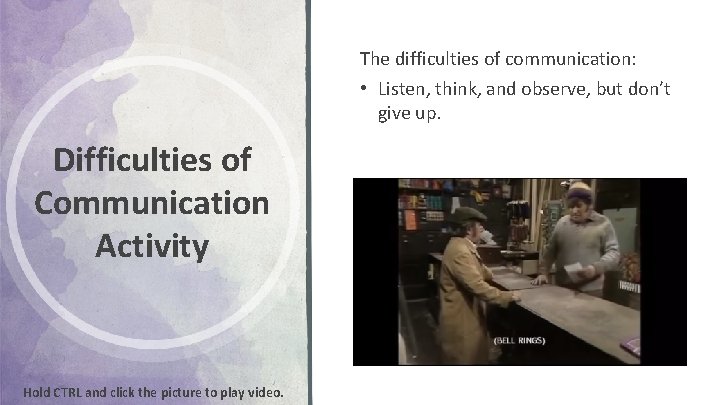
The difficulties of communication: • Listen, think, and observe, but don’t give up. Difficulties of Communication Activity Hold CTRL and click the picture to play video.
Difficulties of Communication Reflection • Why didn’t the clerk understand the requests? • Why was the clerk frustrated with the customer? • How do you feel when you are asked to do something, and you don’t understand the directions? • How can you help employees understand what you want from them?
How to Communicate Effectively How do you communicate effectively with employees?
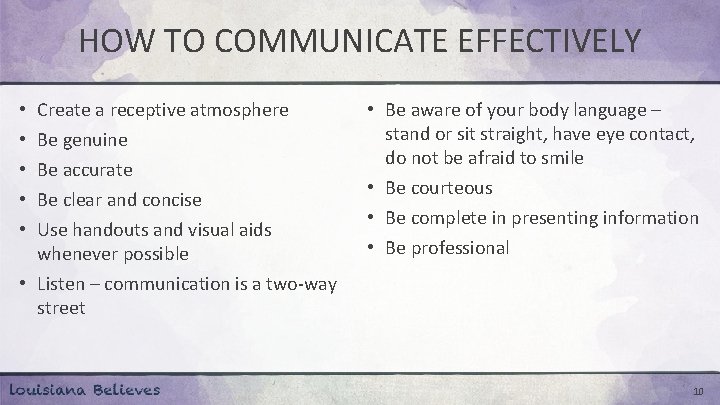
HOW TO COMMUNICATE EFFECTIVELY • • • Create a receptive atmosphere Be genuine Be accurate Be clear and concise Use handouts and visual aids whenever possible • Listen – communication is a two-way street • Be aware of your body language – stand or sit straight, have eye contact, do not be afraid to smile • Be courteous • Be complete in presenting information • Be professional 10
Listening and Feedback Hold CTRL and click the picture to play video. • Is there a difference between hearing and listening? • Do you listen to hear, or do you listen to understand? • Do you listen to understand, or do you listen with the intent to reply?
Coaching 12
Coaching • What is your definition of a coach? • What are the qualities of a coach?
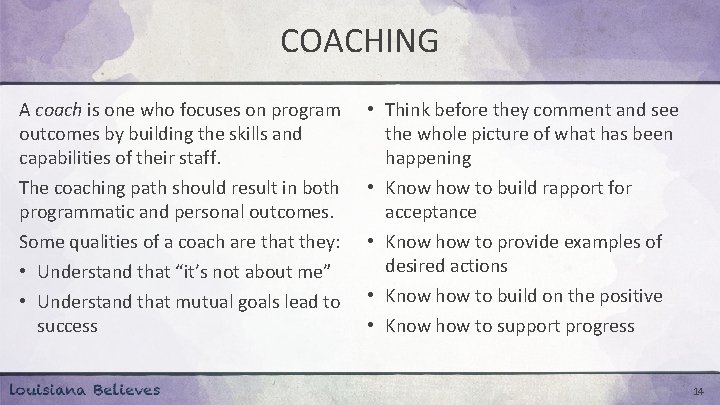
COACHING A coach is one who focuses on program outcomes by building the skills and capabilities of their staff. The coaching path should result in both programmatic and personal outcomes. Some qualities of a coach are that they: • Understand that “it’s not about me” • Understand that mutual goals lead to success • Think before they comment and see the whole picture of what has been happening • Know how to build rapport for acceptance • Know how to provide examples of desired actions • Know how to build on the positive • Know how to support progress 14
Staff Development Planning 15
STAFF DEVELOPMENT PLANNING Staff development plans guide both leadership and staff toward improvement and toward a high-quality early learning program. Each staff member should have an individualized staff development plan. The goal of an individualized staff development plan is to have teachers understand their own needs to grow and develop in their job • How many of you have a staff development plan for each employee? • How do you or would you implement a staff development plan for each employee? • When should an individualized staff development plan be created? 16
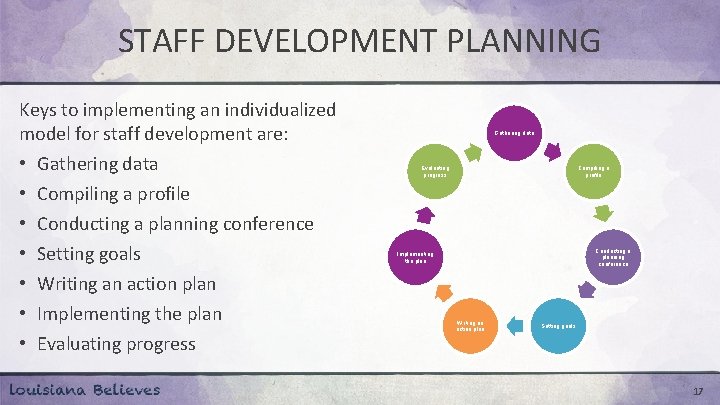
STAFF DEVELOPMENT PLANNING Keys to implementing an individualized model for staff development are: • Gathering data • Compiling a profile • Conducting a planning conference • Setting goals • Writing an action plan • Implementing the plan • Evaluating progress Gathering data Evaluating progress Compiling a profile Conducting a planning conference Implementing the plan Writing an action plan Setting goals 17
Systems, Policies, and Procedures 18
Systems, Policies, and Procedures • Why are planning, record-keeping, and reporting important to the classroom? • What are systems? • What are policies? • What are procedures?
Systems A system is an organized collection of parts related to a whole. So, there are subsystems that assist us in reaching the goals of the whole. • Can you give any examples of systems and subsystems?
SYSTEMS AND SUB-SYSTEMS A successful restaurant has to have systems in place. The example given here demonstrates that everyone has a role. For example: • A person greets you when you walk in the door and takes you to a table and gives you a menu • Then someone comes and asks if you would like something to drink • Then someone comes and takes your order • To be able to serve what you have ordered, there has been behind the scenes work – a cook prepared your food, someone ordered the food into the restaurant, a food vendor had a delivery person, etc. 21
SYSTEMS FOR AN EARLY LEARNING CENTER One system that an early learning center must have is how to schedule staff and when they should arrive at the center. For example: • There is the person who opens the center • There is a second person who comes in when the first child arrives • There is a schedule worked out for the arrival of additional teachers • There is a schedule for when staff leave for the day in an organized manner related to the number of children present and their ages 22
POLICIES Policies are written statements of the organization’s principles and guidelines. • They allow management a way to communicate job expectations to employees • In early learning, policies relate to the organization’s principles, and procedures are used to manage workflow • Procedures flow from policies • For example: “It is the policy of this organization that cell phones may not be used in the classroom. ” 23
PROCEDURES Procedures are designed to help one carry out the policies of the organization. • They state specifically how a task will be done • For example: “In order to accomplish the cell phone policy of the organization, cell phones must be left in their cars or checked into the director’s office before work is begun. ” 24
CLASSROOM SYSTEMS Classroom systems are part of the many systems needed to make the center run smoothly and provide accountability. • For example: Morning attendance, daily playground checks, lunch and meal service, closing checklists, fire drill 25
PROCEDURES AND GOALS Procedures cannot be developed if you do not know the “end goal” for each classroom. • What is the curriculum you use? • How much planning is needed to implement the curriculum? • How much time is allocated for the planning? • What are the end curriculum expectations? • What are parent expectations? • What are your program’s expectations? 26
POLICICES AND PROCEDURES FOR STAFF AND PARENTS • • Parent registration forms Parent handbook Field trip forms Late pick up Sick children Discipline and biting Medications Conferences • Immunization and records • Hours of operation and ages of children served • Toilet training • Excessively hot or cold weather • Weather emergencies • Accidents 27
COVID-19 IMPLICATIONS • Do you need new policies concerning payment/refunds when the center is closed due to health reasons? • Did you create and implement new systems regarding parents entering the building? • Did you create and implement new systems regarding children, staff, or parents wearing masks? • Did you find a way to continue pre-school via Zoom, or other methods? If you did, what are the tuition implications? • Did you create any new systems, policies, or procedures regarding lesson plans because of COVID-19 and using Zoom? 28
System Communication 29
Communicate with Thought and Intention Hold CTRL and click the picture to play video.
Communicate with Thought and Intention Reflection • How do you help employees understand what you want from them? • How do you support employees in asking for what they need? • Was there a system in place that the animals could have used or benefitted from? • Was the rabbit’s initial communication to the deer and coyote clear and precise and well-planned? • If they worked as a group, could there have been different outcomes for the deer and the coyote?
SYSTEM COMMUNICATION Communication and implementing systems, policies, and procedures with staff requires: • Demonstration – show the steps in a process, let someone do it while you watch and provide scaffolding if needed • Written information – memos, email, policy manuals, social media, etc. • Supervision – check on the process regularly, check more frequently at the beginning, ask for questions, acknowledge progress • Documentation – keep a log, note on calendar, review at staff meeting, and keep minutes 32
System Communication What are the best ways to establish and support planning, record keeping, and reporting center-wide?
SYSTEM COMMUNICATION When communicating and monitoring classroom activities and procedures there are questions to be addressed. • Will plans be reviewed? If so, by whom and when? • What constitutes adequate planning? • Are adequate materials and supplies available? • What records should be kept and where? • Ex. : attendance, meals, daily records, accidents and incidences, fire drills, medication, lesson plans, etc. 34
The Effects of Leadership and Environment 35
LEADERSHIP, ENVIRONMENT, AND STAFF INTERACTION • Leadership and a respectful and supportive environment help create teamwork and involve various types of communication and positive social interactions with staff and between staff • Disengaged employees are lost opportunity • Just a smile can stimulate the brain and release endorphins that make us feel good 36
TEACHER WORKING CONDITIONS/ENVIRONMENT • Is the working environment of preschool teachers a paradox? • Are preschool teachers isolate or do they work in an autonomous setting? • Do preschool teachers need support and encouragement on a daily basis? If so, from where does this come? If not, why not? • Are there negatives in a teacher’s working environment? If so, what are they? • How do positive or negatives in the working environment impact staff, children, and the early learning program? • What is administration/management’s role in creating a positive working environment? 37
TEACHER WORKING ENVIRONMENT Suggestions on how to improve the teaching environment: • • Be available Keep staff informed Follow through on your promised actions in a timely manner Have ongoing professional development Develop activities that staff can do together Develop teams regarding curriculum and preparation – collaborate Understand the teacher’s need to have time with adults Use staff meetings effectively 38
STAFF MEETINGS Staff meeting should be well-run and well-planned and held on a regular basis: • Avoid impulsive staff meetings where the matter could be addressed later • Avoid creating the atmosphere that the meeting is to tell employees what they did wrong and are not constructive – you do not want a “what’s wrong now” attitude • Use meetings for staff development • Allow social time before or after the meeting – build camaraderie 39
STAFF MEETINGS Staff meeting should: • • • Have an agenda Have time limits for topics Stay on topic Have a setting that supports interaction Have a setting that removes distractions Come to resolution with the leader summarizing the meeting and ending with a plan and clear steps to take forward 40
Teacher Training 41
TEACHER TRAINING AND STAFF DEVELOPMENT Teacher training is an essential part of staff development and early learning program improvement. This training cannot be done in a helter-skelter manner. Training needs to be individualized and planned ahead of time. The following needs to be taken into consideration as well: • State licensing requirements for staff • Availability of quality low-cost training opportunities • Advanced planning in the budget for conferences and trainings • Staff input about topics that interest them 42
Session Review 43
REVIEW LEARNING OBJECTIVES • Understand that classroom planning, record keeping, and reporting rely on the use of wellconstructed systems • Understand that listening and feedback are important communication tools • Understand the role of a coach • Know how to write a staff development plan • Know how to use systems, policies, and procedures effectively • Understand that systems only work when communicated and used • Improve staff interaction • Know the importance of staffing meetings and how to conduct them • Identify that teacher training necessitates planning and research 44
Reflections, Questions, & Comments
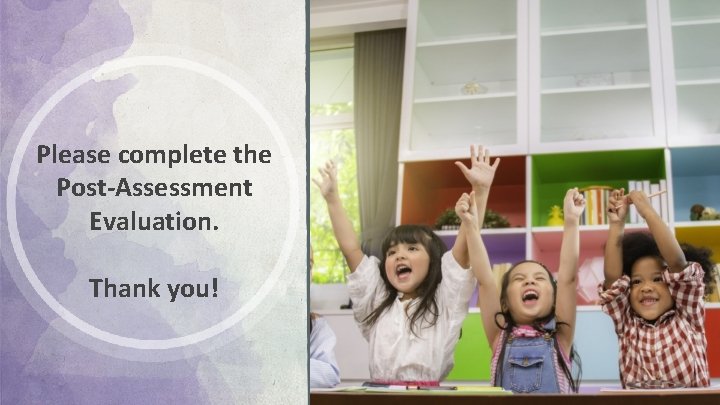
Please complete the Post-Assessment Evaluation. Thank you! 46