
Managing dynamic concurrent tasks in realtime multimedia systems
- Slides: 24
Managing dynamic concurrent tasks in real-time multi-media systems Francky Catthoor, IMEC, Belgium ARRM’ 01, Oct. 17 © imec 2001
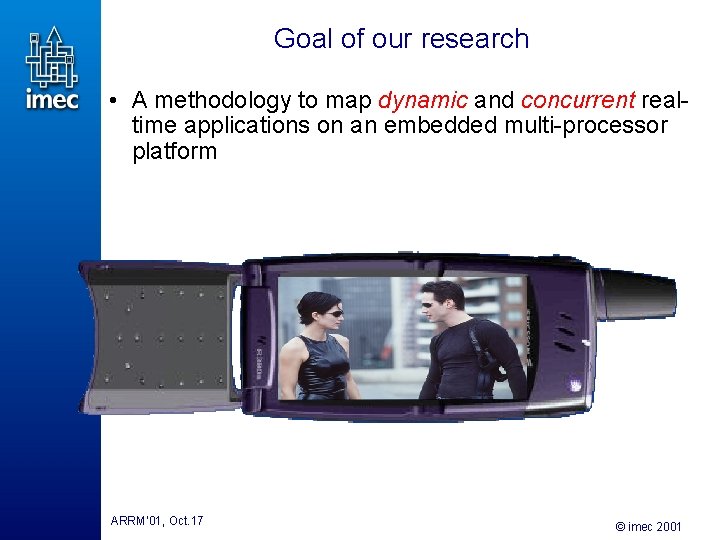
Goal of our research • A methodology to map dynamic and concurrent realtime applications on an embedded multi-processor platform ARRM’ 01, Oct. 17 © imec 2001
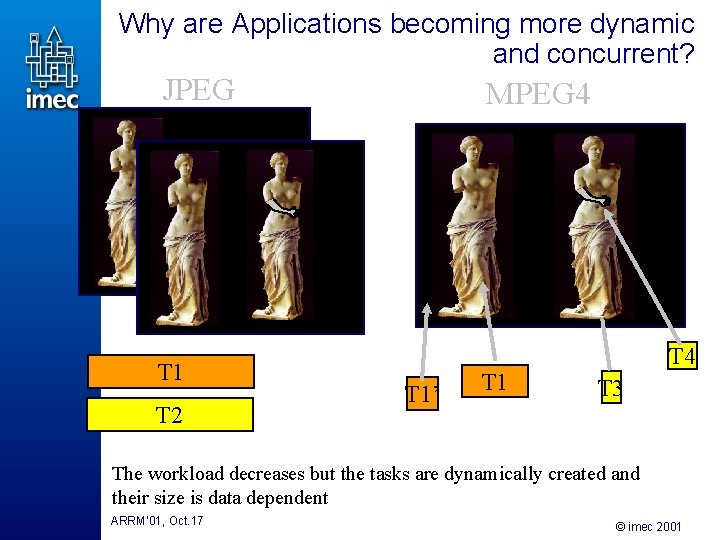
Why are Applications becoming more dynamic and concurrent? JPEG T 1 T 2 MPEG 4 T 1’ T 1 T 4 T 3 The workload decreases but the tasks are dynamically created and their size is data dependent ARRM’ 01, Oct. 17 © imec 2001
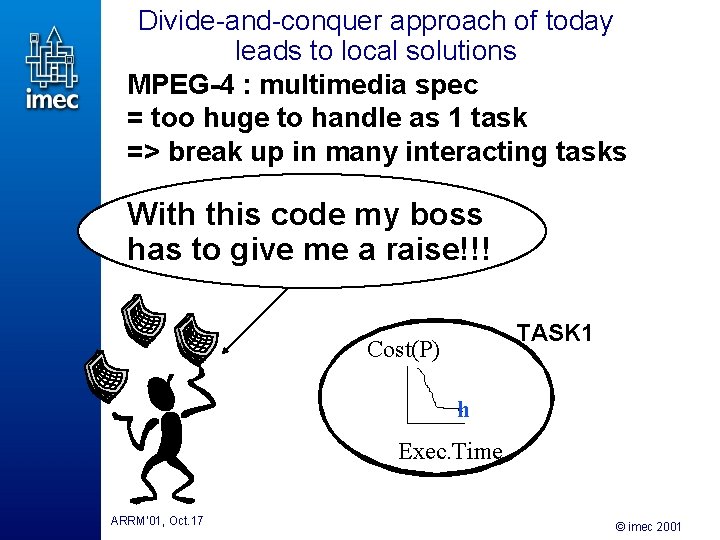
Divide-and-conquer approach of today leads to local solutions MPEG-4 : multimedia spec = too huge to handle as 1 task => break up in many interacting tasks With this code my boss has to give me a raise!!! TASK 1 Cost(P) h Exec. Time ARRM’ 01, Oct. 17 © imec 2001
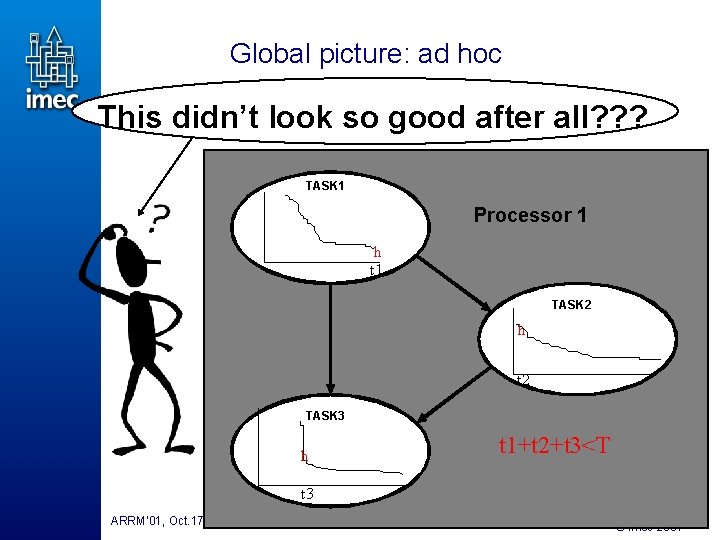
Global picture: ad hoc This didn’t look so good after all? ? ? TASK 1 Processor 1 h t 1 TASK 2 h t 2 TASK 3 h t 1+t 2+t 3<T t 3 ARRM’ 01, Oct. 17 © imec 2001
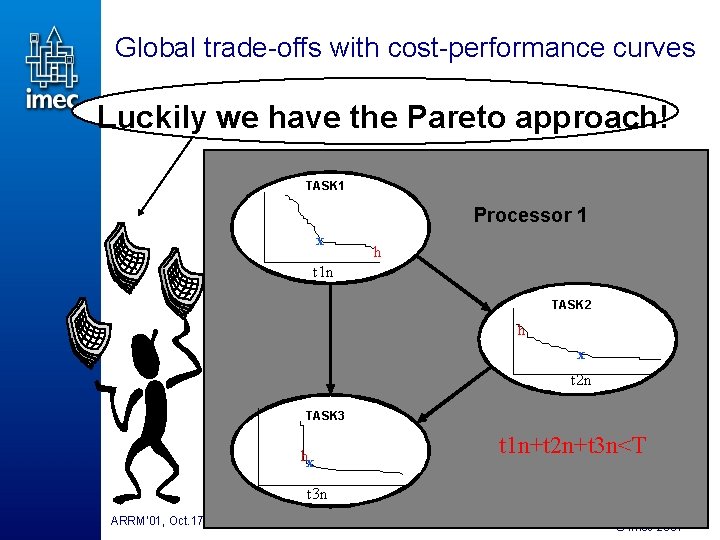
Global trade-offs with cost-performance curves Luckily we have the Pareto approach! TASK 1 Processor 1 x h t 1 n TASK 2 h x t 2 n TASK 3 hx t 1 n+t 2 n+t 3 n<T t 3 n ARRM’ 01, Oct. 17 © imec 2001
Outline • Motivation: new challenges in system-level design • Overview of TCM methodology • Cost-efficient design-time scheduling ARRM’ 01, Oct. 17 © imec 2001
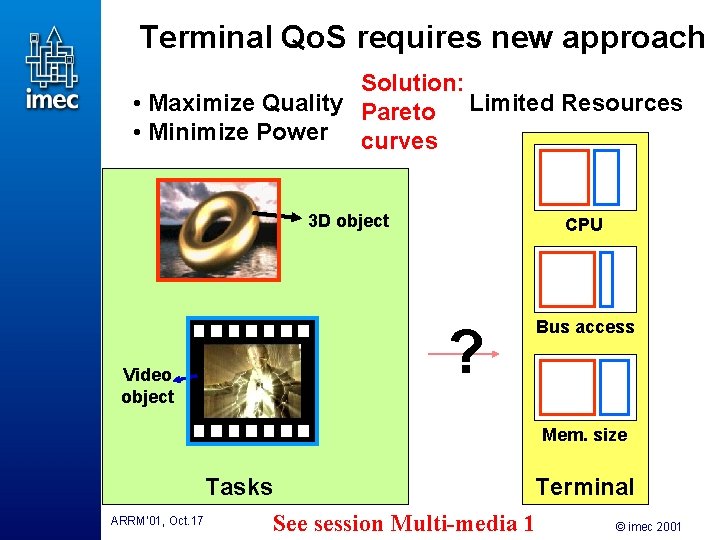
Terminal Qo. S requires new approach Solution: • Maximize Quality Pareto Limited Resources • Minimize Power curves 3 D object Video object CPU ? Bus access Mem. size Tasks Terminal ARRM’ 01, Oct. 17 See session Multi-media 1 © imec 2001
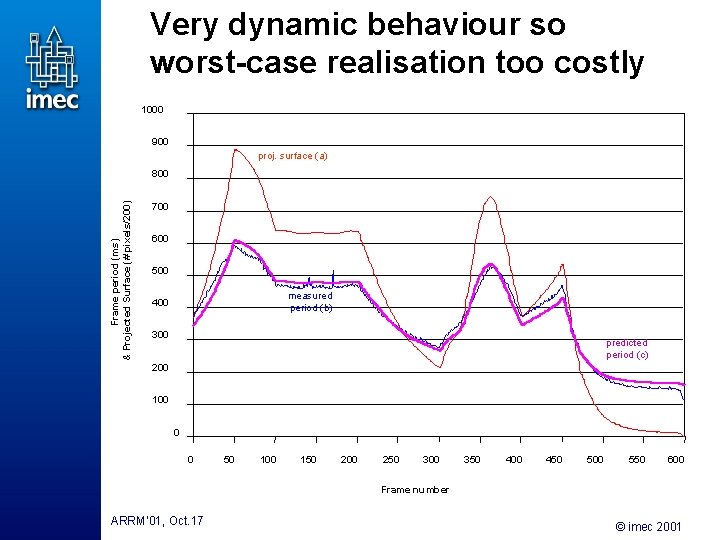
Very dynamic behaviour so worst-case realisation too costly 1000 900 proj. surface (a) Frame period (ms) & Projected Surface (# pixels/200) 800 700 600 500 measured period (b) 400 300 predicted period (c) 200 100 0 0 50 100 150 200 250 300 350 400 450 500 550 600 Frame number ARRM’ 01, Oct. 17 © imec 2001
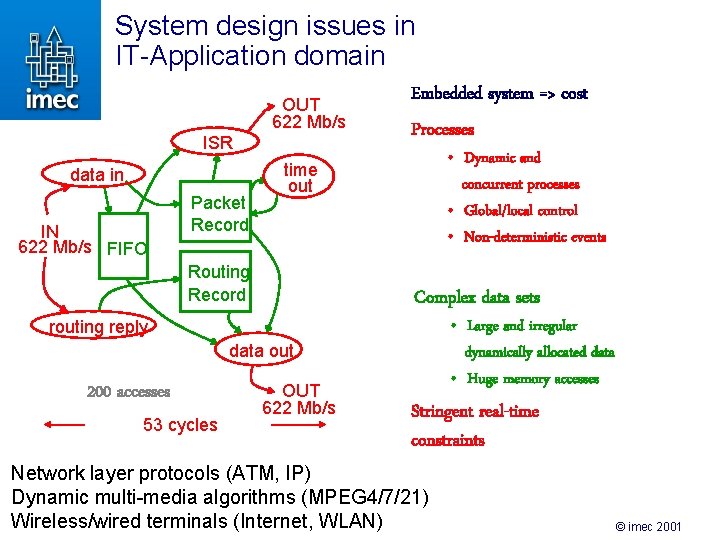
System design issues in IT-Application domain OUT 622 Mb/s ISR data in IN 622 Mb/s FIFO Packet Record Embedded system => cost Processes • Dynamic and concurrent processes • Global/local control • Non-deterministic events time out Routing Record Complex data sets routing reply • Large and irregular dynamically allocated data • Huge memory accesses data out 200 accesses 53 cycles OUT 622 Mb/s Stringent real-time constraints Network layer protocols (ATM, IP) Dynamic multi-media algorithms (MPEG 4/7/21) ARRM’ 01, Oct. 17 Wireless/wired terminals (Internet, WLAN) © imec 2001
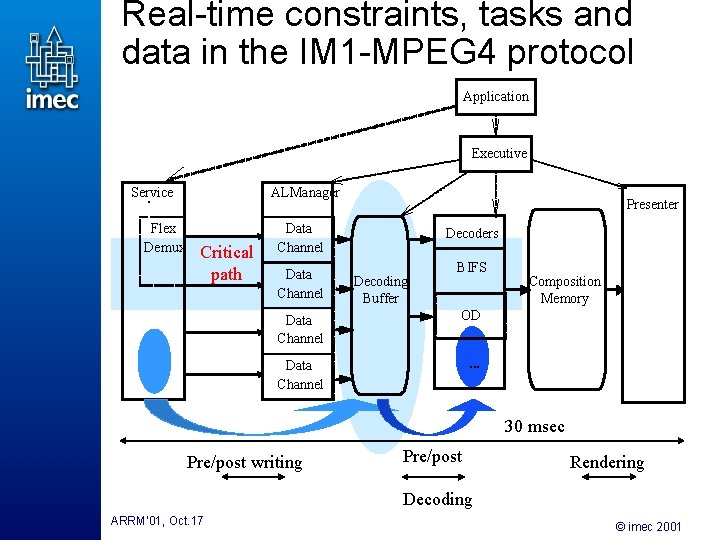
Real-time constraints, tasks and data in the IM 1 -MPEG 4 protocol Application Executive Service Flex Demux ALManager Critical path Presenter Data Channel Decoders Decoding Buffer BIFS Data Channel OD Data Channel . . . Composition Memory 30 msec Pre/post writing Pre/post Rendering Decoding ARRM’ 01, Oct. 17 © imec 2001
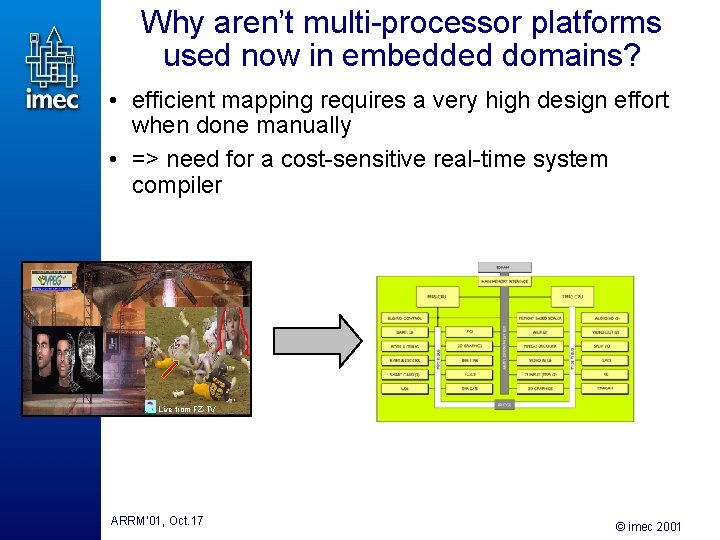
Why aren’t multi-processor platforms used now in embedded domains? • efficient mapping requires a very high design effort when done manually • => need for a cost-sensitive real-time system compiler Live from FZ-TV ARRM’ 01, Oct. 17 © imec 2001
Outline • Motivation: new challenges in system-level design • Overview of TCM methodology • Cost-efficient design-time scheduling ARRM’ 01, Oct. 17 © imec 2001
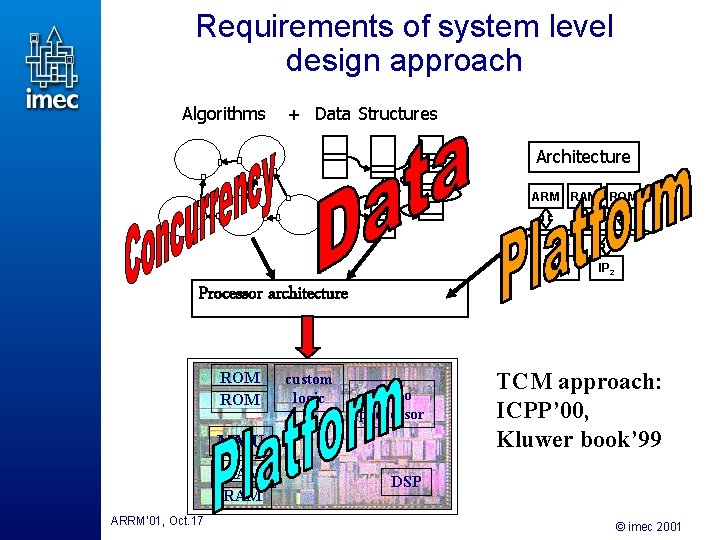
Requirements of system level design approach Algorithms + Data Structures Architecture ARM RAM ROM IP 1 IP 2 Processor architecture ROM custom logic micro processor MMU RAM ARRM’ 01, Oct. 17 TCM approach: ICPP’ 00, Kluwer book’ 99 DSP © imec 2001
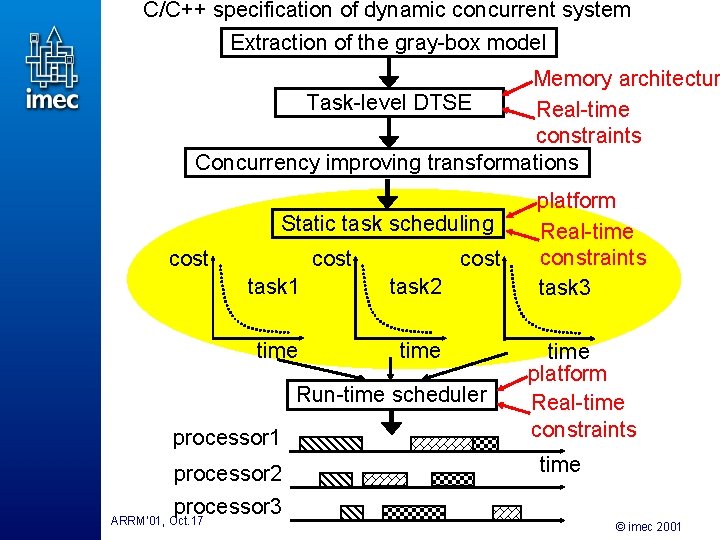
C/C++ specification of dynamic concurrent system Extraction of the gray-box model Memory architectur Task-level DTSE Real-time constraints Concurrency improving transformations Static task scheduling cost task 1 task 2 time Run-time scheduler processor 1 processor 2 platform Real-time constraints task 3 time platform Real-time constraints time processor 3 ARRM’ 01, Oct. 17 © imec 2001
Outline • Motivation: new challenges in system-level design • Overview of TCM methodology • Cost-efficient design-time scheduling ARRM’ 01, Oct. 17 © imec 2001
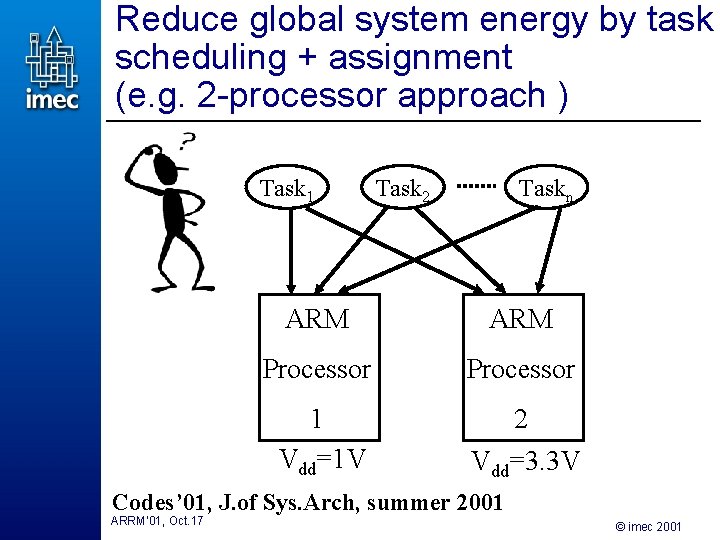
Reduce global system energy by task scheduling + assignment (e. g. 2 -processor approach ) Task 1 Task 2 Taskn ARM Processor 1 Vdd=1 V 2 Vdd=3. 3 V Codes’ 01, J. of Sys. Arch, summer 2001 ARRM’ 01, Oct. 17 © imec 2001
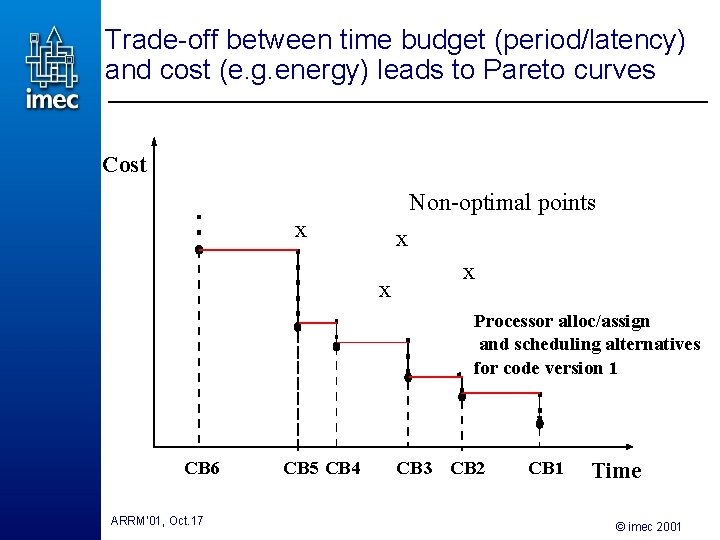
Trade-off between time budget (period/latency) and cost (e. g. energy) leads to Pareto curves Cost Non-optimal points x x Processor alloc/assign and scheduling alternatives for code version 1 CB 6 ARRM’ 01, Oct. 17 CB 5 CB 4 CB 3 CB 2 CB 1 Time © imec 2001
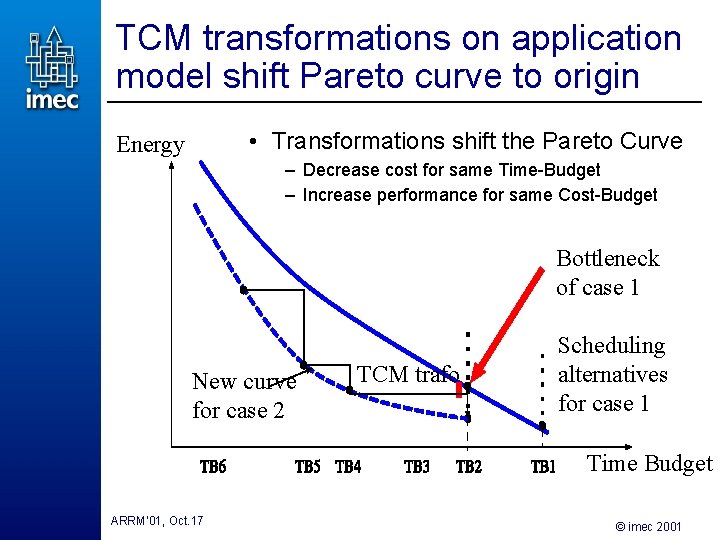
TCM transformations on application model shift Pareto curve to origin • Transformations shift the Pareto Curve Energy – Decrease cost for same Time-Budget – Increase performance for same Cost-Budget Bottleneck of case 1 New curve for case 2 TCM trafo Scheduling alternatives for case 1 Time Budget ARRM’ 01, Oct. 17 © imec 2001
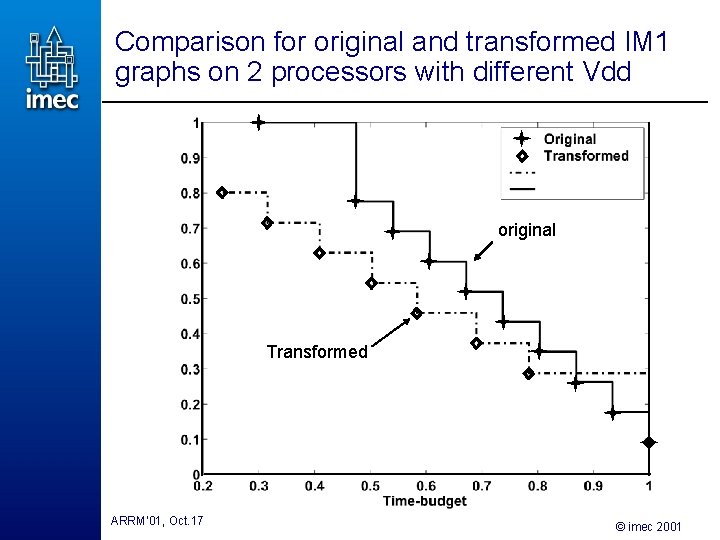
Comparison for original and transformed IM 1 graphs on 2 processors with different Vdd original Transformed ARRM’ 01, Oct. 17 © imec 2001
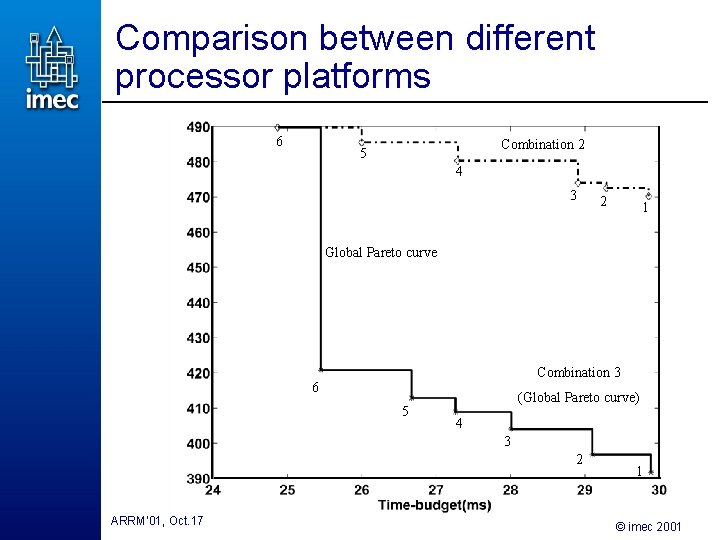
Comparison between different processor platforms 6 Combination 2 5 4 3 2 1 Global Pareto curve Combination 3 6 5 (Global Pareto curve) 4 3 2 ARRM’ 01, Oct. 17 1 © imec 2001
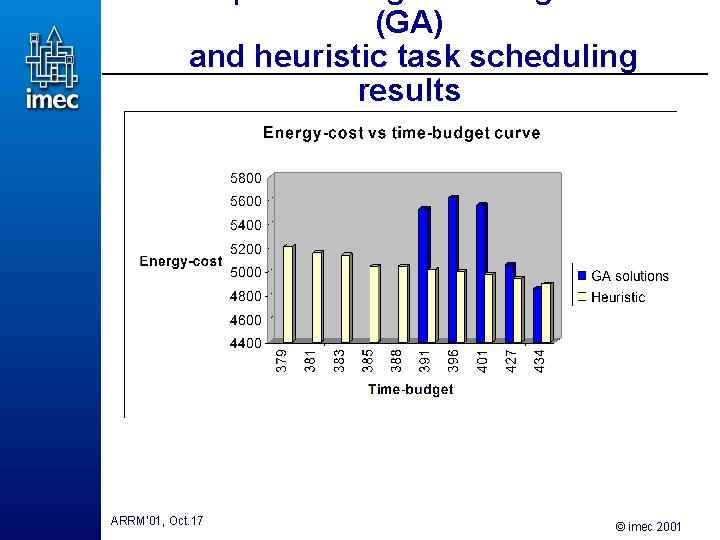
(GA) and heuristic task scheduling results ARRM’ 01, Oct. 17 © imec 2001
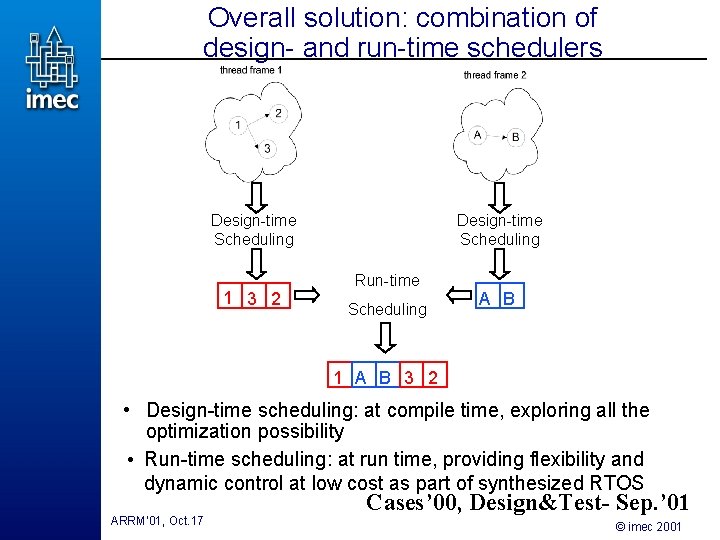
Overall solution: combination of design- and run-time schedulers Design-time Scheduling 1 3 2 Design-time Scheduling Run-time Scheduling A B 1 A B 3 2 • Design-time scheduling: at compile time, exploring all the optimization possibility • Run-time scheduling: at run time, providing flexibility and dynamic control at low cost as part of synthesized RTOS ARRM’ 01, Oct. 17 Cases’ 00, Design&Test- Sep. ’ 01 © imec 2001
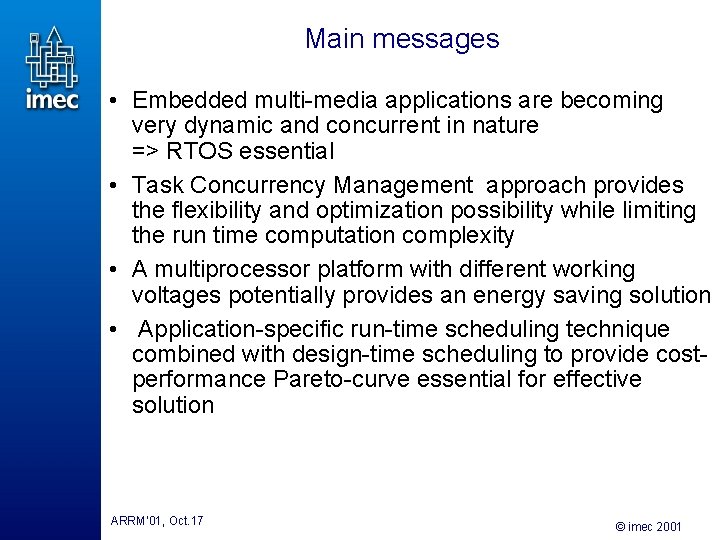
Main messages • Embedded multi-media applications are becoming very dynamic and concurrent in nature => RTOS essential • Task Concurrency Management approach provides the flexibility and optimization possibility while limiting the run time computation complexity • A multiprocessor platform with different working voltages potentially provides an energy saving solution • Application-specific run-time scheduling technique combined with design-time scheduling to provide costperformance Pareto-curve essential for effective solution ARRM’ 01, Oct. 17 © imec 2001