
Managing Complexity Programming is more than just syntax
![Example n A modifiable program: n n public class Lexicon { private String[] words;](https://slidetodoc.com/presentation_image_h2/deff09889378f85a940a431a5469e16c/image-9.jpg "Example n A modifiable program: n n public class Lexicon { private String[] words;")
- Slides: 11
Managing Complexity Programming is more than just syntax
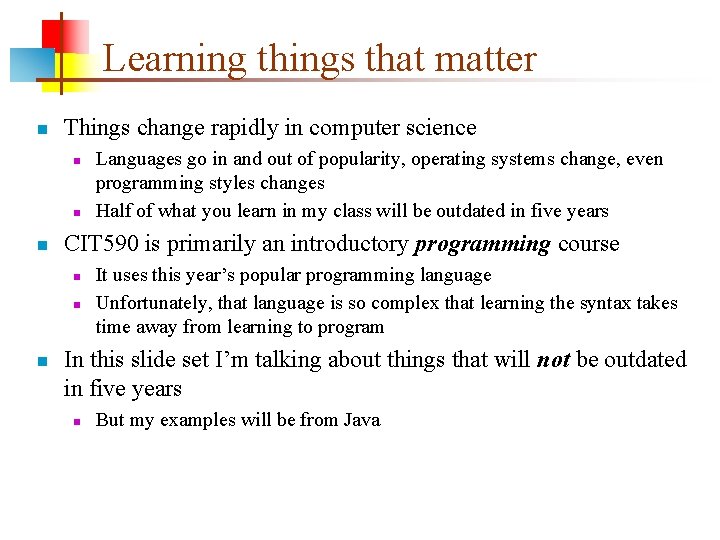
Learning things that matter n Things change rapidly in computer science n n n CIT 590 is primarily an introductory programming course n n n Languages go in and out of popularity, operating systems change, even programming styles changes Half of what you learn in my class will be outdated in five years It uses this year’s popular programming language Unfortunately, that language is so complex that learning the syntax takes time away from learning to program In this slide set I’m talking about things that will not be outdated in five years n But my examples will be from Java
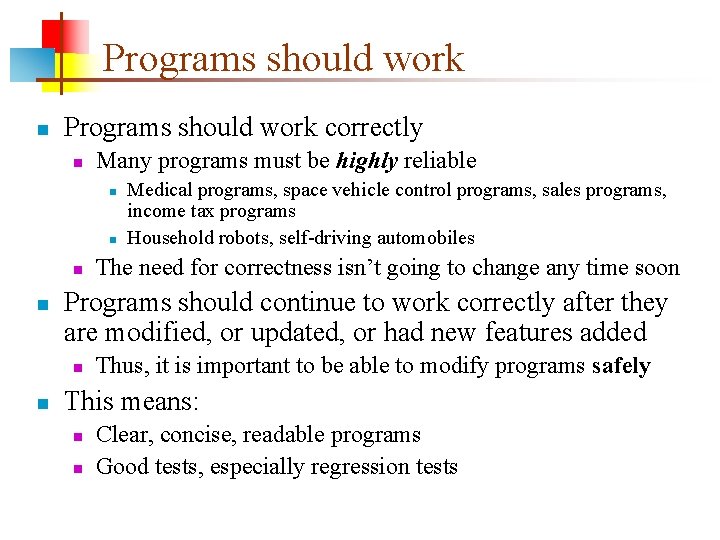
Programs should work n Programs should work correctly n Many programs must be highly reliable n n The need for correctness isn’t going to change any time soon Programs should continue to work correctly after they are modified, or updated, or had new features added n n Medical programs, space vehicle control programs, sales programs, income tax programs Household robots, self-driving automobiles Thus, it is important to be able to modify programs safely This means: n n Clear, concise, readable programs Good tests, especially regression tests
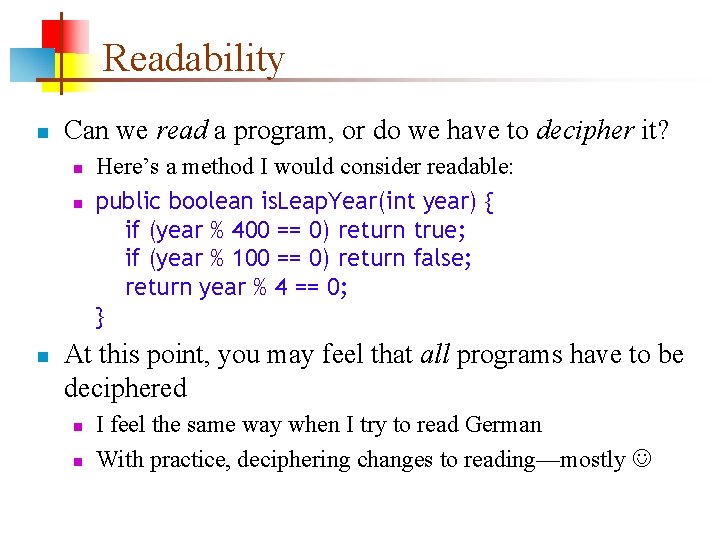
Readability n Can we read a program, or do we have to decipher it? n n n Here’s a method I would consider readable: public boolean is. Leap. Year(int year) { if (year % 400 == 0) return true; if (year % 100 == 0) return false; return year % 4 == 0; } At this point, you may feel that all programs have to be deciphered n n I feel the same way when I try to read German With practice, deciphering changes to reading—mostly
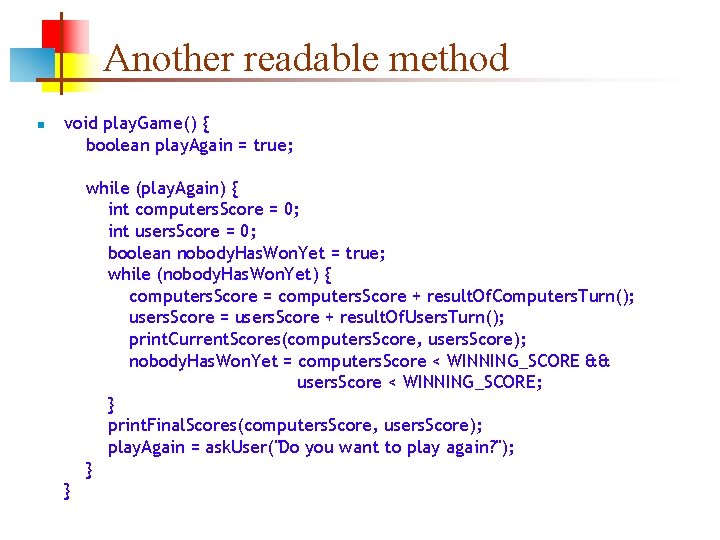
Another readable method n void play. Game() { boolean play. Again = true; while (play. Again) { int computers. Score = 0; int users. Score = 0; boolean nobody. Has. Won. Yet = true; while (nobody. Has. Won. Yet) { computers. Score = computers. Score + result. Of. Computers. Turn(); users. Score = users. Score + result. Of. Users. Turn(); print. Current. Scores(computers. Score, users. Score); nobody. Has. Won. Yet = computers. Score < WINNING_SCORE && users. Score < WINNING_SCORE; } print. Final. Scores(computers. Score, users. Score); play. Again = ask. User("Do you want to play again? "); } }
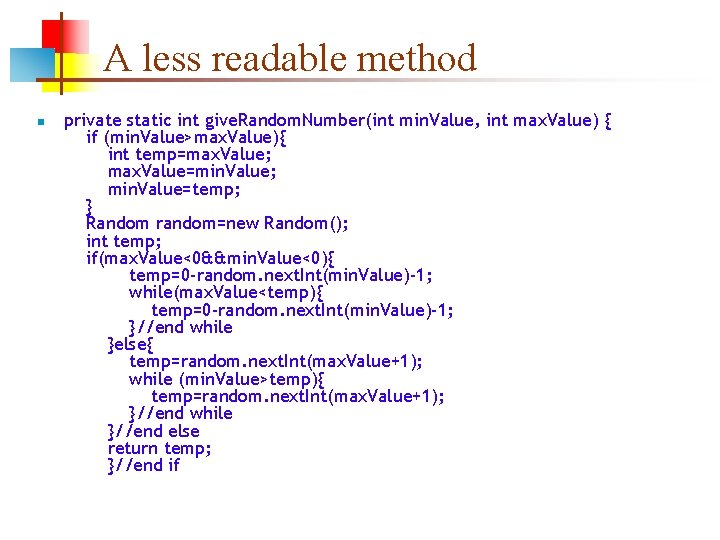
A less readable method n private static int give. Random. Number(int min. Value, int max. Value) { if (min. Value>max. Value){ int temp=max. Value; max. Value=min. Value; min. Value=temp; } Random random=new Random(); int temp; if(max. Value<0&&min. Value<0){ temp=0 -random. next. Int(min. Value)-1; while(max. Value<temp){ temp=0 -random. next. Int(min. Value)-1; }//end while }else{ temp=random. next. Int(max. Value+1); while (min. Value>temp){ temp=random. next. Int(max. Value+1); }//end while }//end else return temp; }//end if
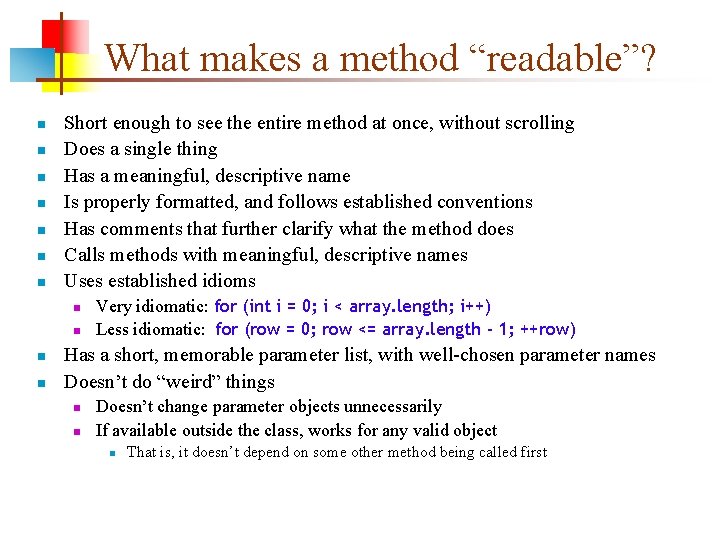
What makes a method “readable”? n n n n Short enough to see the entire method at once, without scrolling Does a single thing Has a meaningful, descriptive name Is properly formatted, and follows established conventions Has comments that further clarify what the method does Calls methods with meaningful, descriptive names Uses established idioms n n Very idiomatic: for (int i = 0; i < array. length; i++) Less idiomatic: for (row = 0; row <= array. length - 1; ++row) Has a short, memorable parameter list, with well-chosen parameter names Doesn’t do “weird” things n n Doesn’t change parameter objects unnecessarily If available outside the class, works for any valid object n That is, it doesn’t depend on some other method being called first
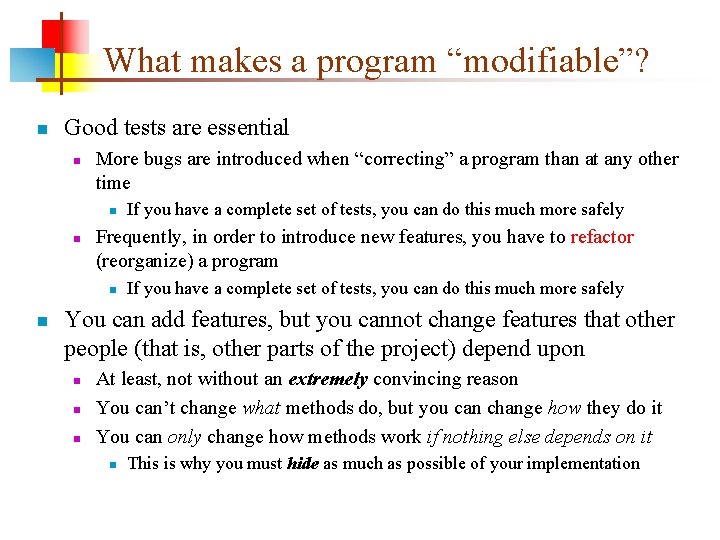
What makes a program “modifiable”? n Good tests are essential n More bugs are introduced when “correcting” a program than at any other time n n Frequently, in order to introduce new features, you have to refactor (reorganize) a program n n If you have a complete set of tests, you can do this much more safely You can add features, but you cannot change features that other people (that is, other parts of the project) depend upon n At least, not without an extremely convincing reason You can’t change what methods do, but you can change how they do it You can only change how methods work if nothing else depends on it n This is why you must hide as much as possible of your implementation
Example n A modifiable program: n n public class Lexicon { private String[] words; private int[] counts; private int number. Of. Words = 0; // etc. } An unmodifiable program: n public class Lexicon { String[] words; int[] counts; int number. Of. Words = 0; // etc. }
Information hiding n When you provide a class to a project, n n You should provide everything that is needed by the project You should not provide anything that isn’t needed n n If you do, someone, somewhere, will take advantage of it If you then change it, you will get the blame There is a lot more to be said on the topic of information hiding, but I don’t have the time right now to say it all I will add this much: n n Information hiding also applies to your JUnit tests If you don’t want your tests to break when you make correct changes to your program, don’t depend on features that should be hidden
The End