
Managing Combative Residents In Long Term Care Burt
Managing Combative Residents In Long Term Care Burt Dirkse, ARM, RCFE-A Director, Risk Services BDirkse@MWIAInsurance. com
• Resident aggression causes physical and psychological trauma to both staff and other residents. • 88, 000 of the 1. 3 million nursing home residents (6. 8%) are physically aggressive each week. * • Residents may have underlying psychiatric conditions, cognitive impairment and dementia, which contribute to combativeness. *Potentially Modifiable Resident Characteristics That Are Associated With Physical or Verbal Aggression Among Nursing Home Residents With Dementia, 2006
• Caregiver training can provide the knowledge to identify certain behaviors that can prevent an actual combative episode. • The outburst is not a personal attack on the caregiver; it is the resident’s way of communicating a need, want or desire.
Resident-to-Resident Aggression • Resident-to-Resident aggression (RRA) most frequently happens in dining room and resident rooms. • RRA triggers: – Communication/language barriers – Entering the room of another resident – Territoriality (sharing common items) – Inability to communicate needs effectively • Room temp, TV volume, window shade, lighting
RRA, continued… • Other factors that contribute to RRA: – Roomate conflict – Responses to loud noises – Jealousy • Racial, ethnic and religious affiliation can trigger RRA • Psychological impairment=communication and negotiation skills are diminished, leading to conflict (verbal and physical)
RRA Prevention: • Perform a careful and comprehensive resident assessment before admission to identify individual triggers (physician report, care plan, chart, family interview, etc) • Observe resident in their current situation • Consider their background, acuity level (psych and physical), cultural norms and biases when placing them with roomates. Observe initial placement and comments/complaints.
Combativeness with Caregivers • Contributing factors… – Activities: dressing, bathing, turning, transferring can be confusing to residents, who may lash out. Residents who can’t verbalize needs such as hunger, pain, thirst, toileting, body temp and sleep disruption may use combative gestures. – Environmental factors: light, noises, voices, traffic in room, roommate activity – Resident health: their health status and psych condition may impact their combativeness, and their perception of reality may be altered.
Strategies to Reduce Combativeness • Evaluate resident and the situation: – What are they trying to communicate ? 1 confused trying 2 to perform ADLs ? – Are they – What was happening prior to the episode ? – Are they oriented to the past and have trouble accepting present ? – Any loud noises ? 3 needs met 4(hunger, pain, thirst, toileting, – Are physical temp, sleep disruption) – Any new meds (side effects) – Any new routines, triggers or external factors ?
Strategies to Reduce Combativeness • Ask family about past behaviors or life experiences that may contribute to episiodes • Identify what causes problem behaviors (activity, condition or situation).
Activity: • Bathing: – Consider patient past experience (shower vs. bath vs sponge bath) – Modesty factors (cultural, ethnic, religious, gender pref. ) – Timing (time of day, when is resident most cooperative/least stressed ? ) – Temp of room and water. – Any pain with movement ? (pain meds prior to bath) – Explain the bathing process to each resident each time, including while undressing them. Don’t just pull them from their room, undress them and start touching them
Activity: • Mealtimes: seating preference ? Dining companions ? • Wandering: – Redirect pacing into productive activity – Reassue resident if they appear disoriented • Sleep Problem Mgt: – Address nightime restlessness with • • Improved sleep hygiene (incontinent ? ) Reduce noise and light, play soothing music Keep consistent sleep schedule Use night lights Provide favorite stuffed animal or blanket Increase activity during the day, monitor napping Limit caffeine
Activity: • Toileting – Is resident incontinent ? – Keep toileting schedule – Manage incontinence with pre-bed toileting, even if resident says they don’t have to go (they often will when on toilet). – Avoid constipation (inactivity and some meds contribute to constipation, which can cause pain and anger.
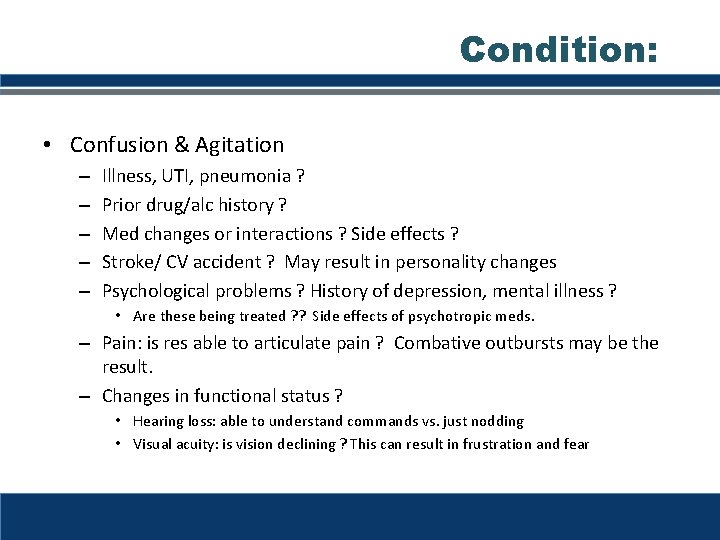
Condition: • Confusion & Agitation – – – Illness, UTI, pneumonia ? Prior drug/alc history ? Med changes or interactions ? Side effects ? Stroke/ CV accident ? May result in personality changes Psychological problems ? History of depression, mental illness ? • Are these being treated ? ? Side effects of psychotropic meds. – Pain: is res able to articulate pain ? Combative outbursts may be the result. – Changes in functional status ? • Hearing loss: able to understand commands vs. just nodding • Visual acuity: is vision declining ? This can result in frustration and fear
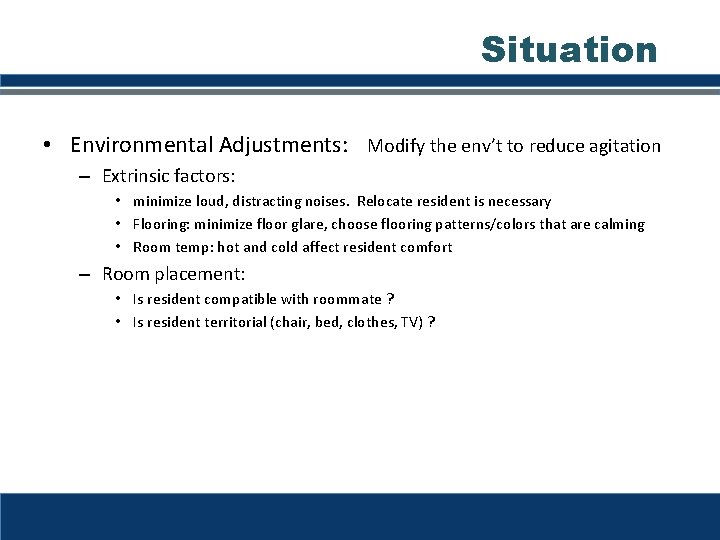
Situation • Environmental Adjustments: Modify the env’t to reduce agitation – Extrinsic factors: • minimize loud, distracting noises. Relocate resident is necessary • Flooring: minimize floor glare, choose flooring patterns/colors that are calming • Room temp: hot and cold affect resident comfort – Room placement: • Is resident compatible with roommate ? • Is resident territorial (chair, bed, clothes, TV) ?
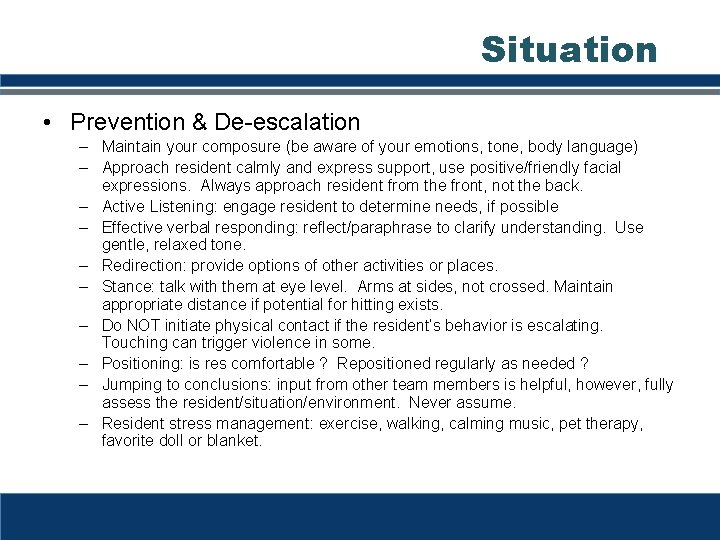
Situation • Prevention & De-escalation – Maintain your composure (be aware of your emotions, tone, body language) – Approach resident calmly and express support, use positive/friendly facial expressions. Always approach resident from the front, not the back. – Active Listening: engage resident to determine needs, if possible – Effective verbal responding: reflect/paraphrase to clarify understanding. Use gentle, relaxed tone. – Redirection: provide options of other activities or places. – Stance: talk with them at eye level. Arms at sides, not crossed. Maintain appropriate distance if potential for hitting exists. – Do NOT initiate physical contact if the resident’s behavior is escalating. Touching can trigger violence in some. – Positioning: is res comfortable ? Repositioned regularly as needed ? – Jumping to conclusions: input from other team members is helpful, however, fully assess the resident/situation/environment. Never assume. – Resident stress management: exercise, walking, calming music, pet therapy, favorite doll or blanket.
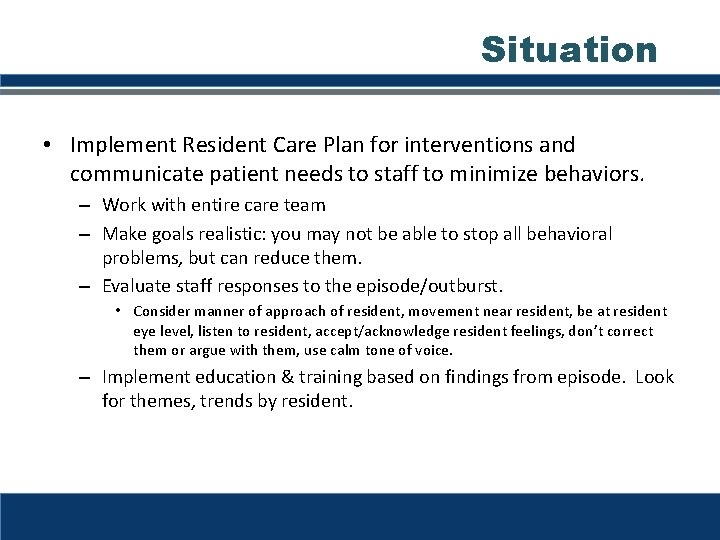
Situation • Implement Resident Care Plan for interventions and communicate patient needs to staff to minimize behaviors. – Work with entire care team – Make goals realistic: you may not be able to stop all behavioral problems, but can reduce them. – Evaluate staff responses to the episode/outburst. • Consider manner of approach of resident, movement near resident, be at resident eye level, listen to resident, accept/acknowledge resident feelings, don’t correct them or argue with them, use calm tone of voice. – Implement education & training based on findings from episode. Look for themes, trends by resident.
Summary • • Any questions ? Specific situations or challenges in your facility ? Any lessons learned on addressing combativeness ? Discussion of specific residents or outbursts ? – Solutions ? Combativeness in long term care may always be present, but we can reduce resident combativeness with staff education and training necessary to identify triggers which increase combativeness.
- Slides: 17