
MANAGING CHANGE STRATEGICALLY J Michael Mike Geringer Ph


- Slides: 26
MANAGING CHANGE STRATEGICALLY J. Michael (Mike) Geringer, Ph. D. O’Bleness Professor of International Strategy Director, Center for International Business – College of Business email: geringer@ohio. edu October 2013 Materials in this packet copyright © by Geringer & Associates, Inc. Do not quote, cite, reproduce or otherwise infringe without written permission. Leading Change in Turbulent Times Executive Education Seminar
WHAT IS STRATEGY? How would YOU define strategy? © Geringer & Associates, Inc.
WHAT IS STRATEGY? Strategy is the pattern evident in the fundamental choices a firm makes about developing & deploying scarce resources to achieve & maintain a unique & valuable position l involves a set of activities different from competitors, yet consistent among the activities … the pieces form a coherent whole © Geringer & Associates, Inc.
WHAT IS STRATEGY? Strategy is about being different in ways that add value & are clearly better V R I O Valuable Rare Hard to imitate or substitute for Organizationally able to develop, sustain, & capture benefits © Geringer & Associates, Inc.
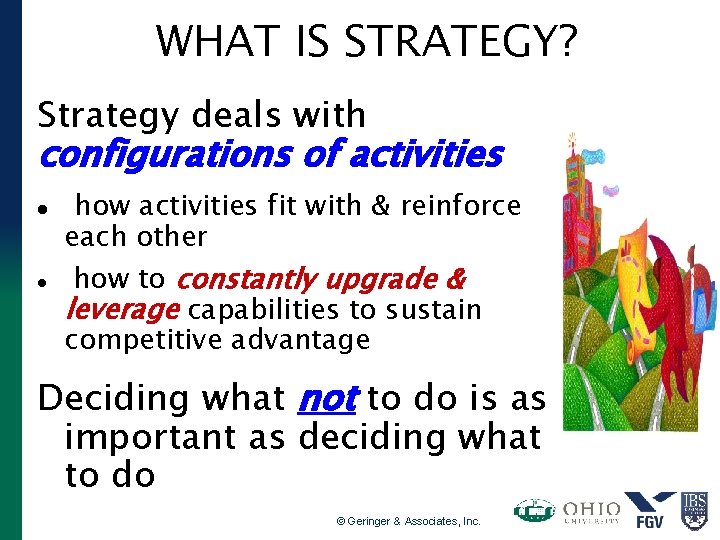
WHAT IS STRATEGY? Strategy deals with configurations of activities l l how activities fit with & reinforce each other how to constantly upgrade & leverage capabilities to sustain competitive advantage Deciding what not to do is as important as deciding what to do © Geringer & Associates, Inc.
PERSPECTIVE ON STRATEGY FROM THE CEO OF A LITTLE $150 BILLION COMPANY… “Look, what is strategy but resource allocation? When you strip away all the noise, that’s what it comes down to. Strategy means making clear-cut choices about how to compete. You cannot be everything to everybody, no matter what the size your business or how deep its pockets. You have to figure out what to say “NO” to. ” Jeffrey Immelt, CEO, General Electric
IMPORTANCE OF CLEAR STATEMENTS OF STRATEGY • Clear strategy statements leave no room for misinterpretation – facilitates communication, empowerment & resource allocation • Strategy statement of Edward Jones: “To grow to 17, 000 financial advisors by offering trusted and convenient face-to-face financial advice to conservative individual investors who delegate their financial decisions, through a national network of onefinancial-advisor offices. ” © by Geringer & Associates, Inc.
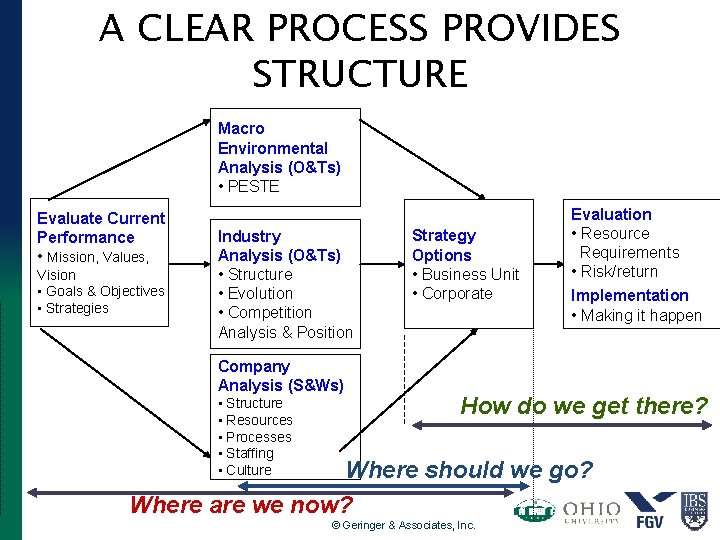
A CLEAR PROCESS PROVIDES STRUCTURE Macro Environmental Analysis (O&Ts) • PESTE Evaluate Current Performance • Mission, Values, Vision • Goals & Objectives • Strategies Industry Analysis (O&Ts) • Structure • Evolution • Competition Analysis & Position Company Analysis (S&Ws) • Structure • Resources • Processes • Staffing • Culture Strategy Options • Business Unit • Corporate Evaluation • Resource Requirements • Risk/return Implementation • Making it happen How do we get there? Where should we go? Where are we now? © Geringer & Associates, Inc.
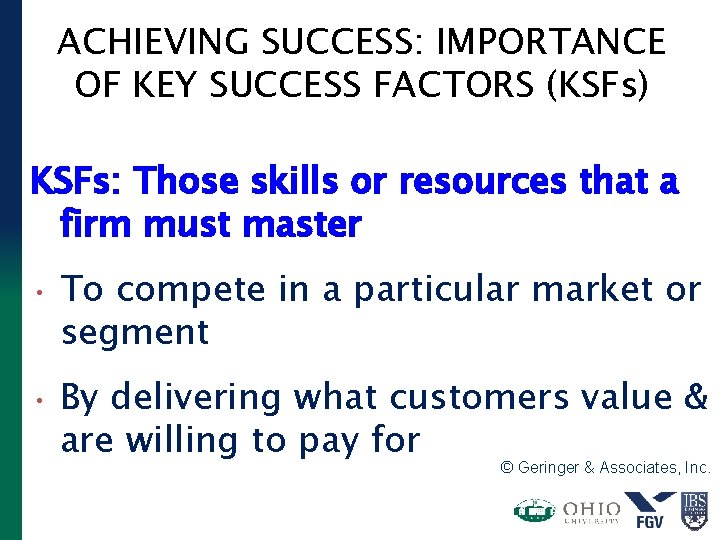
ACHIEVING SUCCESS: IMPORTANCE OF KEY SUCCESS FACTORS (KSFs) KSFs: Those skills or resources that a firm must master • To compete in a particular market or segment • By delivering what customers value & are willing to pay for © Geringer & Associates, Inc.
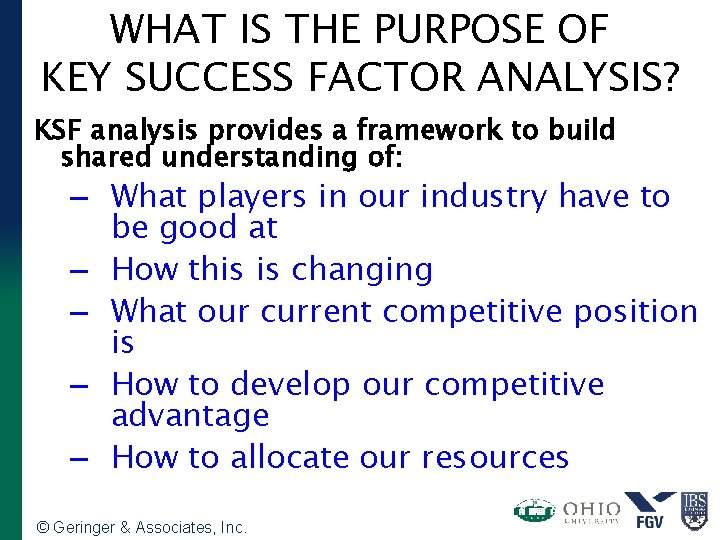
WHAT IS THE PURPOSE OF KEY SUCCESS FACTOR ANALYSIS? KSF analysis provides a framework to build shared understanding of: – What players in our industry have to be good at – How this is changing – What our current competitive position is – How to develop our competitive advantage – How to allocate our resources © Geringer & Associates, Inc.
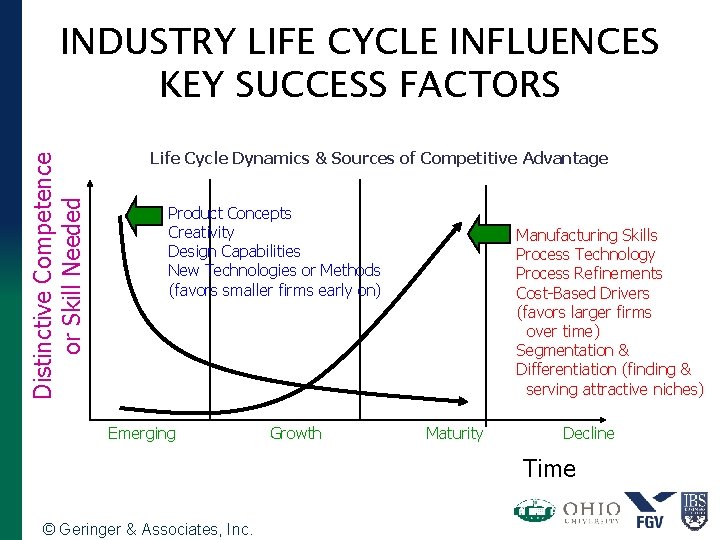
Distinctive Competence or Skill Needed INDUSTRY LIFE CYCLE INFLUENCES KEY SUCCESS FACTORS Life Cycle Dynamics & Sources of Competitive Advantage Product Concepts Creativity Design Capabilities New Technologies or Methods (favors smaller firms early on) Emerging Growth Manufacturing Skills Process Technology Process Refinements Cost-Based Drivers (favors larger firms over time) Segmentation & Differentiation (finding & serving attractive niches) Maturity Decline Time © Geringer & Associates, Inc.
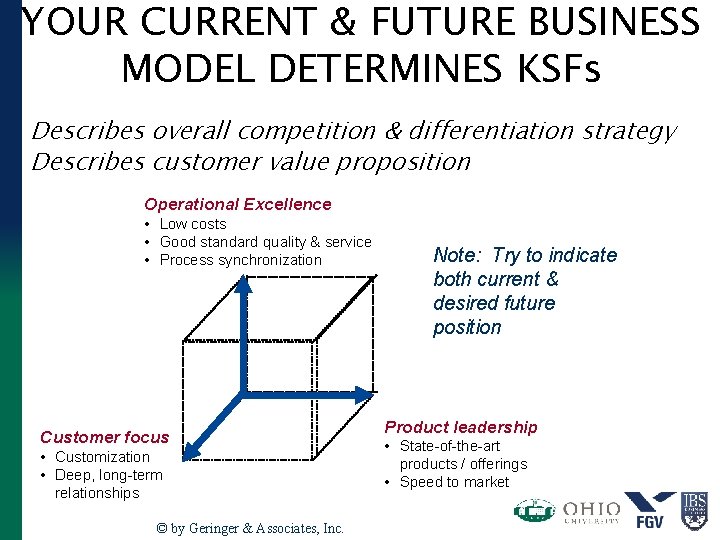
YOUR CURRENT & FUTURE BUSINESS MODEL DETERMINES KSFs Describes overall competition & differentiation strategy Describes customer value proposition Operational Excellence • Low costs • Good standard quality & service • Process synchronization Customer focus • Customization • Deep, long-term relationships © by Geringer & Associates, Inc. Note: Try to indicate both current & desired future position Product leadership • State-of-the-art products / offerings • Speed to market
GETTING “STUCK IN THE MIDDLE”: NO CLEAR COMPETITIVE POSITION • Competitive strategies are generally mutually exclusive • A clear competitive position is critical to successful implementation • A strategic change must be total: all operations must be realigned across your company’s chain of activities in order to support the new strategy © by Geringer & Associates, Inc.
Key Point: Strategy is INTERNAL as well as EXTERNAL © Geringer & Associates, Inc.
ACHIEVING STRATEGIC SUCCESS: DISTINCTIVE COMPETENCIES Competencies should define strategy • Company-specific effects account for ~30% 45% of variation in performance among firms, vs. ~20% for industry effects • Should define business around distinctive skills, not end products/markets A distinctive competence: what a company does better than anyone else, distinguishing your company competitively © Geringer & Associates, Inc.
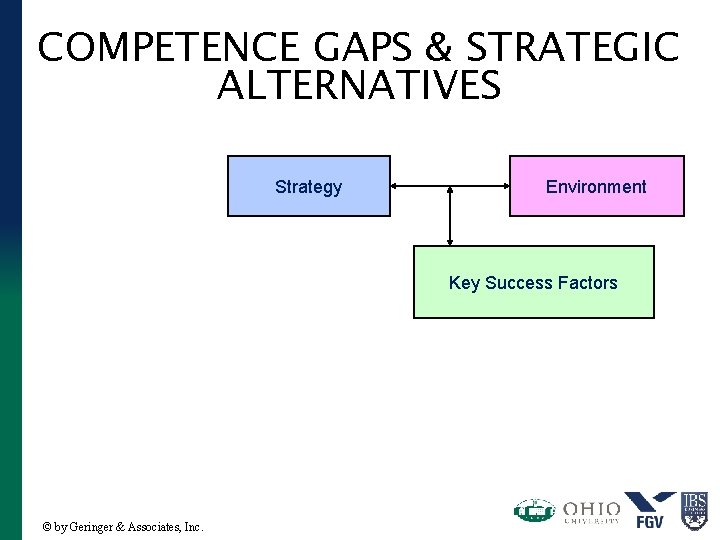
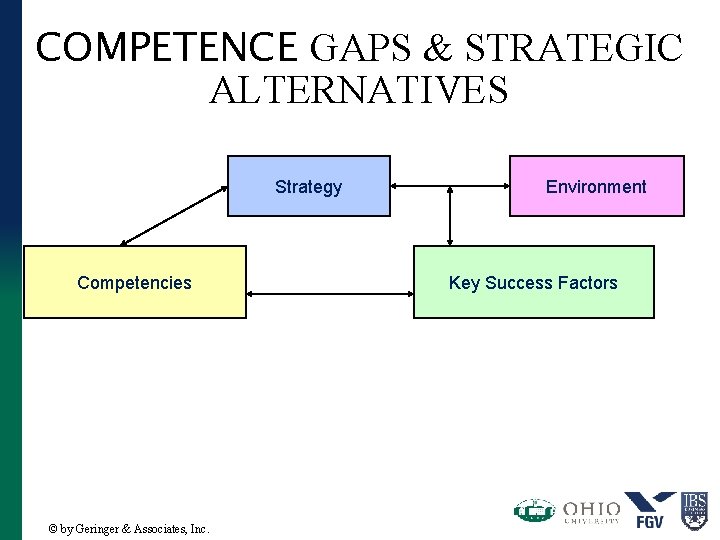
COMPETENCE GAPS & STRATEGIC ALTERNATIVES Strategy Environment Key Success Factors © by Geringer & Associates, Inc.
COMPETENCE GAPS & STRATEGIC ALTERNATIVES Strategy Competencies © by Geringer & Associates, Inc. Environment Key Success Factors
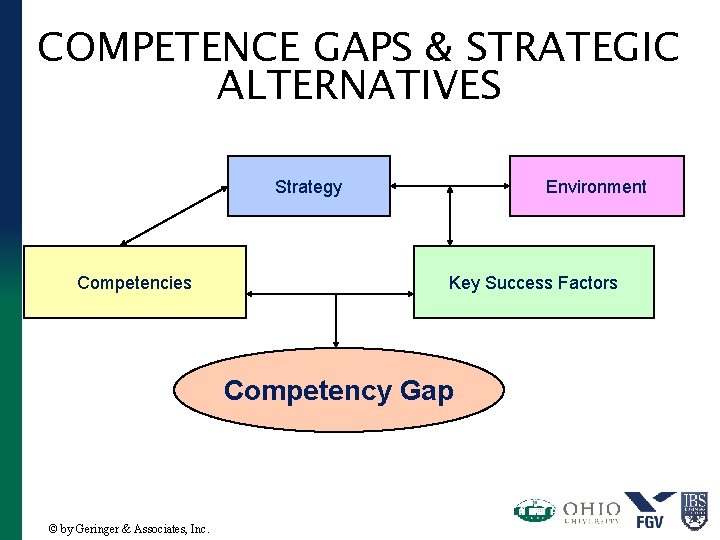
COMPETENCE GAPS & STRATEGIC ALTERNATIVES Strategy Competencies Environment Key Success Factors Competency Gap © by Geringer & Associates, Inc.
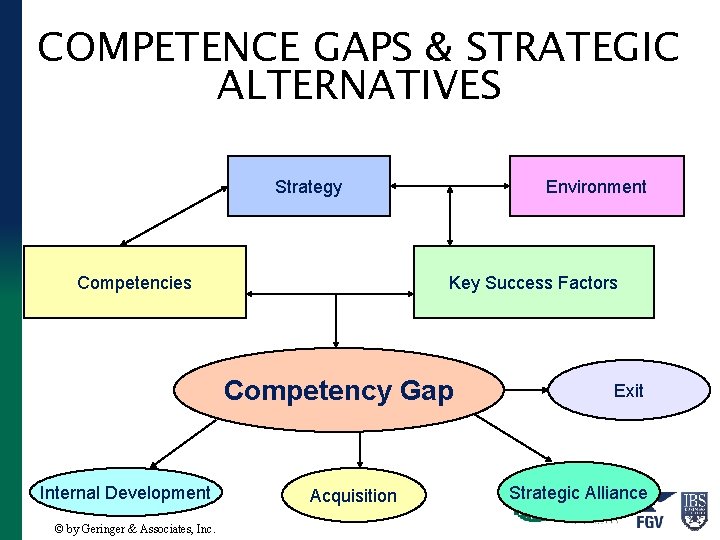
COMPETENCE GAPS & STRATEGIC ALTERNATIVES Strategy Competencies Environment Key Success Factors Competency Gap Internal Development © by Geringer & Associates, Inc. Acquisition Exit Strategic Alliance
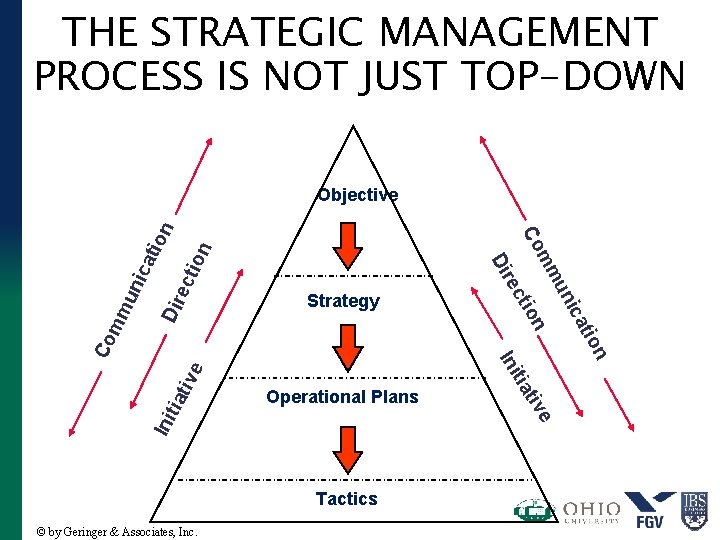
THE STRATEGIC MANAGEMENT PROCESS IS NOT JUST TOP-DOWN ion Dir ect ati mm un ic ive tia t e Ini n tiv tia Ini Co tio ica un on cti Operational Plans Tactics © by Geringer & Associates, Inc. re Di Strategy mm Co on Objective
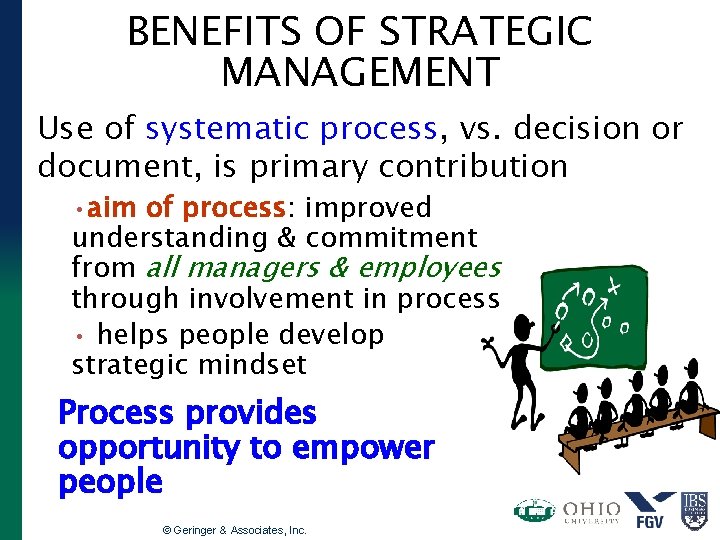
BENEFITS OF STRATEGIC MANAGEMENT Use of systematic process, vs. decision or document, is primary contribution • aim of process: improved understanding & commitment from all managers & employees through involvement in process • helps people develop strategic mindset Process provides opportunity to empower people © Geringer & Associates, Inc.
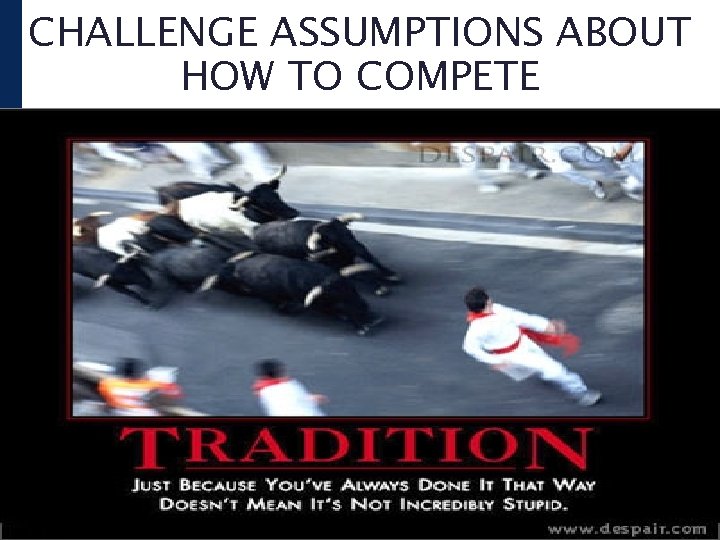
CHALLENGE ASSUMPTIONS ABOUT HOW TO COMPETE
WORLDVIEWS • Understand how you filter information to create meaning • Challenge your filters so you don’t miss anything important • Understand your filters & those for whom you are doing the scanning • And…try & understand worldviews of the people you are scanning – which ones have blind spots, and about what activities or events? © by Geringer & Associates, Inc.
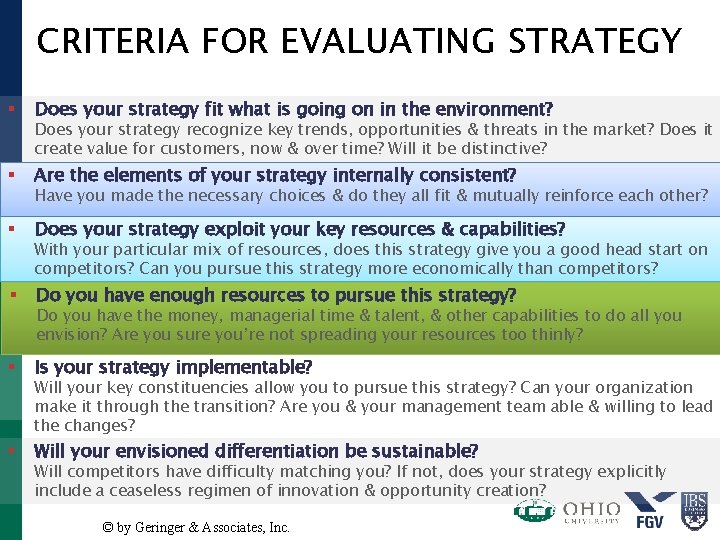
CRITERIA FOR EVALUATING STRATEGY § Does your strategy fit what is going on in the environment? § Are the elements of your strategy internally consistent? § Does your strategy exploit your key resources & capabilities? § Do you have enough resources to pursue this strategy? § Is your strategy implementable? § Will your envisioned differentiation be sustainable? Does your strategy recognize key trends, opportunities & threats in the market? Does it create value for customers, now & over time? Will it be distinctive? Have you made the necessary choices & do they all fit & mutually reinforce each other? With your particular mix of resources, does this strategy give you a good head start on competitors? Can you pursue this strategy more economically than competitors? Do you have the money, managerial time & talent, & other capabilities to do all you envision? Are you sure you’re not spreading your resources too thinly? Will your key constituencies allow you to pursue this strategy? Can your organization make it through the transition? Are you & your management team able & willing to lead the changes? Will competitors have difficulty matching you? If not, does your strategy explicitly include a ceaseless regimen of innovation & opportunity creation? © by Geringer & Associates, Inc.
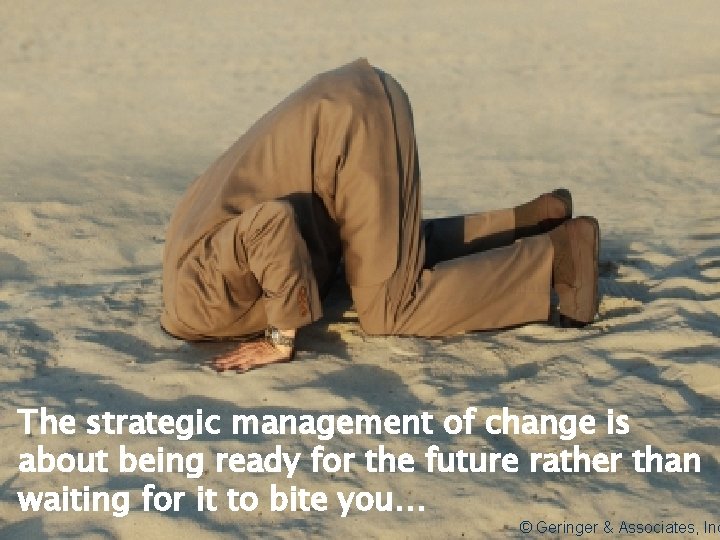
The strategic management of change is about being ready for the future rather than waiting for it to bite you… © Geringer & Associates, Inc