
Managing Capital Charges on derivative trading desks 24

- Slides: 23
Managing Capital Charges on derivative trading desks 24 th September 2013 Julian Keenan – Head of CVA/FVA, Lloyds Banking Group
If you thought CVA / FVA pricing was opaque… § Pricing of capital is the one of the key differentiators of bank derivative pricing. § There are standardised and advanced capital frameworks. § Inputs and specification of forward RWA pricing equations are far from standardised. 2
Contents § Pricing Components § e. Cap to Reg. Cap § Capital Requirements § RWA basics § RWA uncertainties § RWA hedging § Appendix: RWA equations 3
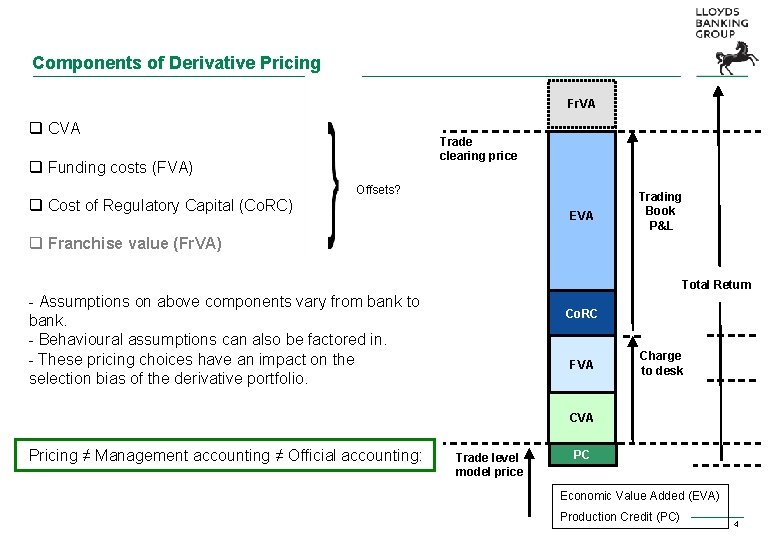
Components of Derivative Pricing Fr. VA q CVA Trade clearing price q Funding costs (FVA) q Cost of Regulatory Capital (Co. RC) Offsets? EVA Trading Book P&L q Franchise value (Fr. VA) Total Return - Assumptions on above components vary from bank to bank. - Behavioural assumptions can also be factored in. - These pricing choices have an impact on the selection bias of the derivative portfolio. Co. RC FVA Charge to desk CVA Pricing ≠ Management accounting ≠ Official accounting: Trade level model price PC Economic Value Added (EVA) Production Credit (PC) 4
§ Pricing Components § e. Cap to Reg. Cap § Capital Requirements § RWA basics § RWA uncertainties § RWA hedging § Appendix: RWA equations 5
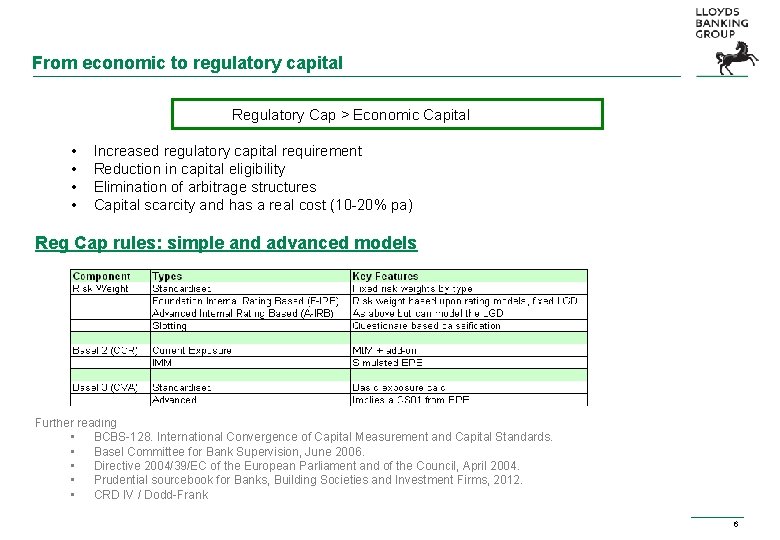
From economic to regulatory capital Regulatory Cap > Economic Capital • • Increased regulatory capital requirement Reduction in capital eligibility Elimination of arbitrage structures Capital scarcity and has a real cost (10 -20% pa) Reg Cap rules: simple and advanced models Further reading • BCBS-128. International Convergence of Capital Measurement and Capital Standards. • Basel Committee for Bank Supervision, June 2006. • Directive 2004/39/EC of the European Parliament and of the Council, April 2004. • Prudential sourcebook for Banks, Building Societies and Investment Firms, 2012. • CRD IV / Dodd-Frank 6
§ Pricing Components § e. Cap to Reg. Cap § Capital Requirements § RWA basics § RWA uncertainties § RWA hedging § Appendix: RWA equations 7
Capital Requirements Capital Requirement = Min Capital Requirement (%) x Total RWA “ 8%” redefined The Tier 1, Additional T 1 and Tier 2 composition will change Changing composition and potential path of capital requirements Capital Conservation buffer +2. 5% to allow for multi year stress periods Countercyclical capital buffer Raised during excessive credit growth and released in downturns. Set by member states and can be 0 -2. 5% Systemically important banks Additional capital of 0 -3. 5% varies per bank Phase in for all 3 buffers 1 st Jan 2016 to end of 2018 BCBS-255: Global systemically important banks: updated assessment methodology and the higher loss absorbency requirement 8
§ Pricing Components § e. Cap to Reg. Cap § Capital Requirements § RWA basics § RWA uncertainties § RWA hedging § Appendix: RWA equations 9
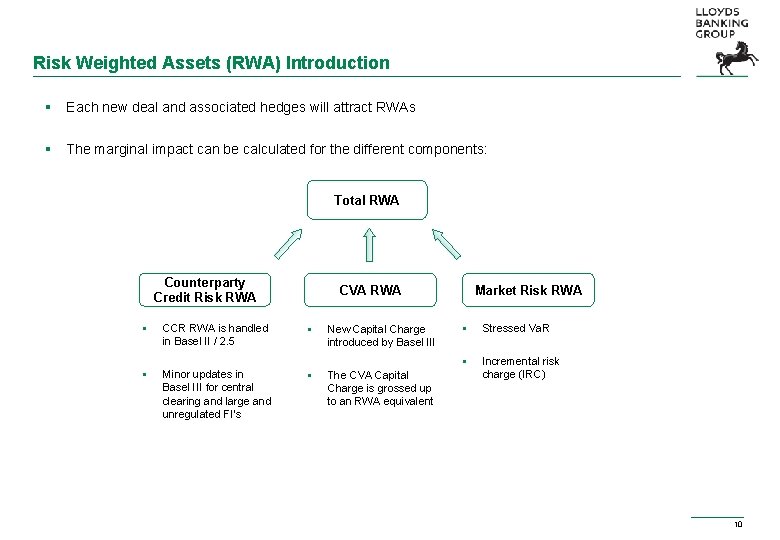
Risk Weighted Assets (RWA) Introduction § Each new deal and associated hedges will attract RWAs § The marginal impact can be calculated for the different components: Total RWA Counterparty Credit Risk RWA Market Risk RWA CVA RWA § CCR RWA is handled in Basel II / 2. 5 § New Capital Charge introduced by Basel III § Minor updates in Basel III for central clearing and large and unregulated FI’s § The CVA Capital Charge is grossed up to an RWA equivalent § Stressed Va. R § Incremental risk charge (IRC) 10
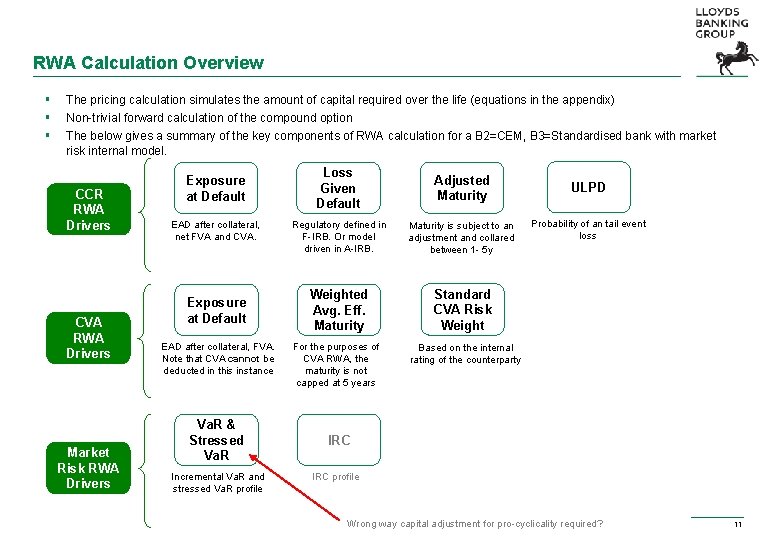
RWA Calculation Overview § § § The pricing calculation simulates the amount of capital required over the life (equations in the appendix) Non-trivial forward calculation of the compound option The below gives a summary of the key components of RWA calculation for a B 2=CEM, B 3=Standardised bank with market risk internal model. CCR RWA Drivers CVA RWA Drivers Market Risk RWA Drivers Exposure at Default EAD after collateral, net FVA and CVA. Exposure at Default EAD after collateral, FVA. Note that CVA cannot be deducted in this instance Va. R & Stressed Va. R Incremental Va. R and stressed Va. R profile Loss Given Default Adjusted Maturity Regulatory defined in F-IRB. Or model driven in A-IRB. Maturity is subject to an adjustment and collared between 1 - 5 y Weighted Avg. Eff. Maturity Standard CVA Risk Weight For the purposes of CVA RWA, the maturity is not capped at 5 years Based on the internal rating of the counterparty ULPD Probability of an tail event loss IRC profile Wrong way capital adjustment for pro-cyclicality required? 11
§ Pricing Components § e. Cap to Reg. Cap § Capital Requirements § RWA basics § RWA uncertainties § RWA hedging § Appendix: RWA equations 12
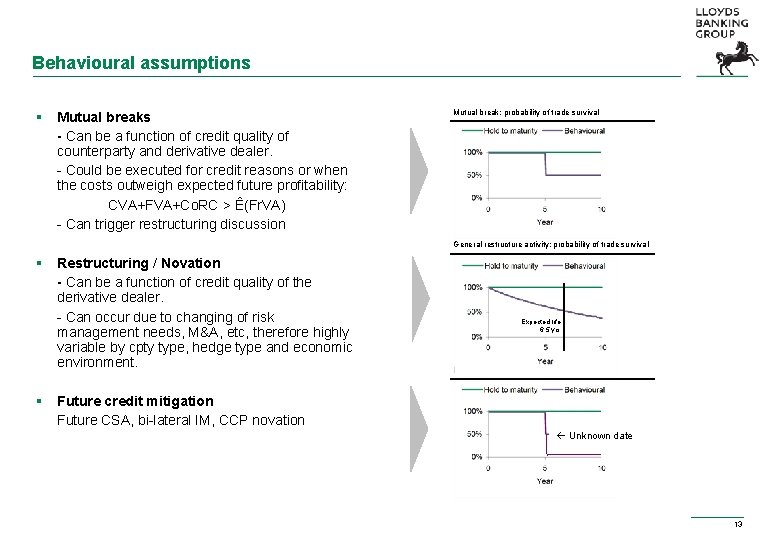
Behavioural assumptions § Mutual breaks - Can be a function of credit quality of counterparty and derivative dealer. - Could be executed for credit reasons or when the costs outweigh expected future profitability: CVA+FVA+Co. RC > Ê(Fr. VA) - Can trigger restructuring discussion Mutual break: probability of trade survival General restructure activity: probability of trade survival § Restructuring / Novation - Can be a function of credit quality of the derivative dealer. - Can occur due to changing of risk management needs, M&A, etc, therefore highly variable by cpty type, hedge type and economic environment. Expected life 6. 5 yrs Mutual break: probability of trade survival § Future credit mitigation Future CSA, bi-lateral IM, CCP novation Unknown date 13
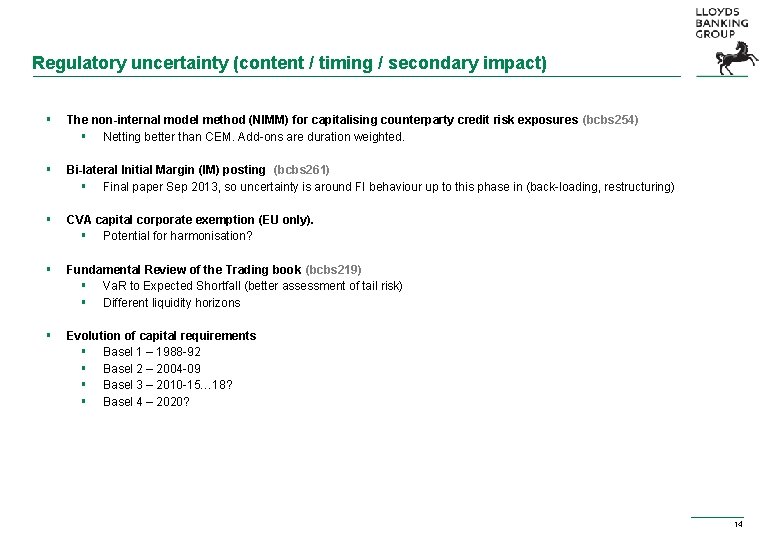
Regulatory uncertainty (content / timing / secondary impact) § The non-internal model method (NIMM) for capitalising counterparty credit risk exposures (bcbs 254) § Netting better than CEM. Add-ons are duration weighted. § Bi-lateral Initial Margin (IM) posting (bcbs 261) § Final paper Sep 2013, so uncertainty is around FI behaviour up to this phase in (back-loading, restructuring) § CVA capital corporate exemption (EU only). § Potential for harmonisation? § Fundamental Review of the Trading book (bcbs 219) § Va. R to Expected Shortfall (better assessment of tail risk) § Different liquidity horizons § Evolution of capital requirements § Basel 1 – 1988 -92 § Basel 2 – 2004 -09 § Basel 3 – 2010 -15… 18? § Basel 4 – 2020? 14
§ Pricing Components § e. Cap to Reg. Cap § Capital Requirements § RWA basics § RWA uncertainties § RWA hedging § Appendix: RWA equations 15
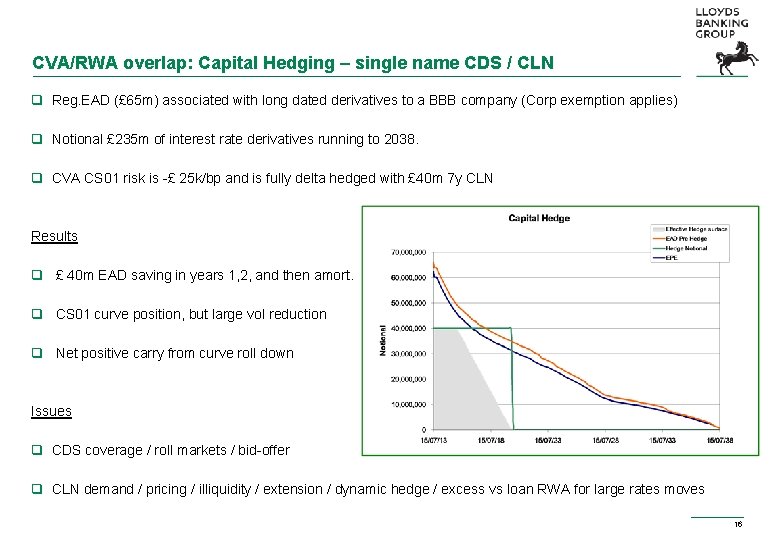
CVA/RWA overlap: Capital Hedging – single name CDS / CLN q Reg. EAD (£ 65 m) associated with long dated derivatives to a BBB company (Corp exemption applies) q Notional £ 235 m of interest rate derivatives running to 2038. q CVA CS 01 risk is -£ 25 k/bp and is fully delta hedged with £ 40 m 7 y CLN Results q £ 40 m EAD saving in years 1, 2, and then amort. q CS 01 curve position, but large vol reduction q Net positive carry from curve roll down Issues q CDS coverage / roll markets / bid-offer q CLN demand / pricing / illiquidity / extension / dynamic hedge / excess vs loan RWA for large rates moves 16
Hedging of banks return requirements? § Loan hedging banks (receivers of fixed) have large RWA from back-book increasing Mt. M. The original return did not factor in the actual drop in rates. § Should they lock in the return from new business with swap? This would remove this market risk dependency on future capital costs? § Limited appetite to hedge business risk with market risk instruments. § Accounting Issue. § Timing of return recognition 17
Summary & Questions § Pricing Components § e. Cap to Reg. Cap § Capital Requirements § RWA basics § RWA uncertainties § RWA hedging § Appendix: RWA equations 18
§ Pricing Components § e. Cap to Reg. Cap § Capital Requirements § RWA basics § RWA uncertainties § RWA hedging § Appendix: RWA equations 19
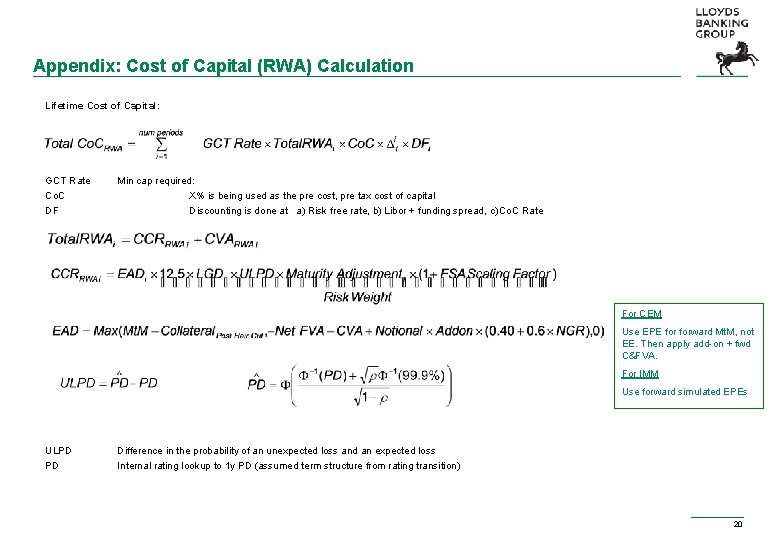
Appendix: Cost of Capital (RWA) Calculation Lifetime Cost of Capital: GCT Rate Co. C DF Min cap required: X% is being used as the pre cost, pre tax cost of capital Discounting is done at a) Risk free rate, b) Libor + funding spread, c) Co. C Rate For CEM Use EPE forward Mt. M, not EE. Then apply add-on + fwd C&FVA. For IMM Use forward simulated EPEs ULPD PD Difference in the probability of an unexpected loss and an expected loss Internal rating lookup to 1 y PD (assumed term structure from rating transition) 20
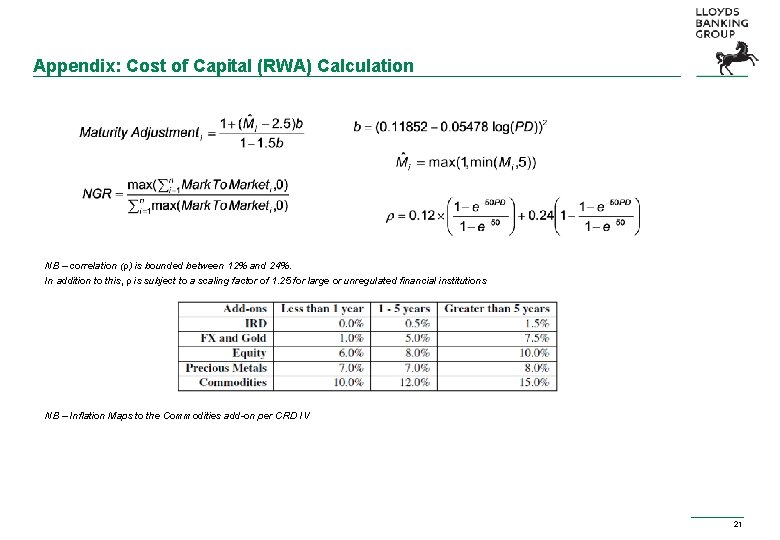
Appendix: Cost of Capital (RWA) Calculation NB – correlation (ρ) is bounded between 12% and 24%. In addition to this, ρ is subject to a scaling factor of 1. 25 for large or unregulated financial institutions NB – Inflation Maps to the Commodities add-on per CRD IV 21
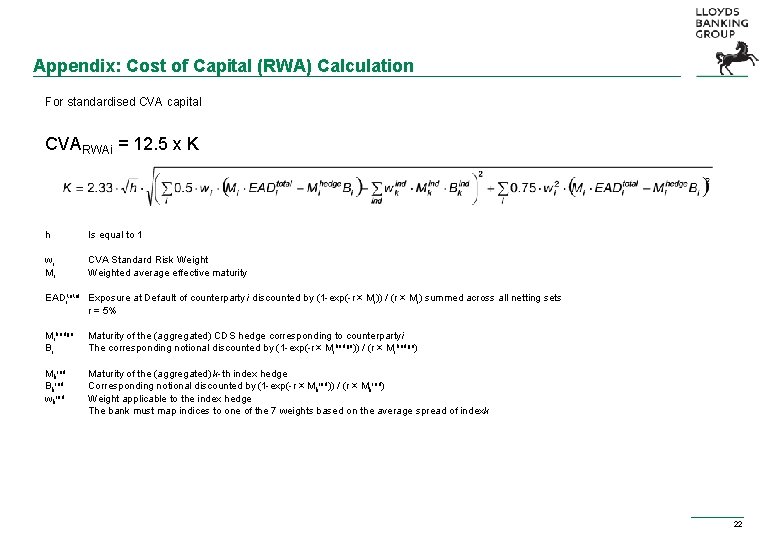
Appendix: Cost of Capital (RWA) Calculation For standardised CVA capital CVARWAi = 12. 5 x K h Is equal to 1 wi Mi CVA Standard Risk Weighted average effective maturity EADitotal Exposure at Default of counterparty i discounted by (1 -exp(-r × Mi)) / (r × Mi) summed across all netting sets r = 5% Mihedge Bi Maturity of the (aggregated) CDS hedge corresponding to counterparty i The corresponding notional discounted by (1 -exp(-r × Mihedge)) / (r × Mihedge) Mkind Bkind wkind Maturity of the (aggregated) k-th index hedge Corresponding notional discounted by (1 -exp(-r × Mkind)) / (r × Mkind) Weight applicable to the index hedge The bank must map indices to one of the 7 weights based on the average spread of indexk 22
Disclaimer The views expressed in this presentation are the personal views of the speaker and do not necessarily reflect the views or policies of current or previous employers. 23