
MANAGING BY DESIGN Diagrams for Section A This

MANAGING BY DESIGN Diagrams for Section A This set of slides contains the diagrams contained in Section A of the book ‘Managing by Design’. Please do not attempt to use these slides as part of a presentation until you have read and fully understood the relevant sections of ‘Managing by Design’, and you are clear on the points you wish to make with them. © Tesseract Management Systems / Managing by Design / 2002 - 1
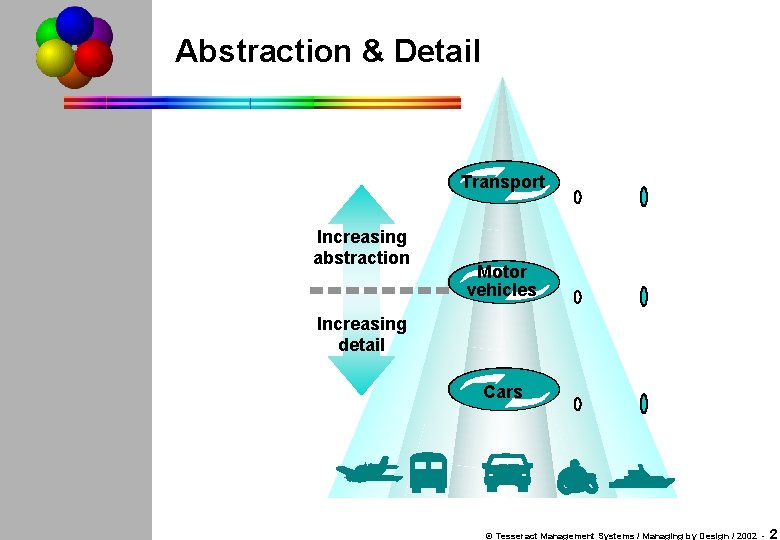
Abstraction & Detail Transport Increasing abstraction Motor vehicles Increasing detail Cars © Tesseract Management Systems / Managing by Design / 2002 - 2
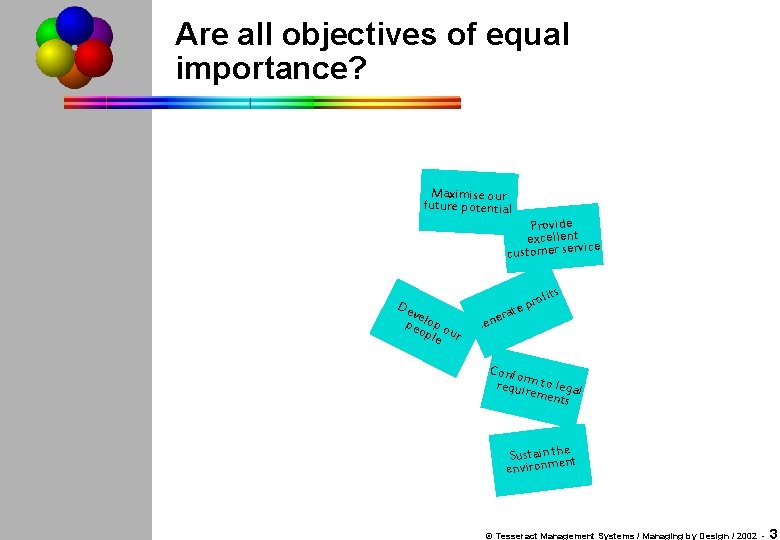
Are all objectives of equal importance? Maximise our future potential Provide excellent e customer servic De ve peolop o ple ur ts ofi r p te era Gen Confo requirrm to legal emen ts Sustain theent environm © Tesseract Management Systems / Managing by Design / 2002 - 3
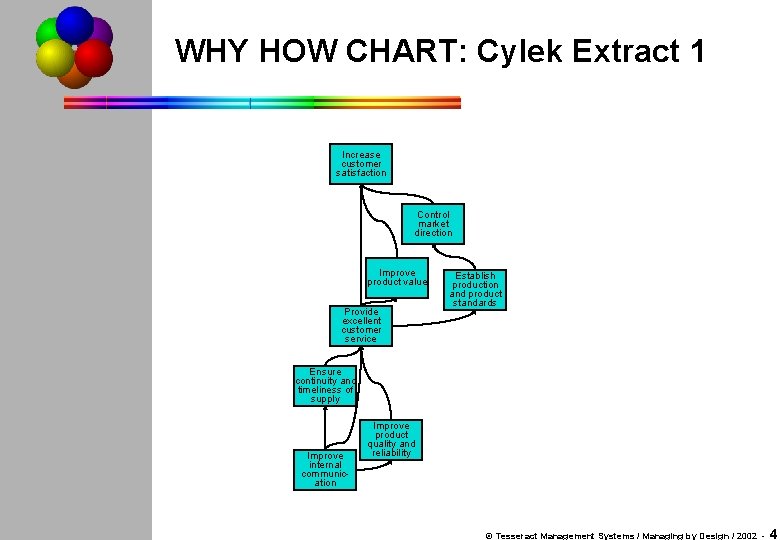
WHY HOW CHART: Cylek Extract 1 Increase customer satisfaction Control market direction Improve product value Provide excellent customer service Establish production and product standards Ensure continuity and timeliness of supply Improve internal communication Improve product quality and reliability © Tesseract Management Systems / Managing by Design / 2002 - 4
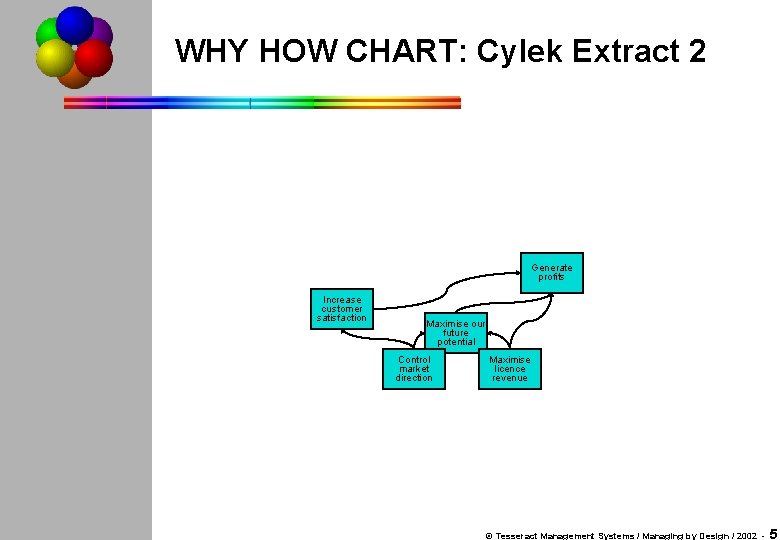
WHY HOW CHART: Cylek Extract 2 Generate profits Increase customer satisfaction Maximise our future potential Control market direction Maximise licence revenue © Tesseract Management Systems / Managing by Design / 2002 - 5
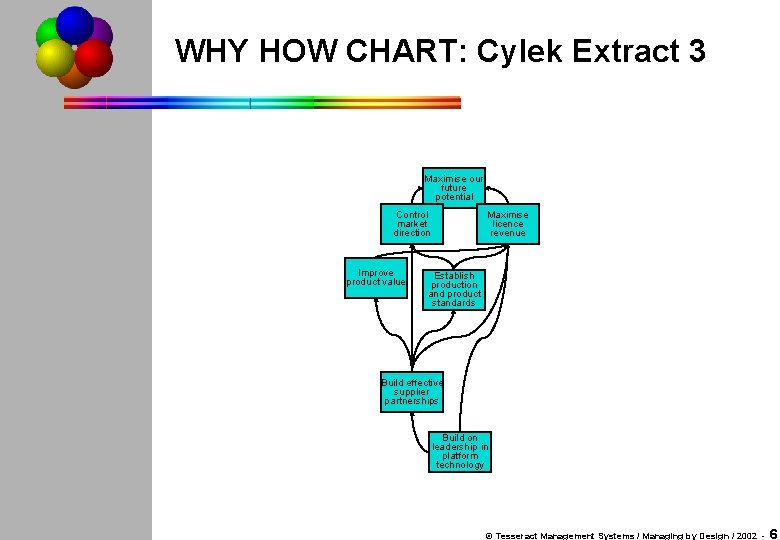
WHY HOW CHART: Cylek Extract 3 Maximise our future potential Control market direction Improve product value Maximise licence revenue Establish production and product standards Build effective supplier partnerships Build on leadership in platform technology © Tesseract Management Systems / Managing by Design / 2002 - 6
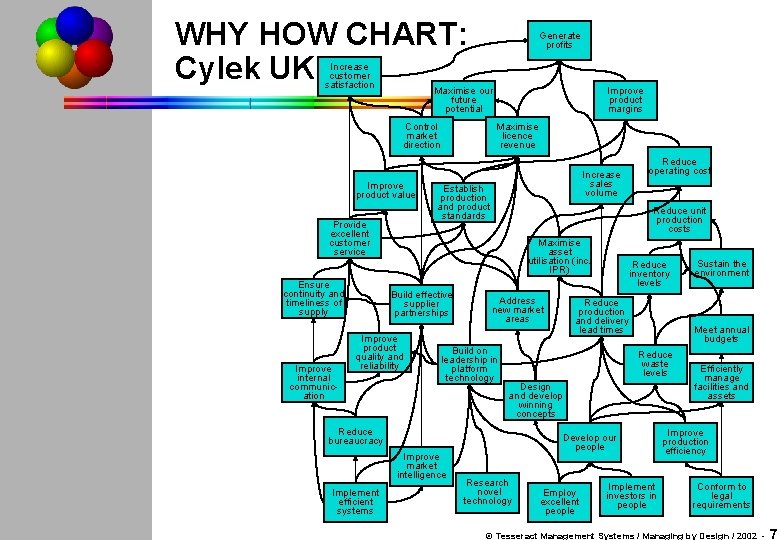
WHY HOW CHART: Cylek UK Increase customer satisfaction Generate profits Maximise our future potential Control market direction Improve product value Provide excellent customer service Ensure continuity and timeliness of supply Improve internal communication Improve product margins Maximise licence revenue Increase sales volume Establish production and product standards Reduce unit production costs Maximise asset utilisation (inc. IPR) Build effective supplier partnerships Improve product quality and reliability Address new market areas Build on leadership in platform technology Implement efficient systems Reduce inventory levels Reduce production and delivery lead times Design and develop winning concepts Develop our people Research novel technology Employ excellent people Sustain the environment Meet annual budgets Reduce waste levels Reduce bureaucracy Improve market intelligence Reduce operating cost Implement investors in people Efficiently manage facilities and assets Improve production efficiency Conform to legal requirements © Tesseract Management Systems / Managing by Design / 2002 - 7
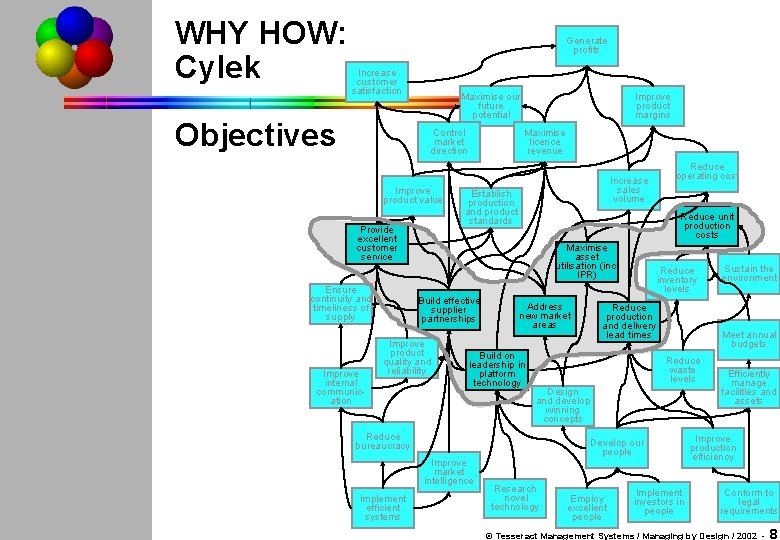
WHY HOW: Cylek Generate profits Increase customer satisfaction Objectives Maximise our future potential Control market direction Improve product value Provide excellent customer service Ensure continuity and timeliness of supply Improve internal communication Improve product margins Maximise licence revenue Increase sales volume Establish production and product standards Reduce unit production costs Maximise asset utilisation (inc. IPR) Build effective supplier partnerships Improve product quality and reliability Address new market areas Build on leadership in platform technology Implement efficient systems Reduce inventory levels Reduce production and delivery lead times Design and develop winning concepts Develop our people Research novel technology Employ excellent people Sustain the environment Meet annual budgets Reduce waste levels Reduce bureaucracy Improve market intelligence Reduce operating cost Implement investors in people Efficiently manage facilities and assets Improve production efficiency Conform to legal requirements © Tesseract Management Systems / Managing by Design / 2002 - 8
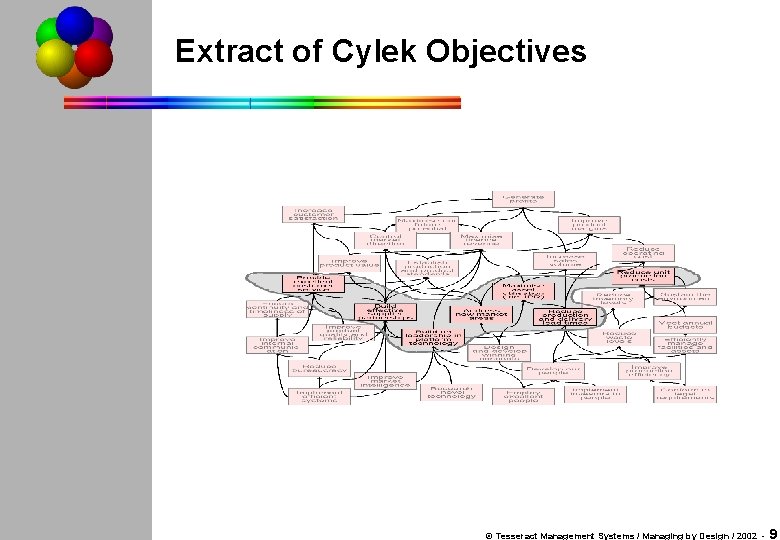
Extract of Cylek Objectives © Tesseract Management Systems / Managing by Design / 2002 - 9
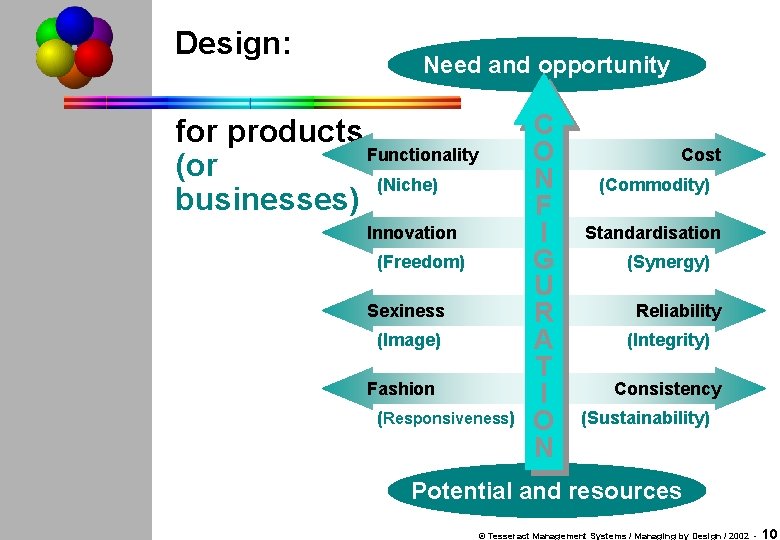
Design: Need and opportunity for products Functionality (or (Niche) businesses) Innovation (Freedom) Sexiness (Image) Fashion (Responsiveness) C O N F I G U R A T I O N Cost (Commodity) Standardisation (Synergy) Reliability (Integrity) Consistency (Sustainability) Potential and resources © Tesseract Management Systems / Managing by Design / 2002 - 10
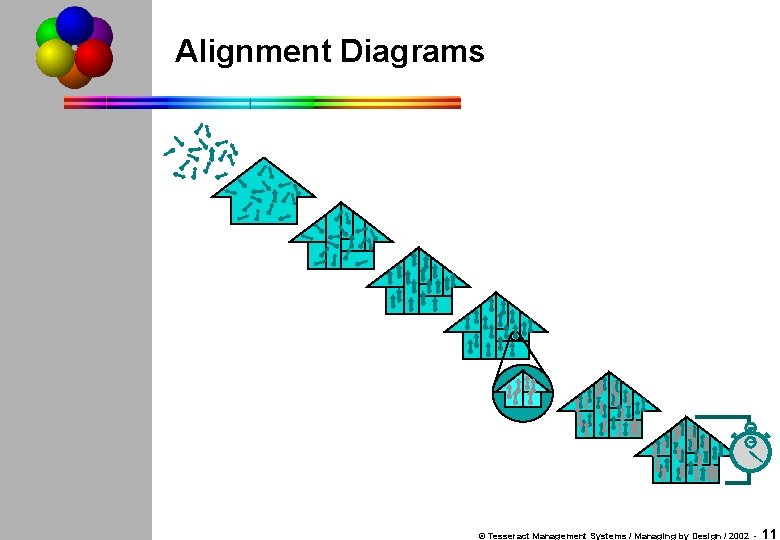
Alignment Diagrams © Tesseract Management Systems / Managing by Design / 2002 - 11
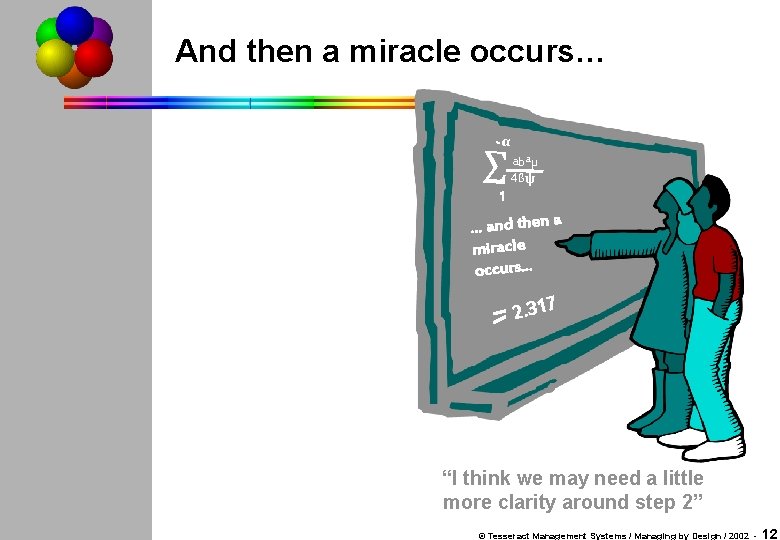
And then a miracle occurs… -α Σ abªµ 4ßψ 1 … and then a miracle occurs… 2. 317 “I think we may need a little more clarity around step 2” © Tesseract Management Systems / Managing by Design / 2002 - 12
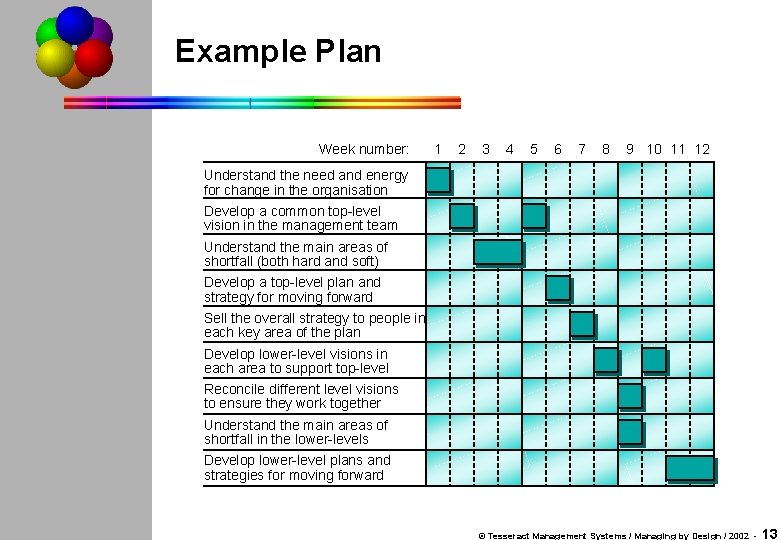
Example Plan Week number: 1 2 3 4 5 6 7 8 9 10 11 12 Understand the need and energy for change in the organisation Develop a common top-level vision in the management team Understand the main areas of shortfall (both hard and soft) Develop a top-level plan and strategy for moving forward Sell the overall strategy to people in each key area of the plan Develop lower-level visions in each area to support top-level Reconcile different level visions to ensure they work together Understand the main areas of shortfall in the lower-levels Develop lower-level plans and strategies for moving forward © Tesseract Management Systems / Managing by Design / 2002 - 13
The competition question Imagine our group has been called upon by ‘Harvard Business Review’ to judge a competition to identify the best: The competition has applicants from 3 companies: (Our organisation has been asked to be an independent judge and so cannot take part). We are allowed to see whatever we want, and to talk to whoever we want in selecting the winner. On what criteria do we base our decision? © Tesseract Management Systems / Managing by Design / 2002 - 14
Cylek’s competition answers? Customer satisfaction survey score Level of repeat business Business growth (in terms of turnover) Profitability (as value and percent of turnover) % Innovations introduced ahead of competition % Sales from products less than 2 years old % Competence growth (e. g. against skills matrix) Employee satisfaction survey score Business partner satisfaction survey score % Vacancies recruited internally % Levels of waste and rework % Annual process performance improvement Product comparison ranking (independent press) © Tesseract Management Systems / Managing by Design / 2002 - 15
Scientific Approach Question Imagine you are a team of scientists and engineers appointed by the benevolent owner of “Deep Thought” Ltd. (an organisation in the same business as your own) to improve its performance. You have no management skills, but are expert in the creative thinking and objective analysis that your discipline requires. It is for this, and your naivety in traditional management, that you have been selected. You are empowered to change anything, as long as you apply your professional discipline in doing so, but must not get embroiled in the day to day operation yourself. How do you begin to delight your new boss? © Tesseract Management Systems / Managing by Design / 2002 - 16
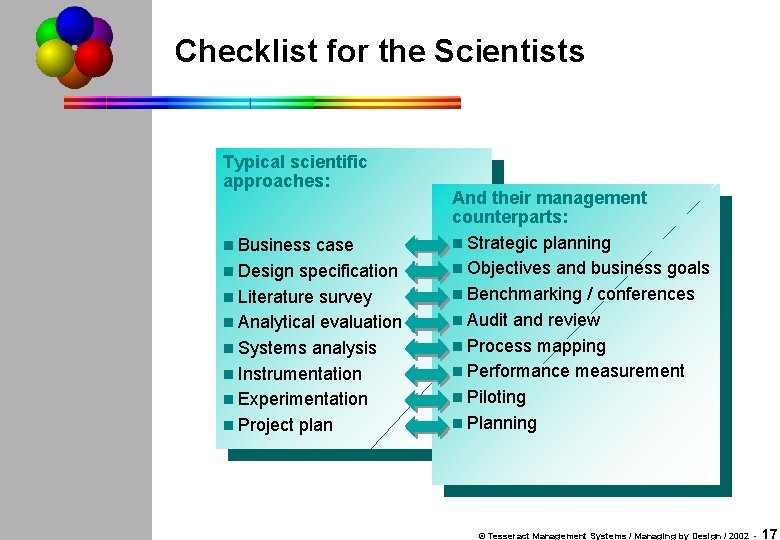
Checklist for the Scientists Typical scientific approaches: n Business case n Design specification n Literature survey n Analytical evaluation n Systems analysis n Instrumentation n Experimentation n Project plan And their management counterparts: n Strategic planning n Objectives and business goals n Benchmarking / conferences n Audit and review n Process mapping n Performance measurement n Piloting n Planning © Tesseract Management Systems / Managing by Design / 2002 - 17
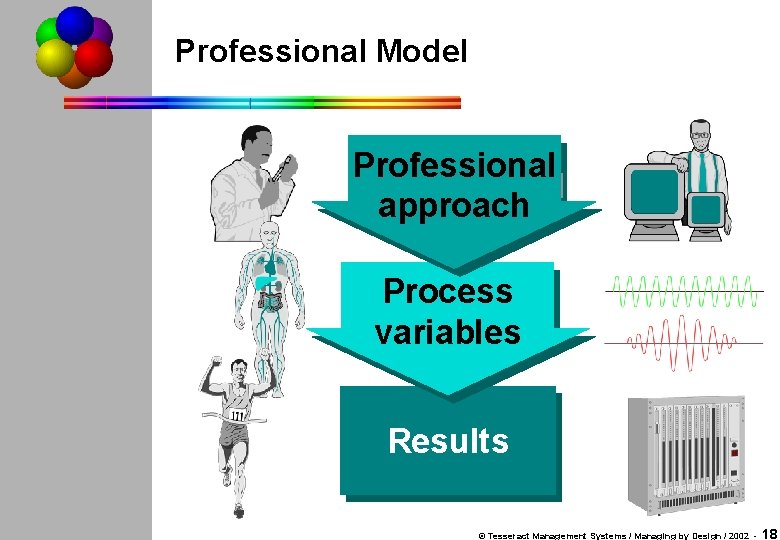
Professional Model Professional Fundamental approach randd Process Operational variables randd Results © Tesseract Management Systems / Managing by Design / 2002 - 18
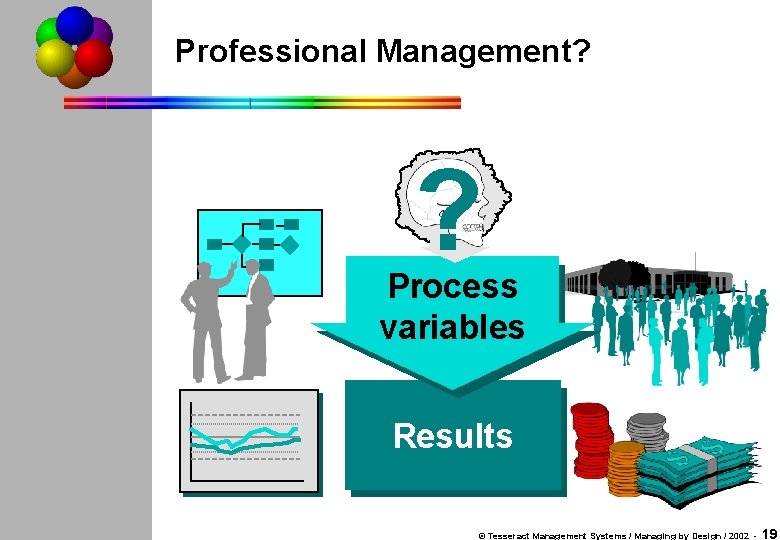
Professional Management? ? Process Operational variables randd Results © Tesseract Management Systems / Managing by Design / 2002 - 19
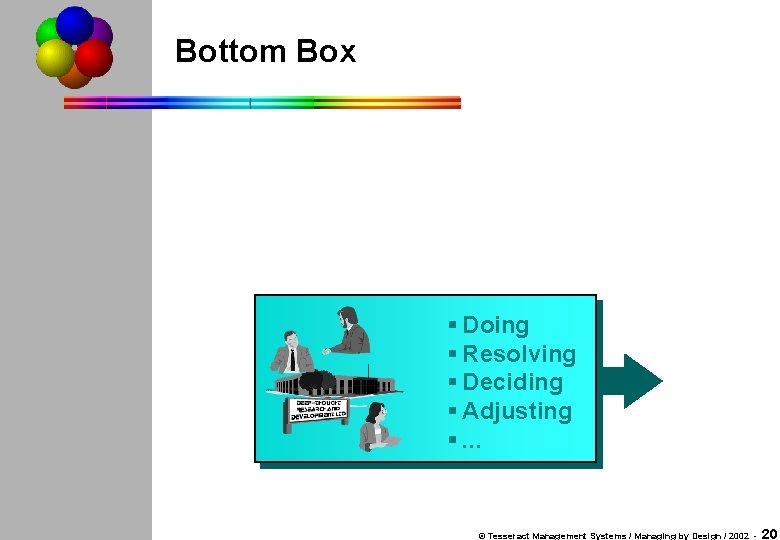
Bottom Box § Doing § Resolving § Deciding § Adjusting §. . . © Tesseract Management Systems / Managing by Design / 2002 - 20
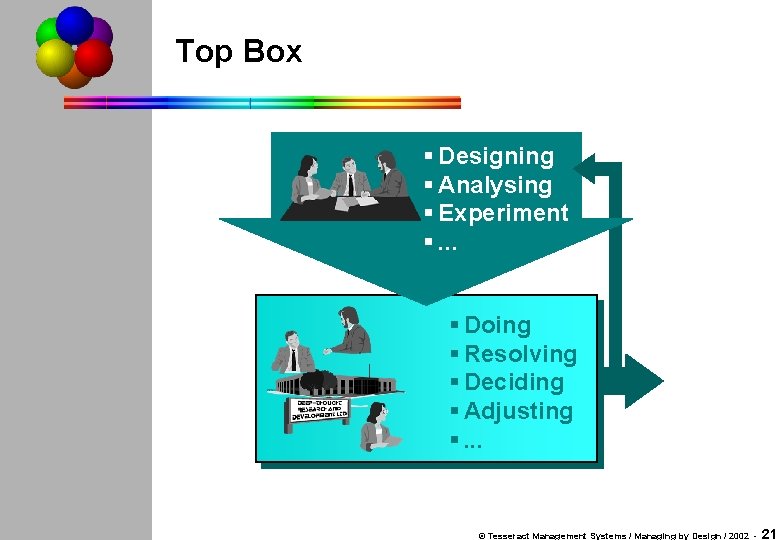
Top Box § Designing § Analysing § Experiment §. . . § Doing § Resolving § Deciding § Adjusting §. . . © Tesseract Management Systems / Managing by Design / 2002 - 21
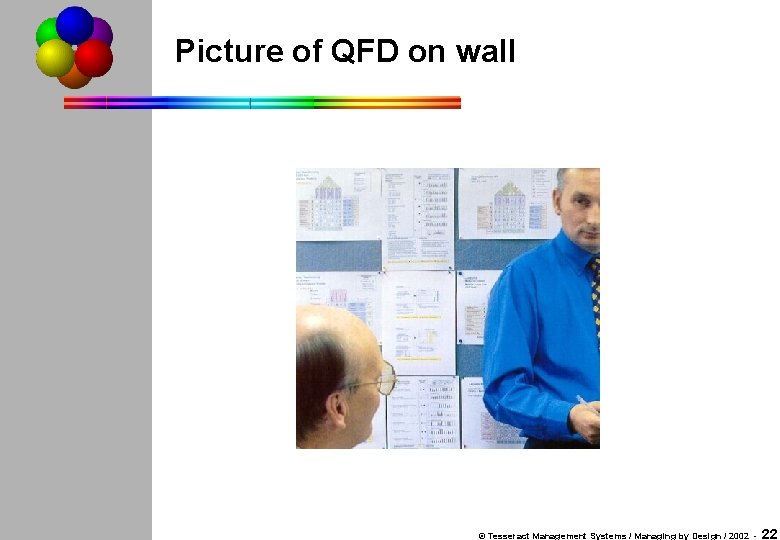
Picture of QFD on wall © Tesseract Management Systems / Managing by Design / 2002 - 22
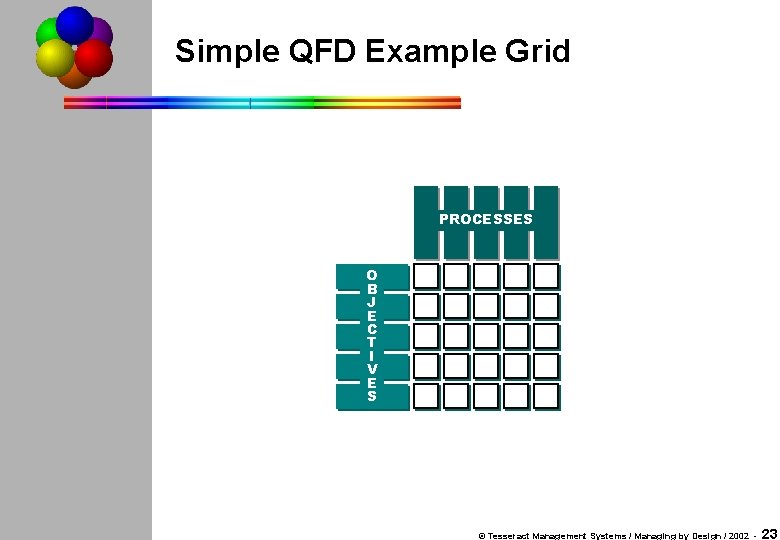
Simple QFD Example Grid PROCESSES O B J E C T I V E S © Tesseract Management Systems / Managing by Design / 2002 - 23
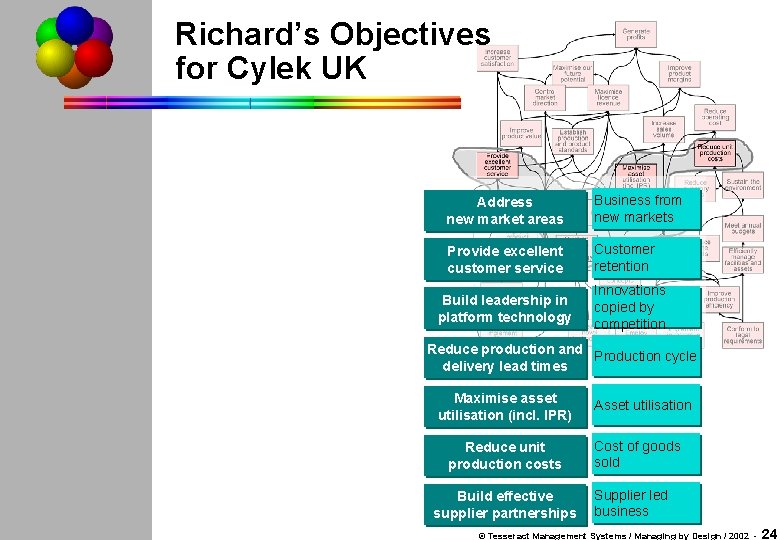
Richard’s Objectives for Cylek UK Address new market areas Business from new markets Provide excellent customer service Customer retention Build leadership in platform technology Innovations copied by competition Reduce production and Production cycle delivery lead times Maximise asset utilisation (incl. IPR) Reduce unit production costs Build effective supplier partnerships Asset utilisation Cost of goods sold Supplier led business © Tesseract Management Systems / Managing by Design / 2002 - 24
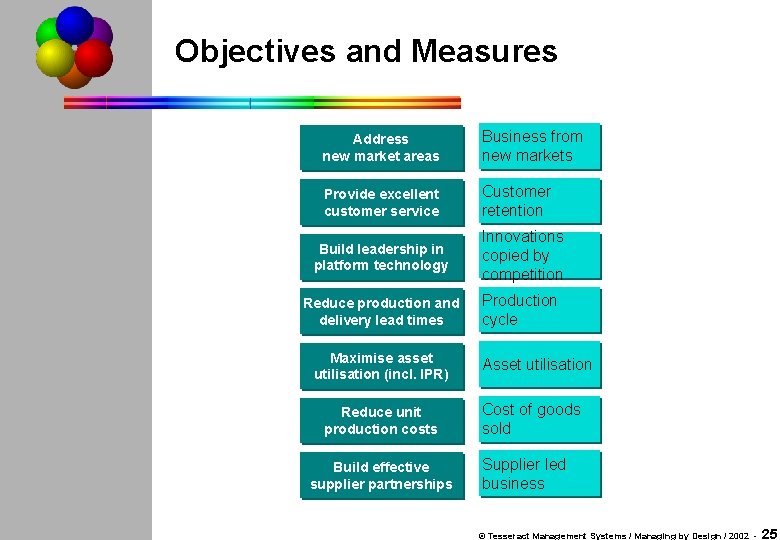
Objectives and Measures Address new market areas Business from new markets Provide excellent customer service Customer retention Build leadership in platform technology Innovations copied by competition Reduce production and delivery lead times Production cycle Maximise asset utilisation (incl. IPR) Reduce unit production costs Build effective supplier partnerships Asset utilisation Cost of goods sold Supplier led business © Tesseract Management Systems / Managing by Design / 2002 - 25
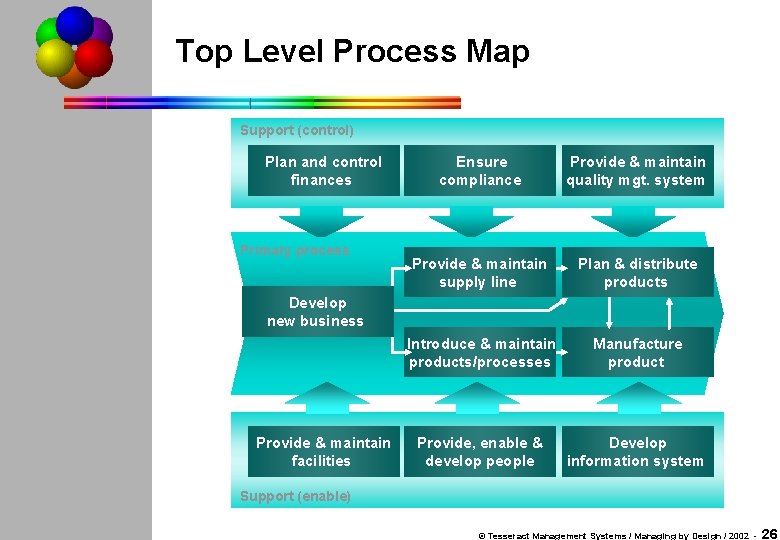
Top Level Process Map Support (control) Plan and control finances Primary process Ensure compliance Provide & maintain quality mgt. system Provide & maintain supply line Plan & distribute products Introduce & maintain products/processes Manufacture product Provide, enable & develop people Develop information system Develop new business Provide & maintain facilities Support (enable) © Tesseract Management Systems / Managing by Design / 2002 - 26
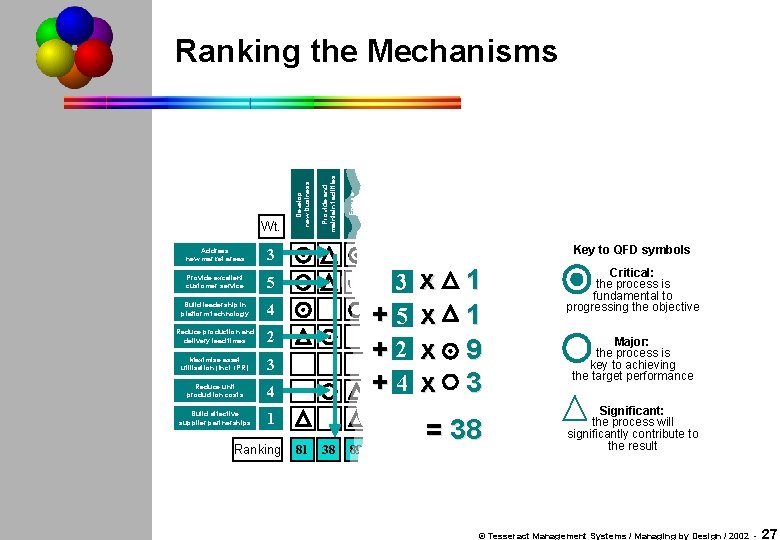
Address new market areas 3 Provide excellent customer service 5 Build leadership in platform technology 4 Reduce production and delivery lead times 2 Maximise asset utilisation (incl. IPR) 3 Reduce unit production costs 4 Build effective supplier partnerships 1 Ranking Ensure compliance Provide and maintain facilities Wt. Develop new business Ranking the Mechanisms Key to QFD symbols 3 +5 +2 +4 81 38 89 x x 1 1 9 3 = 38 Critical: the process is fundamental to progressing the objective Major: the process is key to achieving the target performance Significant: the process will significantly contribute to the result © Tesseract Management Systems / Managing by Design / 2002 - 27
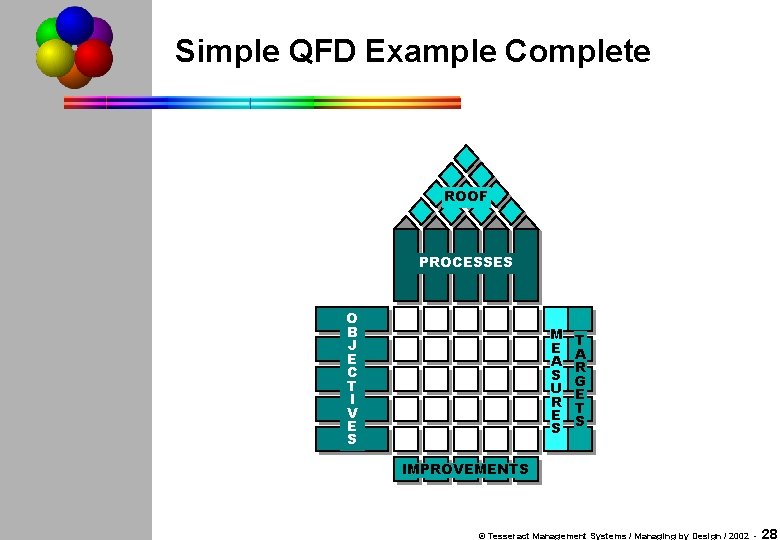
Simple QFD Example Complete ROOF PROCESSES O B J E C T I V E S M E A S U R E S T A R G E T S IMPROVEMENTS © Tesseract Management Systems / Managing by Design / 2002 - 28
- Slides: 28