
Managing Business Performance The Challenge of Intangible Assets

Managing Business Performance: The Challenge of Intangible Assets Prepared by Dr. David P. Norton Author, The Balanced Scorecard Prepared for WPI Events September ― October, 2012
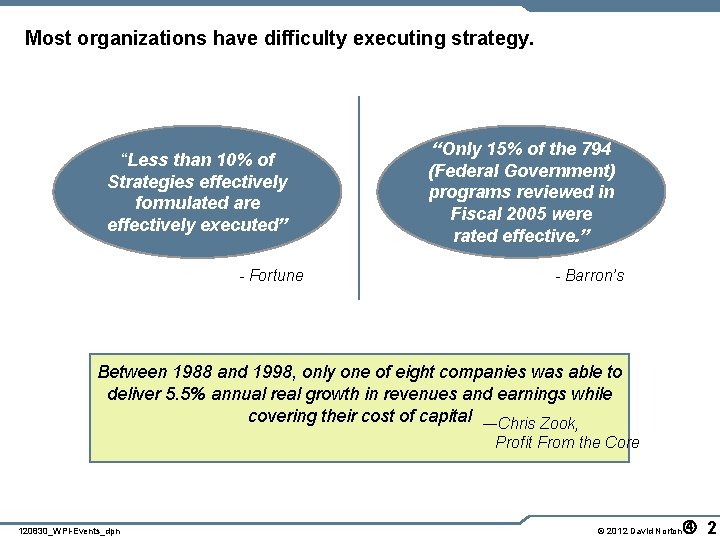
Most organizations have difficulty executing strategy. “Less than 10% of Strategies effectively formulated are effectively executed” - Fortune “Only 15% of the 794 (Federal Government) programs reviewed in Fiscal 2005 were rated effective. ” - Barron’s Between 1988 and 1998, only one of eight companies was able to deliver 5. 5% annual real growth in revenues and earnings while covering their cost of capital ―Chris Zook, Profit From the Core 120830_WPI-Events_dpn 2 © 2012 David Norton
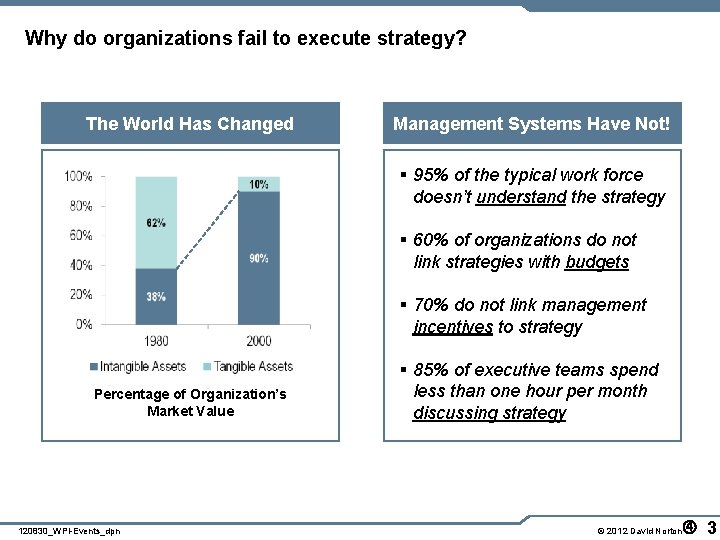
Why do organizations fail to execute strategy? The World Has Changed Management Systems Have Not! § 95% of the typical work force doesn’t understand the strategy § 60% of organizations do not link strategies with budgets § 70% do not link management incentives to strategy Percentage of Organization’s Market Value 120830_WPI-Events_dpn § 85% of executive teams spend less than one hour per month discussing strategy 3 © 2012 David Norton
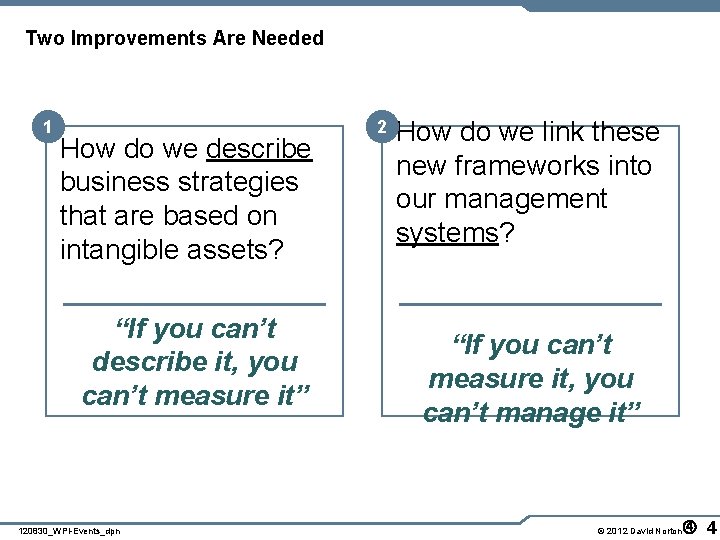
Two Improvements Are Needed 1 How do we describe business strategies that are based on intangible assets? “If you can’t describe it, you can’t measure it” 120830_WPI-Events_dpn 2 How do we link these new frameworks into our management systems? “If you can’t measure it, you can’t manage it” 4 © 2012 David Norton
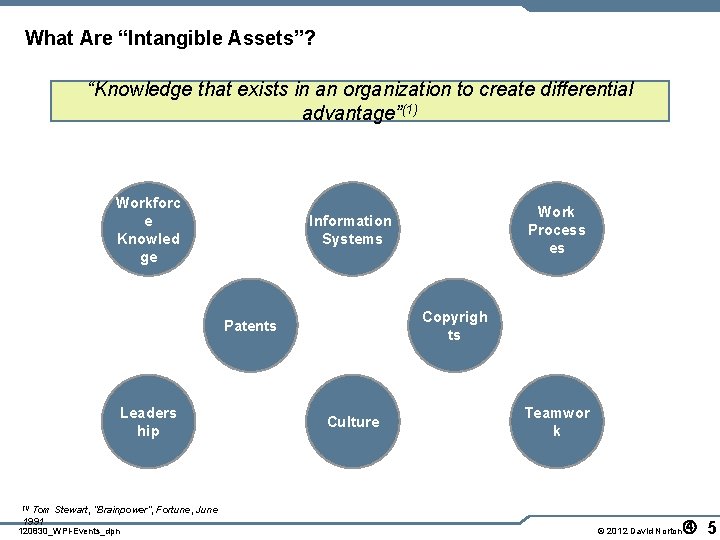
What Are “Intangible Assets”? “Knowledge that exists in an organization to create differential advantage”(1) Workforc e Knowled ge Copyrigh ts Patents Leaders hip (1) Tom 1991 Work Process es Information Systems Culture Teamwor k Stewart, “Brainpower”, Fortune, June 120830_WPI-Events_dpn 5 © 2012 David Norton
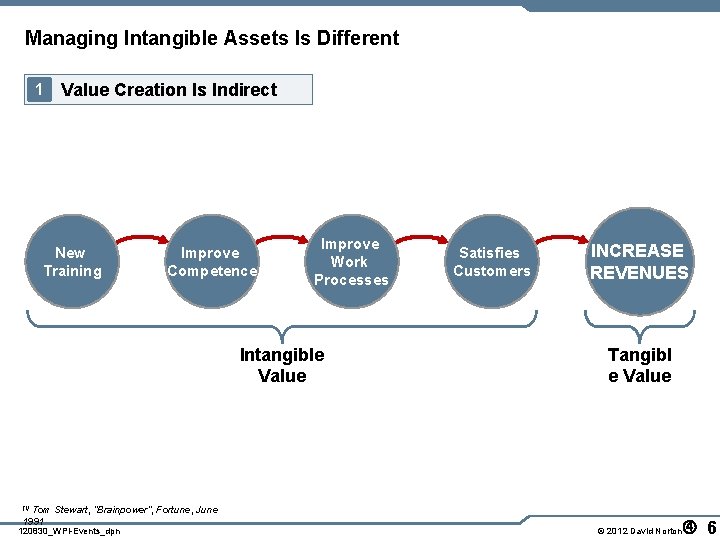
Managing Intangible Assets Is Different 1 Value Creation Is Indirect New Training Improve Competence Improve Work Processes Intangible Value (1) Tom 1991 Satisfies Customers INCREASE REVENUES Tangibl e Value Stewart, “Brainpower”, Fortune, June 120830_WPI-Events_dpn 6 © 2012 David Norton
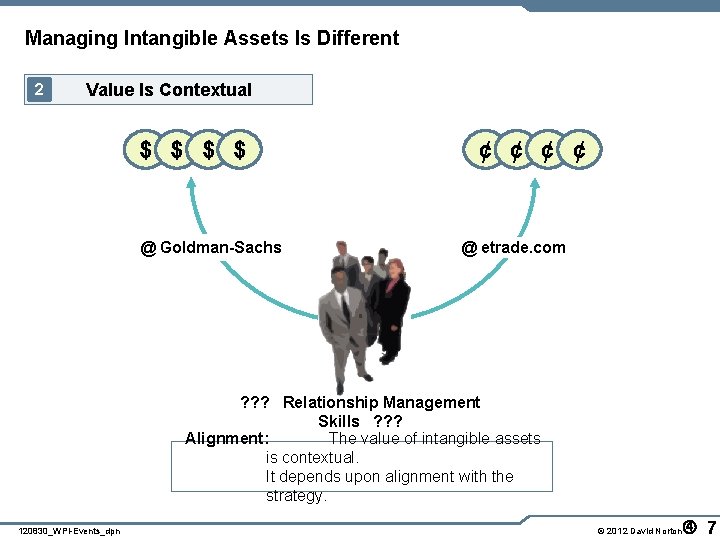
Managing Intangible Assets Is Different 2 Value Is Contextual $ $ @ Goldman-Sachs ¢ ¢ @ etrade. com ? ? ? Relationship Management Skills ? ? ? Alignment: The value of intangible assets is contextual. It depends upon alignment with the strategy. 120830_WPI-Events_dpn 7 © 2012 David Norton
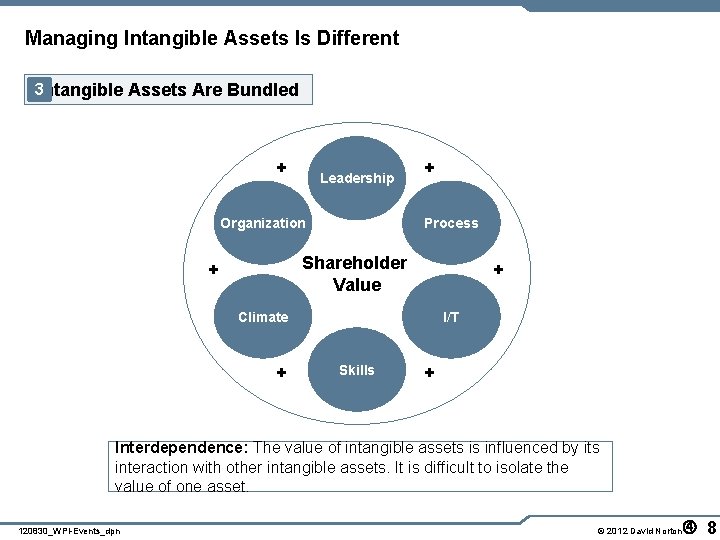
Managing Intangible Assets Is Different 3 Intangible Assets Are Bundled + Leadership Organization + Process Shareholder Value + + Climate + I/T Skills + Interdependence: The value of intangible assets is influenced by its interaction with other intangible assets. It is difficult to isolate the value of one asset. 120830_WPI-Events_dpn 8 © 2012 David Norton
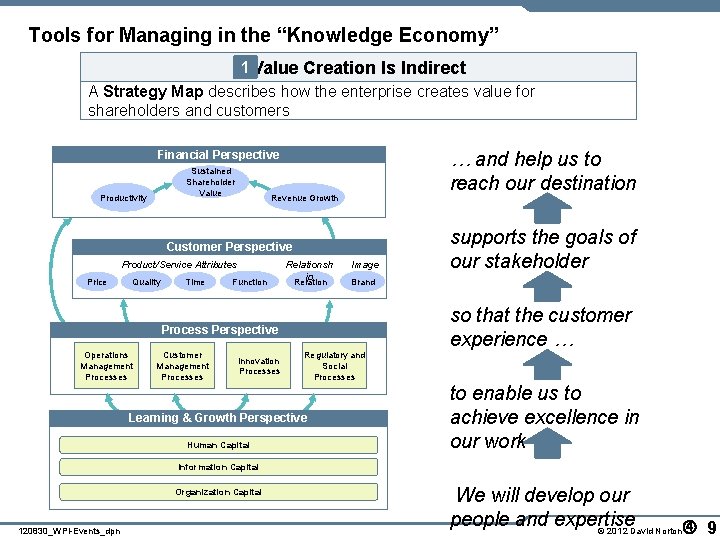
Tools for Managing in the “Knowledge Economy” 1 Value Creation Is Indirect A Strategy Map describes how the enterprise creates value for shareholders and customers … and help us to reach our destination Financial Perspective Sustained Shareholder Value Productivity Revenue Growth Customer Perspective Product/Service Attributes Price Quality Time Function Relationsh ip Relation Image Brand so that the customer experience … Process Perspective Operations Management Processes Customer Management Processes Innovation Processes Regulatory and Social Processes Learning & Growth Perspective Human Capital supports the goals of our stakeholder to enable us to achieve excellence in our work … Information Capital Organization Capital 120830_WPI-Events_dpn We will develop our people and expertise © 2012 David Norton 9
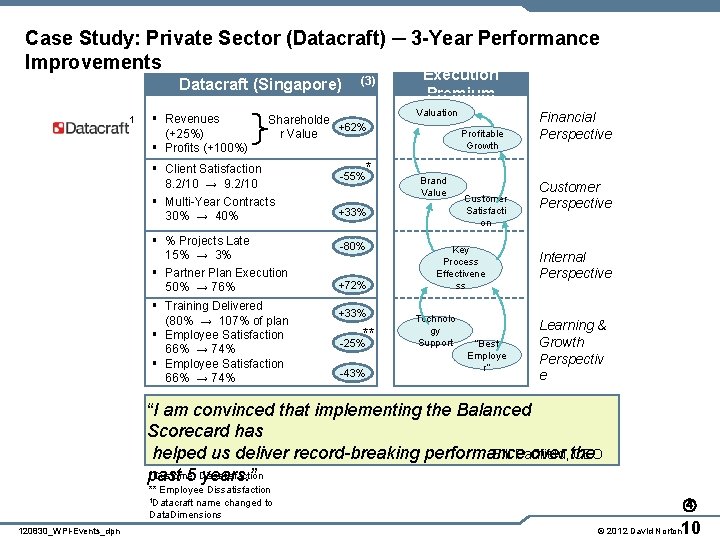
Case Study: Private Sector (Datacraft) ─ 3 -Year Performance Improvements Datacraft (Singapore) 1 § Revenues (+25%) § Profits (+100%) (3) Shareholde +62% r Value § Client Satisfaction 8. 2/10 → 9. 2/10 § Multi-Year Contracts 30% → 40% § % Projects Late 15% → 3% § Partner Plan Execution 50% → 76% § Training Delivered (80% → 107% of plan § Employee Satisfaction 66% → 74% -55% * Execution Premium Valuation Profitable Growth Brand Value +33% -80% +72% +33% ** -25% -43% Customer Satisfacti on Key Process Effectivene ss Technolo gy Support “Best Employe r” Financial Perspective Customer Perspective Internal Perspective Learning & Growth Perspectiv e “I am convinced that implementing the Balanced Scorecard has Bill Padfield, CEO helped us deliver record-breaking performance over the *Customer past 5 Dissatisfaction years. ” ** Employee Dissatisfaction 1 Datacraft name changed to Data. Dimensions 120830_WPI-Events_dpn © 2012 David Norton 10
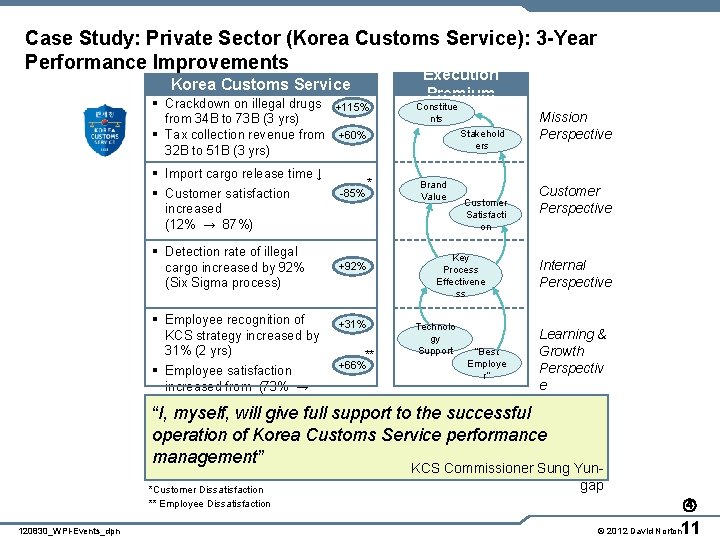
Case Study: Private Sector (Korea Customs Service): 3 -Year Performance Improvements Korea Customs Service § Crackdown on illegal drugs +115% from 34 B to 73 B (3 yrs) § Tax collection revenue from +60% 32 B to 51 B (3 yrs) § Import cargo release time ↓ § Customer satisfaction increased (12% → 87%) § Detection rate of illegal cargo increased by 92% (Six Sigma process) § Employee recognition of KCS strategy increased by 31% (2 yrs) § Employee satisfaction increased from (73% → 91%) -85% * +92% +31% ** +66% Execution Premium Constitue nts Stakehold ers Brand Value Customer Satisfacti on Key Process Effectivene ss Technolo gy Support “Best Employe r” Mission Perspective Customer Perspective Internal Perspective Learning & Growth Perspectiv e “I, myself, will give full support to the successful operation of Korea Customs Service performance management” *Customer Dissatisfaction ** Employee Dissatisfaction 120830_WPI-Events_dpn KCS Commissioner Sung Yungap © 2012 David Norton 11
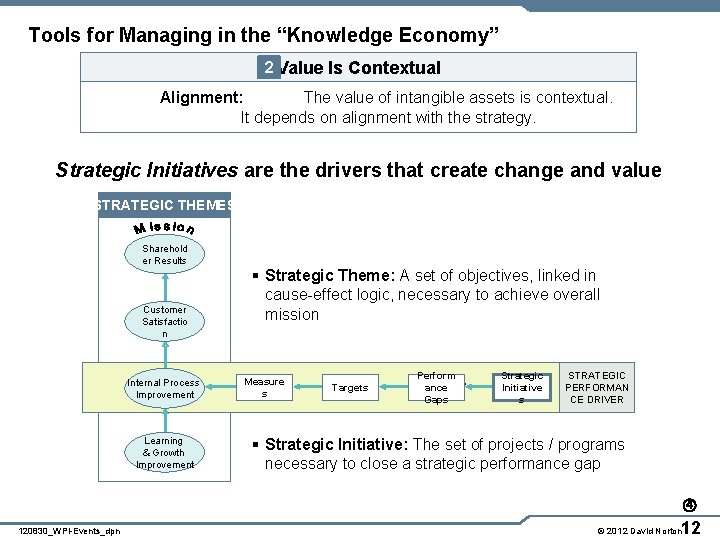
Tools for Managing in the “Knowledge Economy” 2 Value Is Contextual Alignment: The value of intangible assets is contextual. It depends on alignment with the strategy. Strategic Initiatives are the drivers that create change and value STRATEGIC THEMES Sharehold er Results Customer Satisfactio n Internal. Process Improvement Learning & Growth Improvement 120830_WPI-Events_dpn § Strategic Theme: A set of objectives, linked in cause-effect logic, necessary to achieve overall mission Measures s Perform Targets Performance Gaps Strategic Initiatives s STRATEGIC PERFORMAN CE DRIVER § Strategic Initiative: The set of projects / programs necessary to close a strategic performance gap © 2012 David Norton 12
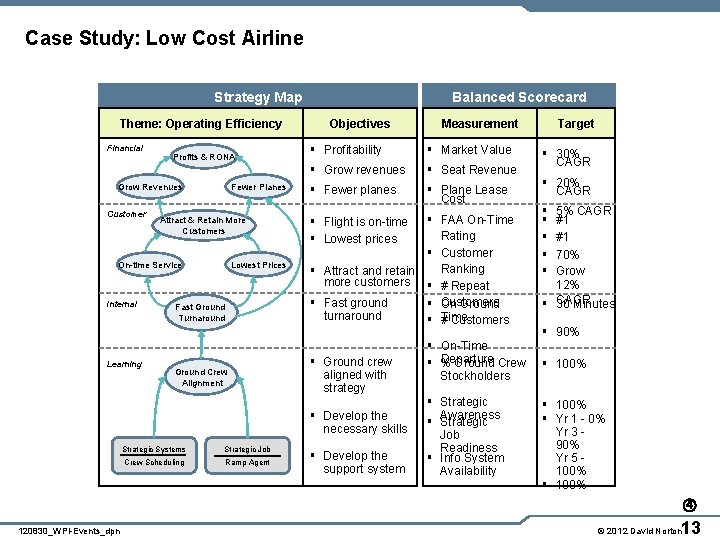
Case Study: Low Cost Airline Strategy Map Theme: Operating Efficiency Financial Profits & RONA Grow Revenues Customer Fewer Planes Attract & Retain More Customers On-time Service Internal Learning Lowest Prices Fast Ground Turnaround Ground Crew Alignment Balanced Scorecard Objectives § Profitability § Market Value § Grow revenues § Seat Revenue § Fewer planes § Plane Lease Cost § FAA On-Time Rating § Customer Ranking § Attract and retain more customers § # Repeat § Fast ground § Customers On Ground turnaround § Time # Customers § Flight is on-time § Lowest prices § Ground crew aligned with strategy § Develop the necessary skills 120830_WPI-Events_dpn Strategic Systems Strategic Job Crew Scheduling Ramp Agent Measurement § Develop the support system § On-Time Departure § % Ground Crew Stockholders § Strategic Awareness § Strategic Job Readiness § Info System Availability Target § 30% CAGR § 20% CAGR § § § 5% CAGR #1 #1 70% Grow 12% § CAGR 30 Minutes § 90% § 100% § Yr 1 - 0% Yr 3 90% Yr 5 100% § 100% © 2012 David Norton 13
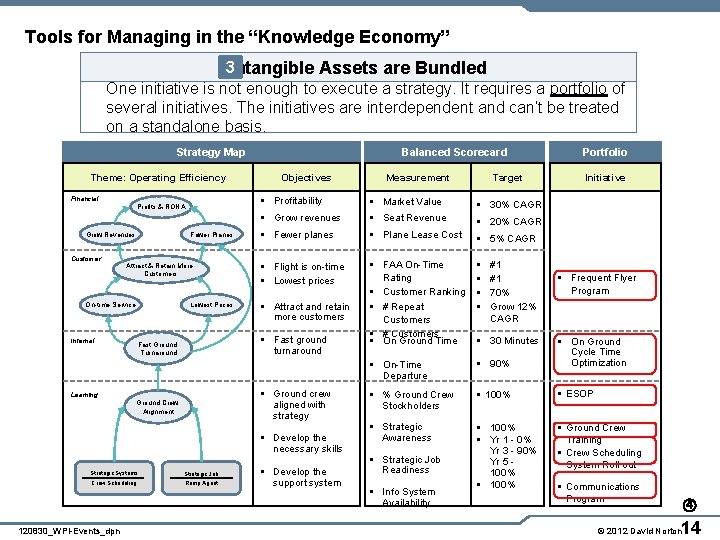
Tools for Managing in the “Knowledge Economy” 3 Intangible Assets are Bundled One initiative is not enough to execute a strategy. It requires a portfolio of several initiatives. The initiatives are interdependent and can’t be treated on a standalone basis. Strategy Map Theme: Operating Efficiency Financial Profits & RONA Grow Revenues Customer Fewer Planes Attract & Retain More Customers On-time Service Lowest Prices Internal Balanced Scorecard Objectives Ground Crew Alignment § 30% CAGR § Grow revenues § Seat Revenue § 20% CAGR § Fewer planes § Plane Lease Cost § 5% CAGR § Flight is on-time § Lowest prices § FAA On-Time Rating § Customer Ranking § # Repeat Customers § # Customers § On Ground Time § § § On-Time Departure § 90% § On Ground Cycle Time Optimization § % Ground Crew Stockholders § 100% § ESOP § Strategic Awareness § 100% § Yr 1 - 0% Yr 3 - 90% Yr 5 100% § Ground Crew Training § Crew Scheduling System Roll out § Attract and retain more customers § Develop the necessary skills Strategic Systems Strategic Job Crew Scheduling Ramp Agent 120830_WPI-Events_dpn Initiative § Market Value § Ground crew aligned with strategy Learning Target § Profitability § Fast ground turnaround Fast Ground Turnaround Measurement Portfolio § Develop the support system § Strategic Job Readiness § Info System Availability #1 #1 70% Grow 12% CAGR § 30 Minutes § Frequent Flyer Program § Communications Program © 2012 David Norton 14
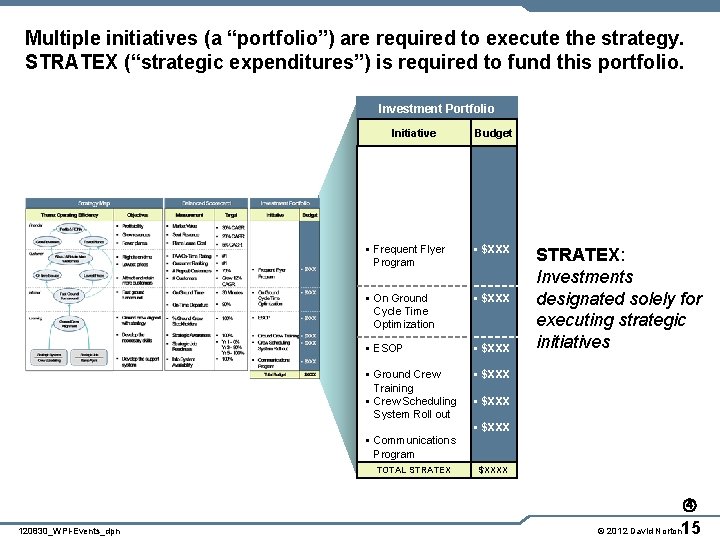
Multiple initiatives (a “portfolio”) are required to execute the strategy. STRATEX (“strategic expenditures”) is required to fund this portfolio. Investment Portfolio Initiative Budget § Frequent Flyer Program § $XXX § On Ground Cycle Time Optimization § $XXX § ESOP § $XXX § Ground Crew Training § Crew Scheduling System Roll out § $XXX STRATEX: Investments designated solely for executing strategic initiatives § $XXX § Communications Program TOTAL STRATEX 120830_WPI-Events_dpn $XXXX © 2012 David Norton 15
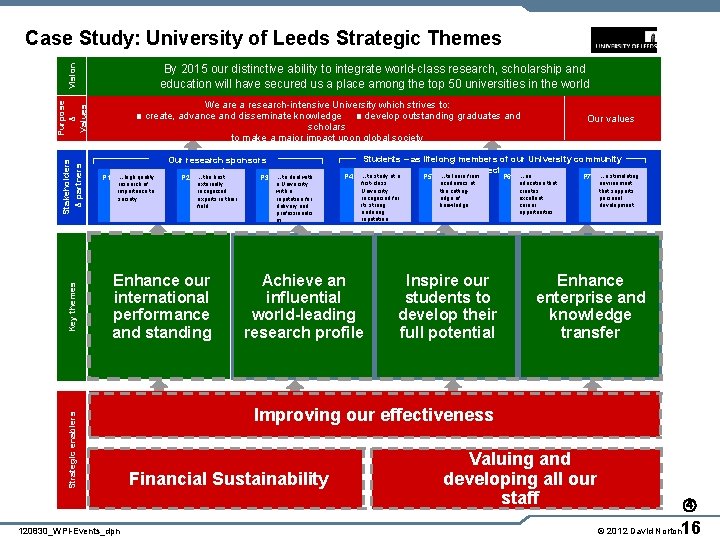
Case Study: University of Leeds Strategic Themes Vision By 2015 our distinctive ability to integrate world-class research, scholarship and education will have secured us a place among the top 50 universities in the world P 1 …high quality research of importance to society Our research sponsors expect … P 2 …the best externally recognized experts in their field Enhance our international performance and standing Strategic enablers Key themes Stakeholders & partners Purpose & Values We are a research-intensive University which strives to: ■ create, advance and disseminate knowledge ■ develop outstanding graduates and scholars to make a major impact upon global society 120830_WPI-Events_dpn P 3 …to deal with a University with a reputation for delivery and professionalis m P 4 Our values Students – as lifelong members of our University community expect … …to study at a first-class University recognised for its strong, enduring reputation Achieve an influential world-leading research profile P 5 …to learn from academics at the cuttingedge of knowledge Inspire our students to develop their full potential P 6 …an education that creates excellent career opportunities P 7 …a stimulating environment that supports personal development Enhance enterprise and knowledge transfer Improving our effectiveness Financial sustainability Financial Sustainability Valuing and developing all our staff © 2012 David Norton 16
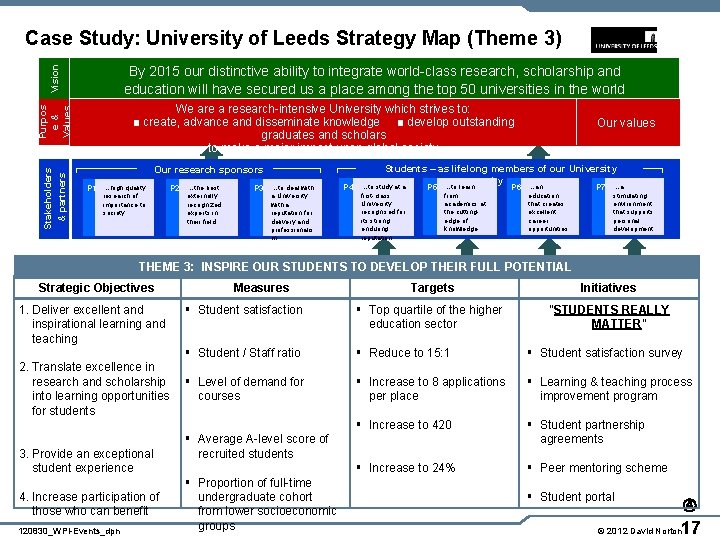
Vision Case Study: University of Leeds Strategy Map (Theme 3) By 2015 our distinctive ability to integrate world-class research, scholarship and education will have secured us a place among the top 50 universities in the world Stakeholders & partners Purpos e& Values We are a research-intensive University which strives to: ■ create, advance and disseminate knowledge ■ develop outstanding graduates and scholars to make a major impact upon global society P 1 …high quality Our research sponsors expect … research of importance to society P 2 …the best externally recognized experts in their field P 3 …to deal with a University with a reputation for delivery and professionalis m P 4 Our values Students – as lifelong members of our University community expect … …to study at a first-class University recognised for its strong, enduring reputation P 5 …to learn from academics at the cuttingedge of knowledge P 6 …an education that creates excellent career opportunities P 7 …a stimulating environment that supports personal development THEME 3: INSPIRE OUR STUDENTS TO DEVELOP THEIR FULL POTENTIAL Strategic Objectives 1. Deliver excellent and inspirational learning and teaching 2. Translate excellence in research and scholarship into learning opportunities for students 3. Provide an exceptional student experience 4. Increase participation of those who can benefit 120830_WPI-Events_dpn Measures Targets Initiatives § Student satisfaction § Top quartile of the higher education sector § Student / Staff ratio § Reduce to 15: 1 § Student satisfaction survey § Level of demand for courses § Increase to 8 applications per place § Learning & teaching process improvement program § Increase to 420 § Student partnership agreements § Increase to 24% § Peer mentoring scheme § Average A-level score of recruited students § Proportion of full-time undergraduate cohort from lower socioeconomic groups “STUDENTS REALLY MATTER” § Student portal © 2012 David Norton 17
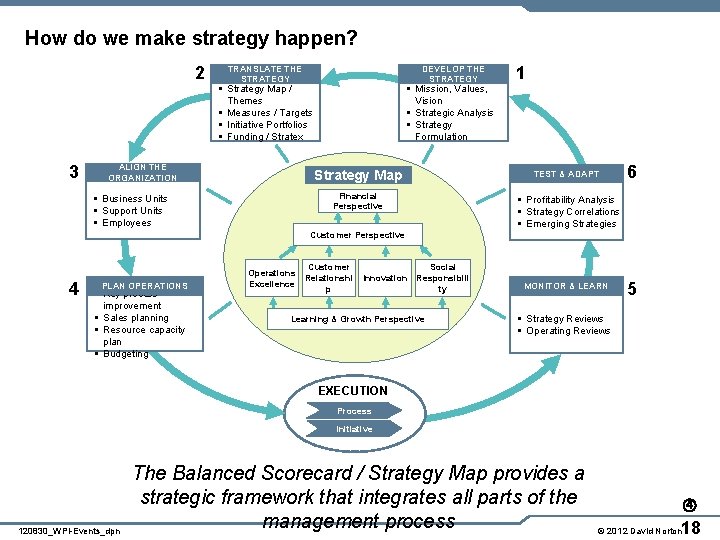
How do we make strategy happen? 2 3 TRANSLATE THE STRATEGY DEVELOP THE STRATEGY § Strategy Map / Themes § Measures / Targets § Initiative Portfolios § Funding / Stratex ALIGN THE ORGANIZATION § Business Units § Support Units § Employees § Mission, Values, Vision § Strategic Analysis § Strategy Formulation 1 Strategy Map TEST & ADAPT Financial Perspective § Profitability Analysis § Strategy Correlations § Emerging Strategies 6 Customer Perspective 4 PLAN OPERATIONS § Key process improvement § Sales planning § Resource capacity plan § Budgeting Operations Excellence Customer Relationshi p Social Innovation Responsibili ty Learning & Growth Perspective MONITOR & LEARN 5 § Strategy Reviews § Operating Reviews EXECUTION Process Initiative 120830_WPI-Events_dpn The Balanced Scorecard / Strategy Map provides a strategic framework that integrates all parts of the management process © 2012 David Norton 18
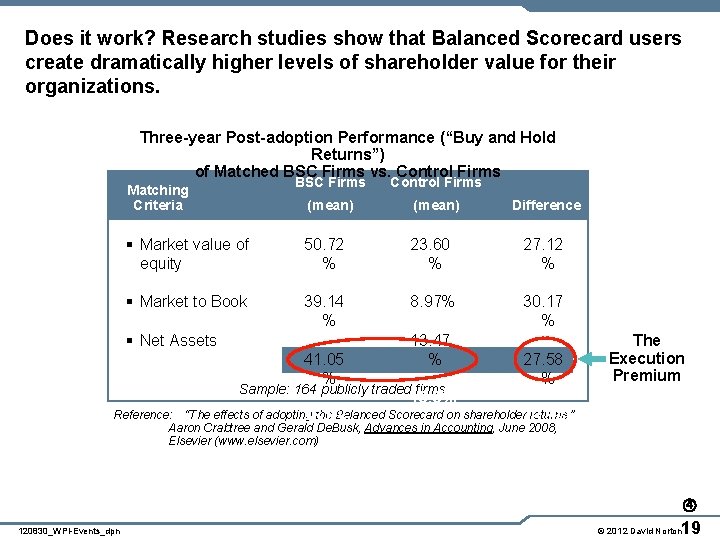
Does it work? Research studies show that Balanced Scorecard users create dramatically higher levels of shareholder value for their organizations. Three-year Post-adoption Performance (“Buy and Hold Returns”) of Matched BSC Firms vs. Control Firms BSC Firms Control Firms (mean) § Market value of equity 50. 72 % 23. 60 % 27. 12 % § Market to Book 39. 14 % 8. 97% 30. 17 % Matching Criteria § Net Assets 41. 05 % 13. 47 % Sample: 164 publicly traded firms Difference 27. 58 % The Execution Premium 15. 3% Reference: “The effects of adopting the Balanced Scorecard on shareholder 28. 3% returns, ” 43. 6% Aaron Crabtree and Gerald De. Busk, Advances in Accounting, June 2008, Elsevier (www. elsevier. com) 120830_WPI-Events_dpn © 2012 David Norton 19
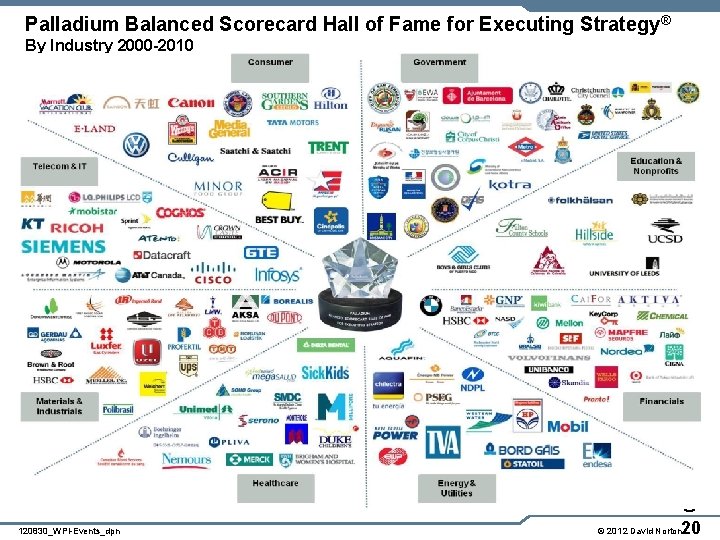
Palladium Balanced Scorecard Hall of Fame for Executing Strategy ® By Industry 2000 -2010 120830_WPI-Events_dpn © 2012 David Norton 20
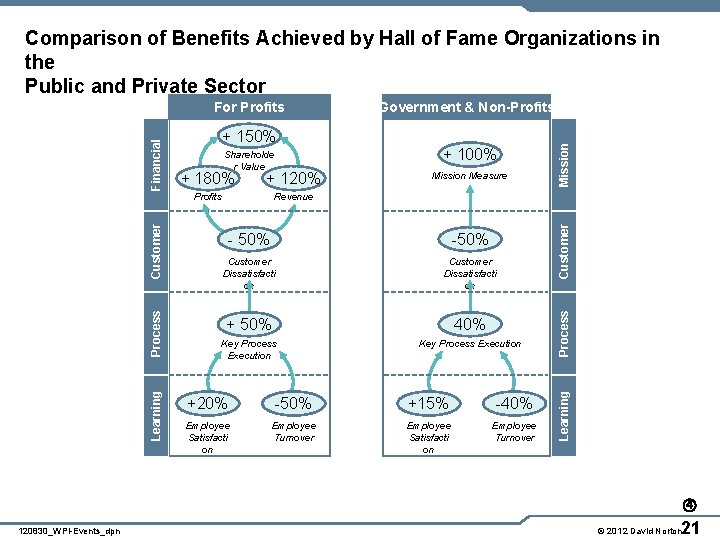
Comparison of Benefits Achieved by Hall of Fame Organizations in the Public and Private Sector 120830_WPI-Events_dpn + 180% + 120% Profits Revenue Mission Measure - 50% -50% Customer Dissatisfacti on + 50% 40% Key Process Execution +20% -50% +15% -40% Employee Satisfacti on Employee Turnover Customer + 100% Shareholde r Value Process + 150% Mission Government & Non-Profits Learning Process Customer Financial For Profits © 2012 David Norton 21
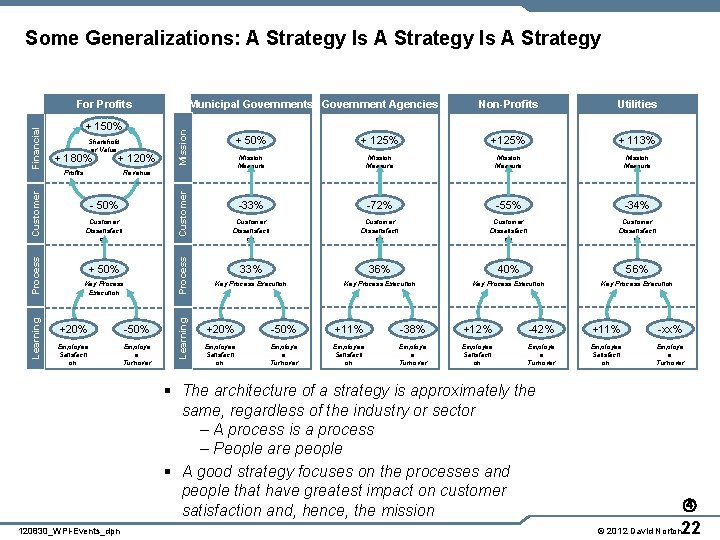
Some Generalizations: A Strategy Is A Strategy Municipal Governments Government Agencies Sharehold er Value + 120% Profits Revenue Customer + 180% Mission + 150% - 50% Process Customer Dissatisfacti on + 50% Key Process Execution +20% -50% Employee Satisfacti on Employe e Turnover Learning Process Customer Financial For Profits Non-Profits Utilities + 50% + 125% + 113% Mission Measure -33% -72% -55% -34% Customer Dissatisfacti on 33% 36% 40% 56% Key Process Execution +20% -50% +11% -38% +12% -42% +11% -xx% Employee Satisfacti on Employe e Turnover § The architecture of a strategy is approximately the same, regardless of the industry or sector – A process is a process – People are people § A good strategy focuses on the processes and people that have greatest impact on customer satisfaction and, hence, the mission 120830_WPI-Events_dpn © 2012 David Norton 22
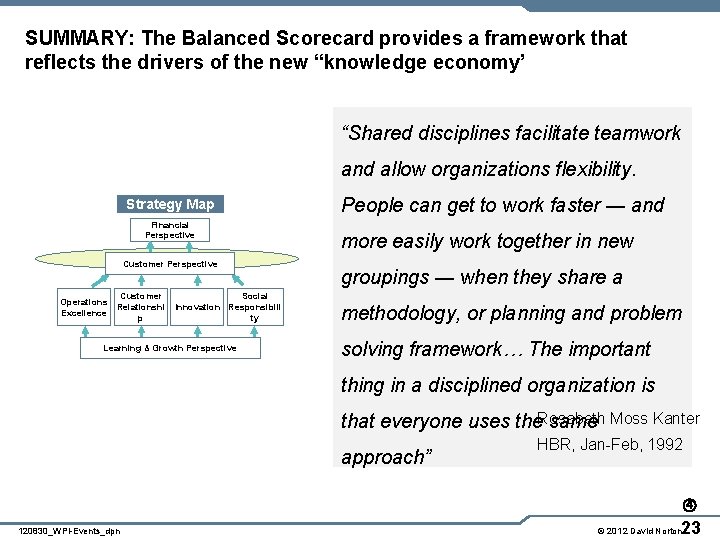
SUMMARY: The Balanced Scorecard provides a framework that reflects the drivers of the new “knowledge economy’ “Shared disciplines facilitate teamwork and allow organizations flexibility. Strategy Map Financial Perspective Customer Perspective Operations Excellence Customer Relationshi p Social Innovation Responsibili ty Learning & Growth Perspective People can get to work faster ― and more easily work together in new groupings ― when they share a methodology, or planning and problem solving framework… The important thing in a disciplined organization is that everyone uses the. Rosabeth same Moss Kanter approach” 120830_WPI-Events_dpn HBR, Jan-Feb, 1992 © 2012 David Norton 23
- Slides: 23