
Managing Adaptation to Environmental Change in Coastal Communities
![A Community Vulnerability Index (1) § CSVI = 0. 20 [FC+HC+SC+NC+PC] § Financial Capital](https://slidetodoc.com/presentation_image_h2/624108b507da305d2ff6be4bb572dfe7/image-46.jpg "A Community Vulnerability Index (1) § CSVI = 0. 20 [FC+HC+SC+NC+PC] § Financial Capital")
- Slides: 49
Managing Adaptation to Environmental Change in Coastal Communities: Canada and the Caribbean STATUS UPDATES IDRC Presentation, 30 November 2010
Outline § § § 1 October 2010 Project Objectives Case Study Sites Methodologies Work in Progress Community Engagement Student Training Papers in Progress Dissemination Activities Roadmap for 2011 Case Study 1: Grande Riviere, Trinidad Case Study 2: Georgetown, Guyana
Project Objectives § The creation and maintenance of mitigation and adaptation strategies for the impeding threats to coastal communities from sea-level rise and storm surges § To develop community awareness, infrastructure, and decision support tools for preparing for adaptation and mitigation strategies for the impacts of sea-level rise and storm surges on selected regional coastal communities in Canada and the Caribbean § a multidisciplinary approach, incorporating aspects of sociology, economics, management science, and geomatics engineering 2 October 2010
Case Study Sites § Grande Riviere: a small coastal village in Trinidad that surrounds a major spawning site for leatherback turtles, around which an eco-tourism industry is developing § Georgetown: the capital of Guyana, an urban centre that is below sea level § Bequia: a small island in the St. Vincent and the Grenadine chain that is the site of major tourism activities § Belize Barrier Reef: a reef ecosystem that is vital to the fisheries of Belize 3 October 2010
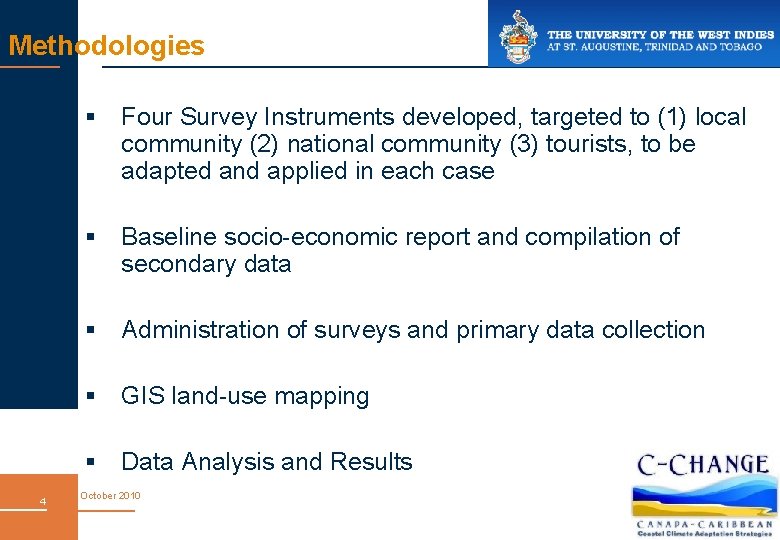
Methodologies § Four Survey Instruments developed, targeted to (1) local community (2) national community (3) tourists, to be adapted and applied in each case § Baseline socio-economic report and compilation of secondary data § Administration of surveys and primary data collection § GIS land-use mapping § Data Analysis and Results 4 October 2010
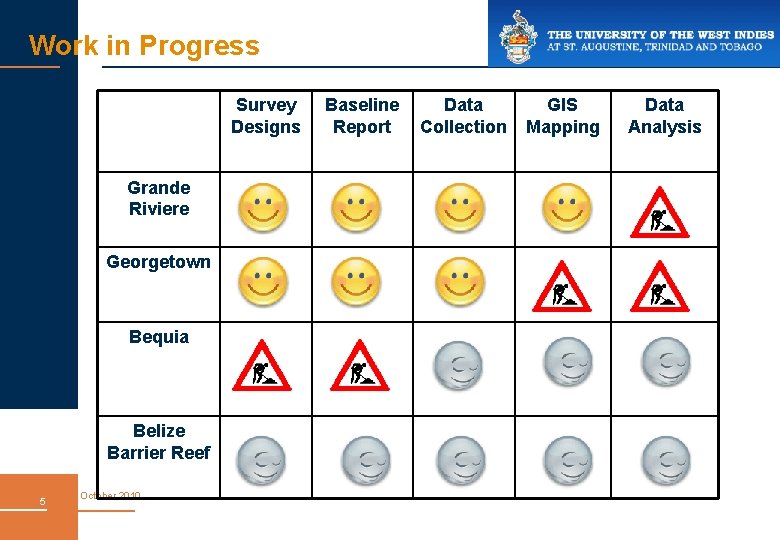
Work in Progress Survey Designs Grande Riviere Georgetown Bequia Belize Barrier Reef 5 October 2010 Baseline Report Data Collection GIS Mapping Data Analysis
Community Engagement § Grande Riviere, Trinidad Ø Turtle Village Trust, Grande Riviere Tour Guides Association Ø Conference on Eco-Tourism and Leatherback Turtles in Trinidad, July 2009 Ø Tour Guides assistance in data collection § Georgetown, Guyana Ø Housing 6 October 2010 and Planning Authority
Student Training I § Economics Ø 1 completed MSc student: • “Vulnerability to Sea Level Rise in an Urban Centre of a Developing Country: A Case Study of Georgetown, Guyana” Ø 1 new MSc student: Ø Biodiversity, Eco-Tourism and Sustainable Livelihoods: Empirical Linkages in Grande Riviere, Trinidad Ø 1 new Ph. D student: • Socio-Economic Vulnerability in Two Caribbean Coastal Sites: Bequia and Belize Barrier Reef 7 October 2010
Student Training II § Engineering Ø 4 completed undergraduate student projects (Geomatics Engineering and Land Management): • Developing a Predictive GIS Model of Sea Level Rise for a Selected Coastal Community • Social and economic impact of potential climate change on coastal communities • An Assessment of sea level scenarios and their impacts upon coastal communities. A case study of the coastal community of Grand Riviere 8 October 2010
Student Training III § Engineering Ø 1 completed MSc (Urban and Regional Planning) student: • “Adaptation Measures to Climate Change and Sea Level in Georgetown, Guyana” Ø 2 ongoing MSc (Urban and Regional Planning) students: • Structural and Non-Structural Adaptation Measures to Climate Change and Sea Level in Belize City, Belize • Adaptation Measures to Protect Sea Turtle Nesting Habitat: Climate Change, Sea Level Rise and Beach Erosion in Grand Riviere, Toco 9 October 2010
Student Training IV § Science and Agriculture Ø 2 ongoing Ph. D students • Sustainable Development of the Caribbean’s Coastlines • The effects of Seasonal Beach Dynamics on the Nests of the Leatherback Turtle (Dermochelys coriacea) at Matura and Grande Riviere, Trinidad 10 October 2010
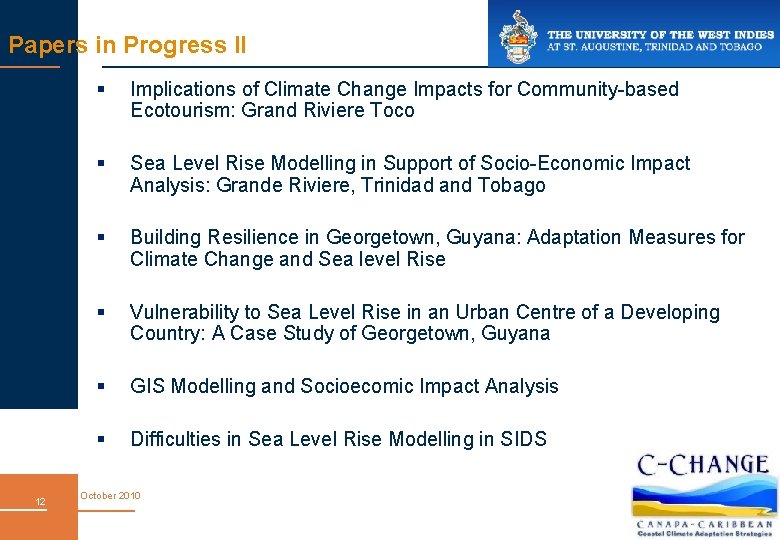
Papers in Progress I 11 § The Importance of Nature to Rural Communities in Developing Countries: Community Perceptions of Biodiversity and Ecosystem Services in Grande Riviere, Trinidad § A Rural Community Perspective of Climate Change in Developing Countries : State of Knowledge, Level of Concern and Perception of Risk § Raising Awareness of Climate Change in Rural Communities of Developing Countries: The Role of Social Media § Costing Adaptations to Climate Change and Sea Level Rise: The case of turtle nesting sites at Grand Riviere § GIS Applications and Coastal Setbacks as an Adaptation Measure to Climate Change and Sea Level Rise: Sea Turtle Nesting in Grande Riviere October 2010
Papers in Progress II 12 § Implications of Climate Change Impacts for Community-based Ecotourism: Grand Riviere Toco § Sea Level Rise Modelling in Support of Socio-Economic Impact Analysis: Grande Riviere, Trinidad and Tobago § Building Resilience in Georgetown, Guyana: Adaptation Measures for Climate Change and Sea level Rise § Vulnerability to Sea Level Rise in an Urban Centre of a Developing Country: A Case Study of Georgetown, Guyana § GIS Modelling and Socioecomic Impact Analysis § Difficulties in Sea Level Rise Modelling in SIDS October 2010
Dissemination Activities § Conference and Seminar Presentations Ø conference talks in 2009 -2010 § Academic Papers Ø papers in progress § Website http: //www. coastalchange. ca/ 13 October 2010
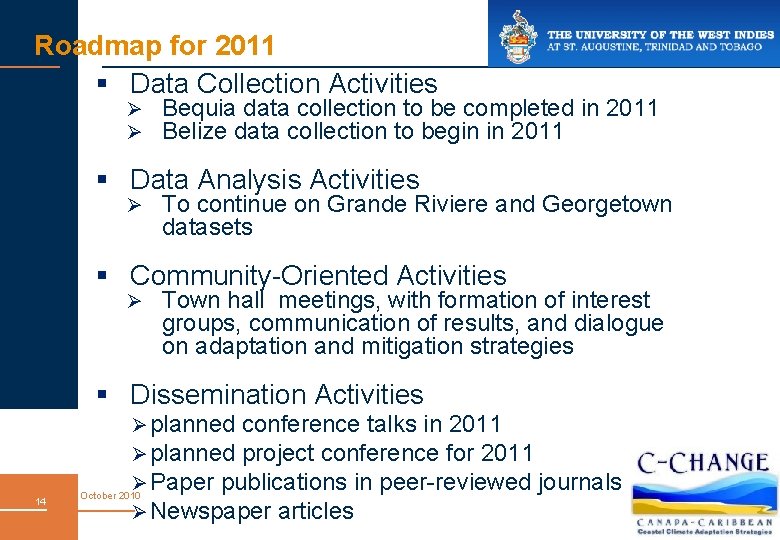
Roadmap for 2011 § Data Collection Activities Ø Ø Bequia data collection to be completed in 2011 Belize data collection to begin in 2011 § Data Analysis Activities Ø To continue on Grande Riviere and Georgetown datasets § Community-Oriented Activities Ø Town hall meetings, with formation of interest groups, communication of results, and dialogue on adaptation and mitigation strategies § Dissemination Activities 14 Ø planned conference talks in 2011 Ø planned project conference for 2011 Ø Paper publications in peer-reviewed journals October 2010 Ø Newspaper articles
Thank You! Patrick Watson: patrick. watson@sta. uwi. edu Sonja Teelucksingh: sonja. teelucksingh@sta. uwi. edu Michael Sutherland: Michael. sutherland@sta. uwi. edu BUT, if there is time for more……. 15 October 2010
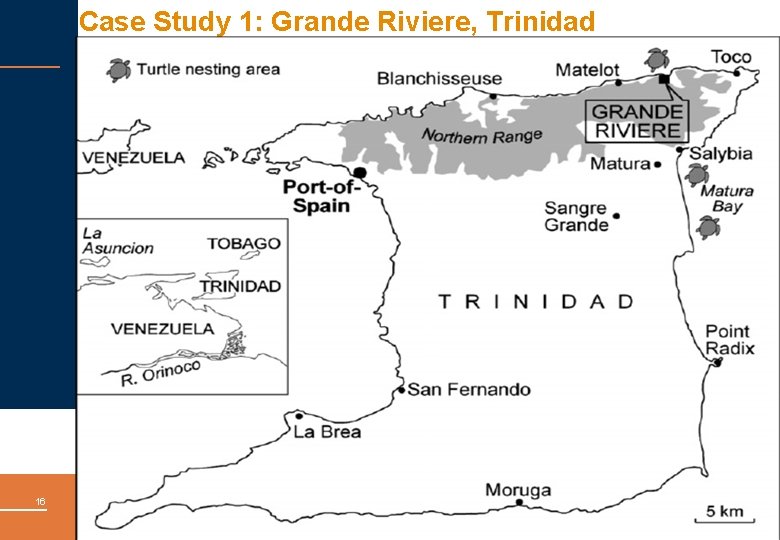
Case Study 1: Grande Riviere, Trinidad 16 October 2010
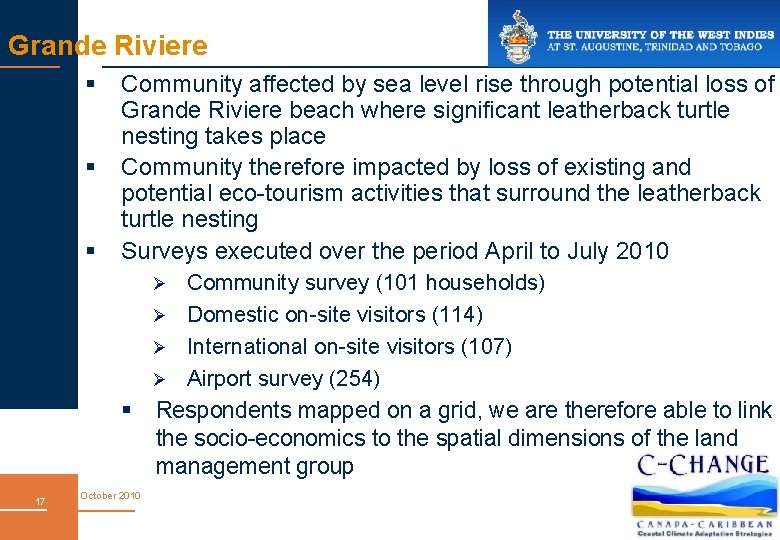
Grande Riviere § § § Community affected by sea level rise through potential loss of Grande Riviere beach where significant leatherback turtle nesting takes place Community therefore impacted by loss of existing and potential eco-tourism activities that surround the leatherback turtle nesting Surveys executed over the period April to July 2010 Community survey (101 households) Ø Domestic on-site visitors (114) Ø International on-site visitors (107) Ø Airport survey (254) § Respondents mapped on a grid, we are therefore able to link the socio-economics to the spatial dimensions of the land management group Ø 17 October 2010
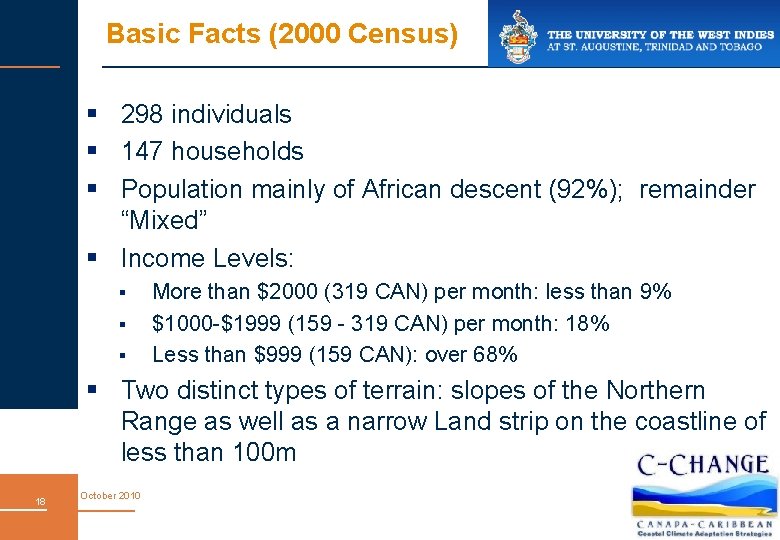
Basic Facts (2000 Census) § 298 individuals § 147 households § Population mainly of African descent (92%); remainder “Mixed” § Income Levels: § § § More than $2000 (319 CAN) per month: less than 9% $1000 -$1999 (159 - 319 CAN) per month: 18% Less than $999 (159 CAN): over 68% § Two distinct types of terrain: slopes of the Northern Range as well as a narrow Land strip on the coastline of less than 100 m 18 October 2010
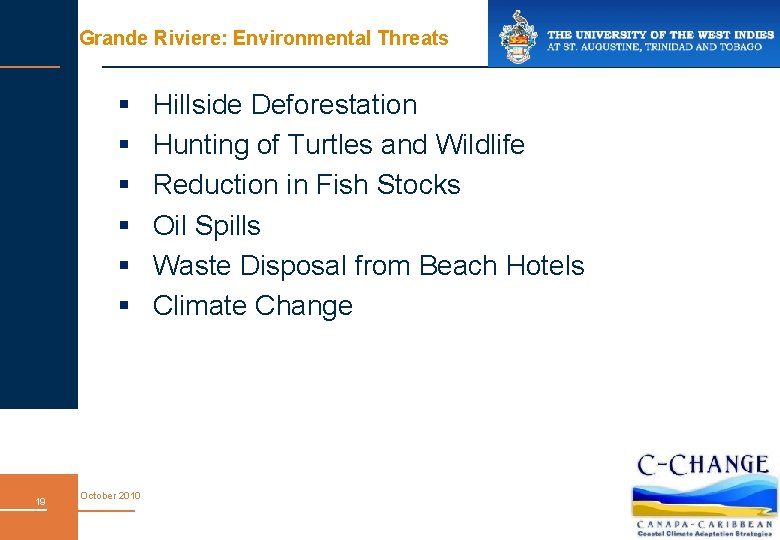
Grande Riviere: Environmental Threats § § § 19 October 2010 Hillside Deforestation Hunting of Turtles and Wildlife Reduction in Fish Stocks Oil Spills Waste Disposal from Beach Hotels Climate Change
Identification of Threats to Turtles § Underlying threats of climate change Ø Sea level rise can swamp small nesting beaches Ø Warming temperatures can affect gender § threats to nesting (beaches) § threats to foraging and migration (open waters) § Threats to nesting can be dealt with at community and national level (beach patrols) § Threats of open waters very difficult to manage 20 October 2010
Grande Riviere: Economic Potential § Rich in biodiversity and natural fauna § A popular eco-destination despite its remote location (4000 on turtle tours estimated yearly) § 4 small eco-resorts, 10 guesthouses § The Grande Riviere Nature Tour Guide Association managed by local residents § Community initiatives to protect the nesting turtles increasingly famous worldwide § Recently identified by British Airways Magazine as one of the top 50 beaches in the world 21 October 2010
Grande Riviere Survey Instruments 22 § Community Survey: to assess the attitudes and opinions of the community on (1) climatic issues (2) their interactions with nature § On Site National Visitors: To estimate and profile existing and potential national demand for eco-tourism surrounding the leatherback turtles in Grande Riviere § On Site International Visitors: To estimate and profile existing and potential international demand for eco-tourism surrounding the leatherback turtles in Grande Riviere § Off Site Visitors / Airport Surveys: To determine the potential demand for eco-tourism surrounding the leatherback turtles in Grande Riviere October 2010
Grande Riviere Community Survey § to assess their attitudes and opinions on: A. B. C. their interactions with nature the eco-tourism surrounding the turtle nesting climatic issues § 5 sections consisting of: 1. 2. 3. 4. 5. 23 October 2010 General Demographic Ecosystem Services Eco-Tourism and Leatherback Turtles Climate Change
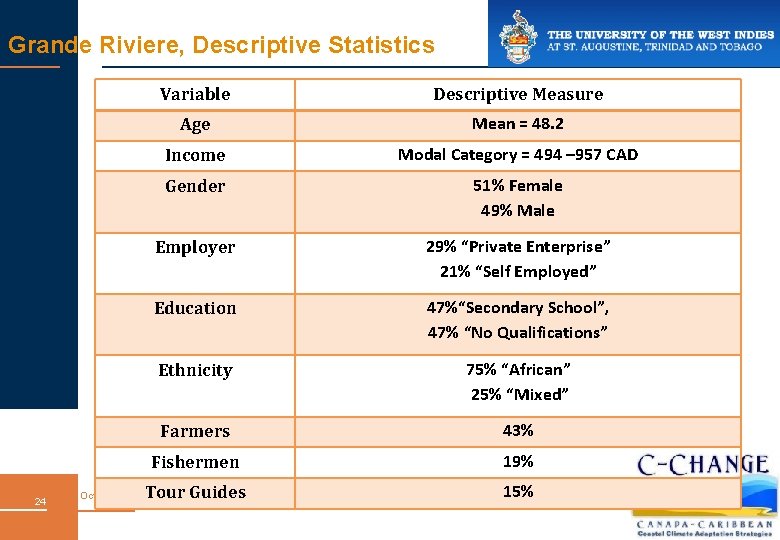
Grande Riviere, Descriptive Statistics 24 October 2010 Variable Descriptive Measure Age Mean = 48. 2 Income Modal Category = 494 – 957 CAD Gender 51% Female 49% Male Employer 29% “Private Enterprise” 21% “Self Employed” Education 47%“Secondary School”, 47% “No Qualifications” Ethnicity 75% “African” 25% “Mixed” Farmers 43% Fishermen 19% Tour Guides 15%
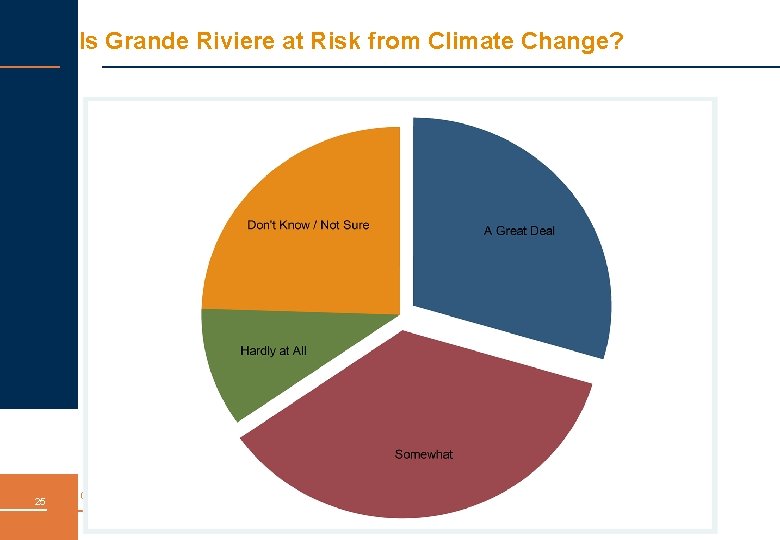
Is Grande Riviere at Risk from Climate Change? 25 October 2010
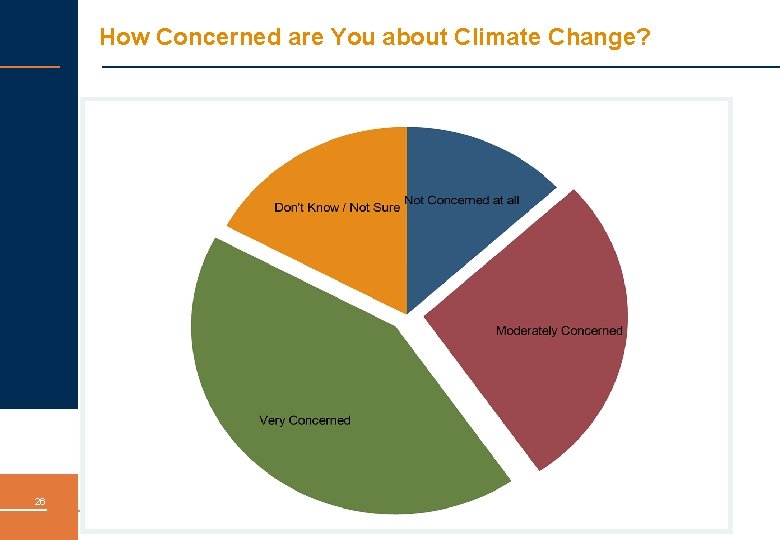
How Concerned are You about Climate Change? 26 October 2010
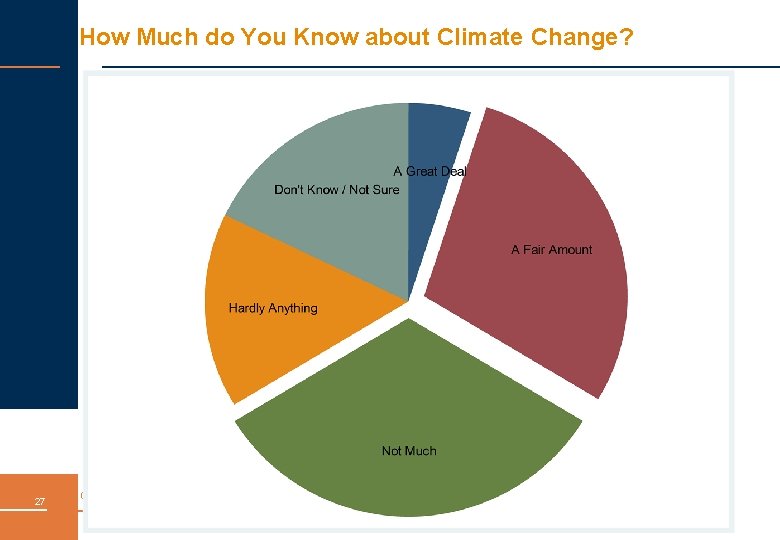
How Much do You Know about Climate Change? 27 October 2010
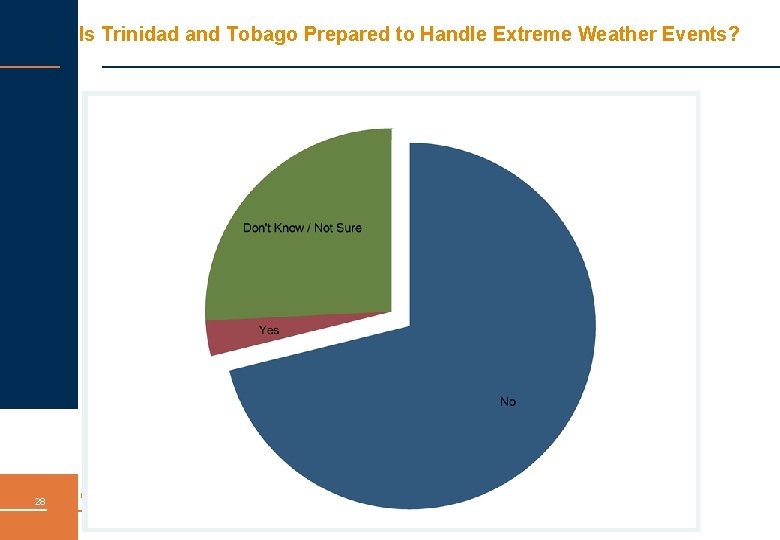
Is Trinidad and Tobago Prepared to Handle Extreme Weather Events? 28 October 2010
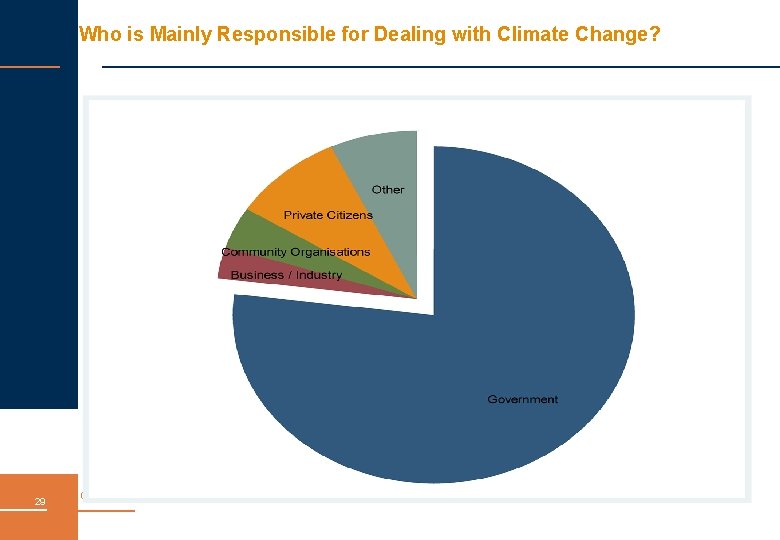
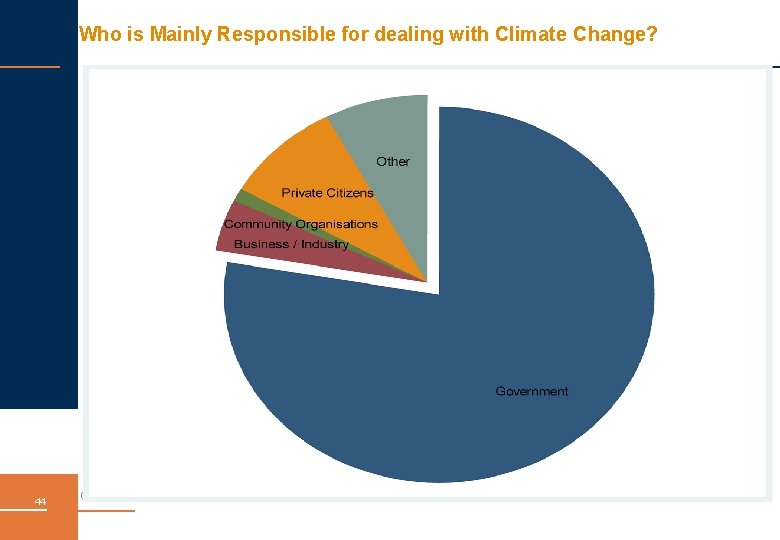
Who is Mainly Responsible for Dealing with Climate Change? 29 October 2010
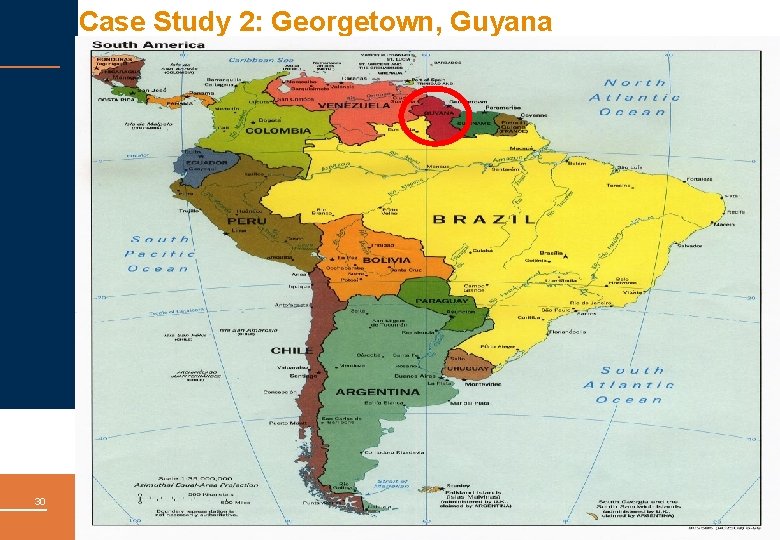
Case Study 2: Georgetown, Guyana 30 October 2010
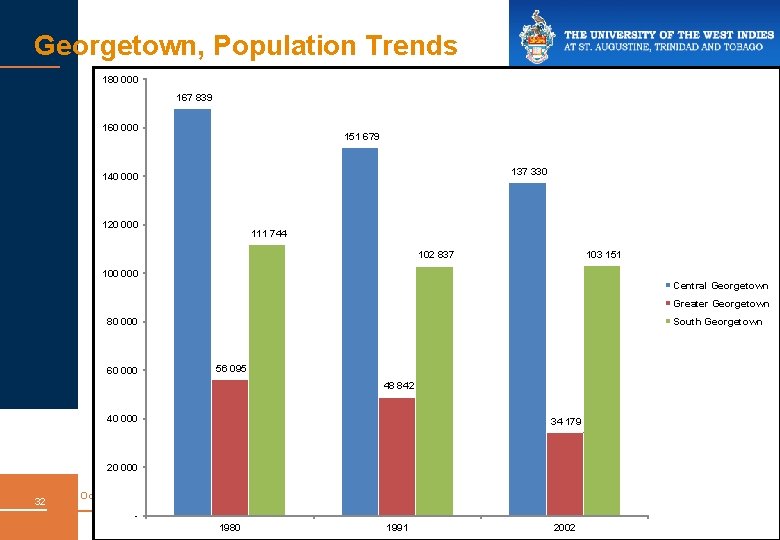
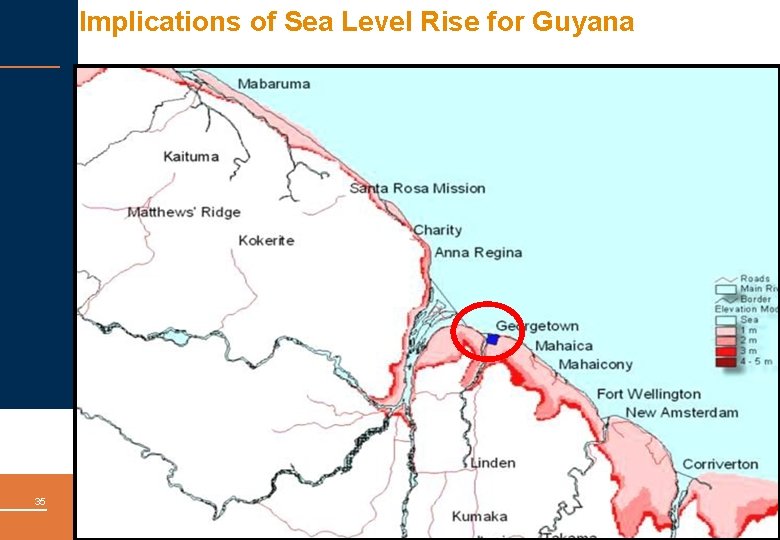
Georgetown § About 90% of the Guyana’s population lives on a coastal belt that is 1. 4 metres below sea level § Rising sea-levels are likely to increase the frequency and intensity of flooding in Georgetown. § In the last decade, extreme weather conditions more frequent § Most of the potable water provided by artesian wells whose water tables are susceptible to saltwater intrusion § Specific areas suffer from saltwater intrusion mainly due to the many drainage canals and water outlets, overtopping, and flooding resulting from heavy rainfall § Since the coast is critical to the economic development of the entire economy, the ripple effects are expected to be felt further than the coastal regions of Guyana. 31 October 2010
Georgetown, Population Trends 180 000 167 839 160 000 151 679 137 330 140 000 120 000 111 744 103 151 102 837 100 000 Central Georgetown Greater Georgetown South Georgetown 80 000 60 000 56 095 48 842 40 000 34 179 20 000 32 October 2010 1980 1991 2002
33 October 2010
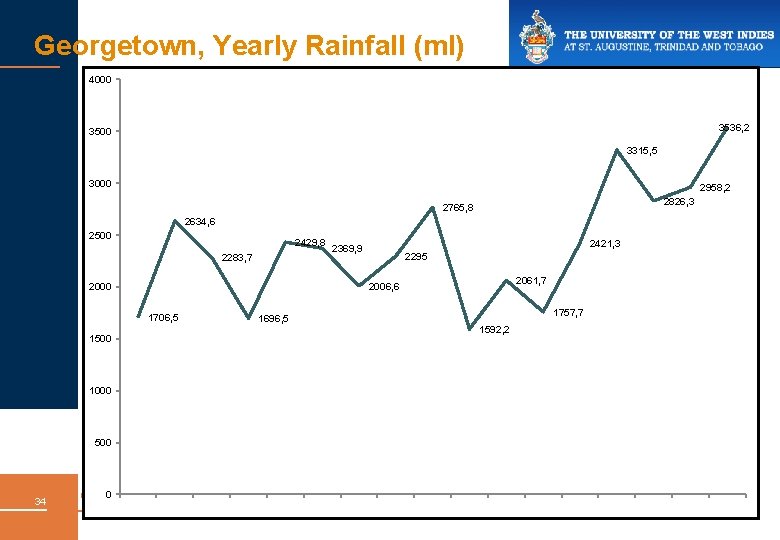
Georgetown, Yearly Rainfall (ml) 4000 3536, 2 3500 3315, 5 3000 2958, 2 2826, 3 2765, 8 2634, 6 2500 2429, 8 2283, 7 1706, 5 1000 500 34 0 2010 October 2295 2061, 7 2006, 6 2000 1500 2421, 3 2369, 9 1696, 5 1757, 7 1592, 2
Implications of Sea Level Rise for Guyana 35 October 2010
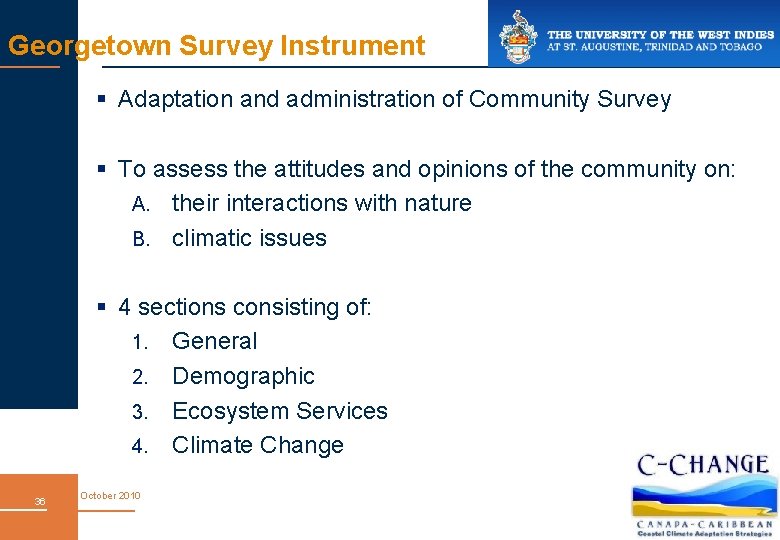
Georgetown Survey Instrument § Adaptation and administration of Community Survey § To assess the attitudes and opinions of the community on: A. their interactions with nature B. climatic issues § 4 sections consisting of: 1. General 2. Demographic 3. Ecosystem Services 4. Climate Change 36 October 2010
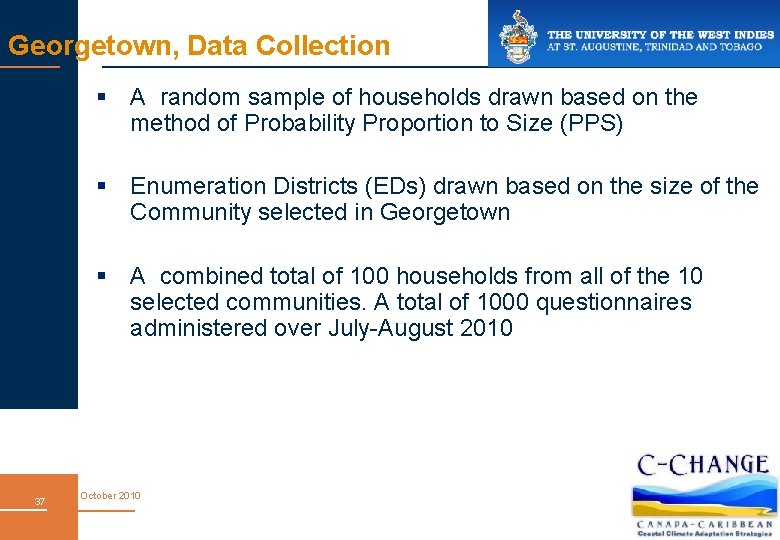
Georgetown, Data Collection § A random sample of households drawn based on the method of Probability Proportion to Size (PPS) § Enumeration Districts (EDs) drawn based on the size of the Community selected in Georgetown § A combined total of 100 households from all of the 10 selected communities. A total of 1000 questionnaires administered over July-August 2010 37 October 2010
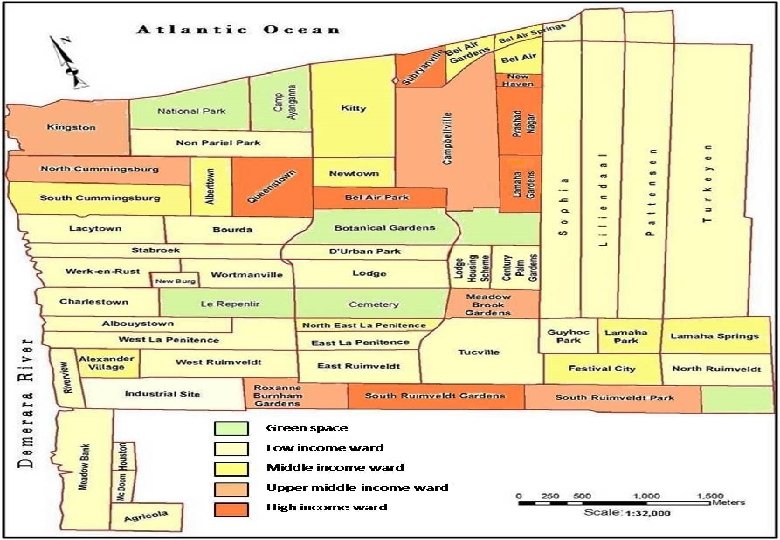
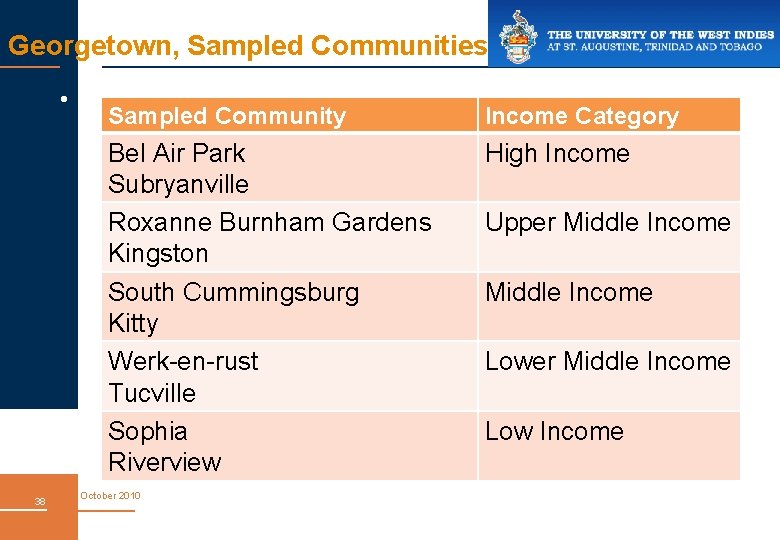
Georgetown, Sampled Communities • Five categories of wards in Georgetown. Suggested Case Studies Sampled Community Income Category Bel Air Park Subryanville Roxanne Burnham Gardens Kingston South Cummingsburg Kitty Werk-en-rust Tucville Sophia Riverview 38 October 2010 High Income Upper Middle Income Lower Middle Income Low Income
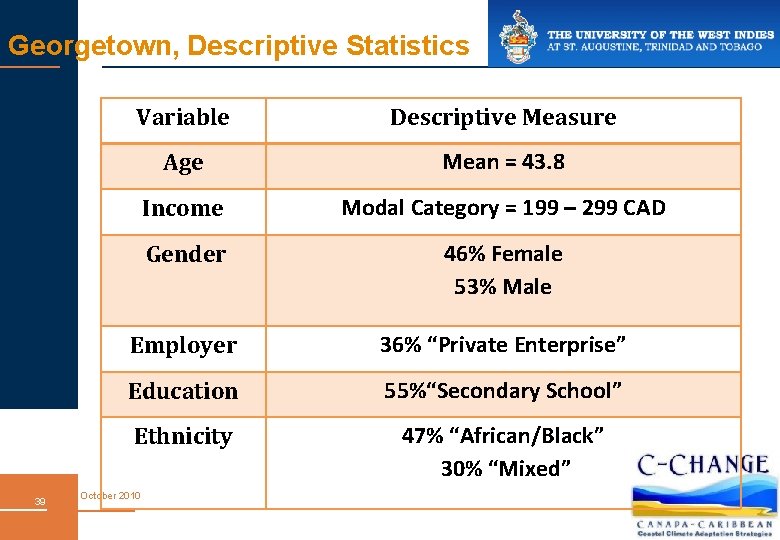
Georgetown, Descriptive Statistics 39 Variable Descriptive Measure Age Mean = 43. 8 Income Modal Category = 199 – 299 CAD Gender 46% Female 53% Male Employer 36% “Private Enterprise” Education 55%“Secondary School” Ethnicity 47% “African/Black” 30% “Mixed” October 2010
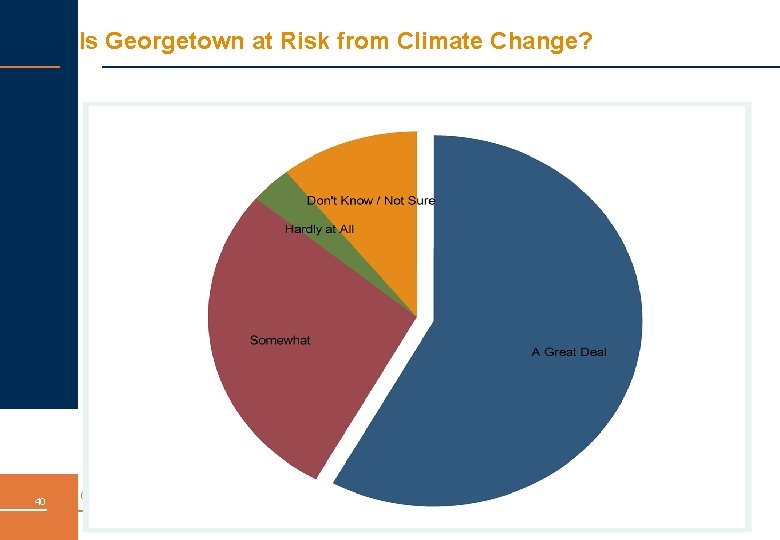
Is Georgetown at Risk from Climate Change? 40 October 2010
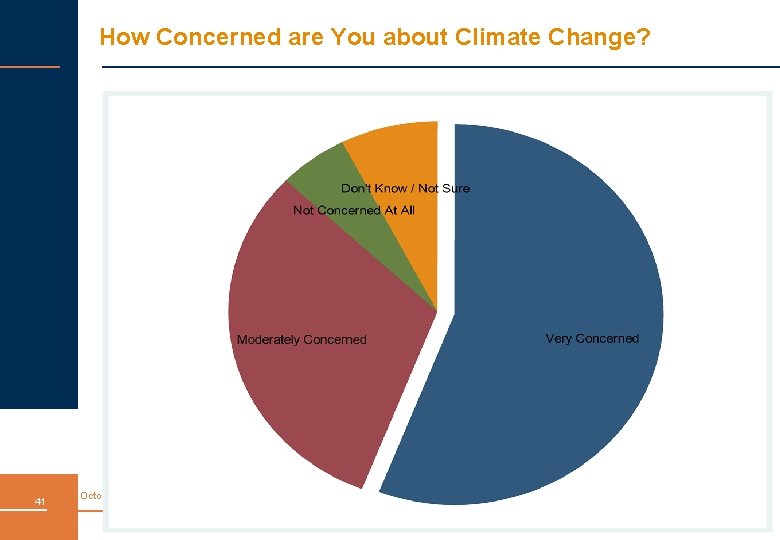
How Concerned are You about Climate Change? 41 October 2010
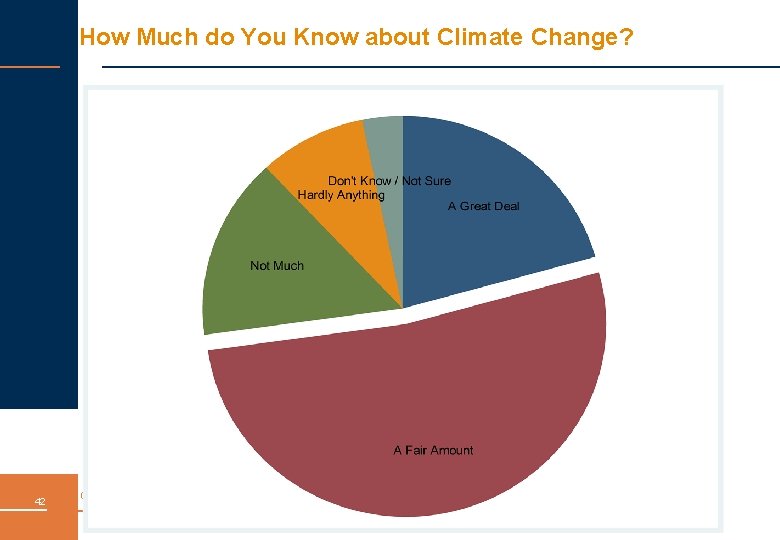
How Much do You Know about Climate Change? 42 October 2010
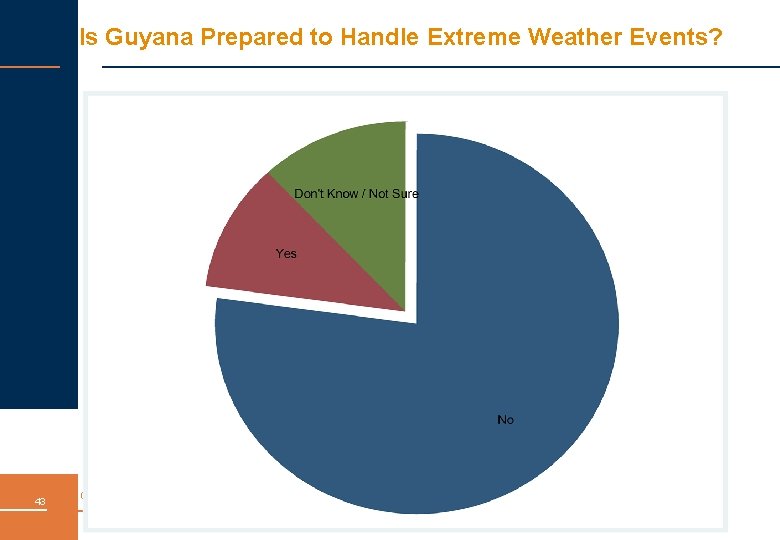
Is Guyana Prepared to Handle Extreme Weather Events? 43 October 2010
Who is Mainly Responsible for dealing with Climate Change? 44 October 2010
A Community Vulnerability Index (1) § CSVI = 0. 20 [FC+HC+SC+NC+PC] § Financial Capital (20%) Dwelling Type (33. 33%) Ø Dwelling Ownership (33. 33%) Ø Land Ownership (33. 33%) Ø § Human Capital (20%) Current Economic Activity (33. 33%) Ø Main Occupation (33. 33%) Ø Major Industry (33. 3%) Ø 45 October 2010
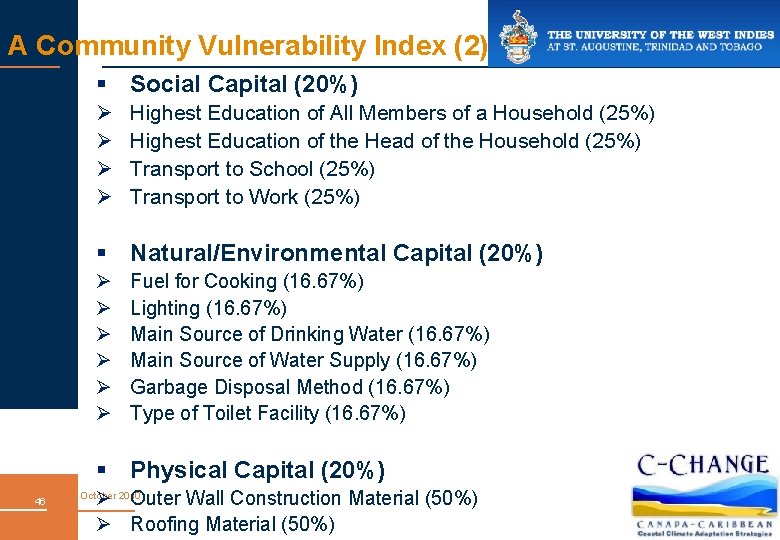
A Community Vulnerability Index (2) § Social Capital (20%) Ø Ø Highest Education of All Members of a Household (25%) Highest Education of the Head of the Household (25%) Transport to School (25%) Transport to Work (25%) § Natural/Environmental Capital (20%) Ø Ø Ø Fuel for Cooking (16. 67%) Lighting (16. 67%) Main Source of Drinking Water (16. 67%) Main Source of Water Supply (16. 67%) Garbage Disposal Method (16. 67%) Type of Toilet Facility (16. 67%) § Physical Capital (20%) 46 Ø Outer Wall Construction Material (50%) Ø Roofing Material (50%) October 2010
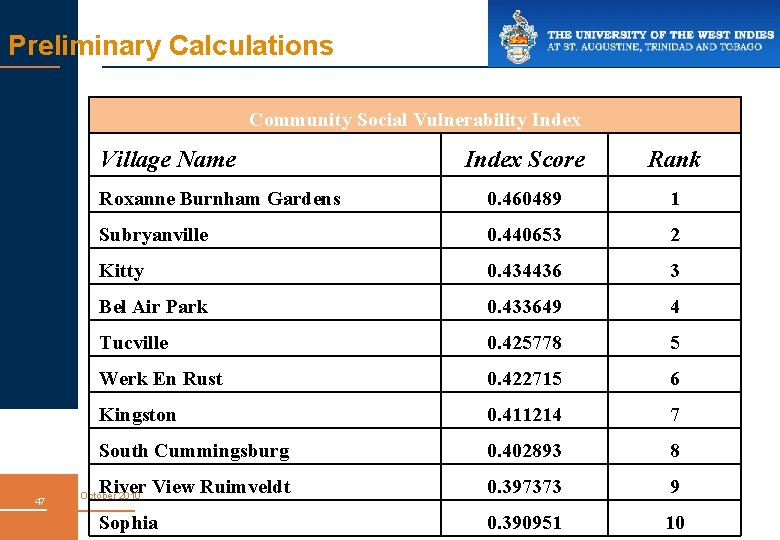
Preliminary Calculations Community Social Vulnerability Index Village Name 47 Index Score Rank Roxanne Burnham Gardens 0. 460489 1 Subryanville 0. 440653 2 Kitty 0. 434436 3 Bel Air Park 0. 433649 4 Tucville 0. 425778 5 Werk En Rust 0. 422715 6 Kingston 0. 411214 7 South Cummingsburg 0. 402893 8 River View Ruimveldt 0. 397373 9 Sophia 0. 390951 10 October 2010
Once Again, Thank You! Feel free to contact us: Patrick Watson: patrick. watson@sta. uwi. edu Sonja Teelucksingh: sonja. teelucksingh@sta. uwi. edu Michael Sutherland: Michael. sutherland@sta. uwi. edu 48 October 2010