
Managing a Testing Group Chapter 15 Overview l












- Slides: 37
Managing a Testing Group Chapter 15
Overview l l Mission Independent test labs Scheduling and performance measurement Staffing
MANAGING A TEST GROUP
Managing a test group l Primary task: – l A well run test group delivers: – – – l Search out and report bad news Competence Testing time Independence Job hazards – Turnover is high l l High stress Political problems
Managing a test group l Key quote from the chapter: “Integrity, professionalism, and humanistic management will always reinforce each other in your overall effectiveness as a test manager. ”
THE ROLE OF THE TESTING GROUP
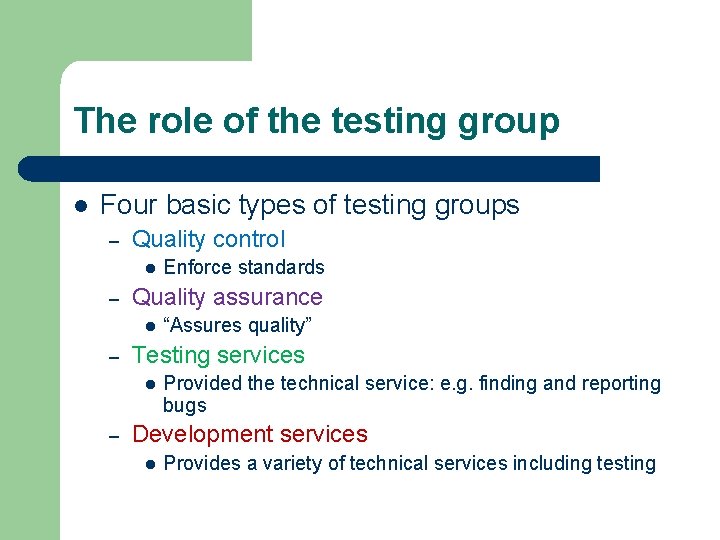
The role of the testing group l Four basic types of testing groups – Quality control l – Quality assurance l – “Assures quality” Testing services l – Enforce standards Provided the technical service: e. g. finding and reporting bugs Development services l Provides a variety of technical services including testing
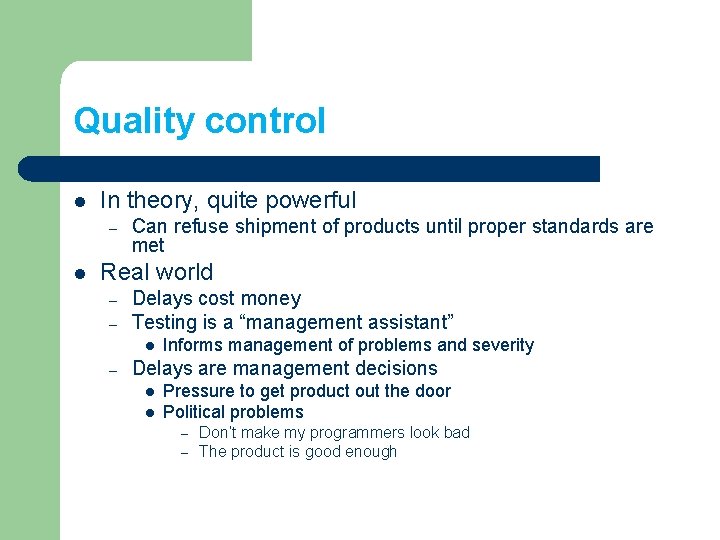
Quality control l In theory, quite powerful – l Can refuse shipment of products until proper standards are met Real world – – Delays cost money Testing is a “management assistant” l – Informs management of problems and severity Delays are management decisions l l Pressure to get product out the door Political problems – – Don’t make my programmers look bad The product is good enough
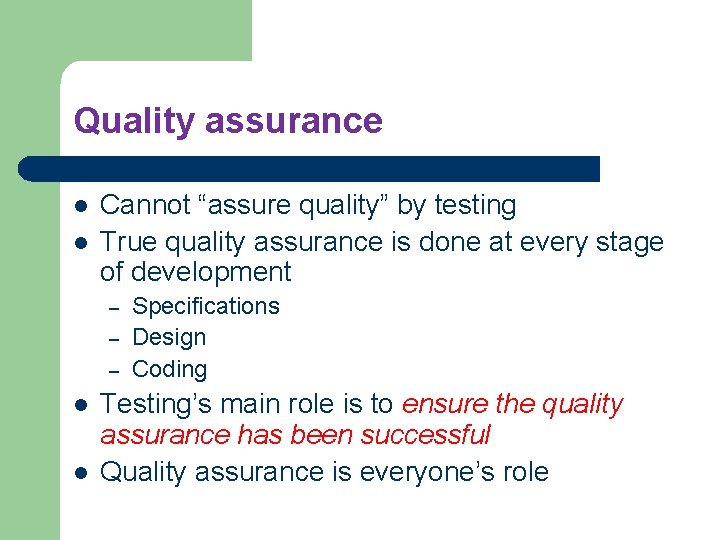
Quality assurance l l Cannot “assure quality” by testing True quality assurance is done at every stage of development – – – l l Specifications Design Coding Testing’s main role is to ensure the quality assurance has been successful Quality assurance is everyone’s role
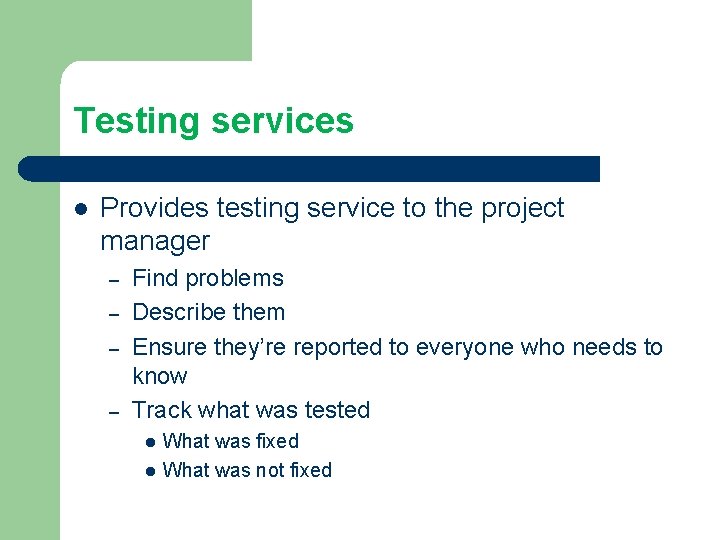
Testing services l Provides testing service to the project manager – – Find problems Describe them Ensure they’re reported to everyone who needs to know Track what was tested l l What was fixed What was not fixed
Development services l Testing services plus: – – – – Debugging Customer support Copy editing of the manuals Technical editing of manuals Usability testing Comparative product evaluations Customer satisfaction studies
A TEST GROUP IS NOT AN UNMIXED BLESSING
A Test Group Is Not an Unmixed Blessing l Scenarios: – No test group l Programmers – test code thoroughly Test group present l Programmers ease up on testing their own code l “Testers will catch it”
A Test Group Is Not an Unmixed Blessing l Real world: – Programmers find the vast majority of the errors l l l – Understand the code Know where most problems occur Know how to best fix Programmers finding bugs is relatively cheap l l l The sooner errors are found the less it costs to fix Programmers don’t need to replicate the errors Programmers don’t have to explain the problem to anyone else Programmers don’t have to be told how the program is run Less paperwork, overhead, etc.
A Test Group Is Not an Unmixed Blessing l Real world: – Programmers miss some errors l “Understand” the code – – – Familiarity with “their” function Misunderstand the actual problem Other errors l Wrong or bad specs – l Programmer coded to incorrect spec Solve wrong problem
ALTERNATIVES: INDEPENDENT TEST AGENCIES
An alternative? Independent test agencies l You don’t need to do all your own testing – l l Or even any of your testing Hire an independent company In theory independent test groups are: – – Independent No political pressures
Independent test agencies l Potential problems – – – – Less independent and they seem Standards may not be as high as yours Staff may not be very senior May miss testing significant areas May not provide enough supervision and support May not necessarily help you budget realistically Do not have product knowledge
Independent test agencies l At the least: – Have an in-house testing staff l l Replicate every bug Look for related problems Criticize the programs user interface Evaluate the testing coverage
SCHEDULING TIPS
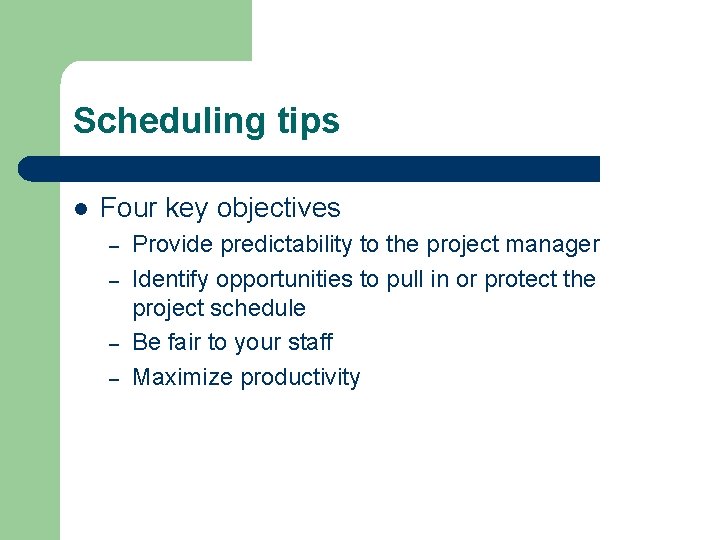
Scheduling tips l Four key objectives – – Provide predictability to the project manager Identify opportunities to pull in or protect the project schedule Be fair to your staff Maximize productivity
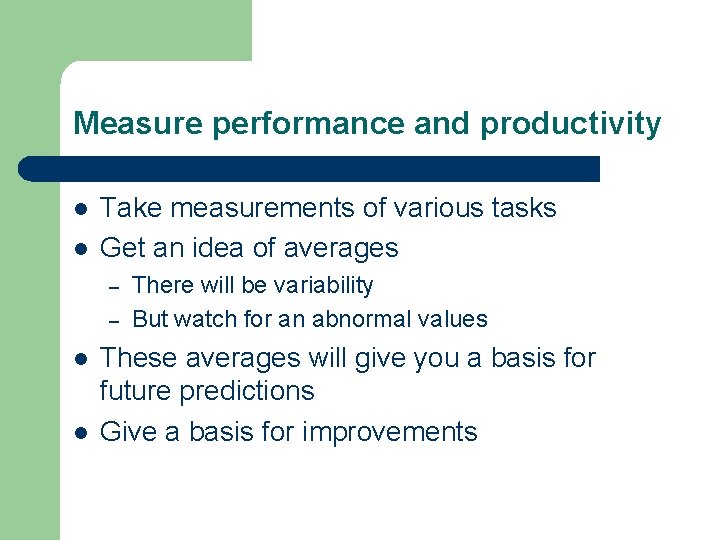
Measure performance and productivity l l Take measurements of various tasks Get an idea of averages – – l l There will be variability But watch for an abnormal values These averages will give you a basis for future predictions Give a basis for improvements
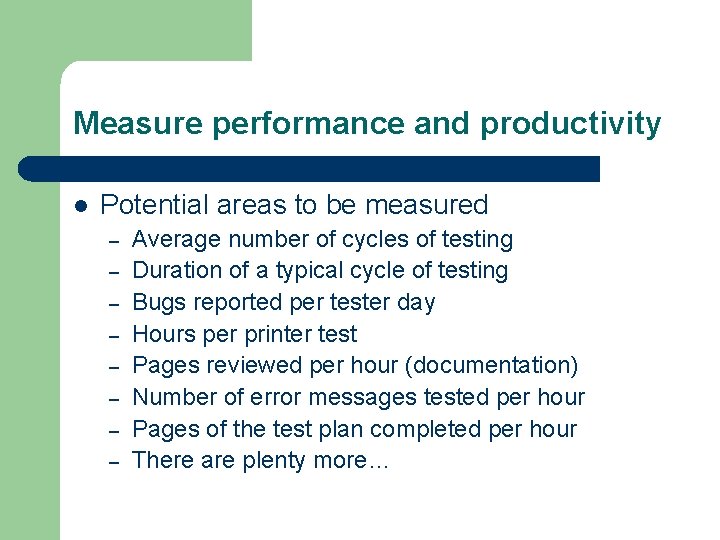
Measure performance and productivity l Potential areas to be measured – – – – Average number of cycles of testing Duration of a typical cycle of testing Bugs reported per tester day Hours per printer test Pages reviewed per hour (documentation) Number of error messages tested per hour Pages of the test plan completed per hour There are plenty more…
Sidebar discussion: l Who should have access to this data?
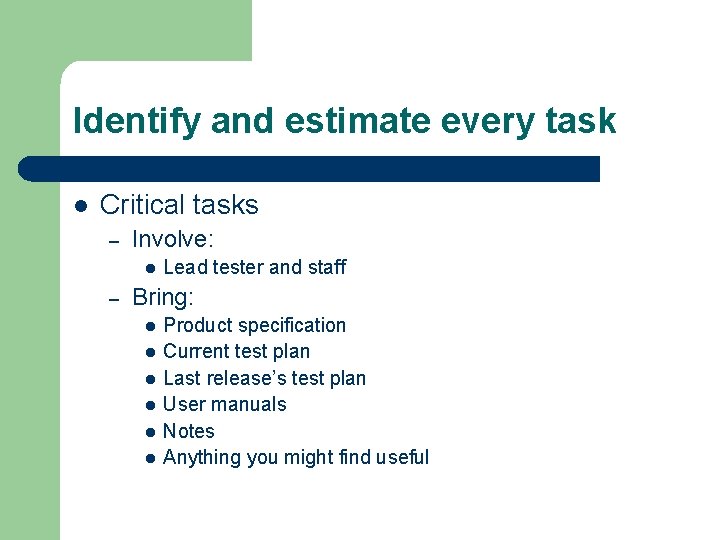
Identify and estimate every task l Critical tasks – Involve: l – Lead tester and staff Bring: l l l Product specification Current test plan Last release’s test plan User manuals Notes Anything you might find useful
Identify and estimate every task l Brainstorm and document – – Flip charts are good media Start noting: l l Main testing tasks For each main testing task – Split into sub tasks – Identify elements – In the process to the very last detail – Review l l – – Take a break Get others involved Make estimates End up with a comprehensive list of tasks
Identify and estimate every task l Decision time! – – – Decide which you cannot do Prioritize the rest Some tasks may only be partially doable l l – Identify the important and critical tasks l – Sort what can be done from what cannot be done Sort what can easily be done from difficult or complicated tasks Prioritize them (put on fast path) Document l What will be done – l l When! What cannot be done and why Concerns if testing cannot be accomplished on time
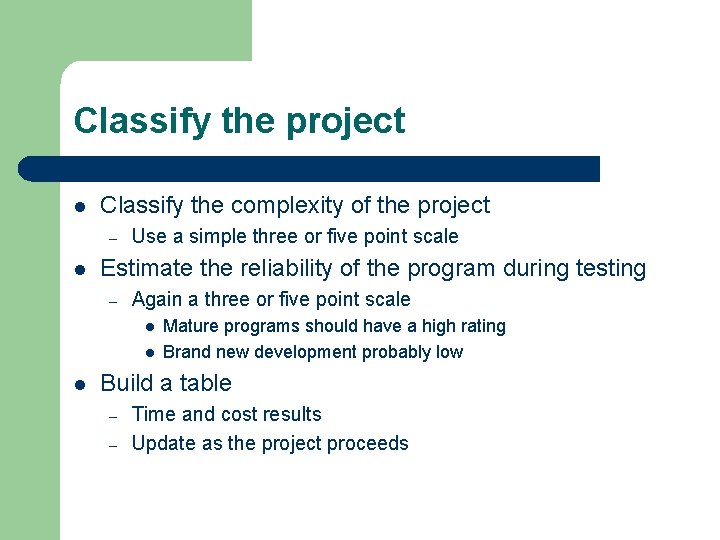
Classify the project l Classify the complexity of the project – l Use a simple three or five point scale Estimate the reliability of the program during testing – Again a three or five point scale l l l Mature programs should have a high rating Brand new development probably low Build a table – – Time and cost results Update as the project proceeds
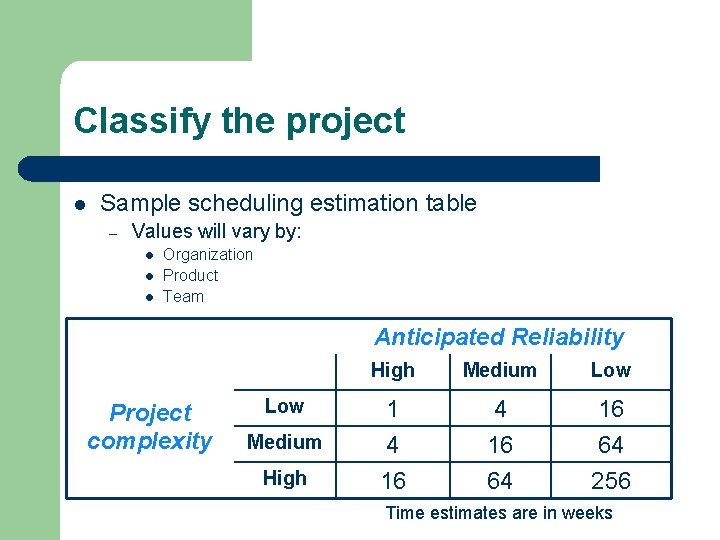
Classify the project l Sample scheduling estimation table – Values will vary by: l l l Organization Product Team Anticipated Reliability Project complexity High Medium Low Medium 1 4 4 16 16 64 High 16 64 256 Low Time estimates are in weeks
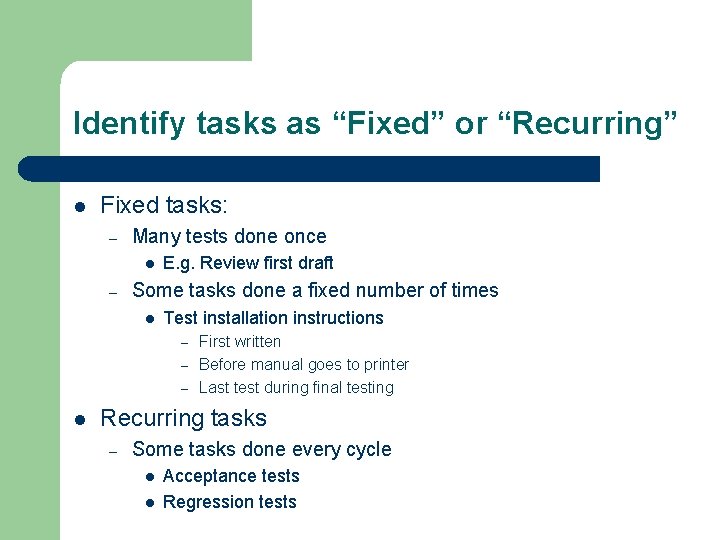
Identify tasks as “Fixed” or “Recurring” l Fixed tasks: – Many tests done once l – E. g. Review first draft Some tasks done a fixed number of times l Test installation instructions First written – Before manual goes to printer – Last test during final testing – l Recurring tasks – Some tasks done every cycle l l Acceptance tests Regression tests
Miscellanea l One person testing two products – l Give time to switch over Allow time for overhead – – Meetings Reports Timesheet accounting Water cooler
Miscellanea l Lucky if you get six hours a day in testing – – Individuality of people Hiring weakens the schedule l – Beware of shortcuts l – Time must be spent on training new hires Called shortcuts for a reason Meetings
YOUR STAFF
Your staff l Who to hire – Programmers are not necessarily good testers l – “Lousy programmers are usually lousy testers. Don’t accept rejects from other departments. ” Important skills l l l l Integrity Empirical frame of reference vs. theoretical Education Some programming background Experience with a wide variety of computers and software packages Knowledge of combinatorics Excellent spoken and written communication Good at error guessing Fast abstraction skills Good with puzzles Conscious of efficiency Ability to juggle many tasks Good at scheduling Careful observer, patient, attends to detail Role playing imagination Ability to read and write specifications
Your staff l Morale – – – Staff needs moral support Praise good work privately and publicly Build a good group culture Be a shield for your staff Be the focal point for requests or changes for your staff
Your staff l Career growth – – Staff wants to experience personal growth Utilize that need l – Allow staff to gain skills and leave as they outgrow your area Ask candidates why they want to be in testing l If it’s transitional evaluate that person – – Will they contribute for the short term Overall l l Some will want to leave early Others will have loyalty and want to stay with their team
SUMMARY