
Managers briefing Why XBRL Steven Baker Decision Soft
Managers’ briefing: Why XBRL? Steven Baker Decision. Soft Ltd http: //xbrl. decisionsoft. com/
Intro Decision. Soft Ltd: A background in XML data modelling and processing, A leading role in creating the XBRL Specification, Five years’ experience implementing online XML and XBRL processing systems, particularly for government Subject: The “how” of electronic business reporting Agenda: General problems XML vs XBRL Architecture Benefits Selecting XBRL General ledger Status
General problems Existing manual processes are: Slow Inaccurate Expensive Hard to integrate Electronic business reporting facilitates: Improved processes Improved confidence Accelerated decision making Lower costs XBRL is the standard for electronic business reports

XML vs XBRL XML – e. Xtensible Markup Language A set of rules for how any data can be expressed as text; it is a syntax. A foundation for particular applications Immensely flexible XBRL – e. Xtensible Business Reporting Language An application of XML One design for business reports in XML

An example XBRL report
The components of XBRL The report (or instance) The business data we care about For every item of data, provides Context Units Precision The taxonomy Defines the business data that may be reported Provides: Allowable data items Labels for those items Relevant references Relationships: How items are calculated from one another How items might be presented Equivalence and other miscellaneous relationships Can be extended

XBRL architecture Business Information Catalogued Accounts, Tax, Expenditures, Income, Facts Details reported in in XBRL Taxonomies Defines legal items XBRLReport XBRL Reports Defines format Defines XBRL format Int’l
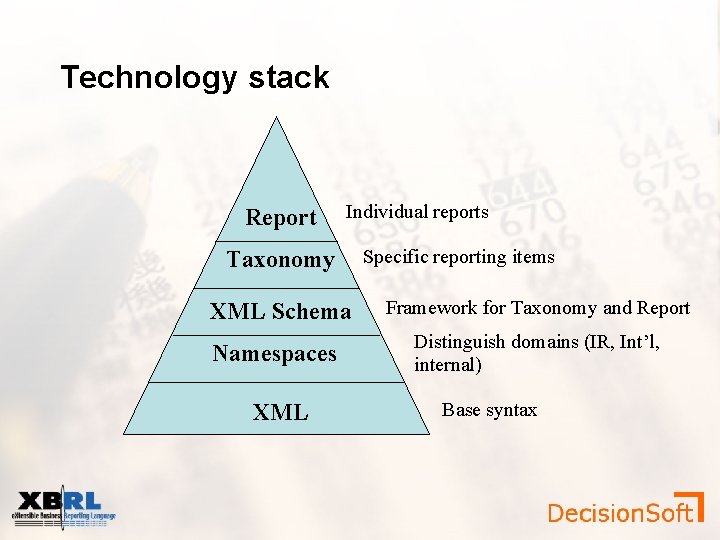
Technology stack Report Individual reports Taxonomy XML Schema Namespaces XML Specific reporting items Framework for Taxonomy and Report Distinguish domains (IR, Int’l, internal) Base syntax
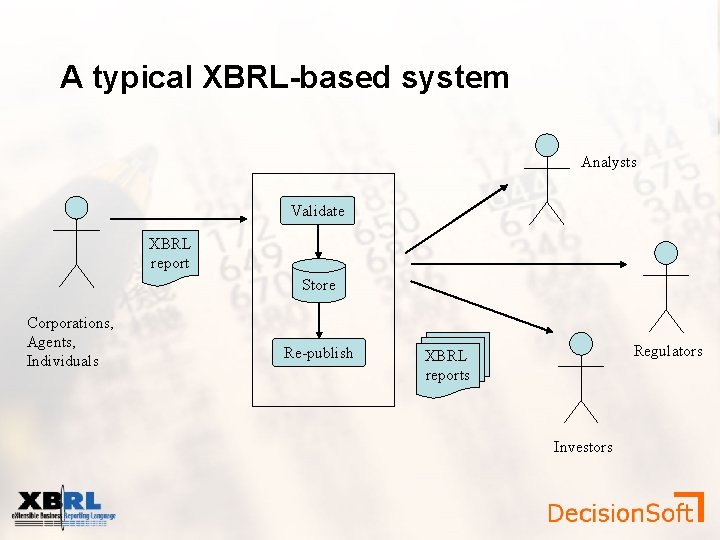
A typical XBRL-based system Analysts Validate XBRL report Store Corporations, Agents, Individuals Re-publish Regulators XBRL reports Investors
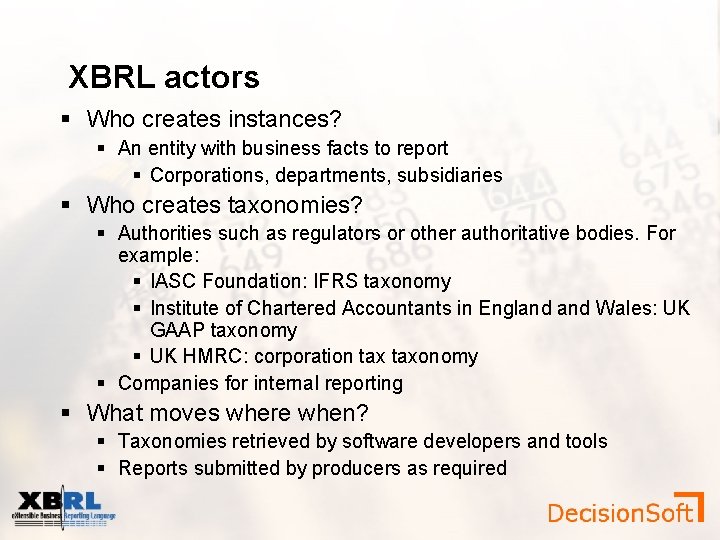
XBRL actors Who creates instances? An entity with business facts to report Corporations, departments, subsidiaries Who creates taxonomies? Authorities such as regulators or other authoritative bodies. For example: IASC Foundation: IFRS taxonomy Institute of Chartered Accountants in England Wales: UK GAAP taxonomy UK HMRC: corporation taxonomy Companies for internal reporting What moves where when? Taxonomies retrieved by software developers and tools Reports submitted by producers as required
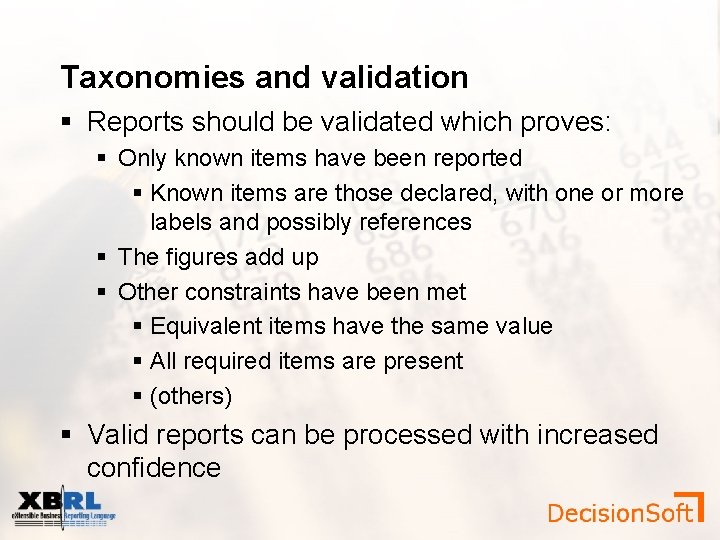
Taxonomies and validation Reports should be validated which proves: Only known items have been reported Known items are those declared, with one or more labels and possibly references The figures add up Other constraints have been met Equivalent items have the same value All required items are present (others) Valid reports can be processed with increased confidence
Demonstration
Benefits of XBRL Assurance Esp. for regulators and investment banks Manual errors eliminated Internal consistency checked by validation Security through digital signatures Interoperability An open standard using an open format Flexibility Analysis of data Output to Web, PDF, spreadsheet, word processor.
Why to select XBRL Realise the benefits of electronic reporting Speed, accuracy, efficiency and assurance Adopt the world-wide standard IFRS and GAAP use XBRL Converge on one design for electronic reporting Use standard tools No vendor lock-in XBRL is open
XBRL-GL The XBRL standard for General Ledger Intended to bring together internal business data: Chart of accounts Journal entries Historical transactions Does not require a standard chart of accounts, but can be used to link to one Further opportunities for convergence http: //www. xbrl. org/GLTaxonomy/
Where is XBRL now? Version 2. 1 published 31 Dec 2003 XBRL is stable No version 3 or even version 2. 2 is planned. XBRL is in use Edgar Online Microsoft Reuters TSX Group UK HMCR and others Also: http: //www. xbrl. org/XBRLin. Action/ Support from about 250 leading companies including Microsoft, Oracle, SAP, Peoplesoft, KPMG, PWC, Ernst and Young, Deloitte and other major firms
Conclusion Extensive business benefits are available from adopting the world-wide standard for electronic business reporting XBRL provides a standard design of XML document for business reporting Also general ledger XBRL enjoys extensive support and is open
- Slides: 17