
Managerial Economics ninth edition Thomas Maurice Chapter 1
- Slides: 19
Managerial Economics ninth edition Thomas Maurice Chapter 1 Managers, Profits, and Markets Mc. Graw-Hill/Irwin Managerial Economics, 9 e Copyright © 2008 by the Mc. Graw-Hill Companies, Inc. All rights reserved.
Managerial Economics & Theory • Managerial economics applies microeconomic theory to business problems • How to use economic analysis to make decisions to achieve firm’s goal of profit maximization • Microeconomics • Study of behavior of individual economic agents 2
Managerial Economics Economic Cost of Resources • Opportunity cost of using any resource is: • What firm owners must give up to use the resource • Market-supplied resources • Owned by others & hired, rented, or leased • Owner-supplied resources • Owned & used by the firm 3
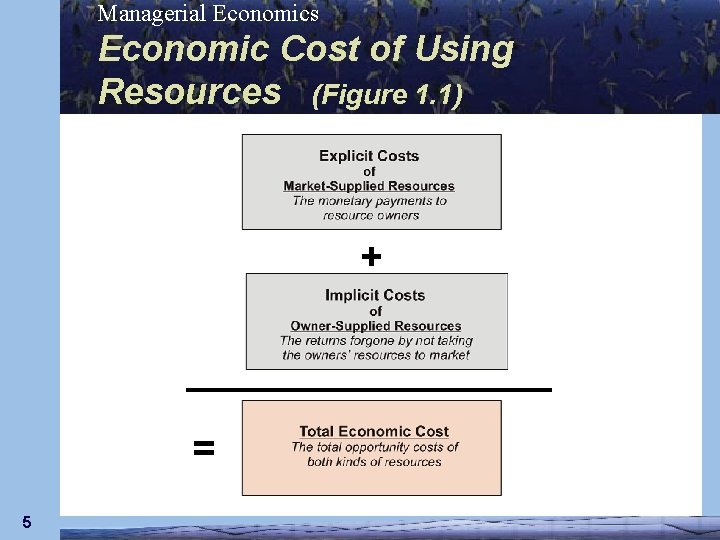
Managerial Economics Total Economic Cost • Total Economic Cost • Sum of opportunity costs of both market-supplied resources & ownersupplied resources • Explicit Costs • Monetary payments to owners of market-supplied resources • Implicit Costs • Nonmonetary opportunity costs of using owner-supplied resources 4
Managerial Economics Economic Cost of Using Resources (Figure 1. 1) + = 5
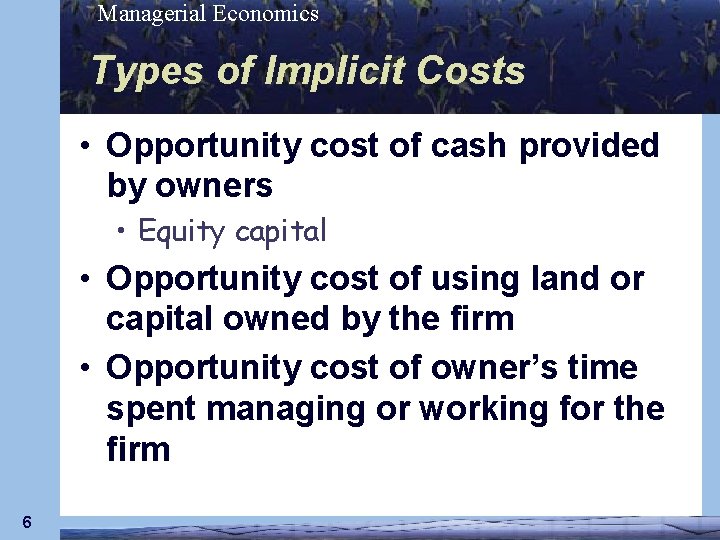
Managerial Economics Types of Implicit Costs • Opportunity cost of cash provided by owners • Equity capital • Opportunity cost of using land or capital owned by the firm • Opportunity cost of owner’s time spent managing or working for the firm 6
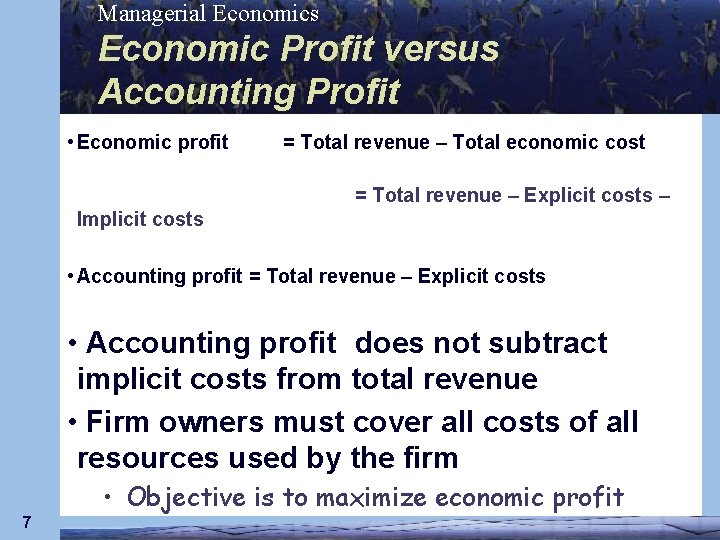
Managerial Economics Economic Profit versus Accounting Profit • Economic profit = Total revenue – Total economic cost = Total revenue – Explicit costs – Implicit costs • Accounting profit = Total revenue – Explicit costs • Accounting profit does not subtract implicit costs from total revenue • Firm owners must cover all costs of all resources used by the firm 7 • Objective is to maximize economic profit
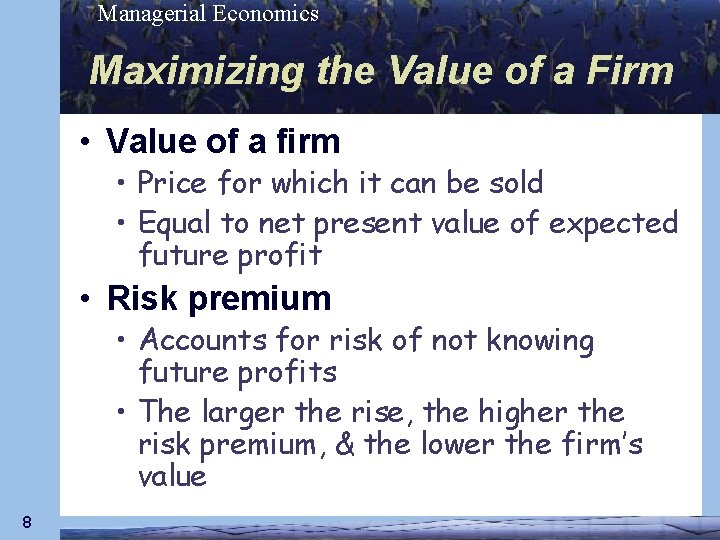
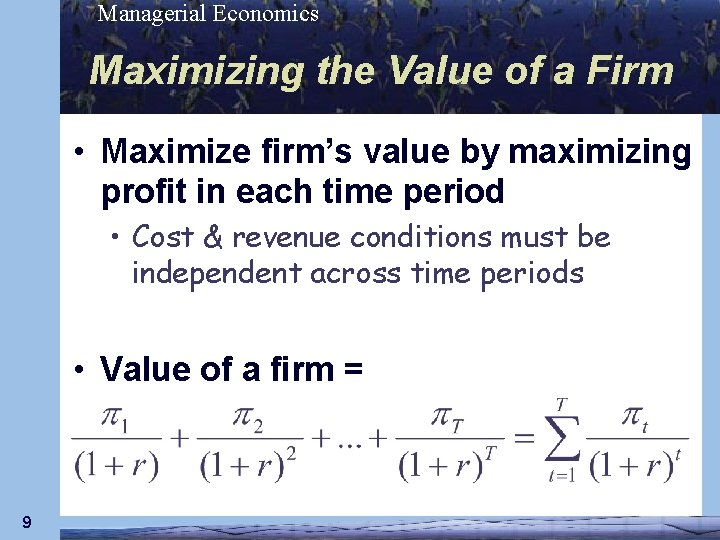
Managerial Economics Maximizing the Value of a Firm • Value of a firm • Price for which it can be sold • Equal to net present value of expected future profit • Risk premium • Accounts for risk of not knowing future profits • The larger the rise, the higher the risk premium, & the lower the firm’s value 8
Managerial Economics Maximizing the Value of a Firm • Maximize firm’s value by maximizing profit in each time period • Cost & revenue conditions must be independent across time periods • Value of a firm = 9
Managerial Economics Separation of Ownership & Control • Principal-agent problem • Conflict that arises when goals of management (agent) do not match goals of owner (principal) • Moral Hazard • When either party to an agreement has incentive not to abide by all its provisions & one party cannot cost effectively monitor the agreement 10
Managerial Economics Corporate Control Mechanisms • Require managers to hold stipulated amount of firm’s equity • Increase percentage of outsiders serving on board of directors • Finance corporate investments with debt instead of equity 11
Managerial Economics Price-Takers vs. Price-Setters • Price-taking firm • Cannot set price of its product • Price is determined strictly by market forces of demand & supply • Price-setting firm • Can set price of its product • Has a degree of market power, which is ability to raise price without losing all sales 12
Managerial Economics What is a Market? • A market is any arrangement through which buyers & sellers exchange goods & services • Markets reduce transaction costs • Costs of making a transaction other than the price of the good or service 13
Managerial Economics Market Structures • Market characteristics that determine the economic environment in which a firm operates • Number & size of firms in market • Degree of product differentiation • Likelihood of new firms entering market 14
Managerial Economics Perfect Competition • Large number of relatively small firms • Undifferentiated product • No barriers to entry 15
Managerial Economics Monopoly • Single firm • Produces product with no close substitutes • Protected by a barrier to entry 16
Managerial Economics Monopolistic Competition • Large number of relatively small firms • Differentiated products • No barriers to entry 17
Managerial Economics Oligopoly • Few firms produce all or most of market output • Profits are interdependent • Actions by any one firm will affect sales & profits of the other firms 18
Managerial Economics Globalization of Markets • Economic integration of markets located in nations around the world • Provides opportunity to sell more goods & services to foreign buyers • Presents threat of increased competition from foreign producers 19