
MANAGERIAL ECONOMICS ECON 5133 Lesson 22 SHORTRUN COST
- Slides: 17
MANAGERIAL ECONOMICS ECON 5133, Lesson 22 SHORT-RUN COST FUNCTIONS Short-run cost functions Graphic representations Peculiarities of cost functions Copyright © 2005 by George A. Collier Jr.
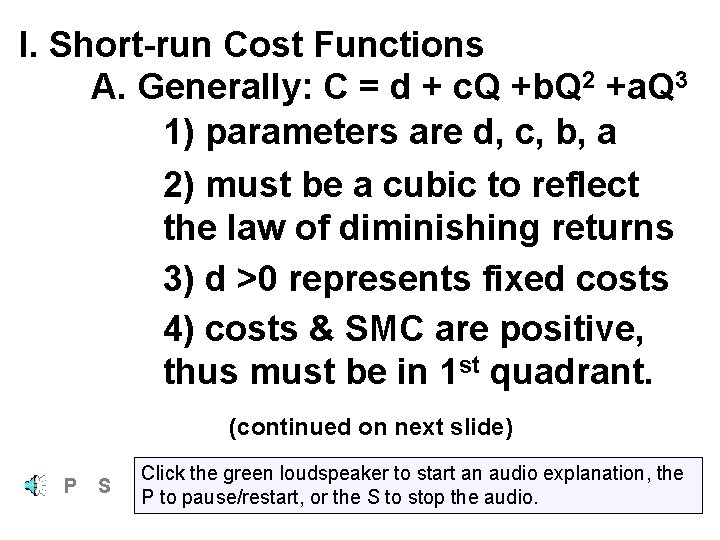
I. Short-run Cost Functions A. Generally: C = d + c. Q +b. Q 2 +a. Q 3 1) parameters are d, c, b, a 2) must be a cubic to reflect the law of diminishing returns 3) d >0 represents fixed costs 4) costs & SMC are positive, thus must be in 1 st quadrant. (continued on next slide) P S Click the green loudspeaker to start an audio explanation, the P to pause/restart, or the S to stop the audio.
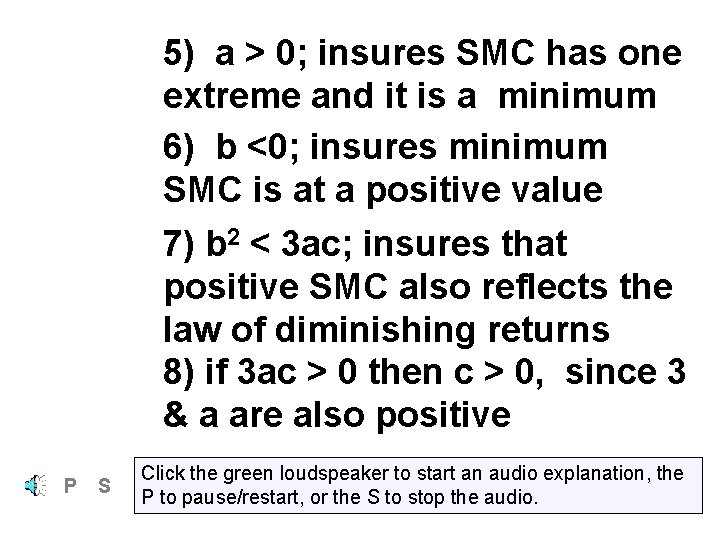
5) a > 0; insures SMC has one extreme and it is a minimum 6) b <0; insures minimum SMC is at a positive value 7) b 2 < 3 ac; insures that positive SMC also reflects the law of diminishing returns 8) if 3 ac > 0 then c > 0, since 3 & a are also positive P S Click the green loudspeaker to start an audio explanation, the P to pause/restart, or the S to stop the audio.
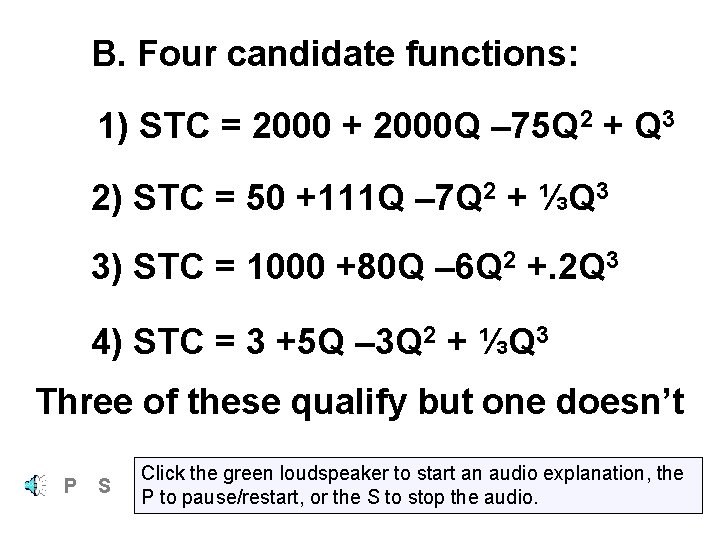
B. Four candidate functions: 1) STC = 2000 + 2000 Q – 75 Q 2 + Q 3 2) STC = 50 +111 Q – 7 Q 2 + ⅓Q 3 3) STC = 1000 +80 Q – 6 Q 2 +. 2 Q 3 4) STC = 3 +5 Q – 3 Q 2 + ⅓Q 3 Three of these qualify but one doesn’t P S Click the green loudspeaker to start an audio explanation, the P to pause/restart, or the S to stop the audio.
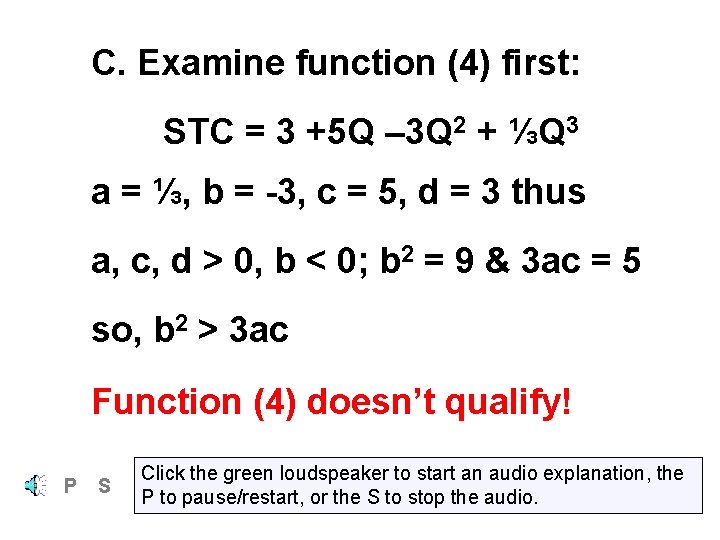
C. Examine function (4) first: STC = 3 +5 Q – 3 Q 2 + ⅓Q 3 a = ⅓, b = -3, c = 5, d = 3 thus a, c, d > 0, b < 0; b 2 = 9 & 3 ac = 5 so, b 2 > 3 ac Function (4) doesn’t qualify! P S Click the green loudspeaker to start an audio explanation, the P to pause/restart, or the S to stop the audio.
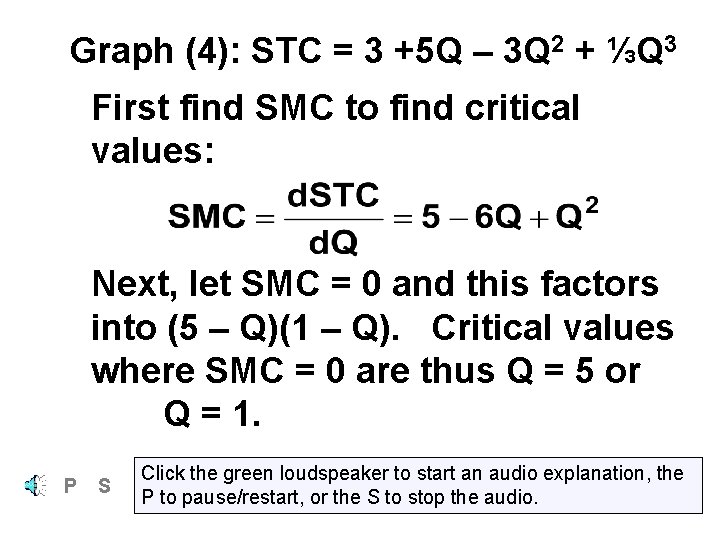
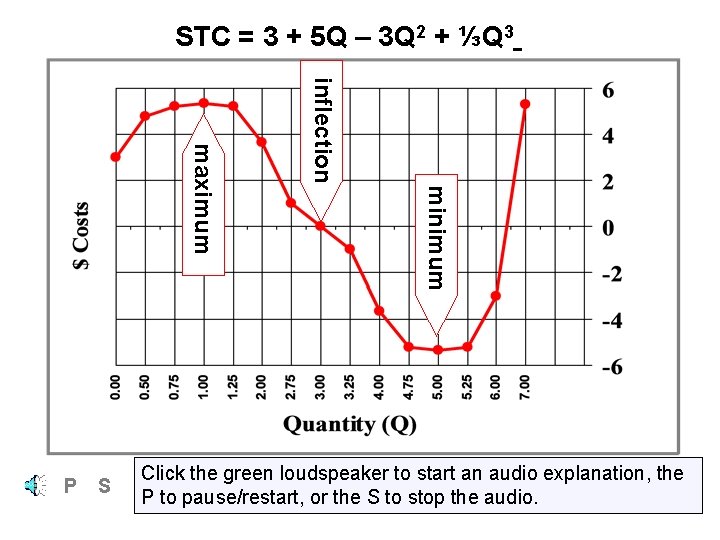
Graph (4): STC = 3 +5 Q – 3 Q 2 + ⅓Q 3 First find SMC to find critical values: Next, let SMC = 0 and this factors into (5 – Q)(1 – Q). Critical values where SMC = 0 are thus Q = 5 or Q = 1. P S Click the green loudspeaker to start an audio explanation, the P to pause/restart, or the S to stop the audio.
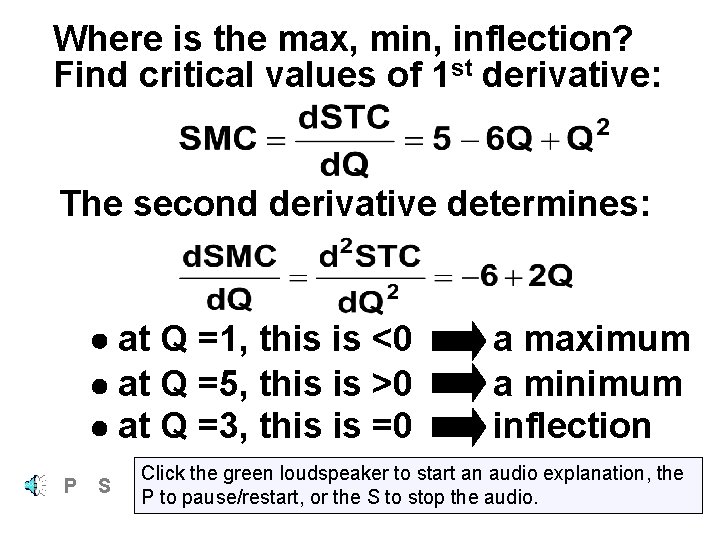
Where is the max, min, inflection? Find critical values of 1 st derivative: The second derivative determines: at Q =1, this is <0 at Q =5, this is >0 at Q =3, this is =0 P S a maximum a minimum inflection Click the green loudspeaker to start an audio explanation, the P to pause/restart, or the S to stop the audio.
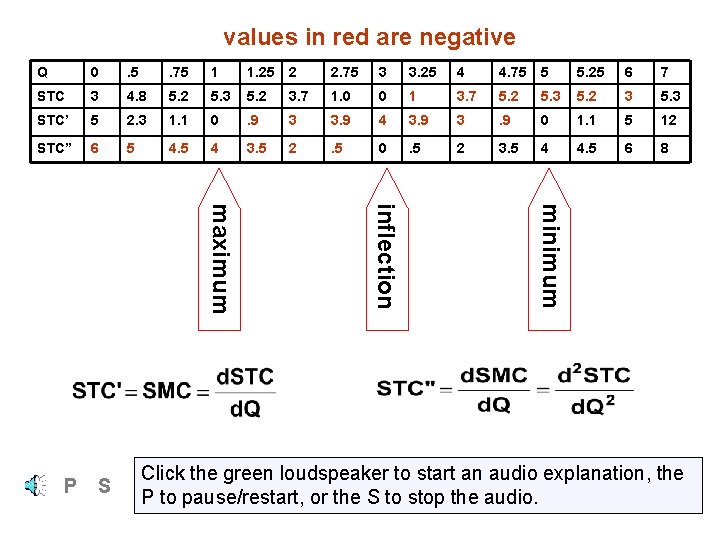
values in red are negative Q 0 . 5 . 75 1 1. 25 2 2. 75 3 3. 25 4 4. 75 5 5. 25 6 7 STC 3 4. 8 5. 2 5. 3 5. 2 3. 7 1. 0 0 1 3. 7 5. 2 5. 3 5. 2 3 5. 3 STC’ 5 2. 3 1. 1 0 . 9 3 3. 9 4 3. 9 3 . 9 0 1. 1 5 12 STC” 6 5 4 3. 5 2 . 5 0 . 5 2 3. 5 4 4. 5 6 8 minimum S inflection maximum P Click the green loudspeaker to start an audio explanation, the P to pause/restart, or the S to stop the audio.
STC = 3 + 5 Q – 3 Q 2 + ⅓Q 3 minimum S inflection maximum P Click the green loudspeaker to start an audio explanation, the P to pause/restart, or the S to stop the audio.
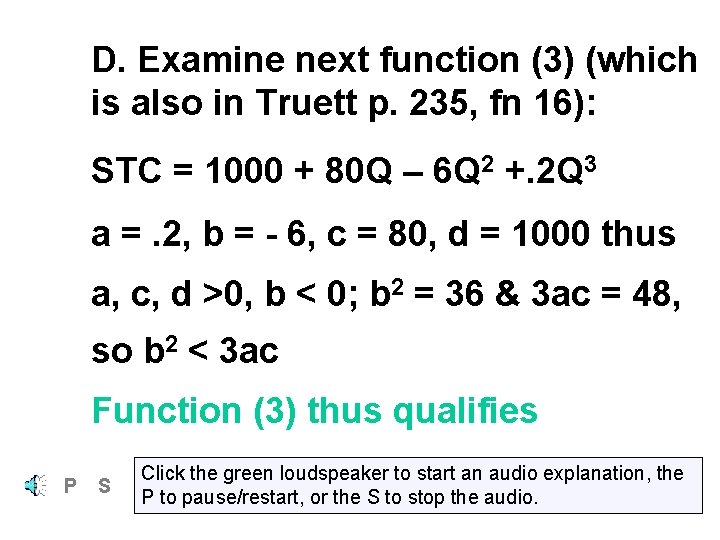
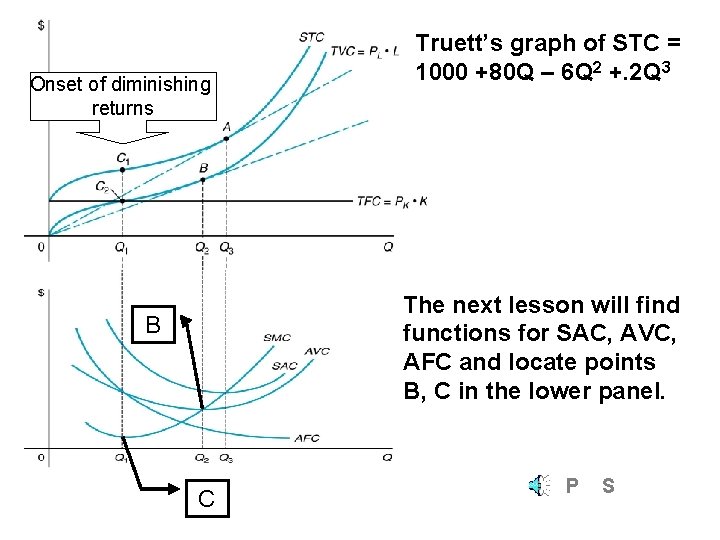
D. Examine next function (3) (which is also in Truett p. 235, fn 16): STC = 1000 + 80 Q – 6 Q 2 +. 2 Q 3 a =. 2, b = - 6, c = 80, d = 1000 thus a, c, d >0, b < 0; b 2 = 36 & 3 ac = 48, so b 2 < 3 ac Function (3) thus qualifies P S Click the green loudspeaker to start an audio explanation, the P to pause/restart, or the S to stop the audio.
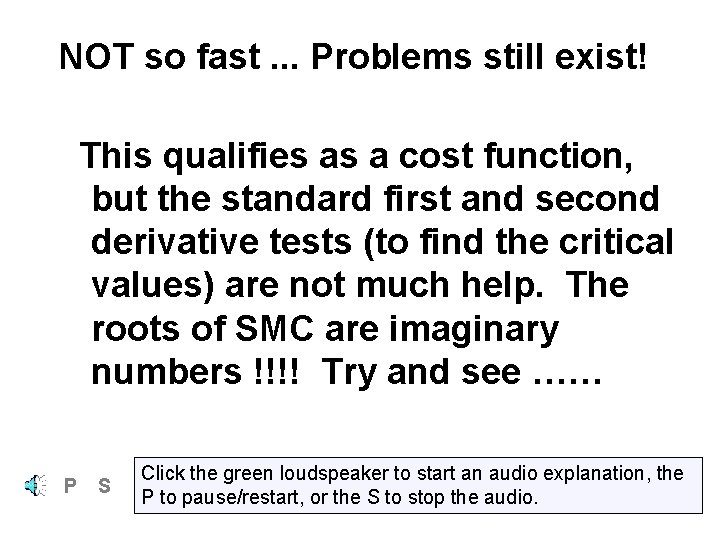
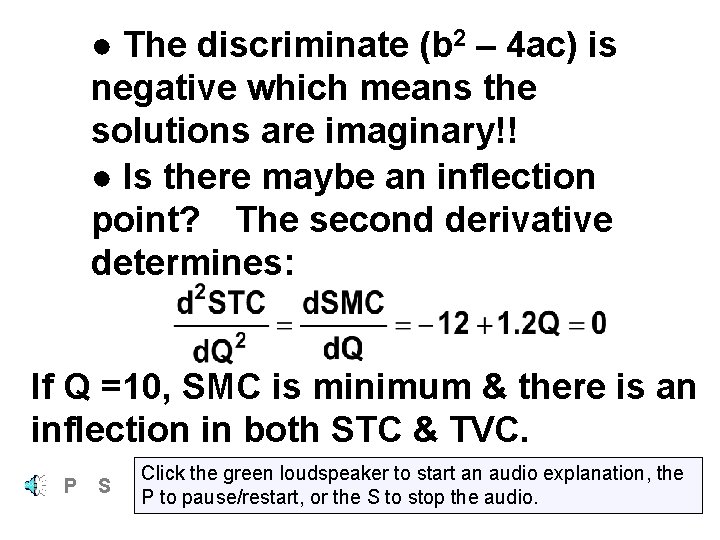
NOT so fast. . . Problems still exist! This qualifies as a cost function, but the standard first and second derivative tests (to find the critical values) are not much help. The roots of SMC are imaginary numbers !!!! Try and see …… P S Click the green loudspeaker to start an audio explanation, the P to pause/restart, or the S to stop the audio.
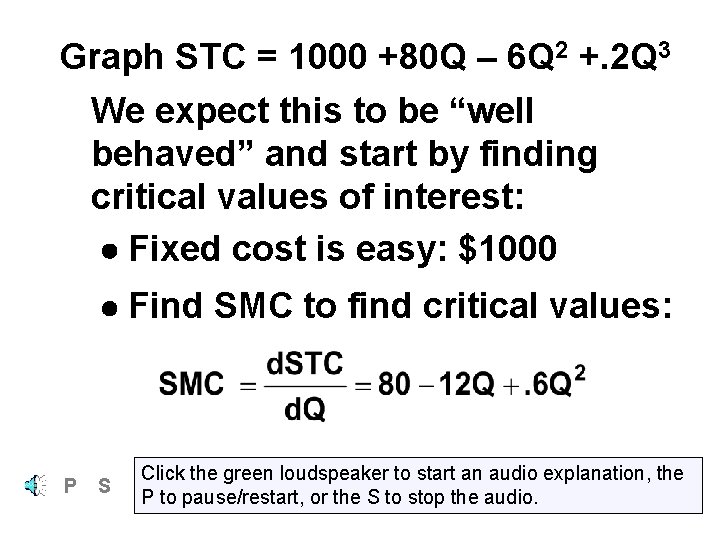
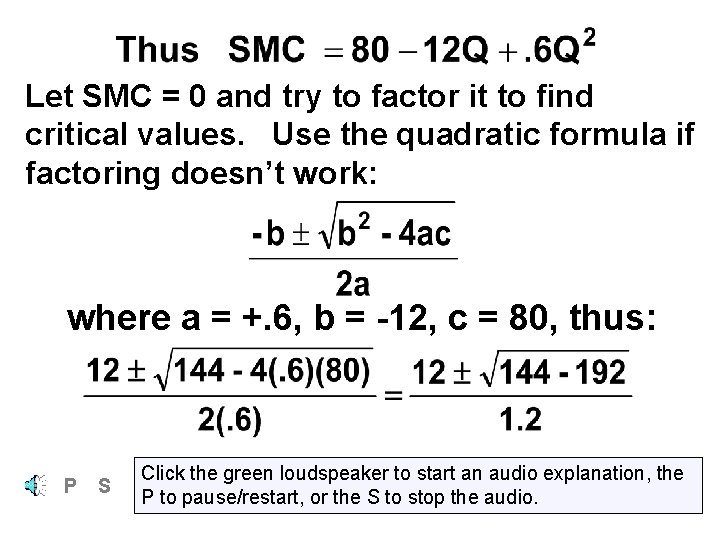
Graph STC = 1000 +80 Q – 6 Q 2 +. 2 Q 3 We expect this to be “well behaved” and start by finding critical values of interest: Fixed cost is easy: $1000 Find SMC to find critical values: P S Click the green loudspeaker to start an audio explanation, the P to pause/restart, or the S to stop the audio.
Let SMC = 0 and try to factor it to find critical values. Use the quadratic formula if factoring doesn’t work: where a = +. 6, b = -12, c = 80, thus: P S Click the green loudspeaker to start an audio explanation, the P to pause/restart, or the S to stop the audio.
● The discriminate (b 2 – 4 ac) is negative which means the solutions are imaginary!! ● Is there maybe an inflection point? The second derivative determines: If Q =10, SMC is minimum & there is an inflection in both STC & TVC. P S Click the green loudspeaker to start an audio explanation, the P to pause/restart, or the S to stop the audio.
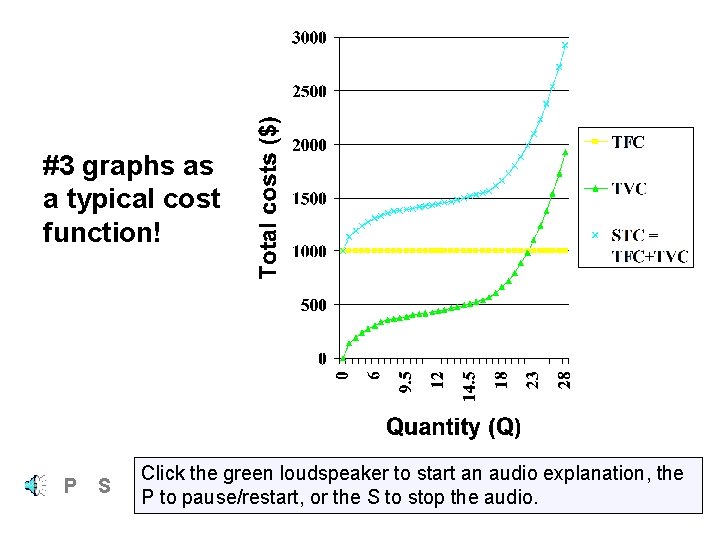
#3 graphs as a typical cost function! P S Click the green loudspeaker to start an audio explanation, the P to pause/restart, or the S to stop the audio.
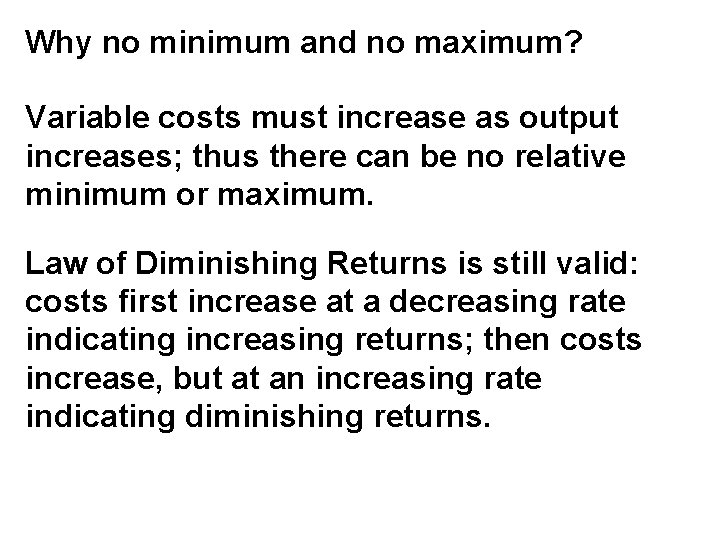
Why no minimum and no maximum? Variable costs must increase as output increases; thus there can be no relative minimum or maximum. Law of Diminishing Returns is still valid: costs first increase at a decreasing rate indicating increasing returns; then costs increase, but at an increasing rate indicating diminishing returns.
Onset of diminishing returns Truett’s graph of STC = 1000 +80 Q – 6 Q 2 +. 2 Q 3 The next lesson will find functions for SAC, AVC, AFC and locate points B, C in the lower panel. B C P S