
MANAGERIAL ECONOMICS ECON 5133 ELASTICITY 202 Lesson 18

- Slides: 25
MANAGERIAL ECONOMICS ECON 5133 ELASTICITY 202, Lesson 18 Two Price Elasticity of Demand Concepts Using Elasticity as a Pricing Guide Additional Demand Topics Copyright © 2005 by George A. Collier Jr.
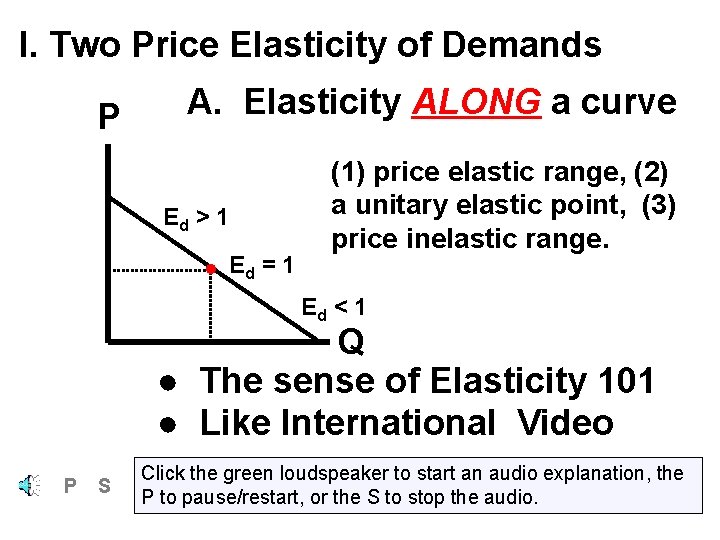
I. Two Price Elasticity of Demands P A. Elasticity ALONG a curve Ed > 1 • Ed = 1 (1) price elastic range, (2) a unitary elastic point, (3) price inelastic range. Ed < 1 Q ● The sense of Elasticity 101 ● Like International Video P S Click the green loudspeaker to start an audio explanation, the P to pause/restart, or the S to stop the audio.
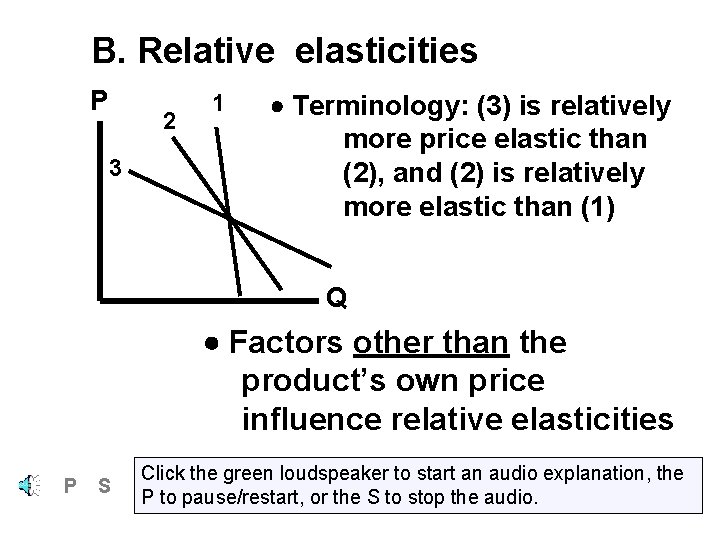
B. Relative elasticities P 2 3 1 Terminology: (3) is relatively more price elastic than (2), and (2) is relatively more elastic than (1) Q Factors other than the product’s own price influence relative elasticities P S Click the green loudspeaker to start an audio explanation, the P to pause/restart, or the S to stop the audio.
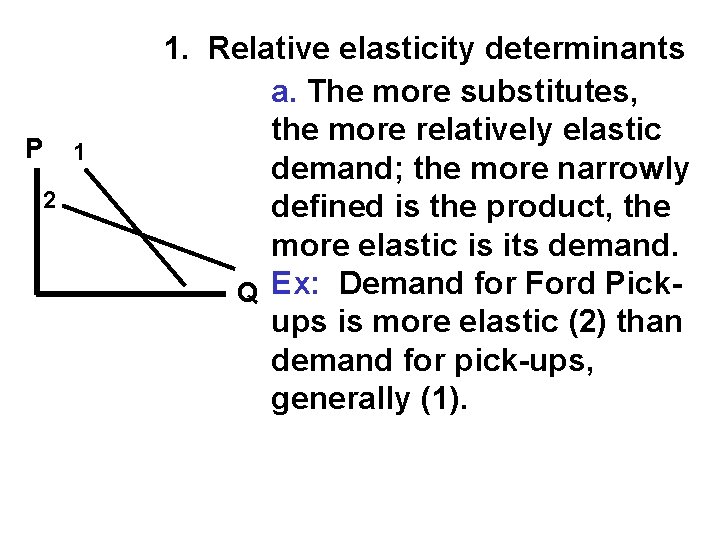
P 2 1 1. Relative elasticity determinants a. The more substitutes, the more relatively elastic demand; the more narrowly defined is the product, the more elastic is its demand. Q Ex: Demand for Ford Pickups is more elastic (2) than demand for pick-ups, generally (1).
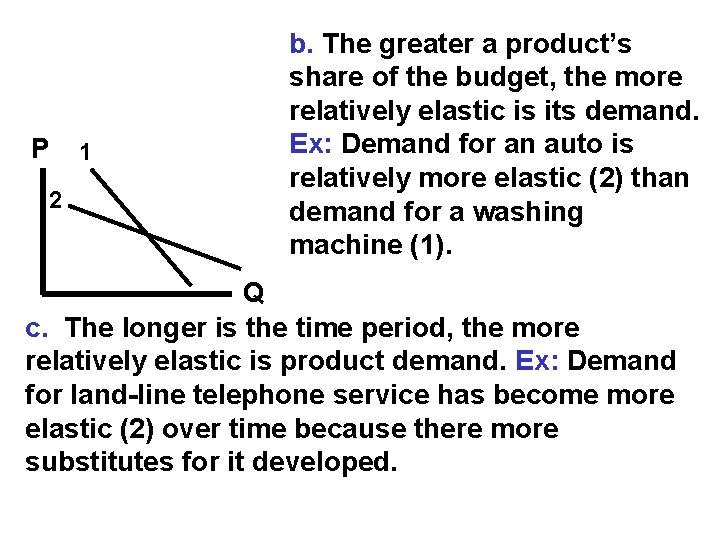
P 2 1 b. The greater a product’s share of the budget, the more relatively elastic is its demand. Ex: Demand for an auto is relatively more elastic (2) than demand for a washing machine (1). Q c. The longer is the time period, the more relatively elastic is product demand. Ex: Demand for land-line telephone service has become more elastic (2) over time because there more substitutes for it developed.
2. Sir Alfred Marshall’s four principles of the relative elasticity of derived resource demand. Two examples of derived demand first: Ex 1: Demand for power supplies that go into desktop PCs derives from new desktop PC demand. Ex 2: The demand for labor derives from the demand for the product it produces.
Marshall claims a component’s or resource's demand is more elastic: a. the less essential to the product is the component or resource b. the more elastic is the demand for the end product
c. a component’s or resource’s demand is more elastic the larger a proportion the cost of the component is of the end product’s cost. d. a component’s or resource’s demand is more elastic the more elastic is the supply of the component’s input resources.
CAUTION Slides from the next to the last in this lesson contain SUPPLEMENTARY materials which are not absolutely needed To complete the Assignment.
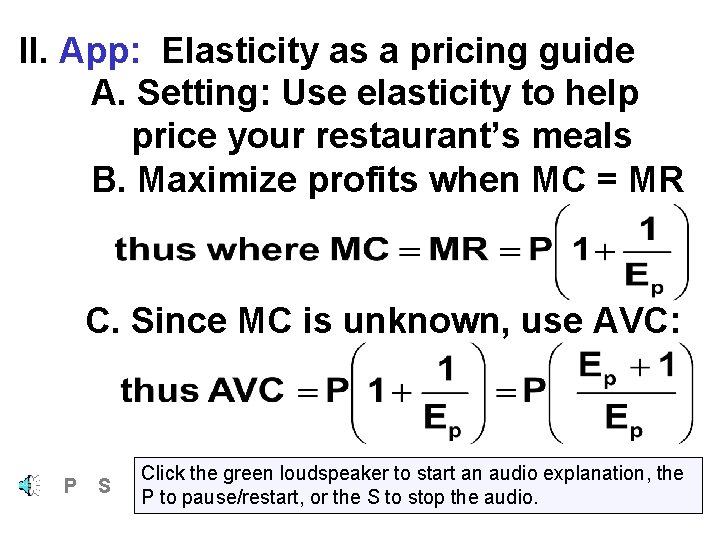
II. App: Elasticity as a pricing guide A. Setting: Use elasticity to help price your restaurant’s meals B. Maximize profits when MC = MR C. Since MC is unknown, use AVC: P S Click the green loudspeaker to start an audio explanation, the P to pause/restart, or the S to stop the audio.
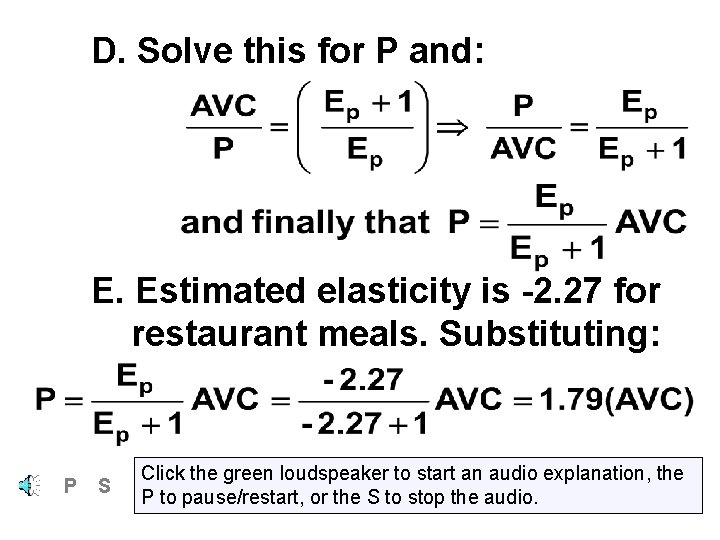
D. Solve this for P and: E. Estimated elasticity is -2. 27 for restaurant meals. Substituting: P S Click the green loudspeaker to start an audio explanation, the P to pause/restart, or the S to stop the audio.
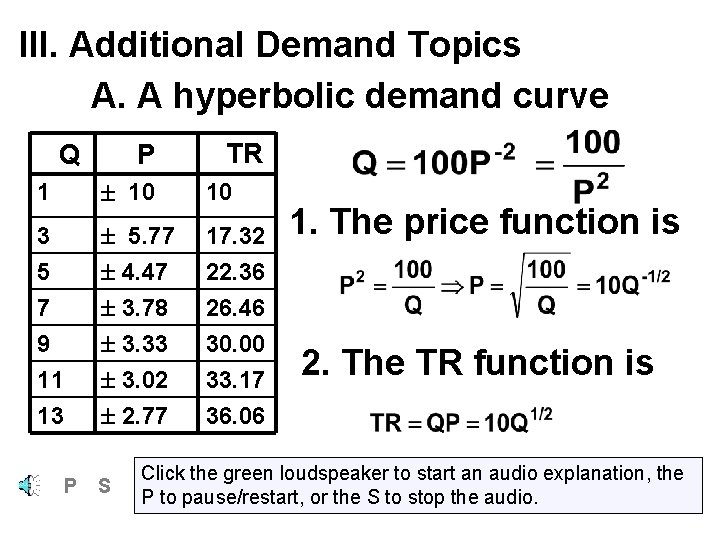
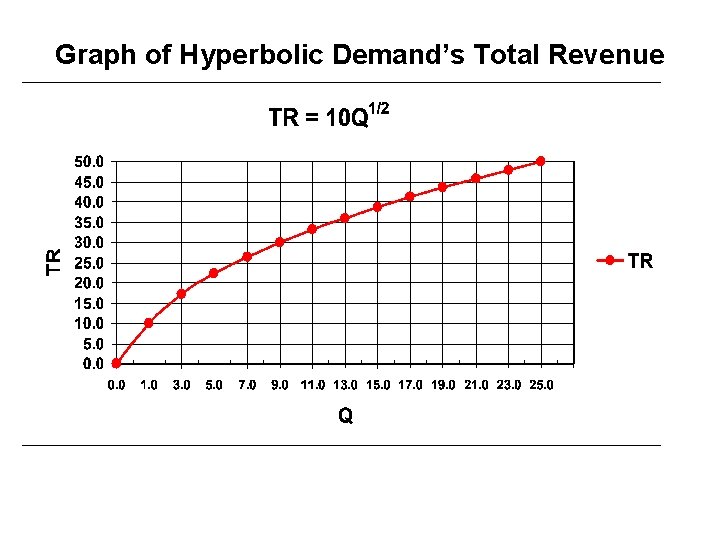
III. Additional Demand Topics A. A hyperbolic demand curve Q P TR 1 10 10 3 5 7 9 11 13 5. 77 4. 47 3. 78 3. 33 3. 02 2. 77 17. 32 22. 36 26. 46 30. 00 33. 17 36. 06 P S 1. The price function is 2. The TR function is Click the green loudspeaker to start an audio explanation, the P to pause/restart, or the S to stop the audio.
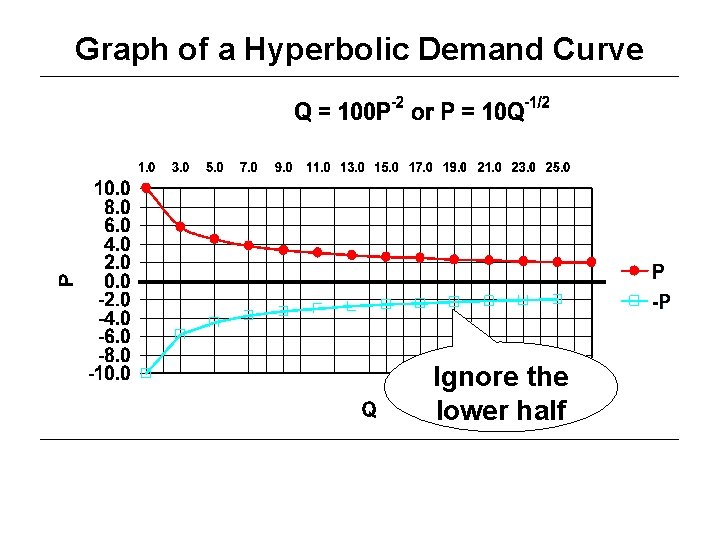
Graph of a Hyperbolic Demand Curve Ignore the lower half
Graph of Hyperbolic Demand’s Total Revenue
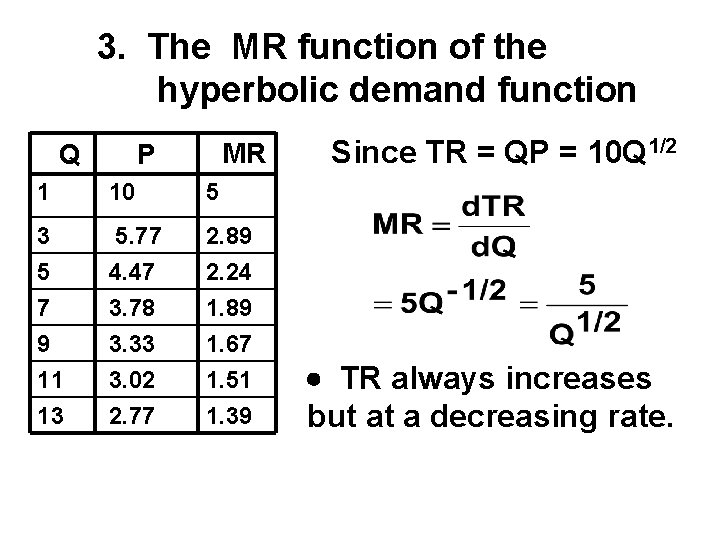
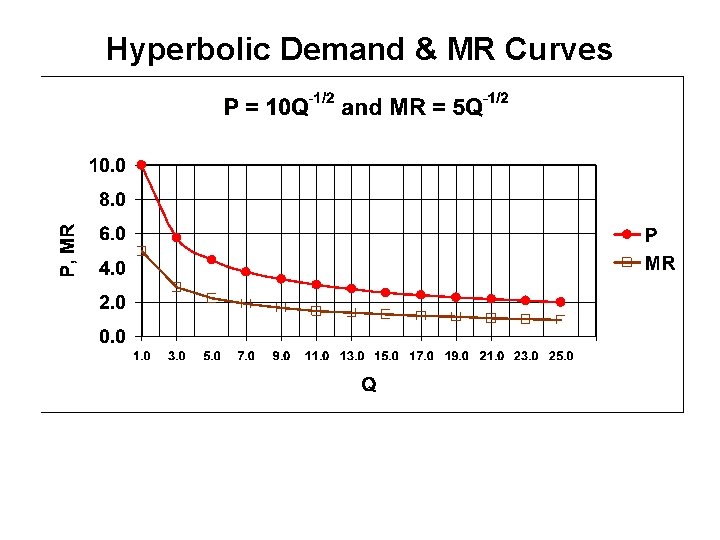
3. The MR function of the hyperbolic demand function Q MR P 1 10 5 3 5 7 9 11 13 5. 77 4. 47 3. 78 3. 33 3. 02 2. 77 2. 89 2. 24 1. 89 1. 67 1. 51 1. 39 Since TR = QP = 10 Q 1/2 TR always increases but at a decreasing rate.
Hyperbolic Demand & MR Curves
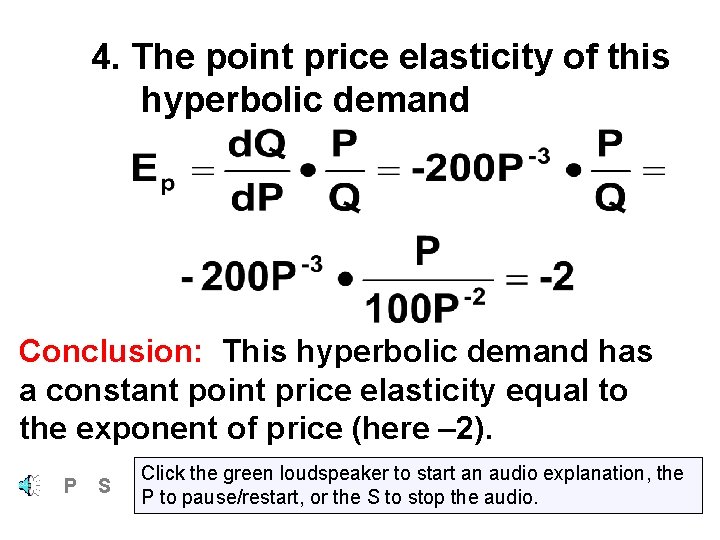
4. The point price elasticity of this hyperbolic demand Conclusion: This hyperbolic demand has a constant point price elasticity equal to the exponent of price (here – 2). P S Click the green loudspeaker to start an audio explanation, the P to pause/restart, or the S to stop the audio.
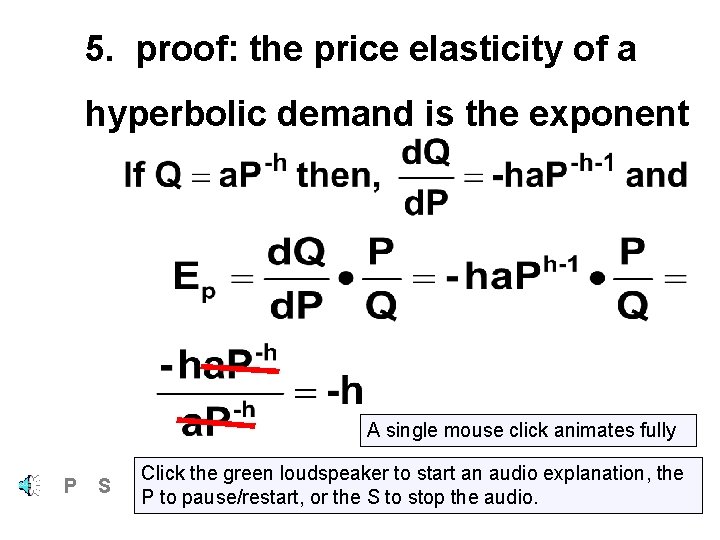
5. proof: the price elasticity of a hyperbolic demand is the exponent A single mouse click animates fully P S Click the green loudspeaker to start an audio explanation, the P to pause/restart, or the S to stop the audio.
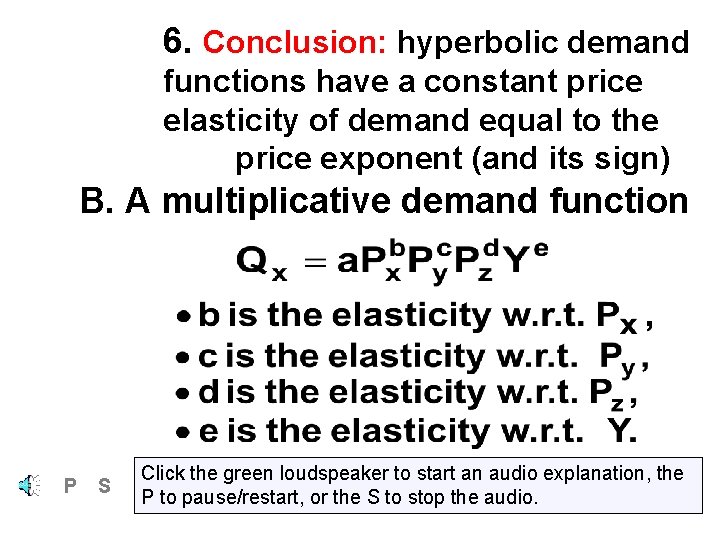
6. Conclusion: hyperbolic demand functions have a constant price elasticity of demand equal to the price exponent (and its sign) B. A multiplicative demand function P S Click the green loudspeaker to start an audio explanation, the P to pause/restart, or the S to stop the audio.
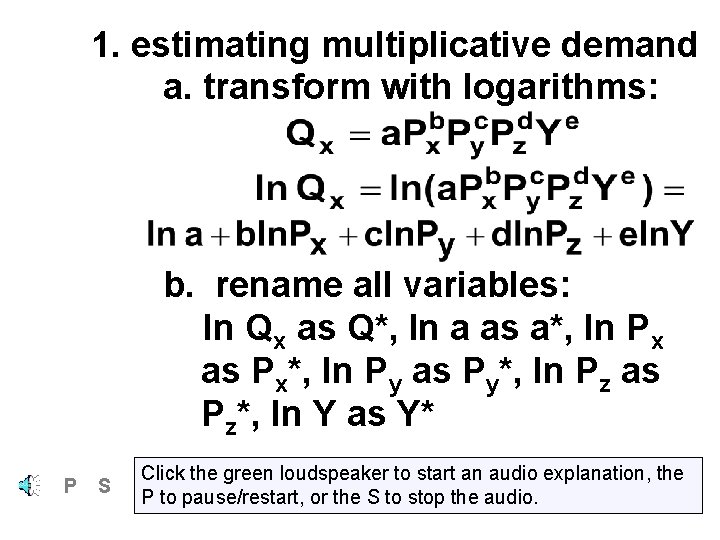
1. estimating multiplicative demand a. transform with logarithms: b. rename all variables: ln Qx as Q*, ln a as a*, ln Px as Px*, ln Py as Py*, ln Pz as Pz*, ln Y as Y* P S Click the green loudspeaker to start an audio explanation, the P to pause/restart, or the S to stop the audio.
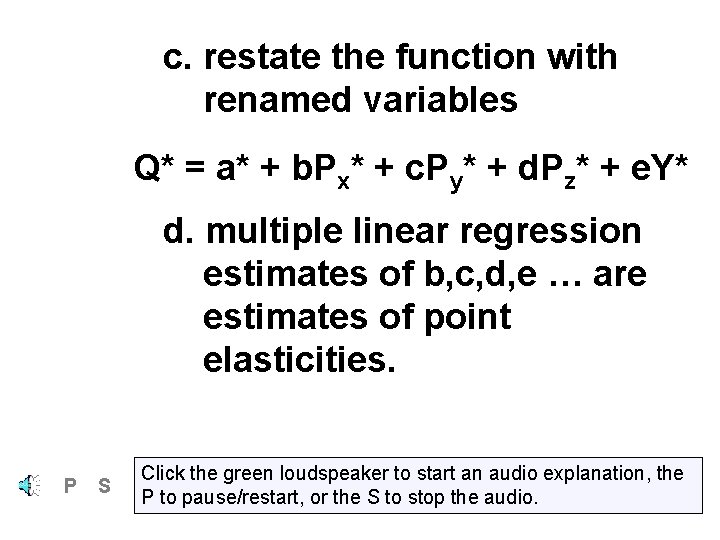
c. restate the function with renamed variables Q* = a* + b. Px* + c. Py* + d. Pz* + e. Y* d. multiple linear regression estimates of b, c, d, e … are estimates of point elasticities. P S Click the green loudspeaker to start an audio explanation, the P to pause/restart, or the S to stop the audio.
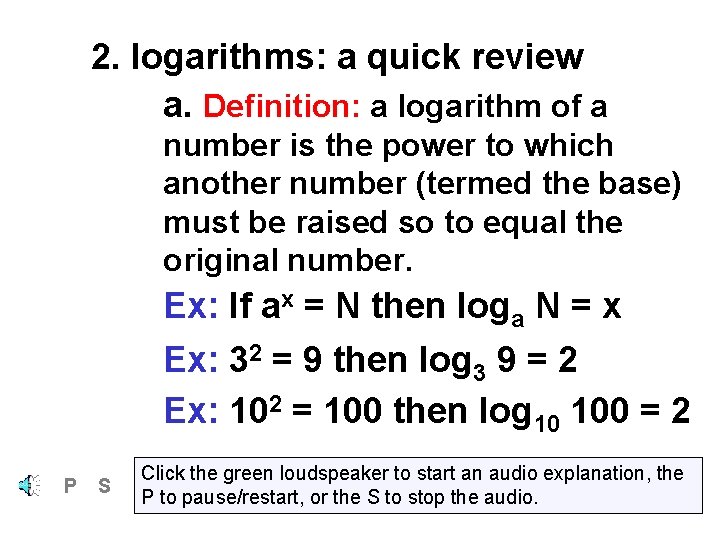
2. logarithms: a quick review a. Definition: a logarithm of a number is the power to which another number (termed the base) must be raised so to equal the original number. Ex: If ax = N then loga N = x Ex: 32 = 9 then log 3 9 = 2 Ex: 102 = 100 then log 10 100 = 2 P S Click the green loudspeaker to start an audio explanation, the P to pause/restart, or the S to stop the audio.
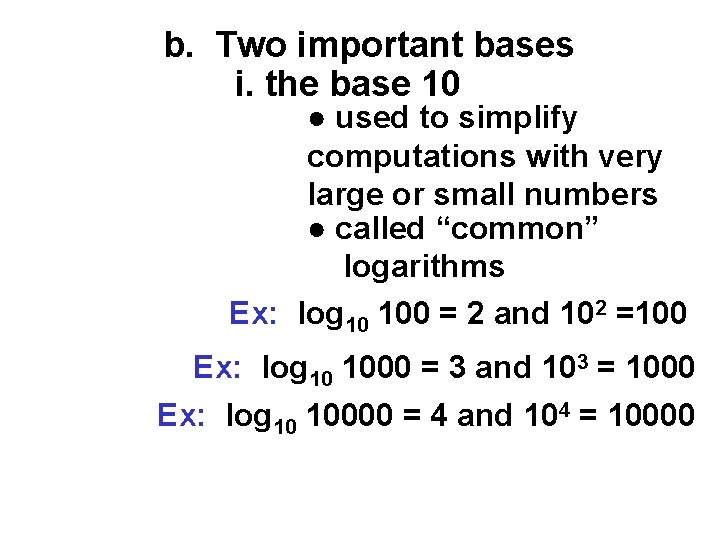
b. Two important bases i. the base 10 ● used to simplify computations with very large or small numbers ● called “common” logarithms Ex: log 10 100 = 2 and 102 =100 Ex: log 10 1000 = 3 and 103 = 1000 Ex: log 10 10000 = 4 and 104 = 10000
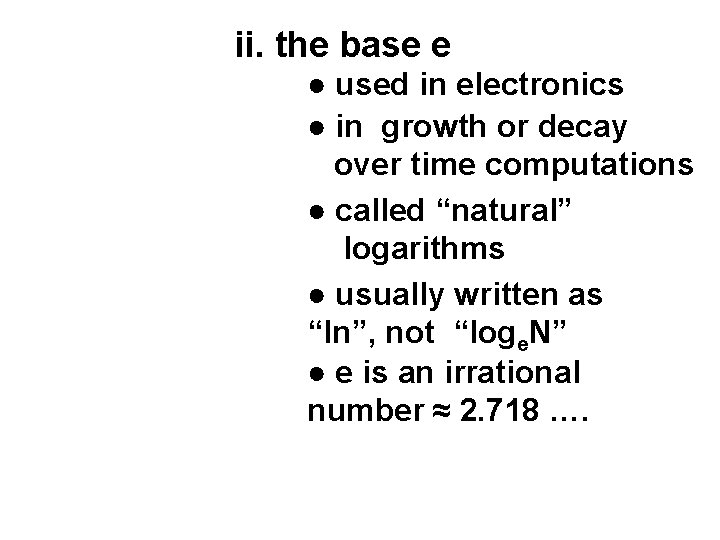
ii. the base e ● used in electronics ● in growth or decay over time computations ● called “natural” logarithms ● usually written as “ln”, not “loge. N” ● e is an irrational number ≈ 2. 718 ….
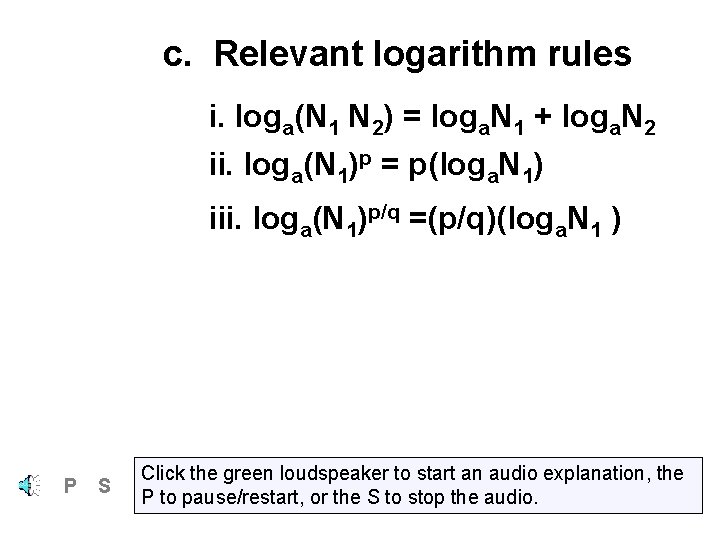
c. Relevant logarithm rules i. loga(N 1 N 2) = loga. N 1 + loga. N 2 ii. loga(N 1)p = p(loga. N 1) iii. loga(N 1)p/q =(p/q)(loga. N 1 ) P S Click the green loudspeaker to start an audio explanation, the P to pause/restart, or the S to stop the audio.