
Managerial Economics Business Strategy Chapter 5 The Production

Managerial Economics & Business Strategy Chapter 5 The Production Process and Costs
How do we know the OPTIMAL level of capital and labor in the long run • Isoquant n n The combinations of inputs (K, L) that yield the producer the same level of output. Shape reflects how managers can substitute inputs and maintaining the same level of output.
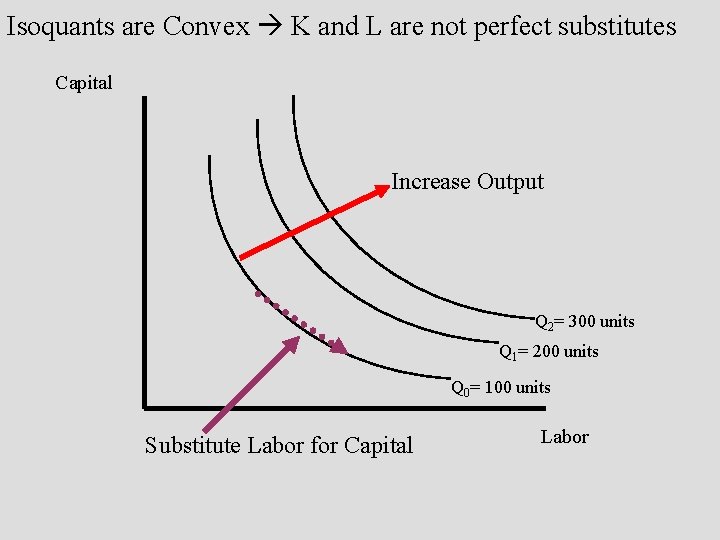
Isoquants are Convex K and L are not perfect substitutes Capital Increase Output Q 2= 300 units Q 1= 200 units Q 0= 100 units Substitute Labor for Capital Labor
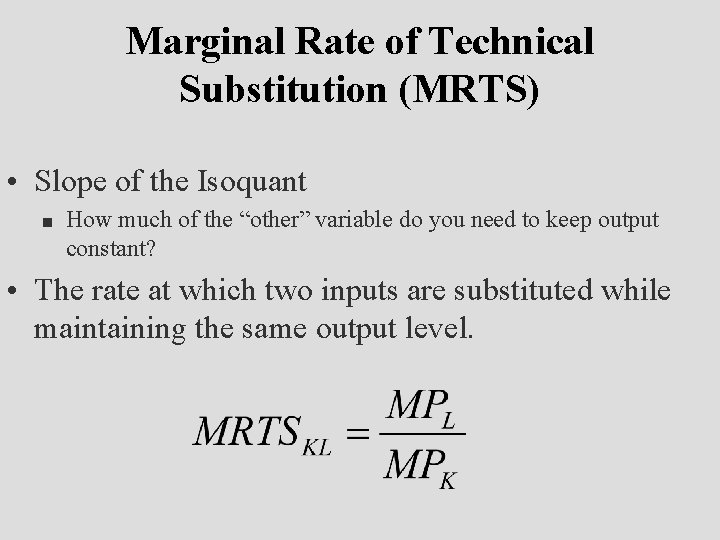
Marginal Rate of Technical Substitution (MRTS) • Slope of the Isoquant n How much of the “other” variable do you need to keep output constant? • The rate at which two inputs are substituted while maintaining the same output level.
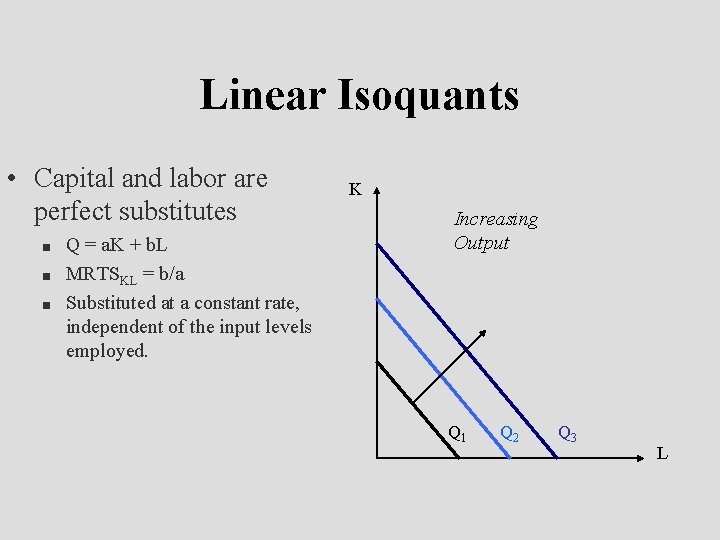
Linear Isoquants • Capital and labor are perfect substitutes n n n Q = a. K + b. L MRTSKL = b/a Substituted at a constant rate, independent of the input levels employed. K Increasing Output Q 1 Q 2 Q 3 L
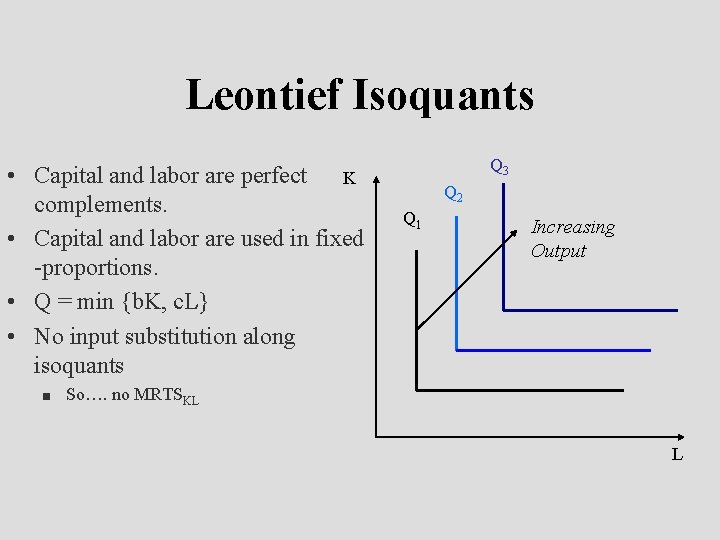
Leontief Isoquants • Capital and labor are perfect K complements. • Capital and labor are used in fixed -proportions. • Q = min {b. K, c. L} • No input substitution along isoquants n Q 3 Q 2 Q 1 Increasing Output So…. no MRTSKL L
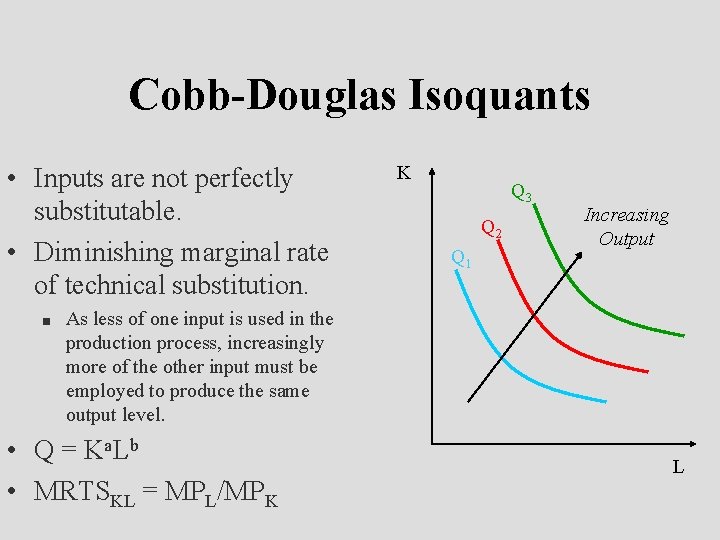
Cobb-Douglas Isoquants • Inputs are not perfectly substitutable. • Diminishing marginal rate of technical substitution. n K Q 3 Q 2 Q 1 Increasing Output As less of one input is used in the production process, increasingly more of the other input must be employed to produce the same output level. • Q = Ka L b • MRTSKL = MPL/MPK L
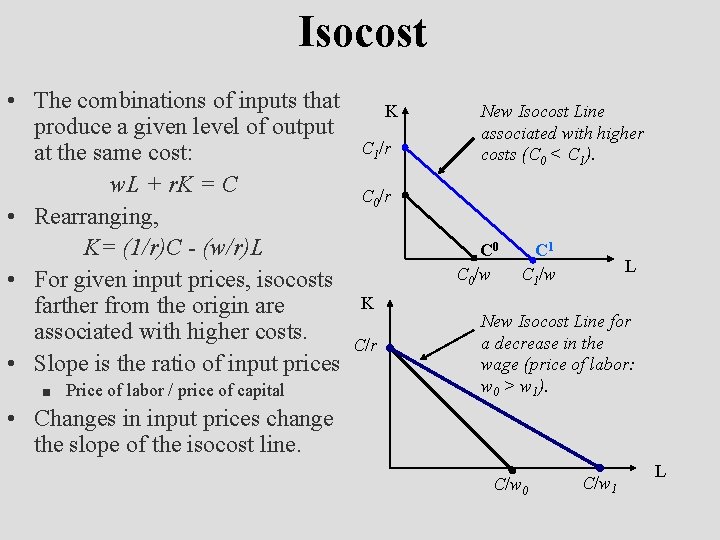
Isocost • The combinations of inputs that produce a given level of output at the same cost: w. L + r. K = C • Rearranging, K= (1/r)C - (w/r)L • For given input prices, isocosts farther from the origin are associated with higher costs. • Slope is the ratio of input prices n Price of labor / price of capital K C 1/r New Isocost Line associated with higher costs (C 0 < C 1). C 0/r C 0/w K C/r C 1/w L New Isocost Line for a decrease in the wage (price of labor: w 0 > w 1). • Changes in input prices change the slope of the isocost line. C/w 0 C/w 1 L
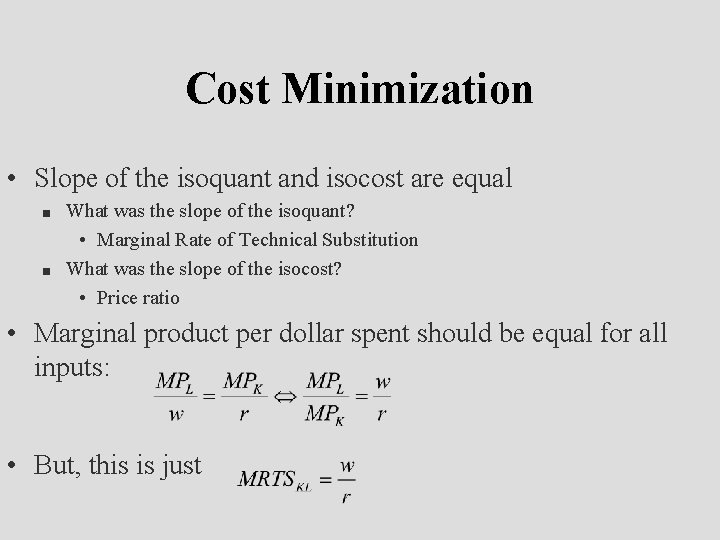
Cost Minimization • Slope of the isoquant and isocost are equal n n What was the slope of the isoquant? • Marginal Rate of Technical Substitution What was the slope of the isocost? • Price ratio • Marginal product per dollar spent should be equal for all inputs: • But, this is just
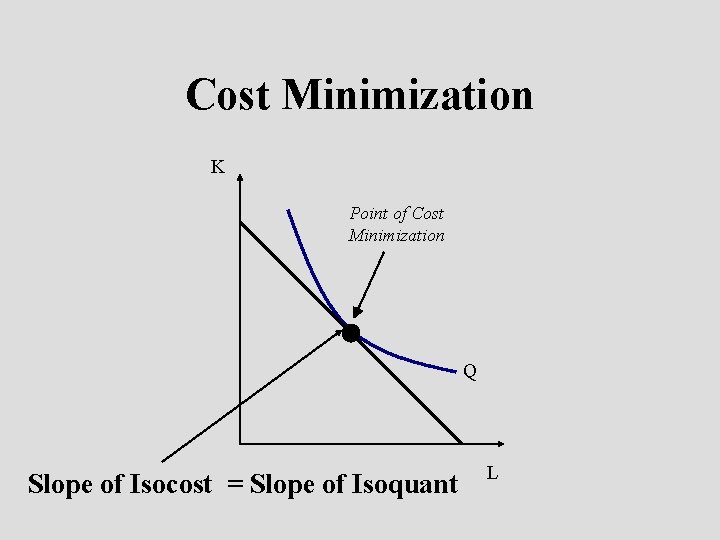
Cost Minimization K Point of Cost Minimization Q Slope of Isocost = Slope of Isoquant L
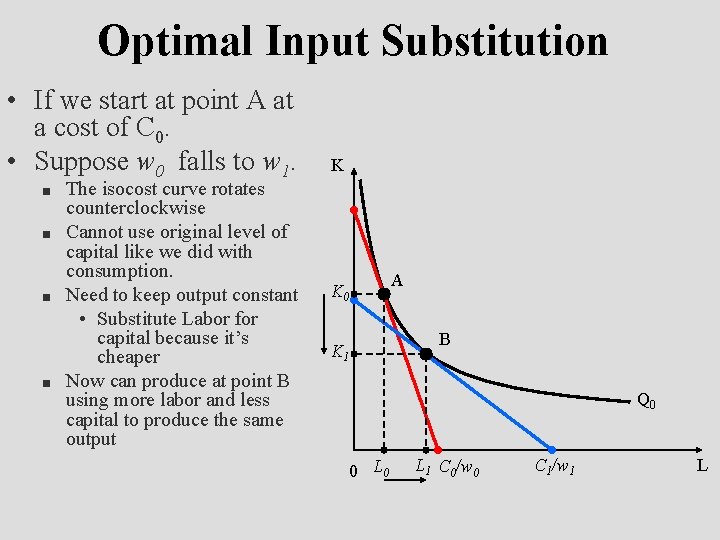
Optimal Input Substitution • If we start at point A at a cost of C 0. • Suppose w 0 falls to w 1. n n The isocost curve rotates counterclockwise Cannot use original level of capital like we did with consumption. Need to keep output constant • Substitute Labor for capital because it’s cheaper Now can produce at point B using more labor and less capital to produce the same output K A K 0 B K 1 Q 0 0 L 1 C 0/w 0 C 1/w 1 L
Cost Analysis • Types of Costs n n Fixed costs (FC) Variable costs (VC) Total costs (TC) Sunk costs
- Slides: 12