
Managerial Decision Modeling with Spreadsheets Chapter 3 Linear














- Slides: 43
Managerial Decision Modeling with Spreadsheets Chapter 3 Linear Programming Modeling (Selected) Applications: With Computer Analyses in Excel
Learning Objectives 1. Model wide variety of linear programming (LP) problems. 2. Understand major business application areas for LP problems: manufacturing, marketing, labor scheduling, blending, transportation, finance, and multi-period planning. 3. Gain experience in setting up and solving LP problems using Excel’s Solver.
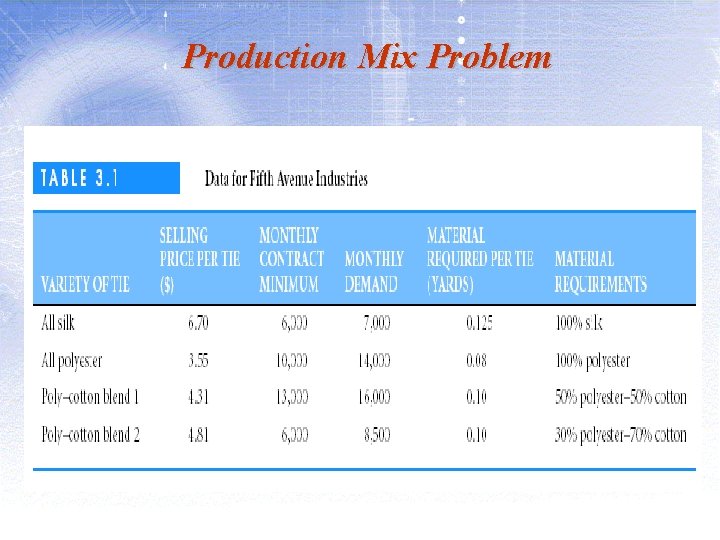
Production Mix Problem Fifth Avenue Industries • Nationally known menswear manufacturer. • Produces four varieties of neckties. – All-silk tie. – All-polyester tie. – Two different polyester and cotton blends. • Has fixed contracts with major department stores. – Table 3. 1 summarizes contract demand for products.
Production Mix Problem Material Cost per yard Material available per month (yards) Silk Polyestar $20 $6 1, 000 3, 000 Cotton $9 1, 600 Fifth Avenue uses a standard labor cost of $0. 75 per tie (for any variety)
Production Mix Problem
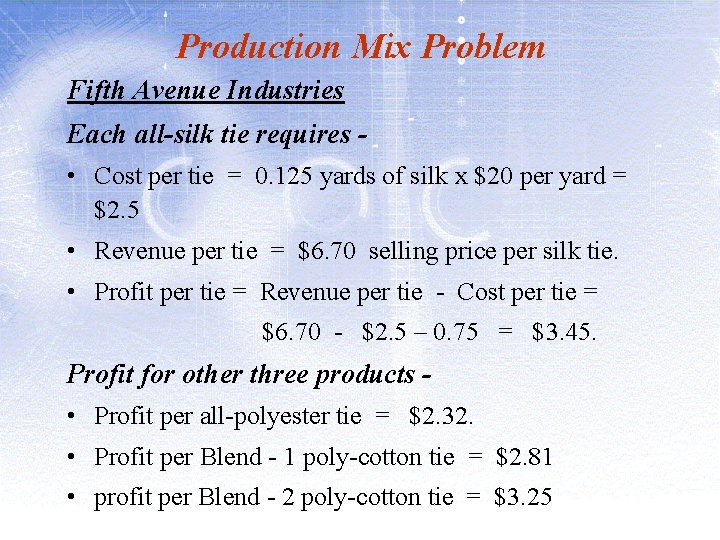
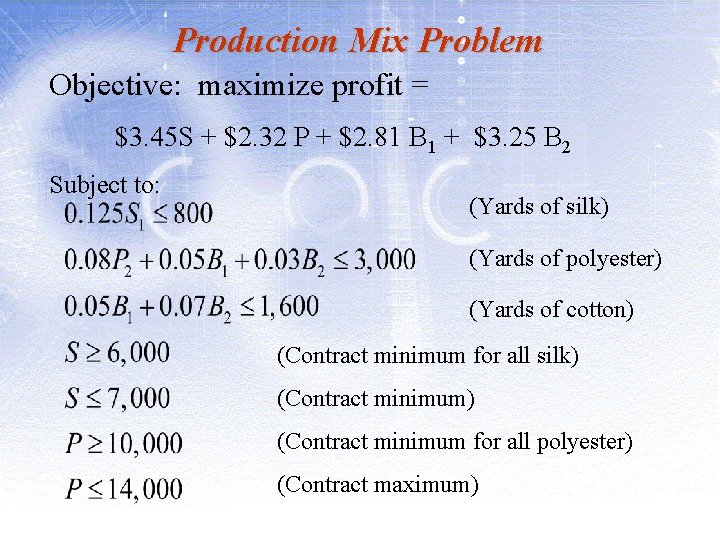
Production Mix Problem Fifth Avenue Industries Each all-silk tie requires • Cost per tie = 0. 125 yards of silk x $20 per yard = $2. 5 • Revenue per tie = $6. 70 selling price per silk tie. • Profit per tie = Revenue per tie - Cost per tie = $6. 70 - $2. 5 – 0. 75 = $3. 45. Profit for other three products • Profit per all-polyester tie = $2. 32. • Profit per Blend - 1 poly-cotton tie = $2. 81 • profit per Blend - 2 poly-cotton tie = $3. 25
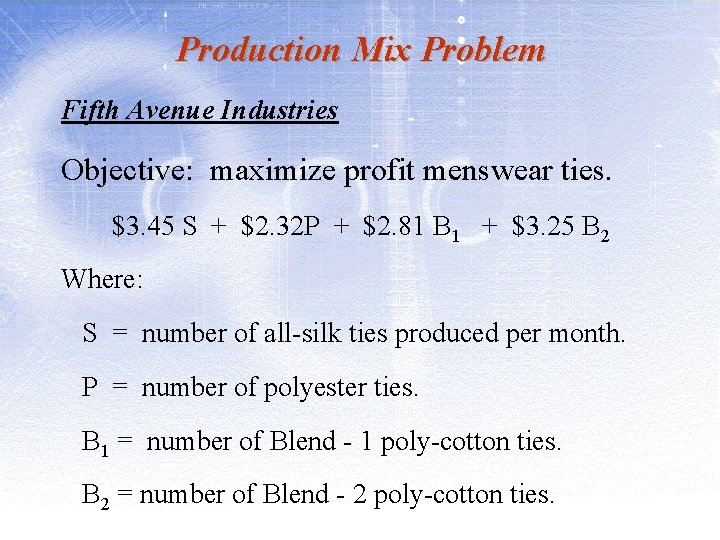
Production Mix Problem Fifth Avenue Industries Objective: maximize profit menswear ties. $3. 45 S + $2. 32 P + $2. 81 B 1 + $3. 25 B 2 Where: S = number of all-silk ties produced per month. P = number of polyester ties. B 1 = number of Blend - 1 poly-cotton ties. B 2 = number of Blend - 2 poly-cotton ties.
Production Mix Problem Objective: maximize profit = $3. 45 S + $2. 32 P + $2. 81 B 1 + $3. 25 B 2 Subject to: (Yards of silk) (Yards of polyester) (Yards of cotton) (Contract minimum for all silk) (Contract minimum for all polyester) (Contract maximum)
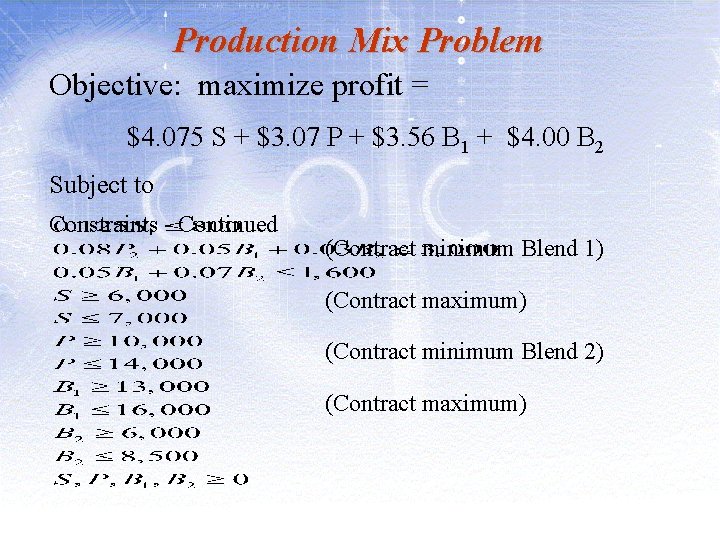
Production Mix Problem Objective: maximize profit = $4. 075 S + $3. 07 P + $3. 56 B 1 + $4. 00 B 2 Subject to Constraints - Continued (Contract minimum Blend 1) (Contract maximum) (Contract minimum Blend 2) (Contract maximum)
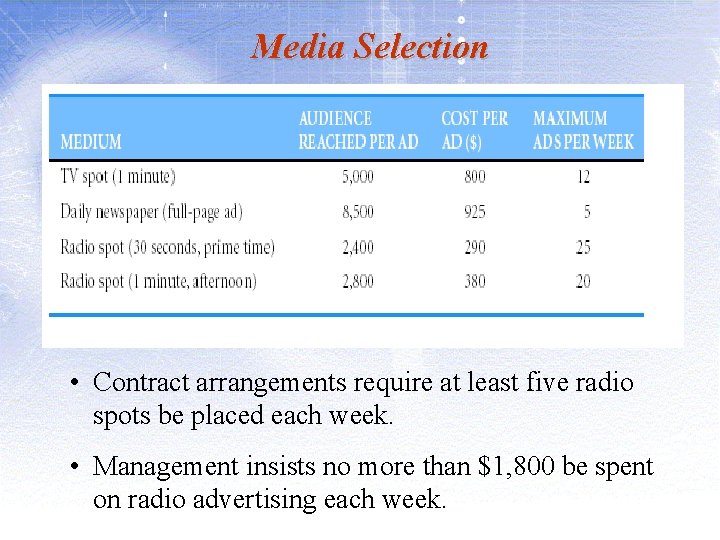
Media Selection Win Big Gambling Club promotes gambling junkets from a large Midwestern city to casinos in the Bahamas. • Club has budgeted up to $8, 000 per week for local advertising. – Money is to be allocated among four promotional media: • TV spots, • Newspaper ads, and • Two types of radio advertisements. • Win Big’s goal - reach largest possible high-potential audience through various media.
Media Selection • Contract arrangements require at least five radio spots be placed each week. • Management insists no more than $1, 800 be spent on radio advertising each week.
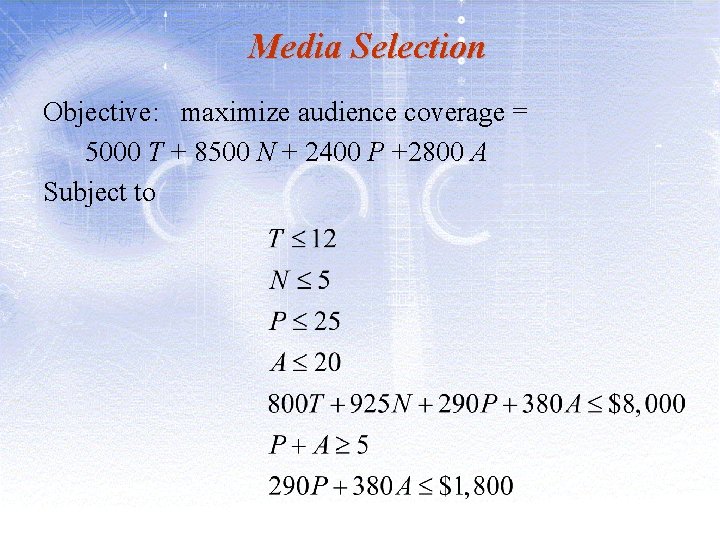
Media Selection Objective: maximize audience coverage= 5000 T + 8500 N + 2400 P +2800 A T = number of 1 -minute TV spots taken each week. N = number of full-page daily newspaper ads taken each week. P = number of 30 -second prime-time radio spots taken each week. A = number of 1 -minute afternoon radio spots taken each week.
Media Selection Objective: maximize audience coverage = 5000 T + 8500 N + 2400 P +2800 A Subject to
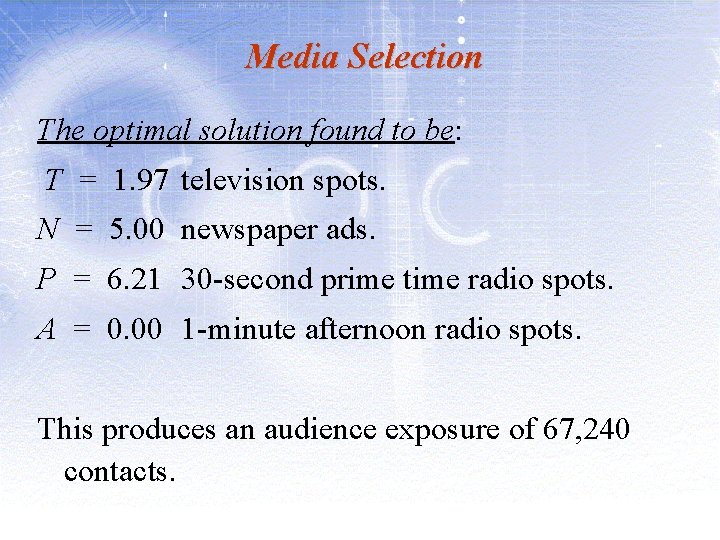
Media Selection The optimal solution found to be: T = 1. 97 television spots. N = 5. 00 newspaper ads. P = 6. 21 30 -second prime time radio spots. A = 0. 00 1 -minute afternoon radio spots. This produces an audience exposure of 67, 240 contacts.
Marketing Research Problem Management Sciences Associates (MSA) handles consumer surveys. MSA has to determine, for a client, that it must fulfill several requirements in order to draw statistically valid conclusions on sensitive issue of new U. S. immigration laws: 1. Survey at least 2, 300 U. S. households. 2. Survey at least 1, 000 households whose heads are 30 years of age or younger.
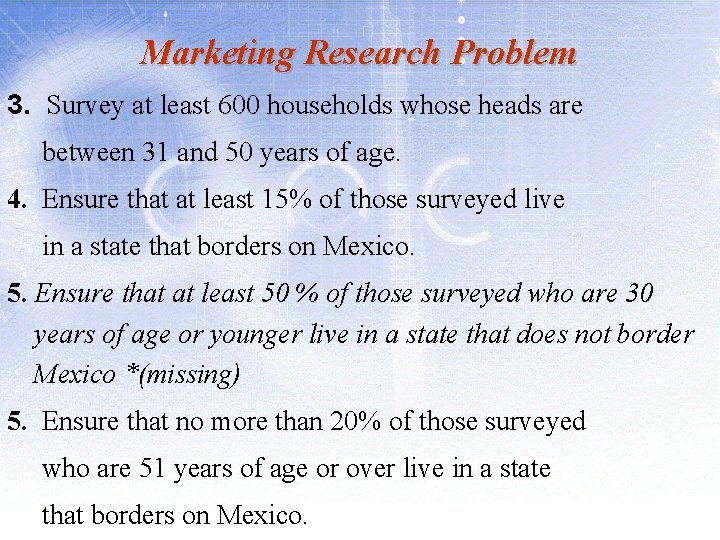
Marketing Research Problem 3. Survey at least 600 households whose heads are between 31 and 50 years of age. 4. Ensure that at least 15% of those surveyed live in a state that borders on Mexico. 5. Ensure that at least 50 % of those surveyed who are 30 years of age or younger live in a state that does not border Mexico *(missing) 5. Ensure that no more than 20% of those surveyed who are 51 years of age or over live in a state that borders on Mexico.
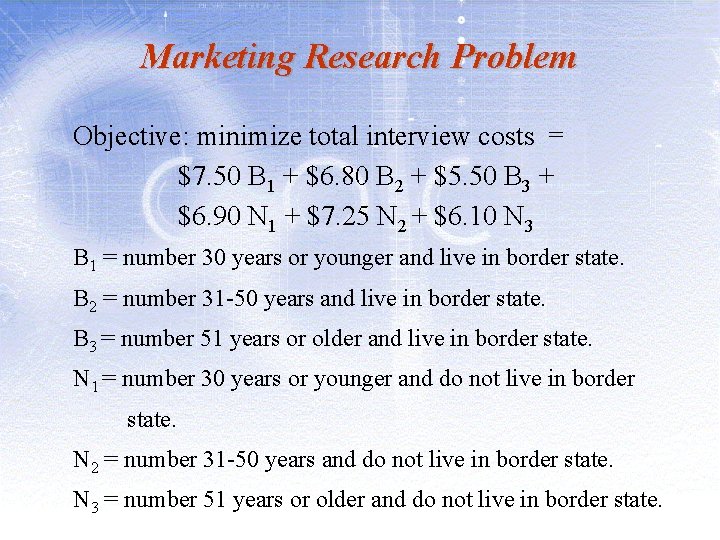
Marketing Research Problem Objective: minimize total interview costs = $7. 50 B 1 + $6. 80 B 2 + $5. 50 B 3 + $6. 90 N 1 + $7. 25 N 2 + $6. 10 N 3 B 1 = number 30 years or younger and live in border state. B 2 = number 31 -50 years and live in border state. B 3 = number 51 years or older and live in border state. N 1 = number 30 years or younger and do not live in border state. N 2 = number 31 -50 years and do not live in border state. N 3 = number 51 years or older and do not live in border state.
Marketing Research Problem Objective: minimize total interview costs = $7. 50 B 1 + $6. 80 B 2 + $5. 50 B 3 + $6. 90 N 1 + $7. 25 N 2 + $6. 10 N 3 Subject to
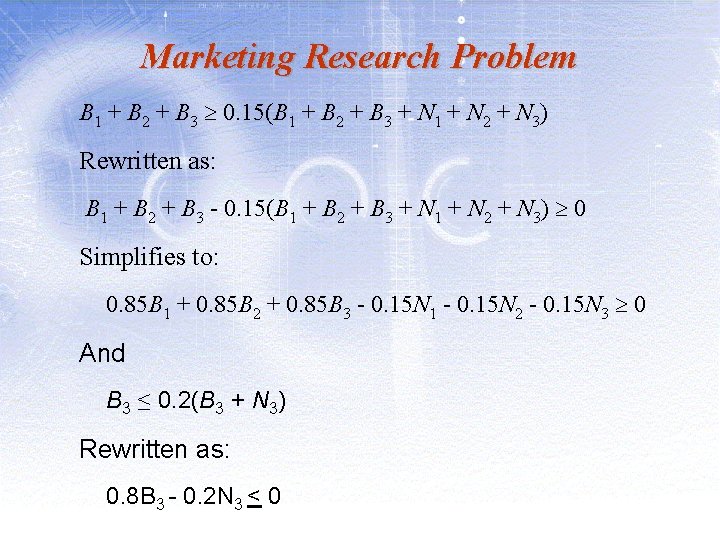
Marketing Research Problem B 1 + B 2 + B 3 0. 15(B 1 + B 2 + B 3 + N 1 + N 2 + N 3) Rewritten as: B 1 + B 2 + B 3 - 0. 15(B 1 + B 2 + B 3 + N 1 + N 2 + N 3) 0 Simplifies to: 0. 85 B 1 + 0. 85 B 2 + 0. 85 B 3 - 0. 15 N 1 - 0. 15 N 2 - 0. 15 N 3 0 And B 3 ≤ 0. 2(B 3 + N 3) Rewritten as: 0. 8 B 3 - 0. 2 N 3 < 0
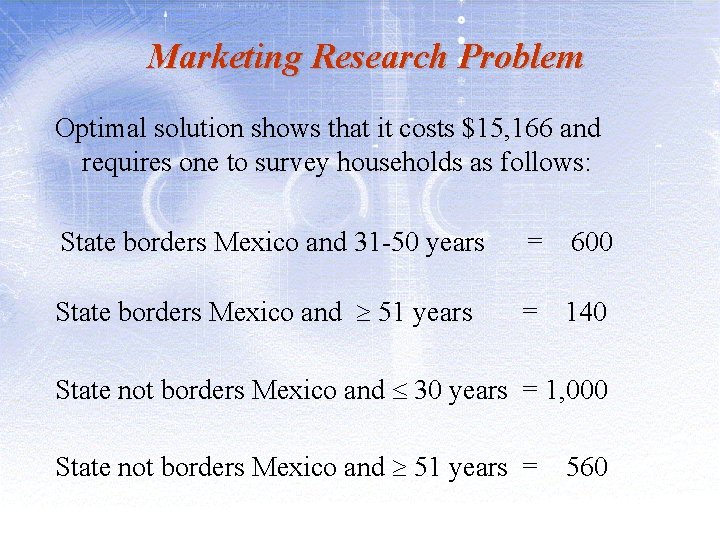
Marketing Research Problem Optimal solution shows that it costs $15, 166 and requires one to survey households as follows: State borders Mexico and 31 -50 years = 600 State borders Mexico and 51 years = 140 State not borders Mexico and 30 years = 1, 000 State not borders Mexico and 51 years = 560
Employee Scheduling Application Hong Kong Bank now employs 12 full-time tellers. Parttime employees (four hours per day) are available. They can start work anytime between 9 A. M. and 1 P. M. Tellers requirements:
Employee Scheduling Application Hong Kong Bank Labor Constraints: • Full-timers work from 9 A. M. to 5 P. M. – Allowed 1 hour for lunch. – Half of full-timers eat at 11 A. M. and other half at noon. – Full-timers thus provide 35 hours per week of productive labor time. • Part-time hours limited to a maximum of 50% of day’s total requirement. Costs: • Part-timers earn $7 per hour (or $28 per day) on average. • Full-timers earn $90 per day in salary and benefits, on average.
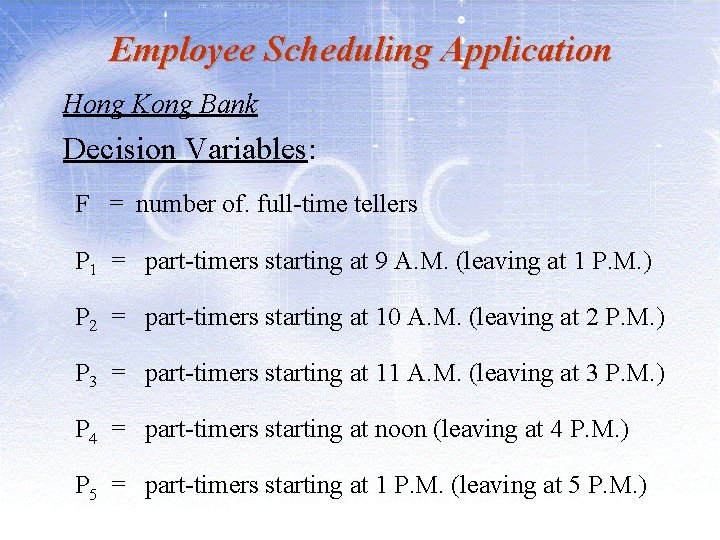
Employee Scheduling Application Hong Kong Bank Decision Variables: F = number of. full-time tellers P 1 = part-timers starting at 9 A. M. (leaving at 1 P. M. ) P 2 = part-timers starting at 10 A. M. (leaving at 2 P. M. ) P 3 = part-timers starting at 11 A. M. (leaving at 3 P. M. ) P 4 = part-timers starting at noon (leaving at 4 P. M. ) P 5 = part-timers starting at 1 P. M. (leaving at 5 P. M. )
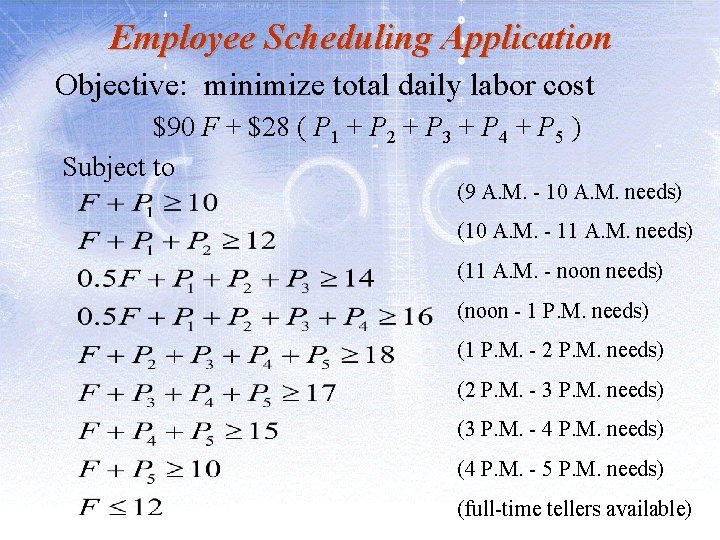
Employee Scheduling Application Objective: minimize total daily labor cost $90 F + $28 ( P 1 + P 2 + P 3 + P 4 + P 5 ) Subject to (9 A. M. - 10 A. M. needs) (10 A. M. - 11 A. M. needs) (11 A. M. - noon needs) (noon - 1 P. M. needs) (1 P. M. - 2 P. M. needs) (2 P. M. - 3 P. M. needs) (3 P. M. - 4 P. M. needs) (4 P. M. - 5 P. M. needs) (full-time tellers available)
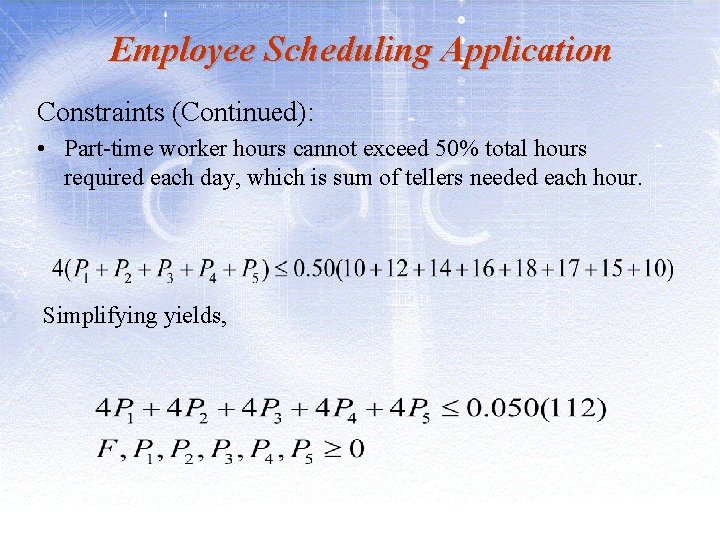
Employee Scheduling Application Constraints (Continued): • Part-time worker hours cannot exceed 50% total hours required each day, which is sum of tellers needed each hour. Simplifying yields,
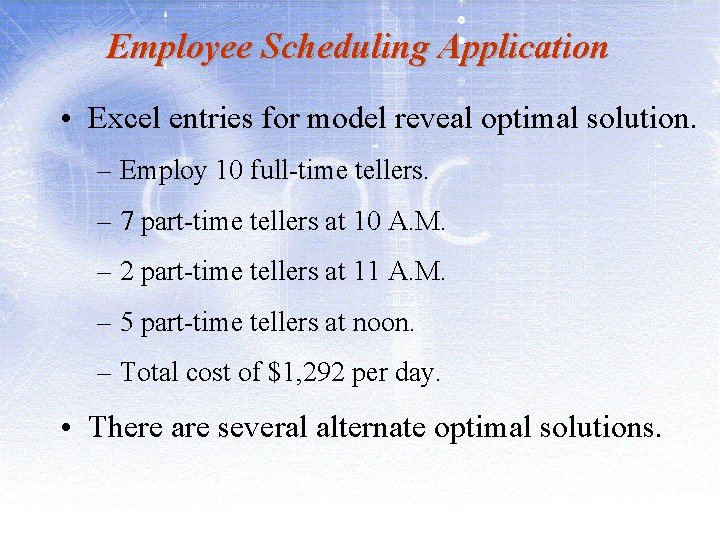
Employee Scheduling Application • Excel entries for model reveal optimal solution. – Employ 10 full-time tellers. – 7 part-time tellers at 10 A. M. – 2 part-time tellers at 11 A. M. – 5 part-time tellers at noon. – Total cost of $1, 292 per day. • There are several alternate optimal solutions.
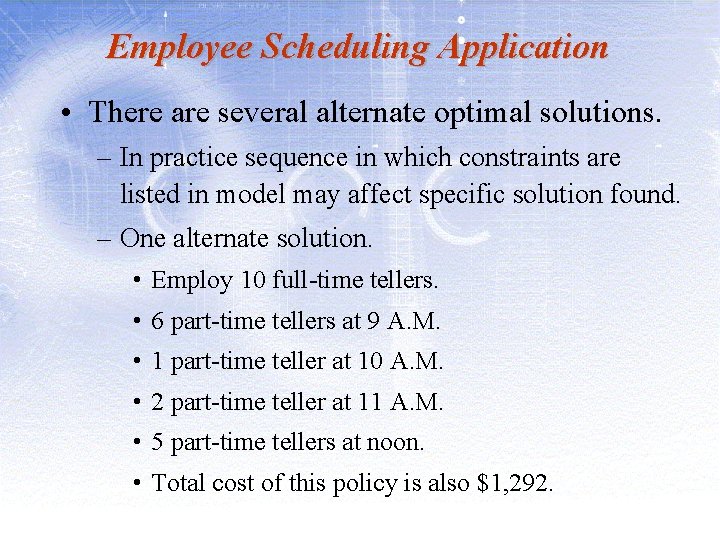
Employee Scheduling Application • There are several alternate optimal solutions. – In practice sequence in which constraints are listed in model may affect specific solution found. – One alternate solution. • Employ 10 full-time tellers. • 6 part-time tellers at 9 A. M. • 1 part-time teller at 10 A. M. • 2 part-time teller at 11 A. M. • 5 part-time tellers at noon. • Total cost of this policy is also $1, 292.
Ingredient Blending Applications Diet Problems Diet problem involves specifying a food or food ingredient combination that satisfies stated nutritional requirements at minimum cost. • Whole Food Nutrition Center uses three bulk grains to blend natural cereal that sells by the pound. • Each 2 -ounce serving of cereal, when taken with 1. 2 cup of whole milk, meets an average adult’s minimum daily requirement for protein, riboflavin, phosphorus, and magnesium.
Ingredient Blending Applications Whole Food Nutrition Center Diet Problems • Minimum adult daily requirement: – Protein 3 units. – Riboflavin 2 units. – Phosphorus 1 unit. – Magnesium 0. 425 unit. • Select blend of grains to meet USRDA at minimum cost.
Ingredient Blending Applications Decision Variables: A = pounds of grain in one 2 -ounce cereal serving. B = pounds of grain in one 2 -ounce cereal serving. C = pounds of grain in one 2 -ounce cereal serving.
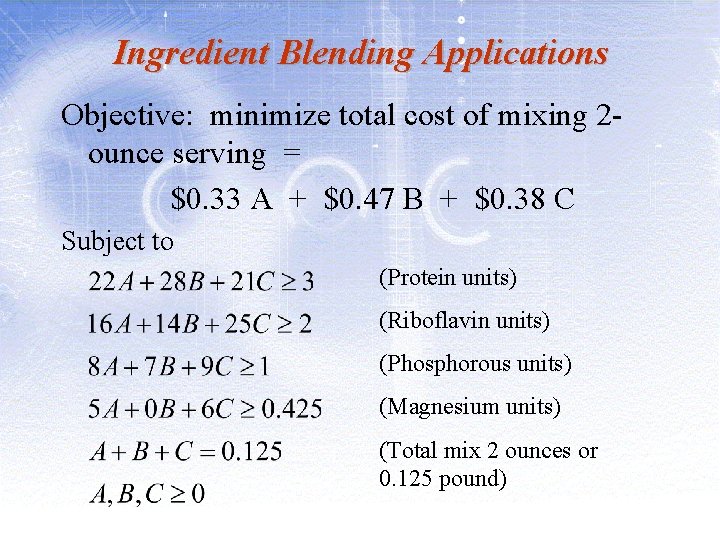
Ingredient Blending Applications Objective: minimize total cost of mixing 2 ounce serving = $0. 33 A + $0. 47 B + $0. 38 C Subject to (Protein units) (Riboflavin units) (Phosphorous units) (Magnesium units) (Total mix 2 ounces or 0. 125 pound)
Multi-period Applications • Most challenging application of LP is modeling multi-period scenarios. • Situations where decision maker has to determine optimal decisions for several periods (weeks, months, etc. ). • These problems especially difficult because decision choices in later periods are directly dependent on decisions made in earlier periods.
Multi-period Applications Production Scheduling Greenberg Motors, Inc. , manufactures two different electrical motors for sale under contract to Drexel Corp. Model GM 3 A is found in many Drexel food processors, and model GM 3 B is used in assembly of blenders. • Production planning must consider four factors: – Desirability of producing same number of each motor each month. – Necessity to reduce inventory carrying, or holding, costs. – Warehouse limitations cannot be exceeded. – Company’s no-layoff policy.
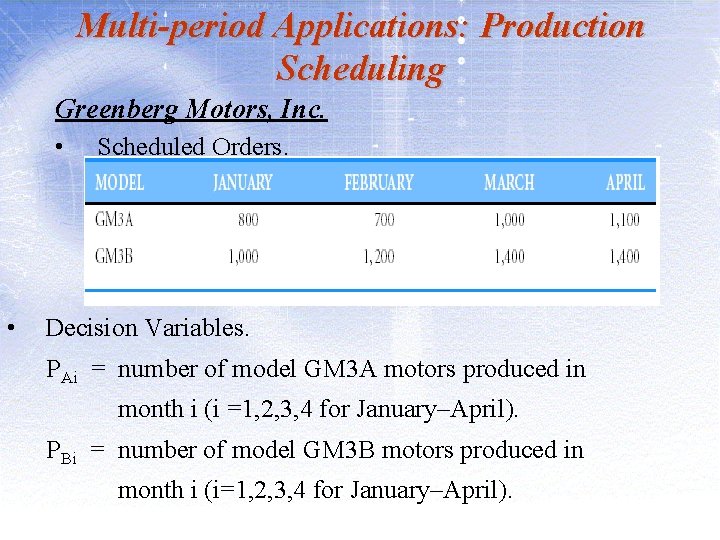
Multi-period Applications: Production Scheduling Greenberg Motors, Inc. • • Scheduled Orders. Decision Variables. PAi = number of model GM 3 A motors produced in month i (i =1, 2, 3, 4 for January–April). PBi = number of model GM 3 B motors produced in month i (i=1, 2, 3, 4 for January–April).
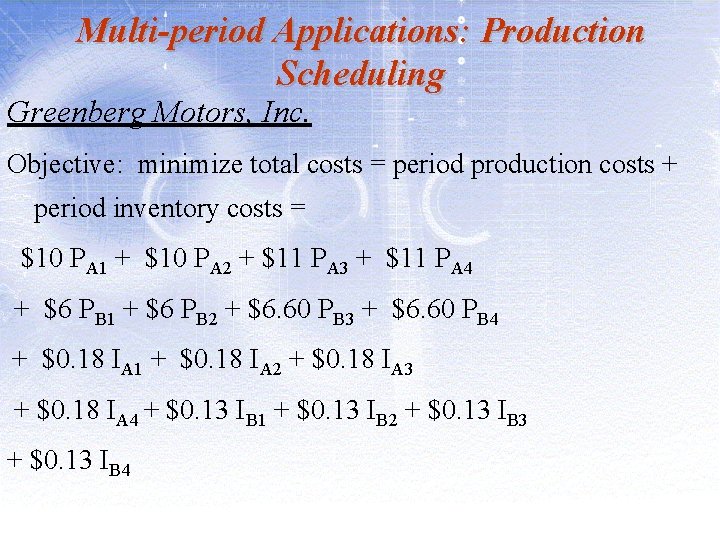
Multi-period Applications: Production Scheduling Greenberg Motors, Inc. • Associated Costs. • Production costs now - – GM 3 A is $10. – GM 3 B is $6. • Prices will increase in March to $11 and $6. 60, respectively. • Production Cost = $10 PA 1 + $10 PA 2 + $11 PA 3 + $11 PA 4 + $6 PB 1 + $6 PB 2 + $6. 60 PB 3 + $6. 60 PB 4
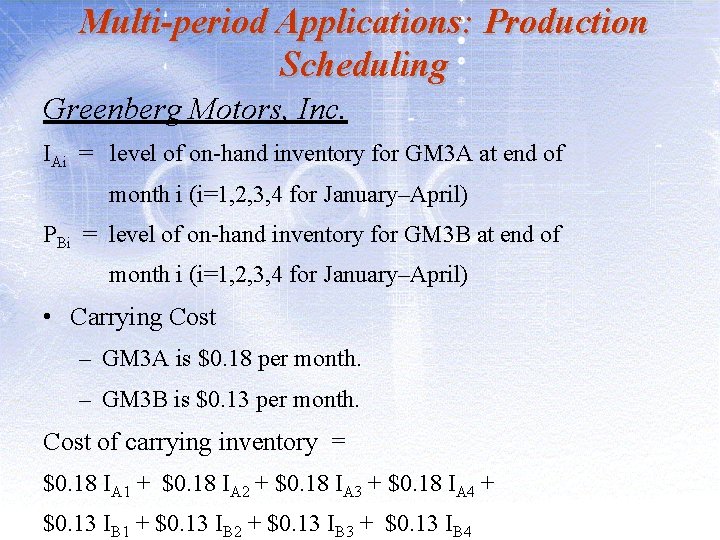
Multi-period Applications: Production Scheduling Greenberg Motors, Inc. IAi = level of on-hand inventory for GM 3 A at end of month i (i=1, 2, 3, 4 for January–April) PBi = level of on-hand inventory for GM 3 B at end of month i (i=1, 2, 3, 4 for January–April) • Carrying Cost – GM 3 A is $0. 18 per month. – GM 3 B is $0. 13 per month. Cost of carrying inventory = $0. 18 IA 1 + $0. 18 IA 2 + $0. 18 IA 3 + $0. 18 IA 4 + $0. 13 IB 1 + $0. 13 IB 2 + $0. 13 IB 3 + $0. 13 IB 4
Multi-period Applications: Production Scheduling Greenberg Motors, Inc. Objective: minimize total costs = period production costs + period inventory costs = $10 PA 1 + $10 PA 2 + $11 PA 3 + $11 PA 4 + $6 PB 1 + $6 PB 2 + $6. 60 PB 3 + $6. 60 PB 4 + $0. 18 IA 1 + $0. 18 IA 2 + $0. 18 IA 3 + $0. 18 IA 4 + $0. 13 IB 1 + $0. 13 IB 2 + $0. 13 IB 3 + $0. 13 IB 4
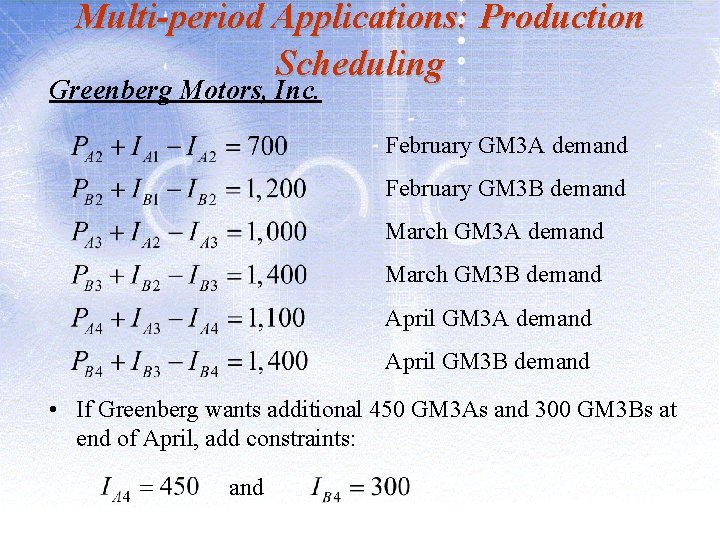
Multi-period Applications: Production Scheduling • Inventory at end of month is: • January’s demand for GM 3 As is 800 and for GM 3 Bs is 1, 000, write relation as: IA 1 = 0 + PA 1 - 800 IB 1 = 0 + PB 1 - 1000 • Rewrite as: PA 1 - IA 1 = 800 PB 1 - IB 1 = 1000
Multi-period Applications: Production Scheduling Greenberg Motors, Inc. February GM 3 A demand February GM 3 B demand March GM 3 A demand March GM 3 B demand April GM 3 A demand April GM 3 B demand • If Greenberg wants additional 450 GM 3 As and 300 GM 3 Bs at end of April, add constraints: and
Multi-period Applications: Production Scheduling • Warehouse space constraints:
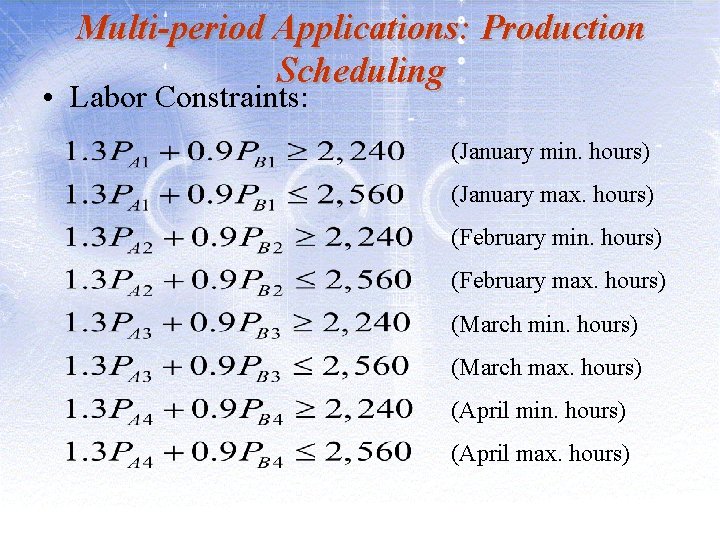
Multi-period Applications: Production Scheduling • Labor Constraints: (January min. hours) (January max. hours) (February min. hours) (February max. hours) (March min. hours) (March max. hours) (April min. hours) (April max. hours)
Multi-period Applications: Production Scheduling
Summary • Continued discussion of LP models. • More experience in formulating and solving problems from variety of disciplines and applications: – Marketing, manufacturing, employee scheduling, – Finance, transportation, ingredient blending, and – Multi-period planning. • Illustrated setup and solution of models using Excel’s Solver add-in.