
Managerial Decision Making Learning Objectives After studying the
Managerial Decision Making
Learning Objectives After studying the chapter, you should be able to: • Differentiate between programmed and nonprogrammed decisions, and explain why non-programmed decision making is a complex, uncertain process. • Describe the six steps that managers should take to make the best decisions. • Explain how cognitive biases can lead managers to make poor decisions.
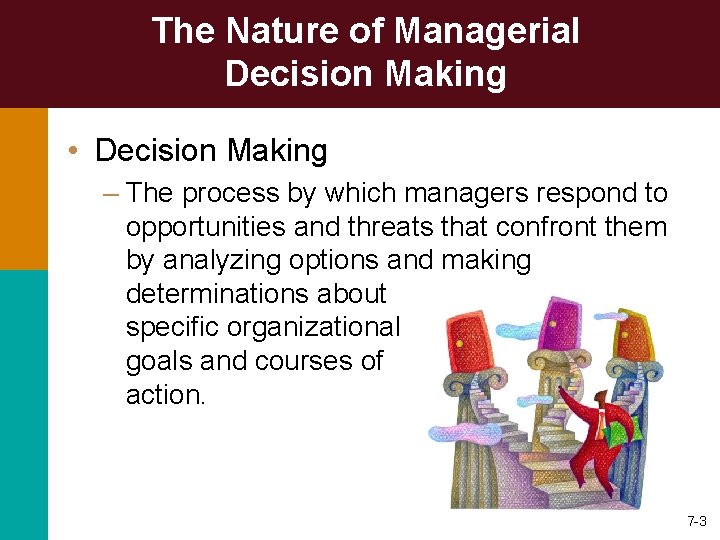
The Nature of Managerial Decision Making • Decision Making – The process by which managers respond to opportunities and threats that confront them by analyzing options and making determinations about specific organizational goals and courses of action. 7 -3
The Nature of Managerial Decision Making • Decisions in response to opportunities • occurs when managers respond to ways to improve organizational performance to benefit customers, employees, and other stakeholder groups • Decisions in response to threats • events inside or outside the organization are adversely affecting organizational performance 7 -4
Decision Making Programmed Decision – Routine, certain and fairly structured decisions – Virtually automatic decision making that follows established rules or guidelines. • Managers have made the same decision many times before • Little ambiguity involved 7 -5

Decision Making Non-Programmed Decisions – Non routine decision made in response to unusual or novel opportunities and threats. – The are no rules to follow since the decision is new. • Decisions are made based on information, and a manager’s intuition, and judgment. 7 -6
Decision Making • Intuition – feelings, beliefs, and hunches that come readily to mind, require little effort and information gathering and result in on-the-spot decisions 7 -7
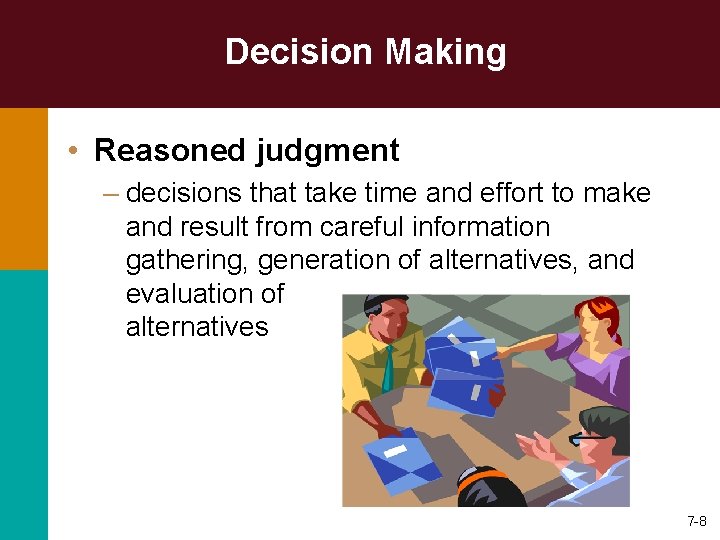
Decision Making • Reasoned judgment – decisions that take time and effort to make and result from careful information gathering, generation of alternatives, and evaluation of alternatives 7 -8

MODELS FOR DECISION-MAKING 7 -9
The Classical Model of Decision Making – A prescriptive model of decision making that assumes the decision maker can identify and evaluate all possible alternatives and their consequences and rationally choose the most appropriate course of action. – Optimum decision • The most appropriate decision in light of what managers believe to be the most desirable future consequences for their organization. 7 -10
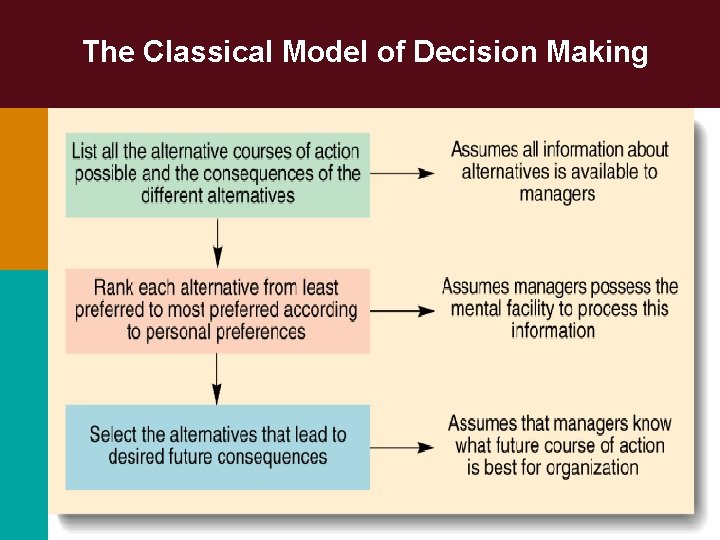
The Classical Model of Decision Making Figure 7. 1 7 -11
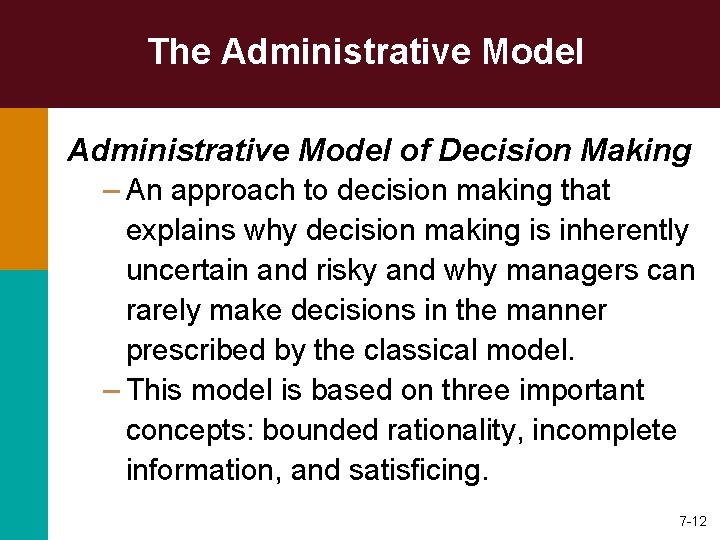
The Administrative Model of Decision Making – An approach to decision making that explains why decision making is inherently uncertain and risky and why managers can rarely make decisions in the manner prescribed by the classical model. – This model is based on three important concepts: bounded rationality, incomplete information, and satisficing. 7 -12
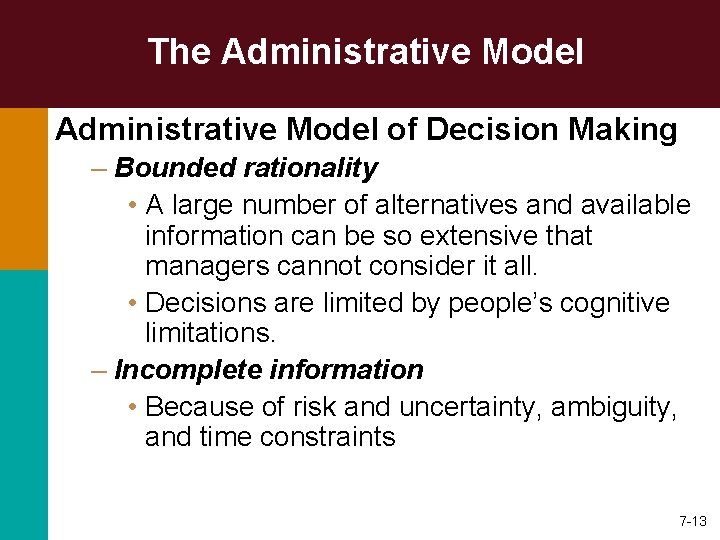
The Administrative Model of Decision Making – Bounded rationality • A large number of alternatives and available information can be so extensive that managers cannot consider it all. • Decisions are limited by people’s cognitive limitations. – Incomplete information • Because of risk and uncertainty, ambiguity, and time constraints 7 -13
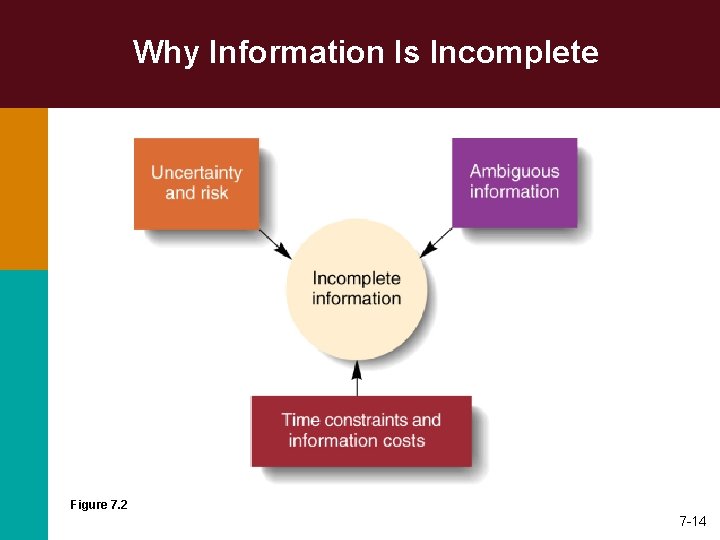
Why Information Is Incomplete Figure 7. 2 7 -14
Causes of Incomplete Information • Risk – Present when managers know the possible outcomes of a particular course of action and can assign probabilities to them. • Uncertainty – Probabilities cannot be given for outcomes and the future is unknown. 7 -15
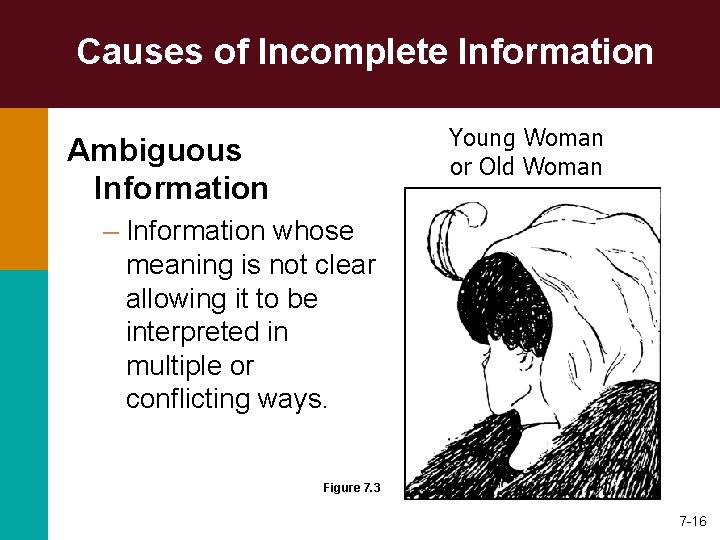
Causes of Incomplete Information Young Woman or Old Woman Ambiguous Information – Information whose meaning is not clear allowing it to be interpreted in multiple or conflicting ways. Figure 7. 3 7 -16
Causes of Incomplete Information • Time constraints and information costs – managers have neither the time nor money to search for all possible alternatives and evaluate potential consequences 7 -17
Causes of Incomplete Information • Satisficing – Searching for and choosing an acceptable, or satisfactory response to problems and opportunities, rather than trying to make the best decision. 7 -18
Causes of Incomplete Information • Managers explore a limited number of options and choose an acceptable decision rather than the optimum decision. • This is the typical response of managers when dealing with incomplete information. 7 -19
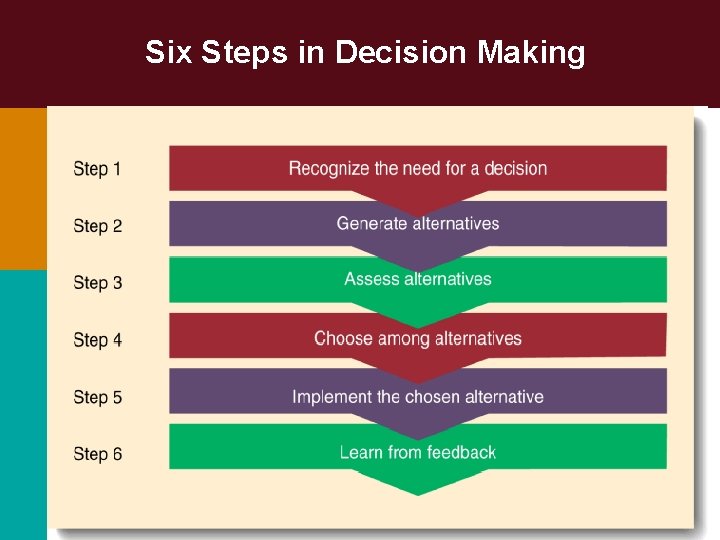
Six Steps in Decision Making 7 -20
Decision Making Steps Step 1. Recognize Need for a Decision or Awareness of a problem – Sparked by an event such as environment changes. • Managers must first realize that a decision must be made. Step 2. Generate Alternatives – Managers must develop feasible alternative courses of action. • If good alternatives are missed, the resulting decision is poor. • It is hard to develop creative alternatives, so managers need to look for new ideas.
Decision Making Steps Step 3. Evaluate Alternatives – What are the advantages and disadvantages of each alternative? – Managers should specify criteria, then evaluate. 7 -22
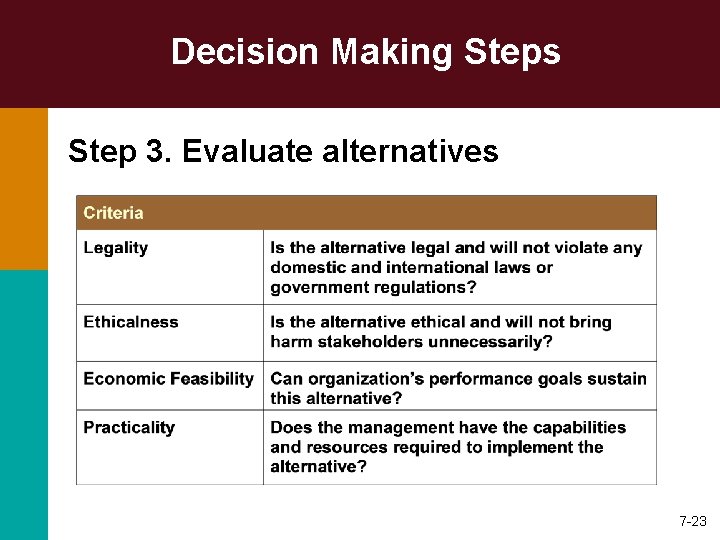
Decision Making Steps Step 3. Evaluate alternatives 7 -23
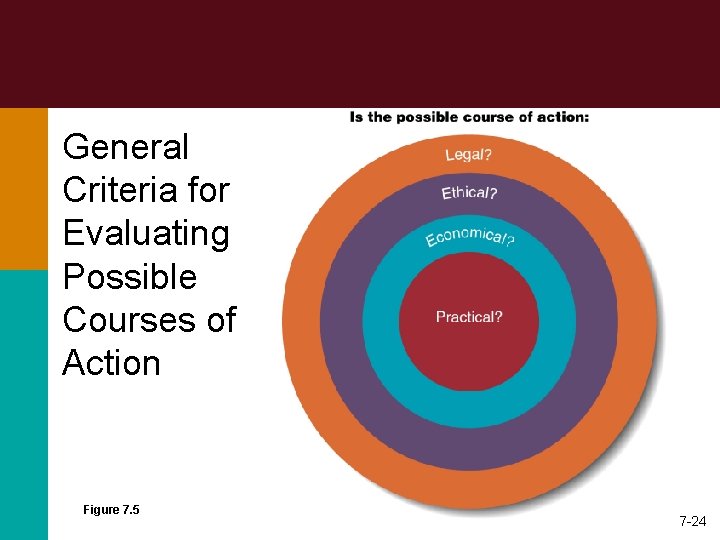
General Criteria for Evaluating Possible Courses of Action Figure 7. 5 7 -24
Decision Making Steps Step 4. Choose Among Alternatives – Rank the various alternatives and make a decision – Managers must be sure all the information available is brought to bear on the problem or issue at hand 7 -25
Decision Making Steps Step 5. Implement Chosen Alternative – Managers must now carry out the alternative. – Often a decision is made and not implemented. Step 6. Learn From Feedback – Managers should consider what went right and wrong with the decision and learn for the future. – Without feedback, managers do not learn from experience and will repeat the same mistake over. 7 -26
Feedback Procedure 1. Compare what actually happened to what was expected to happen as a result of the decision 2. Explore why any expectations for the decision were not met 3. Derive guidelines that will help in future decision making 7 -27
Cognitive Biases and Decision Making Heuristics – Rules of thumb that simplify the process of making decisions. – Decision makers use heuristics to deal with bounded rationality. • If the heuristic is wrong, however, then poor decisions result from its use. • Systematic errors – errors that people make over and that result in poor decision making 7 -28
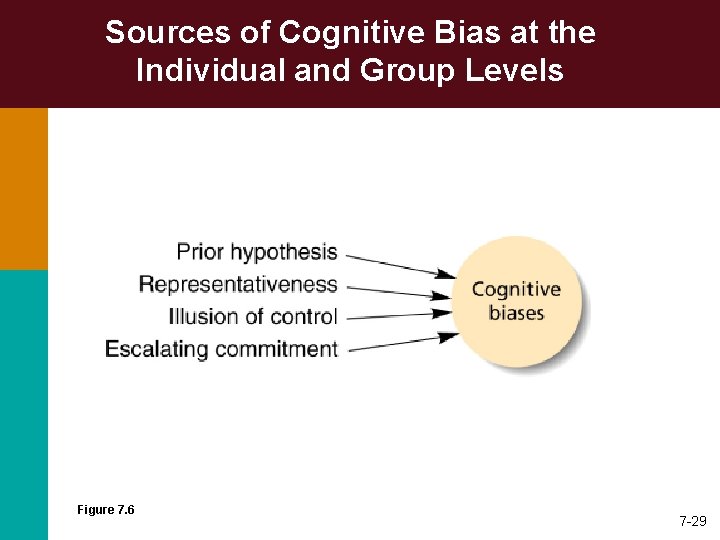
Sources of Cognitive Bias at the Individual and Group Levels Figure 7. 6 7 -29
Types of Cognitive Biases • Prior Hypothesis Bias – Allowing strong prior beliefs about a relationship between variables to influence decisions based on these beliefs even when evidence shows they are wrong. • Representativeness – The decision maker incorrectly generalizes a decision from a small sample or a single incident. 7 -30
Types of Cognitive Biases • Illusion of Control – The tendency to overestimates one’s own ability to control activities and events. • Escalating Commitment – Committing considerable resources to project and then committing more even if evidence shows the project is failing. 7 -31
Group Decision Making • Superior to individual making • Choices less likely to fall victim to bias • Able to draw on combined skills of group members • Improve ability to generate feasible alternatives 7 -32
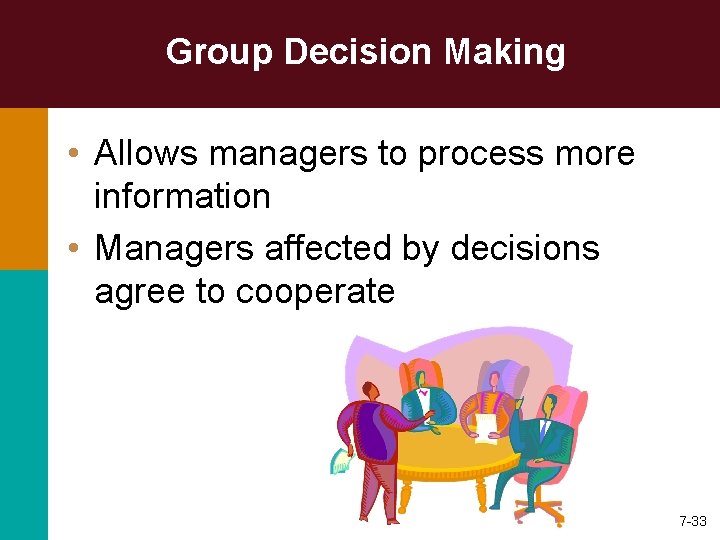
Group Decision Making • Allows managers to process more information • Managers affected by decisions agree to cooperate 7 -33
Methods for Group Decision - making 1. Nominal Technique 2. Delphi Technique 7 -34
1. Nominal Group Technique • The nominal group technique (NGT) is a decision making method for use among groups of many sizes, who want to make their decision quickly, as by a vote, but want everyone's opinions taken into account • The nominal technique restricts discussion or interpersonal communication during the decision-making process, and hence, the term “nominal”. 7 -35
Process for Nominal Group Technique • When any problem is presented and then the following steps are taken by group members: 1. Members meet as a group. But before any discussion takes place, each member independently writes down his or her ideas on the problem. 2. After this silent period, each member presents one idea to the group. Each member takes his or her turn, presenting a single idea until all ideas have been presented and recorded. No discussion takes place until all ideas have been 36 recorded.
Continue…. 3. The group now discusses the ideas for clarity and evaluates them. 4. Each group member silently and independently rank-orders the ideas. The ideas with the highest aggregate ranking determine the final decision. 7 -37
2. Delphi Technique • The Delphi method is a systematic, interactive forecasting method which relies on a panel of experts. • The experts answer questionnaires in two or more rounds. After each round, a facilitator provides an anonymous summary of the experts’ forecasts from the previous round as well as the reasons they provided for their judgments. 7 -38
• Thus, experts are encouraged to revise their earlier answers in light of the replies of other members of their panel. • It is believed that during this process the range of the answers will decrease and the group will converge towards the "correct" answer. 7 -39
2. Delphi Technique – Written approach to creative problem solving. – Group leader writes a statement of the problem to which managers respond – Questionnaire is sent to managers to generate solutions – Team of managers summarizes the responses and results are sent back to the participants – Process is repeated until a consensus is reached 7 -40
Group Decision Making • Potential Disadvantages – Can take much longer than individuals to make decisions – Can be difficult to get two or more managers to agree because of different interests and preferences – Can be undermined by biases 7 -41
References • Gareth R. Jones. Contemporary Management, Tata Mc. Graw hill publication. • Stephen Robbins. Organizational Behaviour. Pearson Education India. 7 -42
- Slides: 42