
Managerial Accounting and Cost Concepts CHAPTER 1 Power
- Slides: 50
Managerial Accounting and Cost Concepts CHAPTER 1 Power. Point Authors: Susan Coomer Galbreath, Ph. D. , CPA Jon A. Booker, Ph. D. , CPA, CIA Cynthia J. Rooney, Ph. D. , CPA ©Mc. Graw-Hill Education. All rights reserved. Authorized only for instructor use in the classroom. No reproduction or further distribution permitted without the prior written consent of Mc. Graw-Hill Education.
1 -2 Needs of Management Financial accounting is concerned with reporting financial information to external parties, such as stockholders, creditors, and regulators. Managerial accounting is concerned with providing information to managers within an organization so that they can formulate plans, control operations, and make decisions. ©Mc. Graw-Hill Education. All rights reserved. Authorized only for instructor use in the classroom. No reproduction or further distribution permitted without the prior written consent of Mc. Graw-Hill Education.
1 -3 Purposes of Cost Classification 1. Assigning costs to cost objects 2. Accounting for costs in manufacturing companies 3. Preparing financial statements 4. Predicting cost behavior in response to changes in activity 5. Making decisions ©Mc. Graw-Hill Education. All rights reserved. Authorized only for instructor use in the classroom. No reproduction or further distribution permitted without the prior written consent of Mc. Graw-Hill Education.
1 -4 Learning Objective 1 Understand cost classifications used for assigning costs to cost objects: direct costs and indirect costs. ©Mc. Graw-Hill Education. All rights reserved. Authorized only for instructor use in the classroom. No reproduction or further distribution permitted without the prior written consent of Mc. Graw-Hill Education.
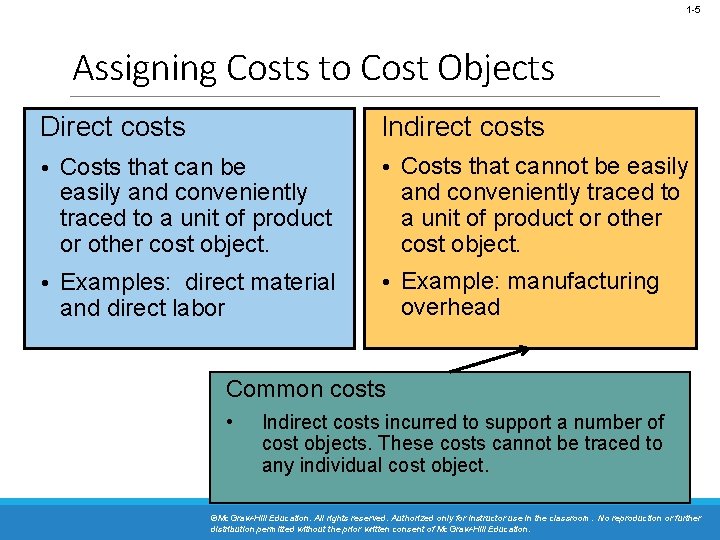
1 -5 Assigning Costs to Cost Objects Direct costs Indirect costs • Costs that can be easily and conveniently traced to a unit of product or other cost object. • Costs that cannot be easily and conveniently traced to a unit of product or other cost object. • Examples: direct material and direct labor • Example: manufacturing overhead Common costs • Indirect costs incurred to support a number of cost objects. These costs cannot be traced to any individual cost object. ©Mc. Graw-Hill Education. All rights reserved. Authorized only for instructor use in the classroom. No reproduction or further distribution permitted without the prior written consent of Mc. Graw-Hill Education.
1 -6 Learning Objective 2 Identify and give examples of each of the three basic manufacturing cost categories. ©Mc. Graw-Hill Education. All rights reserved. Authorized only for instructor use in the classroom. No reproduction or further distribution permitted without the prior written consent of Mc. Graw-Hill Education.
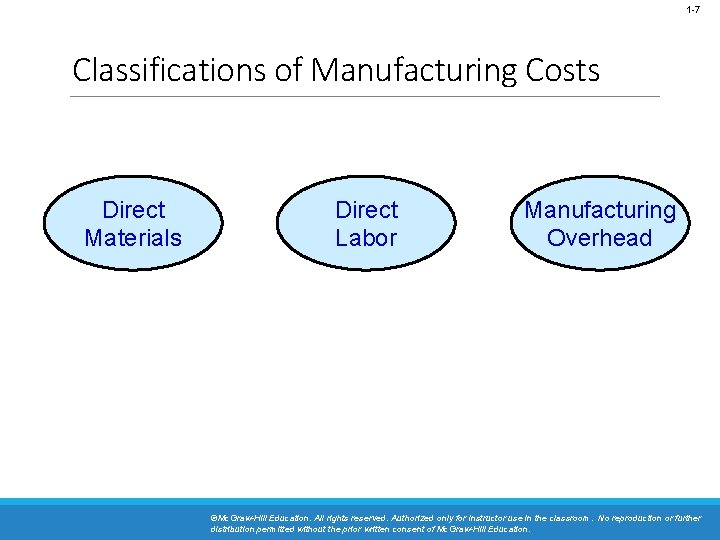
1 -7 Classifications of Manufacturing Costs Direct Materials Direct Labor Manufacturing Overhead ©Mc. Graw-Hill Education. All rights reserved. Authorized only for instructor use in the classroom. No reproduction or further distribution permitted without the prior written consent of Mc. Graw-Hill Education.
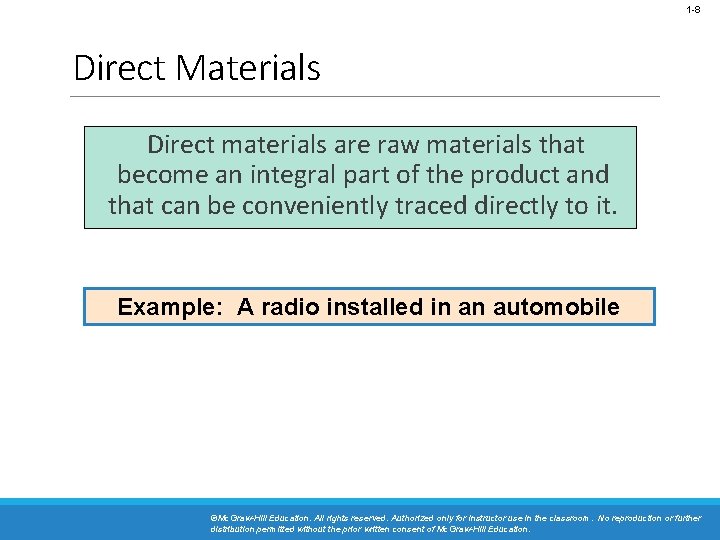
1 -8 Direct Materials Direct materials are raw materials that become an integral part of the product and that can be conveniently traced directly to it. Example: A radio installed in an automobile ©Mc. Graw-Hill Education. All rights reserved. Authorized only for instructor use in the classroom. No reproduction or further distribution permitted without the prior written consent of Mc. Graw-Hill Education.
1 -9 Direct Labor Direct labor costs are those labor costs that can be easily traced to individual units of product. Example: Wages paid to automobile assembly workers ©Mc. Graw-Hill Education. All rights reserved. Authorized only for instructor use in the classroom. No reproduction or further distribution permitted without the prior written consent of Mc. Graw-Hill Education.
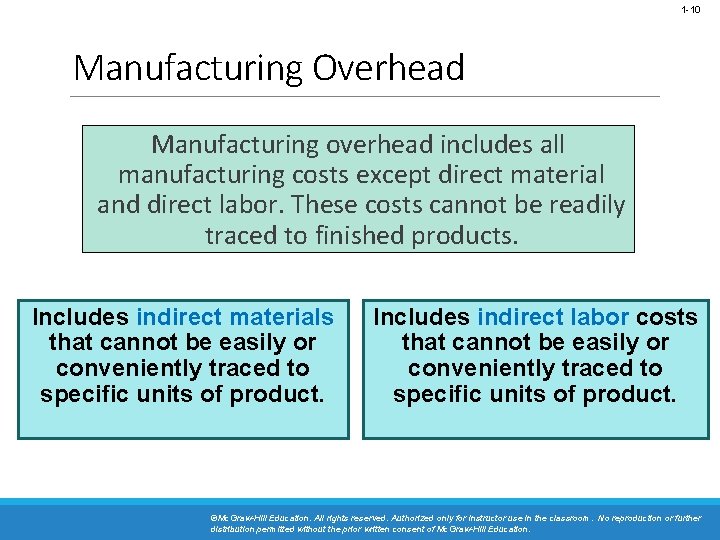
1 -10 Manufacturing Overhead Manufacturing overhead includes all manufacturing costs except direct material and direct labor. These costs cannot be readily traced to finished products. Includes indirect materials that cannot be easily or conveniently traced to specific units of product. Includes indirect labor costs that cannot be easily or conveniently traced to specific units of product. ©Mc. Graw-Hill Education. All rights reserved. Authorized only for instructor use in the classroom. No reproduction or further distribution permitted without the prior written consent of Mc. Graw-Hill Education.
1 -11 Manufacturing Overhead – Examples of manufacturing overhead: • Depreciation of manufacturing equipment • Utility costs • Property taxes • Insurance premiums incurred to operate a manufacturing facility Only those indirect costs associated with operating the factory are included in manufacturing overhead. ©Mc. Graw-Hill Education. All rights reserved. Authorized only for instructor use in the classroom. No reproduction or further distribution permitted without the prior written consent of Mc. Graw-Hill Education.
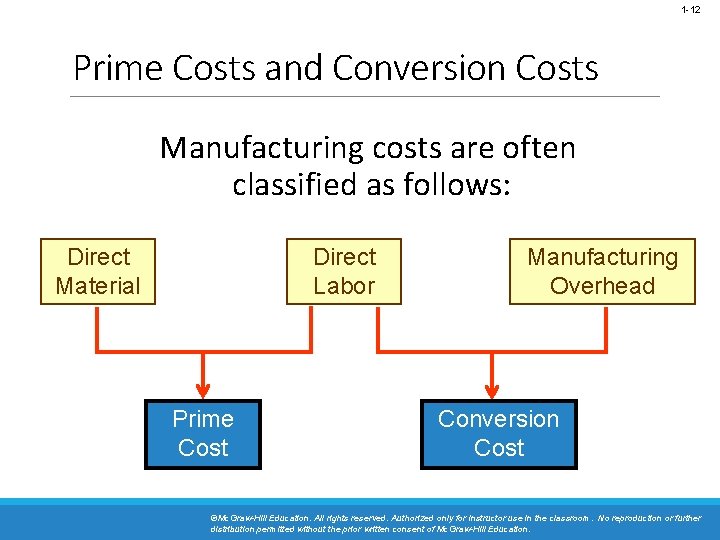
1 -12 Prime Costs and Conversion Costs Manufacturing costs are often classified as follows: Direct Material Direct Labor Prime Cost Manufacturing Overhead Conversion Cost ©Mc. Graw-Hill Education. All rights reserved. Authorized only for instructor use in the classroom. No reproduction or further distribution permitted without the prior written consent of Mc. Graw-Hill Education.
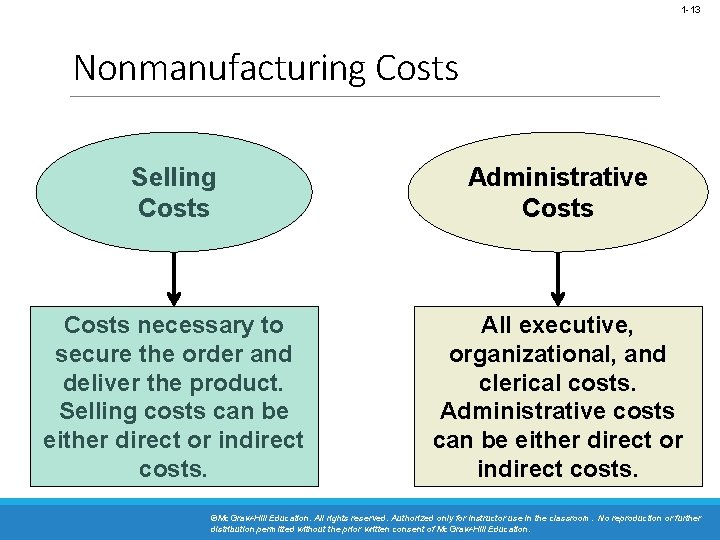
1 -13 Nonmanufacturing Costs Selling Costs Administrative Costs necessary to secure the order and deliver the product. Selling costs can be either direct or indirect costs. All executive, organizational, and clerical costs. Administrative costs can be either direct or indirect costs. ©Mc. Graw-Hill Education. All rights reserved. Authorized only for instructor use in the classroom. No reproduction or further distribution permitted without the prior written consent of Mc. Graw-Hill Education.
1 -14 Learning Objective 3 Understand cost classifications used to prepare financial statements: product costs and period costs. ©Mc. Graw-Hill Education. All rights reserved. Authorized only for instructor use in the classroom. No reproduction or further distribution permitted without the prior written consent of Mc. Graw-Hill Education.
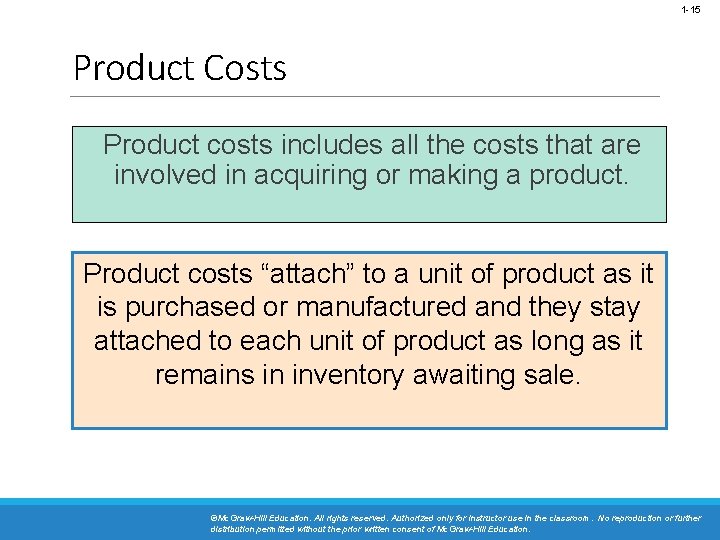
1 -15 Product Costs Product costs includes all the costs that are involved in acquiring or making a product. Product costs “attach” to a unit of product as it is purchased or manufactured and they stay attached to each unit of product as long as it remains in inventory awaiting sale. ©Mc. Graw-Hill Education. All rights reserved. Authorized only for instructor use in the classroom. No reproduction or further distribution permitted without the prior written consent of Mc. Graw-Hill Education.
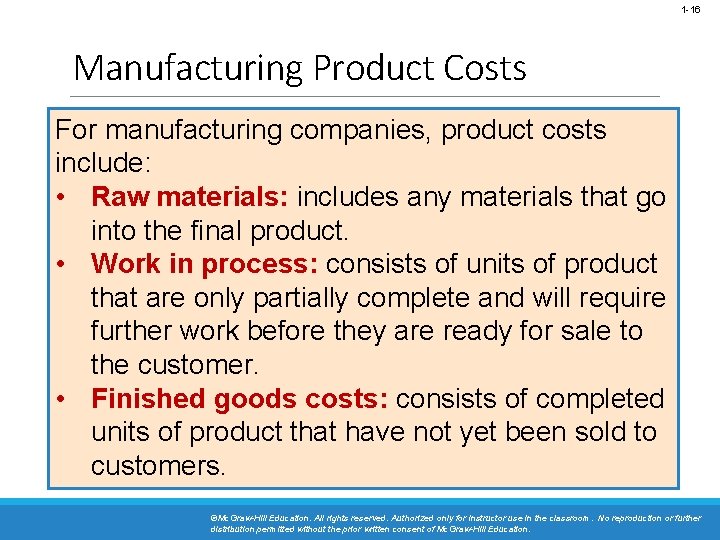
1 -16 Manufacturing Product Costs For manufacturing companies, product costs include: • Raw materials: includes any materials that go into the final product. • Work in process: consists of units of product that are only partially complete and will require further work before they are ready for sale to the customer. • Finished goods costs: consists of completed units of product that have not yet been sold to customers. ©Mc. Graw-Hill Education. All rights reserved. Authorized only for instructor use in the classroom. No reproduction or further distribution permitted without the prior written consent of Mc. Graw-Hill Education.
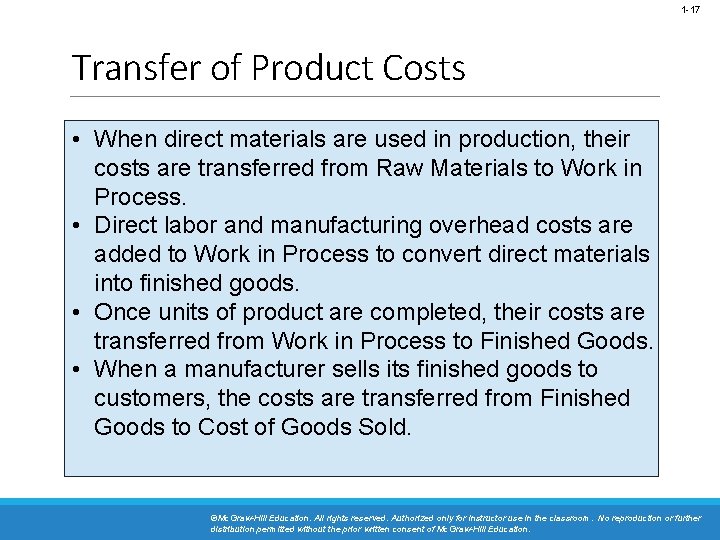
1 -17 Transfer of Product Costs • When direct materials are used in production, their costs are transferred from Raw Materials to Work in Process. • Direct labor and manufacturing overhead costs are added to Work in Process to convert direct materials into finished goods. • Once units of product are completed, their costs are transferred from Work in Process to Finished Goods. • When a manufacturer sells its finished goods to customers, the costs are transferred from Finished Goods to Cost of Goods Sold. ©Mc. Graw-Hill Education. All rights reserved. Authorized only for instructor use in the classroom. No reproduction or further distribution permitted without the prior written consent of Mc. Graw-Hill Education.
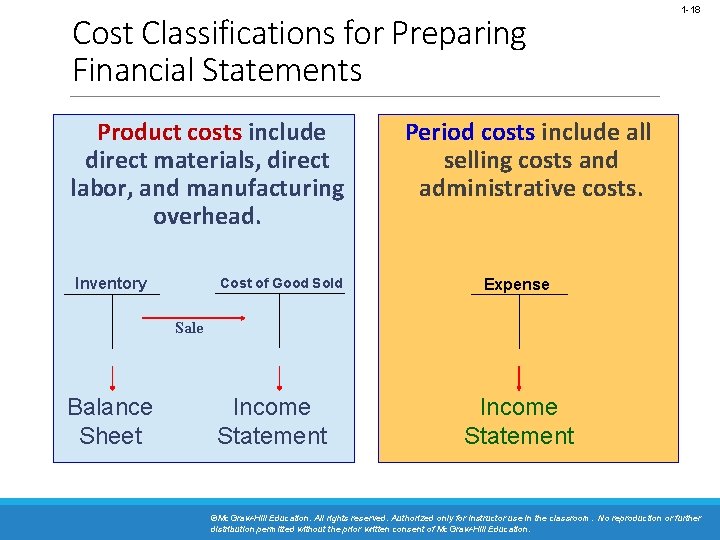
Cost Classifications for Preparing Financial Statements Product costs include direct materials, direct labor, and manufacturing overhead. Inventory Cost of Good Sold 1 -18 Period costs include all selling costs and administrative costs. Expense Sale Balance Sheet Income Statement ©Mc. Graw-Hill Education. All rights reserved. Authorized only for instructor use in the classroom. No reproduction or further distribution permitted without the prior written consent of Mc. Graw-Hill Education.
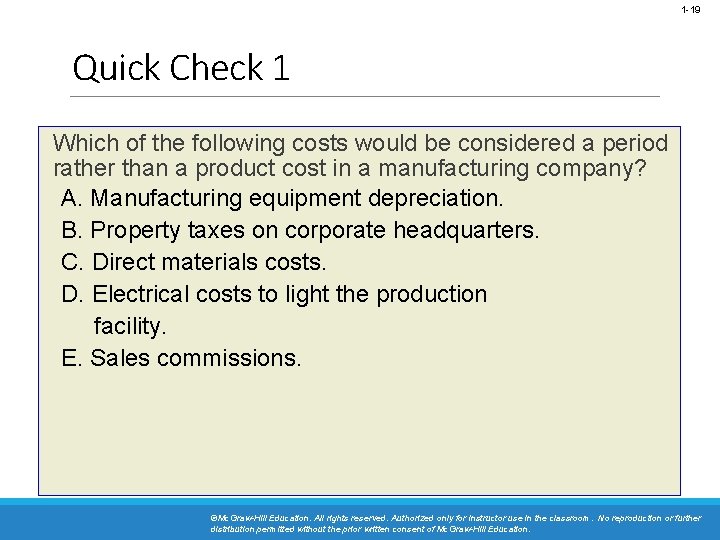
1 -19 Quick Check 1 Which of the following costs would be considered a period rather than a product cost in a manufacturing company? A. Manufacturing equipment depreciation. B. Property taxes on corporate headquarters. C. Direct materials costs. D. Electrical costs to light the production facility. E. Sales commissions. ©Mc. Graw-Hill Education. All rights reserved. Authorized only for instructor use in the classroom. No reproduction or further distribution permitted without the prior written consent of Mc. Graw-Hill Education.
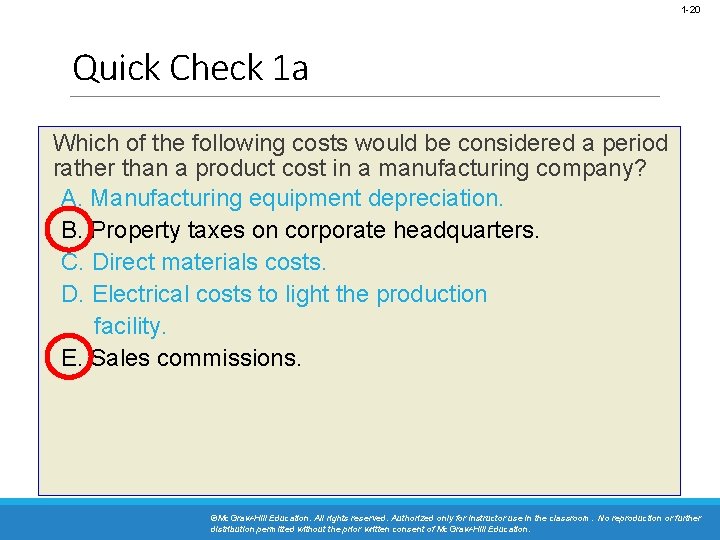
1 -20 Quick Check 1 a Which of the following costs would be considered a period rather than a product cost in a manufacturing company? A. Manufacturing equipment depreciation. B. Property taxes on corporate headquarters. C. Direct materials costs. D. Electrical costs to light the production facility. E. Sales commissions. ©Mc. Graw-Hill Education. All rights reserved. Authorized only for instructor use in the classroom. No reproduction or further distribution permitted without the prior written consent of Mc. Graw-Hill Education.
1 -21 Learning Objective 4 Understand cost classifications used to predict cost behavior: variable costs, fixed costs, and mixed costs. ©Mc. Graw-Hill Education. All rights reserved. Authorized only for instructor use in the classroom. No reproduction or further distribution permitted without the prior written consent of Mc. Graw-Hill Education.
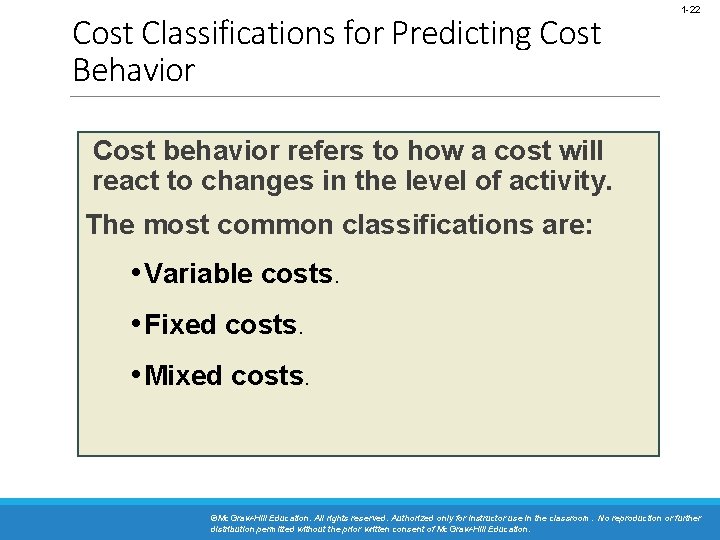
Cost Classifications for Predicting Cost Behavior 1 -22 Cost behavior refers to how a cost will react to changes in the level of activity. The most common classifications are: • Variable costs. • Fixed costs. • Mixed costs. ©Mc. Graw-Hill Education. All rights reserved. Authorized only for instructor use in the classroom. No reproduction or further distribution permitted without the prior written consent of Mc. Graw-Hill Education.
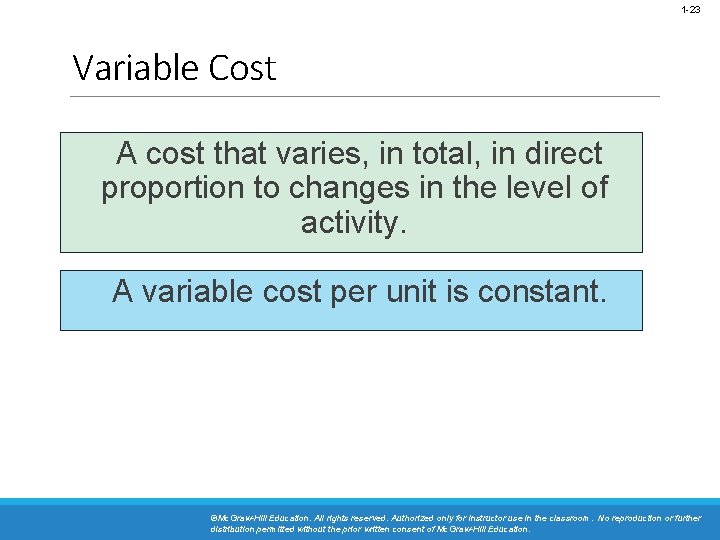
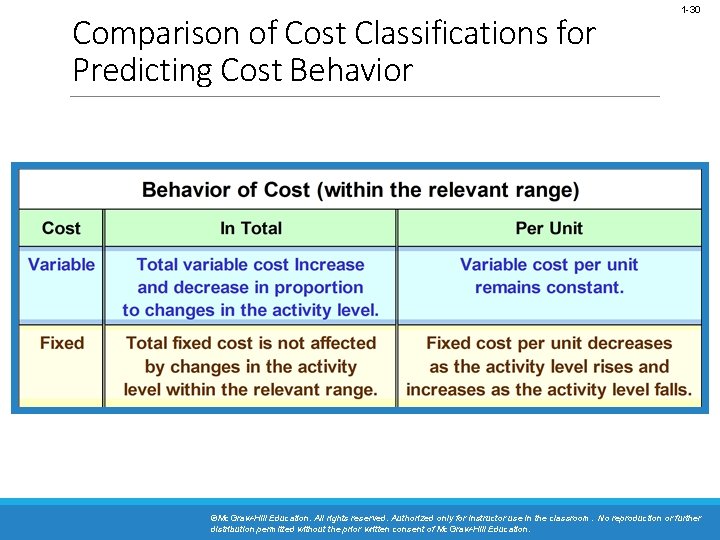
1 -23 Variable Cost A cost that varies, in total, in direct proportion to changes in the level of activity. A variable cost per unit is constant. ©Mc. Graw-Hill Education. All rights reserved. Authorized only for instructor use in the classroom. No reproduction or further distribution permitted without the prior written consent of Mc. Graw-Hill Education.
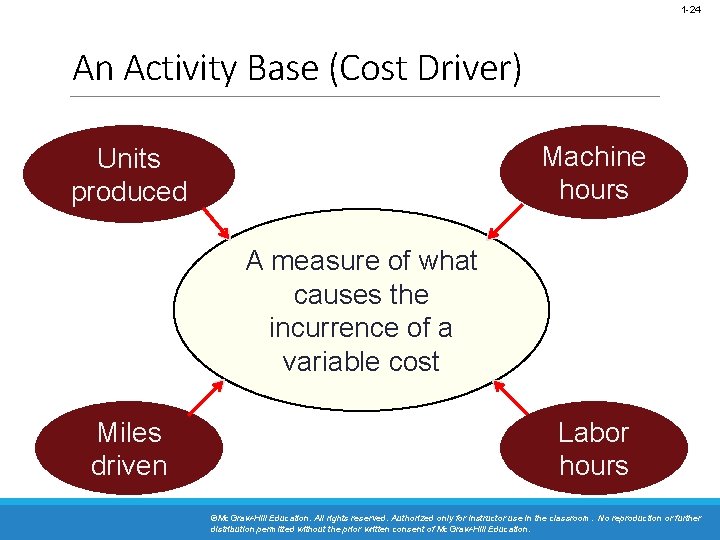
1 -24 An Activity Base (Cost Driver) Machine hours Units produced A measure of what causes the incurrence of a variable cost Miles driven Labor hours ©Mc. Graw-Hill Education. All rights reserved. Authorized only for instructor use in the classroom. No reproduction or further distribution permitted without the prior written consent of Mc. Graw-Hill Education.
1 -25 Fixed Cost A cost that remains constant, in total, regardless of changes in the level of the activity. If expressed on a per unit basis, the average fixed cost per unit varies inversely with changes in activity. ©Mc. Graw-Hill Education. All rights reserved. Authorized only for instructor use in the classroom. No reproduction or further distribution permitted without the prior written consent of Mc. Graw-Hill Education.
1 -26 Types of Fixed Costs Committed Discretionary Long-term, cannot be significantly reduced in the short term May be altered in the short-term by current managerial decisions ©Mc. Graw-Hill Education. All rights reserved. Authorized only for instructor use in the classroom. No reproduction or further distribution permitted without the prior written consent of Mc. Graw-Hill Education.
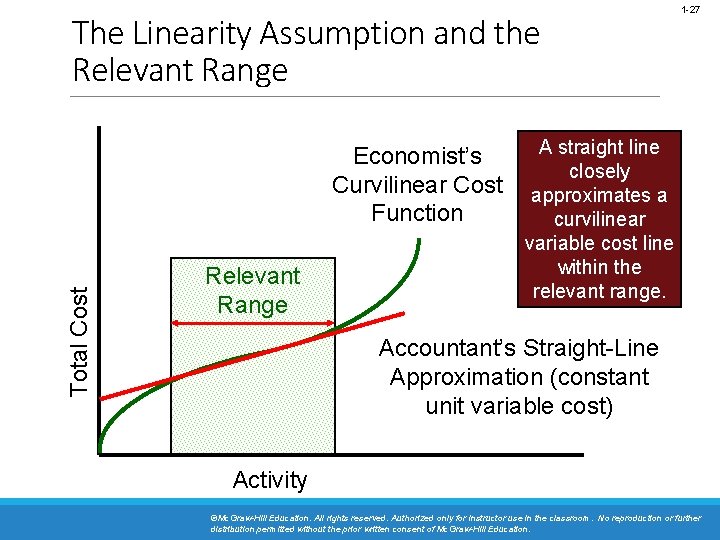
The Linearity Assumption and the Relevant Range Total Cost Economist’s Curvilinear Cost Function Relevant Range 1 -27 A straight line closely approximates a curvilinear variable cost line within the relevant range. Accountant’s Straight-Line Approximation (constant unit variable cost) Activity ©Mc. Graw-Hill Education. All rights reserved. Authorized only for instructor use in the classroom. No reproduction or further distribution permitted without the prior written consent of Mc. Graw-Hill Education.
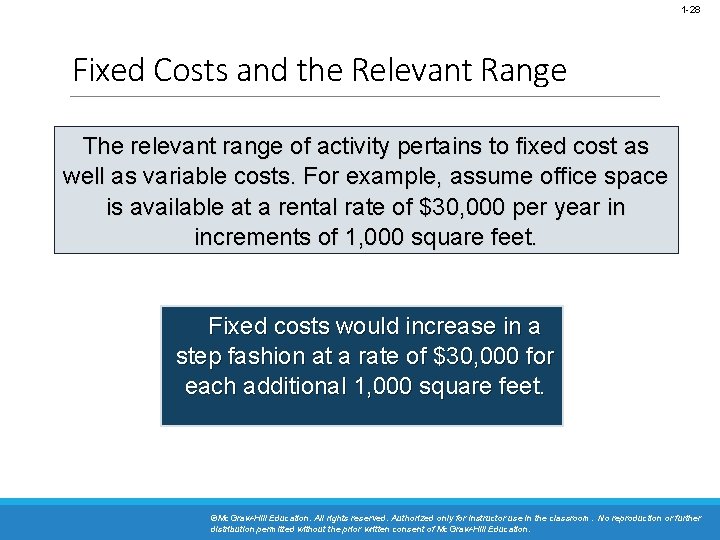
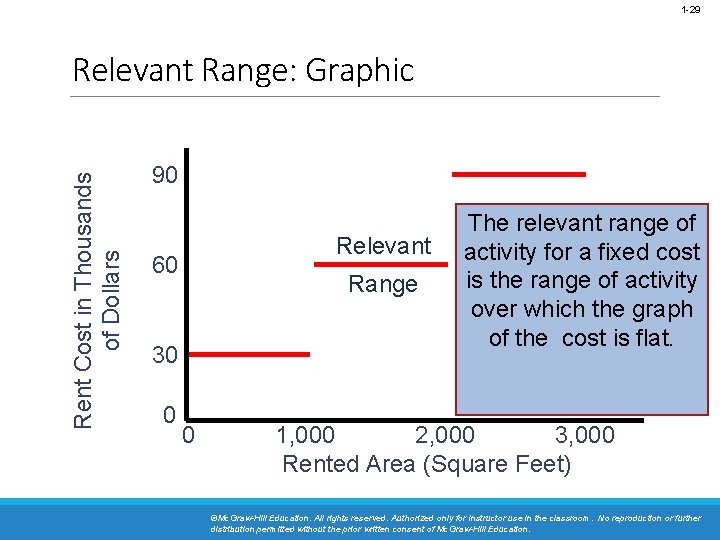
1 -28 Fixed Costs and the Relevant Range The relevant range of activity pertains to fixed cost as well as variable costs. For example, assume office space is available at a rental rate of $30, 000 per year in increments of 1, 000 square feet. Fixed costs would increase in a step fashion at a rate of $30, 000 for each additional 1, 000 square feet. ©Mc. Graw-Hill Education. All rights reserved. Authorized only for instructor use in the classroom. No reproduction or further distribution permitted without the prior written consent of Mc. Graw-Hill Education.
1 -29 Rent Cost in Thousands of Dollars Relevant Range: Graphic 90 Relevant 60 Range 30 0 0 The relevant range of activity for a fixed cost is the range of activity over which the graph of the cost is flat. 1, 000 2, 000 3, 000 Rented Area (Square Feet) ©Mc. Graw-Hill Education. All rights reserved. Authorized only for instructor use in the classroom. No reproduction or further distribution permitted without the prior written consent of Mc. Graw-Hill Education.
Comparison of Cost Classifications for Predicting Cost Behavior 1 -30 ©Mc. Graw-Hill Education. All rights reserved. Authorized only for instructor use in the classroom. No reproduction or further distribution permitted without the prior written consent of Mc. Graw-Hill Education.
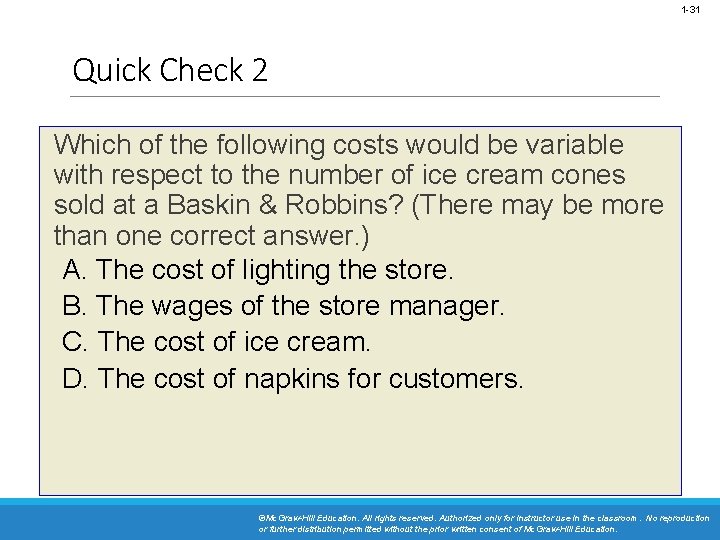
1 -31 Quick Check 2 Which of the following costs would be variable with respect to the number of ice cream cones sold at a Baskin & Robbins? (There may be more than one correct answer. ) A. The cost of lighting the store. B. The wages of the store manager. C. The cost of ice cream. D. The cost of napkins for customers. ©Mc. Graw-Hill Education. All rights reserved. Authorized only for instructor use in the classroom. No reproduction or further distribution permitted without the prior written consent of Mc. Graw-Hill Education.
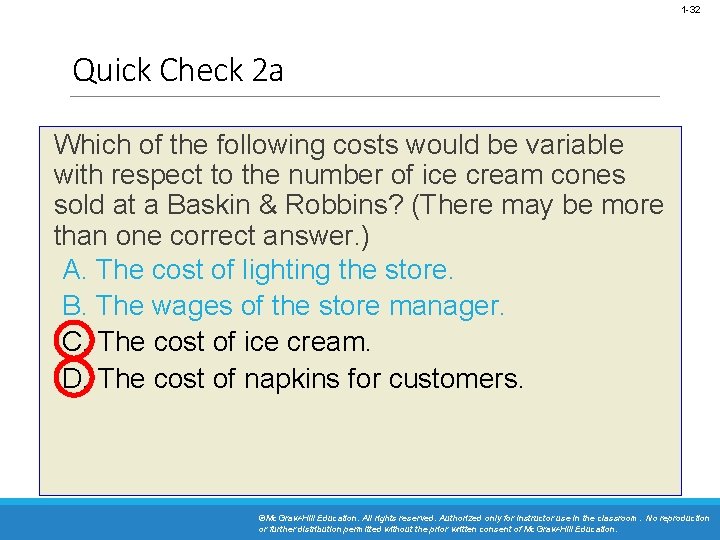
1 -32 Quick Check 2 a Which of the following costs would be variable with respect to the number of ice cream cones sold at a Baskin & Robbins? (There may be more than one correct answer. ) A. The cost of lighting the store. B. The wages of the store manager. C. The cost of ice cream. D. The cost of napkins for customers. ©Mc. Graw-Hill Education. All rights reserved. Authorized only for instructor use in the classroom. No reproduction or further distribution permitted without the prior written consent of Mc. Graw-Hill Education.
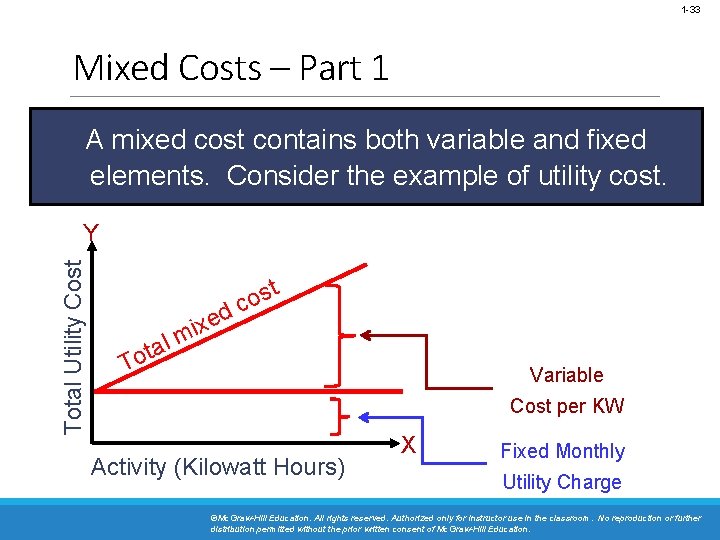
1 -33 Mixed Costs – Part 1 A mixed cost contains both variable and fixed elements. Consider the example of utility cost. Total Utility Cost Y l a t To ed x i m t s o c Variable Cost per KW Activity (Kilowatt Hours) X Fixed Monthly Utility Charge ©Mc. Graw-Hill Education. All rights reserved. Authorized only for instructor use in the classroom. No reproduction or further distribution permitted without the prior written consent of Mc. Graw-Hill Education.
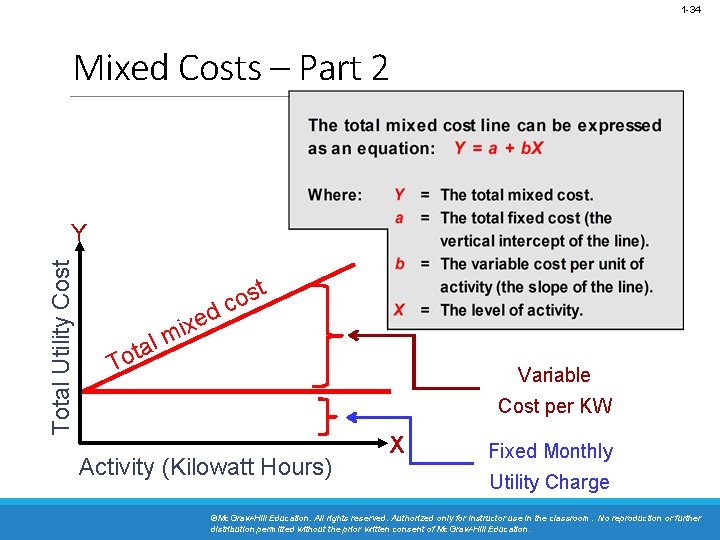
1 -34 Mixed Costs – Part 2 Total Utility Cost Y l a t o ed x i m t s o c T Variable Cost per KW Activity (Kilowatt Hours) X Fixed Monthly Utility Charge ©Mc. Graw-Hill Education. All rights reserved. Authorized only for instructor use in the classroom. No reproduction or further distribution permitted without the prior written consent of Mc. Graw-Hill Education.
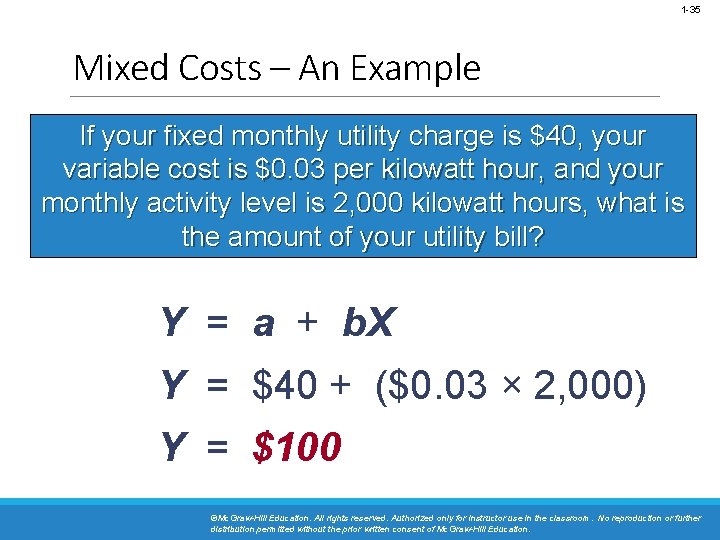
1 -35 Mixed Costs – An Example If your fixed monthly utility charge is $40, your variable cost is $0. 03 per kilowatt hour, and your monthly activity level is 2, 000 kilowatt hours, what is the amount of your utility bill? Y = a + b. X Y = $40 + ($0. 03 × 2, 000) Y = $100 ©Mc. Graw-Hill Education. All rights reserved. Authorized only for instructor use in the classroom. No reproduction or further distribution permitted without the prior written consent of Mc. Graw-Hill Education.
1 -36 Learning Objective 5 Understand cost classifications used in making decisions: differential costs, sunk costs, and opportunity costs. ©Mc. Graw-Hill Education. All rights reserved. Authorized only for instructor useuse in the classroom. No No reproduction or fur ©Mc. Graw-Hill Education. rights reserved. Authorized only instructor in the classroom. reproduction distribution without the prior written of Mc. Graw-Hill Education. or furtherpermitted distribution permitted without the consent prior written consent of Mc. Graw-Hill
1 -37 Cost Classifications for Decision Making Decisions involve choosing between alternatives. The goal of making decisions is to identify those costs that are either relevant or irrelevant to the decision. To make decisions, it is essential to have a grasp on three concepts: differential costs, sunk costs, and opportunity costs. ©Mc. Graw-Hill Education. All rights reserved. Authorized only for instructor use in the classroom. No reproduction or further distribution permitted without the prior written consent of Mc. Graw-Hill Education.
1 -38 Differential Costs Differential costs (or incremental costs) are the difference in cost between any two alternatives. A difference in revenue between two alternatives is called differential revenue. Both are always relevant to decisions. Differential costs can be either fixed or variable. ©Mc. Graw-Hill Education. All rights reserved. Authorized only for instructor use in the classroom. No reproduction or further distribution permitted without the prior written consent of Mc. Graw-Hill Education.
1 -39 Sunk Costs Sunk costs have already been incurred and cannot be changed now or in the future. These costs should be ignored when making decisions. ©Mc. Graw-Hill Education. All rights reserved. Authorized only for instructor use in the classroom. No reproduction or further distribution permitted without the prior written consent of Mc. Graw-Hill Education.
1 -40 Opportunity Cost The potential benefit that is given up when one alternative is selected over another. These costs are not usually found in accounting records but must be explicitly considered in every decision. For students: What is the opportunity cost you incur by attending class? ©Mc. Graw-Hill Education. All rights reserved. Authorized only for instructor use in the classroom. No reproduction or further distribution permitted without the prior written consent of Mc. Graw-Hill Education.
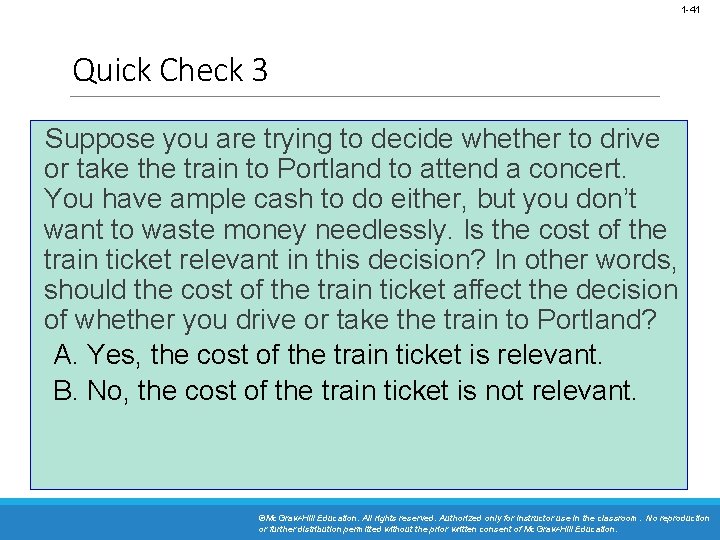
1 -41 Quick Check 3 Suppose you are trying to decide whether to drive or take the train to Portland to attend a concert. You have ample cash to do either, but you don’t want to waste money needlessly. Is the cost of the train ticket relevant in this decision? In other words, should the cost of the train ticket affect the decision of whether you drive or take the train to Portland? A. Yes, the cost of the train ticket is relevant. B. No, the cost of the train ticket is not relevant. ©Mc. Graw-Hill Education. All rights reserved. Authorized only for instructor use in the classroom. No reproduction or further distribution permitted without the prior written consent of Mc. Graw-Hill Education.
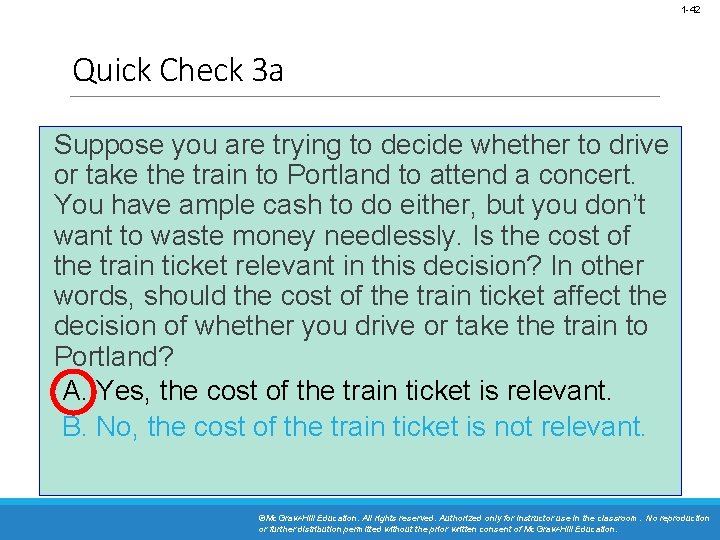
1 -42 Quick Check 3 a Suppose you are trying to decide whether to drive or take the train to Portland to attend a concert. You have ample cash to do either, but you don’t want to waste money needlessly. Is the cost of the train ticket relevant in this decision? In other words, should the cost of the train ticket affect the decision of whether you drive or take the train to Portland? A. Yes, the cost of the train ticket is relevant. B. No, the cost of the train ticket is not relevant. ©Mc. Graw-Hill Education. All rights reserved. Authorized only for instructor use in the classroom. No reproduction or further distribution permitted without the prior written consent of Mc. Graw-Hill Education.
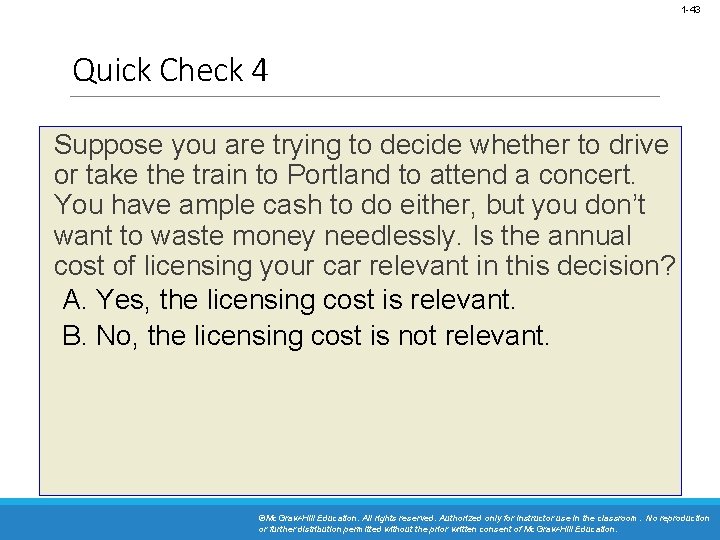
1 -43 Quick Check 4 Suppose you are trying to decide whether to drive or take the train to Portland to attend a concert. You have ample cash to do either, but you don’t want to waste money needlessly. Is the annual cost of licensing your car relevant in this decision? A. Yes, the licensing cost is relevant. B. No, the licensing cost is not relevant. ©Mc. Graw-Hill Education. All rights reserved. Authorized only for instructor use in the classroom. No reproduction or further distribution permitted without the prior written consent of Mc. Graw-Hill Education.
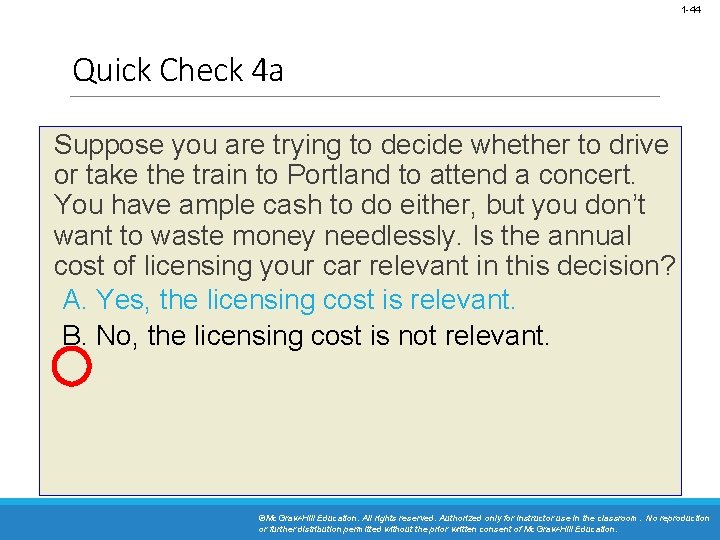
1 -44 Quick Check 4 a Suppose you are trying to decide whether to drive or take the train to Portland to attend a concert. You have ample cash to do either, but you don’t want to waste money needlessly. Is the annual cost of licensing your car relevant in this decision? A. Yes, the licensing cost is relevant. B. No, the licensing cost is not relevant. ©Mc. Graw-Hill Education. All rights reserved. Authorized only for instructor use in the classroom. No reproduction or further distribution permitted without the prior written consent of Mc. Graw-Hill Education.
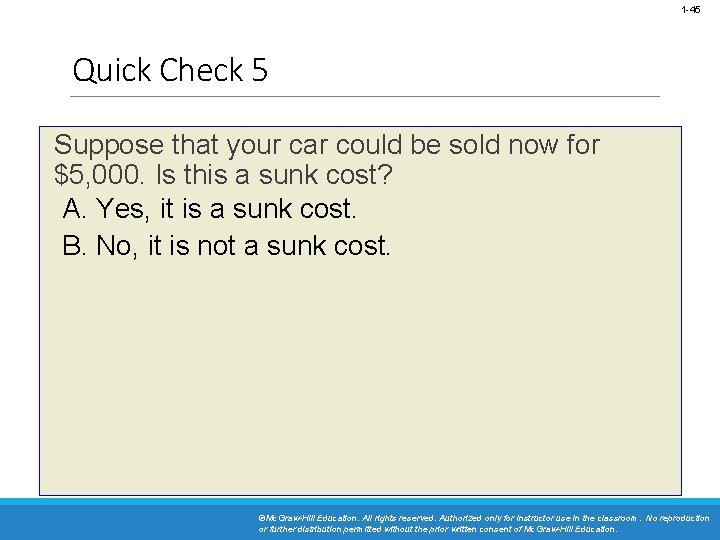
1 -45 Quick Check 5 Suppose that your car could be sold now for $5, 000. Is this a sunk cost? A. Yes, it is a sunk cost. B. No, it is not a sunk cost. ©Mc. Graw-Hill Education. All rights reserved. Authorized only for instructor use in the classroom. No reproduction or further distribution permitted without the prior written consent of Mc. Graw-Hill Education.
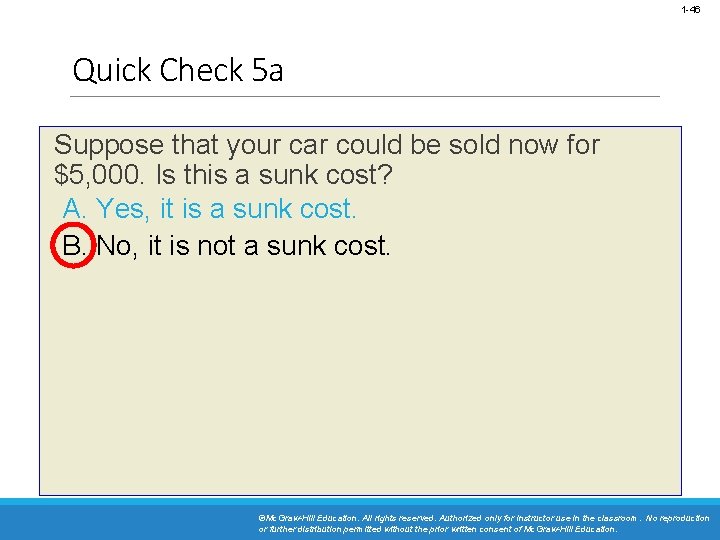
1 -46 Quick Check 5 a Suppose that your car could be sold now for $5, 000. Is this a sunk cost? A. Yes, it is a sunk cost. B. No, it is not a sunk cost. ©Mc. Graw-Hill Education. All rights reserved. Authorized only for instructor use in the classroom. No reproduction or further distribution permitted without the prior written consent of Mc. Graw-Hill Education.
1 -47 Learning Objective 6 Prepare income statements for a merchandising company using the traditional and contribution formats. ©Mc. Graw-Hill Education. All rights reserved. Authorized only for instructor use in the classroom. No reproduction or further distribution permitted without the prior written consent of Mc. Graw-Hill Education.
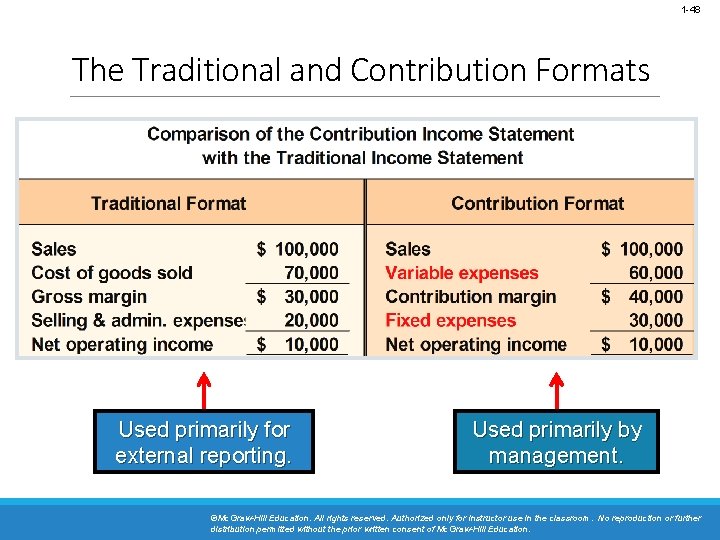
1 -48 The Traditional and Contribution Formats Used primarily for external reporting. Used primarily by management. ©Mc. Graw-Hill Education. All rights reserved. Authorized only for instructor use in the classroom. No reproduction or further distribution permitted without the prior written consent of Mc. Graw-Hill Education.
1 -49 Uses of the Contribution Format The contribution income statement format is used as an internal planning and decision-making tool. We will use this approach for: 1. Cost-volume-profit analysis (Chapter 5). 2. Segmented reporting of profit data (Chapter 6). 3. Budgeting (Chapter 8). 4. Special decisions such as pricing and make-or-buy analysis (Chapter 12). ©Mc. Graw-Hill Education. All rights reserved. Authorized only for instructor use in the classroom. No reproduction or further distribution permitted without the prior written consent of Mc. Graw-Hill Education.
1 -50 End of Chapter 1 ©Mc. Graw-Hill Education. All rights reserved. Authorized only for instructor use in the classroom. No reproduction or further distribution permitted without the prior written consent of Mc. Graw-Hill Education.