
Managerial Accounting An Introduction To Concepts Methods And
- Slides: 19
Managerial Accounting: An Introduction To Concepts, Methods, And Uses Chapter 1 Fundamental Concepts Maher, Stickney and Weil
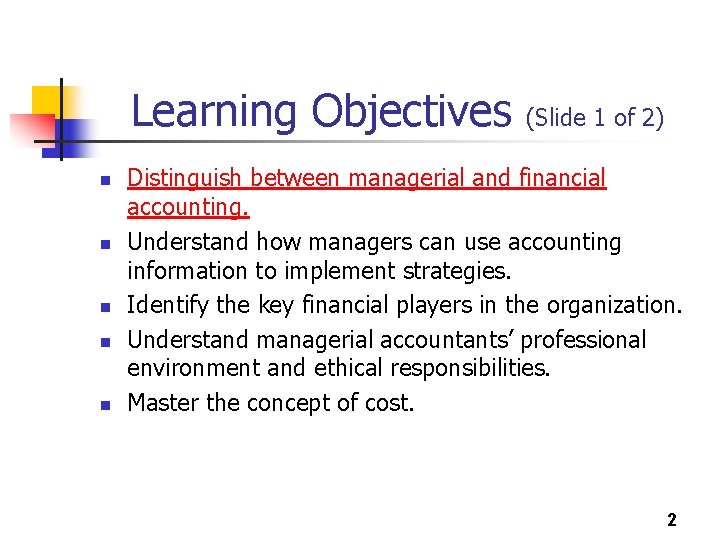
Learning Objectives n n n (Slide 1 of 2) Distinguish between managerial and financial accounting. Understand how managers can use accounting information to implement strategies. Identify the key financial players in the organization. Understand managerial accountants’ professional environment and ethical responsibilities. Master the concept of cost. 2
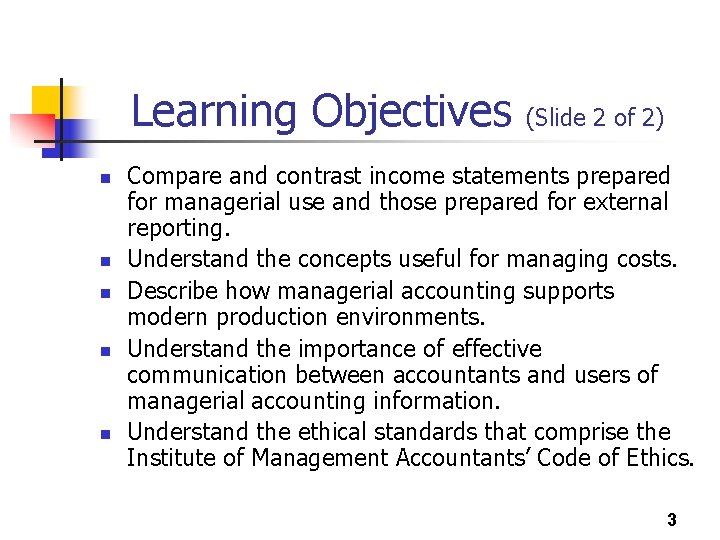
Learning Objectives n n n (Slide 2 of 2) Compare and contrast income statements prepared for managerial use and those prepared for external reporting. Understand the concepts useful for managing costs. Describe how managerial accounting supports modern production environments. Understand the importance of effective communication between accountants and users of managerial accounting information. Understand the ethical standards that comprise the Institute of Management Accountants’ Code of Ethics. 3
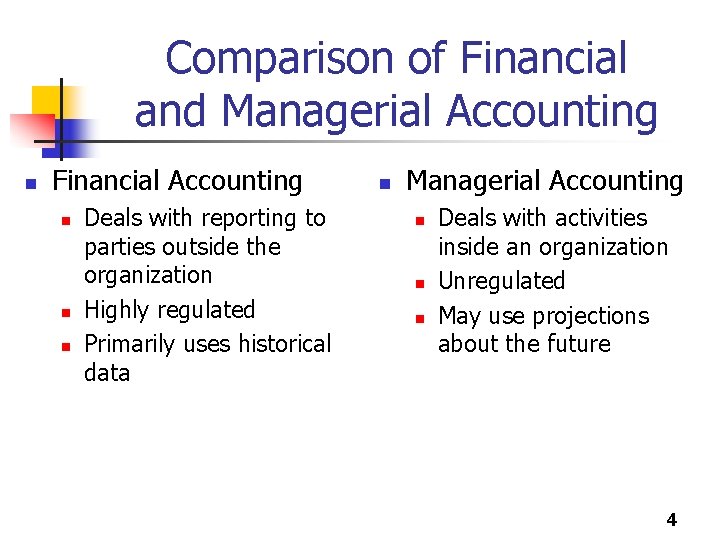
Comparison of Financial and Managerial Accounting n Financial Accounting n n n Deals with reporting to parties outside the organization Highly regulated Primarily uses historical data n Managerial Accounting n n n Deals with activities inside an organization Unregulated May use projections about the future 4
Implementing Strategies n Managerial accounting system should help managers implement organization’s strategy n n System must be adapted to each organization’s objectives, strategy and environment Information required for decision making, planning, and other managerial activities often is not provided by the financial accounting system 5
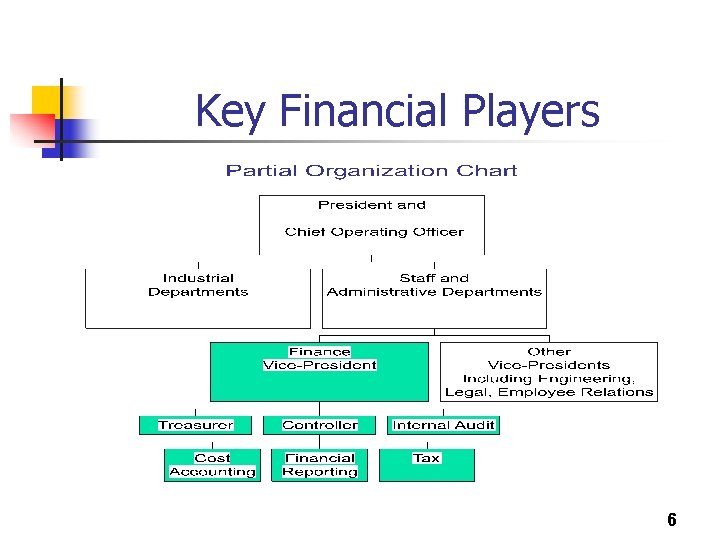
Key Financial Players 6
Professional Environment (Slide 1 of 2) n Institute of Management Accountants (IMA) n n Sponsors Certified Management Accountant and Certified in Financial Management programs Publishes a journal, policy statements and research studies on accounting issues Certified Public Accountant Cost Accounting Standards Board n Sets accounting standards for contracts between the U. S. government and defense contractors 7
Professional Environment (Slide 2 of 2) n n Ethical issues, while always important, have taken on added significance due to recent accounting failures The IMA has developed a Code of Conduct mandating that management accountants have a responsibility to maintain the highest levels of ethical conduct 8
Basis Cost Concepts n A cost is a sacrifice of resources n n (Slide 1 of 4) You must know the context in which the word cost is used to know its meaning Opportunity cost is the foregone income from using an asset in its best alternative 9
Basis Cost Concepts n (Slide 2 of 4) A cost is distinguished from an expense n n An outlay of cash may lead to another resource taking its place The term expense is reserved for external reporting under GAAP and for income tax reporting 10
Basis Cost Concepts n (Slide 3 of 4) A cost object is any item for which the manager wishes to measure cost n n Costs directly related to the cost object are called direct costs Other costs are called indirect costs 11
Basis Cost Concepts n (Slide 4 of 4) The distinction between fixed and variable costs is important since it affects strategic decision making n n Variable costs change in total as the activity level changes Fixed costs do not change in total when the activity level changes 12
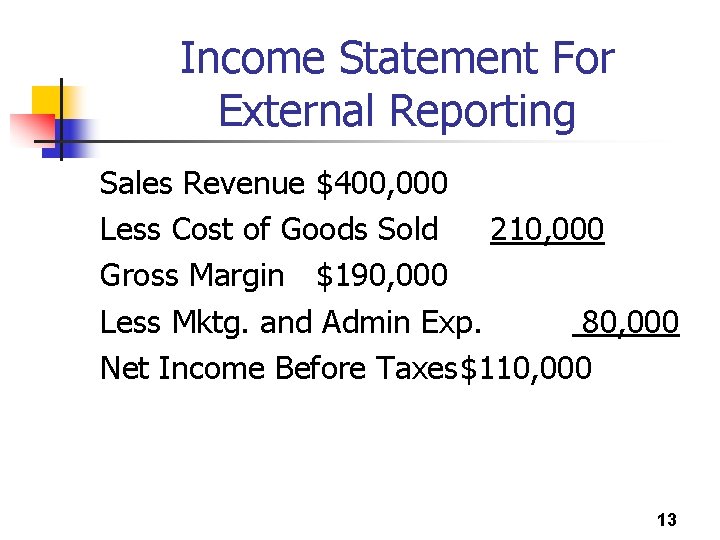
Income Statement For External Reporting Sales Revenue $400, 000 Less Cost of Goods Sold 210, 000 Gross Margin $190, 000 Less Mktg. and Admin Exp. 80, 000 Net Income Before Taxes$110, 000 13
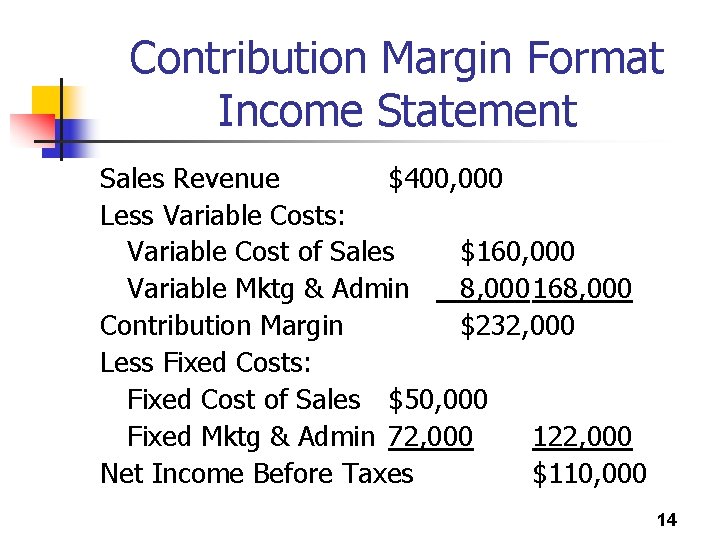
Contribution Margin Format Income Statement Sales Revenue $400, 000 Less Variable Costs: Variable Cost of Sales $160, 000 Variable Mktg & Admin 8, 000168, 000 Contribution Margin $232, 000 Less Fixed Costs: Fixed Cost of Sales $50, 000 Fixed Mktg & Admin 72, 000 122, 000 Net Income Before Taxes $110, 000 14
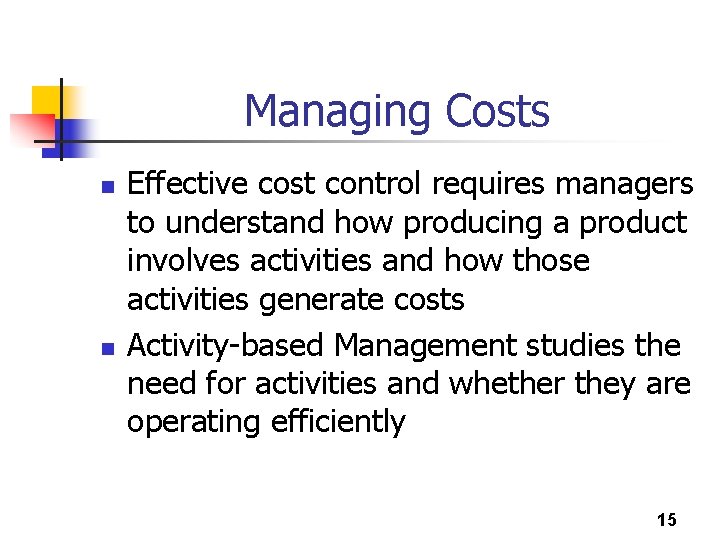
Managing Costs n n Effective cost control requires managers to understand how producing a product involves activities and how those activities generate costs Activity-based Management studies the need for activities and whether they are operating efficiently 15
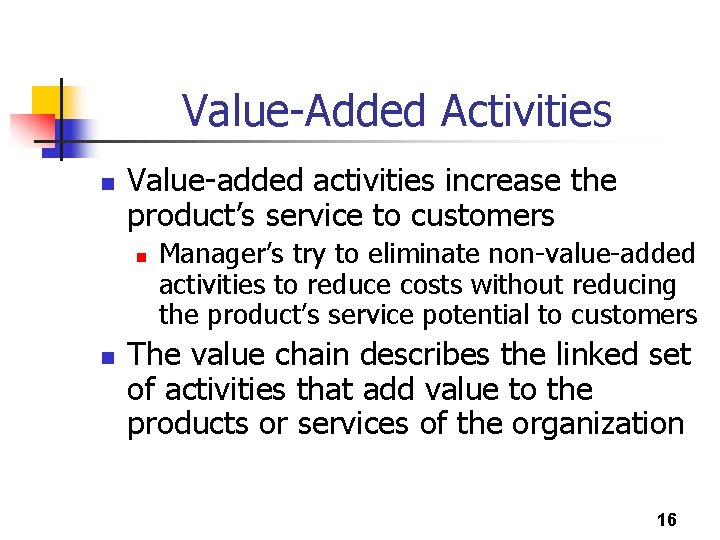
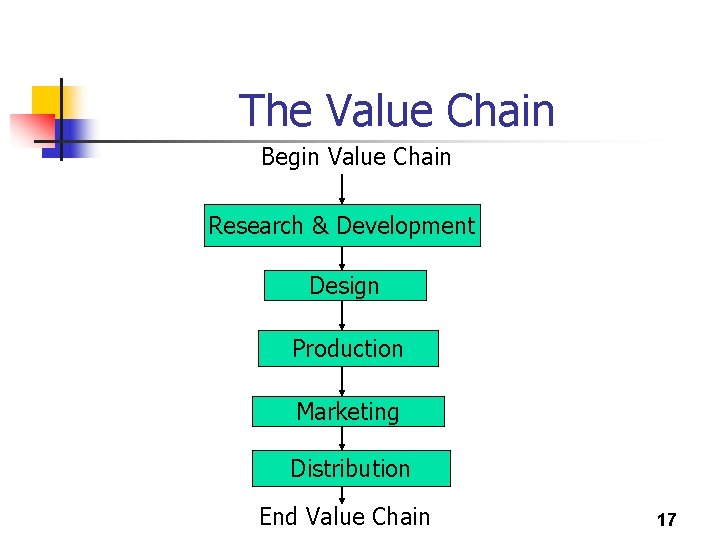
Value-Added Activities n Value-added activities increase the product’s service to customers n n Manager’s try to eliminate non-value-added activities to reduce costs without reducing the product’s service potential to customers The value chain describes the linked set of activities that add value to the products or services of the organization 16
The Value Chain Begin Value Chain Research & Development Design Production Marketing Distribution End Value Chain 17
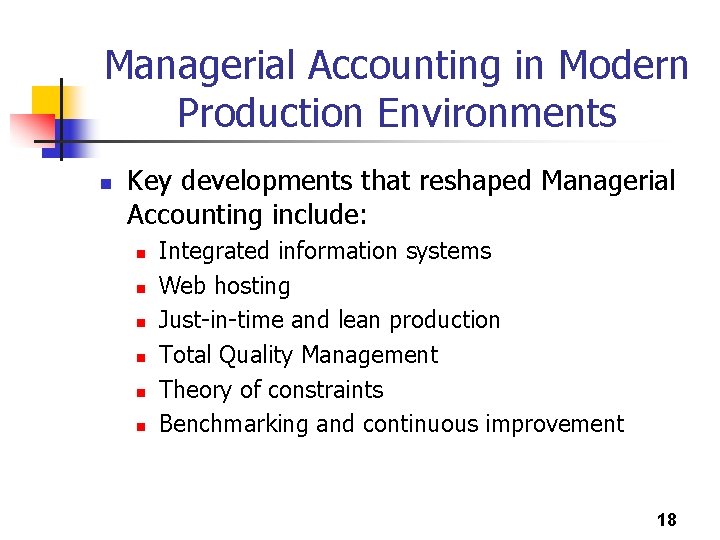
Managerial Accounting in Modern Production Environments n Key developments that reshaped Managerial Accounting include: n n n Integrated information systems Web hosting Just-in-time and lean production Total Quality Management Theory of constraints Benchmarking and continuous improvement 18
If you have any comments or suggestions concerning this Power. Point Presentation for Managerial Accounting, An Introduction To Concepts, Methods, And Uses please contact: Dr. Donald R. Trippeer, CPA donald. trippeer@colostate-pueblo. edu Colorado State University-Pueblo 19