
Managerial Accounting An Introduction To Concepts Methods And
- Slides: 22
Managerial Accounting: An Introduction To Concepts, Methods, And Uses 9 th Edition Maher, Stickney and Weil
Chapter 1 Overview and Basic Concepts
Learning Objectives (Slide 1 of 2) § Distinguish between managerial & financial accounting. § Understand how managers can use accounting information to implement strategies. § Identify the key financial players in the organization. § Understand managerial accountants’ professional environment and ethical responsibilities. § Master the concept of cost.
Learning Objectives (Slide 2 of 2) § § Compare and contrast income statements prepared for managerial use and those prepared for external reporting. Describe how managerial accounting supports modern production environments. Understand the importance of effective communication between accountants and users of managerial accounting information. Understand the ethical standards that comprise the Institute of Management Accountants’ Code of Ethics. (Appendix 1. 1)
Compare Financial & Managerial Accounting Financial Accounting Managerial Accounting
Discuss Implementing Strategies
Review Misuses of Accounting Information
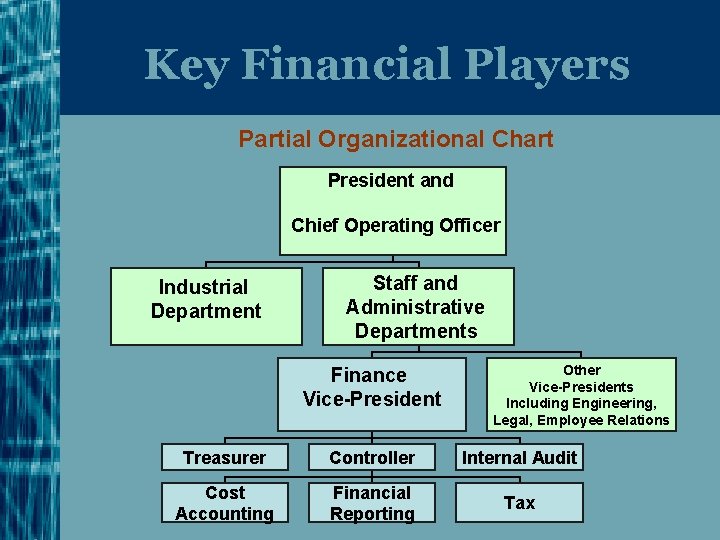
Key Financial Players Partial Organizational Chart President and Chief Operating Officer Industrial Department Staff and Administrative Departments Finance Vice-President Other Vice-Presidents Including Engineering, Legal, Employee Relations Treasurer Controller Internal Audit Cost Accounting Financial Reporting Tax
Professional Environment (Slide 1 of 2) Institute of Management Accountants (IMA) § Sponsors Certified Management Accountant & Certified Financial Management programs § Publishes a journal, policy statements and research studies on accounting issues Certified Public Accountant Cost Accounting Standards Board § Sets accounting standards for contracts between the U. S. government and defense contractors
Professional Environment (Slide 2 of 2) § Ethical issues, while always important, have taken on added significance due to recent accounting failures § The IMA has developed a Code of Conduct mandating that management accountants have a responsibility to maintain the highest levels of ethical conduct
Define the Following Basic Cost Concepts (Slide 1 of 4) § A cost § Opportunity cost
Basic Cost Concepts (Slide 2 of 4) § Distinguish between a cost and an expense
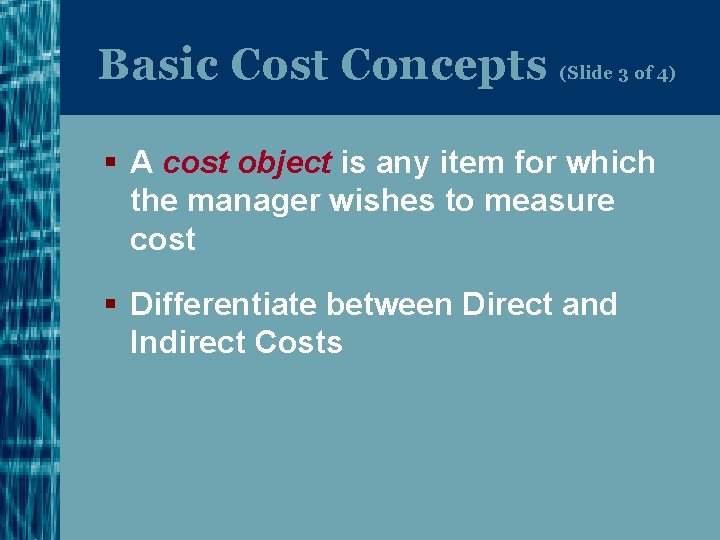
Basic Cost Concepts (Slide 3 of 4) § A cost object is any item for which the manager wishes to measure cost § Differentiate between Direct and Indirect Costs
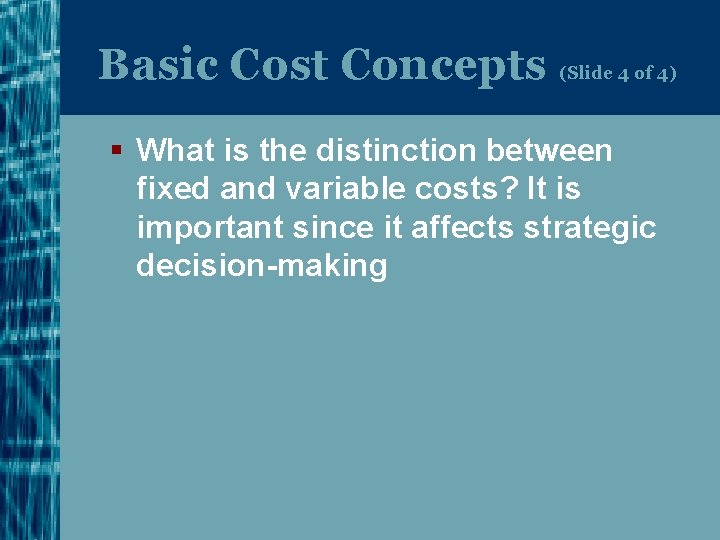
Basic Cost Concepts (Slide 4 of 4) § What is the distinction between fixed and variable costs? It is important since it affects strategic decision-making
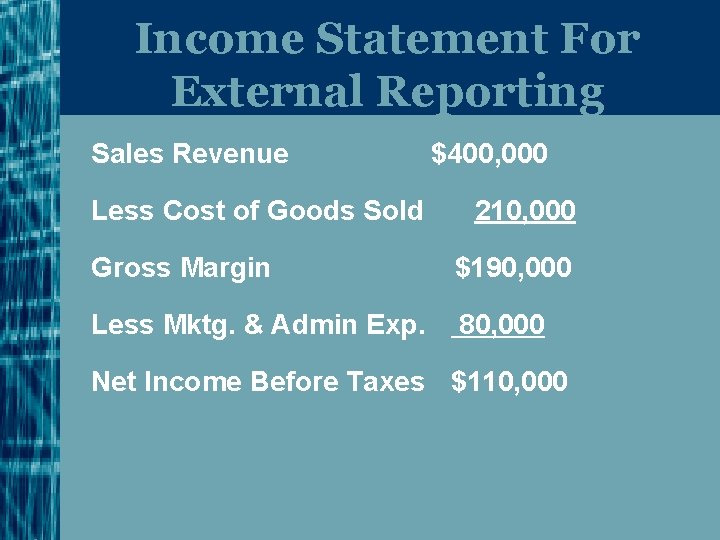
Income Statement For External Reporting Sales Revenue Less Cost of Goods Sold $400, 000 210, 000 Gross Margin $190, 000 Less Mktg. & Admin Exp. 80, 000 Net Income Before Taxes $110, 000
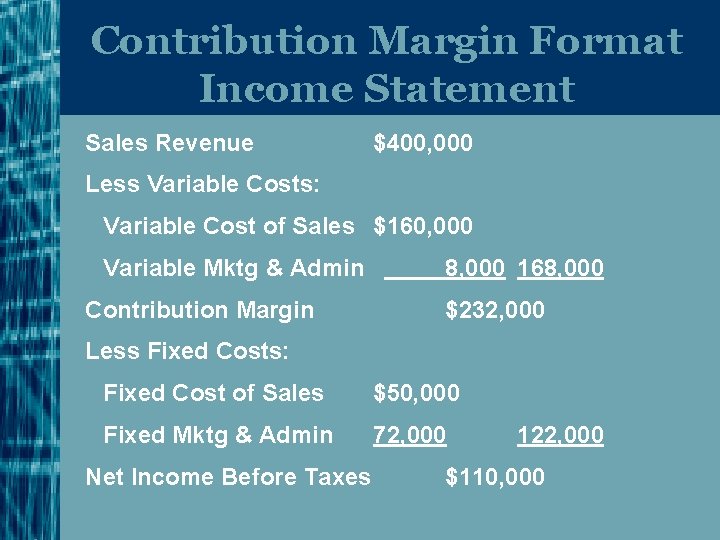
Contribution Margin Format Income Statement Sales Revenue $400, 000 Less Variable Costs: Variable Cost of Sales $160, 000 Variable Mktg & Admin Contribution Margin 8, 000 168, 000 $232, 000 Less Fixed Costs: Fixed Cost of Sales $50, 000 Fixed Mktg & Admin 72, 000 Net Income Before Taxes 122, 000 $110, 000
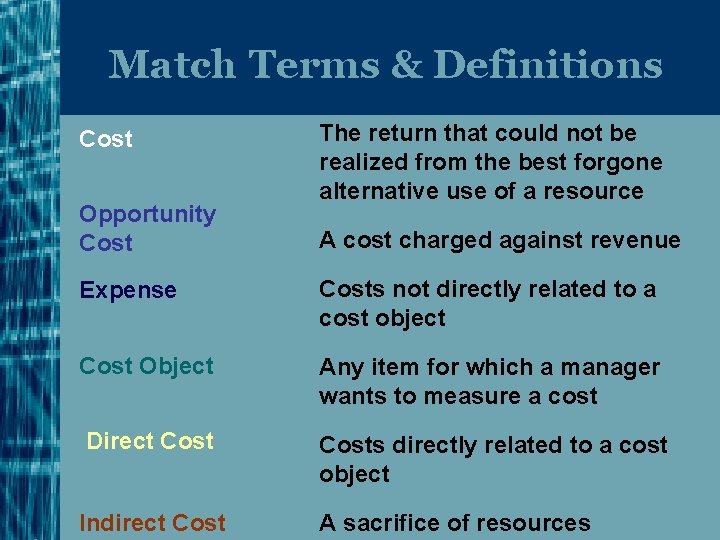
Match Terms & Definitions Cost Opportunity Cost The return that could not be realized from the best forgone alternative use of a resource A cost charged against revenue Expense Costs not directly related to a cost object Cost Object Any item for which a manager wants to measure a cost Direct Costs directly related to a cost object Indirect Cost A sacrifice of resources
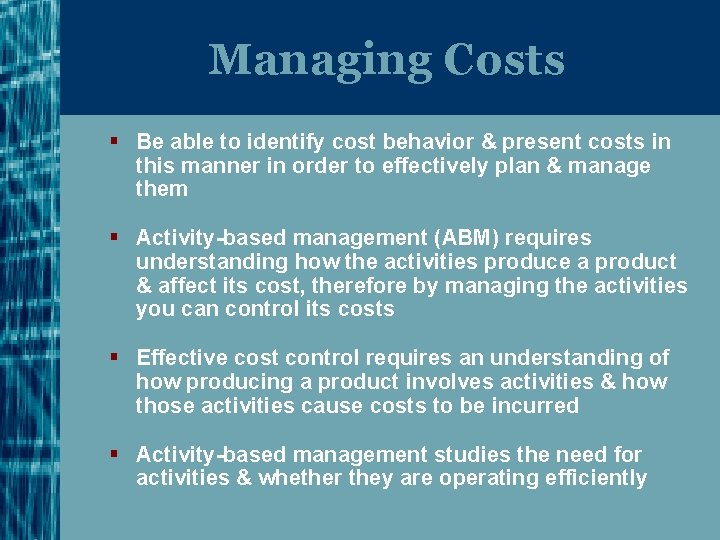
Managing Costs § Be able to identify cost behavior & present costs in this manner in order to effectively plan & manage them § Activity-based management (ABM) requires understanding how the activities produce a product & affect its cost, therefore by managing the activities you can control its costs § Effective cost control requires an understanding of how producing a product involves activities & how those activities cause costs to be incurred § Activity-based management studies the need for activities & whether they are operating efficiently
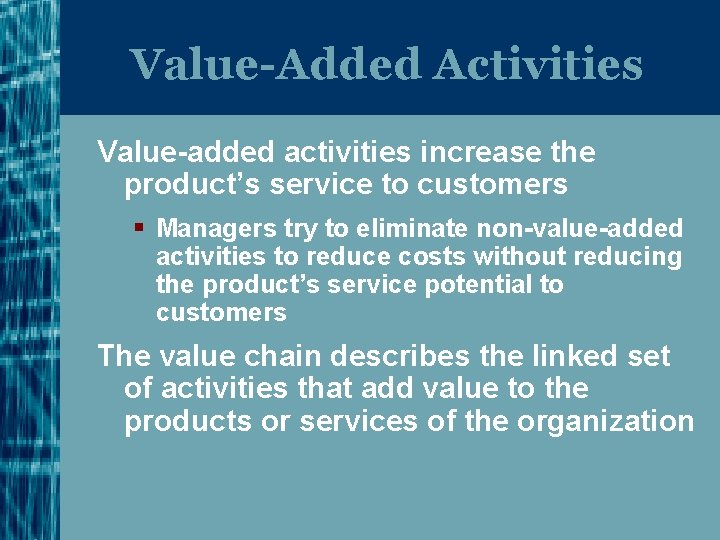
Value-Added Activities Value-added activities increase the product’s service to customers § Managers try to eliminate non-value-added activities to reduce costs without reducing the product’s service potential to customers The value chain describes the linked set of activities that add value to the products or services of the organization
Describe the Value Chain
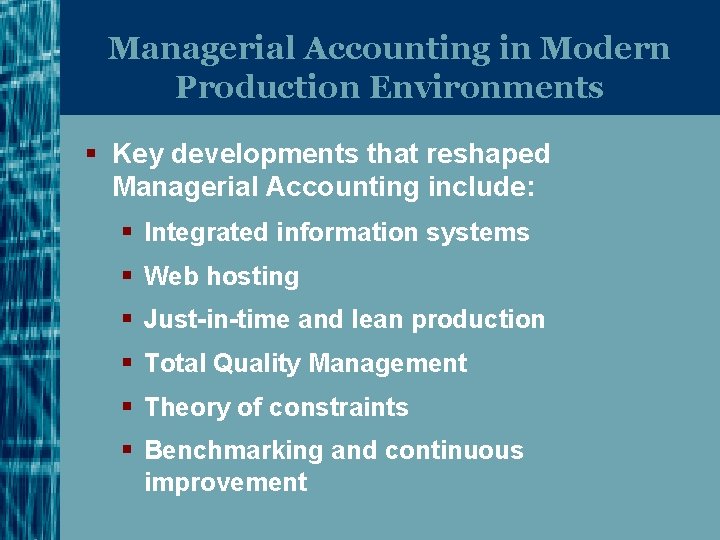
Managerial Accounting in Modern Production Environments § Key developments that reshaped Managerial Accounting include: § Integrated information systems § Web hosting § Just-in-time and lean production § Total Quality Management § Theory of constraints § Benchmarking and continuous improvement
If you have any comments or suggestions concerning this Power. Point Presentation for Managerial Accounting, An Introduction To Concepts, Methods, And Uses please contact: Dr. Michael Blue, CFE, CPA, CMA blue@bloomu. edu Bloomsburg University of Pennsylvania