
Management Topic 5 Planning Processes and Techniques Study
- Slides: 21
Management Topic 5: Planning Processes and Techniques
Study Question 1: Why and how do managers plan? ØPlanning The process of setting objectives and determining how to best accomplish them. ØObjectives Identify the specific results or desired outcomes that one intends to achieve. ØPlan A statement of action steps to be taken in order to accomplish the objectives.
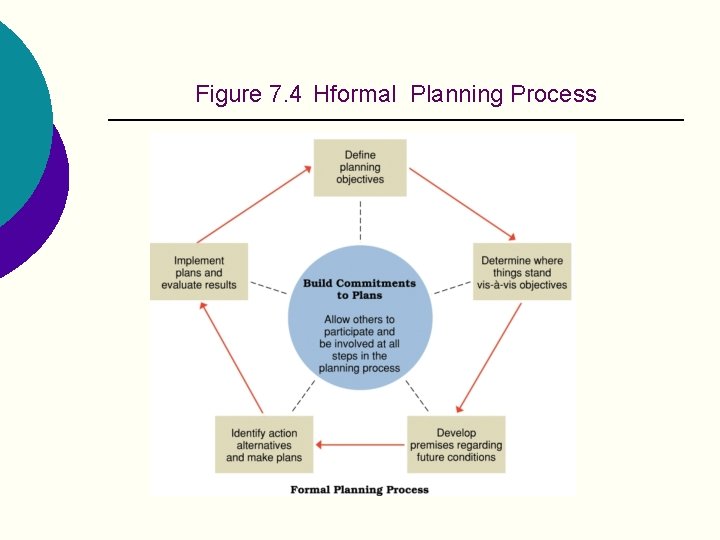
Study Question 1: Why and how do managers plan? Ø Steps in the planning process: l Define your objectives. l Determine where you stand vis-à-vis objectives. l Develop premises regarding future conditions. l Analyze and choose among action alternatives. l Implement the plan and evaluate results.
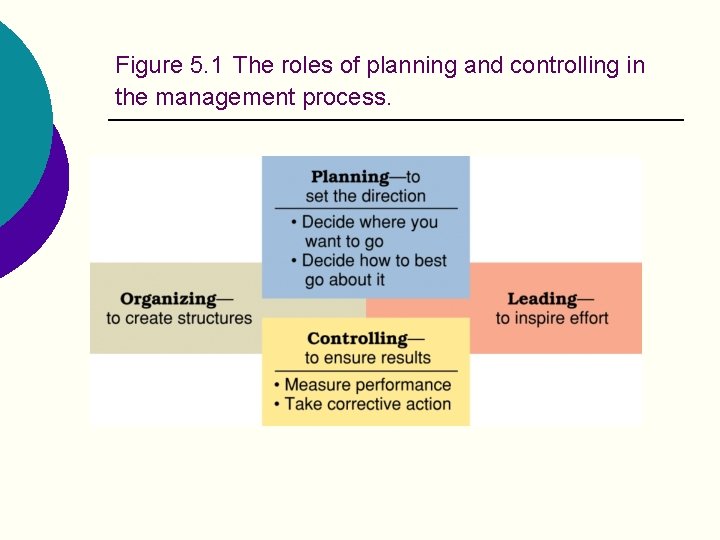
Figure 5. 1 The roles of planning and controlling in the management process.
Study Question 1: Why and how do managers plan? Ø Benefits of planning: l Improves focus and flexibility. l Improves action orientation. l Improves coordination. l Improves time management. l Improves control.
Study Question 2: What types of plans do managers use? Ø Short-range and long-range plans l Short-range plans = 1 year or less l Intermediate-range plans = 1 to 2 years l Long-range plans = 3 or more years Ø People vary in their capability to deal effectively with different time horizons. Ø Higher management levels focus on longer time horizons.
Study Question 2: What types of plans do managers use? Ø Strategic and operational plans l l Strategic plans — set broad, comprehensive, and longer-term action directions for the entire organization. Operational plans — define what needs to be done in specific areas to implement strategic plans. ¡ Production plans ¡ Financial plans ¡ Facilities plans ¡ Marketing plans ¡ Human resource plans
Study Question 2: What types of plans do managers use? Ø Policies and procedures l Standing plans ¡ l Policy ¡ l Policies and procedures that are designed for repeated use. Broad guidelines for making decisions and taking action in specific circumstances. Rules or procedures ¡ Plans that describe exactly what actions are to be taken in specific situations.
Study Question 2: What types of plans do managers use? Ø Budgets and project schedules l Single-use plans ¡ Only used once to meet the needs and objectives of a well-defined situation in a timely manner. l Budgets Single-use plans that commit resources to activities, projects, or programs. ¡ Fixed, flexible, and zero-based budgets. ¡ l Projects One-time activities that have clear beginning and end points. ¡ Project management and project schedules. ¡
Study Question 3: What are the useful planning tools and techniques? Ø Forecasting l Making assumptions about what will happen in the future. l Qualitative forecasting uses expert opinions. l Quantitative forecasting uses mathematical and statistical analysis. l All forecasts rely on human judgment. l Planning involves deciding on how to deal with the implications of a forecast.
Study Question 3: What are the useful planning tools and techniques? Ø Contingency planning l Identifying alternative courses of action that can be implemented to meet the needs of changing circumstances. l Contingency plans anticipate changing conditions. l Contingency plans contain trigger points.
Study Question 3: What are the useful planning tools and techniques? Ø Scenario planning l A long-term version of contingency planning. l Identifying alternative future scenarios. l Plans made for each future scenario. l Increases organization’s flexibility and preparation for future shocks.
Study Question 3: What are the useful planning tools and techniques? Ø Benchmarking l Use of external comparisons to better evaluate current performance and identify possible actions for the future. l Adopting best practices of other organizations that achieve superior performance.
Study Question 3: What are the useful planning tools and techniques? Ø Use of staff planners l Coordinating the planning function for the total organization or one of its major components. l Possible communication gaps between staff planners and line management.
Study Question 4: How can plans be well implemented? Ø Project management… Makes sure activities required to complete a project are planned well and accomplished on time and within budget Ø Projects – one-time activities with many component tasks that must be completed in proper order and within budget
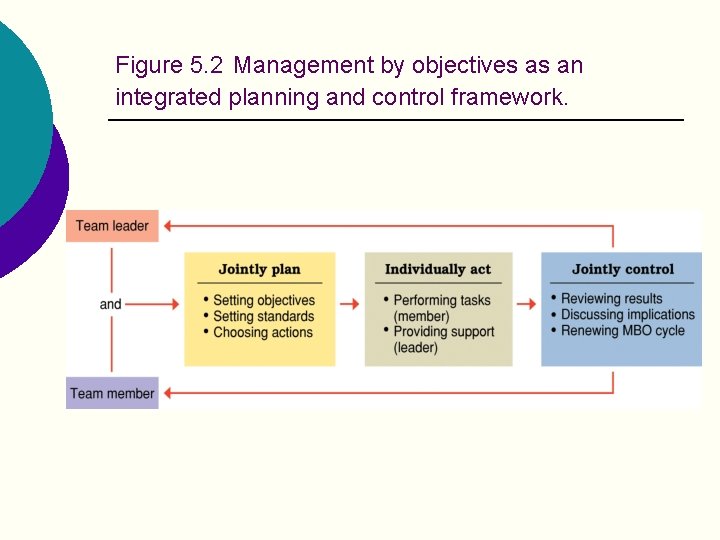
Study Question 4: How can plans be well implemented? Ø Management by Objectives (MBO) l A structured process of regular communication. l Supervisor/team leader and workers jointly set performance objectives. l Supervisor/team leader and workers jointly review results.
Figure 5. 2 Management by objectives as an integrated planning and control framework.
Study Question 5: How does management by objectives operate? Ø The MBO process: l l l Supervisor and workers jointly set objectives, establish standards, and choose actions. Workers act individually to perform tasks; supervisors act individually to provide necessary support. Supervisor and workers jointly review results, discuss implications, and renew the MBO cycle.
Study Question 5: How does management by objectives operate? Ø Pitfalls to avoid in using MBO l Tying MBO to pay. l Focusing too much attention on easily quantifiable objectives. l Requiring excessive paperwork. l Having managers tell workers their objectives.
Study Question 5: How does management by objectives operate? Ø Advantages of MBO l l Focuses workers on most important tasks and objectives. Focuses supervisor’s efforts on important areas of support. Contributes to relationship building. Gives workers a structured opportunity to participate in decision making.
Figure 7. 4 Hformal Planning Process