
Management Stephen P Robbins Chapter 2 Mary Coulter
Management Stephen P. Robbins Chapter 2 Mary Coulter Management History
Learning Outcomes Follow this Learning Outline as you read and study this chapter. 2. 1 Historical Background Of Management. 2. 2 Classical Approach. 2. 3 Quantitative Approach. 2. 4 Behavioral Approach 2. 5 Contingency/Contemporary Approach
Historical Background of Management Ancient Management § Egypt (pyramids), China (Great Wall), the Qutab Minar and Taj Mehal are tangible evidence that projects of tremendous scope, employing tens of thousands of people completed in ancient times § In Venice, warships were floated among the canals and it was look like a car “floating” along an automobile assembly line § Adam Smith published “Wealth of Nations” in which he argued about division of labor (or job specialization) by using example of pin industry § In late 18 th century Industrial Revolution changed management history and human power was replaced by machine power § In Industrial Revolution factories were established and someone had to forecast demand, ensuring availability of raw material, assigning tasks and directing daily activities
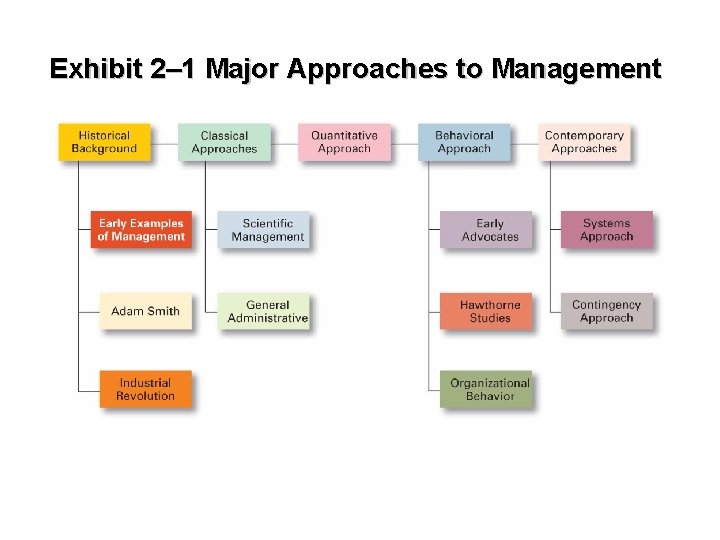
Exhibit 2– 1 Major Approaches to Management
Approaches to Management 1. Classical Approach § Formal study of management began until early in 20 th century and these first studies of management called Classical Approach § It emphasized rationality and making organizations and workers as efficient as possible § This classical approach consisted two major theories (a) Scientific Management (b) General Administrative Theory
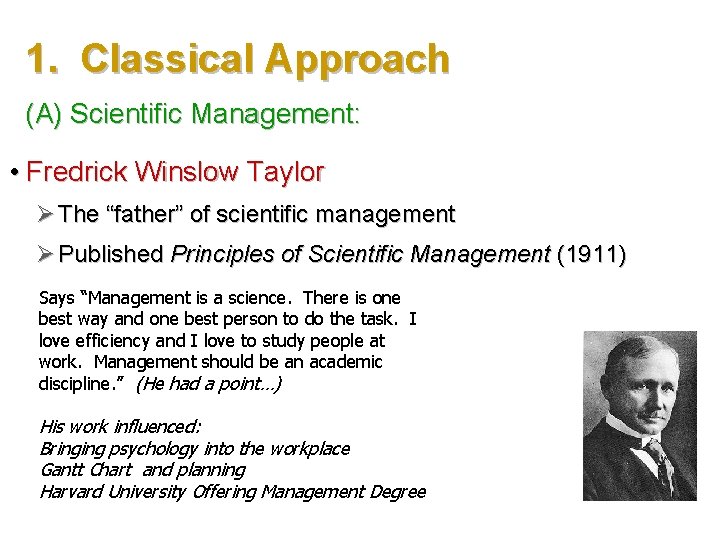
1. Classical Approach (A) Scientific Management: • Fredrick Winslow Taylor Ø The “father” of scientific management Ø Published Principles of Scientific Management (1911) Says “Management is a science. There is one best way and one best person to do the task. I love efficiency and I love to study people at work. Management should be an academic discipline. ” (He had a point…) His work influenced: Bringing psychology into the workplace Gantt Chart and planning Harvard University Offering Management Degree
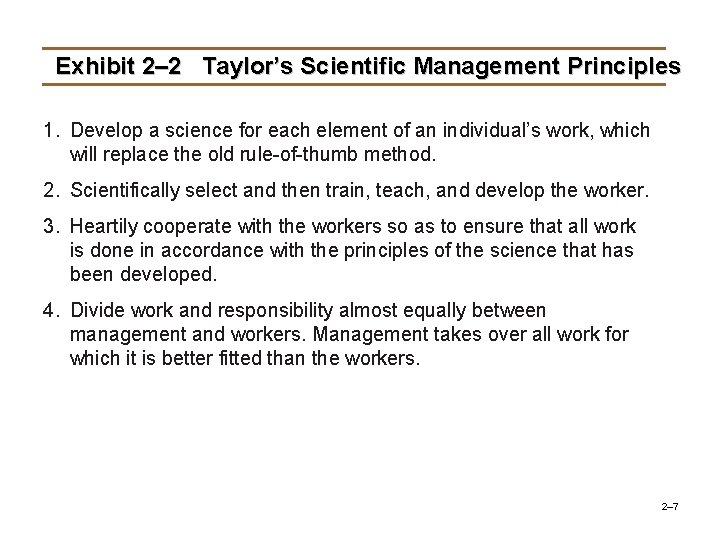
Exhibit 2– 2 Taylor’s Scientific Management Principles 1. Develop a science for each element of an individual’s work, which will replace the old rule-of-thumb method. 2. Scientifically select and then train, teach, and develop the worker. 3. Heartily cooperate with the workers so as to ensure that all work is done in accordance with the principles of the science that has been developed. 4. Divide work and responsibility almost equally between management and workers. Management takes over all work for which it is better fitted than the workers. 2– 7
1. Classical Approach (b) General Administrative Theory § An approach to management that focuses on describing what managers do and what constitutes good management practices § The two prominent individuals behind this theory were Henri Fayol and Max Weber Henri Fayol: § Fayol first identified five functions of management planning, organizing, commanding, coordinating and controlling § Taylor was concerned with first-line managers while Fayal's attention was directed at all levels of management § Henri Fayol developed 14 Principles of Management-----Fundamental rules of management that could be applied in all organizational structures and taught in schools
(b) General Administrative Theory Max Weber § Weber was a German Sociologist and in 1900 he developed a theory of authority structures and relations based on an ideal type of organization he called a Bureaucracy § Bureaucracy----- A form of organization characterized by division of labor, a clearly defined hierarchy, detailed rules and regulations and impersonal relationships Use of General Administrative Theory in Recent World § Functional view of a manger’s job can be attributed to Fayol § Many current management concepts-----such as managerial authority, centralized decision making, reporting to only one boss have evolved from Fayal's 14 Principles of Management § Weber’s bureaucratic model is still applicable in many organizations such as UTV and Infosays but in present world it is not considered too much effective because it hinders employee creativity and efficiency
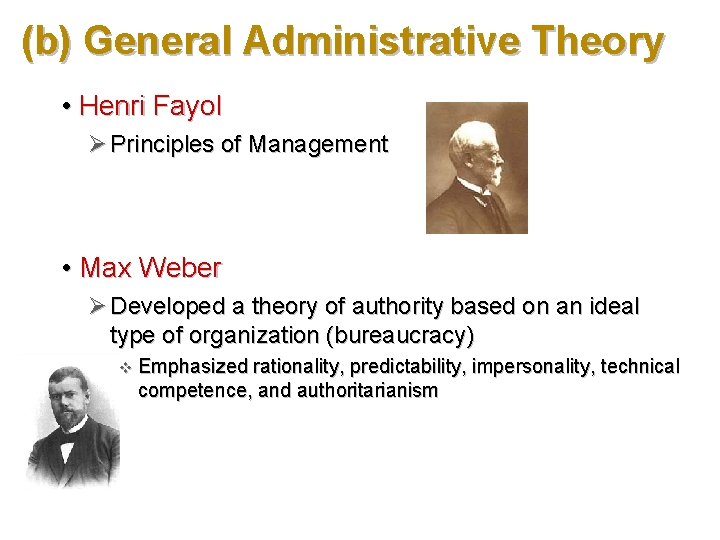
(b) General Administrative Theory • Henri Fayol Ø Principles of Management • Max Weber Ø Developed a theory of authority based on an ideal type of organization (bureaucracy) v Emphasized rationality, predictability, impersonality, technical competence, and authoritarianism
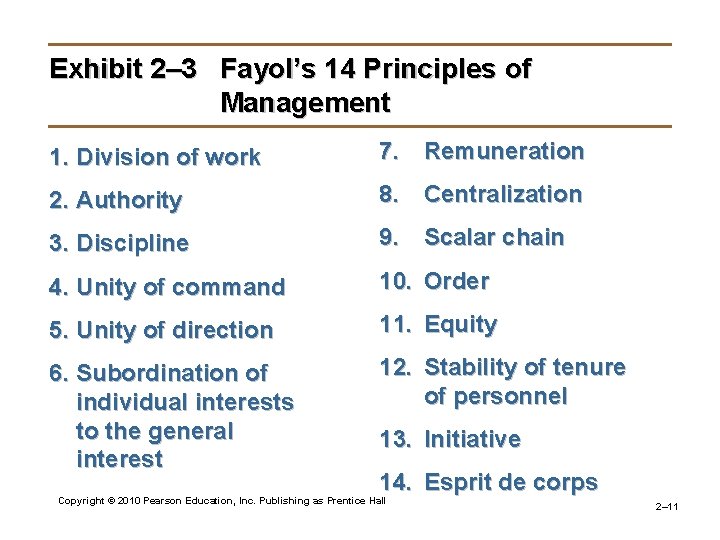
Exhibit 2– 3 Fayol’s 14 Principles of Management 1. Division of work 7. Remuneration 2. Authority 8. Centralization 3. Discipline 9. Scalar chain 4. Unity of command 10. Order 5. Unity of direction 11. Equity 6. Subordination of individual interests to the general interest 12. Stability of tenure of personnel 13. Initiative 14. Esprit de corps Copyright © 2010 Pearson Education, Inc. Publishing as Prentice Hall 2– 11
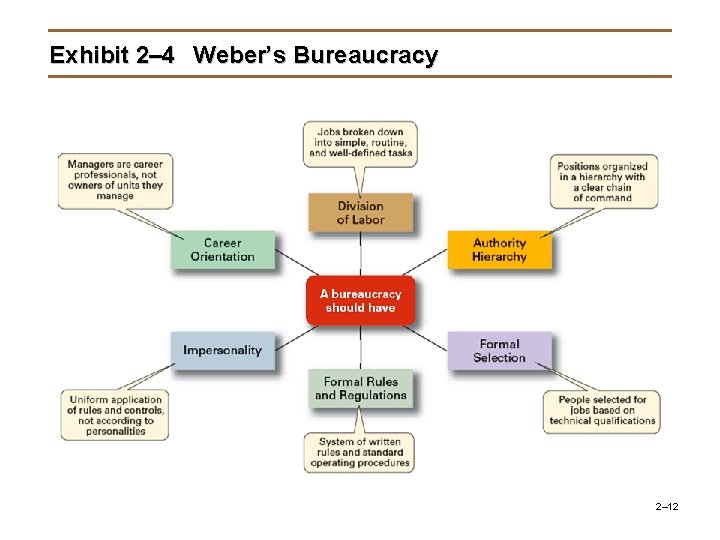
Exhibit 2– 4 Weber’s Bureaucracy 2– 12
2. Quantitative Approach to Management § The use of quantitative techniques to improve decision making and this approach is also known as Management Science § Evolved from mathematical and statistical methods developed to solve WW-II military logistics and quality control problems § British and American military had developed techniques using math/stats to plan for attacks, convoy sizes, bombing raids, etc… § Focuses on improving managerial decision making by applying: § Statistics, optimization models, information models, and computer simulations § Computers do most of this work today
2. Quantitative Approach to Management Total Quality Management (TQM): § A quality revolution swept through both business and public sectors in 1980 s and 1990 s § It was inspired by a small group of quality experts, the most famous being W. Edwards Deming and Joseph M. Juran and their ideas and techniques became the basis for today’s quality management programs § TQM is a management philosophy devoted to continual improvement and responding to customer needs and expectations § TQM was a departure from earlier management approaches that were based on the belief that keeping costs low is the only way to improve productivity § The Japanese demonstrated that it was possible for the highest quality manufacturers to be among the lowest-cost producers
Exhibit 2– 5 What Is Quality Management? § Intense focus on the Customer---Both Internal and External § Concern for Continual Improvement---- Being not satisfied § Process-Focused------ Focus on work processes § Improvement in the Quality of Everything----- In each and every aspect of the organization § Accurate Measurement---- Statistical techniques are used to measure every critical variable in an organization and then these are compared with set standards e. g. 6 -Sigma § Empowerment of Employees------Decentralized organizational environment and teams are widely used to find and fix the quality problems
2. Quantitative Approach to Management How Today’s Managers use Quantitative Approach § Queue Management: Science of keeping lines moving--- Many organizations use queuing theory for their customers in order to avoid rush and customer dissatisfaction e. g. Indian Railway uses Railway Reservation Systems § Call centers also use the same logic to queue the receiver’s call § Tour operators make their real time availability and confirmation to the domestic and inbound travelers in the City Tour in India § The Quantitative Approach contributes directly to management decision making in the areas of planning and control § In organizations many activities like budgeting, queuing, scheduling, quality control and similar techniques based on quantitative approach to management
3. Behavioral Approach Organizational Behavior (OB) “The field of study that researches the actions (behaviors) of people at workplace is called OB”. § Much of what managers do today when managing people---motivating, leading, building trust, working with a team, managing conflict and so forth--- has come out of OB research Early Advocates of Organizational Behavior § Four personalities stand out as early advocates of OB approach: Robert Owen, Hugo Munsterberg, Mary Parker and Chester Bernard § Inspite of their distinctive work they all were believed that people are the most important asset of an organization and must be managed accordingly § Their ideas provided the foundation for such management practices as employee selection procedures, motivation programs, and work teams
3. Behavioral Approach How Today’s Managers Use the Behavioral Approach § From the way that mangers design jobs to the way that they work with employee teams to the way that they communicate, we see elements of behavioral approach § Much of what the early advocates of OB proposed and the conclusions of the Hawthorne Studies have provided the foundation for our current theories of motivation, leadership, group behavior and development, and numerous other behavioral approaches
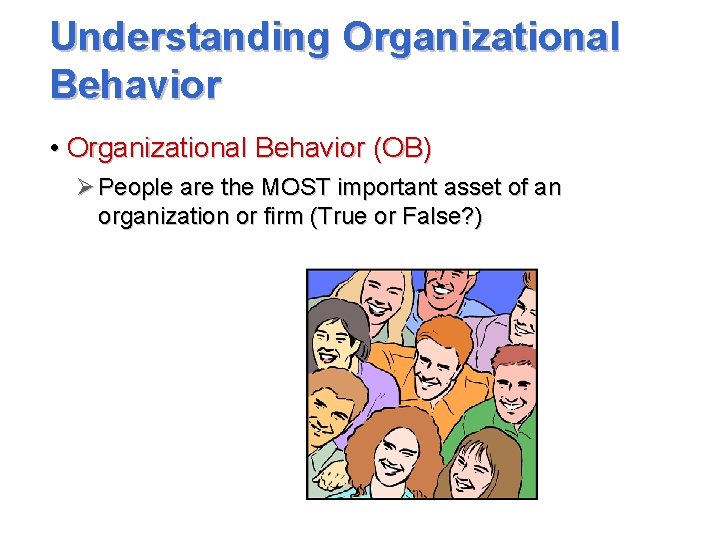
Understanding Organizational Behavior • Organizational Behavior (OB) Ø People are the MOST important asset of an organization or firm (True or False? )
The Hawthorne Studies • A series of productivity experiments conducted at Western Electric from 1924 to 1932. • Experimental findings ØProductivity unexpectedly increased under imposed adverse working conditions. ØThe effect of incentive plans was less than expected. • Research conclusion ØSocial norms, group standards and attitudes more strongly influence individual output and work behavior than do monetary incentives. Copyright © 2010 Pearson Education, Inc. Publishing as Prentice Hall 2– 20
4. Contemporary Approach § Previous three approaches to management were focused on manager’s concerns Inside and organization but due to Contemporary Approach researchers began to look in the external environment of the organization § Two contemporary management perspectives are part of this approach (a) Systems Theory (b) Contingency Approach
4. Contemporary Approach (a) Systems Theory § In 1960 the management researchers began to look more carefully at systems theory and it was considered that system theory is a basic theory in the physical sciences and it can also be applied to organized human efforts System: A system is a set of interrelated and interdependent parts arranged in a manner that produces a unified whole (i) Closed Systems: Systems that are not influenced by and do not interact with their environment (ii) Open Systems: Systems that are interact with their environment § Today when we describe organizations as systems-----we mean Open Systems
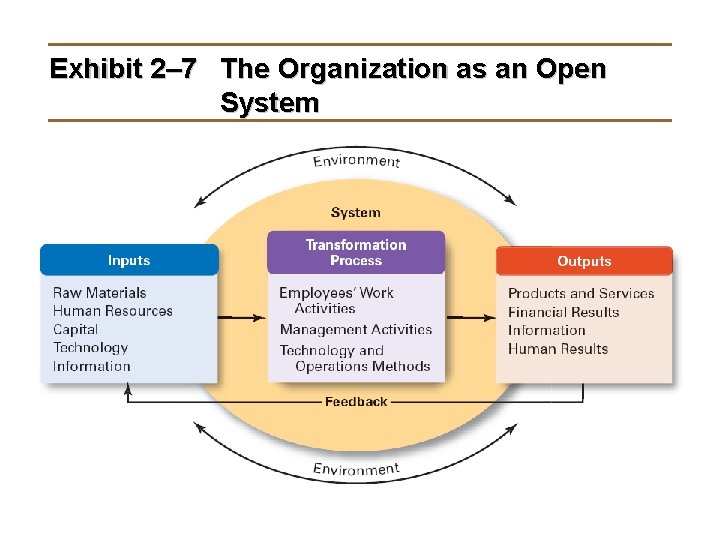
Exhibit 2– 7 The Organization as an Open System
4. Contemporary Approach Implications of the Systems Approach • Coordination of the organization’s parts is essential for proper functioning of the entire organization (i. e. : For production and operations their must be strong coordination among, marketing, finance, HR and SCM functions) • Decisions and actions taken in one area of the organization will have an effect in other areas of the organization (i. e. ; If purchasing department does not acquire the right quantity and quality of inputs it will suffer the activities of production department) • Organizations are not self-contained and, therefore, must adapt to changes in their external environment (i. e. : They rely on their environment for essential inputs and as outlets to absorb their outputs----Organizations should not ignore Govt. regulations, supplier relations or varied external constituencies on which it depends)
4. Contemporary Approach (b) The Contingency Approach § The early management theorists focuses on principles that they generally assumed to be universally applicable § In later research many exceptions were found e. g. : Inspite of division of labor jobs can be too specialized, In many situations other structural designs are important than that of Bureaucracy § The Contingency Approach---Also called Situational Approach, a management approach which says that organizations are different, face different situations and require different ways of managing § There is no one universally applicable set of management principles (rules) by which to manage organizations
4. Contemporary Approach The Contingency Approach and Managers § A good way to describe Contingency is “If, the”: If this is the way my situation is, then this is the best way for me to mange in this situation § This approach is intuitively logical because organizations and even units within the same organizations differ----in terms of size, goals, work activities and the like § Management researches continue working on these situational variables and more than 100 different variables have been identified § The primary value of contingency approach is that it stresses that there are no simplistic or universal rules for managers to follow
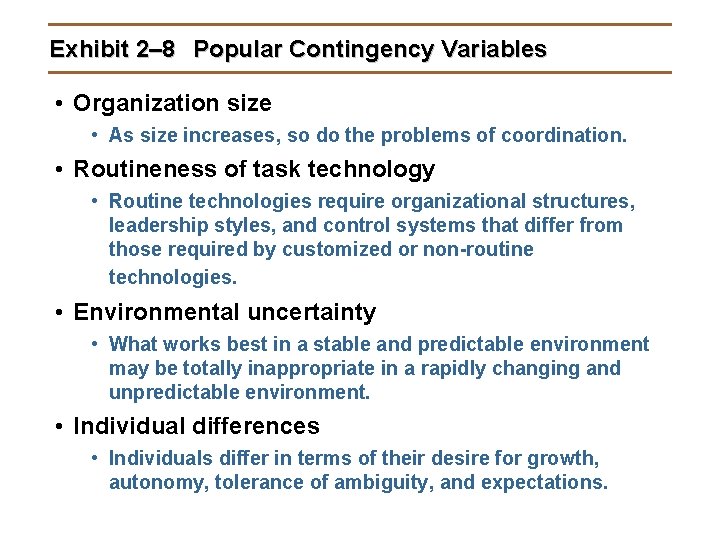
Exhibit 2– 8 Popular Contingency Variables • Organization size • As size increases, so do the problems of coordination. • Routineness of task technology • Routine technologies require organizational structures, leadership styles, and control systems that differ from those required by customized or non-routine technologies. • Environmental uncertainty • What works best in a stable and predictable environment may be totally inappropriate in a rapidly changing and unpredictable environment. • Individual differences • Individuals differ in terms of their desire for growth, autonomy, tolerance of ambiguity, and expectations.
- Slides: 27