
MANAGEMENT SCIENCE Unit 1 Introduction to Management DEFINITIONS

- Slides: 33
MANAGEMENT SCIENCE Unit - 1
Introduction to Management
DEFINITIONS n “Management is knowing exactly what you want men to do and then seeing that they do it the best and cheapest ways” F. W. Taylor n “Management is defined as the creation and maintenance of an internal environment in an enterprise where individuals working together in groups, can perform efficiently and effectively towards the attainment of group goals” - Koontz and O’Donell
DEFINITIONS – CONT. n n Henri Fayol(1916): To manage is forecast and plan , to organize, command, to coordinate and control to to Peter. F. Drucker(1955): Management is concerned with the systematic organization of economic resources and its task is to make these resources productive.
Nature / Characteristics of Management n n n n Multidisciplinary Flexible nature of principles Relative, not absolute principles Management is both a Science and Art Management as profession Management is transformation process Management is universal
Nature / Characteristics of Management n n n System of authority Aids Co – Ordination Management is Dynamic Management aids decision making Setting goals for organizations Awareness of opportunities and resources
IMPORTANCE n n n Effective utilization of resources Development of resources To incorporate innovations Integrating various interest groups Stability in the society
Levels of Management 1. Top Management 2. Upper Middle management 3. Middle Management 4. Lower Management 5. Operating Force or Rank and file workmen
Levels of Management Top Management includes: a) Board of directors b) Managing directors c) Chief executives d) General Manager e) Owners f) Share holders Functions: a) Setting basic goals and objectives b) Expanding or contracting activities c) Establishing policies d) Monitoring performance e) Designing/Redesigning organization system f) Shouldering financial responsibilities etc.
Levels of Management Upper Middle Management includes: a) Sales executives b) Production executives c) Finance executives d) Accounts executives e) R & D executives Functions: a) Selection of staff for lower levels of management b) Installing different departments c) Designing operating policies and routines d) Assigning duties to their subordinates
Levels of Management Middle Management includes: a) Superintendent b) Branch Managers Functions: a) To cooperate to run organization smoothly b) To understand inter locking of department in major policies c) To achieve coordination between different parts of the organization d) To conduct training for employee development e) To build an efficient company team spirit
Levels of Management Lower Management includes: a) Foremen b) Supervisors c) Office Superintendent d) Inspectors etc. Functions: a) Direct supervision of workers and their work b) Developing and improving work methods operations c) Inspection function d) Imparting instruction to workers e) To give finishing touch to the plans and policies of top management
Levels of Management Operating force includes: a) Workers b) Skilled and Semi-skilled workers c) Unskilled workers Functions: a) To do work on machines or manually, using tools etc. b) To work independently (in case of skilled workers) or under the guidance of supervisor.
FUNCTIONS OF MANAGEMENT n According to Luther Gullick P-----Planning O------Organizing S-----Staffing D----Directing Co–--Controlling & Coordinating R---Reporting B---Budgeting
Taylor’s Scientific Management Theory F. W. Taylor –Father of Scientific Management holds prominently two greatest exponents of classical theories - Henry Fayol who was a French industrialist, and FW Taylor who stared his career as an apprentice in engineering. Fayol’s contribution was enterprise oriented, he tried to understand organization from the top to the bottom. Taylor’s focus was work oriented. And analyzed organization from the bottom to the top. n
Principles of Taylor’s Scientific Management Taylor's four principles are as follows: n n Use the scientific method to study work and determine the most efficient way to perform specific tasks rather than replacing work by "rule of thumb, " or simple habit and common sense. Rather than simply assigning workers to just any job, match workers to their jobs based on capability and motivation, and train them to work at maximum efficiency. Monitor worker performance, and provide instructions and supervision to ensure that they're using the most efficient ways of working. Allocate the work between managers and workers so that the managers spend their time planning, training and allowing the workers to perform their tasks efficiently.
Fayol’s Principle of Management n 1. 2. 3. 4. 5. 6. Henri Fayol contributed 14 principles to management Division of Work Authority Discipline Unity of command Unity of direction Subordination of individual interest to group interest
Fayol’s Principle of Management 7. Remuneration 8. Centralization of authority 9. Scalar chain 10. Order 11. Equity 12. Stability of tenure of personnel 13. Initiative 14. Espirit de corps (Team work)
Mayo’s Hawthorne Experiments n Mayo known for his famous experiment at Hawthorne plant of the western electric company, Chicago, USA, for evaluating the attitudes and Psychological reaction of workers on the job situations.
Mayo’s Hawthorne Experiment Details n Over the course of five years, Mayo’s team altered the female worker’s working conditions and monitored how the change in working conditions affected the workers morale and productivity. The changes in working conditions included changes in working hours, rest breaks, lighting, humidity, and temperature. The changes were explained to the workers prior to implementation.
Mayo’s Hawthorne Experiment Results n At the end of the five year period, the female worker’s working conditions, reverted back to the conditions before the experiment began. Unexpectedly the workers morale and productivity rose to levels higher than before and during the experiments. The combination of results during and after the experiment (ie the increase in the workers productivity when they were returned to their original working conditions) led Mayo to conclude that workers were motivated by psychological conditions more than physical working condition.
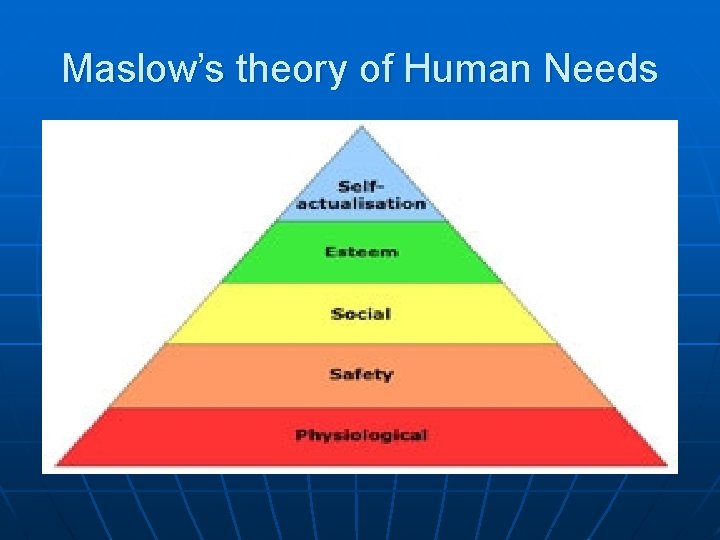
Maslow’s theory of Human Needs n 1. 2. 3. 4. 5. According to him humans have 5 needs Physiological needs Safety needs (law, freedom from fear) Affiliation or acceptance needs (family, friends) Esteem needs (prestige, status) Self-actualisation needs (self-fulfillment, peak experiences)
Maslow’s theory of Human Needs
Douglas Mc. Gregor’s Theory X and Theory Y Theory X: Assumptions 1. Employees are lazy 2. They require constant guidance and support 3. Some times they require even coercion and control 4. Given an opportunity they would like to avoid responsibility 5. They do not show any ambition but always seek security
Theory Y Assumptions: 1. Some employees consider work as natural as play 2. The employees are capable of directing and controlling performance on their own. They are much committed to objectives of the organization. 3. Higher rewards make these employees more committed to organization. 4. Most of them are highly imaginative, creative, and display integrity in handling organizational issues. 5. Given an opportunity , they not only accept responsibility but also look for opportunities to out perform others.
Herzberg’s Two-factors Theory n n Maslow’s theory has been modified by Herzberg and he called in two-factors theory of motivation. In 1959, Frederick Herzberg, a behavioural scientist proposed a two-factor theory or the motivator-hygiene theory. According to Herzberg, there are some job factors that result in satisfaction while there are other job factors that prevent dissatisfaction. According to Herzberg, the opposite of “Satisfaction” is “No satisfaction” and the opposite of “Dissatisfaction” is “No Dissatisfaction”.
Herzberg’s Two-factors Theory n n “Herzberg called these factors as ‘dissatisfiers’ and not motivators, by this he means their presence or existence does not motivate in the sense of yielding satisfaction, but their absence would result in dissatisfaction. These are also referred to as ‘hygiene’ factors. In the second group are the ‘satisfiers’ in the sense that they are motivators, which are related to ‘Job content’. He included the factors of achievement, recognition, challenge work, advancement and growth in the job. He says that their presence will yield feelings of satisfactory or no satisfaction, but not dissatisfaction.
System Approach to Management n Modern approaches to understand management is the systems approach. Here the organization is viewed as a system. Every department is considered as a sub-system, it is also possible that every department can be viewed as a system and every section in the department can be viewed as a sub-system. System approach helps to study the basic feature and functions of the organization in its minutest details.
System Approach to Management n n The collection of interrelated parts called as sub-system which constitutes one whole unit. System approach facilitates the study of each of these parts in detail to have a close understanding of the whole system. Ex: Every part of the study such as the eyes, brain, and heart can also be viewed as a sub-system, a study of each of the parts of the body in necessary to understand the whole body.
Leadership Leader n One who leads a given group or team of people is called leader. If you can influence people to perform better in a given organizational setting, that means you are a leader. n Leadership is ability to influence people to achieve the given goals in an organization. n A true leader is one who shares success with followers and absorbs all failures. n If a manager has to be a mini-leader he has to inspire his subordinates and get work done
Leadership styles n n n Autocratic leadership: Here, leader command the followers and expects compliance from them for all the instructions given, leaders are more dogmatic and positive. They lead by his ability to withhold or give rewards or punishments. Democratic leadership: Here leaders consult subordinates and involve them in decision making. They encourage discussion with the group leaders believes in two-way communication. They listen to followers; try to facilitate the decision making. Free – Rein leadership: Free – Rein leaders exercise little authority and give maximum freedom to subordinates while making decisions. It is a bottom-up approach. Suggestions from the followers are encourage and rewarded. They give high degree of independence subordinates in their operations.
Social Responsibility Social responsibility refers to the process with includes several activities from providing safe products and services to giving a portion of the company’s profits to welfare organizations. n Responsibility towards shareholders n Responsibility towards consumers n Responsibility towards employees n Responsibility towards creditors n Responsibility towards Government n Responsibility towards competitors n Responsibility towards public
Questions