
MANAGEMENT SCIENCE DR HENDY TANNADY ST MM MBA

MANAGEMENT SCIENCE DR. HENDY TANNADY, ST, MM, MBA. DEPARTMENT OF MANAGEMENT FACULTY OF HUMANITIES AND BUSINESS UNIVERSITAS PEMBANGUNAN JAYA JOHN A. LAWRENCE. & BARRY A. PASTERNACK. (2002). APPLIED MANAGEMENT SCIENCE. NY: WILEY.
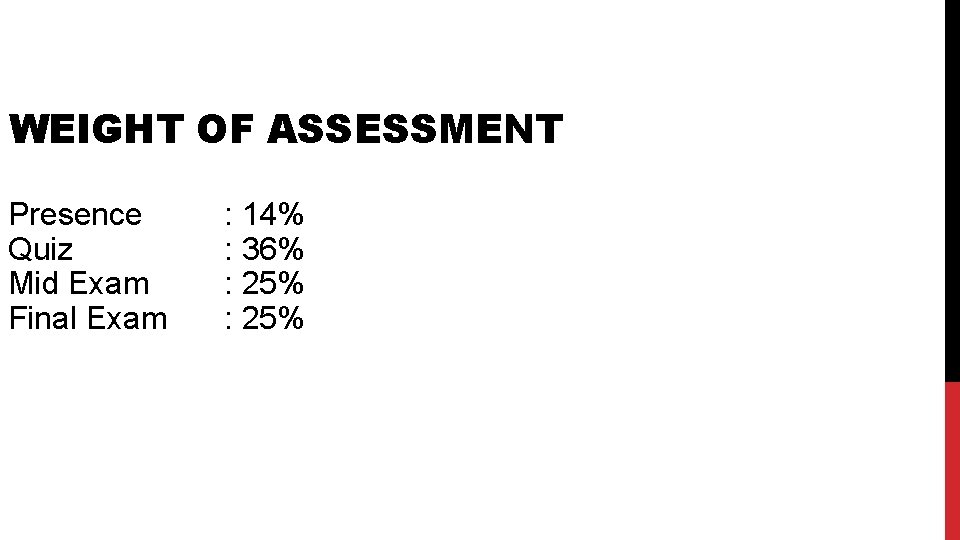
WEIGHT OF ASSESSMENT Presence Quiz Mid Exam Final Exam : 14% : 36% : 25%
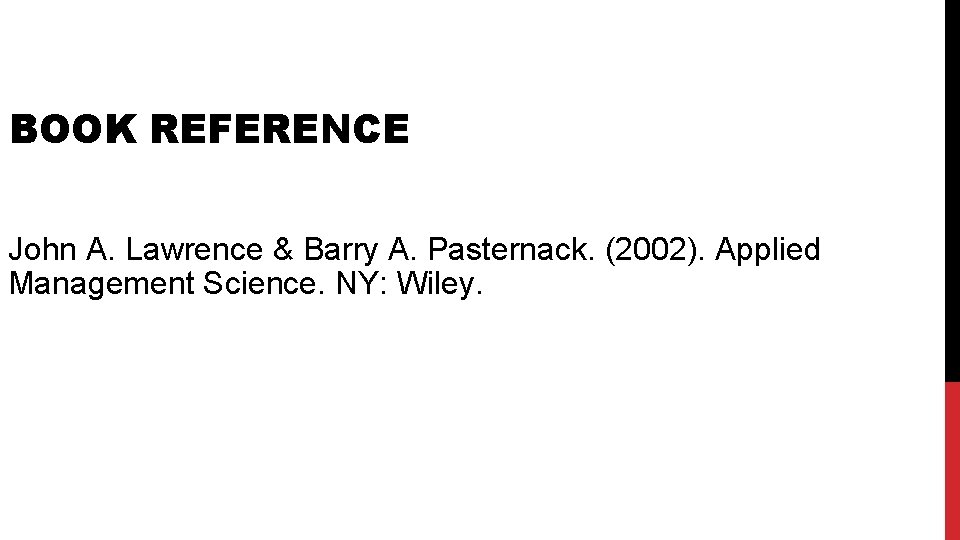
BOOK REFERENCE John A. Lawrence & Barry A. Pasternack. (2002). Applied Management Science. NY: Wiley.
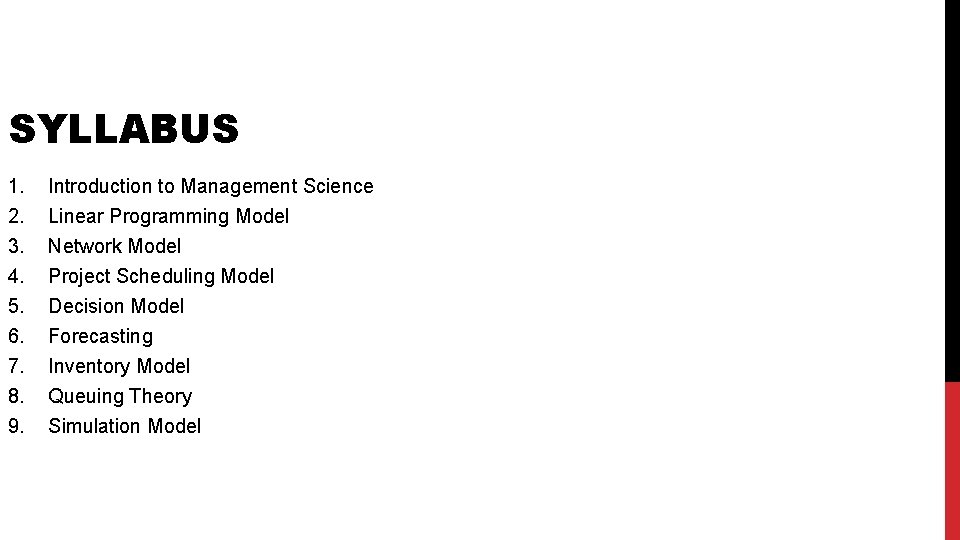
SYLLABUS 1. 2. 3. 4. 5. 6. 7. 8. 9. Introduction to Management Science Linear Programming Model Network Model Project Scheduling Model Decision Model Forecasting Inventory Model Queuing Theory Simulation Model
Introduction to Management Science Models Week 1
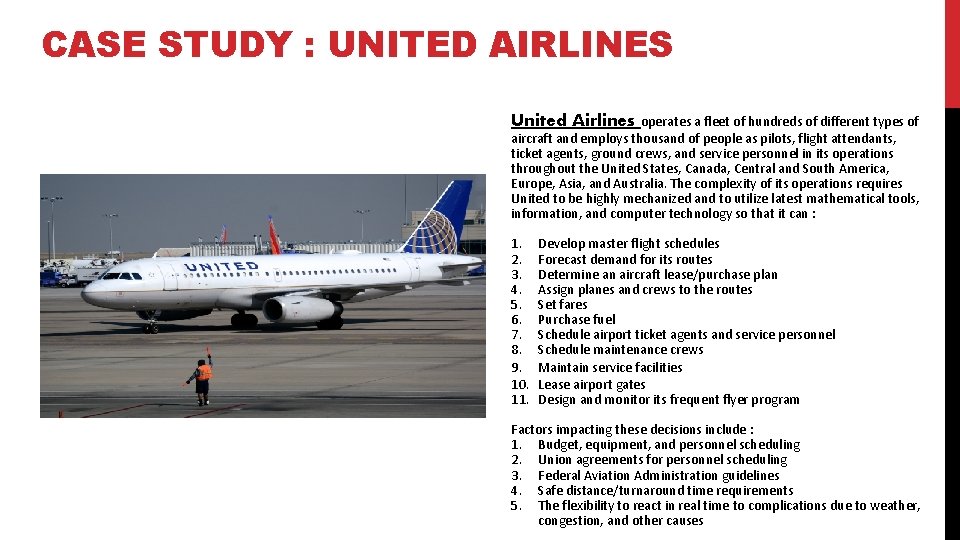
CASE STUDY : UNITED AIRLINES United Airlines operates a fleet of hundreds of different types of aircraft and employs thousand of people as pilots, flight attendants, ticket agents, ground crews, and service personnel in its operations throughout the United States, Canada, Central and South America, Europe, Asia, and Australia. The complexity of its operations requires United to be highly mechanized and to utilize latest mathematical tools, information, and computer technology so that it can : 1. 2. 3. 4. 5. 6. 7. 8. 9. 10. 11. Develop master flight schedules Forecast demand for its routes Determine an aircraft lease/purchase plan Assign planes and crews to the routes Set fares Purchase fuel Schedule airport ticket agents and service personnel Schedule maintenance crews Maintain service facilities Lease airport gates Design and monitor its frequent flyer program Factors impacting these decisions include : 1. Budget, equipment, and personnel scheduling 2. Union agreements for personnel scheduling 3. Federal Aviation Administration guidelines 4. Safe distance/turnaround time requirements 5. The flexibility to react in real time to complications due to weather, congestion, and other causes
1. 1 WHAT IS MANAGEMENT SCIENCE ? MANAGEMENT SCIENCE is the discipline that adapts the scientific approach for problem solving to executive decision making in order to accomplish the goal. It involves : 1. Analyzing and building mathematical models of complex business situations 2. Solving and refining the mathematical models typically using spreadsheets and/or other software programs to gain insight into the business situation 3. Communicating/implementing the resulting insights and recommendations based on these models
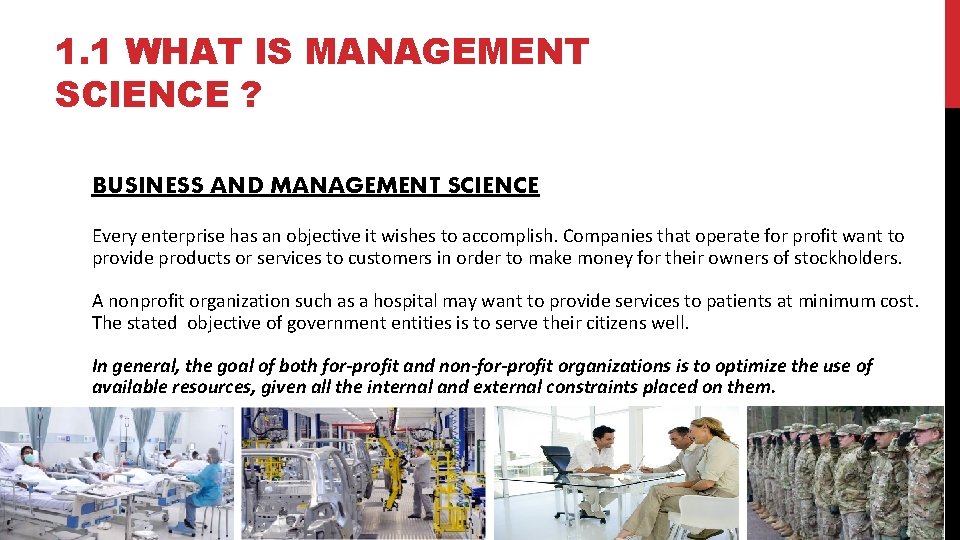
1. 1 WHAT IS MANAGEMENT SCIENCE ? BUSINESS AND MANAGEMENT SCIENCE Every enterprise has an objective it wishes to accomplish. Companies that operate for profit want to provide products or services to customers in order to make money for their owners of stockholders. A nonprofit organization such as a hospital may want to provide services to patients at minimum cost. The stated objective of government entities is to serve their citizens well. In general, the goal of both for-profit and non-for-profit organizations is to optimize the use of available resources, given all the internal and external constraints placed on them.
1. 1 WHAT IS MANAGEMENT SCIENCE ? THE MANAGEMENT SCIENCE APPROACH Modern-day management science grew out of successful applications of the scientific approcach to solving military operational problems during World War II. Hence, it was originally dubbed “operational research”. After the war, as this approach found its way into all areas of the military, government, and industry, the term was shortened to “operations research (OR)”. As managers in business began using operations research approaches to aid in decision making, the term “management science (MS)” was coined. MS/OR involves : The use of techniques such as statistical inference and decision theory, mathematical programming, probabilistic models, network and computer science (to solve complex operational and strategic issues).
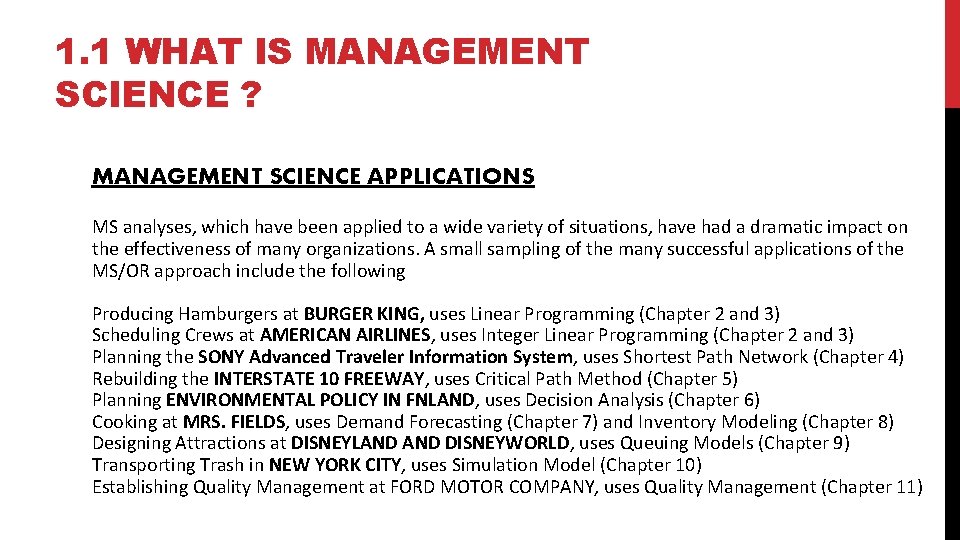
1. 1 WHAT IS MANAGEMENT SCIENCE ? MANAGEMENT SCIENCE APPLICATIONS MS analyses, which have been applied to a wide variety of situations, have had a dramatic impact on the effectiveness of many organizations. A small sampling of the many successful applications of the MS/OR approach include the following Producing Hamburgers at BURGER KING, uses Linear Programming (Chapter 2 and 3) Scheduling Crews at AMERICAN AIRLINES, uses Integer Linear Programming (Chapter 2 and 3) Planning the SONY Advanced Traveler Information System, uses Shortest Path Network (Chapter 4) Rebuilding the INTERSTATE 10 FREEWAY, uses Critical Path Method (Chapter 5) Planning ENVIRONMENTAL POLICY IN FNLAND, uses Decision Analysis (Chapter 6) Cooking at MRS. FIELDS, uses Demand Forecasting (Chapter 7) and Inventory Modeling (Chapter 8) Designing Attractions at DISNEYLAND DISNEYWORLD, uses Queuing Models (Chapter 9) Transporting Trash in NEW YORK CITY, uses Simulation Model (Chapter 10) Establishing Quality Management at FORD MOTOR COMPANY, uses Quality Management (Chapter 11)
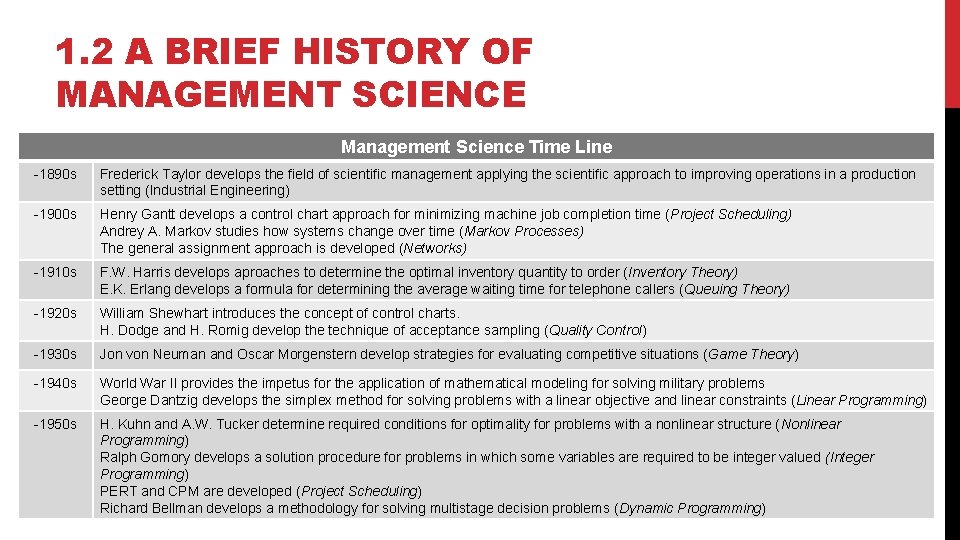
1. 2 A BRIEF HISTORY OF MANAGEMENT SCIENCE Management Science Time Line -1890 s Frederick Taylor develops the field of scientific management applying the scientific approach to improving operations in a production setting (Industrial Engineering) -1900 s Henry Gantt develops a control chart approach for minimizing machine job completion time (Project Scheduling) Andrey A. Markov studies how systems change over time (Markov Processes) The general assignment approach is developed (Networks) -1910 s F. W. Harris develops aproaches to determine the optimal inventory quantity to order (Inventory Theory) E. K. Erlang develops a formula for determining the average waiting time for telephone callers (Queuing Theory) -1920 s William Shewhart introduces the concept of control charts. H. Dodge and H. Romig develop the technique of acceptance sampling (Quality Control) -1930 s Jon von Neuman and Oscar Morgenstern develop strategies for evaluating competitive situations (Game Theory) -1940 s World War II provides the impetus for the application of mathematical modeling for solving military problems George Dantzig develops the simplex method for solving problems with a linear objective and linear constraints (Linear Programming) -1950 s H. Kuhn and A. W. Tucker determine required conditions for optimality for problems with a nonlinear structure (Nonlinear Programming) Ralph Gomory develops a solution procedure for problems in which some variables are required to be integer valued (Integer Programming) PERT and CPM are developed (Project Scheduling) Richard Bellman develops a methodology for solving multistage decision problems (Dynamic Programming)
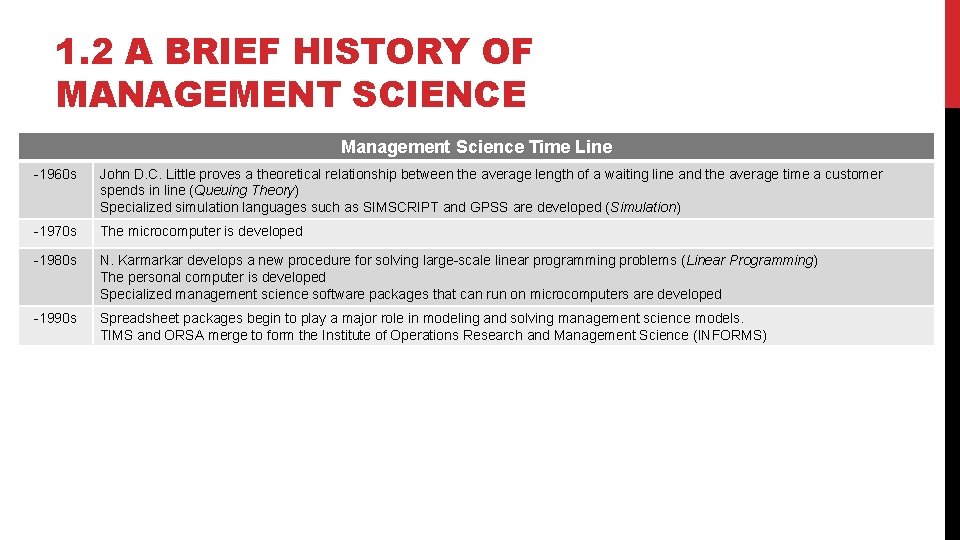
1. 2 A BRIEF HISTORY OF MANAGEMENT SCIENCE Management Science Time Line -1960 s John D. C. Little proves a theoretical relationship between the average length of a waiting line and the average time a customer spends in line (Queuing Theory) Specialized simulation languages such as SIMSCRIPT and GPSS are developed (Simulation) -1970 s The microcomputer is developed -1980 s N. Karmarkar develops a new procedure for solving large-scale linear programming problems (Linear Programming) The personal computer is developed Specialized management science software packages that can run on microcomputers are developed -1990 s Spreadsheet packages begin to play a major role in modeling and solving management science models. TIMS and ORSA merge to form the Institute of Operations Research and Management Science (INFORMS)
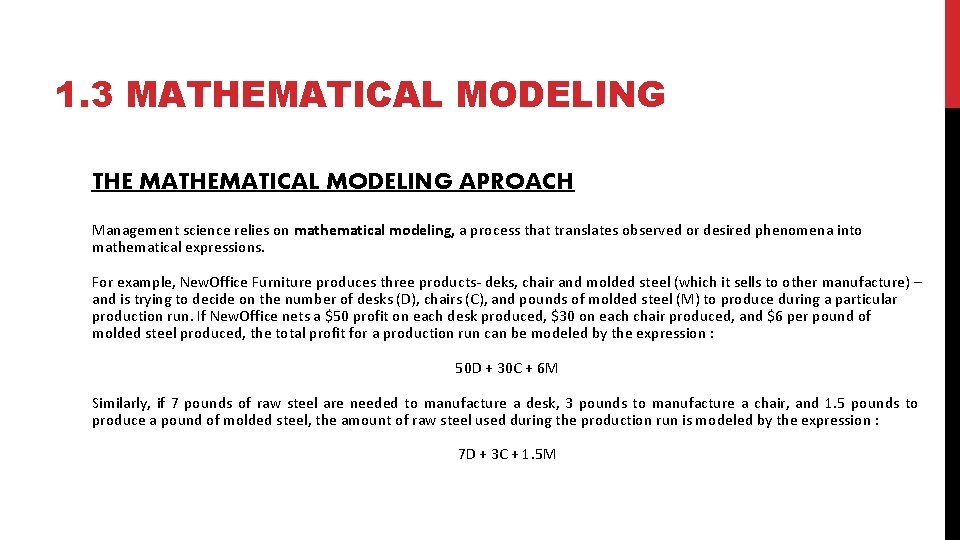
1. 3 MATHEMATICAL MODELING THE MATHEMATICAL MODELING APROACH Management science relies on mathematical modeling, a process that translates observed or desired phenomena into mathematical expressions. For example, New. Office Furniture produces three products- deks, chair and molded steel (which it sells to other manufacture) – and is trying to decide on the number of desks (D), chairs (C), and pounds of molded steel (M) to produce during a particular production run. If New. Office nets a $50 profit on each desk produced, $30 on each chair produced, and $6 per pound of molded steel produced, the total profit for a production run can be modeled by the expression : 50 D + 30 C + 6 M Similarly, if 7 pounds of raw steel are needed to manufacture a desk, 3 pounds to manufacture a chair, and 1. 5 pounds to produce a pound of molded steel, the amount of raw steel used during the production run is modeled by the expression : 7 D + 3 C + 1. 5 M
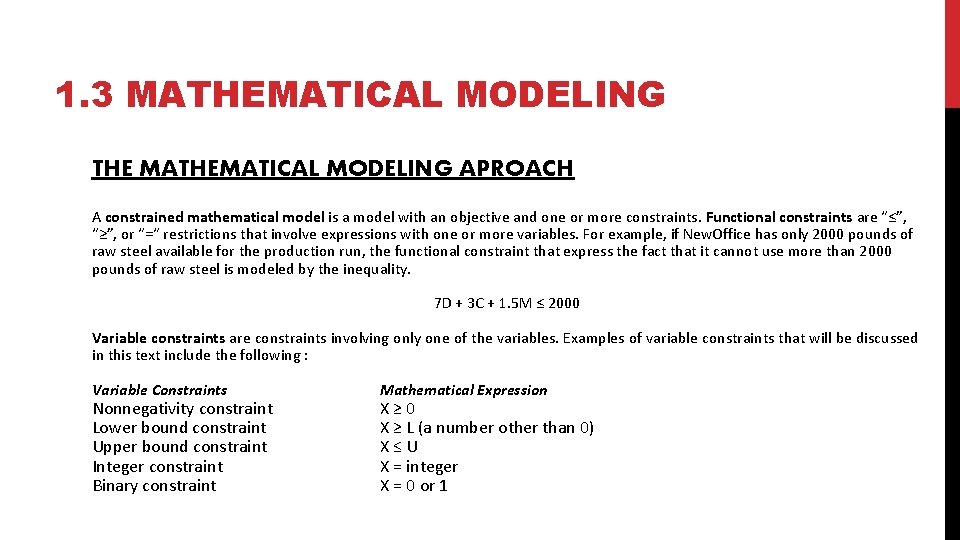
1. 3 MATHEMATICAL MODELING THE MATHEMATICAL MODELING APROACH A constrained mathematical model is a model with an objective and one or more constraints. Functional constraints are “≤”, “≥”, or “=“ restrictions that involve expressions with one or more variables. For example, if New. Office has only 2000 pounds of raw steel available for the production run, the functional constraint that express the fact that it cannot use more than 2000 pounds of raw steel is modeled by the inequality. 7 D + 3 C + 1. 5 M ≤ 2000 Variable constraints are constraints involving only one of the variables. Examples of variable constraints that will be discussed in this text include the following : Variable Constraints Nonnegativity constraint Lower bound constraint Upper bound constraint Integer constraint Binary constraint Mathematical Expression X≥ 0 X ≥ L (a number other than 0) X≤U X = integer X = 0 or 1
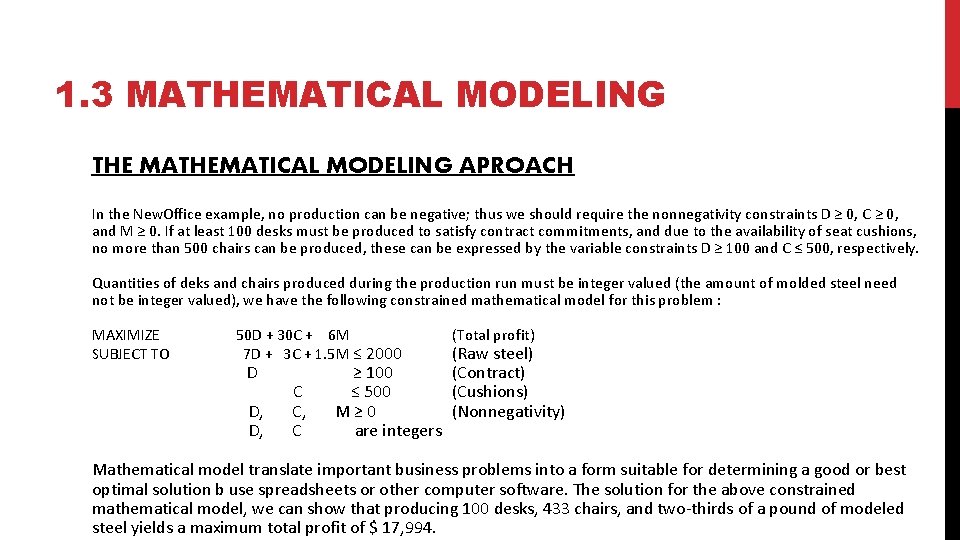
1. 3 MATHEMATICAL MODELING THE MATHEMATICAL MODELING APROACH In the New. Office example, no production can be negative; thus we should require the nonnegativity constraints D ≥ 0, C ≥ 0, and M ≥ 0. If at least 100 desks must be produced to satisfy contract commitments, and due to the availability of seat cushions, no more than 500 chairs can be produced, these can be expressed by the variable constraints D ≥ 100 and C ≤ 500, respectively. Quantities of deks and chairs produced during the production run must be integer valued (the amount of molded steel need not be integer valued), we have the following constrained mathematical model for this problem : MAXIMIZE SUBJECT TO 50 D + 30 C + 6 M 7 D + 3 C + 1. 5 M ≤ 2000 D D, D, C C, C ≥ 100 ≤ 500 M≥ 0 are integers (Total profit) (Raw steel) (Contract) (Cushions) (Nonnegativity) Mathematical model translate important business problems into a form suitable for determining a good or best optimal solution b use spreadsheets or other computer software. The solution for the above constrained mathematical model, we can show that producing 100 desks, 433 chairs, and two-thirds of a pound of modeled steel yields a maximum total profit of $ 17, 994.
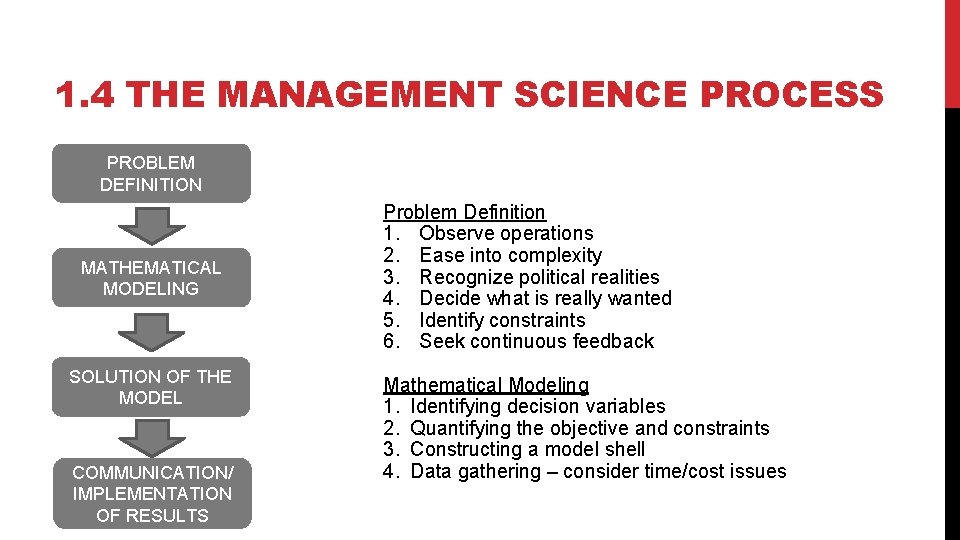
1. 4 THE MANAGEMENT SCIENCE PROCESS PROBLEM DEFINITION MATHEMATICAL MODELING SOLUTION OF THE MODEL COMMUNICATION/ IMPLEMENTATION OF RESULTS Problem Definition 1. Observe operations 2. Ease into complexity 3. Recognize political realities 4. Decide what is really wanted 5. Identify constraints 6. Seek continuous feedback Mathematical Modeling 1. Identifying decision variables 2. Quantifying the objective and constraints 3. Constructing a model shell 4. Data gathering – consider time/cost issues
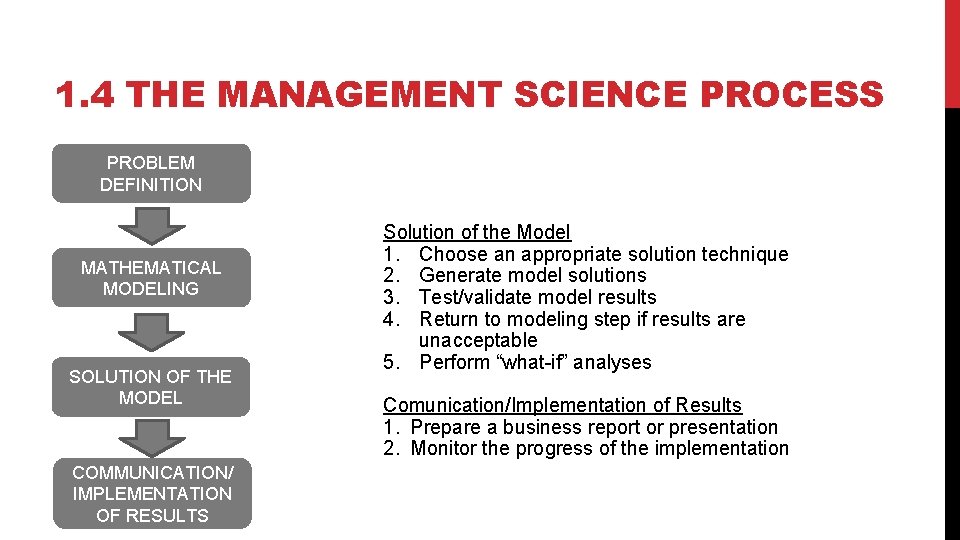
1. 4 THE MANAGEMENT SCIENCE PROCESS PROBLEM DEFINITION MATHEMATICAL MODELING SOLUTION OF THE MODEL COMMUNICATION/ IMPLEMENTATION OF RESULTS Solution of the Model 1. Choose an appropriate solution technique 2. Generate model solutions 3. Test/validate model results 4. Return to modeling step if results are unacceptable 5. Perform “what-if” analyses Comunication/Implementation of Results 1. Prepare a business report or presentation 2. Monitor the progress of the implementation
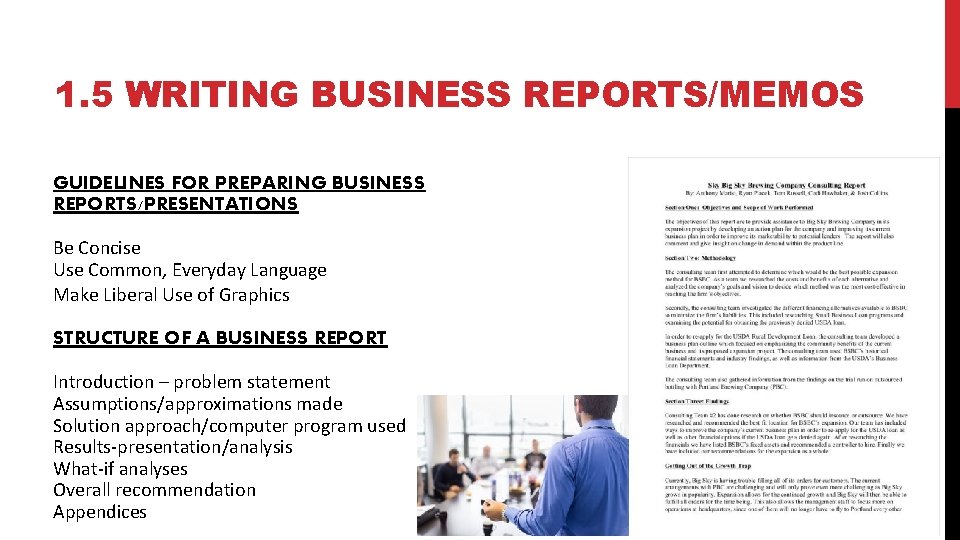
1. 5 WRITING BUSINESS REPORTS/MEMOS GUIDELINES FOR PREPARING BUSINESS REPORTS/PRESENTATIONS Be Concise Use Common, Everyday Language Make Liberal Use of Graphics STRUCTURE OF A BUSINESS REPORT Introduction – problem statement Assumptions/approximations made Solution approach/computer program used Results-presentation/analysis What-if analyses Overall recommendation Appendices
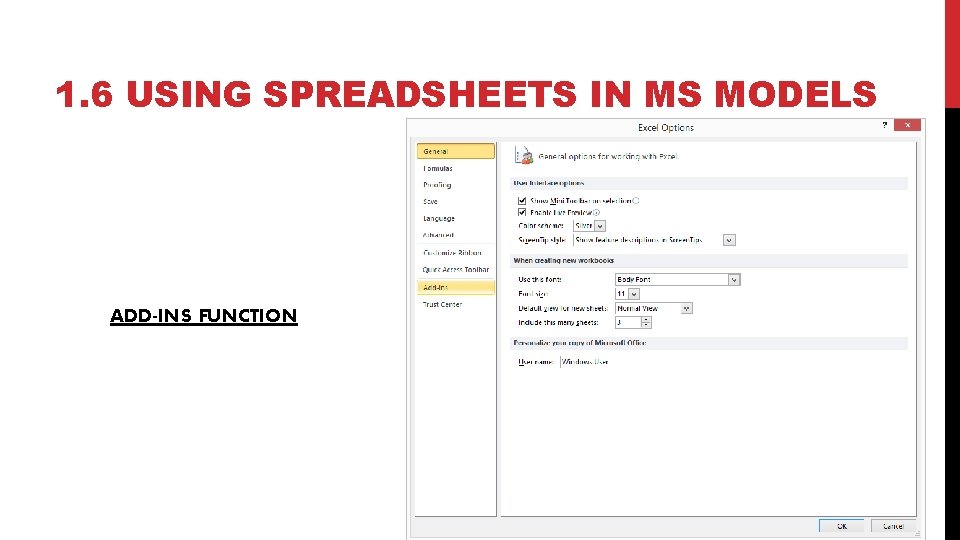
1. 6 USING SPREADSHEETS IN MS MODELS ADD-INS FUNCTION
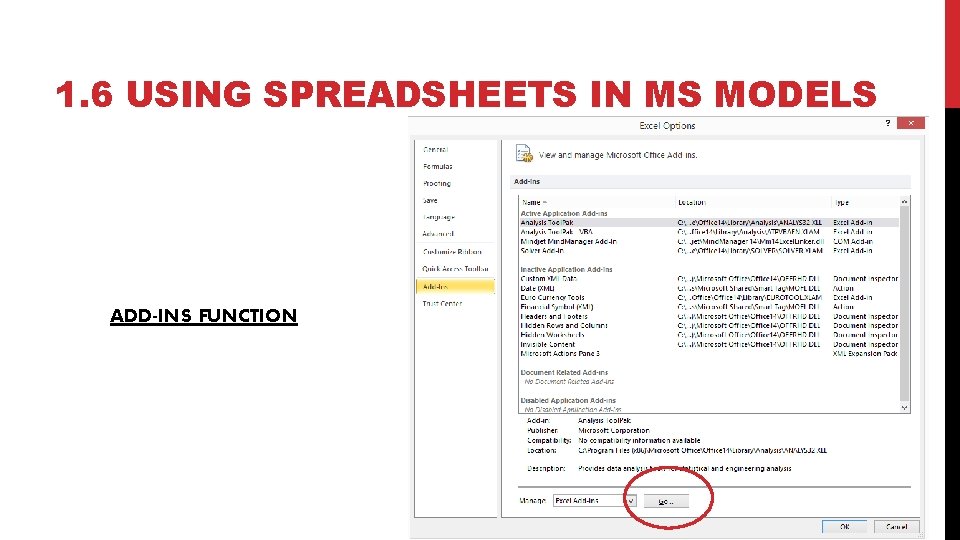
1. 6 USING SPREADSHEETS IN MS MODELS ADD-INS FUNCTION
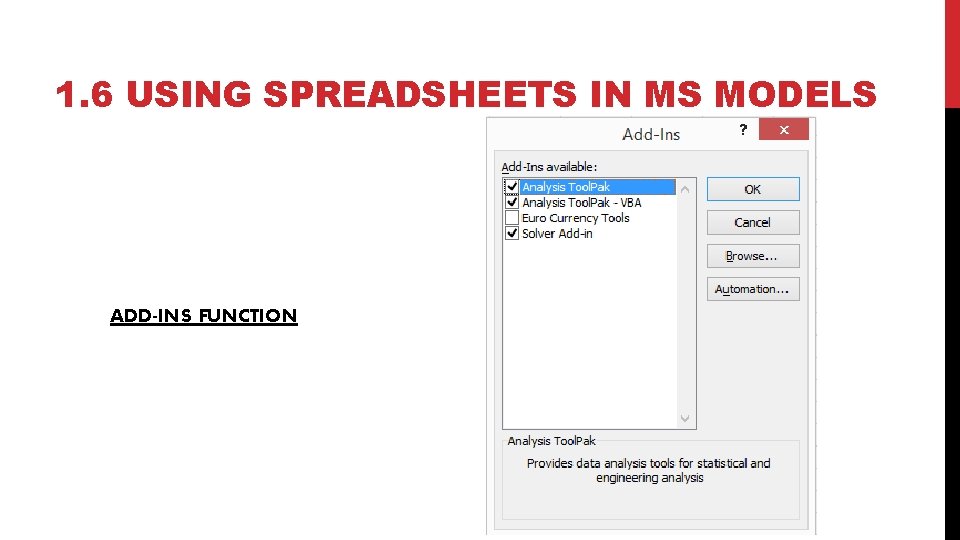
1. 6 USING SPREADSHEETS IN MS MODELS ADD-INS FUNCTION
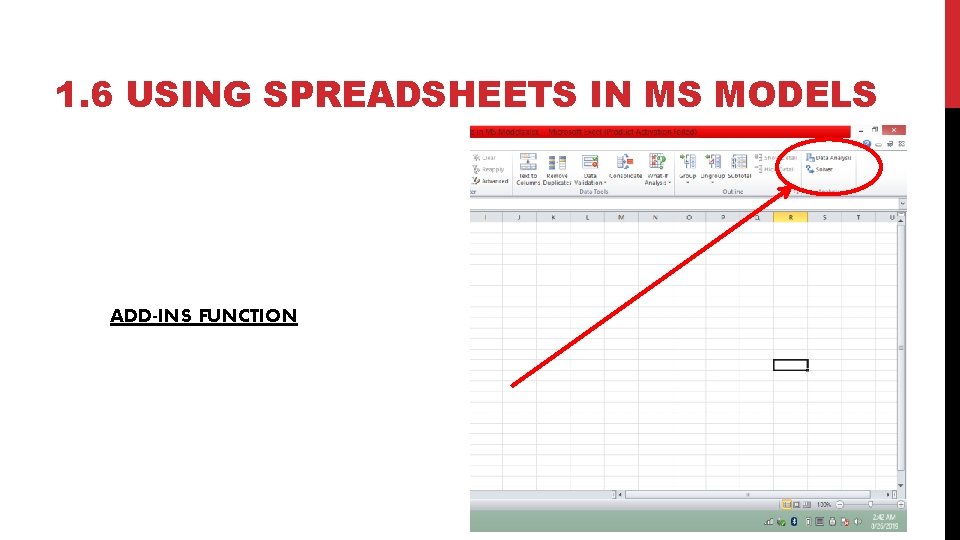
1. 6 USING SPREADSHEETS IN MS MODELS ADD-INS FUNCTION
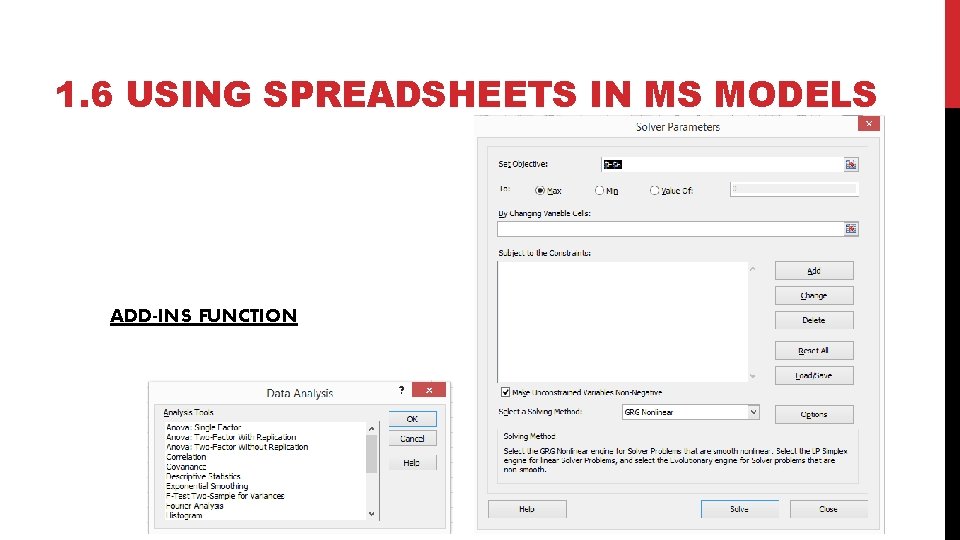
1. 6 USING SPREADSHEETS IN MS MODELS ADD-INS FUNCTION
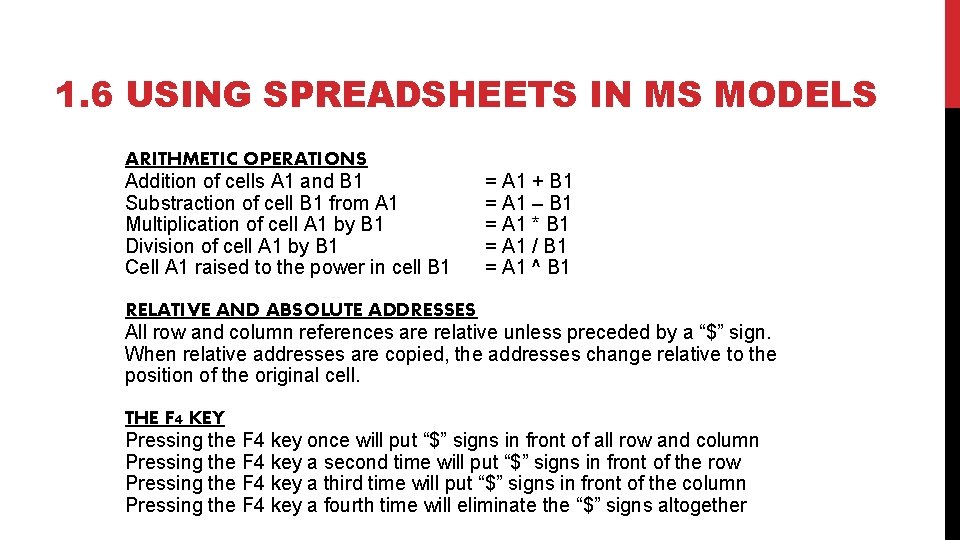
1. 6 USING SPREADSHEETS IN MS MODELS ARITHMETIC OPERATIONS Addition of cells A 1 and B 1 Substraction of cell B 1 from A 1 Multiplication of cell A 1 by B 1 Division of cell A 1 by B 1 Cell A 1 raised to the power in cell B 1 = A 1 + B 1 = A 1 – B 1 = A 1 * B 1 = A 1 / B 1 = A 1 ^ B 1 RELATIVE AND ABSOLUTE ADDRESSES All row and column references are relative unless preceded by a “$” sign. When relative addresses are copied, the addresses change relative to the position of the original cell. THE F 4 KEY Pressing the F 4 key once will put “$” signs in front of all row and column Pressing the F 4 key a second time will put “$” signs in front of the row Pressing the F 4 key a third time will put “$” signs in front of the column Pressing the F 4 key a fourth time will eliminate the “$” signs altogether
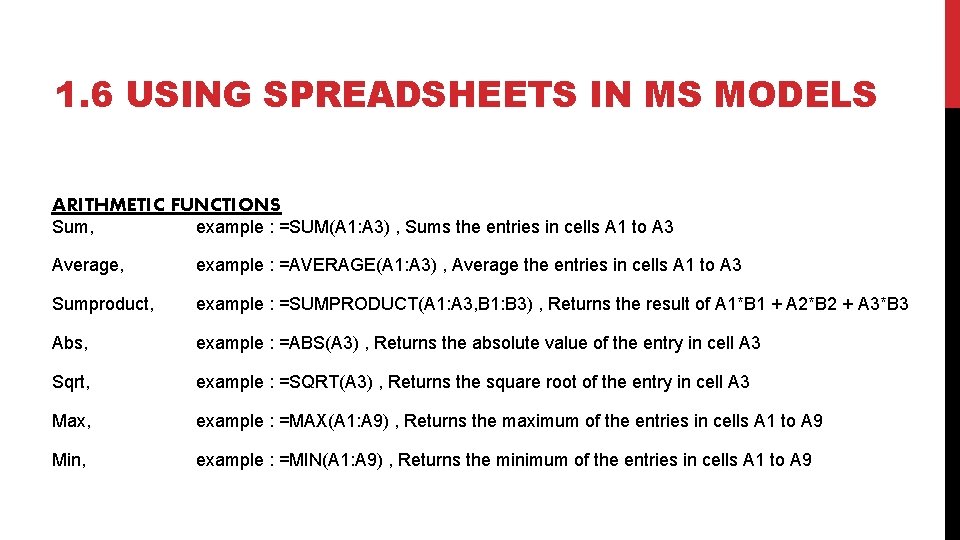
1. 6 USING SPREADSHEETS IN MS MODELS ARITHMETIC FUNCTIONS Sum, example : =SUM(A 1: A 3) , Sums the entries in cells A 1 to A 3 Average, example : =AVERAGE(A 1: A 3) , Average the entries in cells A 1 to A 3 Sumproduct, example : =SUMPRODUCT(A 1: A 3, B 1: B 3) , Returns the result of A 1*B 1 + A 2*B 2 + A 3*B 3 Abs, example : =ABS(A 3) , Returns the absolute value of the entry in cell A 3 Sqrt, example : =SQRT(A 3) , Returns the square root of the entry in cell A 3 Max, example : =MAX(A 1: A 9) , Returns the maximum of the entries in cells A 1 to A 9 Min, example : =MIN(A 1: A 9) , Returns the minimum of the entries in cells A 1 to A 9
1. 6 USING SPREADSHEETS IN MS MODELS CONDITIONAL FUNCTIONS IF, example : =IF(A 4>4, B 1+B 2, B 1 -B 2) Adds cells B 1 and B 2 if cell A 4 > 4 and substracts cell B 2 from B 1 if A 4≤ 4 SUMIF, example : =SUMIF(F 1: F 12, ”>60”, G 1: G 12) Sums the numbers in cells G 1: G 12 only if the corresponding numbers in cells F 1: F 12 are greater than 60
PROBLEMS 1. List of four steps in the management science process and give a brief statement about the important of each step. 2. Ford Motor Company requires thousands of parts to build and assemble cars at its plants. The Villa Park Ford dealership requires parts to service its customers’ Ford products. Both are concerned with finding optimal inventory policies. Ford Motor Company employs a large staff of personnel who use mathematical models to develop optimal inventory policies, whereas Villa Park Ford relies on the input of one service manager, who uses, at best, crude “mathematical models”. Discuss why it is important for Ford Motor Company to employ sophisticated mathematical models to determine its inventory policies (with the associated expense of many high-paying analytical jobs), whereas it would probably not be worthwhile for Villa Park Ford to employ a full-time inventory analysis.
PROBLEMS 3. Flores File Company makes inexpensive, grey two-drawer, three-drawer, and four-drawer filing cabinets. It estimates that it makes a net profit of $4 for each two -drawer model, $6 for each three-drawer model, and $10 for each four-drawer model produced. a. Write a mathematical expression for the objective of maximizing total net profit b. The filing cabinets are made from thick sheet metal. Each two-drawer cabinet requires 40 squares feet of sheet metal; each three-drawer cabinet requires 55 squares feet of sheet metal; and each four-drawer requires 70 square feet. For the current production run, Flores has 25, 000 square feet of sheet metal available. Write a constraint that states the following: “The number of square feet of sheet metal used cannot exceed the amount of sheet metal available”.
- Slides: 28