
Management Roles Functions and Skills Chapter 7 Business
Management Roles, Functions, and Skills Chapter 7 Business in Action 6 e Bovée/Thill
Learning Objectives 1. Explain the importance of management and 2. 3. identify the three vital management roles Describe the planning function and outline the strategic planning process Describe the organizing function and differentiate among top, middle, and first-line management Copyright © 2013 Pearson Education, Inc. publishing as Prentice Hall 7 -2
Learning Objectives (cont. ) 4. Describe the leading function, leadership style, and organizational culture 5. Describe the controlling function and explain the four steps in the control cycle 6. Identify and explain four important types of managerial skills Copyright © 2013 Pearson Education, Inc. publishing as Prentice Hall 7 -3
Management ª Management 9 The process of planning, organizing, leading, and controlling to meet organizational goals Copyright © 2013 Pearson Education, Inc. publishing as Prentice Hall 7 -4
The Roles of Management ª Managerial Roles 9 Behavioral patterns and activities involved in carrying out the functions of management; includes interpersonal, informational, and decision making roles Copyright © 2013 Pearson Education, Inc. publishing as Prentice Hall 7 -5
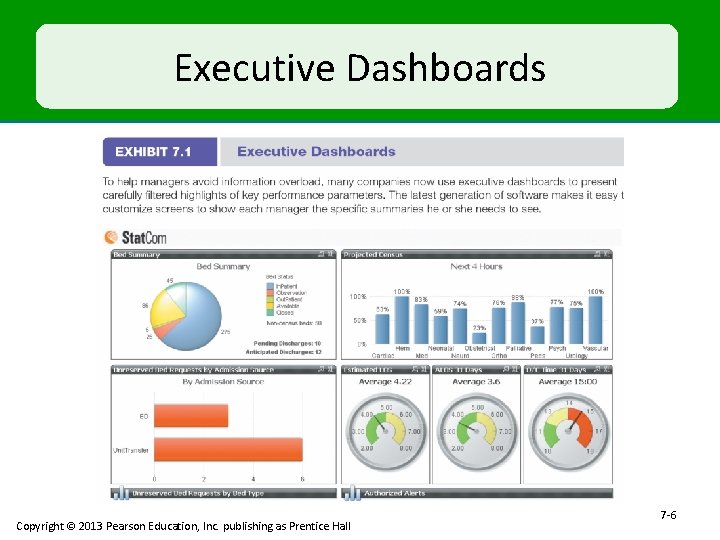
Executive Dashboards Copyright © 2013 Pearson Education, Inc. publishing as Prentice Hall 7 -6
The Planning Function ª Planning 9 Establishing objectives and goals for an organization and determining the best ways to accomplish them Copyright © 2013 Pearson Education, Inc. publishing as Prentice Hall 7 -7
The Planning Function ª Strategic plans 9 Plans that establish the actions and the resource allocation required to accomplish strategic goals 9 Usually defined for periods of two to five years and developed by top managers Copyright © 2013 Pearson Education, Inc. publishing as Prentice Hall 7 -8
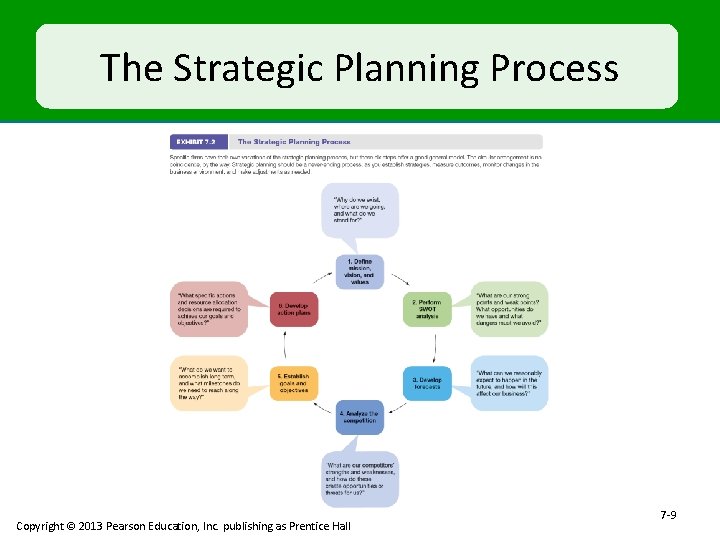
The Strategic Planning Process Copyright © 2013 Pearson Education, Inc. publishing as Prentice Hall 7 -9
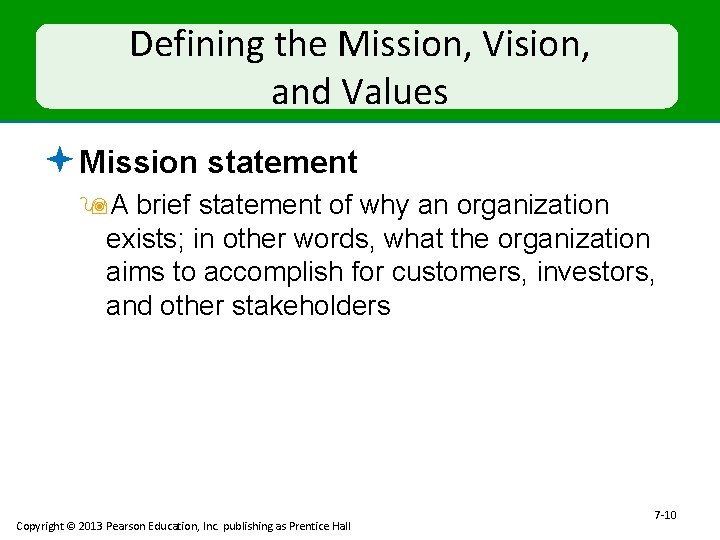
Defining the Mission, Vision, and Values ª Mission statement 9 A brief statement of why an organization exists; in other words, what the organization aims to accomplish for customers, investors, and other stakeholders Copyright © 2013 Pearson Education, Inc. publishing as Prentice Hall 7 -10
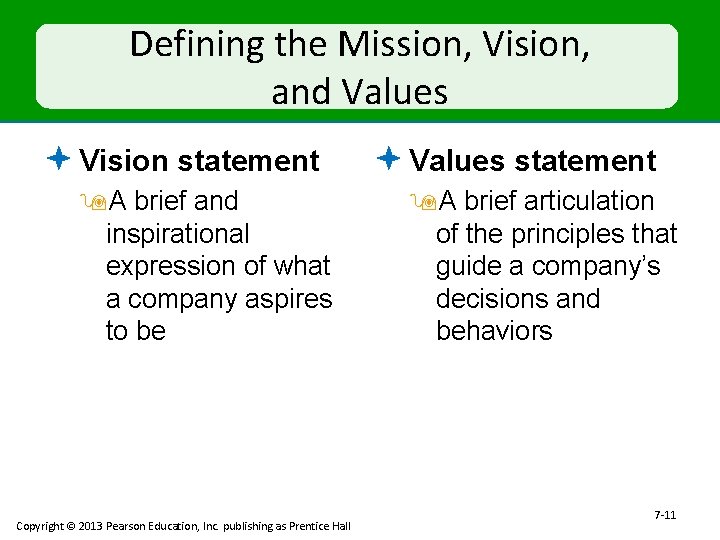
Defining the Mission, Vision, and Values ª Vision statement 9 A brief and inspirational expression of what a company aspires to be Copyright © 2013 Pearson Education, Inc. publishing as Prentice Hall ª Values statement 9 A brief articulation of the principles that guide a company’s decisions and behaviors 7 -11
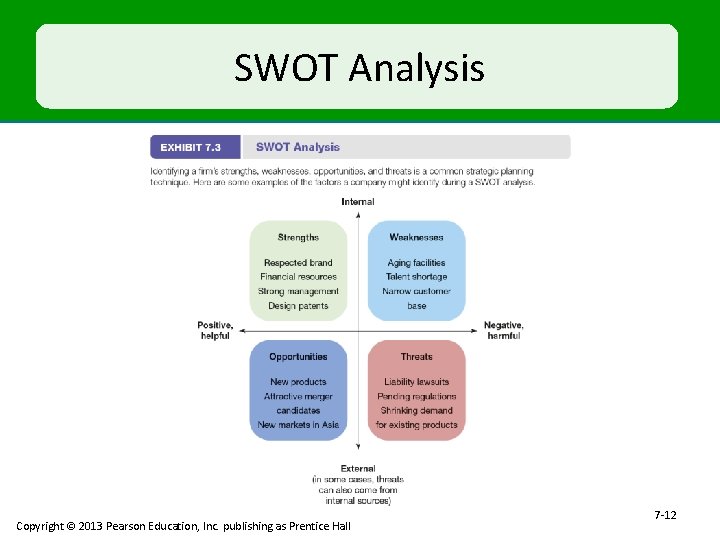
SWOT Analysis Copyright © 2013 Pearson Education, Inc. publishing as Prentice Hall 7 -12
Developing Forecasts ª Quantitative Forecasts 9 typically based on historical data or tests and often involve complex statistical computations ª Qualitative Forecasts 9 based on intuitive judgments Copyright © 2013 Pearson Education, Inc. publishing as Prentice Hall 7 -13
Establishing Goals and Objectives ª Goal 9 A broad, long-range target or aim Copyright © 2013 Pearson Education, Inc. publishing as Prentice Hall ª Objective 9 A specific, shortrange target or aim 7 -14
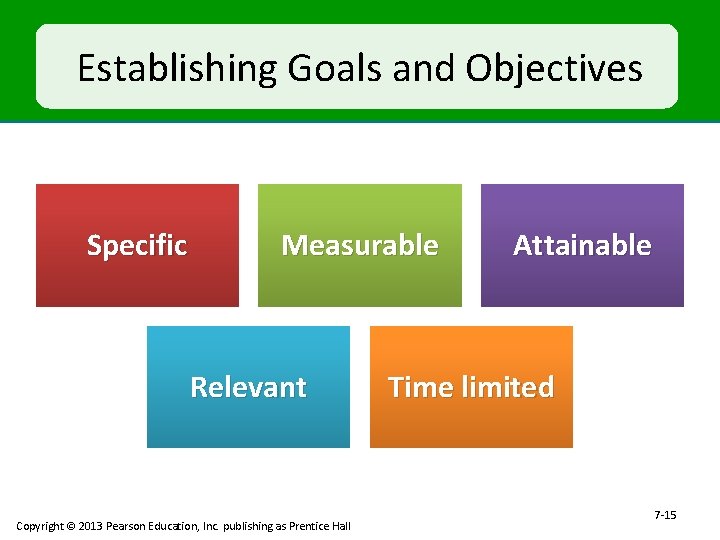
Establishing Goals and Objectives Specific Measurable Relevant Copyright © 2013 Pearson Education, Inc. publishing as Prentice Hall Attainable Time limited 7 -15
The Organizing Function ª Organizing 9 The process of arranging resources to carry out the organization’s plans ª Management Pyramid 9 An organizational structure divided into top, middle, and first-line management Copyright © 2013 Pearson Education, Inc. publishing as Prentice Hall 7 -16
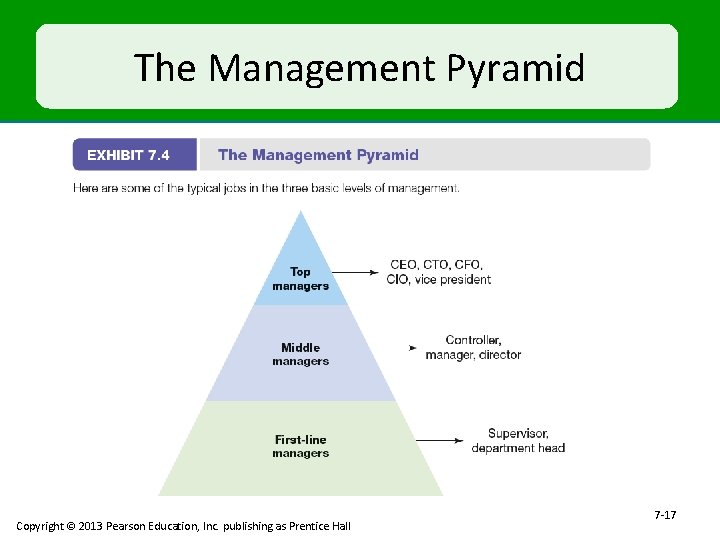
The Management Pyramid Copyright © 2013 Pearson Education, Inc. publishing as Prentice Hall 7 -17
The Management Pyramid ª Top Managers 9 Those at the highest level of the organization’s management hierarchy 9 Responsible for setting strategic goals, and they have the most power and responsibility in the organization Copyright © 2013 Pearson Education, Inc. publishing as Prentice Hall 7 -18
The Management Pyramid (cont. ) ª Middle Managers 9 Those in the middle of the management hierarchy 9 they develop plans to implement the goals of top managers and coordinate the work of firstline managers Copyright © 2013 Pearson Education, Inc. publishing as Prentice Hall 7 -19
The Management Pyramid (cont. ) ª First-line Managers 9 Those at the lowest level of the management hierarchy 9 They supervise the operating employees and implement the plans set at the higher management levels Copyright © 2013 Pearson Education, Inc. publishing as Prentice Hall 7 -20
The Leading Function ª Leading 9 The process of guiding and motivating people to work toward organizational goals Copyright © 2013 Pearson Education, Inc. publishing as Prentice Hall 7 -21
The Leading Function (cont. ) ª Cognitive Intelligence 9 involves reasoning, problem solving, memorization, and other rational skills ª Emotional Intelligence 9 measure of a person’s awareness of and ability to manage his or her own emotions Copyright © 2013 Pearson Education, Inc. publishing as Prentice Hall 7 -22
The Leading Function ª Social intelligence 9 involves looking outward to understand the dynamics of social situations and the emotions of other people, in addition to your own Copyright © 2013 Pearson Education, Inc. publishing as Prentice Hall 7 -23
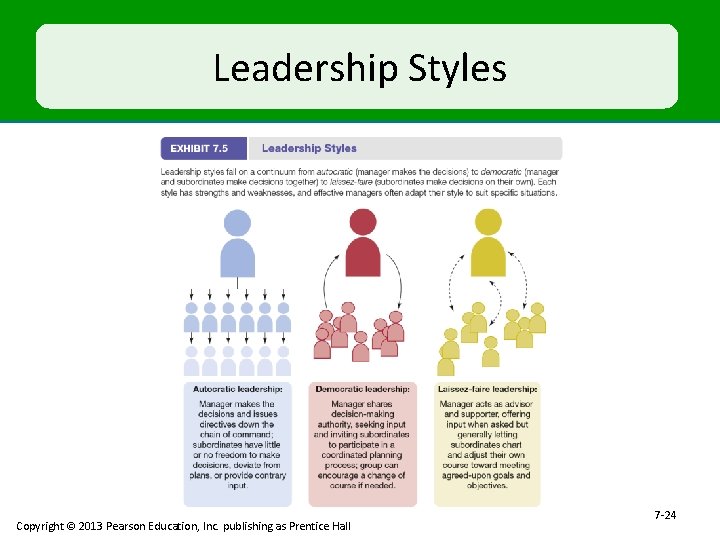
Leadership Styles Copyright © 2013 Pearson Education, Inc. publishing as Prentice Hall 7 -24
Leadership Styles ª Participative Management 9 A philosophy of allowing employees to take part in planning and decision making ª Employee Empowerment 9 Granting decision-making and problemsolving authorities to employees so they can act without getting approval from management Copyright © 2013 Pearson Education, Inc. publishing as Prentice Hall 7 -25
Coaching and Mentoring ª Coaching 9 Helping employees reach their highest potential by meeting with them, discussing problems that hinder their ability to work effectively, and offering suggestions and encouragement to overcome these problems Copyright © 2013 Pearson Education, Inc. publishing as Prentice Hall 7 -26
Coaching and Mentoring ª Mentoring 9 A process in which experienced managers guide less-experienced colleagues in the nuances of office politics, serving as a role model for appropriate business behavior, and helping to negotiate the corporate structure Copyright © 2013 Pearson Education, Inc. publishing as Prentice Hall 7 -27
Managing Change 1. Identify everything that needs to change 2. Identify the forces acting for and against a change 3. Choose the approach best suited to the situation 4. Reinforce changed behavior and monitor continued progress Copyright © 2013 Pearson Education, Inc. publishing as Prentice Hall 7 -28
Building a Positive Organizational Culture ª Organizational Culture 9 A set of shared values and norms that support the management system and that guide management and employee behavior Copyright © 2013 Pearson Education, Inc. publishing as Prentice Hall 7 -29
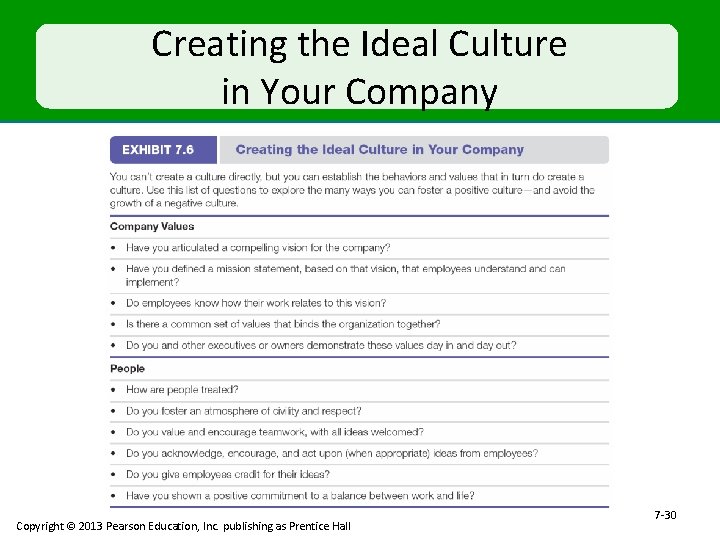
Creating the Ideal Culture in Your Company Copyright © 2013 Pearson Education, Inc. publishing as Prentice Hall 7 -30
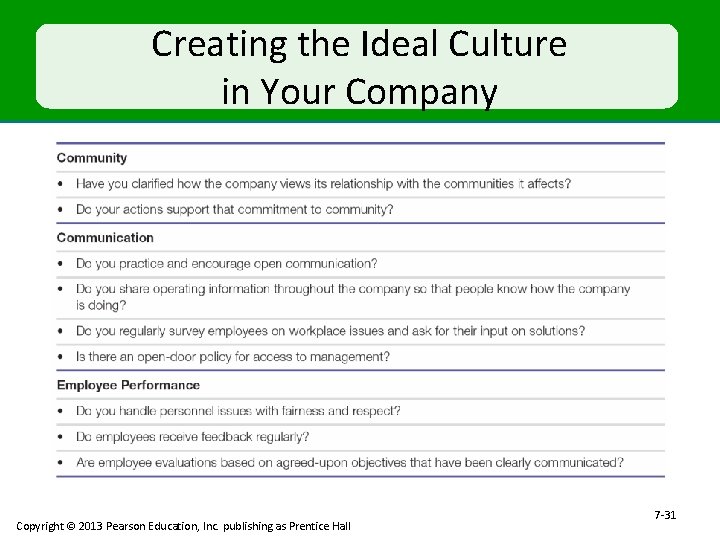
Creating the Ideal Culture in Your Company Copyright © 2013 Pearson Education, Inc. publishing as Prentice Hall 7 -31
The Controlling Function ª Controlling 9 The process of measuring progress against goals and objectives and correcting deviations if results are not as expected Copyright © 2013 Pearson Education, Inc. publishing as Prentice Hall 7 -32
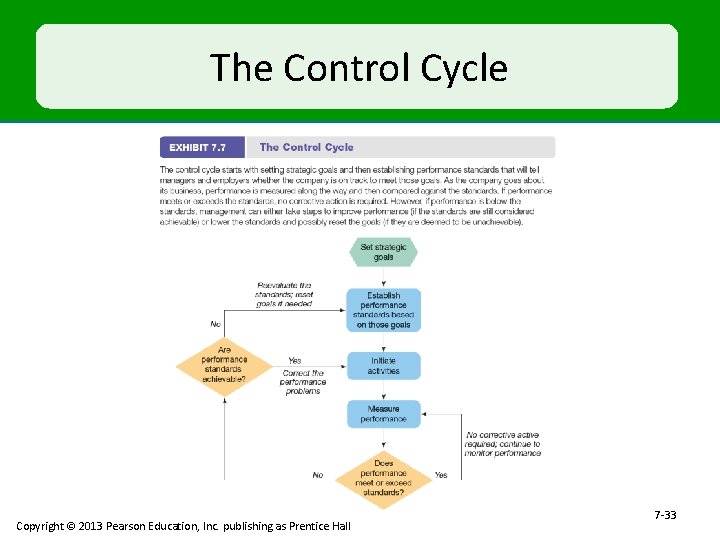
The Control Cycle Copyright © 2013 Pearson Education, Inc. publishing as Prentice Hall 7 -33
Establishing Performance Standards ª Standards 9 Criteria against which performance is measured ª Benchmarking 9 Collecting and comparing process and performance data from other companies Copyright © 2013 Pearson Education, Inc. publishing as Prentice Hall 7 -34
Essential Management Skills ª Interpersonal Skills 9 Skills required to understand other people and to interact effectively with them Copyright © 2013 Pearson Education, Inc. publishing as Prentice Hall ª Technical Skills 9 The ability and knowledge to perform the mechanics of a particular job 7 -35
Essential Management Skills ª Administrative Skills 9 Technical skills in information gathering, data analysis, planning, organizing, and other aspects of managerial work Copyright © 2013 Pearson Education, Inc. publishing as Prentice Hall ª Conceptual Skills 9 The ability to understand the relationship of parts to the whole 7 -36
Essential Management Skills ª Decision-Making Skills 9 The ability to identify a decision situation, analyze the problem, weigh the alternatives, choose an alternative, implement it, and to evaluate the results Copyright © 2013 Pearson Education, Inc. publishing as Prentice Hall 7 -37
Applying What You’ve Learned 1. Explain the importance of management and 2. 3. identify the three vital management roles Describe the planning function and outline the strategic planning process Describe the organizing function and differentiate among top, middle, and first-line management Copyright © 2013 Pearson Education, Inc. publishing as Prentice Hall 7 -38
Applying What You’ve Learned (cont. ) 4. Describe the leading function, leadership style, and organizational culture 5. Describe the controlling function and explain the four steps in the control cycle 6. Identify and explain four important types of managerial skills Copyright © 2013 Pearson Education, Inc. publishing as Prentice Hall 7 -39
Copyright © 2013 Pearson Education, Inc. publishing as Prentice Hall 7 -40 40
- Slides: 40