
Management Roles and Responsibilities OTA 240 Leadership Defined
Management Roles and Responsibilities OTA 240

Leadership Defined- intentionally influencing the beliefs and actions of willing followers Encouraging others to purposefully accomplish an outcome to achieve fullest potential Individual Department Profession community

Leadership in Health Care Transactional leadership Transformational leadership Measurement of success of leadership can be both subjective or objective Effective leadership may vary across departments, organization Therefore important to understand type of leadership theories, but the skills of successful leader

Leadership Styles Visionary Coaching Affiliative Democratic Pacesetting Commanding
Characteristics of Leaders Future oriented, innovative, and view change as opportunity Impeccable ethics and integrity Clear sense of values, strengths, and weaknesses Aware of and sensitive to needs of people and organization Models self-awareness Acknowledge and learn from mistakes
Leader’s Role and Responsibilities Establish Direction Create a vision Clarify big picture Set strategies Aligning People Communicate goals Seek commitment Build teams and coalitions
Leader’s Role (Cont. ) Motivating and Inspiring Inspire and energize Empower subordinates Satisfy unmet needs
Management Defined- the formally recognized leadership of an organization, allocation of responsibilities and provision of resources to others so they can do the work that leads to fulfilling organizational objectives. Produce order and consistency
Management Styles Participative Bureaucratic Autocratic Laissez-Faire
Manager’s Roles and Responsibilities Planning and Budgeting Establishing agendas Set time tables Allocate resources Organizing/Staffing Provide structure Make job placements Establish rules and procedures
Manager’s Role (cont. ) Controlling/Problem Solving Develop incentives Generate creative solutions Take corrective action
OTA’s Role in Management Depends on information found in: Illinois Practice Act Illinois Rules and Regulations Facility Policy Third Party Payer policies/practices Level of experience
Typical Management Domains Change and the history of OT Credentialing issues, ethics, and legalities Reimbursement and finance Staffing requirements and constraints Supervision and professional development Communication Continuous Quality Improvement Research Entrepreneurship
Change Management Why do we look at change? What does change mean to us and how do we deal with it?
The Evolving Healthcare Arena EMR ACA Emerging niche areas- telehealth Cultural diversity Organizational shifts in responsibility, productivity, and accountability
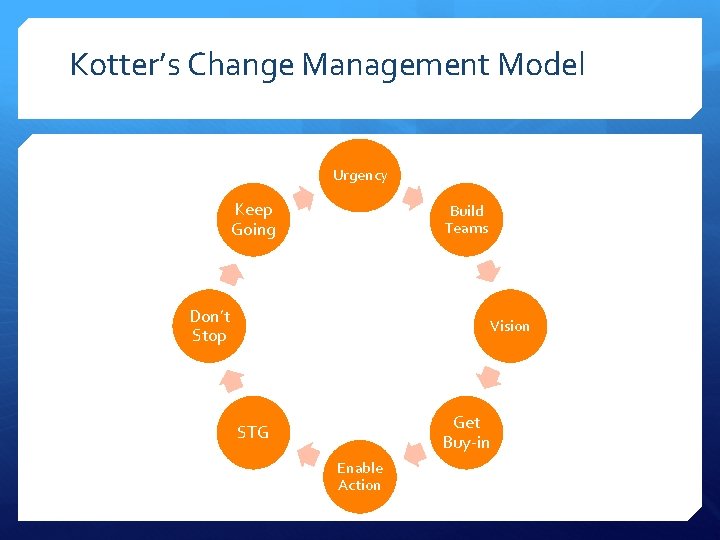
Kotter’s Change Management Model Urgency Keep Going Build Teams Don’t Stop Vision Get Buy-in STG Enable Action
Change as a Loss Change within an organization can trigger a variety of emotions: Denial Anger Bargaining Depression Acceptance
Why Does it Matter? How does the way we react to change effect: Our performance? Our interaction with patients? How we represent ourselves? Our institution? Our profession?
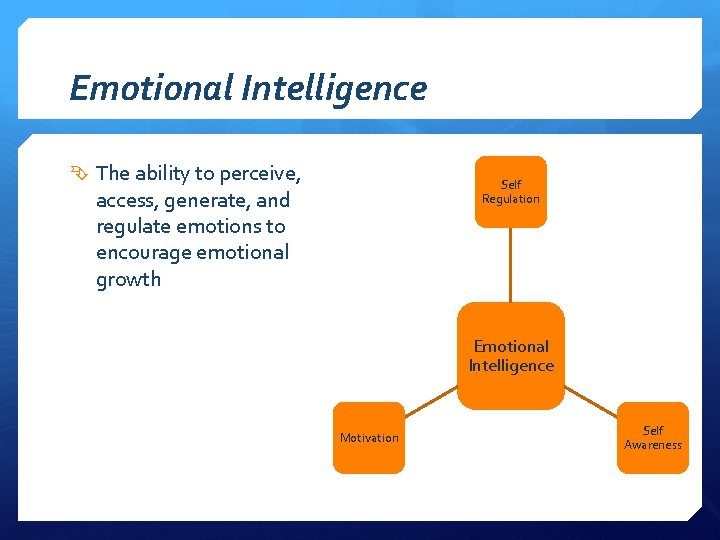
Emotional Intelligence The ability to perceive, Self Regulation access, generate, and regulate emotions to encourage emotional growth Emotional Intelligence Motivation Self Awareness
What are the relationships in which an OT practitioner can be a leader? Relationship between OTA practitioner and self Relationship between OTA practitioner and client Relationship between OTA practitioner and interdisciplinary team Relationship between practitioner and community
Advocacy and OT Advocacy-process of supporting a cause, idea, policy, or activity that can directly impact a person’s or group’s wellbeing. How can we advocate for the OT profession? See table 2 -4 page 29 in your books
References Campbell, R. J. (2008). Change management in health care. The Health Care Manager, (27) 1, 23 -29. Guerin, S. (2013). Managing rapid change in the healthcare environment. Managed Care, 2, 1 -3. Northouse, P. G. (2004). Leadership theory and practice, 3 rd ed. Thousand Oaks, CA: Sage Publications, Inc. Nosse, L. J. & Friberg. D. G. (2010). Managerial and supervisory principles for physical therapists, 3 rd ed. Baltimore, MD: Lippincott, Williams, & Wilkins. Jacobs, K. (2015). Management and administration skills for the ota. Thorofare, NJ: SLACK, Inc.
- Slides: 22