
MANAGEMENT PRINCIPLES FOR HEALTH CARE SERVICES Sesi 9
















- Slides: 43
MANAGEMENT PRINCIPLES FOR HEALTH CARE SERVICES Sesi 9
LEARNING OBJECTIVES u. Memahami organisasi pelayanan kesehatan sebagai suatu sistem dan para manajer di dalamnya u. Memahami aspek manusia dalam melakukan perencanaan, pengorganisasian, pelaksanaan dan pengendalian upaya kesehatan; u. Memahami berbagai isu dalam pelaksanaan program. u. Memahami kebutuhan strategis agar lembaga pelayanan dapat hidup dan berkembang.
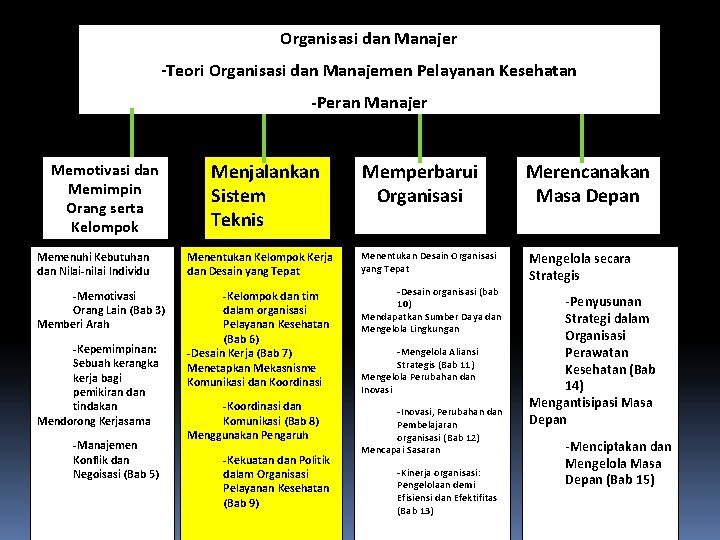
Organisasi dan Manajer -Teori Organisasi dan Manajemen Pelayanan Kesehatan -Peran Manajer Memotivasi dan Memimpin Orang serta Kelompok Menjalankan Sistem Teknis Memperbarui Organisasi Memenuhi Kebutuhan dan Nilai-nilai Individu Menentukan Kelompok Kerja dan Desain yang Tepat Menentukan Desain Organisasi yang Tepat -Memotivasi Orang Lain (Bab 3) Memberi Arah -Kelompok dan tim dalam organisasi Pelayanan Kesehatan (Bab 6) -Desain Kerja (Bab 7) Menetapkan Mekasnisme Komunikasi dan Koordinasi -Desain organisasi (bab 10) Mendapatkan Sumber Daya dan Mengelola Lingkungan -Kepemimpinan: Sebuah kerangka kerja bagi pemikiran dan tindakan Mendorong Kerjasama -Manajemen Konflik dan Negoisasi (Bab 5) -Koordinasi dan Komunikasi (Bab 8) Menggunakan Pengaruh -Kekuatan dan Politik dalam Organisasi Pelayanan Kesehatan (Bab 9) -Mengelola Aliansi Strategis (Bab 11) Mengelola Perubahan dan Inovasi -Inovasi, Perubahan dan Pembelajaran organisasi (Bab 12) Mencapai Sasaran -Kinerja organisasi: Pengelolaan demi Efisiensi dan Efektifitas (Bab 13) Merencanakan Masa Depan Mengelola secara Strategis -Penyusunan Strategi dalam Organisasi Perawatan Kesehatan (Bab 14) Mengantisipasi Masa Depan -Menciptakan dan Mengelola Masa Depan (Bab 15)
Organisasi dan Manajer -Teori Organisasi dan Manajemen Pelayanan Kesehatan -Peran Manajer Memotivasi dan Memimpin Orang serta Kelompok Menjalankan Sistem Teknis Memperbarui Organisasi Memenuhi Kebutuhan dan Nilai-nilai Individu Menentukan Kelompok Kerja dan Desain yang Tepat Menentukan Desain Organisasi yang Tepat -Memotivasi Orang Lain (Bab 3) Memberi Arah -Kelompok dan tim dalam organisasi Pelayanan Kesehatan (Bab 6) -Desain Kerja (Bab 7) Menetapkan Mekasnisme Komunikasi dan Koordinasi -Desain organisasi (bab 10) Mendapatkan Sumber Daya dan Mengelola Lingkungan -Kepemimpinan: Sebuah kerangka kerja bagi pemikiran dan tindakan Mendorong Kerjasama -Manajemen Konflik dan Negoisasi (Bab 5) -Koordinasi dan Komunikasi (Bab 8) Menggunakan Pengaruh -Kekuatan dan Politik dalam Organisasi Pelayanan Kesehatan (Bab 9) -Mengelola Aliansi Strategis (Bab 11) Mengelola Perubahan dan Inovasi -Inovasi, Perubahan dan Pembelajaran organisasi (Bab 12) Mencapai Sasaran -Kinerja organisasi: Pengelolaan demi Efisiensi dan Efektifitas (Bab 13) Merencanakan Masa Depan Mengelola secara Strategis -Penyusunan Strategi dalam Organisasi Perawatan Kesehatan (Bab 14) Mengantisipasi Masa Depan -Menciptakan dan Mengelola Masa Depan (Bab 15)
Managing Groups and Teams
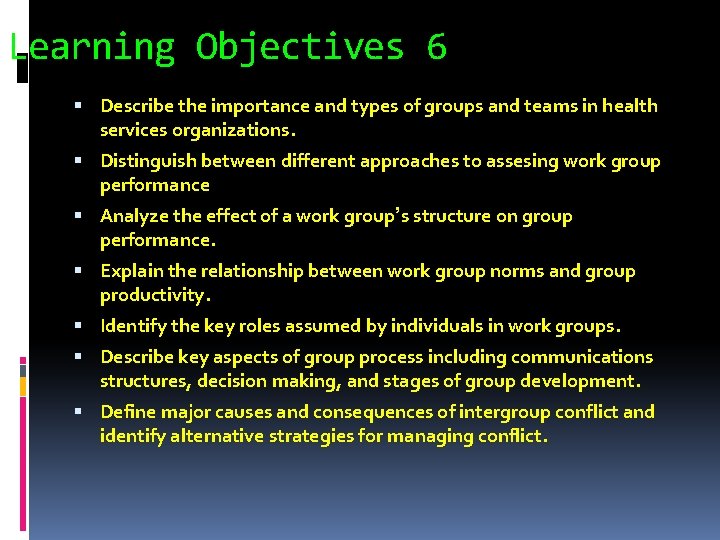
Learning Objectives 6 Describe the importance and types of groups and teams in health services organizations. Distinguish between different approaches to assesing work group performance Analyze the effect of a work group’s structure on group performance. Explain the relationship between work group norms and group productivity. Identify the key roles assumed by individuals in work groups. Describe key aspects of group process including communications structures, decision making, and stages of group development. Define major causes and consequences of intergroup conflict and identify alternative strategies for managing conflict.
Types of groups and teams in organizations Reference Groups Friendship Groups Interest Groups Work Groups Management teams Temporary Groups or task forces Intermittent Groups Standing Committees
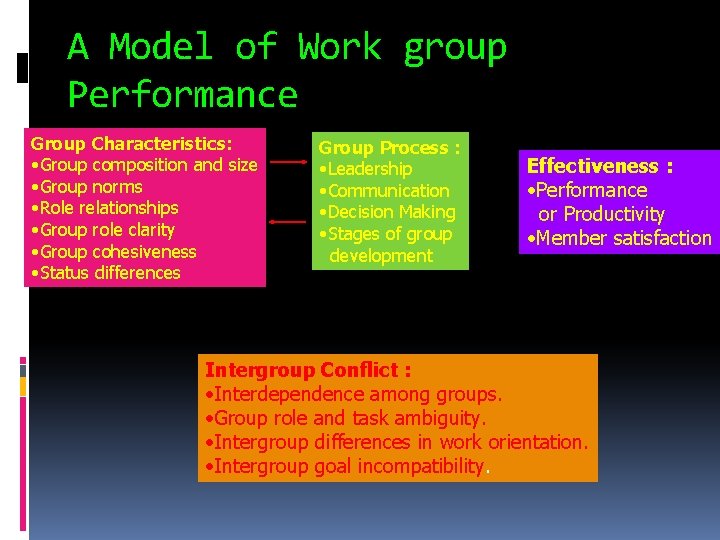
A Model of Work group Performance Group Characteristics: • Group composition and size • Group norms • Role relationships • Group role clarity • Group cohesiveness • Status differences Group Process : • Leadership • Communication • Decision Making • Stages of group development Effectiveness : • Performance or Productivity • Member satisfaction Intergroup Conflict : • Interdependence among groups. • Group role and task ambiguity. • Intergroup differences in work orientation. • Intergroup goal incompatibility.
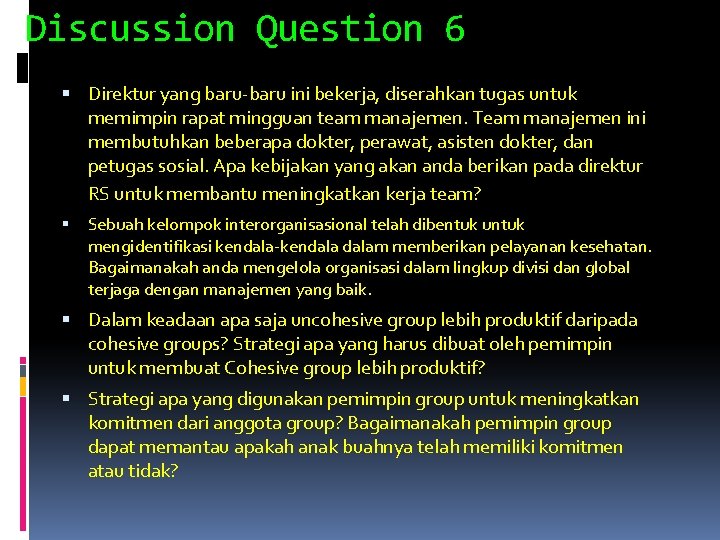
Discussion Question 6 Direktur yang baru-baru ini bekerja, diserahkan tugas untuk memimpin rapat mingguan team manajemen. Team manajemen ini membutuhkan beberapa dokter, perawat, asisten dokter, dan petugas sosial. Apa kebijakan yang akan anda berikan pada direktur RS untuk membantu meningkatkan kerja team? Sebuah kelompok interorganisasional telah dibentuk untuk mengidentifikasi kendala-kendalam memberikan pelayanan kesehatan. Bagaimanakah anda mengelola organisasi dalam lingkup divisi dan global terjaga dengan manajemen yang baik. Dalam keadaan apa saja uncohesive group lebih produktif daripada cohesive groups? Strategi apa yang harus dibuat oleh pemimpin untuk membuat Cohesive group lebih produktif? Strategi apa yang digunakan pemimpin group untuk meningkatkan komitmen dari anggota group? Bagaimanakah pemimpin group dapat memantau apakah anak buahnya telah memiliki komitmen atau tidak?
Work Design
Learning Objectives 7 Identify the range of approaches to work design, including the psychological and task inventory approaches. Understand the relationship between work design and individuals motivation and productivity. Discuss the differences between work and working. Identify components of work, their characteristics and their performance requirement. Analyze the interconnectedness of components of work among individuals and among work groups. Understand how to approach the design of individual jobs and work units.
Approaches to job design Task Inventory approaches. Psychological approaches
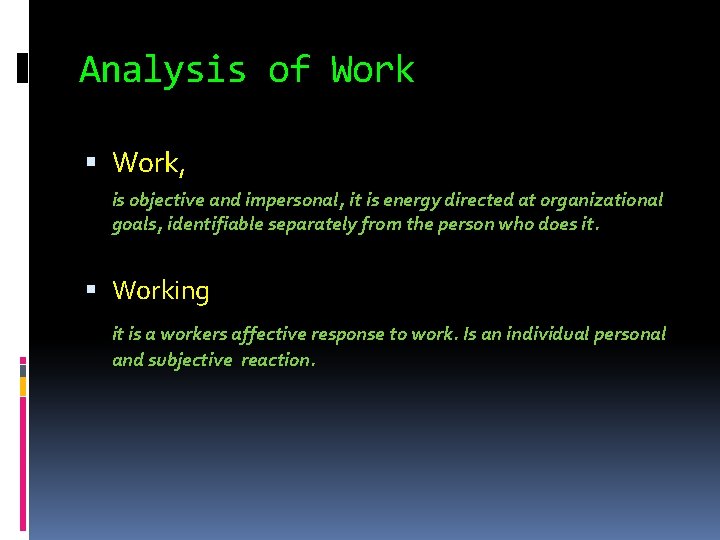
Analysis of Work, is objective and impersonal, it is energy directed at organizational goals, identifiable separately from the person who does it. Working it is a workers affective response to work. Is an individual personal and subjective reaction.
Types of Work Direct work effort that directly contributes to the accomplishment of an organization’s goals Management Work Providing the resources and context within which direct work can be perform. Support Work Does not directly result in achievement of an organizational goal, but it needed for effective accomplishment of other job
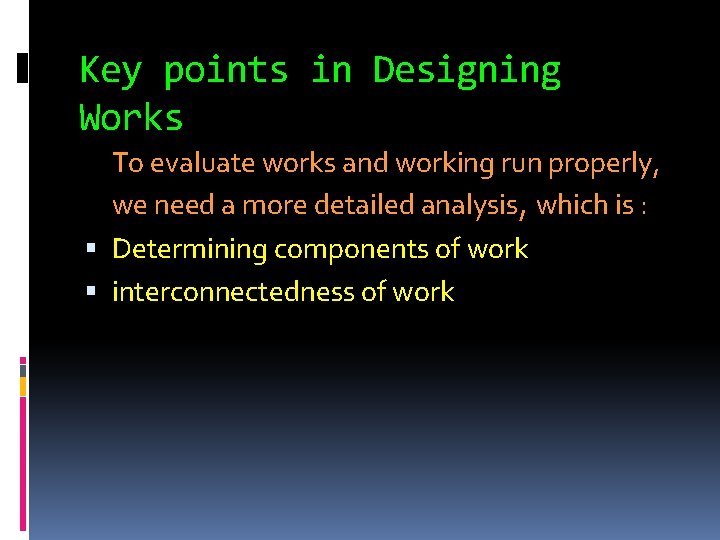
Key points in Designing Works To evaluate works and working run properly, we need a more detailed analysis, which is : Determining components of work interconnectedness of work
Designing individual job It is important to match people and their needs to jobs and their inherent work requirements. People evaluate courses of action for the purpose of choosing among them
Coordinating interconnected work within organizational Interconnected elements of work are best placed within an individual units job. In this section, focus on how to achieve coordination. Van de Ven et al. Found variations in patterns of coordination among unit facing different level of task uncertainty. Charns et al extended the findings, Mintzberg suggest that work groups use a combination of six approaches to coordination and that the use of these approaches is related to the effectiveness of patient care. The Six approaches fall into two categories: programming methods and feedback methods.
Discussion Questions 7 Under what conditions does a job with a high motivating potential lead to high job holder motivation? What are the potential pitfallsin job redesign ? Give examples of highly motivated people who do not contribute greatly to organizational productivity? What is the relationship among individual motivation and satisfaction and an organization’s ability to coordinate work? Give examples of situations in which dependable role performance is required in a job but effort above minimum level is not. What happens when individuals in such jobs innovate? Give examples of jobs requiring cooperative behavior. What happens when people in such jobs are willing to give only dependable role performance?
Coordination and Communication
Learning Objectives Differentiate between pooled, sequential, and reciprocal interdependence. Differentiate between intraorganizational coordination and interorganizational coordination. Discuss a variety of coordination mechanisms used in intraorganizational settings. Consider the aplication of the intraorganizational coordinating mechanisms to a given situation using the contigency approach. Discuss the three major types of transactions used in interorganizational coordination. Discuss the management of interorganizational linkages. Describe the elements of effective communications Discuss the technical mechanism of communication. Discuss the barriers to communication Describe the flow of intraorganizational communication. Describe the flow of interorganizational communication Discuss the special case of communication between units of a system.
Interdependence Pooled interdependence Sequential interdependence Reciprocal interdependence
Skills needed by Managers & n o i t ina tion d r o Co ica n u m Com Within the Hospital Managers Coo r Com dination mun icat & ion With Other Organizations
Coordination As a means of effectively linking together the various part of an organization or of linking together organizations and dealing with interdependence. Intraorganizational Coordination Interorganizational
Intraorganizational Coordination Since the activities of health professionals are seen as being complex, uncertain, and of great social importance, three distinctive structural arrangements has evolved to support the autonomy of these professions. Autonomous arrangement, present when an organization delegates to a professional group goal setting, implementation, and evaluation of performance and the administration manages the support staff. Heteronomous arrangement, Professionals are subordinated to the administrative structure with specific responsibilities delegated to various professional groups. Conjoint arrangement, Professionals and administration are equal in power.
Intraorganizational Mechanisms of Coordination Hierarchical coordination, The various activities are linked by placing them under a central authority. Administrative system, emphasizing formal procedures, provides a second mechanism for coordinating activities. Voluntary Action, inw hich individuals or group see a need for coordination, develop a method, and implement it.
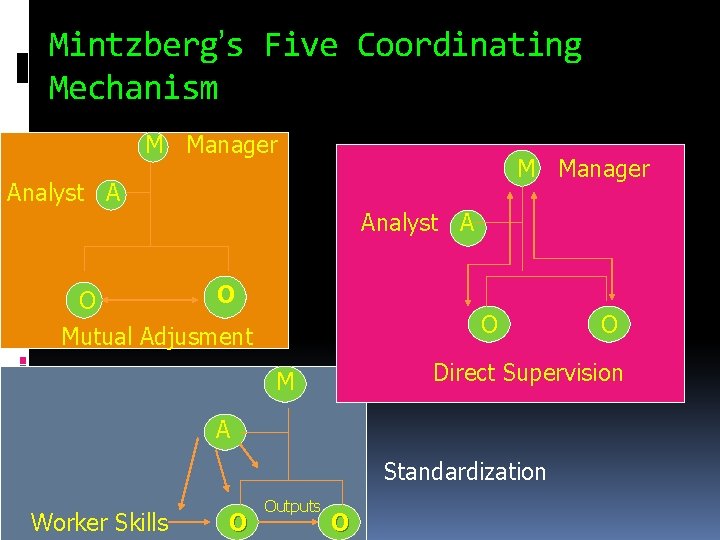
Mintzberg’s Five Coordinating Mechanism M Manager Analyst A O O Mutual Adjusment O Direct Supervision M A Standardization Worker Skills O Outputs O O
Interorganizational Coordination Typology : Market Transactions, Involve the focal organization and other organizations entering into relationships in order to obtain operational resources or product markets. Voluntary interorganizational relationship transactions, Distinguished by the voluntary dimension of the transactions. Involuntary Interorganizational Transactions, lead to unique ways of managing interdependence.
Managing Interorganizational linkages It is important for a manager to use a contigency approach when establishing and maintaining relationships with interdependent organizations
Communication Provides information people need to make decisions. Communications from the Managers perspective, has: Intraorganizational Communication, depends on formal establishment of channels and networks within the organizations. Interorganizational Dimensions, occurs between organizations or between organizations and constituencies outside them.
Elements of Effective Communication Reinforcement Desire to Communicate Effective Communication: • Being Understood • Making meaning, not agreement Understanding How others Learn • Perceive and Process information • Analytic vs Intuitive • Abstract vs Concrete, etc Purpose Content Sender Credibility Time Frame Information Cues Eliciting Cues Decision Cues Importance Complexity Ascribed Achieved Long vs Short
Barriers to Communication Environmental Barriers Personal Barriers
Flows of intraorganizational Communications Downward Flow Upward Flow Horizontal and Diagonal Flows Communication Networks Communication networks Chain Networks Y Pattern Wheel Pattern Circle Pattern All-Channels Network
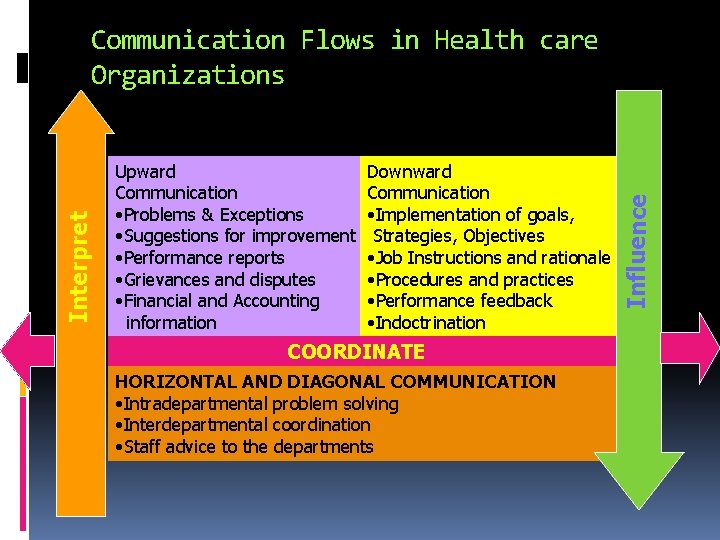
Upward Communication • Problems & Exceptions • Suggestions for improvement • Performance reports • Grievances and disputes • Financial and Accounting information Downward Communication • Implementation of goals, Strategies, Objectives • Job Instructions and rationale • Procedures and practices • Performance feedback • Indoctrination COORDINATE HORIZONTAL AND DIAGONAL COMMUNICATION • Intradepartmental problem solving • Interdepartmental coordination • Staff advice to the departments Influence Interpret Communication Flows in Health care Organizations
Discussion Questions Diskusikan perbedaan koordinasi intra dan inter organisasional. Apa sajakah cara-cara yang dapat digunakan oleh manajer untuk mencapai koorinasi tipe tertentu? Jelaskan model komunikasi dan gambarkan model komunikasinya! Anda baru saja diangkat menjadi manajer sebuah proyek bersama antara RS tempat anda bekerja dengan beberapa staff medis untuk mengoperasikan fasilitas bedah. Program yang anda pentingkan adalah untuk menjalin kerjasama yang efektif dengan RS. Buatlah rencana proyek ini berdasarkan materi pada bab ini! Bayangkan Organisasi pelayanan kesehatan anda menerima sebuah pemberitaan yang buruk. Bagaimanakah organisasi anda akan bereaksi?
Power And Politics in Health Services Organizations
Learning Objectives 9 Distinguish between rational and political models of organization of their appropriateness to health services organizations. Know the practical, managerial implications of the effective use of power in health services organizations. Identify the conditions that promote the use of power, politics, and informal Influences in health services organizations. Understand the range of political strategies and tactics employed by members of health services organizations Understand the sources of power in health services organizations. Know the key approaches for consolidating and developing power by managers, physicians, and other groups in health services organizations.
Power, Influences and Politics, definitions Power, has been a notoriously elusive term to define and identify within organizations. Influence, indicate actions that, either directly or indirectly, cause a change in the behavior or attitudes of another individual or group. Politics, domain activity in which participants attempt to influences organizational decisions and activities in ways that are not sanctioned by either the formal authority system of the organization, its accepted ideology, or certified expertise.
Rational vs political perspectives on management Organizational management is influenced by two models : Rational models imply that the managers are orchestrating the activities of a team whose members all subscribe to a common set of goals and objectives. Political Perspectives acknowledge the existence of power and influence other than that vested in formal authority system or professional expertise.
Sources of power Access to resources Access to information Formal Authority Skill in dealing with uncertainty
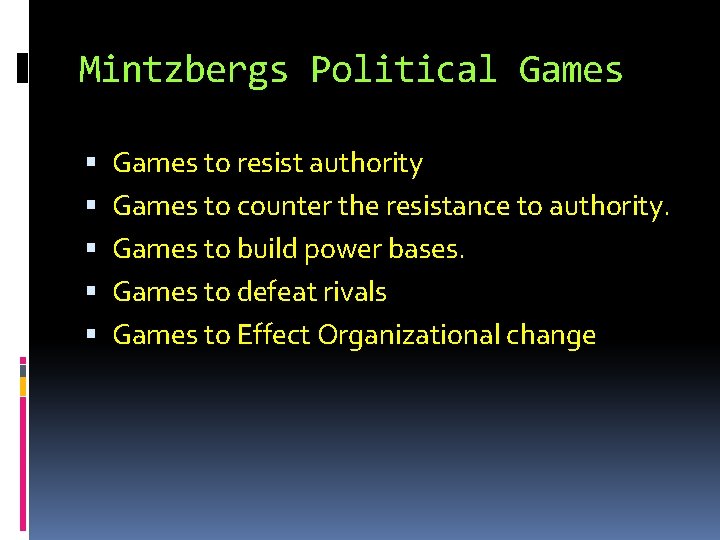
Mintzbergs Political Games to resist authority Games to counter the resistance to authority. Games to build power bases. Games to defeat rivals Games to Effect Organizational change
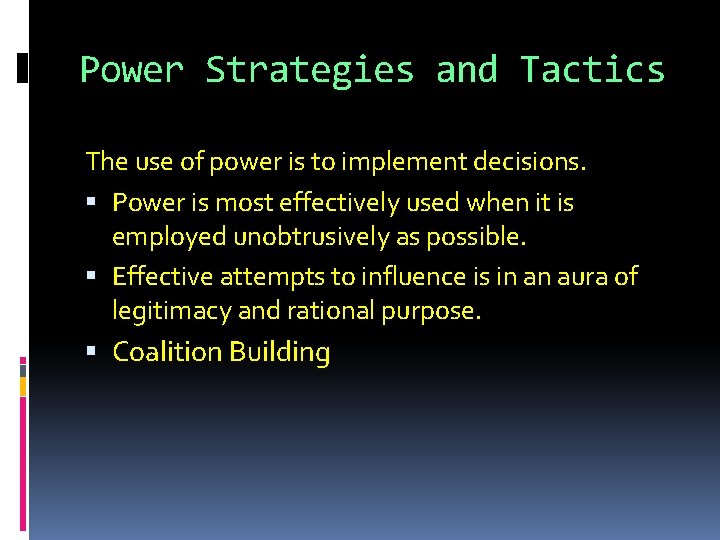
Power Strategies and Tactics The use of power is to implement decisions. Power is most effectively used when it is employed unobtrusively as possible. Effective attempts to influence is in an aura of legitimacy and rational purpose. Coalition Building
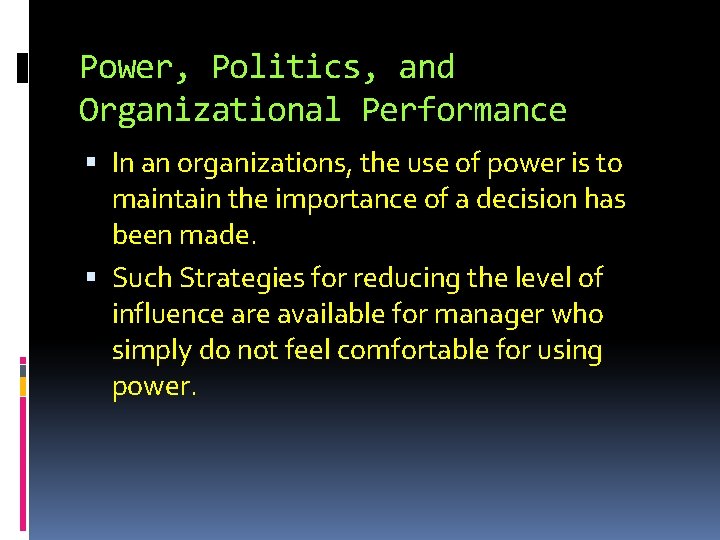
Power, Politics, and Organizational Performance In an organizations, the use of power is to maintain the importance of a decision has been made. Such Strategies for reducing the level of influence are available for manager who simply do not feel comfortable for using power.