
Management Organizational Behavior An Integrated Perspective Jon L
Management Organizational Behavior An Integrated Perspective Jon L. Pierce & Donald G. Gardner CHAPTER 4 The Organizational Environment with Randall B. Dunham Copyright © 2002 by South-Western Power. Point Presentation by Charlie Cook
Learning Objectives 1. Identify and discuss key aspects of the organization’s general environment and task environments. 2. Identify the major problems that confront managers as a result of the relationship between their organization and its external environment. 3. Identify tactics that managers can use to increase their power over the task environment. 4. Explain how differences in environmental stability and segmentation influence the approach to managing and organizational design. Copyright © 2002 by South-Western 2
Learning Objectives 5. Explain the concepts of mechanistic and organic organizations, and open and closed management systems. 6. Understand the importance of the boundary-spanning process. 7. Differentiate between the organizations’ external and internal environments. Copyright © 2002 by South-Western 3
Organizational Environments • External environment v The environment that is outside the formal boundaries of the organization; having a set of conditions, circumstances, and influences that surround affect the functioning of an organization. v Effective organizations develop management systems that integrate management practices and organizational design with the characteristics of their external environment. Copyright © 2002 by South-Western 4
Organizational Environments (cont’d) • External environment partitions (cont’d) v The general environment—the broader milieu (environment, political setting, surroundings) in which an organization operates along with many other organizations. v The task environment—the more specific and immediate (localized) environment in which the organization conducts its business. Copyright © 2002 by South-Western 5
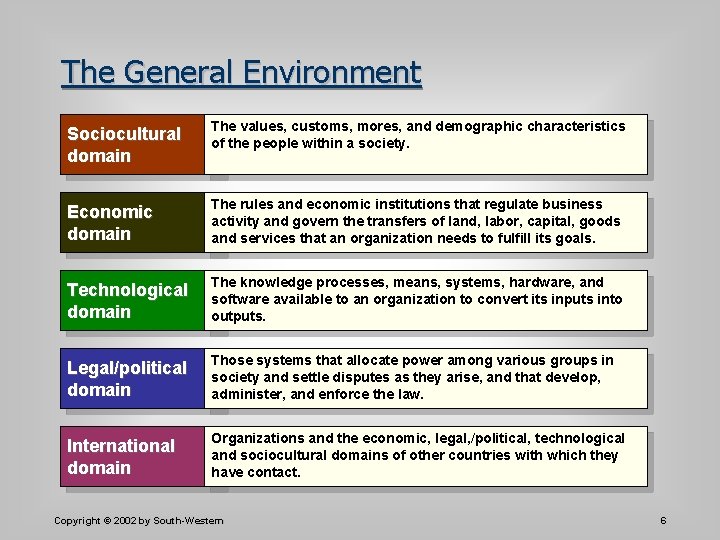
The General Environment Sociocultural domain The values, customs, mores, and demographic characteristics of the people within a society. Economic domain The rules and economic institutions that regulate business activity and govern the transfers of land, labor, capital, goods and services that an organization needs to fulfill its goals. Technological domain The knowledge processes, means, systems, hardware, and software available to an organization to convert its inputs into outputs. Legal/political domain Those systems that allocate power among various groups in society and settle disputes as they arise, and that develop, administer, and enforce the law. International domain Organizations and the economic, legal, /political, technological and sociocultural domains of other countries with which they have contact. Copyright © 2002 by South-Western 6
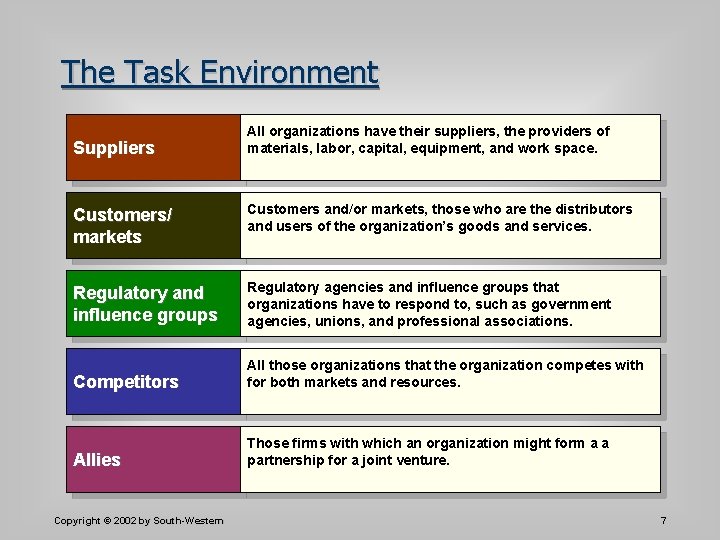
The Task Environment Suppliers All organizations have their suppliers, the providers of materials, labor, capital, equipment, and work space. Customers/ markets Customers and/or markets, those who are the distributors and users of the organization’s goods and services. Regulatory and influence groups Regulatory agencies and influence groups that organizations have to respond to, such as government agencies, unions, and professional associations. Competitors All those organizations that the organization competes with for both markets and resources. Allies Those firms with which an organization might form a a partnership for a joint venture. Copyright © 2002 by South-Western 7
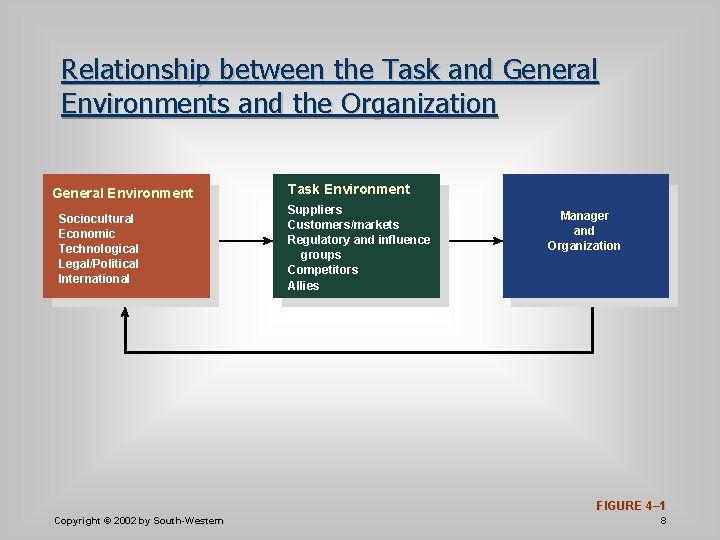
Relationship between the Task and General Environments and the Organization General Environment Sociocultural Economic Technological Legal/Political International Task Environment Suppliers Customers/markets Regulatory and influence groups Competitors Allies Manager and Organization FIGURE 4– 1 Copyright © 2002 by South-Western 8
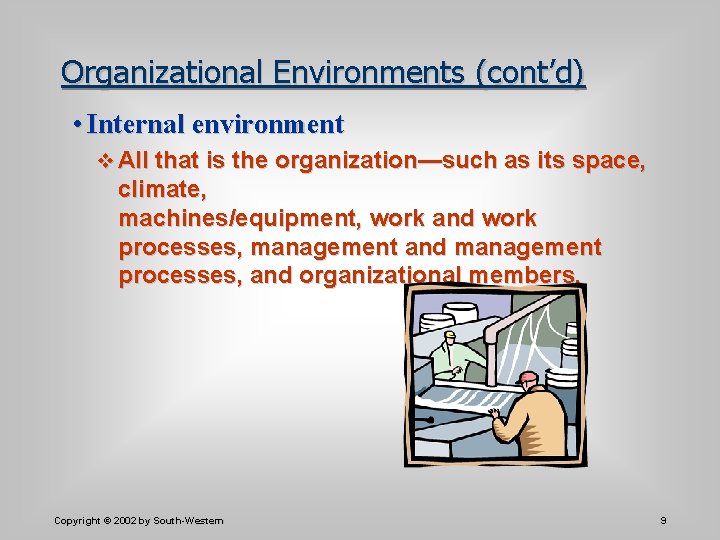
Organizational Environments (cont’d) • Internal environment v All that is the organization—such as its space, climate, machines/equipment, work and work processes, management and management processes, and organizational members. Copyright © 2002 by South-Western 9
The Organization-Environment Relationship • Problems of environmental uncertainty v Managers can neither control nor predict everything that will happen in the organization’s interaction with the external environment. • Problems of interdependence v Organizations develop exchange relationships with other organizations that create interdependencies between the partners. Copyright © 2002 by South-Western 10
Managing Uncertainty and Interdependence • Strategies for dealing with uncertainty and interdependence: v Managing the boundary that separates the organization from its external environment to reduce its impact on the organization. v Reducing the level of uncertainty and dependency on the environment by increasing the organization control over the external environment. v Integrating the organization with its external environment to create a “boundaryless” organization. Copyright © 2002 by South-Western 11
Managing the Boundary • Buffering v Stockpiling resources or warehousing outputs to avoid shortages and meet unexpected demand. • Smoothing v Attempting to influence the external environment by offering inducements or imposing premiums to adjust levels of product demand. Copyright © 2002 by South-Western • Anticipating and adapting v Using forecasts to predict anticipated demand taking action on the forecast. • Rationing v Setting priorities for the use of scarce organizational resources to preserve the organization. 12
Reducing the Level of Uncertainty and Dependency • Task Environment Strategies v Prestige—developing a favorable image that attracts others in the task environment. v Contracting—entering into binding arrangements with other entities. v Co-opting—absorbing part of the task environment into the organization. v Coalescing—merging or joining with a member of the task environment. Copyright © 2002 by South-Western 13
Reducing the Level of Uncertainty and Dependency • Tactics v Selectively recruiting of key employees from external environment firms builds information and knowledge about competitors. v Encouraging regulation of the external competitive environment that favors current competitors over new or emerging competitors. v Engaging in political activities that secure additional resources for the organization. Copyright © 2002 by South-Western 14
Environmental Change and Segmentation • Environmental change v The degree to which an organization’s task environment is stable (undergoing few and slow changes) or shifting (dynamic— undergoing frequent and rapid changes). • Environmental segmentation v The degree of homogeneity (similarities) and heterogeneity (differences) among components of the organization’s task environment. Copyright © 2002 by South-Western 15
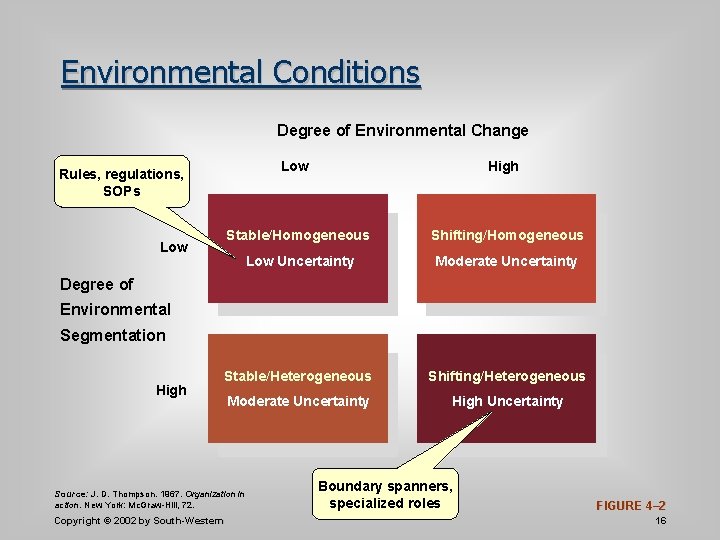
Environmental Conditions Degree of Environmental Change Low High Stable/Homogeneous Shifting/Homogeneous Low Uncertainty Moderate Uncertainty Stable/Heterogeneous Shifting/Heterogeneous Moderate Uncertainty High Uncertainty Rules, regulations, SOPs Low Degree of Environmental Segmentation High Source: J. D. Thompson. 1967. Organization in action. New York: Mc. Graw-Hill, 72. Copyright © 2002 by South-Western Boundary spanners, specialized roles FIGURE 4– 2 16
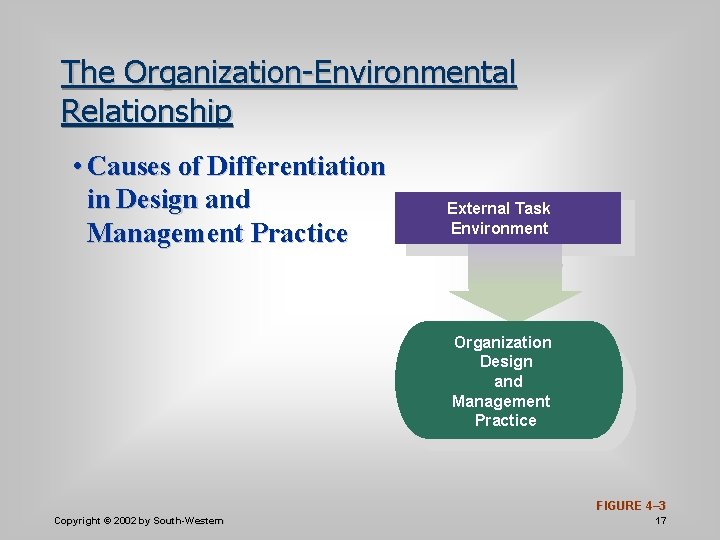
The Organization-Environmental Relationship • Causes of Differentiation in Design and Management Practice External Task Environment Organization Design and Management Practice FIGURE 4– 3 Copyright © 2002 by South-Western 17
Burns and Stalker • A study of the relationships— v environmental conditions, management practice, and organizational design between organizations and their environments. • Identified two types of organizations: v Organic organization Ø An organization whose structure is fluid and flexible. v Mechanistic organization Ø An organization whose structure is fixed and rigid (also referred to as a bureaucracy). Copyright © 2002 by South-Western 18
Mechanistic and Organic Organizations Source: T. Burns and G. Stalker. 1961. The management of innovation. London: Tavistock. Copyright © 2002 by South-Western TABLE 4– 1 19
Closed and Open Organizational Systems • Closed system v An organization that is “shut off” to its external environment and one in which managers look internally for ideas on productivity and efficiency improvements. • Open system v An organization that attempts to integrate itself with its external environment and looks to the outside for ideas on productivity and efficiency improvements. Copyright © 2002 by South-Western 20
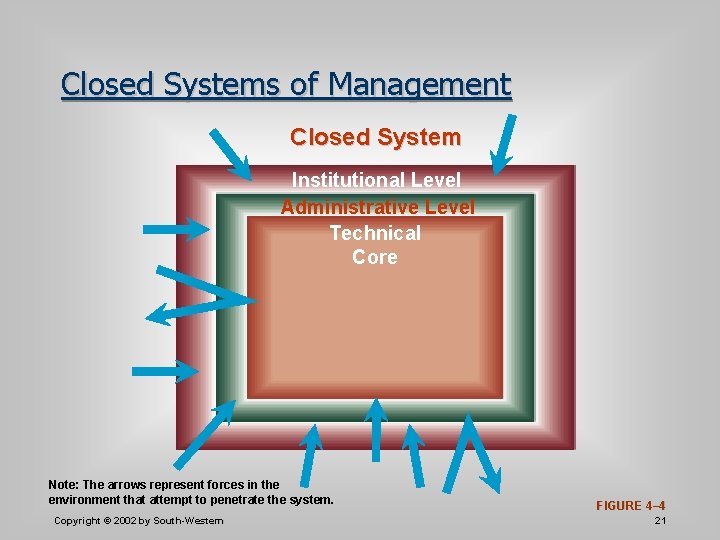
Closed Systems of Management Closed System Institutional Level Administrative Level Technical Core Note: The arrows represent forces in the environment that attempt to penetrate the system. Copyright © 2002 by South-Western FIGURE 4– 4 21
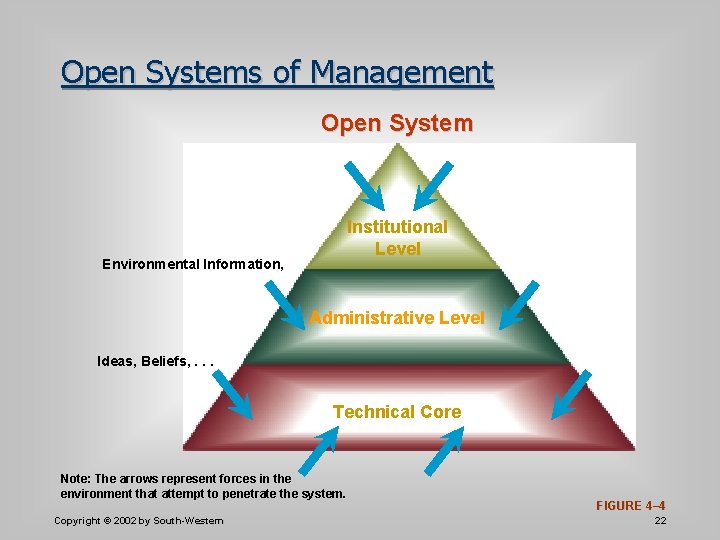
Open Systems of Management Open System Institutional Level Environmental Information, Administrative Level Ideas, Beliefs, . . . Technical Core Note: The arrows represent forces in the environment that attempt to penetrate the system. Copyright © 2002 by South-Western FIGURE 4– 4 22
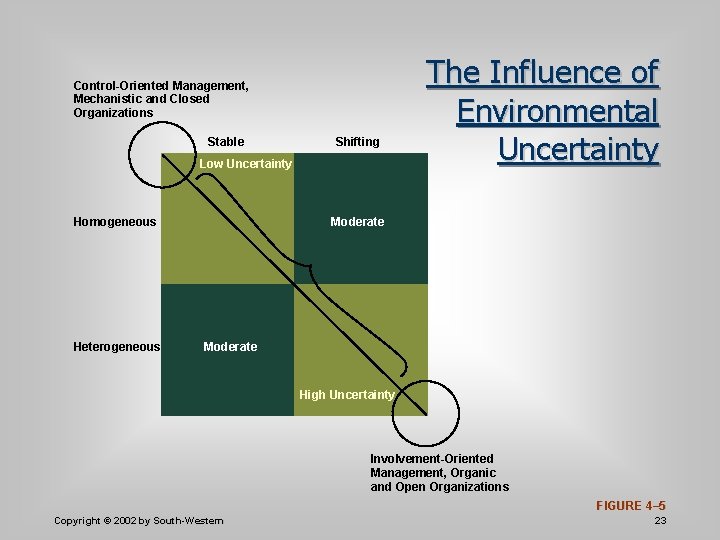
Control-Oriented Management, Mechanistic and Closed Organizations Stable Shifting Low Uncertainty Homogeneous Heterogeneous The Influence of Environmental Uncertainty Moderate High Uncertainty Involvement-Oriented Management, Organic and Open Organizations FIGURE 4– 5 Copyright © 2002 by South-Western 23
Linking Environments and Organizations • The boundary-spanning process v The means by which managers link the organization with its external environment. v Boundary roles—those positions in organizations that link the organization with its external environment. v Boundary spanners—individuals whose job it is to span the organization’s boundaries and integrate the organization with the external environment. Copyright © 2002 by South-Western 24
The Internal Environment • Structures v How are the jobs/work that employees do designed? v What is the structural arrangement of the organization? v What types of technology are used to produce products and/or Copyright © 2002 by South-Western services? • Processes v How is coordination of organizational components maintained? v How is decision making conducted in the organization? v How is information (communications) disseminated in the organization? 25
People and their Beliefs • Organization’s social system v Includes organizational members— management, formal leaders, and nonmanagerial employees and the beliefs and values they share. • Organizational culture v A pattern of basic assumptions invented, discovered, or developed by a given group as it learns to cope with problems of external adaptation and internal integration. Ø Culture is stable and resistant to change once it is established. Ø Cultures have a strong effect on the performance of Copyright © 2002 by South-Western organizations. 26
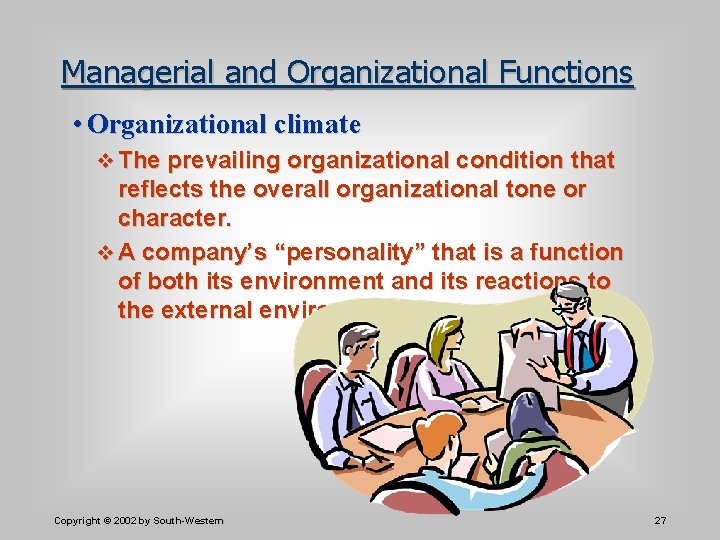
Managerial and Organizational Functions • Organizational climate v The prevailing organizational condition that reflects the overall organizational tone or character. v A company’s “personality” that is a function of both its environment and its reactions to the external environment. Copyright © 2002 by South-Western 27
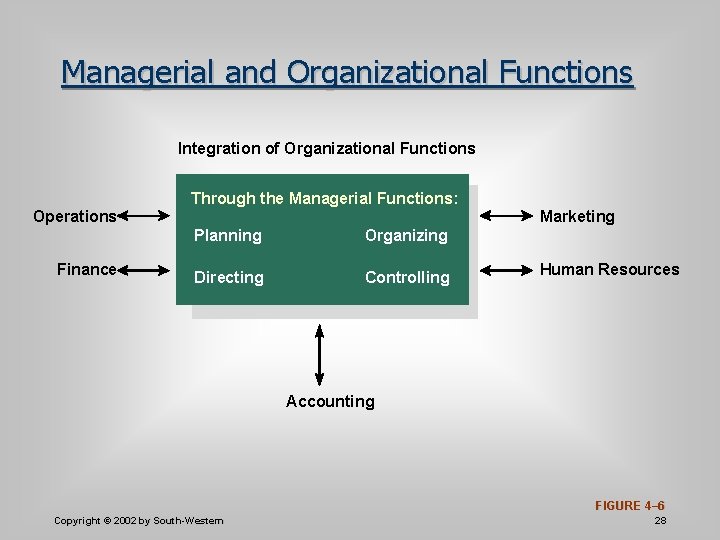
Managerial and Organizational Functions Integration of Organizational Functions Through the Managerial Functions: Operations Finance Marketing Planning Organizing Directing Controlling Human Resources Accounting FIGURE 4– 6 Copyright © 2002 by South-Western 28
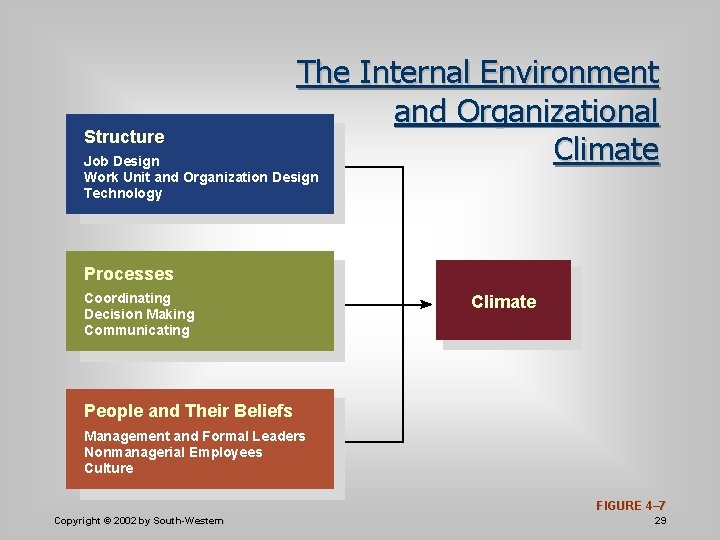
Structure The Internal Environment and Organizational Climate Job Design Work Unit and Organization Design Technology Processes Coordinating Decision Making Communicating Climate People and Their Beliefs Management and Formal Leaders Nonmanagerial Employees Culture FIGURE 4– 7 Copyright © 2002 by South-Western 29
- Slides: 29