
Management Organizational Behavior An Integrated Perspective CHAPTER 6
Management Organizational Behavior An Integrated Perspective CHAPTER 6 Attitudes in Organizations Jon L. Pierce & Donald G. Gardner with Randall B. Dunham Copyright © 2002 by South-Western Power. Point Presentation by Charlie Cook
Learning Objectives 1. Understand how employee attitudes affect organizations. 2. Describe three major components of employee attitudes: cognitive, affective, and behavioral tendency. 3. Understand the attitude formation process. 4. Describe some ways in which managers might try to change employee attitudes. 5. Define job satisfaction, organizational commitment, work and job involvement, and understand their central role and importance to organizations. 6. Explain why it is important for organizations and managers to try to influence employee attitudes. 7. Understand that employee attitudes have a financial impact on an organization’s profitability. Copyright © 2002 by South-Western 2
Attitudes and Their Components • Attitude v An individual’s predisposition to think, feel, perceive, and behave in certain ways toward a particular tangible or intangible phenomenon (attitude object). Ø Cognitive component—what we know, or think we know, about the attitude object. Ø Affective component—the feelings a person has toward an attitude object. Ø Behavioral tendency component—the way an individual is inclined to behave toward an attitude object. v Attitudes develop over time and are resistant to change. Copyright © 2002 by South-Western 3
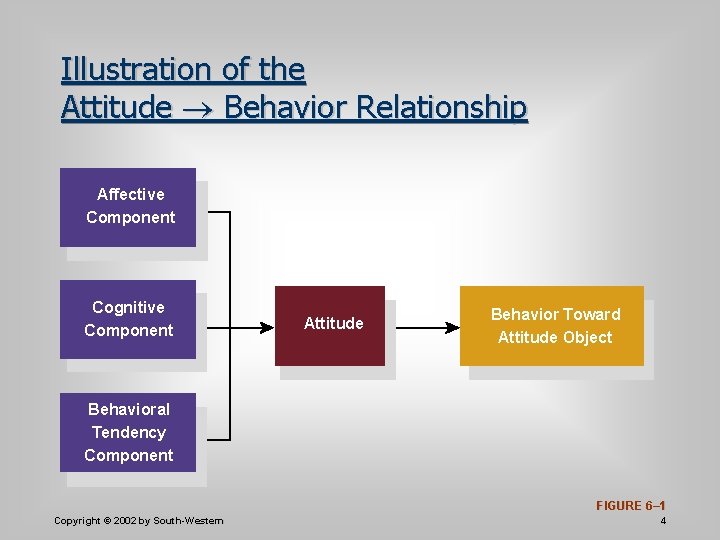
Illustration of the Attitude Behavior Relationship Affective Component Cognitive Component Attitude Behavior Toward Attitude Object Behavioral Tendency Component FIGURE 6– 1 Copyright © 2002 by South-Western 4
Attitude Formation • Personal experience v Coming into direct contact with an attitude object creates perceptions about the object’s characteristics which are transformed into an attitude about the object. • Association v The transference of parts or all of an attitude about an old object to a new attitude object. Copyright © 2002 by South-Western 5
Attitude Formation • Social learning v The influence of persons with whom an individual works on the formation of the individual’s attitudes. • Heredity v The transmission from parents to offspring of certain defining characteristics; a genetic predisposition to behave or think in certain ways. Copyright © 2002 by South-Western 6
Attitude Change • Strategies for changing an attitude: v Present new information (cognitive component). v Present a different emotional reaction to the attitude object (affective component). v Provide a new experience with the attitude object that conflicts with prior experience. v Create new associations for the attitude object. v Use others more experienced with the attitude object for social learning. v Change the behavior associated with the attitude. Copyright © 2002 by South-Western 7

Attitude Change (cont’d) • Cognitive dissonance v An unpleasant psychological state that occurs when a person possesses conflicting thoughts about an attitude object. Copyright © 2002 by South-Western 8
Work-related Attitudes • Job satisfaction v The attitude that results from the appraisal of one’s job as attaining or enabling the attainment of one’s important job values. v Positive job attitudes arise when jobs enable persons to attain their values. Copyright © 2002 by South-Western 9
Work-related Attitudes (cont’d) • Facets of job satisfaction v Job content—what is done on the job v Job context—the environment in which the job is done • Overall job satisfaction v A combination of facet satisfactions that describes a person’s overall affective reaction to a set of work-related factors. Copyright © 2002 by South-Western 10
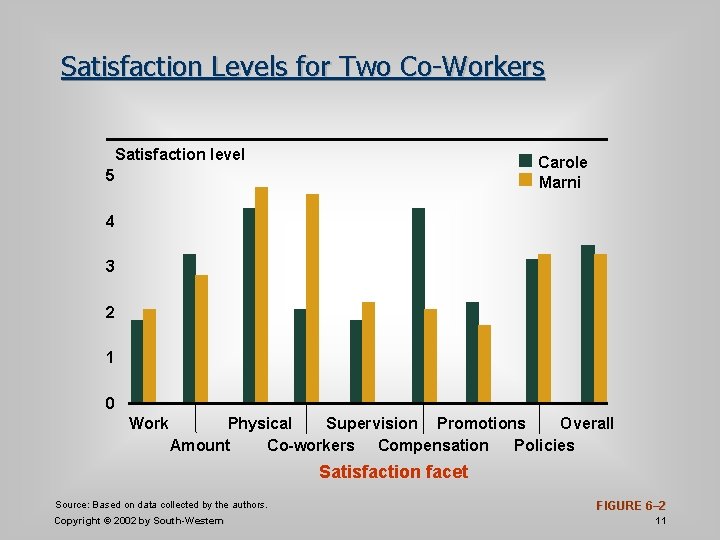
Satisfaction Levels for Two Co-Workers Satisfaction level 5 Carole Marni 4 3 2 1 0 Work Physical Supervision Promotions Overall Amount Co-workers Compensation Policies Satisfaction facet Source: Based on data collected by the authors. Copyright © 2002 by South-Western FIGURE 6– 2 11
Work-related Attitudes (cont’d) • Causes of job satisfaction v Experience with the work environment and job content v Association of the current job with past occupations/jobs v Social learning from others in the workplace v Genetic predispositions v Individual personalities v Organization goals and management actions Copyright © 2002 by South-Western 12
Work-related Attitudes (cont’d) • Measuring job satisfaction v Observing worker behavior v Interviewing workers about satisfaction levels v Distributing questionnaires to obtain information systematically v Measurement instruments: Ø Faces (Kunin) Ø Minnesota Satisfaction Questionnaire (MSQ) Ø Job Descriptive Index (JDI) Copyright © 2002 by South-Western 13
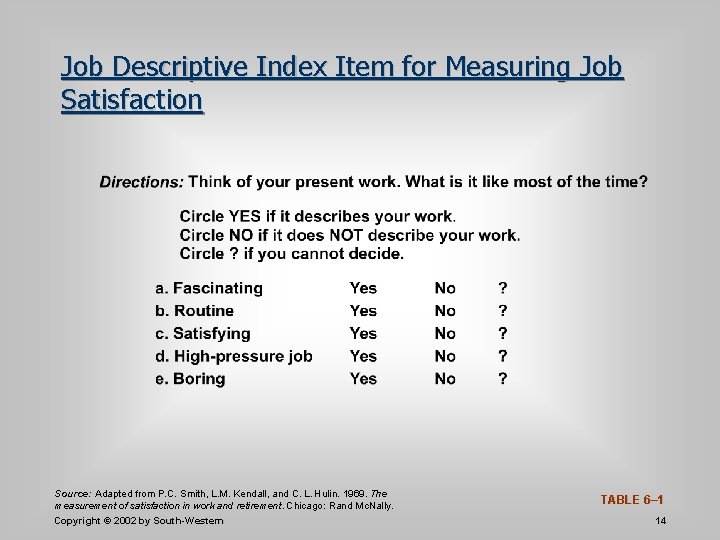
Job Descriptive Index Item for Measuring Job Satisfaction Source: Adapted from P. C. Smith, L. M. Kendall, and C. L. Hulin. 1969. The measurement of satisfaction in work and retirement. Chicago: Rand Mc. Nally. Copyright © 2002 by South-Western TABLE 6– 1 14
Work-related Attitudes (cont’d) • Consequences of job satisfaction v Employees are less likely to: Ø Consider quitting Ø Be absent or tardy Ø Refuse to be good organizational citizens v Job performance does not appear to have a significant relationship to job satisfaction. Copyright © 2002 by South-Western 15
Organizational Commitment • Organizational commitment v The relative strength of an individual’s identification with and involvement in a particular organization. • Components of organizational commitment v Affective commitment—an emotional attachment to the organization and its mission. v Normative commitment—the belief that commitment is a “right” thing to do and is based on the employee’s moral and personal value system v Continuance commitment—organizational Copyright © 2002 by South-Western 16
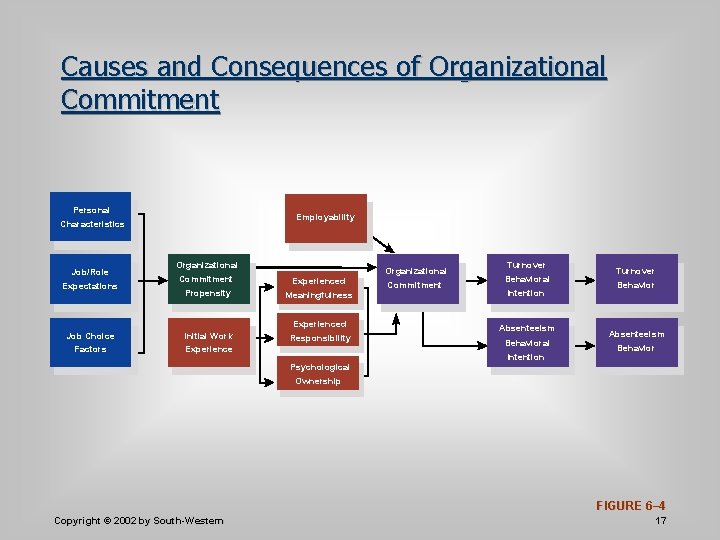
Causes and Consequences of Organizational Commitment Personal Employability Characteristics Job/Role Expectations Organizational Commitment Experienced Propensity Meaningfulness Experienced Job Choice Initial Work Factors Experience Responsibility Psychological Organizational Commitment Turnover Behavioral Intention Absenteeism Behavioral Intention Turnover Behavior Absenteeism Behavior Ownership FIGURE 6– 4 Copyright © 2002 by South-Western 17
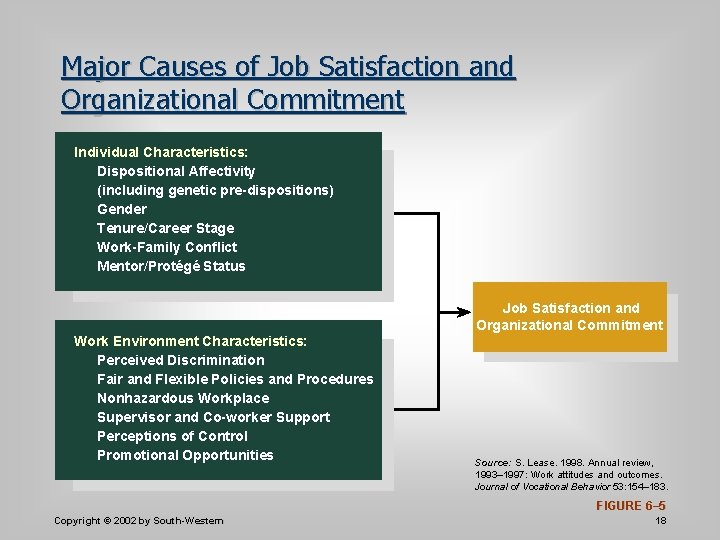
Major Causes of Job Satisfaction and Organizational Commitment Individual Characteristics: Dispositional Affectivity (including genetic pre-dispositions) Gender Tenure/Career Stage Work-Family Conflict Mentor/Protégé Status Job Satisfaction and Organizational Commitment Work Environment Characteristics: Perceived Discrimination Fair and Flexible Policies and Procedures Nonhazardous Workplace Supervisor and Co-worker Support Perceptions of Control Promotional Opportunities Source: S. Lease. 1998. Annual review, 1993– 1997: Work attitudes and outcomes. Journal of Vocational Behavior 53: 154– 183. FIGURE 6– 5 Copyright © 2002 by South-Western 18
Job and Work Involvement • Job involvement v An employee’s psychological involvement with a particular job. • Work involvement v An employee’s devotion to or alienation from work in general. • Job and work involvement aspects v The conscious desire and choice to participate or avoid work or a job. v The centrality or marginality of work to an individual. v The importance of the work to a person’s self. Copyright © 2002 by South-Western concept. 19
Psychological Ownership • Psychological ownership v The state in which an individual feels as though the target of ownership (or a piece of that target) is theirs. • Psychological ownership develops through: v Empowerment through the control of the work v Self-management opportunities v Expanded roles in managing the production process v Participation in problem solving Copyright © 2002 by South-Western 20
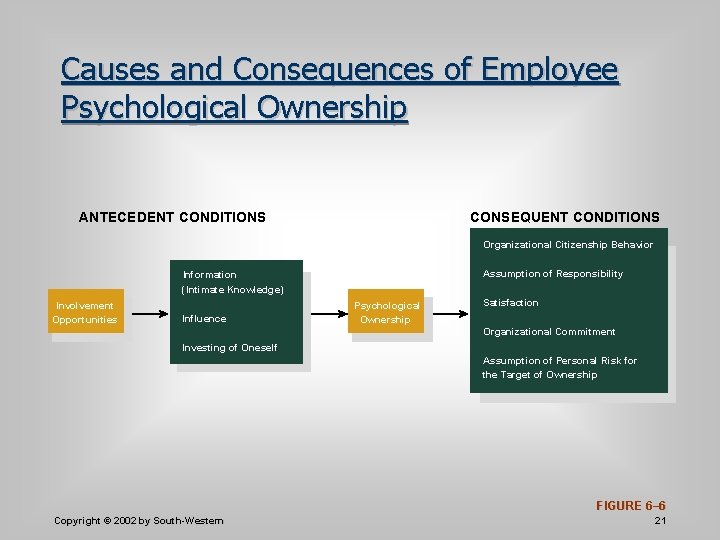
Causes and Consequences of Employee Psychological Ownership ANTECEDENT CONDITIONS CONSEQUENT CONDITIONS Organizational Citizenship Behavior Assumption of Responsibility Information (Intimate Knowledge) Involvement Opportunities Influence Psychological Ownership Satisfaction Organizational Commitment Investing of Oneself Assumption of Personal Risk for the Target of Ownership FIGURE 6– 6 Copyright © 2002 by South-Western 21
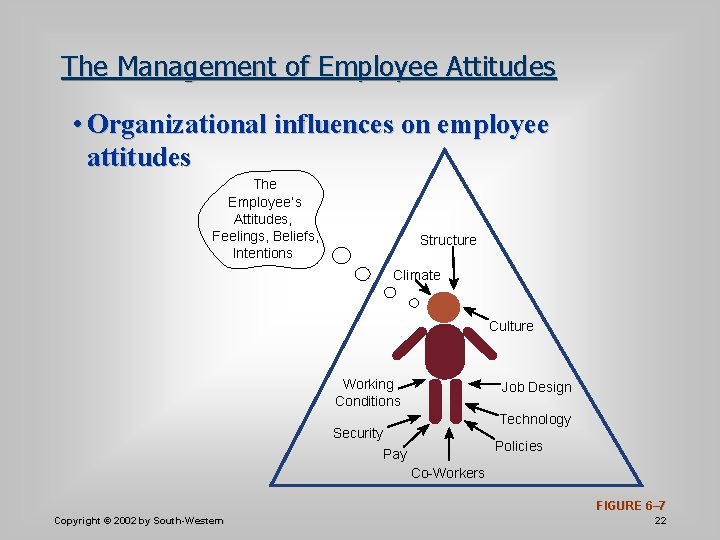
The Management of Employee Attitudes • Organizational influences on employee attitudes The Employee’s Attitudes, Feelings, Beliefs, Intentions Structure Climate Culture Working Conditions Job Design Technology Security Policies Pay Co-Workers FIGURE 6– 7 Copyright © 2002 by South-Western 22
The Financial Impact of Attitudes • Human resource accounting v The application of accounting principles and practices to the evaluation and management of human assets. • Behavioral accounting v The treatment of attitudinal measures as indicators of subsequent employee behavior, which in turn have economic implications for organizations that can be assessed using cost accounting procedures. Copyright © 2002 by South-Western 23
The Financial Impact of Attitudes (cont’d) • A procedure for measuring the financial impact of attitudes: 1. 2. 3. 4. Identify and measure relevant attitudes. Identify and measure relevant “cost items. ” Price behavioral “cost items. ” Identify the relationship between attitudes and behavioral “cost items. ” 5. Estimate the financial impact of attitude changes. Copyright © 2002 by South-Western 24
- Slides: 24