
Management Organisational Behaviour 2 e Chapter 17 The
Management & Organisational Behaviour 2 e Chapter 17 The Role of Human Resource Management in the Organisation ©The Mc. Graw-Hill Companies, 2005
Learning Outcomes • After studying this chapter you will be able to: • Identify the historical developments and their impact on HRM • Outline the development and functions of HRM • Understand the differences between HRM and Personnel management • Evaluate ‘hard’ and ‘soft’ approaches to HRM • Understand how diversity is an issue HR practice • Consider the HRM as an international issue ©The Mc. Graw-Hill Companies, 2005
Personnel Versus Human Resource Management • Sometimes means the same things. • HRM can mean a particular philosophy ©The Mc. Graw-Hill Companies, 2005
Traditional HR Functions ©The Mc. Graw-Hill Companies, 2005
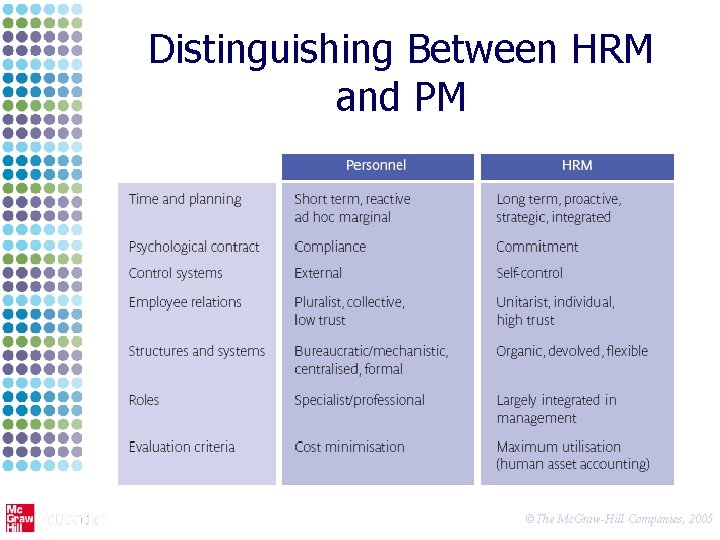
Distinguishing Between HRM and PM ©The Mc. Graw-Hill Companies, 2005
Guest’s Model of HRM • Linked to the strategic management of an organisation. • Seeks commitment to organisational goals • Focuses on the individual needs rather than the collective workforce. • Enables organisations to devolve power and become more flexible • Emphasises people as an asset to be positively utilised by the organisation. ©The Mc. Graw-Hill Companies, 2005
Storey’s Definition of HRM • • 'Human capability and commitment'. Storey argues that this is what differentiates organisations. Strategic importance of HRM. It needs to be implemented into the organisational strategy and needs to be considered at the highest management level. The long term importance of HRM. It needs to be integrated into the management functions and is seen to have importance consequences on the ability of the organisation to achieve its goals. The key functions of HRM which are seen to encourage commitment rather than compliance. ©The Mc. Graw-Hill Companies, 2005
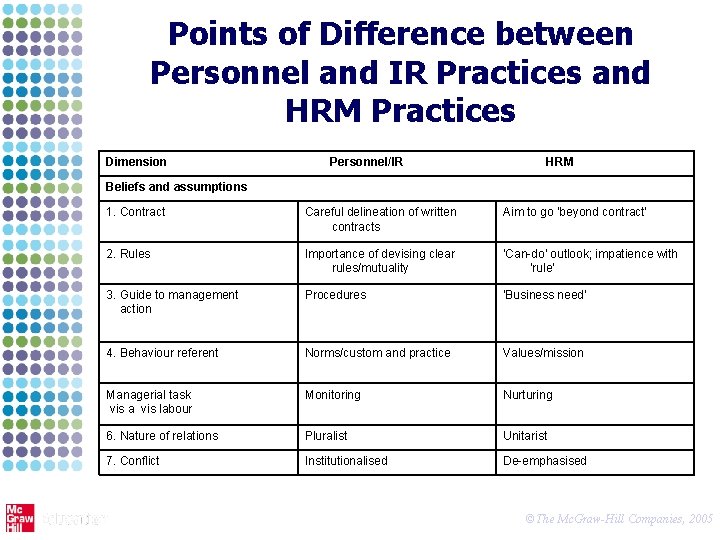
Points of Difference between Personnel and IR Practices and HRM Practices Dimension Personnel/IR HRM Beliefs and assumptions 1. Contract Careful delineation of written contracts Aim to go 'beyond contract' 2. Rules Importance of devising clear rules/mutuality 'Can-do' outlook; impatience with 'rule' 3. Guide to management action Procedures 'Business need' 4. Behaviour referent Norms/custom and practice Values/mission Managerial task vis a vis labour Monitoring Nurturing 6. Nature of relations Pluralist Unitarist 7. Conflict Institutionalised De-emphasised ©The Mc. Graw-Hill Companies, 2005
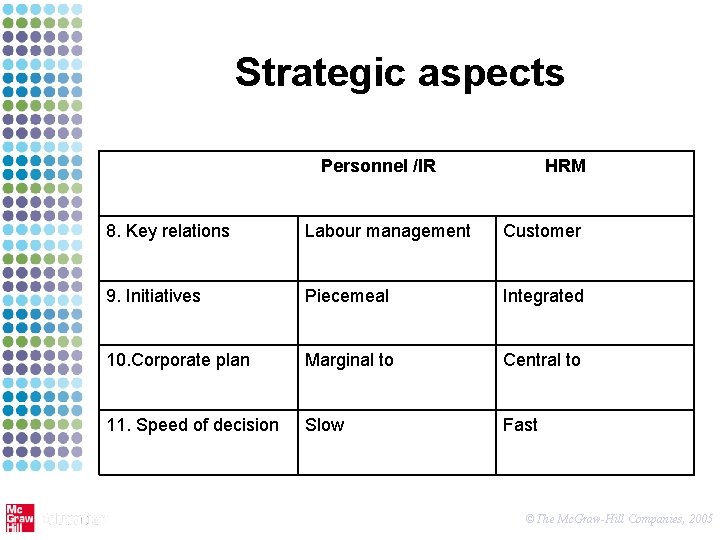
Strategic aspects Personnel /IR HRM 8. Key relations Labour management Customer 9. Initiatives Piecemeal Integrated 10. Corporate plan Marginal to Central to 11. Speed of decision Slow Fast ©The Mc. Graw-Hill Companies, 2005
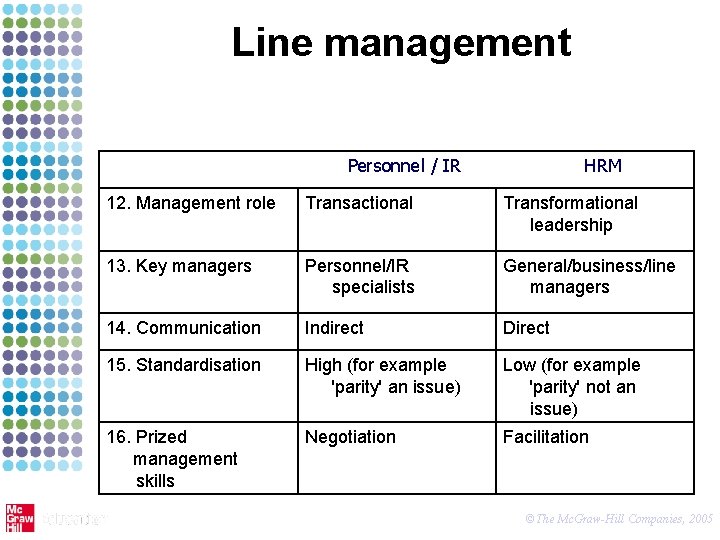
Line management Personnel / IR HRM 12. Management role Transactional Transformational leadership 13. Key managers Personnel/IR specialists General/business/line managers 14. Communication Indirect Direct 15. Standardisation High (for example 'parity' an issue) Low (for example 'parity' not an issue) 16. Prized management skills Negotiation Facilitation ©The Mc. Graw-Hill Companies, 2005
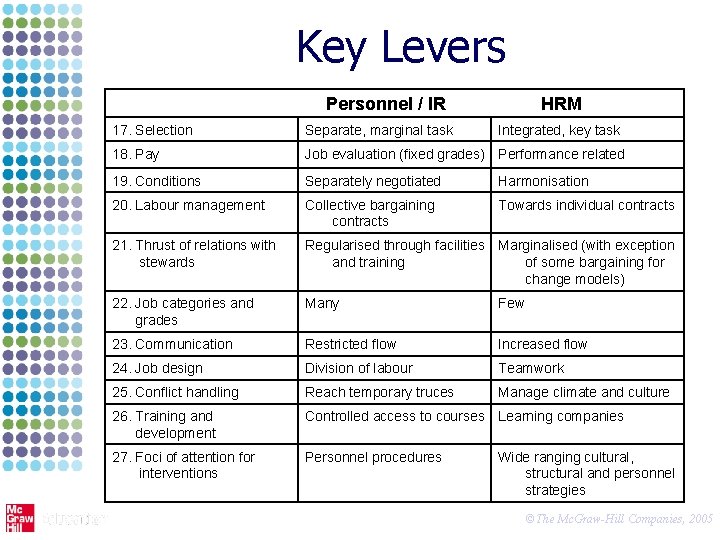
Key Levers Personnel / IR HRM 17. Selection Separate, marginal task Integrated, key task 18. Pay Job evaluation (fixed grades) Performance related 19. Conditions Separately negotiated Harmonisation 20. Labour management Collective bargaining contracts Towards individual contracts 21. Thrust of relations with stewards Regularised through facilities Marginalised (with exception and training of some bargaining for change models) 22. Job categories and grades Many Few 23. Communication Restricted flow Increased flow 24. Job design Division of labour Teamwork 25. Conflict handling Reach temporary truces Manage climate and culture 26. Training and development Controlled access to courses Learning companies 27. Foci of attention for interventions Personnel procedures Wide ranging cultural, structural and personnel strategies ©The Mc. Graw-Hill Companies, 2005
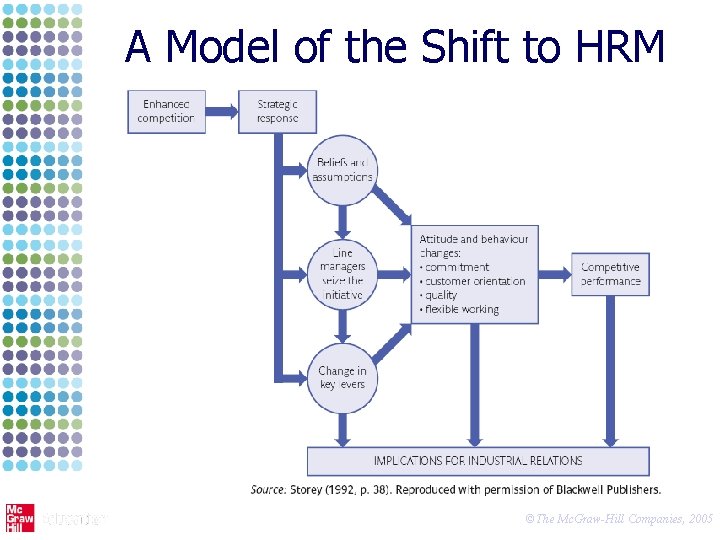
A Model of the Shift to HRM ©The Mc. Graw-Hill Companies, 2005
Hard HRM • The 'hard' approach rooted in the manpower planning approach is concerned with aligning human resource strategy with business strategy ©The Mc. Graw-Hill Companies, 2005
Soft HRM • The 'soft' approach is rooted in the human relations school, with concern for workers' outcomes and encourages commitment to the organisation by focussing on workers' concerns. ©The Mc. Graw-Hill Companies, 2005
The Human Resource System ©The Mc. Graw-Hill Companies, 2005
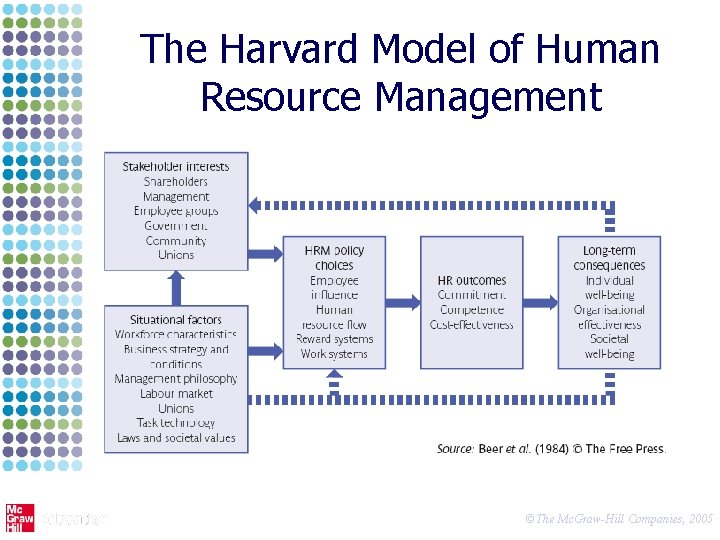
The Harvard Model of Human Resource Management ©The Mc. Graw-Hill Companies, 2005
Guest’s Model of HRM ©The Mc. Graw-Hill Companies, 2005
Strategic Management and Environmental Pressures ©The Mc. Graw-Hill Companies, 2005
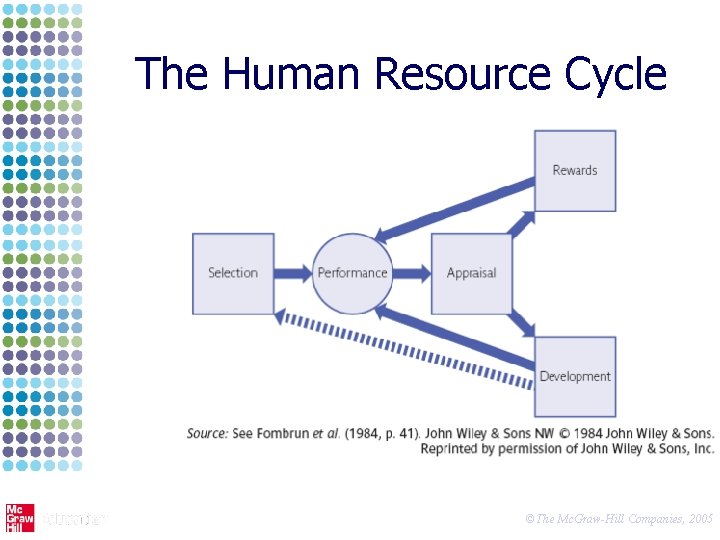
The Human Resource Cycle ©The Mc. Graw-Hill Companies, 2005
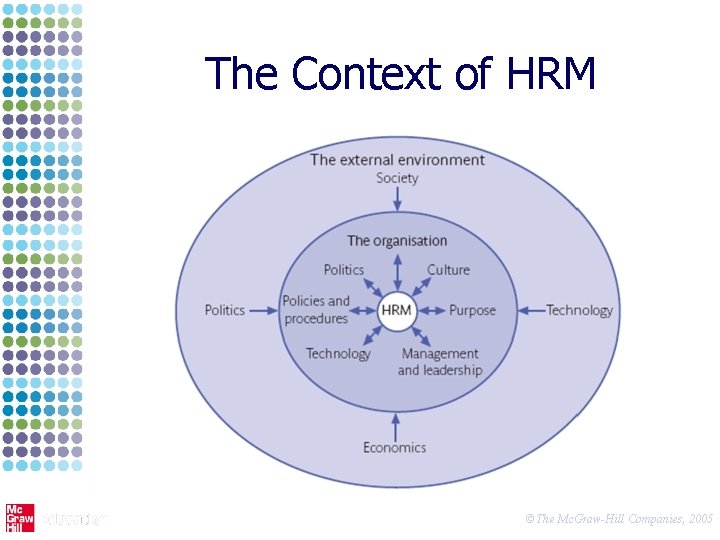
The Context of HRM ©The Mc. Graw-Hill Companies, 2005
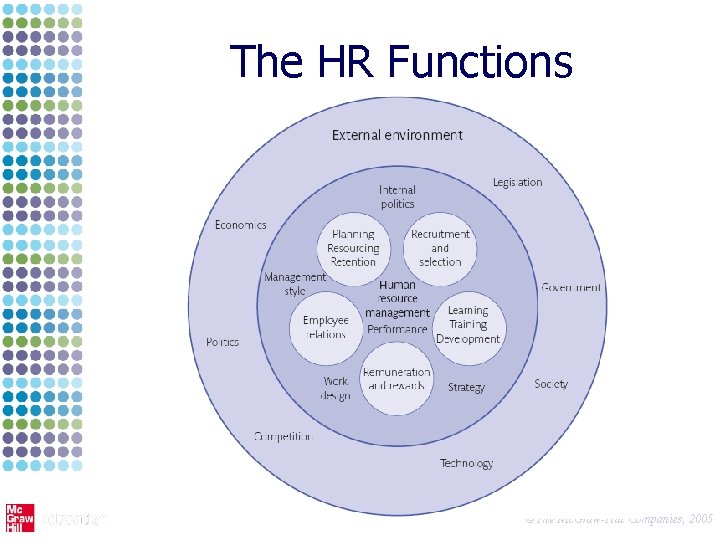
The HR Functions ©The Mc. Graw-Hill Companies, 2005
Summary • An HR manager needs to recognise that Human Resource Management is in a constant state of change. • HR management has progressed from an ad hoc role to the professional body of the CIPD. ©The Mc. Graw-Hill Companies, 2005
Summary continued 1 • The terms Personnel management and HRM have are part of the debate that inform the role of the HR manager. • HRM is viewed as a means of moving people along to achieve organisational goals through staffing, performance, change management and administrative objectives. ©The Mc. Graw-Hill Companies, 2005
Summary continued 2 • Personnel Management has often been seen as a bridge between the employer and the employee. • "Hard" HRM characterised by the Michigan model is seen as viewing people as a resource needed to achieve organisational goals. • "Soft" HRM characterised by the Harvard model is seen as a method of developing strategies to encourage employee ©The Mc. Graw-Hill Companies, 2005 commitment.
Summary continued 3 • The functions of HR include: planning and resourcing; recruitment and selection; training and development; pay and reward and employee relations. • Understanding the HR context in relation to the organisational and external context is important for an effective HR manager. ©The Mc. Graw-Hill Companies, 2005
- Slides: 25