
Management of Young Children Requiring Ventricular Assist Devices











- Slides: 36
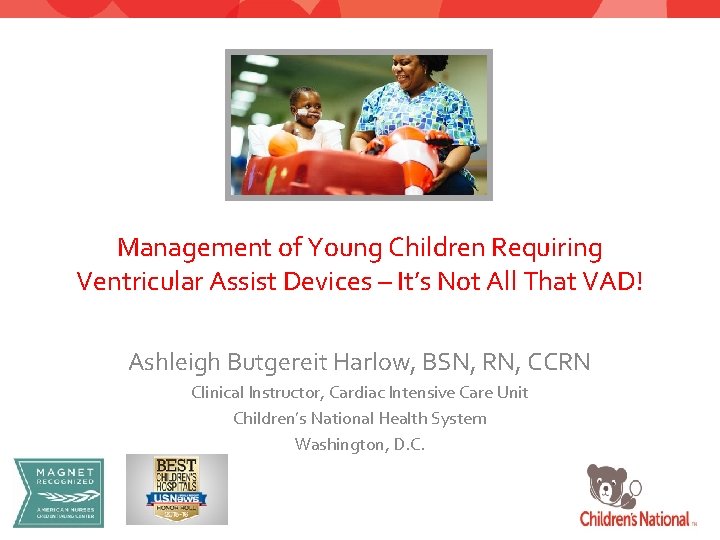
Management of Young Children Requiring Ventricular Assist Devices – It’s Not All That VAD! Ashleigh Butgereit Harlow, BSN, RN, CCRN Clinical Instructor, Cardiac Intensive Care Unit Children’s National Health System Washington, D. C.
I do not have any relevant financial relationships with any commercial interests to disclose.
Our Center • Children’s National Health System in Washington, D. C. • Academic free-standing pediatric facility – 303 beds – 124 critical care beds
Objectives • To share our center’s experiences in caring for young children requiring ventricular assist devices (VADs) • Discuss indications and contraindications for VAD use • To describe strategies for encouraging developmentally appropriate, safe activities during hospitalization • To describe utilization of specialized dressing and slings for device securement and enhanced wound healing
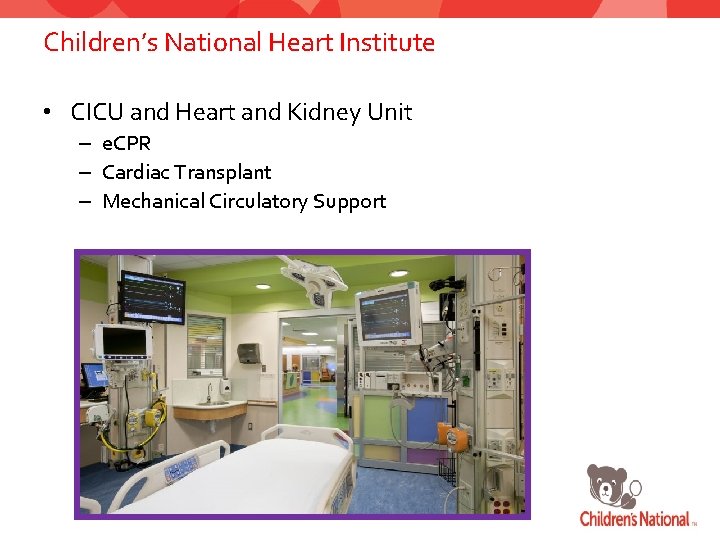
Children’s National Heart Institute • CICU and Heart and Kidney Unit – e. CPR – Cardiac Transplant – Mechanical Circulatory Support
Does your center implant/manage pediatric VADs? A) yes B) no
Indications For Use of VADs In Young Children Infants & Children ( >3 kg) who are candidates for cardiac transplant and also have: • Severe biventricular dysfunction • Severe isolated left ventricular dysfunction • Need mechanical circulatory support as a bridge to cardiac transplant or as bridge to recovery
Indications For Use of VADs In Young Children The Berlin Excor pump is the only device approved for use in pediatric patients (Humanitarian Use Device) • Frequent neurological complications (~30% of patients) • Inability to treat as outpatient
Contraindications • • • Not a candidate for cardiac transplant Inability to tolerate systemic anticoagulation Anticipated need for MRI Presence of mechanical aortic valve Special population challenges: – Single ventricle physiology (40 -60 % mortality)
Post-Operative Goals Immediate • Stabilization in the CICU • 2: 1 ratio Long-Term • CICU • Mobility • Growth and development • Family-Centered Care • VAD Safety
If your center cares for pediatric VAD patients, where are hemodynamically stable patients cared for following extubation? A) ICU only B) ICU and Step Down Unit C) Step Down and Acute Care D) Acute Care E) My unit is an admission-to-discharge unit
Getting Dressed
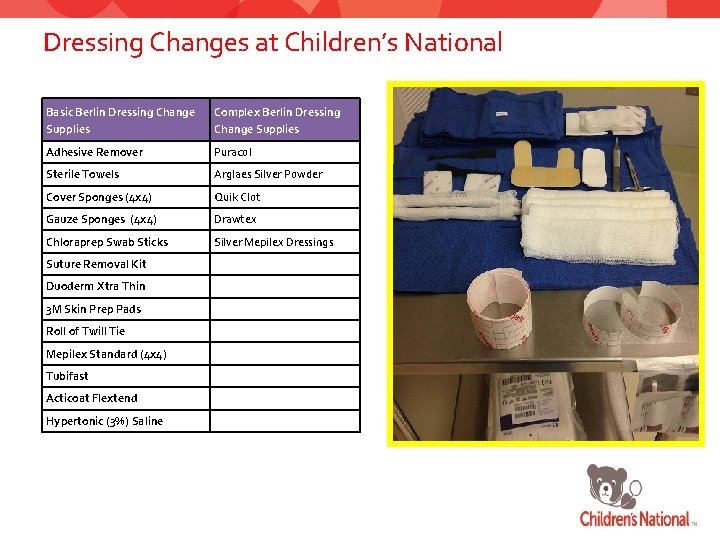
Dressing Changes at Children’s National Basic Berlin Dressing Change Supplies Complex Berlin Dressing Change Supplies Adhesive Remover Puracol Sterile Towels Arglaes Silver Powder Cover Sponges (4 x 4) Quik Clot Gauze Sponges (4 x 4) Drawtex Chloraprep Swab Sticks Silver Mepilex Dressings Suture Removal Kit Duoderm Xtra Thin 3 M Skin Prep Pads Roll of Twill Tie Mepilex Standard (4 x 4) Tubifast Acticoat Flextend Hypertonic (3%) Saline
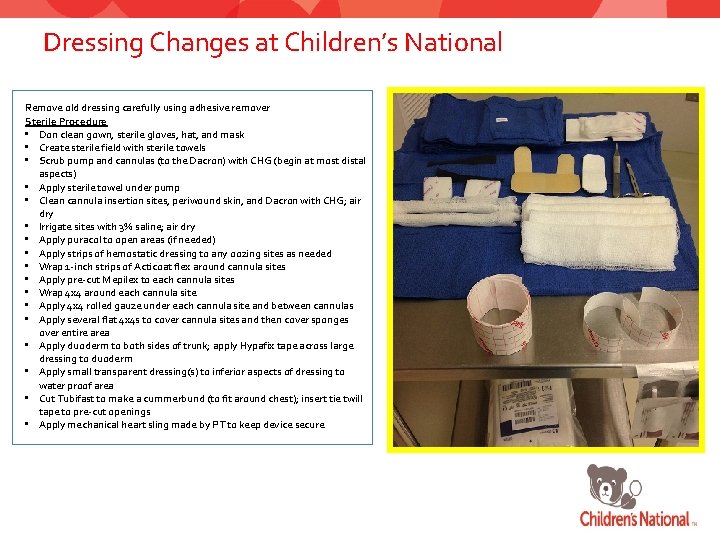
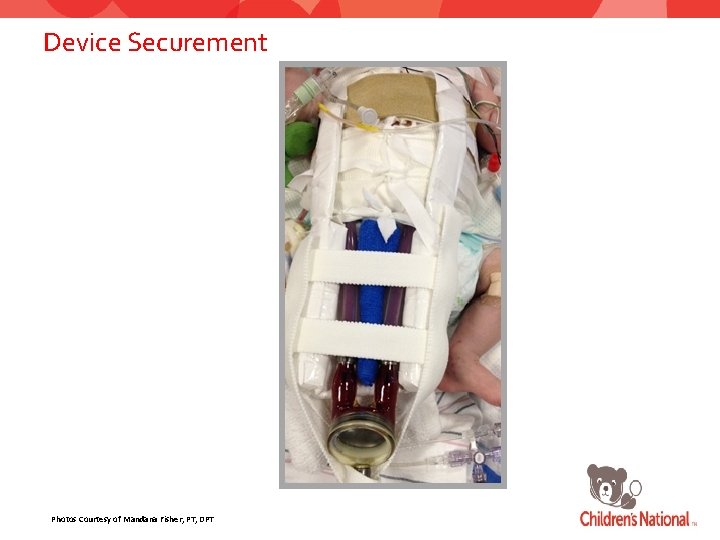
Dressing Changes at Children’s National Remove old dressing carefully using adhesive remover Sterile Procedure • Don clean gown, sterile gloves, hat, and mask • Create sterile field with sterile towels • Scrub pump and cannulas (to the Dacron) with CHG (begin at most distal aspects) • Apply sterile towel under pump • Clean cannula insertion sites, periwound skin, and Dacron with CHG; air dry • Irrigate sites with 3% saline; air dry • Apply puracol to open areas (if needed) • Apply strips of hemostatic dressing to any oozing sites as needed • Wrap 1 -inch strips of Acticoat flex around cannula sites • Apply pre-cut Mepilex to each cannula sites • Wrap 4 x 4 around each cannula site • Apply 4 x 4 rolled gauze under each cannula site and between cannulas • Apply several flat 4 x 4 s to cover cannula sites and then cover sponges over entire area • Apply duoderm to both sides of trunk; apply Hypafix tape across large dressing to duoderm • Apply small transparent dressing(s) to inferior aspects of dressing to water proof area • Cut Tubifast to make a cummerbund (to fit around chest); insert tie twill tape to pre-cut openings • Apply mechanical heart sling made by PT to keep device secure
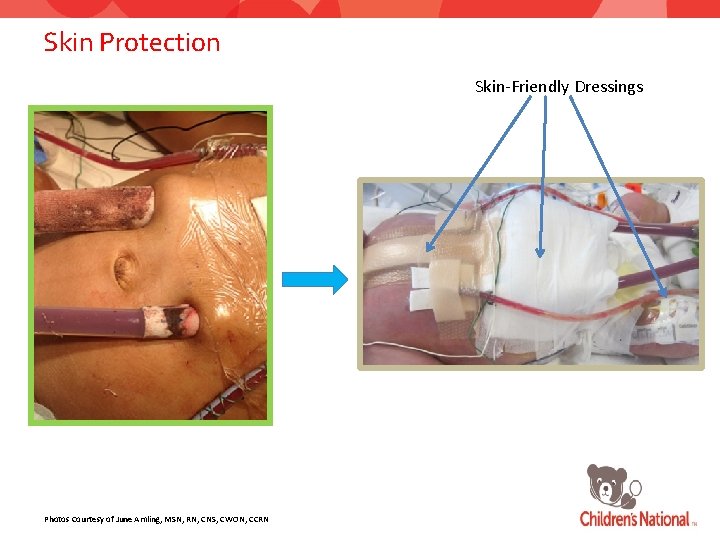
Skin Protection Skin-Friendly Dressings Photos Courtesy of June Amling, MSN, RN, CNS, CWON, CCRN
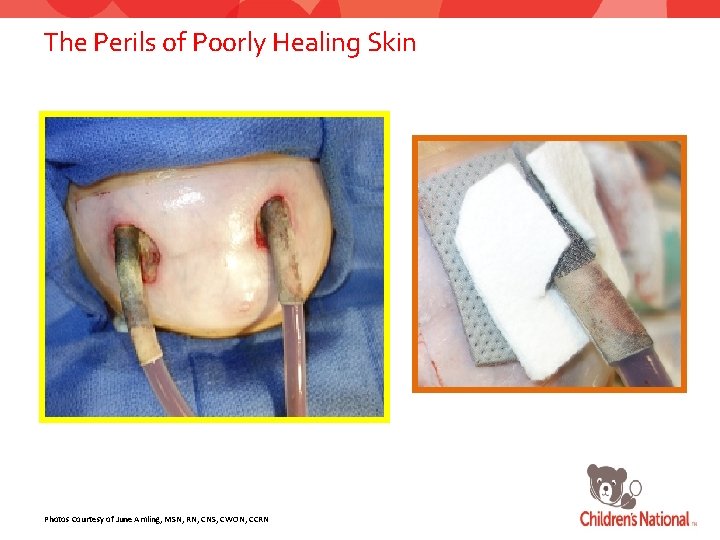
The Perils of Poorly Healing Skin Photos Courtesy of June Amling, MSN, RN, CNS, CWON, CCRN
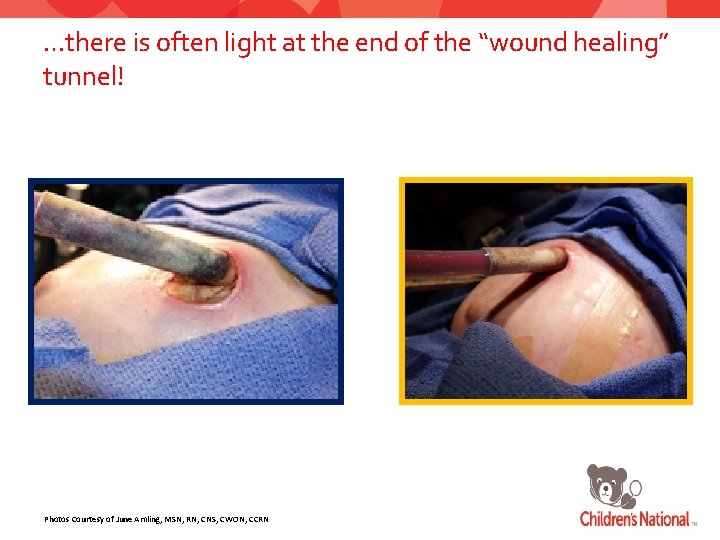
…there is often light at the end of the “wound healing” tunnel! Photos Courtesy of June Amling, MSN, RN, CNS, CWON, CCRN
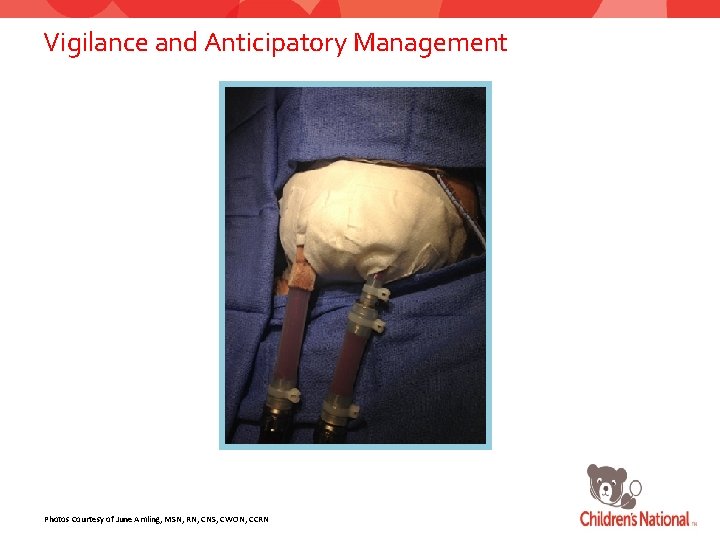
Vigilance and Anticipatory Management Photos Courtesy of June Amling, MSN, RN, CNS, CWON, CCRN
Anticoagulation
Anticoagulation and the Patient Experience • Anticoagulation is required for patients receiving mechanical circulatory support • Subcutaneous injections may be painful and distressing • Pain adjuncts (Buzzy©, topical analgesia) • IV Lovenox • Risks of Anticoagulation
Safety Considerations
Device Securement Photos Courtesy of Mandana Fisher, PT, DPT
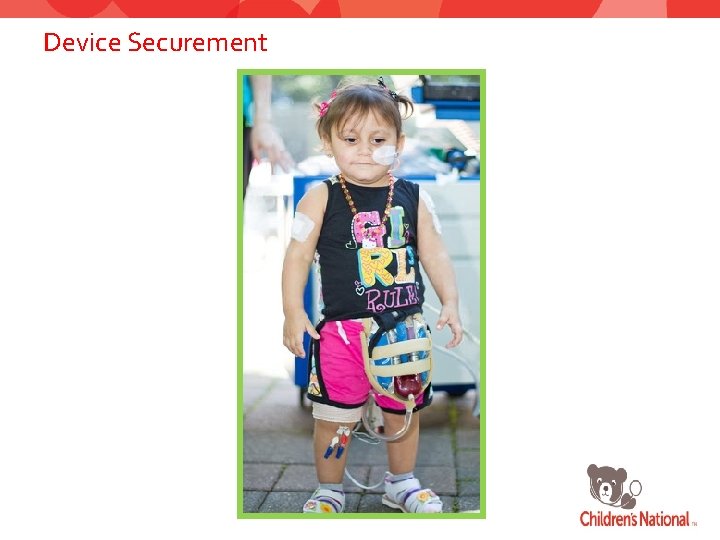
Device Securement
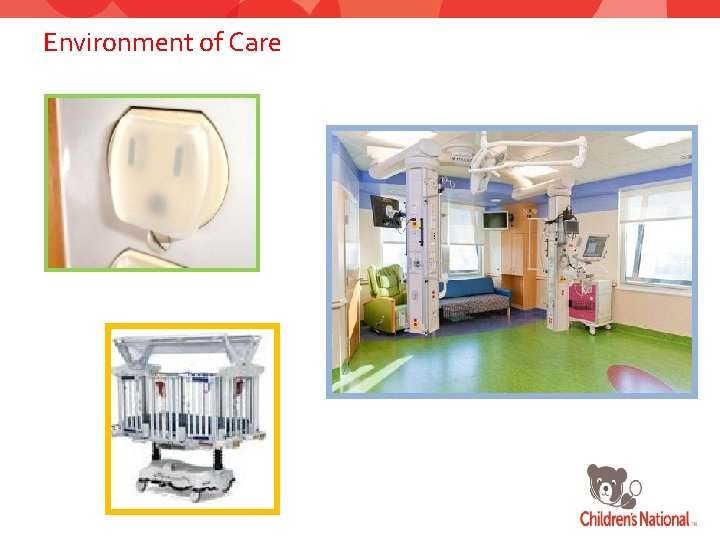
Environment of Care
When caring for active toddlers with a VAD, what bed/crib strategy do you employ? A) Open Crib or Bed B) Crib or bed with enclosure mechanism C) Open Crib or Bed with Safety Attendant (sitter) D) Other
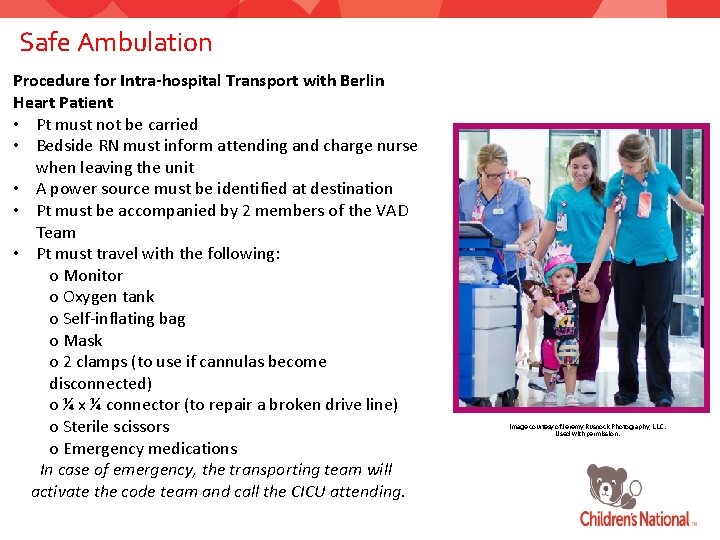
Safe Ambulation Procedure for Intra-hospital Transport with Berlin Heart Patient • Pt must not be carried • Bedside RN must inform attending and charge nurse when leaving the unit • A power source must be identified at destination • Pt must be accompanied by 2 members of the VAD Team • Pt must travel with the following: o Monitor o Oxygen tank o Self-inflating bag o Mask o 2 clamps (to use if cannulas become disconnected) o ¼ x ¼ connector (to repair a broken drive line) o Sterile scissors o Emergency medications In case of emergency, the transporting team will activate the code team and call the CICU attending. Image courtesy of Jeremy Rusnock Photography, LLC. Used with permission.
Growth and Development
Normalizing the Hospital Experience • • Child life specialists Music Therapy Art Therapy Movement Therapy
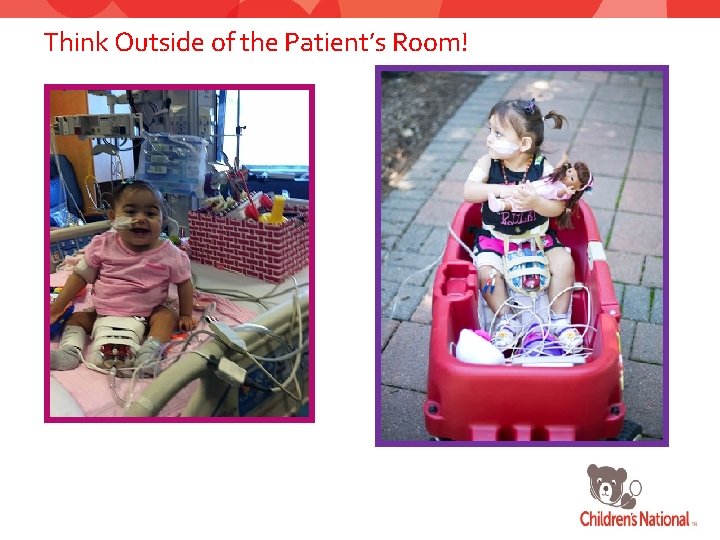
Think Outside of the Patient’s Room!
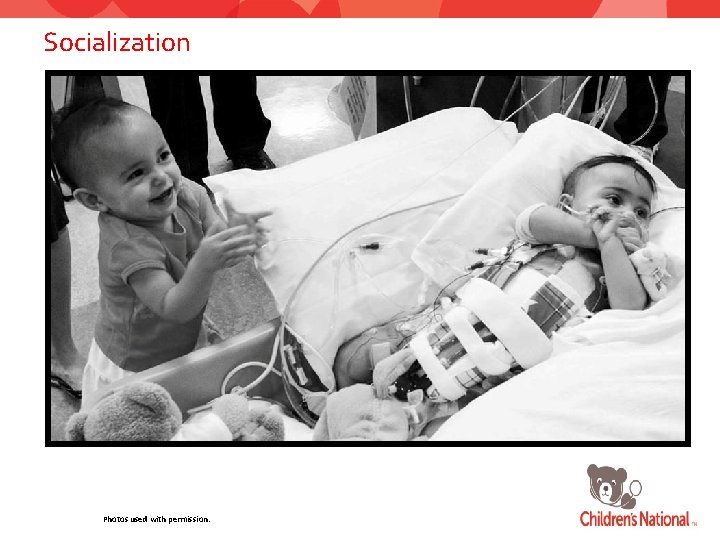
Socialization Photos used with permission.
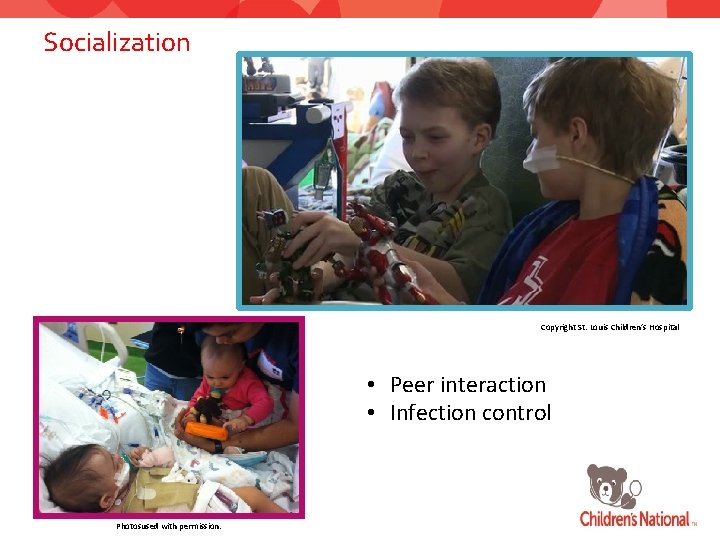
Socialization Copyright St. Louis Children’s Hospital • Peer interaction • Infection control Photosused with permission.
In Conclusion… • Encourage normal growth and development • Emphasizing safe ambulation and device securement I’d love to hear from you! aharlow@childrensnational. org
References • • • • American Academy of, P. (Ed. ). (2013). Children, Adolescents, and the Media. Pediatrics, 132(5), 958 -961. Berlin Buddies - Berlin Heart Patients Bond While Awaiting Heart Transplant. (n. d. ). Retrieved September 1, 2015. Byrnes, J. , Bhutta, A. , Rettiganti, M. , Gomez, A. , Garcia, X. , Dyamenahalli, U. , . . . Prodhan, P. (2015). Steroid Therapy Attenuates Acute Phase Reactant Response Among Children on Ventricular Assist Device Support. The Annals of Thoracic Surgery, 99, 1392 -1398. Cies, J. , Santos, L. , & Chopra, A. (2014). IV Enoxaparin in Pediatric and Cardiac ICU Patients. Pediatric Critical Care Medicine, 95 -103. doi: 10. 1097 Eghtesady, P. , Almond, C. , Tjossem, C. , Epstein, D. , Imamura, M. , Turrentine, M. , . . . Canter, C. (2013). Post-transplant Outcomes of Children Bridged to Transplant With the Berlin Heart EXCOR Pediatric Ventricular Assist Device. Circulation, S 24 -S 31. doi: 10. 1161 Fraser, C. , & Jaquiss, R. (2013). The Berlin Heart EXCOR Pediatric ventricular assist device: History, North American experience, and future directions. Ann. N. Y. Acad. Sci. Annals of the New York Academy of Sciences, 1291, 96 -105. doi: 10. 1111 George, C. , Ameduri, R. , Reed, R. , Dummer, K. , Overman, D. , & Louis, J. (2013). Long-Term Use of Ventricular Assist Device as a Bridge to Recovery in Acute Fulminant Myocarditis. The Annals of Thoracic Surgery, 59 -60. Jordan, L. (2015). Neurological Complications and Outcomes in the Berlin Heart EXCOR® Pediatric Investigational Device Exemption Trial. Journal of the American Heart Association, 4, 1 -11. doi: 10. 1161 Kirklin, J. , Pearce, F. , Dabal, R. , & Carlo, W. (2014). Mechanical Circulatory Support: Strategies and Outcomes in Pediatric Congenital Heart Disease. Seminars in Thoracic and Cardiovascular Surgery: Pediatric Cardiac Surgery Annual, 17, 62 -68. Kirklin, J. (2015). Advances in mechanical assist devices and artificial hearts for children. Current Opinion in Pediatrics, 27(5), 597 -603. Lisa, K. (2010, August 1). Yoga as a Complementary Therapy for Children and Adolescents A Guide for Clinicians. Retrieved September 16, 2015. Patregnani, J. (2015). Monitoring the Harm Associated with Use of Anticoagulants in Pediatric Populations Through Trigger -Based Automated Adverse-Event Detection. The Joint Commission Journal on Quality and Patient Safety, 41(3), 108 -115. Singh, T. (2013). Letter by Singh Regarding Article, "Berlin Heart EXCOR Pediatric Ventricular Assist Device for Bridge to Heart Transplantation in US Children" Circulation, 128. doi: 10. 1161 Sinha, P. , Deutsch, N. , Ratnayaka, K. , Lederman, R. , He, D. , Nuszkowski, M. , . . . Jonas, R. (2014). Effect of mechanical assistance of the systemic ventricle in single ventricle circulation with cavopulmonary connection. The Journal of Thoracic and Cardiovascular Surgery, 147, 1271 -1275. Weinstein, S. , Bello, R. , Pizarro, C. , Fynn-Thompson, F. , Kirklin, J. , Guleserian, K. , . . . Jaquiss, R. (2014). The use of the Berlin Heart EXCOR in patients with functional single ventricle. The Journal of Thoracic and Cardiovascular Surgery, 147(2), 697 -705.